
The big difference between a DeFi dashboard and an AI agent really comes down to one thing: manual observation versus automated action. A dashboard pulls all your assets into one place so you can see what's going on. An AI agent, on the other hand, actually gets its hands dirty, managing and executing investment strategies for you.
If you’re someone who lives for granular control and wants to be in the weeds, a dashboard is your best friend. But if you're looking for efficiency and want to put your returns on autopilot, AI agents are the only way forward.
From Manual Tracking to Automated Yield Generation

The DeFi market is absolutely exploding. That creates a ton of opportunity, but it also means things are getting seriously complex. Having the right tools isn't just a nice-to-have anymore; it's essential if you're serious about investing in this space. The conversation has quickly shifted from just tracking your portfolio to actually generating wealth without being glued to your screen.
This guide will break down the debate between DeFi dashboards and AI agents. We’ll look at the move from just watching your assets to letting intelligent automation do the heavy lifting. By the end, you'll have a much clearer idea of which tool makes sense for your goals, your schedule, and how much risk you're comfortable with.
The Rise of Automation in a Growing Market
For a long time, DeFi dashboards were the go-to for any yield seeker trying to make sense of a fragmented ecosystem. They’re great for pulling data together, but let’s be honest—they're manual. That's where they're getting left behind by AI agents that can find and act on the best strategies in real-time.
The market numbers are staggering. The global DeFi market was valued at USD 44.13 billion in 2025 and is expected to rocket to USD 951.9 billion by 2033, growing at an insane 46.8% CAGR. According to a SkyQuest Technology market report, the data and analytics piece of that pie—where dashboards live—made up over 18% of revenue back in 2022. It shows just how crucial tracking was.
But all this growth and complexity means it’s easy to miss out on good opportunities. While DeFi is more accessible than ever, it’s still a maze for most people. AI agents are built to fix this. From what we're seeing, they can cut down the time spent on research for automated strategies by as much as 80-90%.
The core value proposition is simple: AI agents save you time and aim to enhance your returns. They transition the user from a manual researcher to a strategic overseer of an automated system.
This is where you have to make a choice. Do you want the hands-on, detailed control you get from a dashboard, or do you prefer the set-and-forget efficiency of an AI agent?
Quick Comparison at a Glance
Before we get into the nitty-gritty, here's a quick table that lays out the fundamental differences between old-school DeFi dashboards and modern AI agents.
Feature | DeFi Dashboards | AI Agents |
|---|---|---|
Primary Function | Data aggregation and portfolio monitoring | Automated strategy execution and yield optimization |
User Role | Analyst (manually researches and acts on data) | Strategist (sets goals and risk parameters) |
Effort Required | High (constant monitoring and manual transactions) | Low (set-and-forget with periodic review) |
Opportunity Capture | Reactive (user must spot and act on opportunities) | Proactive (automatically captures opportunities 24/7) |
Best For | Hands-on power users and deep researchers | Time-constrained investors and those seeking automation |
This table gives you the high-level view. Now, let’s dive deeper into what each of these tools really offers and who they’re built for.
How DeFi Dashboards Give You Portfolio Clarity

If you've spent any time in DeFi, you know how messy it gets. Assets scattered across different chains, positions in a dozen protocols... it's a nightmare to track. This is where DeFi dashboards come in. Think of them as your personal command center, pulling everything together into one clean view.
At their core, these dashboards are just sophisticated, read-only aggregators. You connect your wallet, and they get to work, fetching all your token balances, staked assets, and LP positions. Their main job is to give you a single, clear snapshot of your entire portfolio.
The Manual Grind of Using a Dashboard
Here’s the thing, though: the experience is totally user-driven. Once the dashboard pulls in your data, the real work is all on you. You have to be the one to analyze your net worth, dig through your wallet history, and manually compare metrics.
A typical workflow looks something like this:
Connect Your Wallet: You give read-only access to a platform like Zapper or DeBank.
Review Everything: The dashboard lays it all out—your net worth, individual tokens, and every single DeFi position you hold.
Analyze and Compare: This is the grind. You're manually sifting through data, maybe comparing APYs on two different lending platforms or checking how an LP has performed over time.
Figure Out a Strategy: Based on what you find, you decide what to do next. Maybe you'll move funds to a higher-yield farm or pull out of a position that looks too risky.
Execute Manually: And this is the crucial part. You have to leave the dashboard, go to the actual protocol’s website, connect your wallet again, and execute the trades yourself.
This whole process really gets to the heart of the DeFi dashboards vs AI agents debate. A dashboard gives you the map, but you’re still the one who has to pilot the ship.
Where They Shine and Where They Fall Short
Don't get me wrong, dashboards are fantastic at what they do. They're unbeatable for tracking your net worth in real-time and giving you a complete, transparent record of your transaction history. For instance, you can instantly see your total exposure to a single token across three different chains without having to check three different block explorers.
The big limitation, however, is that they’re passive. They show you what's happening but offer zero help in actually doing anything about it. This creates a huge gap between seeing an opportunity and acting on it—a gap that costs you time and requires constant manual effort.
Dashboards arm you with a ton of information, but it's entirely up to you to turn that info into profitable moves. They tell you what's going on, not what you should do next.
This is where your own DeFi knowledge makes all the difference. An expert might see a fleeting arbitrage opportunity in the data and jump on it, while a beginner could just feel paralyzed by all the numbers. If you want to get better at this, you can learn more about how to use DeFi dashboard analytics in our detailed guide.
Ultimately, dashboards are powerful tools for observation, but they stop dead in their tracks when it comes to execution.
Understanding the Power of AI Agents in DeFi
While DeFi dashboards give you a clear window into your portfolio, that’s where their job ends. They show you what’s happening, but all the heavy lifting—the research, the strategy, the execution—is still on you. This is where AI agents come in, shifting the model from reactive and manual to something completely proactive and automated.
An AI agent isn't just a data screen; it's an autonomous system that actively manages your capital. It doesn't just watch the markets 24/7; it executes investment strategies on your behalf to hit the goals you've set. Think of it less like a window and more like a personal, tireless fund manager who never sleeps.
To really get what makes them tick, it helps to understand their basic structure. If you want to go deeper, this guide on What Are AI Agents? is a great starting point for seeing how they operate and why they’re such a game-changer in a complex space like DeFi.
The Automated User Experience
The entire experience with an AI agent is built for simplicity, tackling the "research burden" head-on that so many dashboard users feel. Once you’re set up, the process is almost entirely hands-off.
Here’s what a typical journey with an AI agent like Yield Seeker looks like:
Deposit Funds: You start by depositing stablecoins, like USDC on the Base network.
Set Your Risk Tolerance: You give the agent its marching orders, telling it how aggressive or conservative to be with your capital.
Let the Agent Work: The AI takes it from there, autonomously moving your funds to the best risk-adjusted yield opportunities it can find across the entire DeFi ecosystem.
This "set-it-and-forget-it" approach is a massive difference in the DeFi dashboards vs AI agents debate. While a dashboard user is stuck analyzing charts and chasing alpha, an AI agent has already captured a fleeting yield opportunity and moved on to the next one.
Solving the Research Burden with Automation
The real magic of AI agents is how they eliminate the biggest headaches of managing a DeFi portfolio yourself. They’re built to do the constant monitoring and split-second decision-making that no human can keep up with.
AI agents transform a complex, time-consuming process into a simple, automated experience. They don't just find opportunities; they act on them, turning passive capital into an active, yield-generating asset.
This level of automation is becoming essential as the DeFi market continues its explosive growth. Grand View Research projects the market to skyrocket from USD 37.27 billion in 2026 to an incredible USD 1,417.65 billion by 2033. That kind of growth demands smarter, more efficient tools.
A dashboard might show you Aave's impressive TVL, but an AI agent is what will automatically find and secure the best stablecoin yield on Aave without you ever having to open their site.
By taking over tasks like real-time strategy optimization and automated risk management, these agents finally free you from the screen. If you're interested in the tech behind this, our guide on the capabilities of an AI-driven DeFi agent breaks it down even further. This is how AI agents deliver on the promise of truly passive income in DeFi.
DeFi Dashboards vs. AI Agents: A Core Capabilities Showdown
When you stack up DeFi dashboards against AI agents, you're looking at two completely different philosophies for managing your money. This isn't just about a slick interface versus an automated one. It’s a fundamental split in how you interact with your capital, handle risk, and jump on opportunities.
Figuring out which tool is right for you means getting to grips with these core differences. We’ll break it down into the areas that matter most to any DeFi investor: the day-to-day workflow, the speed of grabbing good deals, and how you protect your funds.
Workflow and Effort: Manual Grind vs. Automated Execution
The most glaring difference is the sheer amount of work involved. With a DeFi dashboard like Zapper or DeBank, you're the one in the driver's seat—and you have to do all the driving.
Your daily routine involves connecting a wallet, sifting through pages of data, finding a promising yield farm on your own, and then hopping over to that protocol’s site to manually make the deposit. It’s a constant, hands-on process that demands your full attention. It's not just time-consuming; it's mentally draining.
AI agents flip this model on its head. They operate on an "intent-based" workflow, which is a fancy way of saying you tell it what to do, not how to do it. Your role shifts from being a hands-on trader to a high-level strategist.
You simply set your goal—say, "earn the best risk-adjusted yield on my USDC"—and the agent takes over from there.
A dashboard user might burn an hour researching a new protocol, checking its safety, and executing a deposit. An AI agent can achieve a similar—or better—result in seconds, with zero manual input after the initial setup.
This is the heart of the DeFi dashboards vs AI agents comparison. One requires you to be the analyst, strategist, and executor; the other lets you direct an automated system to do the heavy lifting for you.
Speed and Opportunity: Reactive vs. Proactive
In DeFi, a few minutes can be the difference between a great return and a missed opportunity. This is where the gap between dashboards and agents widens into a chasm.
Dashboards are, by their very nature, reactive. They show you what's happening, but by the time you see the data, analyze it, and decide to act, the alpha might already be gone.
Imagine spotting a liquidity pool with a juicy 25% APY. You rush over to the protocol, connect your wallet, and approve the transaction, only to see the rate has already dropped to 15% because other people got there faster. It's a frustratingly common experience.
AI agents, on the other hand, are built to be proactive. They're constantly scanning thousands of data points across countless protocols, 24/7, operating at machine speed.
Here’s how an agent snatches up those fleeting opportunities:
Constant Scanning: It’s always looking for new yield sources and shifts in existing ones.
Instantaneous Decisions: Based on its programming and your risk settings, it instantly knows if a new opportunity is a go.
Automated Execution: The agent can fire off the transactions needed to move capital in seconds, locking in peak yields before they decay.
A proactive agent doesn't just show you opportunities; it grabs them for you, often before a human using a dashboard even knows they exist.
Risk Management: User-Managed vs. AI-Assisted
Let's be honest: managing risk is the hardest part of DeFi. With a dashboard, that responsibility is 100% on you. You have to personally vet smart contracts, keep an eye on protocol health, and make the call to pull your funds when things look sketchy. It requires serious expertise and constant vigilance.
An AI agent, however, brings a layer of AI-assisted risk management to the table. While nothing can eliminate risk completely, agents are programmed with specific guardrails to protect your capital.
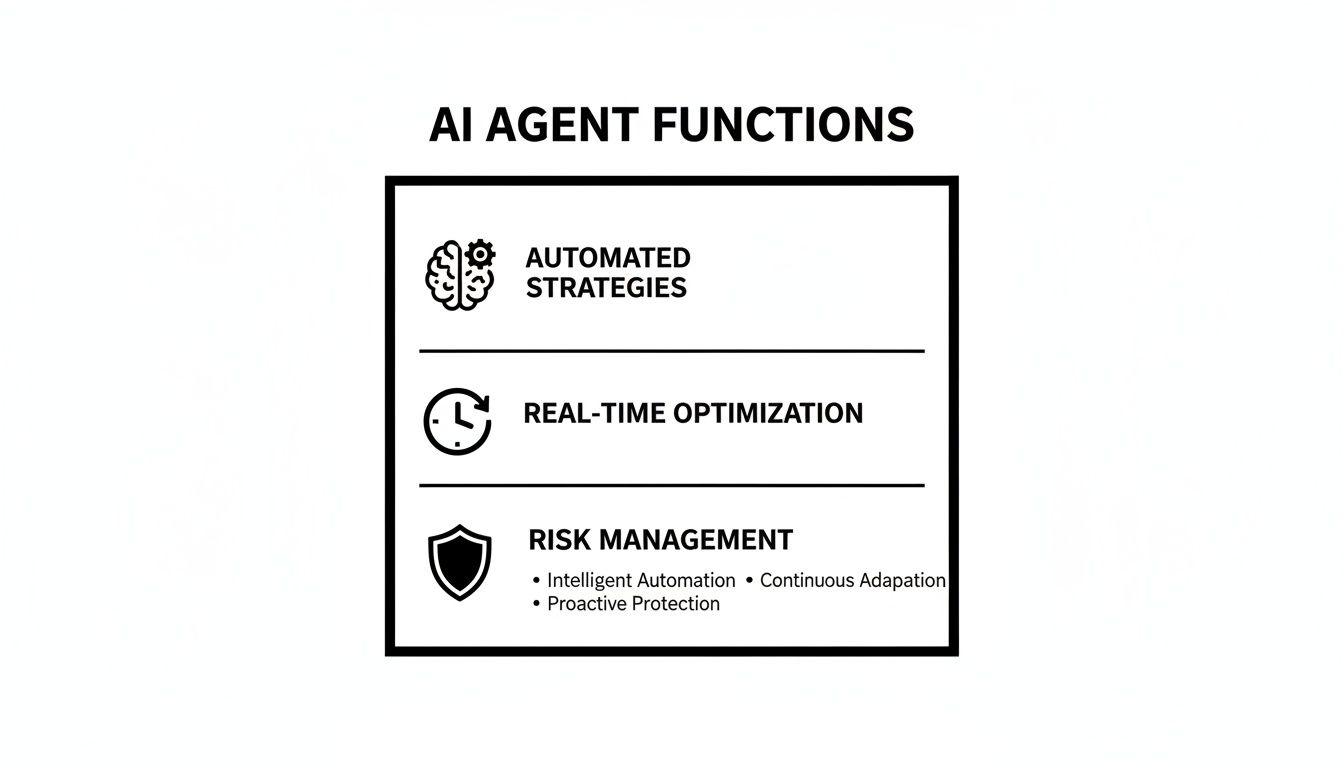
This diagram shows how these functions work together. An agent acts as an intelligent, always-on manager for your funds, combining automated strategies with real-time adjustments and risk checks.
For example, a good agent can be set to automatically withdraw funds from a protocol if its Total Value Locked (TVL) suddenly drops—a classic red flag. It can also spread your deposit across multiple vetted protocols to avoid a single point of failure. It’s an automated defense system that’s tough for even a dedicated manual investor to replicate 24/7.
DeFi Dashboards vs AI Agents Feature Breakdown
To put it all together, let’s look at a direct side-by-side comparison of what you actually do with each tool and what the outcome is. This table breaks down the core features and workflows.
Capability | DeFi Dashboards (e.g., Zapper, DeBank) | AI Agents (e.g., an automated yield agent) |
|---|---|---|
Portfolio Tracking | Primary Function. Aggregates asset data from multiple chains and protocols into one view. | Secondary Function. Tracks assets managed by the agent and reports on performance and actions taken. |
Strategy Execution | Entirely Manual. User must research, decide, and execute every transaction on their own. | Fully Automated. User sets an intent (e.g., "maximize yield"), and the agent executes all transactions. |
Opportunity Discovery | Passive & User-Driven. Displays data, but the user must find and interpret opportunities themselves. | Proactive & Automated. Actively scans thousands of data points 24/7 to identify and act on new opportunities. |
Speed | Human Speed. Limited by user's reaction time, analysis, and execution speed. Prone to delays. | Machine Speed. Executes transactions in seconds to capture fleeting, high-yield opportunities. |
Risk Management | 100% User-Managed. User is solely responsible for vetting protocols and monitoring for risks. | AI-Assisted. Includes automated guardrails like TVL monitoring, diversification, and pre-vetted protocols. |
Effort Required | High. Requires constant monitoring, research, and manual transaction execution. | Low. Requires initial setup and periodic review. The agent handles the day-to-day work. |
As you can see, the choice isn't just about convenience. It’s a strategic decision that shapes your entire approach to DeFi investing. Dashboards are powerful tools for analysis, but they leave the hard work—and the risk—squarely in your hands. AI agents aim to take on that work, acting as your personal, automated portfolio manager.
How to Choose the Right DeFi Tool for You
Picking between a DeFi dashboard and an AI agent really boils down to your own goals, how deep you are in the crypto world, and frankly, how much time you're willing to spend. There's no "best" tool, just the right one for the job at hand. The whole DeFi dashboards vs AI agents debate is really about one thing: manual control versus automated action. Your answer depends entirely on who you are as an investor.
Are you just starting your DeFi journey, a busy professional with zero time to spare, a degen hunting for alpha, or a treasury manager who needs to be efficient? Each of these profiles has a completely different set of needs, and one of these tools will fit you way better than the other. Let's walk through which one makes sense for you.
For DeFi Beginners and Busy Professionals
If you're new to DeFi or your calendar is always slammed, an AI agent is almost a no-brainer. The world of decentralized finance has a brutally steep learning curve, packed with confusing jargon, complex protocols, and risks lurking around every corner. A traditional dashboard gives you data, sure, but it's more likely to leave you feeling overwhelmed than in control.
An AI agent just hides all that complexity. Instead of forcing you to become a full-time researcher, it gives you a simple, guided path to a single goal: earning yield. The process is dead simple: you deposit funds, pick a risk level, and let the agent do the heavy lifting.
For beginners and time-poor investors, the primary value of an AI agent is its ability to deliver results without demanding a heavy investment in time or education. It turns a complex, active pursuit into a simple, passive one.
This automated setup means you can start earning from day one without needing to understand the nitty-gritty of every single protocol. It’s the perfect on-ramp to DeFi, letting you get in on the action while you learn at your own pace.
For DeFi Power Users and Degens
Now, if you're a seasoned DeFi pro or a "degen" who lives for executing complex, multi-leg strategies, then dashboards are still your bread and butter. You thrive on granular control, deep-dive research, and the thrill of manually chasing alpha. Dashboards like Zapper or DeBank are your command center for tracking all your different positions and sniffing out new opportunities.
But that doesn't mean AI agents are off the table. While you'll probably use dashboards for your high-risk, experimental plays, an AI agent can be a seriously powerful tool for automating the "boring" parts of your portfolio.
For example, you could park a chunk of your stablecoins with an AI agent to handle the yield farming automatically. This frees up your time and mental bandwidth to focus on more important things, like hunting for the next 100x gem or managing leveraged positions. The agent just makes sure your stables are always working for you in the background, grinding out steady returns without you having to lift a finger.
For Web3 Treasuries and Organizations
For Web3 teams, DAOs, or creator projects sitting on a treasury, it's all about efficiency and managing risk. The main goal is to protect that capital while earning a decent, low-effort return on stablecoin reserves. The overhead of manually managing these funds with a dashboard is a huge time-sink and opens the door to human error.
This is where AI agents really come into their own as a professional treasury management tool. They offer a completely hands-off, efficient way to manage stablecoins, squeezing out maximum yield while minimizing the need for someone to constantly watch the markets. An agent's built-in risk settings and automated diversification give you a layer of safety that's tough to replicate by hand. If you're looking into this, our guide on stablecoin income tools provides a lot more useful context.
At the end of the day, by delegating stablecoin management to an AI agent, treasuries can make sure their capital is productive 24/7. This lets the core team get back to what they do best—building their product or community—knowing their reserves are being managed with automated precision.
Here’s the rewritten section, crafted in the style of the provided examples:
Your Checklist for Getting Started with an AI Agent
So, you're thinking of making the jump from a DeFi dashboard to an AI agent? It's a big move, shifting from manual clicking to automated yield hunting. I've seen a lot of people get excited about the idea but then hesitate, unsure of where to even begin.
This isn't about taking a blind leap of faith. It's about being smart and methodical. Here’s a simple checklist I've put together to help you onboard to an agent like Yield Seeker with confidence.
First, Define Your Goals and Risk Appetite
Before you even think about depositing a single dollar, you need to have a chat with yourself. What are you actually trying to do here? Are you chasing aggressive double-digit yields, or is protecting your capital the top priority?
This is crucial because it’s how you’ll tell your agent to behave. Most good agents let you set your risk tolerance, which basically becomes its north star.
Conservative: The agent sticks to battle-tested, audited protocols. Think lower-risk, even if it means slightly lower yield. Perfect for a project treasury or if you just can't stomach volatility.
Balanced: This is the middle ground. The agent will build a diversified portfolio, mixing stable returns with a few moderate growth plays across reliable protocols.
Aggressive: For those with a higher risk appetite. The agent might hunt for yield in newer, vetted protocols where the returns are potentially much higher, but so is the risk.
Decide on this upfront. It saves you from making emotional calls down the line.
Do Your Homework on Security and Transparency
Not all AI agents are built the same, not by a long shot. Your next job is to dig into the platform itself. Look for clear documentation on their security, smart contract audits, and who the team is.
Transparency is a non-negotiable in DeFi. A trustworthy platform will be upfront about its strategies, the protocols it uses, and how it manages risk. If you have to hunt for this info, that’s a major red flag.
Look for audit reports from reputable firms. Also, check if the platform shows you exactly where your funds are in real-time. This is what separates the sketchy "black box" tools from the transparent players we need in this space.
Start Small, Test the Waters
Once you’re comfortable with the platform's security, it's time for a test run. Don't go all-in. Seriously. Start with a small amount you wouldn't miss—maybe $10 or $20 in USDC.
This little test deposit does a few things:
Gets you familiar: You can go through the whole process, from deposit to allocation, without any real financial stress.
Verifies everything: You can see your funds appear in the interface and watch the AI agent get to work.
Lets you check performance: You can see how the agent reports earnings and get a feel for the dashboard.
Explore the Dashboard and Monitor Your Agent
With your test funds safely deposited, take some time to click around the app. A good agent won't just show you a balance; it'll give you insights. Look for a performance dashboard, a transaction history, or even a terminal explaining why the agent made certain moves.
Pay close attention to how they report performance. Get to know the metrics like APY and total earnings, and figure out where to see the underlying protocols your funds are sitting in.
Understand How to Get Your Money Out
Finally, before you even think about adding more capital, make sure you know how to withdraw. This is critical. A legit platform like Yield Seeker won't have lock-up periods.
Test the withdrawal process with that small deposit. Make sure it’s smooth and fast. Knowing you can pull your funds out anytime is the ultimate peace of mind.
A Few Common Questions
Whenever you're comparing a couple of different tools, a bunch of questions always pop up. Let's get straight to the point and answer the big ones when it comes to choosing between a DeFi dashboard and an AI agent.
How Do the Security Risks Really Compare?
This is probably the most important question. The security difference is all about where your funds actually live and who can move them.
A DeFi dashboard is basically read-only. It just peeks at your on-chain activity. It never touches your private keys and can't sign transactions for you. The risk here is pretty low—you mainly just have to watch out for phishing scams or connecting your wallet to a shady website.
An AI agent is a different beast. It's custodial by design, meaning you're depositing your funds into its smart contracts to let it work for you. This introduces smart contract risk. Is there a bug? Has the code been exploited? Your risk shifts from protecting your own wallet to trusting the auditing, battle-testing, and security track record of the AI agent's platform.
The core trade-off is simple: you’re swapping self-managed wallet risk (with dashboards) for platform-managed smart contract risk (with AI agents). My advice? Only ever use agents that have public audits from reputable firms and have proven themselves in the wild.
Can I Just Use Both an AI Agent and a Dashboard?
Yes, and honestly, this is a pretty smart way to do it. You get the best of both worlds: automated efficiency and a bird's-eye view of your entire portfolio.
You could put a chunk of your stablecoins into an AI agent and let it do the heavy lifting of generating yield automatically.
At the same time, you can fire up a dashboard like Zapper or DeBank to keep an eye on everything. It will show you the funds sitting in the AI agent's contract right alongside all your other self-managed assets. This gives you hands-off yield generation with a unified view of your total net worth.
How Do These Agents Actually Decide Where to Put My Money?
It’s not just blindly chasing the highest number. AI agents use a pretty sophisticated process that combines set rules with live market data. It usually breaks down like this:
A Pre-Vetted Protocol List: The agent won't just ape into any new farm. It works from a whitelist of protocols that the team has already vetted for security, liquidity, and general reliability.
Real-Time Data Feeds: The AI is constantly pulling in data on APYs, transaction fees, liquidity depth, and other health metrics like a protocol’s Total Value Locked (TVL).
Risk-Adjusted Yield Optimization: This is the key. The agent doesn't just go for the highest APY. It calculates a risk-adjusted return, weighing the potential profit against things like the smart contract's age and overall market sentiment to make the best call.
Will My Funds Be Locked Up If I Use an AI Agent?
This completely depends on the platform. The good ones, like our own Yield Seeker, have no lock-up periods. Your funds are liquid. You can pull them out whenever you want, just like you would from a standard lending protocol like Aave or Compound.
However, you have to be careful. Some platforms might use withdrawal queues or lock-ups to manage their liquidity. Always read the fine print and, more importantly, test the withdrawal process with a small amount before you commit any serious capital.
Ready to move beyond manual tracking and put your stablecoins to work? Yield Seeker offers an AI-powered agent that automates yield farming for you. Start with as little as $10 and experience the future of DeFi. Explore Yield Seeker today.