

When you hear people talking about Base chain DeFi, they're talking about the financial ecosystem popping up on Base, a Layer 2 network built by the team at Coinbase. It’s designed to run on top of Ethereum, giving you all of Ethereum's battle-tested security but with much faster transactions and way lower fees.
What Is Base Chain DeFi and Why Is It Growing?
The easiest way to think about it is with a highway analogy. Imagine Ethereum is a massive, bustling city highway. It's incredibly secure and gets you where you need to go, but it's often jammed with traffic, and the tolls (gas fees) can get ridiculously expensive.
Base is like a brand-new express lane built right alongside it. It zips traffic along at lightning speed for a tiny fraction of the toll cost. Because it's still connected to the main highway, it benefits from all the same security and infrastructure. That, in a nutshell, is Base chain DeFi.
This simple but powerful setup—speed, low cost, and inherited security—has made Base a massive magnet for both money and developers. And with the direct backing of a huge name like Coinbase, there's an built-in level of trust that’s pulling in everyone from DeFi pros to first-time users. It finally makes it practical to lend, borrow, and trade without worrying that gas fees will eat up all your profits.
To give you a quick snapshot, here's a look at the core value proposition of Base.
Base Chain DeFi at a Glance
Attribute | Description | Benefit for DeFi Users |
|---|---|---|
Network Type | Ethereum Layer 2 (Optimistic Rollup) | Inherits Ethereum's security while processing transactions off-chain for speed. |
Backing | Developed and backed by Coinbase | Provides institutional trust, deep liquidity, and a direct on-ramp for millions of users. |
Transaction Costs | Significantly lower than Ethereum mainnet | Makes complex DeFi strategies and smaller transactions economically viable. |
Transaction Speed | Faster block times and finality | Offers a smoother, near-instant user experience for trading and interacting with dApps. |
Ecosystem Focus | Strong emphasis on stablecoin liquidity | Creates a stable and reliable foundation for yield farming and lending protocols. |
This combination is what's really lighting a fire under the ecosystem's growth.
The Fuel Behind the Growth
The explosive growth we've seen on Base is no accident. It’s a classic feedback loop: more users and capital flood in, which in turn gives developers more reason to build cool new apps, which then attracts even more users.
Here’s a breakdown of what’s drawing so much attention:
Drastically Lower Costs: We're not talking about a small discount. Transaction fees on Base can be 10-100 times cheaper than on Ethereum. This makes it affordable to try out strategies that would be far too costly anywhere else, especially if you're not a whale.
Institutional Confidence: Having Coinbase in its corner is a massive vote of confidence. This has led to serious institutional money and slick integrations, like seeing liquidity pools from protocols like Aerodrome show up right inside the Coinbase app.
A Thriving Hub for Stablecoins: Base has quickly become the go-to place for stablecoin yield. With its deep liquidity and cheap fees, over 91% of its total liquidity is parked in stable assets, giving the whole ecosystem a rock-solid foundation.
The numbers don't lie. The Base DeFi ecosystem has been on a tear, with its total value locked (TVL) jumping 23% to $7.8 billion in just one week back in early March 2026. During that same time, the network chewed through over $2.1 billion in transaction volume, proving it can handle the heat.
For a deeper dive into the projects and players making waves, check out our comprehensive guide to the Base ecosystem.
Your First Steps into the Base Ecosystem
Getting your feet wet in Base chain DeFi is a lot easier than it sounds. If you know the right steps, you can go from the sidelines to actually participating in no time. The whole process is built to be pretty accessible, even if you're just starting out in decentralized finance.
Your journey starts with setting up a digital wallet. Think of it as your crypto ID and bank account all in one. A user-friendly choice like Coinbase Wallet is a great place to start, as it plays nicely with the Base network and makes the whole experience much smoother right from the get-go.
Setting Up Your Wallet and Funds
Once you've got your wallet installed, you'll need to get a little bit of Ethereum (ETH) in there. This ETH is for paying transaction fees, which everyone in crypto calls "gas," on the Base network. The good news is that Base is incredibly efficient, so you don't need much—often, just a few dollars' worth is plenty to cover dozens of transactions.
With your wallet set up and ready with gas money, you can now move your main funds, like the USDC stablecoin, over to the Base chain. This is a super important step called "bridging."
Bridging is just the process of moving your crypto from one blockchain to another. In our case, we're shifting stablecoins from the main Ethereum network to the faster, cheaper Base Layer 2. This is what unlocks all the good stuff in Base DeFi.
This diagram gives you a simple visual of how assets move to Base to take advantage of those sweet, low fees.
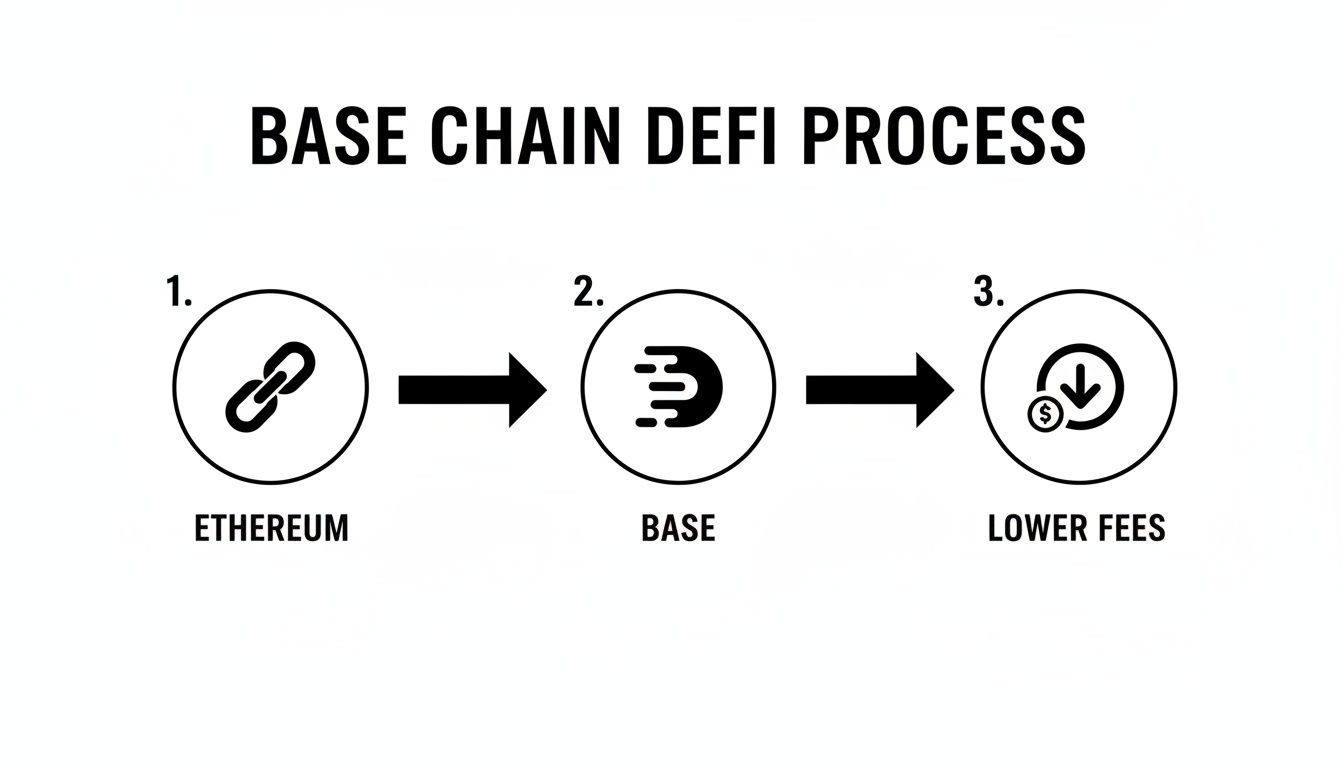
You can see how Base essentially acts like an express lane connected to Ethereum, making everything you do in DeFi way more affordable.
Choosing Your Bridge to Base
So, how do you actually get your funds onto Base? You've got two main routes, and each one has its pros and cons.
The Official Base Bridge: This is the native bridge built and maintained by the Base team, making it the most secure and reliable option. The trade-off? It can be a bit slow, and if you want to withdraw your funds back to Ethereum, you might have to wait a few days.
Third-Party Bridges: Platforms like Stargate or Synapse offer much faster and often cheaper ways to move your assets. These bridges use their own tech to get your funds across in minutes, not days. The catch is that they introduce their own smart contracts into the mix, which adds an extra layer of risk you don't have with the official bridge.
Here’s a quick look at what the official Base Bridge interface looks like when you're about to deposit from Ethereum to Base. It keeps things clean and simple.
Once you’ve successfully bridged your USDC, you’re officially in! You're now ready to start exploring all the interesting yield opportunities waiting for you across the Base DeFi ecosystem.
Navigating the Top Protocols for Stablecoin Yield

Alright, so you’ve bridged your stablecoins over to Base. Now for the fun part: figuring out where to put them to work. The ecosystem is packed with nearly 600 protocols, but you really only need to know a handful of key players to get started with stablecoin yield.
Think of these protocols like different financial shops. Some are busy trading floors where you can earn by helping others swap tokens, while others are more like decentralized banks where you lend out your cash for interest. Knowing the difference is crucial for matching a protocol to your strategy.
Aerodrome Finance: The Liquidity Engine
One of the first places you’ll likely land is Aerodrome Finance. It's the biggest decentralized exchange (DEX) on Base and acts as the network's main liquidity hub, supporting over 400 trading pairs and processing millions in volume every day.
For anyone holding stablecoins, Aerodrome's main draw is liquidity providing. It sounds complex, but the idea is simple:
You deposit your stablecoins (like USDC) into a trading pool, usually paired with another token.
Traders use that pool to swap between the two assets.
In return, you get a slice of the trading fees they pay, plus extra rewards in AERO tokens.
This is a cornerstone of how DeFi works. Aerodrome gets a huge boost from its deep integration with Coinbase, which even shows its liquidity pools right inside the Coinbase app, drawing in tons of users and cash. If you want to go deeper on this, check out some of the highest APY yield farming strategies out there.
A protocol's "Total Value Locked" or TVL is a great health metric. It represents the total amount of assets users have deposited into the platform. A high and growing TVL often signals strong user trust and deep liquidity, which are crucial for a stable yield-bearing environment.
Seamless Protocol and Moonwell: Lending Markets
While Aerodrome is all about trading, other protocols are built specifically for borrowing and lending. These platforms work more like decentralized money markets, and on Base, Seamless Protocol and Moonwell are two of the biggest names in the game.
The process here is much more straightforward:
You supply your stablecoins to the protocol's lending pool.
Borrowers take out loans from that pool and pay interest on them.
You receive a portion of that interest as yield on your deposit.
The interest rates on these platforms are variable, constantly shifting based on supply from lenders and demand from borrowers. This creates a dynamic environment where yields can move up or down. These lending markets are a great option if you want a simpler, more hands-off way to earn on your stablecoins without the hassle of managing a liquidity position.
Alright, you've got your USDC on Base. Now for the fun part: making it work for you. The great thing about DeFi on Base is that you don't need a finance degree to get started. You can begin earning with some pretty straightforward strategies.
We'll walk through two main approaches. First, a simple, lower-risk lending play. Then, we'll look at providing liquidity, which is a bit more involved but can offer higher returns. This should give you a clear idea of which path fits your style.
Let’s dive into the easiest way to put your USDC to work.
Strategy 1: The Low-Risk Lending Approach
The most direct way to earn on your stables is simply to lend them out. It’s a lot like putting your cash in a high-yield savings account, only you're using a decentralized protocol like Moonwell or Seamless instead of a bank.
Here’s how it usually goes down:
Connect Your Wallet: Head over to the lending protocol's site and connect the wallet holding your bridged USDC.
Pick Your Asset: Find the USDC market on the platform. You'll spot a "Supply APY"—that’s the annual percentage yield you can expect to earn.
Deposit Your Funds: Punch in the amount of USDC you want to lend and approve the transaction. Just like that, your funds are in the pool and earning interest for you in real-time.
The yield comes from borrowers who pay interest on the loans they take out. This strategy is generally seen as lower risk because your funds aren't directly exposed to the wild price swings of other crypto assets.
Key Takeaway: Lending is a passive, "set-and-forget" strategy that's perfect for beginners. The main thing to watch out for is smart contract risk—the chance of a bug in the protocol's code. Always stick to well-known, audited platforms.
Strategy 2: The Liquidity Provisioning Approach
If you're okay with a little more complexity for potentially juicier returns, providing liquidity is the next logical step. This involves supplying a pair of assets to a decentralized exchange (DEX) like Aerodrome. In doing so, you're helping other people trade.
For instance, you might provide liquidity to a USDC/ETH pool.
This means you deposit an equal value of both USDC and ETH. In return for your service, you get a cut of the trading fees every single time someone swaps between those two tokens. On top of that, many protocols throw in extra incentives, often paid in their own token (like AERO), which can seriously boost your total APY.
But, this strategy comes with its own unique risk.
Understanding Impermanent Loss
When you provide liquidity for a pair of assets, you open yourself up to something called impermanent loss. This happens when the price of one asset in your pair moves a lot compared to the other.
Imagine you deposit into a USDC/ETH pool when ETH is at $4,000. If ETH rockets up to $5,000, the pool automatically rebalances your stake to keep that 50/50 value split. This rebalancing act means you end up holding less ETH and more USDC than when you started.
If you were to pull your funds out at that exact moment, the total value of your assets could be less than if you had just held them separately. The "loss" only becomes real (or permanent) when you actually withdraw. The trading fees you earn are meant to cancel out this risk, but it's a critical concept to get your head around before you jump in.
Understanding the Risks of Base DeFi
Those high yields on the Base chain look tempting, right? But in DeFi, just like anywhere else, big returns always come with a catch. Before you jump in, it’s crucial to get a handle on the risks involved. Knowing the potential pitfalls is the first step to navigating this space safely.
The biggest risk in any DeFi protocol is hidden in its smart contracts. These are the bits of code that make everything from lending platforms to exchanges work. You can think of a smart contract as the automated engine running a protocol. If there’s a bug or a single flaw in that code, hackers can exploit it, and user funds can vanish in an instant.
This isn't just a theoretical problem; DeFi has a long and painful history of major exploits that have cost users billions. That's exactly why smart contract audits are so important.

Core DeFi Risks to Watch
Getting an audit is like having a mechanic inspect a used car before you buy it. It doesn't mean the car will never break down, but it dramatically lowers your chances of driving off the lot with a lemon. My rule is simple: stick to protocols that have been thoroughly checked out by well-known security firms.
But the code isn't the only thing to worry about. There are a few other built-in risks you need to keep on your radar:
Stablecoin De-Peg Risk: Stablecoins like USDC are designed to be worth exactly $1.00, but they aren't foolproof. A "de-peg" event, where the value drops below a dollar, can be triggered by widespread market panic or problems with the assets backing the coin.
User Error: Honestly, sometimes we are our own worst enemy. Sending funds to the wrong address, getting tricked by a phishing scam, or signing a malicious transaction can lead to losses that are impossible to reverse. Remember, in crypto, there's no "undo" button.
Key Insight: The real dangers in DeFi usually aren't with the Base chain itself, since it gets its security from Ethereum. The risk comes from the applications built on top of it. You're only as secure as the weakest app you interact with.
Practical Steps for Staying Safe
Knowing the risks is half the battle. Now, let's talk about what you can actually do about them. You don't have to be a cybersecurity pro to keep your funds safe—a few good habits go a long, long way in Base chain DeFi.
First things first, get a hardware wallet. This little physical device keeps your private keys completely offline, which makes it nearly impossible for a remote hacker to drain your account. It’s the single best security upgrade you can make, period.
Second, get into the habit of managing your token approvals. Whenever you use a new DeFi app, you give it permission to spend tokens from your wallet. It's a good idea to regularly check and cancel these permissions for apps you're no longer using. Tools like Revoke.cash make this super easy and can stop an old, forgotten approval from turning into a backdoor for a future exploit.
By being cautious and using these simple tools, you can explore the opportunities on Base with a lot more confidence.
How to Automate Your Yield Farming on Base
Let's be honest: manually tracking DeFi strategies, moving your funds around, and digging into every new protocol can feel like a full-time job. For anyone who wants the returns without the constant grind, a whole new breed of AI-powered tools offers a smarter way to put your stablecoins to work.
These platforms are built to automate the whole complex dance of yield farming on the Base chain. Instead of you hunting for the best APYs, they use intelligent agents that are constantly monitoring protocols in real-time. This lets them shuffle your capital to the most competitive and risk-adjusted strategies available at any given moment.
The real magic of automation is simple: it does all the endless research and portfolio tweaking for you. This frees you up while making sure your money is always working as hard as possible, grabbing opportunities you might have otherwise missed.
A Smarter Path for Busy Investors
This automated approach isn't just about chasing the highest number; it's about getting great returns through a simple, clean experience. Platforms like Yield Seeker give you a single dashboard to track your earnings, so you can stop juggling a dozen different browser tabs for every DeFi app you're in.
This model is especially powerful when you look at how much liquidity is sloshing around DeFi. The stablecoin market, which is the bedrock for these yield strategies, exploded by 49% in 2025 to a supply of roughly $300 billion. And with independent DeFi lending platforms hitting $19.1 billion in open borrows, the demand for stablecoins that can earn yield is massive. It’s the perfect playground for AI automation. You can explore more data on the decentralized finance market's rapid expansion.
These tools combine this automation with a serious focus on security, giving busy investors a reliable way to earn passive income. If you're curious, you can learn more about how AI agents work in DeFi in our detailed guide.
Your Top Questions Answered
Whenever you jump into a new DeFi ecosystem, you’re bound to have questions. It’s only natural. So, let's tackle some of the most common ones about getting started with stablecoin yield on the Base chain.
Is Base as Secure as Ethereum?
Yes, it is. Think of Base as a fast lane built on top of Ethereum's super-secure highway. As a Layer 2 network, Base processes transactions quickly and cheaply, then bundles them up and settles them on the Ethereum mainnet. This means it directly inherits the rock-solid, proven security of Ethereum itself.
It's important to remember, though, that this security applies to the chain, not necessarily every app built on it. The individual dApps you use each have their own smart contracts with their own potential risks. Always stick to well-known, audited protocols.
What's the Minimum I Need to Start Earning Yield?
This is one of the best parts about Base. Thanks to the incredibly low transaction fees, most protocols have no required minimum deposit. It’s perfect for anyone, no matter their budget.
You can genuinely start earning yield on some platforms with as little as $10. This low barrier to entry is a huge reason for its explosive growth and is opening up DeFi to a much wider audience.
Can I Lose Money in Base DeFi?
Yes, you can. It's crucial to understand that DeFi is never risk-free. The main things you need to watch out for are:
Smart contract risk: A bug or vulnerability in a protocol's code could be exploited by a hacker. This is the most common risk in DeFi.
De-pegging risk: A stablecoin could lose its 1-to-1 peg to the US dollar due to market pressure or issues with its backing.
Impermanent loss: This is a specific risk when you provide liquidity to a pool and the prices of the two assets you deposited move in different directions.
Always do your own research and never invest more than you’re comfortable with losing.
Ready to put your stablecoins to work without the constant manual effort? Yield Seeker uses AI agents to automatically find and manage the best risk-aware yield opportunities on Base for you. Start earning smarter today at yieldseeker.xyz.