Think of it like this: you have US dollars, but you want to use them on a new financial highway that's both blazing fast and incredibly cheap. That’s pretty much the idea behind USDC on Base. It’s the same trusted, dollar-backed USDC from Circle that many of us already know, but now it’s running on Coinbase’s slick Base network. This opens up a whole new world for earning and transacting.
What Is USDC on Base and Why Is It Getting So Much Attention?

First, a quick refresher on USDC. You can think of it as a digital dollar. Each USDC is designed to be redeemable 1:1 for a U.S. dollar, which is held in reserve by its issuer, Circle. This gives you the stability of regular money with the flexibility of a crypto asset.
Now, that digital dollar needs a road to travel on. For a long time, the main road has been Ethereum. It’s secure, no doubt, but using Ethereum can feel like being stuck in city traffic during rush hour—it's slow and expensive. Every move you make, or transaction, costs a "gas fee" that can sometimes be shockingly high.
This is where Base completely changes the game. Base is a Layer 2 network, which is like an express lane built right on top of Ethereum. It handles transactions on its own much faster and cheaper, then bundles them up to settle on the main Ethereum network later. This design gives us two huge wins.
To get a quick overview, here's a simple breakdown of what USDC on Base brings to the table.
USDC on Base At a Glance
Attribute | Description |
|---|---|
Asset | USDC, a stablecoin pegged 1:1 to the U.S. dollar, issued by Circle. |
Network | Base, a Layer 2 scaling solution for Ethereum developed by Coinbase. |
Key Benefit | Drastically lower transaction fees (often just a few cents) and near-instant confirmation times. |
Primary Use Case | Making DeFi, payments, and yield farming more accessible and cost-effective. |
This combination of a trusted stablecoin on a high-performance network is what makes this so compelling for both new and experienced users.
The Core Advantages of Using Base
The main reason people are flocking to USDC on Base is the massive improvement in speed and cost. Transactions that could take several minutes on Ethereum are often confirmed in just a few seconds on Base. And the fees? They’re a tiny fraction of what you'd pay on the mainnet.
Lower Transaction Fees: Instead of paying several dollars for a simple transfer or a DeFi swap, fees on Base are usually just a few cents.
Faster Confirmation Times: Transactions clear almost instantly, giving you an experience that feels a lot more like using a traditional payment app.
By combining the trusted stability of USDC with the high-speed, low-cost environment of Base, a powerful new hub for decentralized finance has emerged. It makes DeFi more accessible and cost-effective for everyone.
A New Frontier for Earning Yield
These efficiency gains have turned Base into fertile ground for earning passive income, especially with stablecoin yield farming. This is simply the practice of lending or providing your USDC to DeFi protocols in return for rewards. With transaction costs so low, you can move your funds, compound your earnings, and explore different opportunities without worrying about high fees eating into your profits.
Protocols across the fast-growing Base ecosystem and its DeFi potential are popping up daily, offering new ways to put your USDC to work. From lending markets to decentralized exchanges, the options are expanding all the time, making USDC on Base a great starting point for anyone looking for better returns.
This is exactly the kind of environment where automated tools like Yield Seeker shine. We designed it to find and manage the best yield opportunities on Base for you, taking the manual work out of the equation. It makes it easier than ever to turn your stablecoins into a productive, income-generating asset.
A Step-by-Step Guide to Bridging USDC to Base
Moving your USDC from one blockchain to another is called bridging. It might sound a bit technical, but it’s actually pretty simple once you do it once.
Think of it like wiring money from a bank in one country to another. You're just using a secure digital bridge to get your USDC onto Base. I'll walk you through how to do it using the official Base Bridge, which is the safest way to go.
To get started, you'll need two things: a self-custody wallet like MetaMask or Coinbase Wallet, and some USDC on the Ethereum network. You’ll also want a little bit of ETH in that wallet to pay for the initial transaction fee, or "gas," on the Ethereum side.
Preparing for Your First Bridge
Before you jump in, it’s always a good idea to double-check a couple of things. First, make sure your wallet is connected to the Ethereum Mainnet, since that’s where you’ll be starting from.
Also, confirm you have enough ETH to cover the gas fee. While fees on Base are super low, that first hop from Ethereum has a cost.
Heads Up: Bridging from Ethereum to Base is usually quick, often taking just a few minutes. But, if you ever need to move funds back from Base to Ethereum, be aware there's a standard 7-day waiting period for security reasons. So, plan ahead if you think you'll need those funds back on Ethereum anytime soon.
Using the Official Base Bridge
The official bridge is hands-down the most secure way to move native USDC on Base. Just follow these steps for a smooth transfer.
Go to the Official Bridge: Open your browser and head over to the official Base Bridge website. Always, always double-check the URL to make sure you’re on the real site and not a phishing scam.
Connect Your Wallet: Hit the “Connect Wallet” button. Your wallet (like MetaMask) will pop up asking for permission to connect. Go ahead and approve it.
Set Up Your Deposit: The interface is clean and simple. Make sure the "From" network is set to Ethereum and the "To" network is Base. Pick USDC from the asset list and type in the amount you want to send over.
Start the Deposit: Click the “Deposit USDC” button. Your wallet will pop up one more time, showing you the transaction details and the estimated gas fee.
Confirm and Wait: Give the transaction details a final look. Once you hit confirm, the transaction is sent to the Ethereum network. You can even watch its progress on a block explorer like Etherscan using the link they provide. In just a few minutes, your USDC will show up in your wallet on the Base network!
After you bridge, you might need to add the Base network to your wallet and import the native USDC token contract to see your balance. It's a one-time setup.
Verifying the Correct USDC Contract
Okay, this part is super important. After bridging, you have to make sure you’re using the right version of USDC. On any blockchain, tokens are identified by a unique contract address, and using the wrong one can mean your funds are gone for good.
For USDC on Base, the official native token from Circle has a specific address. You can always find this on the Base documentation or from trusted sources like Circle's developer page.
Why it Matters: You'll find other "bridged" versions of USDC on Base that came from third-party bridges. These aren't the same.
Best Practice: Stick to the native USDC. This is the one that's fully backed and secure. It’s why most top DeFi protocols and automated tools like Yield Seeker are built exclusively around the native version.
By following these steps and keeping an eye on the details, you'll be able to move your funds onto Base with confidence. Now that you've got USDC on Base, you’re all set to dive into the awesome DeFi and yield opportunities waiting for you
Finding the Best DeFi Yield Opportunities on Base
Alright, so your wallet is loaded up with USDC on Base, and now comes the fun part: putting those digital dollars to work. The Base ecosystem is humming with ways to generate yield through Decentralized Finance (DeFi). You can think of it like finding a high-yield savings account, but in the crypto world, the options are far more interesting and potentially more rewarding.
Let's walk through the main ways you can start earning. We'll cover everything from simple lending to the more hands-on strategy of providing liquidity, breaking down how each one works in plain English.
First, a quick refresher on getting your USDC ready for action.
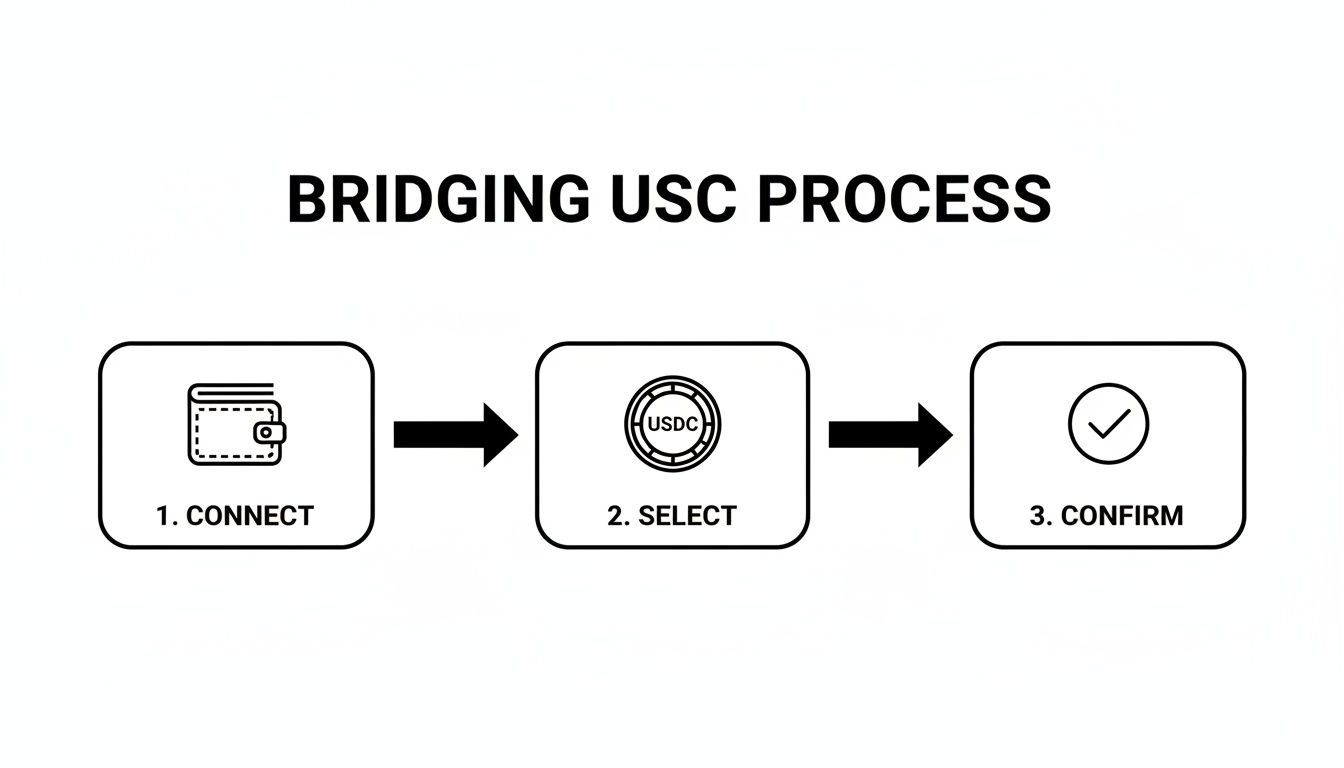
This simple flow—connecting your wallet, choosing your asset, and confirming the move—is your entry ticket into the DeFi protocols we're about to explore. Once your funds are on Base, you're ready to deploy them.
Lending Your USDC for Interest
One of the most straightforward ways to earn yield is by lending out your USDC on a decentralized money market. Platforms like Aave or Compound act like peer-to-peer banking systems, but without the actual bank in the middle. You deposit your USDC into a large lending pool, and borrowers take out loans from it, paying interest back to the pool.
As a lender, you get a slice of that interest. The rate you earn (the APY, or Annual Percentage Yield) fluctuates based on simple supply and demand—how much USDC is in the pool versus how many people want to borrow it.
How it Works: You deposit USDC and get a special token that represents your deposit.
The Reward: You earn a variable interest rate, typically paid out in more USDC.
The Risk: The primary risk is smart contract risk, which is the chance of a bug in the protocol's code.
This method is generally seen as one of the lower-risk DeFi strategies and is a fantastic starting point for anyone new to earning with USDC on Base.
Providing Liquidity on Decentralized Exchanges
Another popular route is to become a liquidity provider (LP) on a decentralized exchange (DEX) like Aerodrome Finance or Uniswap. For a DEX to work, it needs deep pools of tokens so users can easily swap one asset for another.
As an LP, you'd deposit a pair of assets—for instance, USDC and ETH—into a specific liquidity pool. For providing this vital service, you earn a cut of the trading fees every time someone makes a swap using that pool. On top of that, many DEXs on Base offer extra token rewards to attract more liquidity.
By providing liquidity, you’re essentially playing the role of a market maker. You help facilitate trading and get paid in fees for making your assets productive instead of just letting them sit there.
However, this strategy introduces a risk known as impermanent loss. This happens when the prices of the two assets you deposited move in opposite directions. While the trading fees you earn can often cancel this out, it’s a key concept to understand. To get a better handle on this, check out our guide on the highest APY yield farming strategies and their risks.
Using Yield Aggregators for Optimized Returns
Instead of manually hunting for the best yields, you can use a yield aggregator. Think of these platforms as automated crypto portfolio managers. They do the hard work for you, constantly moving your funds to the best-paying lending protocols or liquidity pools across the DeFi landscape.
These platforms use complex, automated strategies to find the highest-earning opportunities and can even auto-compound your profits, saving you a ton of time and transaction fees.
This is where a tool like Yield Seeker really shines. Instead of just finding opportunities, Yield Seeker uses a personalized AI Agent that actively manages your capital across a portfolio of pre-vetted protocols. It constantly monitors the market to strike the right balance between risk and reward, aiming to deliver competitive, hassle-free yield on your USDC on Base.
The manual approach of researching protocols, comparing rates, and moving funds around is a full-time job that requires serious expertise. An automated solution like this takes all that heavy lifting off your plate, making sophisticated DeFi yield strategies accessible to anyone.
How to Automate Your Yield Strategy with Yield Seeker
Trying to manage your DeFi yield manually is a full-time job. It means you’re constantly hunting for the best rates, second-guessing risks, and trying to decide when to move your funds. It's not just time-consuming; it's mentally draining.
This is exactly the problem we set out to solve with Yield Seeker. We wanted to build something that felt like having your own crypto expert, working for you 24/7 to find the best, safest returns for your stablecoins on Base. The idea was simple: automate the hard parts so you can just... earn.
Instead of you doing all the heavy lifting, Yield Seeker handles it. You just deposit your USDC on Base, and your personal AI Agent immediately starts putting it to work.
The Power of an AI Agent
Our approach is a world away from manual yield farming. Your AI Agent doesn't just stick your funds into one protocol and hope for the best. It intelligently spreads your capital across a portfolio of DeFi protocols on the Base network that we’ve already carefully vetted.
This automated diversification is key to managing risk. By splitting your USDC on Base across trusted platforms—like Aave or Aerodrome—your strategy isn't wiped out if a single protocol has a bad day. The AI constantly monitors performance and shuffles your positions to chase the best risk-adjusted returns.
Think of it like a pro fund manager who actively manages a stock portfolio for you. Yield Seeker’s AI Agent does the same thing for your stablecoins, but with the speed and precision only an AI can deliver, all within the Base ecosystem.
The entire system is built on real-time, around-the-clock monitoring. DeFi markets can change in a heartbeat. Your AI Agent is always watching, ready to jump on new opportunities or sidestep emerging risks way faster than any human ever could.
A Clean and Simple User Experience
Let's be honest, DeFi can be way too complicated. We tackled that problem head-on by designing a clean, simple interface that gives you control without drowning you in jargon. The dashboard shows you what you actually care about: your balance, how much you've earned, and how your strategy is doing.
Here’s a quick look at the dashboard. You can see your total balance and active strategies in one simple view.
This clear summary makes it super easy to track your progress and see how your automated strategy for USDC on Base is performing over time.
And while the AI handles all the complex moves, you are always in total command. The platform is completely non-custodial, which means you and only you ever have control over your assets.
No Lockup Periods: Your funds are never locked. You can deposit or withdraw your USDC whenever you want. Total flexibility.
No Withdrawal Fees: Need your capital back? No problem. We don’t hit you with hidden penalties for moving your funds.
Absolute Control: You can start with as little as $10 USDC, pause your strategy, or pull your entire balance out at any time.
We built Yield Seeker to make smart yield generation accessible to everyone, whether you’re a DeFi pro or just a busy person who wants their assets to work harder. By automating your strategy, you get back so much time and mental energy. To dig deeper into how it all works, check out our guide on stablecoin automation and its benefits.
Navigating Security and Risks in the Base Ecosystem
Diving into any new crypto ecosystem is exciting, and Base is no exception. But with all the incredible opportunities to earn yield on your USDC on Base, it’s just as important to be smart and cautious. Keeping your funds safe is priority number one, so let's walk through the security basics you absolutely need to know to navigate Base with confidence.
The first rule of DeFi is simple: be incredibly careful about where you connect your wallet and what transactions you approve. Phishing scams are everywhere, with bad actors creating pixel-perfect copies of popular DeFi apps to trick you. Always, and I mean always, triple-check the URL before you interact with any site.
Foundational Security Practices
To build a solid defense, there are a few non-negotiable habits that will shield you from the most common threats out there. Making these a part of your routine from day one is the best move you can make.
Verify Smart Contracts: Every token and protocol runs on a smart contract, which has a unique address. Before you do anything, find the official contract address from the project's own documentation or a trusted block explorer and make sure you're interacting with the right one.
Use a Hardware Wallet: This is a game-changer. A hardware wallet like a Ledger or Trezor keeps your private keys completely offline. Even if your computer gets compromised, your funds are safe because every single transaction has to be physically approved on the device itself.
Be Wary of Phishing: Scammers love to hang out on social media and Discord, sending urgent-looking DMs with links to fake websites. Never click on unsolicited links, and never, ever share your private keys or seed phrase. No legitimate project will ever ask for them.
These steps create a crucial firewall between you and the bad guys, making your journey into DeFi a whole lot safer.
Native USDC Versus Bridged Versions
Now for a critical point that’s specific to USDC on Base: you have to understand the difference between "native" and "bridged" versions of the token. Not all USDC on Base is the same.
Native USDC is the official version issued directly by Circle on the Base network. It’s fully backed by reserves and is the gold standard for security and trust. Other "bridged" versions are tokens that have been wrapped and brought over from other chains by third-party bridges, which adds another layer of smart contract risk.
For maximum safety, you should only use native USDC. The best DeFi protocols and automated platforms like Yield Seeker are built around the official, native version because it guarantees the asset’s integrity. If you mess around with non-native, bridged versions, you're opening yourself up to potential de-pegging events or bridge exploits.
Understanding the User Experience on Base
Beyond security, there are a couple of practical things to keep in mind. Base is known for its super low costs, but transactions aren't completely free. You'll always need a small amount of ETH on Base in your wallet to pay for gas fees. We're usually talking about just a few cents per transaction, but they are necessary to get anything done on the network.
Honestly, managing all of this—vetting contracts, dodging scams, and making sure you have enough gas—can feel like a full-time job. This is where automated platforms can add another layer of safety and convenience.
By using a service like Yield Seeker, you minimize your direct interaction with a bunch of different, potentially risky smart contracts. We handle the heavy lifting, rigorously vetting every single protocol before our AI Agents even think about putting your funds there. It lets you tap into the best DeFi yield opportunities for your USDC on Base without having to become a smart contract auditor yourself. Think of it as a way to participate in the ecosystem while outsourcing the nitty-gritty security research to a system built for it.
Frequently Asked Questions About USDC on Base
Alright, you've probably got some questions buzzing around your head about USDC on Base. It's totally normal when you're jumping into a new part of the crypto world. Getting straight answers is the best way to feel good about what you're doing.
So, let's tackle the most common questions we hear. Think of this as a quick-fire round to clear up any last-minute doubts before you dive in.
Is USDC on Base the Same as USDC on Ethereum?
Yes and no. It’s the same USDC from Circle, backed by real dollars, so you can trust its value. But it’s living on a completely different blockchain.
Think of it this way: you can have a US dollar bill in your wallet and a US dollar in your bank account. They're both a dollar, but they're in different systems. One is physical cash, the other is digital. Similarly, USDC on Base is the native version for the Base network, while the other is on Ethereum.
The real difference? Performance. Using USDC on Base means your transactions are lightning-fast and cost just a few cents. This is exactly why DeFi apps and automated tools like Yield Seeker stick to the native USDC on Base—it just makes everything cheaper and quicker.
Do I Need ETH to Use USDC on Base?
Yep, you definitely do. Even though you'll be earning yield and moving around USDC, you'll need a tiny bit of Ethereum (ETH) in your wallet on the Base network.
This ETH is for paying "gas" fees. Gas is just what you pay to get anything done on the blockchain, like sending tokens, making a swap, or depositing into a yield protocol.
Every single action on the Base network, from a simple transfer to a complex DeFi move, needs a small gas fee paid in ETH. The good news is these fees are a tiny fraction of what you'd pay on Ethereum, but they aren't zero.
Thankfully, you really don't need much. A few dollars' worth of ETH on Base is usually more than enough for dozens and dozens of transactions. You can bridge it over from Ethereum or just buy it on an exchange that lets you withdraw directly to Base.
What Are the Main Risks of Holding USDC on Base?
Look, nothing in DeFi is 100% risk-free, even with trusted assets like USDC and a solid network like Base. It’s smart to know what you’re getting into so you can make good decisions.
The risks really fall into a few buckets:
Smart Contract Risk: This is the big one in DeFi. It's the risk that the code of a protocol you're using has a bug that a hacker could find and exploit.
Custody Risk: If you leave your USDC on a big exchange, you're trusting them not to get hacked or go bust. Using your own self-custody wallet gets rid of this, but then you're responsible for keeping your keys safe.
De-Peg Risk: It’s extremely unlikely for a major stablecoin like USDC, but there's always a theoretical risk that it could briefly lose its 1:1 peg to the dollar if the market goes completely haywire.
One of the best ways to handle these risks is to not put all your eggs in one basket. This is where an automated solution like Yield Seeker comes in handy. Instead of you picking one protocol, it spreads your funds across multiple, pre-vetted opportunities, which automatically lowers your risk if any single one has a problem.
How Is Native USDC Different from Other Bridged Versions?
This is a super important point for your security. When you're on Base, you'll see different types of USDC. The one you want is native USDC, which is the official version issued directly by Circle on the Base network. It's the safest and most widely used.
You might also see other "bridged" or "wrapped" versions. These are USDC tokens that someone brought over from another blockchain using a third-party bridge. They come with extra risk because their value is tied to the security of that specific bridge. If the bridge gets hacked, those tokens could become worthless.
So, a simple rule of thumb: always double-check that you're using native USDC on Base. All the top-tier DeFi protocols and platforms will only ever deal with the native version to keep everyone's funds safe.
Can I Withdraw My USDC from Base at Any Time?
For the most part, yes. Your USDC on Base is completely liquid. If you're earning yield in a protocol like Aave or through an automated platform like Yield Seeker, you can pull your funds out whenever you want. There are no lockup periods, which gives you total freedom.
There's one big "but" to know about, though. If you decide to send your funds from Base back to the Ethereum mainnet using the official Base Bridge, you have to wait 7 days. This delay is a security feature baked into the technology Base uses (Optimistic Rollups) to give the network time to catch any fishy business.
If you need your money out fast, a much better route is to send your USDC on Base to an exchange like Coinbase. From there, you can withdraw it straight to your bank account without the wait.
Ready to put your stablecoins to work without the hassle? Yield Seeker uses a personalized AI Agent to automatically find and manage the best yield opportunities for your USDC on Base. Start earning smarter, not harder.