

You're probably looking at a stablecoin vault, lending market, or LP strategy right now and thinking two things at once. First, the yield looks attractive. Second, something about it feels fragile.
That instinct is healthy.
Most losses in DeFi don't come from one dramatic mistake. They come from treating stablecoin yield as if it were a savings account with a nicer interface. It isn't. You're taking a stack of risks, some visible, some hidden behind smart contracts, oracles, governance, bridges, and operating assumptions that only matter when markets get ugly.
Good risk management in DeFi doesn't mean avoiding yield. It means knowing what you are being paid for, deciding which risks you'll accept, and putting guardrails around everything else. For stablecoin holders, that's the difference between building durable income and donating capital to the next failure mode you didn't model.
Why DeFi Risk Management Matters for Your Stables
Stablecoins make yield hunting feel safer than it is.
When the asset itself aims to stay stable, people naturally focus on APY and ignore the machinery producing it. But your stablecoin position can still break in several ways. The protocol can fail. Liquidity can vanish. An oracle can report bad data. Governance can push a harmful change. Your own wallet permissions can stay open long after you stop using a platform.
That's why risk management DeFi should be treated like position sizing in trading or underwriting in lending. It isn't bureaucracy. It's the operating system behind sustainable returns.
Yield is never just yield
A high rate on stables is never free money. It usually reflects some combination of smart contract complexity, incentive dependence, liquidity constraints, counterparty exposure, or exit friction.
The practical question isn't “Is this yield good?” It's “What set of risks is paying for this yield, and can I survive them if they show up all at once?”
Practical rule: If you can't explain where the yield comes from in one clear sentence, don't deposit yet.
For example, “This vault lends USDC against overcollateralized borrowers” is understandable. “This strategy routes through several protocols, relies on token incentives, and rebalances across venues” may still be valid, but it demands tighter limits and closer monitoring.
The market is growing up, and risk practices are following
As DeFi scales, informal habits stop working. According to Grand View Research's DeFi market outlook, the sector grew from a 2025 market value of USD 26.94 billion to a projected USD 37.27 billion in 2026, with a forecast rise to USD 1,417.65 billion by 2033 at a 68.2% CAGR from 2026 to 2033. When more capital and more users depend on the same onchain rails, ad hoc risk judgment becomes expensive.
That's the fundamental shift. Serious participants no longer treat DeFi risk as a vibe check. They formalize it.
What works and what doesn't
What works:
Predefined allocation rules: Decide exposure limits before you deposit.
Simple strategy maps: Know the chain, protocol, asset, oracle, and exit route.
Ongoing review: Reassess when market conditions or protocol assumptions change.
What doesn't:
Blind APY chasing: The highest number often carries the least forgiving risk.
Single-metric decisions: TVL alone won't save you.
Panic-based exits: If your first plan starts after an incident, you're already late.
Stablecoin yield is a strategy business, not a scavenger hunt. The people who last are the ones who build a repeatable process.
The Five Core Risks in DeFi Yield Farming
Most users lump everything into “protocol risk.” That's too vague to be useful. For stablecoin yield, you need a cleaner map.
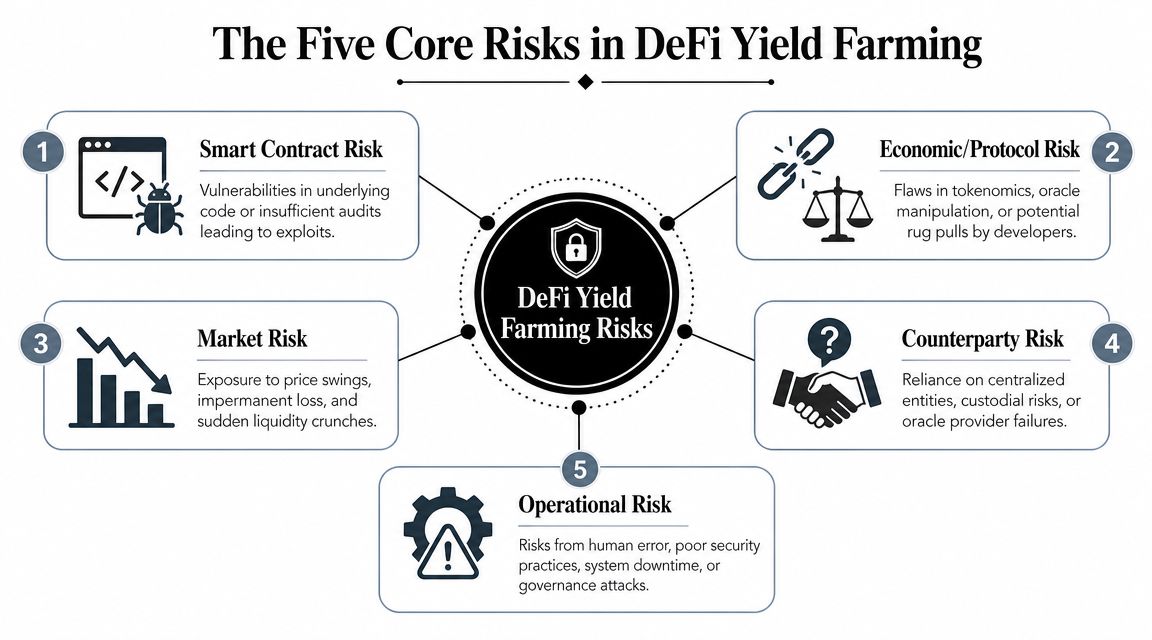
Smart contract risk
This is the structural risk of the code itself. Consider a bank vault door. If the steel is weak, it doesn't matter how good the interest rate looks.
Bugs, poor upgrade patterns, unsafe admin privileges, and weak integrations all sit here. A protocol may be honest and still be exploitable. Audits help, but they don't convert code into certainty.
What works is reading beyond the audit badge. Look for whether the team published reports, addressed findings, and limited upgrade or admin power. What doesn't work is assuming “audited” means “safe.”
Economic and protocol risk
The design can fail even if the code works exactly as written. Token incentives can fade. Liquidation assumptions can break. Governance can vote through changes that hurt depositors. A strategy can depend on users behaving rationally during stress, which is a dangerous assumption.
Oracle and liquidity risk sit at the center of this category. The Enterprise Ethereum Alliance's DeFi risk guidelines explicitly recommend mitigations such as multiple oracles or multiple data sources, TWAP pricing, secure channels, real-time monitoring, regular stress tests, liquidity management, credit-risk controls, and appropriate risk limits. For stablecoin yield-seekers, the practical implication is straightforward: a protocol with thin liquidity or centralized oracle dependencies deserves a lower allocation cap.
A more detailed treatment of this issue appears in this on-chain risk management guide.
A protocol can be solvent in calm conditions and still be unexitable when liquidity thins out.
Market risk
Stablecoins reduce direct price volatility, but they don't remove market risk. A stable can depeg. A lending market can become one-sided. LP positions can suffer from changing pool composition or impaired exits. If you need to withdraw during a crowded exit, slippage and delay become part of your loss.
For stablecoin users, market risk often shows up as “I can't get out cleanly at the price I expected.”
Counterparty risk
DeFi often advertises decentralization while in fact depending on centralized components. That might be a multisig signer group, an oracle operator, a bridge validator set, or a stablecoin issuer.
If one offchain or privileged party can interrupt settlement, freeze an asset, or impair data flow, you have counterparty exposure. It may still be worth taking. You just shouldn't pretend it's fully trustless.
Operational risk
This is the category most users underestimate because it feels too basic. Wrong wallet. Bad approval. Missed governance change. Lost signer hygiene. Bridging to the wrong network. Failing to keep gas ready during an incident.
Operational failures are boring until they're expensive.
Here's the useful mental model: smart contract risk is what the protocol does to you, and operational risk is what you do to yourself. A strong process reduces both.
A Practical Risk Assessment Checklist for Protocols
Institutional frameworks don't treat risk as one blob, and neither should you. Galaxy's SeC FiT PrO framework for DeFi risk rating evaluates protocols across Security, Compliance, Finance, Technology, Protocol, and Operations, using weighted factor scores plus qualitative judgment. That matters because small changes in liquidity, governance, oracle design, or operations can change whether a protocol belongs in your portfolio at all.
You don't need an institutional committee to apply the same logic. You need a checklist.
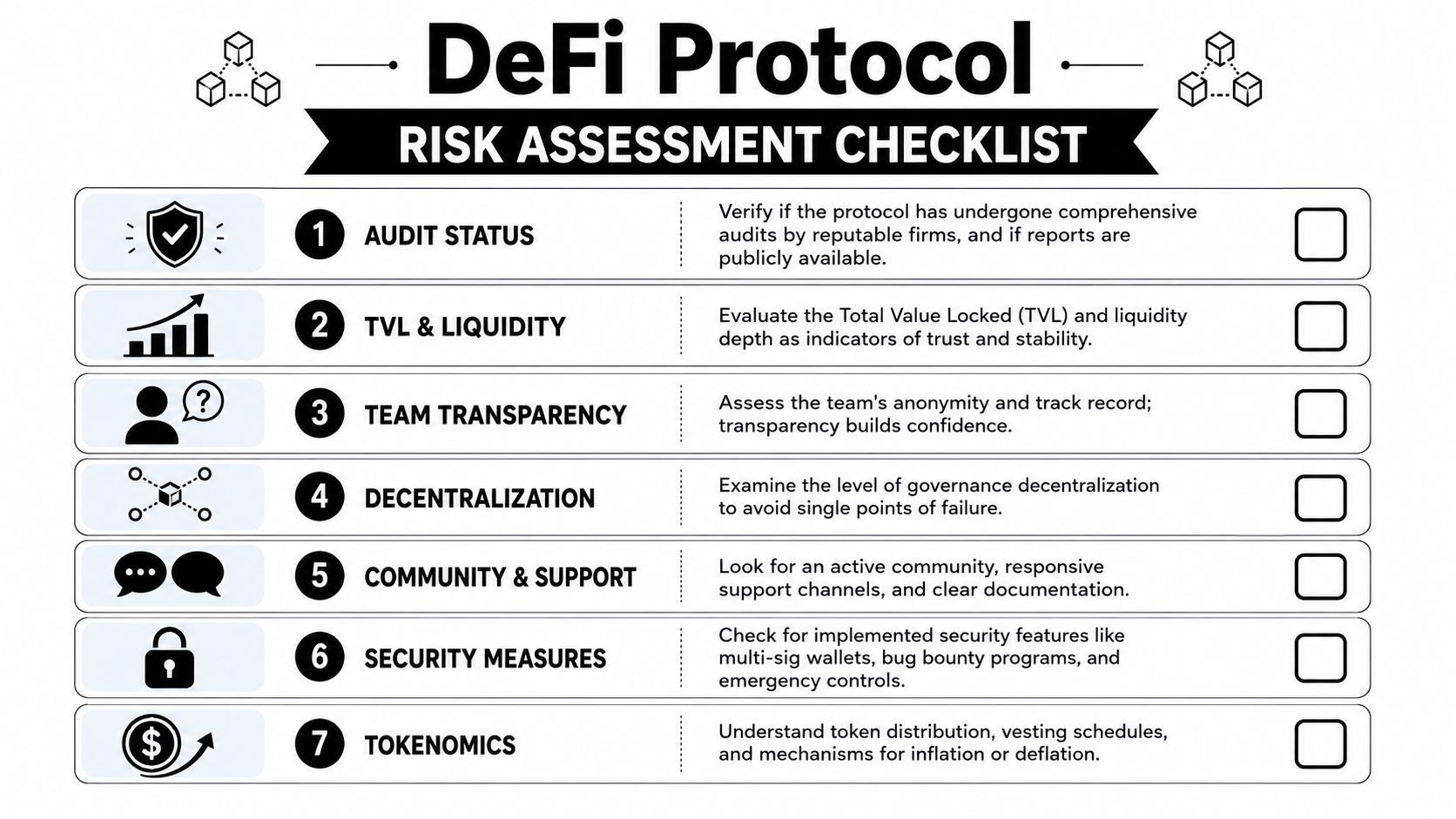
The fast-screen checklist
Use this before any deposit, even a small one.
Category | What to Check | Why It Matters |
|---|---|---|
Team and reputation | Public team history, prior products, communication style, incident handling | Teams reveal their standards long before an emergency |
Audit and security history | Public audit reports, remediation notes, bug bounty, upgrade controls | Security posture is stronger when evidence is visible and maintained |
Liquidity and exits | Pool depth, withdrawal path, concentration of liquidity, chain-specific friction | A strategy is only as good as your ability to leave it |
Oracle design | Data source diversity, fallback logic, dependence on a single provider | Pricing failures can cascade into liquidations and misvaluation |
Governance and admin powers | Multisig structure, timelocks, emergency powers, upgrade rights | Privileged control can protect users or create a hidden central point of failure |
Tokenomics and incentives | Whether yield depends on token emissions, unsustainable rewards, or reflexive demand | Incentive-heavy yield can disappear faster than users expect |
Documentation and support | Clear docs, active announcements, responsive community channels | Silence during stress is its own risk signal |
How to use the checklist in practice
Don't score every category equally. A lending market for stablecoins may deserve heavier weight on oracle quality, liquidation design, and liquidity depth. A delta-neutral vault may demand more focus on operational complexity and dependencies between venues.
That's why broad risk management DeFi frameworks are more useful than one-size-fits-all labels. Risk is contextual.
A good shortcut is to write one sentence for each protocol:
What creates the yield?
What breaks the yield?
What blocks my exit?
Who can change the rules?
If you can't answer those quickly, keep researching.
For scenario thinking, it helps to borrow from tools used in traditional finance. A practical primer on pricing options with Monte Carlo is useful because it trains you to think in distributions and paths rather than one neat forecast. That mindset carries over well to DeFi strategy review.
If you're evaluating code quality more thoroughly, this piece on smart contract security audits is a helpful companion.
Working standard: Never let branding outrank structure. Clean UI, strong social presence, and big promises are not substitutes for sound controls.
Key Mitigation Strategies You Can Use Today
Once you've assessed a protocol, the next job is portfolio construction. Risk management DeFi isn't just selecting safer apps. It's arranging exposures so one problem doesn't take down everything at once.
The strongest signal here comes from institutional behavior. In 2025, 78% of global institutional investors reported having a formal crypto risk management framework, up from 54% in 2023. In North America, 83% of institutional funds had dedicated crypto risk teams, 84% said regulatory compliance was their top priority, and 9 out of 10 cited counterparty risk as their biggest concern, according to this institutional crypto risk management summary. The lesson isn't that you need a large team. It's that disciplined rules beat improvisation.
Diversify by failure mode, not by logo
Holding funds in two different protocols isn't true diversification if both depend on the same oracle network, the same bridge, the same stablecoin issuer, or the same governance circle.
Spread capital across different risk vectors:
Protocol design: lending, market making, basis capture, or treasury-backed vaults
Infrastructure dependencies: don't cluster around one oracle or bridge assumption
Asset exposure: even among stables, issuer and collateral models differ
Operational path: avoid positions that all require the same urgent actions in a crisis
Set allocation caps before emotions show up
Cap every protocol before you deposit. If a strategy is harder to explain, thinner in liquidity, or more dependent on active management, its cap should be lower.
This sounds simple because it is. Simple rules survive stress better than clever ones.
A useful pattern:
Put your most conservative capital in the easiest-to-exit strategies.
Limit more complex yield sources to smaller sleeves.
Review whether your “safe” positions share a hidden dependency.
Use insurance selectively
On-chain insurance can make sense for concentrated positions or for protocols where smart contract risk is the main concern. But insurance isn't a magic shield. Coverage terms matter, claims processes matter, and exclusions matter.
Treat insurance as a layer in your stack, not the stack itself.
Tighten your own operating setup
A surprising amount of DeFi safety is personal hygiene.
Use a hardware wallet: Especially for larger balances or treasury funds.
Separate wallets by function: Keep experimentation away from core capital.
Revoke stale approvals: Old permissions create unnecessary attack surface.
Keep gas ready: Exits fail when the plan assumes you can transact instantly but your wallet can't.
Bookmark official links: Don't rely on search results when urgency is high.
Good defense is often mundane. Wallet segregation, approval review, and preplanned caps won't impress anyone on social media, but they prevent a lot of avoidable damage.
Your Playbook for Monitoring and Incident Response
Most users do some diligence before deposit and then stop. That's incomplete. DeFi positions need ongoing supervision because the risk can change while you sleep.
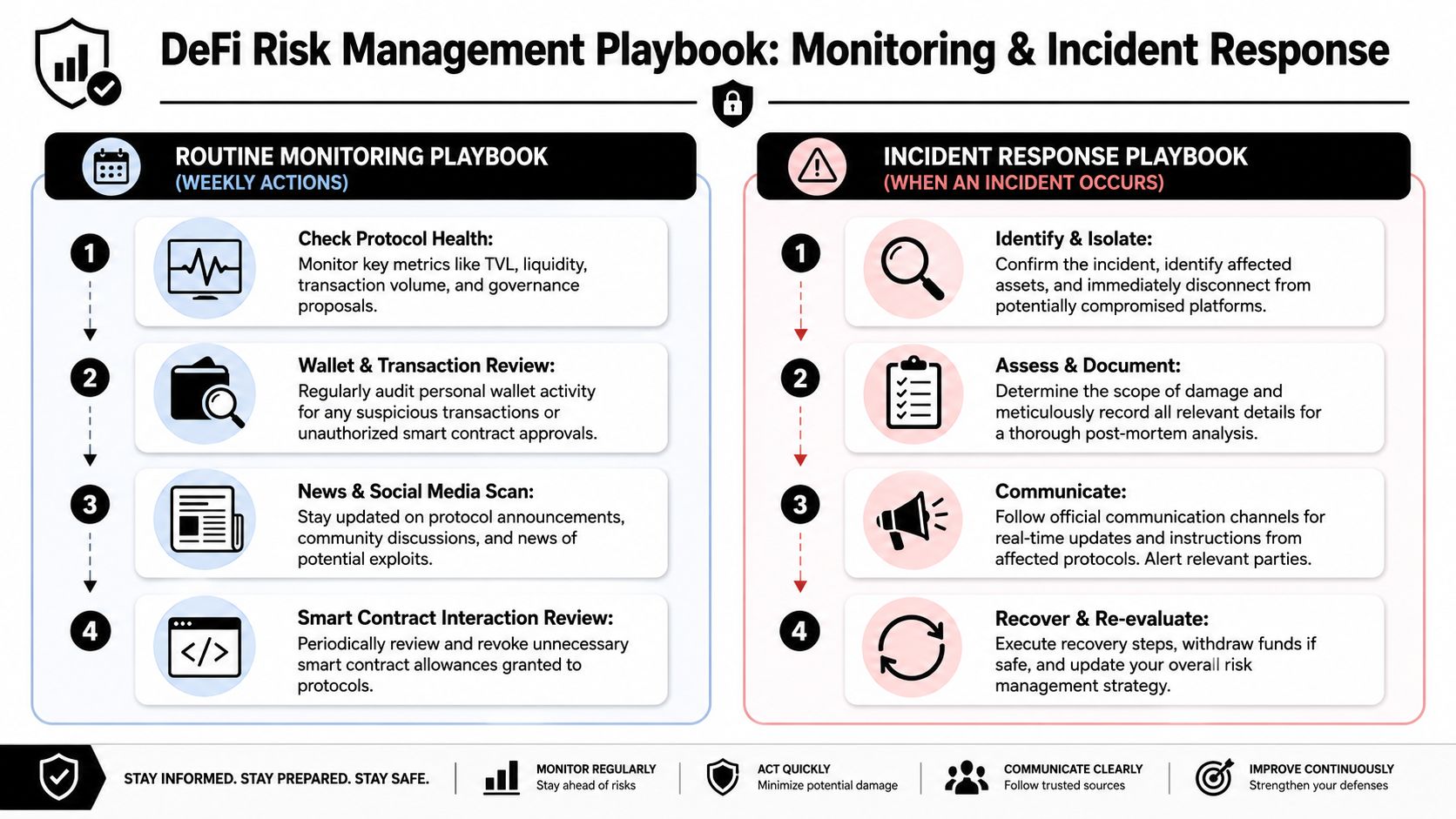
Routine monitoring playbook
Make this a recurring habit, not a vague intention.
Check protocol communications. Read the project's official announcements, governance forum, and status channels. You're looking for parameter changes, upgrades, paused functions, market stress commentary, and anything that changes your assumptions.
Review liquidity and exit conditions. Don't just check the dashboard balance. Check whether the withdrawal route still looks clean. If liquidity is thinning or a market is becoming one-sided, your risk profile has changed even if the APY hasn't.
Audit your wallet activity. Look at recent transactions and token approvals. Remove permissions you no longer need. If a wallet has become cluttered with experiments, retire it from core capital use.
Re-underwrite the thesis. Ask one short question: if I were not already in this position, would I enter it today? If the answer is no, inertia is now part of your risk.
Incident response playbook
When something breaks, speed matters. So does order.
Confirm the incident Don't trade on rumors alone. Verify through official protocol channels, reputable onchain monitoring accounts, and your own wallet exposure.
Identify affected assets and dependencies Check whether the issue is isolated to one vault or whether it touches an oracle, bridge, stablecoin, or chain component that affects multiple positions.
Stop new interactions Don't compound the problem by depositing more, chasing a recovery trade, or signing random transactions under pressure.
Revoke unnecessary permissions If compromise is plausible, reduce attack surface first. This is one of the fastest defensive actions available to users.
Prepare the exit path Make sure you have the right gas asset, know which interface or contract path you'll use, and understand whether partial withdrawal is safer than all-at-once action.
Document what happened Save transaction hashes, screenshots, timestamps, and announcements. That helps with internal review, tax records, or any later claims process.
Three scenario-specific responses
If a protocol exploit is reported: prioritize isolation, permission review, and withdrawal only when the route is confirmed safe.
If a stablecoin depegs: decide in advance whether your rule is immediate exit, monitored hold, or staged reduction. The worst time to invent that policy is mid-event.
If governance pushes a harmful change: treat it as a thesis break. Code can remain intact while the investment case deteriorates.
Panic creates random actions. A written response plan creates sequence.
Automating Safety with AI-Powered Platforms
Manual DeFi risk management works in theory and wears people down in practice. The work never ends. Protocols change parameters. Liquidity shifts across venues. New dependencies appear. Wallets accumulate stale approvals. Opportunities improve and deteriorate around the clock.
That's why a lot of serious users eventually run into the same problem. The strategy is manageable. The operations are not.

Where automation helps most
AI is useful here when it does specific, auditable jobs.
It can monitor protocol health continuously, compare yield sources against risk constraints, flag shifts in liquidity or governance posture, and help rebalance capital when the original thesis weakens. That's different from handing money to a black box and hoping for the best. The value is in execution discipline and constant review.
For busy stablecoin holders, platforms such as Yield Seeker use an AI agent to monitor and allocate stablecoin capital across DeFi protocols in real time, with risk-aware rebalancing built into the workflow. If you want a broader look at how these systems operate, this overview of AI agents in crypto is a useful starting point.
What automation still doesn't replace
You still need policy. An AI system can help enforce limits, but you should define the limits.
Decide your liquidity preference, acceptable protocol complexity, concentration tolerance, and what counts as a thesis break. Automation works best when it is implementing a clear framework, not inventing one on the fly.
A quick walkthrough of that operating model is worth watching:
The practical case for automation is simple. DeFi runs all day, every day. Humans don't. If your safety process depends on you manually checking ten dashboards before breakfast, it won't stay consistent for long.
The Path to Sustainable DeFi Yield
The stablecoin users who do well over time usually stop asking, “Where is the highest APY?” and start asking, “Where is the best risk-adjusted return I can monitor and maintain?”
That shift changes everything.
You stop treating yield as a headline number and start treating it as compensation for specific, identifiable risks. You evaluate protocols with a checklist instead of a hunch. You cap exposures before markets turn. You maintain a response plan so bad days are procedural instead of chaotic.
The durable framework
A sustainable approach usually has four parts:
Understand the risk stack: Separate smart contract, economic, market, counterparty, and operational risk.
Assess before allocating: Use a repeatable checklist, not social proof.
Mitigate actively: Diversify by dependency, not by branding.
Monitor and respond: Keep a live process for review, exits, and incidents.
That framework can be run manually, but many people eventually want system support. In broader business operations, tools such as OpenClaw AI employees are a useful example of how teams use AI to handle repetitive monitoring and execution tasks that would otherwise consume human attention. The same logic applies to DeFi operations. Repetition is where process either becomes reliable or breaks down.
What sustainable yield really looks like
It looks a little less exciting on day one and much better after a difficult month.
That's the part many users learn late. The goal isn't to win the APY screenshot contest. The goal is to keep your capital productive without taking hidden risks you don't understand. Strong risk management in DeFi gives you that path.
If you build the habit, stablecoin yield stops feeling like guesswork. It becomes a system.
If you want a lower-friction way to put this framework into practice, Yield Seeker offers an AI-powered approach to monitoring and allocating stablecoin capital across DeFi protocols so you can pursue yield with a more structured, risk-aware process.