
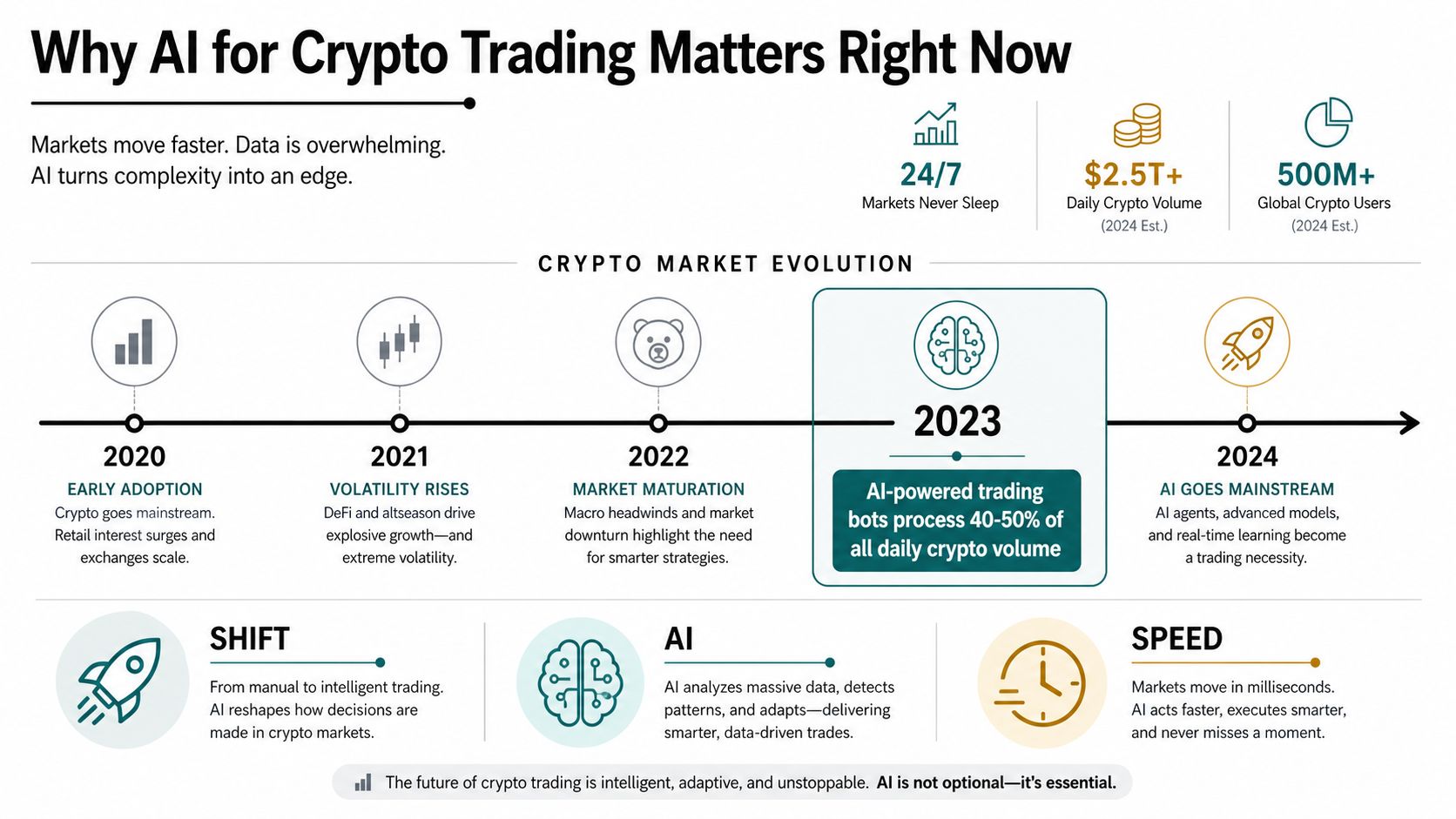
AI-powered trading bots processed roughly 40% to 50% of daily crypto trading volume in 2023, so ai for crypto trading is already part of market structure, not a side experiment. The question now is whether it still improves outcomes after fees, slippage, and regime shifts.
Why AI for Crypto Trading Matters Right Now
Crypto used to reward speed and conviction. Then it started rewarding systems that could read more data than a human ever could, and do it without blinking. By 2023, an estimated 68% of cryptocurrency trading firms were using AI-driven predictive analytics, up from 42% in 2021 Gitnux, which tells you this isn't a novelty anymore.
The market moved from curiosity to infrastructure
Two market-size estimates point in the same direction. One puts the AI-in-crypto market at $1.2 billion in 2023 and projects $12.5 billion by 2030 at a 39.4% CAGR Gitnux. Another forecasts the broader crypto AI market at $5.1 billion in 2025 rising to $55.2 billion by 2035 at 26.8% CAGR Gitnux. Those are projections, but the adoption data behind them is already visible in live markets.
That's why the old framing misses the point. The useful question isn't whether AI belongs in crypto. It's whether AI can still hold up once a trade faces spread, slippage, and the kind of regime change that wipes out a backtest.
Practical rule: if a platform talks only about intelligence and never about execution costs, it's selling analysis, not an edge.
For readers who want a broader overview of the category, this guide on AI for crypto is a useful starting point, but the harder work is figuring out what survives contact with the market.
What AI for Crypto Trading Actually Does
At a basic level, ai for crypto trading does three things. It watches the market, turns that data into a signal, and sends an order if the setup fits the rules. That sounds simple, but the quality of the signal depends on how many market layers the system can read at once.
Signal quality comes from confluence, not one indicator
A single indicator like RSI or MACD rarely tells the whole story. The stronger systems combine multi-timeframe price action with order-book depth, technical indicators, and sentiment from news or social feeds, because each input catches a different part of market behavior Signal AI. One stack described in the verified data scans 1-minute, 5-minute, and 1-hour timeframes alongside RSI, MACD, EMA, Bollinger Bands, Fibonacci levels, order-book depth, and global sentiment Signal AI.
That matters because crypto breaks cleanly from one regime to another. A breakout that looks real on a short chart can fail once liquidity thins out or social sentiment turns. A model that checks multiple horizons has a better chance of separating a real move from noise.
The best mental model is layered decision-making
A second system described in the verified data tracks 26 chart-pattern classes across 15-minute, 1-hour, 4-hour, and daily windows Signal AI. The point isn't pattern worship. The point is that a pattern on one timeframe can be a trap, while a pattern confirmed across several horizons is less fragile.
That same layered logic shows up in DeFi yield allocation. If you've used Pendle-style products, the split between Principal Tokens and Yield Tokens makes the mechanics easier to understand. The principal behaves like the steadier side of the trade, while the yield component carries more variable upside and risk. An AI agent can think in a similar way, asking which return source is stable, which is noisy, and which one deserves capital today.
AI doesn't replace judgment. It gives judgment more input, then forces the decision into a repeatable rule set.
If you're using tools to pull structured market data or on-chain signals into a workflow, something like LLM Scrape API can help with extraction and monitoring, but the edge still comes from how you combine those inputs, not from collecting more of them.

How AI Works in Real DeFi Yield Strategies
The cleanest real-world use case isn't chasing every meme coin candle. It's managing idle stablecoins and moving them into the best risk-aware yield option without making you babysit half a dozen dashboards. That's where ai for crypto trading becomes useful in DeFi, because the job is more allocation than speculation.
A practical agent looks for the best current fit
Say you hold USDC and want yield. A good agent doesn't guess. It scans lending markets, vaults, and liquidity pools, then compares them on expected return, protocol risk, and liquidity depth before moving capital. If the market changes, it can rotate out of a position that no longer fits the risk profile.
One clear pattern is Pendle-style allocation. A user can separate future yield into a steadier principal component and a more variable yield component. An AI agent might route capital into the steadier side when it wants compounding with less churn, then shift away when conditions make the variable side too risky.
For a deeper walkthrough of automated decision-making in this kind of setup, this explanation of how to use AI agents is useful because it focuses on behavior, not hype.
Yield aggregation works only if the agent keeps moving for the right reasons
The same logic applies to automated vaults and lending strategies on Base and other chains. The agent watches APY shifts, protocol health, and concentration risk, then rebalances if the current setup stops making sense. That's not passive income in the lazy sense. It's rule-based capital movement.
A second pattern is cross-chain yield optimization. The system compares opportunities across networks and moves capital only when the combination of return and liquidity is worth the friction of moving. That's the key: an agent should not chase yield every time a number changes. It should move when the trade is better after the full cost of moving.
Rule of thumb: if the agent can't explain why it moved capital, it's automation without accountability.
The Harsh Truth About AI Trading Limits
If every bot printed money, nobody would be selling courses or terminal subscriptions. The reason that's not true is simple. Markets change, and models that looked strong on historical data often fall apart when they meet live frictions.
Backtests are useful, but they're not reality
Backtests usually skip the parts that hurt most. They don't fully capture slippage, spread widening, or the way liquidity disappears right when a system wants to trade. In crypto, that gap matters more because volatility can shift hard and fast.
The verified data also points to why this is a real problem. One report says AI trading bots handled about 50% of all crypto trading volume in 2023, while another puts AI-driven Bitcoin trading volume at 35% to 45% in the same year worldmetrics. That level of automation doesn't erase edge. It compresses it, which means weaker systems get crowded out faster.
Regime shifts are where overconfidence dies
A strategy that works in a trending market can fail in a choppy one. A model trained during calm conditions may keep firing signals after the market has changed shape, and then the losses come fast because the machine doesn't get tired, cautious, or embarrassed.
Recent guidance on autonomous crypto trading keeps coming back to the same idea, regime-aware risk control Bitcoin Foundation. That's the problem, not whether the model can predict a move in isolation. It's whether it knows when prediction quality drops and capital should step aside.
Fast execution cuts both ways. It can speed up entry into a good trade, and it can also speed up a bad one. That's why any system that doesn't separate signal generation from execution, and doesn't test live with tiny capital first, is probably overselling itself.
How to Evaluate AI Trading Platforms and Agents
The market is full of polished claims and thin mechanics. A strong evaluation framework protects you from paying for a dashboard that looks smart but can't survive live trading. The baseline is straightforward, the platform should show how it thinks, how it executes, and how it handles bad conditions.
What to inspect before you trust the system
Kraken's guidance is blunt. First identify a tradable edge, then convert it into an executable algorithm with explicit entry, stop-loss, and take-profit rules, then forward test with very small capital before scaling Kraken. That sequence is the minimum standard, not a bonus feature.
A useful way to compare products is to ask whether they can do all three of these things:
Evaluation Criterion | Strong Signal | Warning Sign |
|---|---|---|
Signal methodology | Combines multiple market inputs and explains the logic | Vague “AI insights” with no clear inputs |
Execution rules | Deterministic entries, exits, and risk controls | Manual discretion with no fixed guardrails |
Forward testing | Small-capital live validation before scaling | Only backtests or screenshots |
Risk transparency | Shows drawdown behavior and regime sensitivity | Promotes win rate without context |
Capital access | Funds remain withdrawable and visible | Lockups or unclear exit terms |
Transparency matters more than polished design
If a platform shares only win rate, that's not enough. Win rate can hide ugly drawdowns, and drawdowns are what force real users to stop a strategy. A system that explains how it adapts to regime shifts gives you a far better read on whether the logic is sound.
For readers comparing broader agent workflows, these AI agent use cases offer a useful way to think about what's generic automation and what's domain-specific. In crypto, that distinction matters because an agent that can answer questions isn't necessarily one that can allocate capital safely.
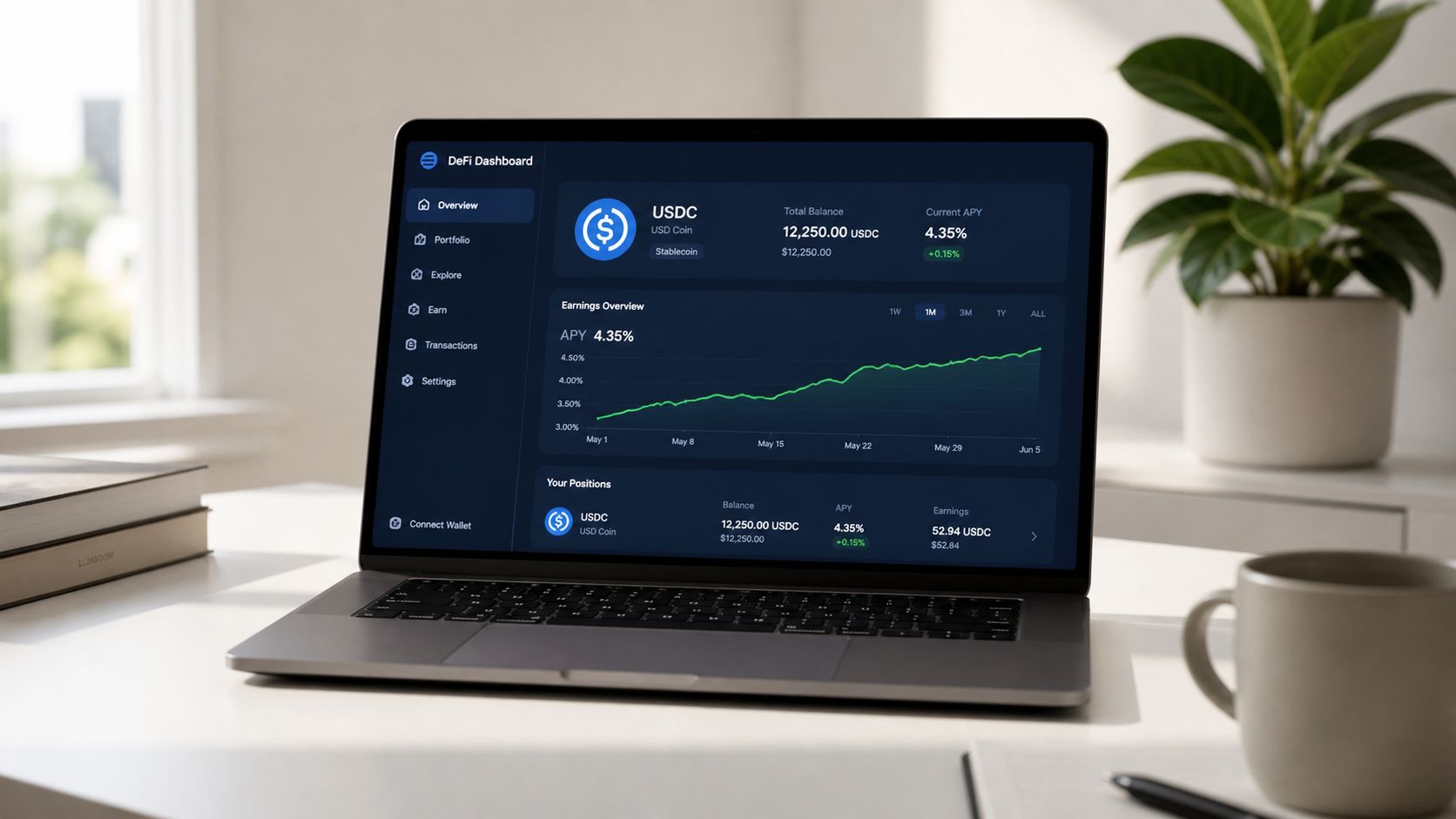
One option worth evaluating in this context is Yield Seeker, which shows balances and earnings clearly and uses an AI agent to monitor and allocate stablecoins across DeFi protocols in real time. Treat that as one reference point, not a substitute for checking the actual rules.
This overview of AI trading platforms is also helpful if you want to compare product categories before depositing funds.
Getting Started with AI for Crypto Trading
The right way to start is boring, and that's a good thing. You decide what you're trying to optimize, then you choose a system that can support that goal without hiding the risks. If you're a stablecoin holder, the first question isn't “How much can I make?” It's “How much volatility can I tolerate while still staying liquid?”
Start with the job you want the agent to do
If your priority is capital preservation, your strategy should look very different from someone chasing aggressive yield. Higher-return setups usually bring more protocol risk, more allocation churn, or more sensitivity to market conditions. That tradeoff has to be explicit from day one.
Next, check whether the platform explains its methodology in plain language. You should be able to see what data it reads, how it decides, and what would cause it to stand down. If the logic is vague, the risk is probably vague too.
Use a small, controlled rollout
Before putting real capital to work, begin with a tiny allocation and record what happens. Treat every move like a research note. Which pool or vault did the agent choose, what risk did it appear to be avoiding, and did the result match the stated logic?
A simple checklist helps here:
Capital access first: Confirm you can withdraw when you want, without surprise lockups or hidden exit costs.
Visible performance: Look for clear balance and earnings tracking, not just a summary score.
Risk explanation: Make sure the system says how it handles protocol risk, liquidity depth, and regime shifts.
Small initial size: Start small enough that a bad call teaches you something without wrecking your week.
Ongoing review: Revisit the strategy regularly, because a setup that worked last month can stop working after conditions change.
For community support and ongoing discussion, this list of the best crypto Discord servers in 2026 can help you find places where people compare tools and share practical observations instead of just posting screenshots.
The last step is discipline. Automated doesn't mean unattended forever. A good system should make monitoring easier, but you still need to check whether the strategy is behaving the way it said it would.
Yield Seeker gives you an AI-powered way to monitor and allocate stablecoin yield across DeFi without manually hopping between protocols. If you want a practical starting point for ai for crypto trading that stays focused on transparent allocation and accessible funds, visit Yield Seeker and compare its workflow against your own risk rules.