
You've probably split a dinner bill in a group chat, waited for two people to “send later,” and ended up chasing the last payment yourself. The same friction shows up in creator payouts, DAO grants, and team treasuries, where someone always becomes the human accountant. Automatic payment pools are built to remove that chasing, by turning distribution into rules that execute on their own.
A useful way to think about the broader operations problem is to compare it with accounts payable automation in traditional finance, where teams try to replace spreadsheets and manual follow-ups with software that routes money according to preset logic. The same coordination instinct appears on-chain, only the assets, trust model, and settlement rails are different. If you want a parallel from the back office world, the guide from Nexist is a good reminder that automation usually matters most when many small decisions keep landing on one person's desk.
The Everyday Problem Automatic Payment Pools Solve
A dinner bill is the cleanest example because everyone understands the pain immediately. One person pays, three others promise to reimburse, and the group chat becomes a mini collections desk. The math is simple, but the coordination is not.
That same pattern scales badly. A creator splitting revenue with editors, designers, and affiliates does not just need arithmetic. They need a reliable way to track who should receive what, when, and under which rules, without revisiting the same spreadsheet every week. The larger the group, the more time disappears into nudges, exceptions, and “Did you get my transfer?” messages.
Why manual coordination breaks down
Manual payout systems fail for boring reasons. People forget. Numbers drift. One participant pays early, another pays late, and the organizer becomes the backup ledger. In a treasury context, that means someone has to approve every disbursement and keep explaining the logic to new participants.
Practical rule: if a payout process still depends on one person remembering the full history, it's not automated enough.
That is the gap automatic payment pools try to close. They replace the ongoing social work of collection and reconciliation with a pool that records value, applies a rule, and settles distributions consistently. The value of the pool is not that it magically creates yield. The value is that it removes repeated coordination from the humans involved.
This is also why the idea shows up outside crypto. Businesses already use software to route invoices and approvals because handoffs are where mistakes creep in. On-chain pools apply the same logic to assets that need to be split, shared, or allocated according to predefined terms.
What an Automatic Payment Pool Actually Is
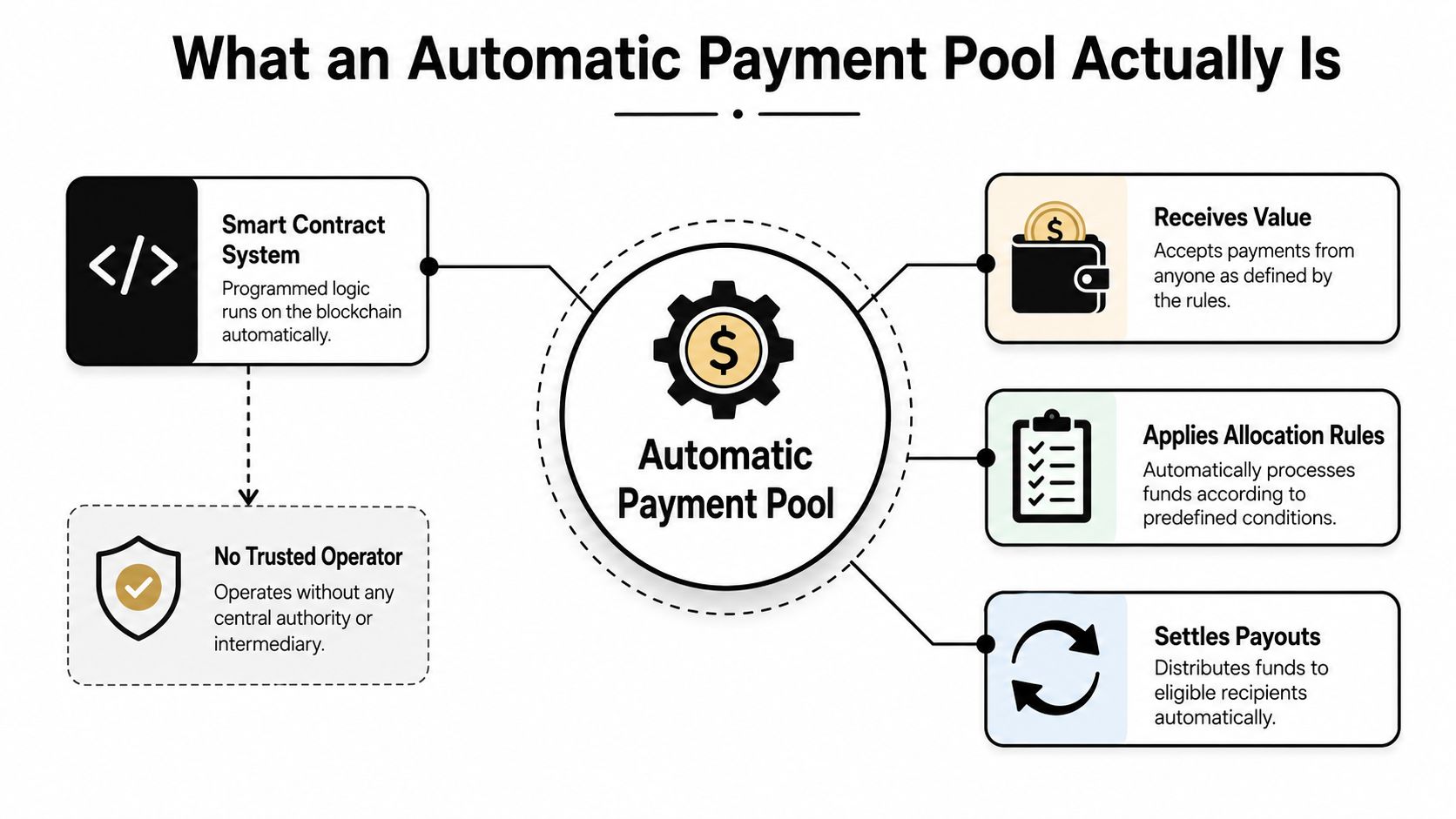
At the simplest level, an automatic payment pool is a smart-contract system that receives or accounts for value, applies explicit allocation rules, and settles payouts without a trusted operator deciding each distribution, as described in this overview of automatic payment pools. If that sounds abstract, think of a vending machine that also knows how to split every coin between several vendors based on preset shares.
The three moving parts
First, the pool has to receive value. That value might come from users, a protocol, or another contract. Once it enters the pool, the contract keeps track of who owns which portion of the whole.
Second, the pool uses allocation rules. Those rules can be simple, like “split by shares,” or more specific, like “allocate rewards only to members who deposited before a cutoff.” The important part is that the rule exists in code before the payout happens.
Third, the pool settles payouts automatically. No human approver should need to open a dashboard and manually decide who gets paid. The contract executes the distribution logic itself.
What matters more than people first expect is share accounting. If the pool tracks claims badly, every later payout becomes messy. In DeFi implementations, that usually means minting or tracking LP shares so participants can claim a proportional share of underlying assets or flow-based rewards. That is why the word automatic refers to the rule execution, not to guaranteed profit.
The pool is a rules engine for money, not a promise that money will grow.
If you remember one sentence, use this one. An automatic payment pool is a contract that holds or accounts for value, applies a pre-agreed distribution rule, and settles claims without a trusted operator deciding each payout.
How Pools Compare to Splitters, Treasuries, and Liquidity Pools
A lot of confusion comes from the fact that several on-chain tools move money automatically, but they automate different parts of the problem. A payment splitter forwards funds. A treasury holds funds. A liquidity pool prices assets and pays trading fees. An automatic payment pool focuses on distribution logic.
The easiest way to separate them is to ask one question, what decision is being automated? If the answer is “who gets paid and how much,” you're closer to a payment pool. If the answer is “who can approve the transaction,” you're looking at governance. If the answer is “how traders can swap between assets,” you're in liquidity-pool territory, like the kind explained in Yield Seeker's liquidity pool guide.
A simple comparison map
Construct | What It Automates | What It Does Not | Where Trust Lives |
|---|---|---|---|
Automatic payment pools | Distribution by preset rule | Market making or human approval | In the contract logic and share accounting |
Payment splitters | Forwarding incoming tokens | Dynamic allocation or payout discretion | In the fixed recipient list and contract code |
Multisig treasuries | Approval workflow | Automatic payout decisions | In the signers and signing policy |
Liquidity pools | Asset pricing and fee collection | Treasury governance or bill splitting | In the pool design and trading rules |
That distinction matters because people often mix up custody with coordination. A multisig treasury can be very secure, but it still depends on humans signing each action. A liquidity pool can be highly automated, but its goal is to facilitate trading, not to solve your team's reimbursement problem. Automatic payment pools sit in the middle, they are about distribution mechanics, not just holding money or pricing it.
For a practical business analogy, a liquidity pool is closer to market infrastructure, while an automatic payment pool is closer to payroll logic. The forex market liquidity and business impact discussion is useful background here because it shows how liquidity supports execution, but that is a different job from allocating funds to contributors or claimants. Different tool, different trust model, different outcome.
The Mechanics That Make an Automatic Payment Pool Work
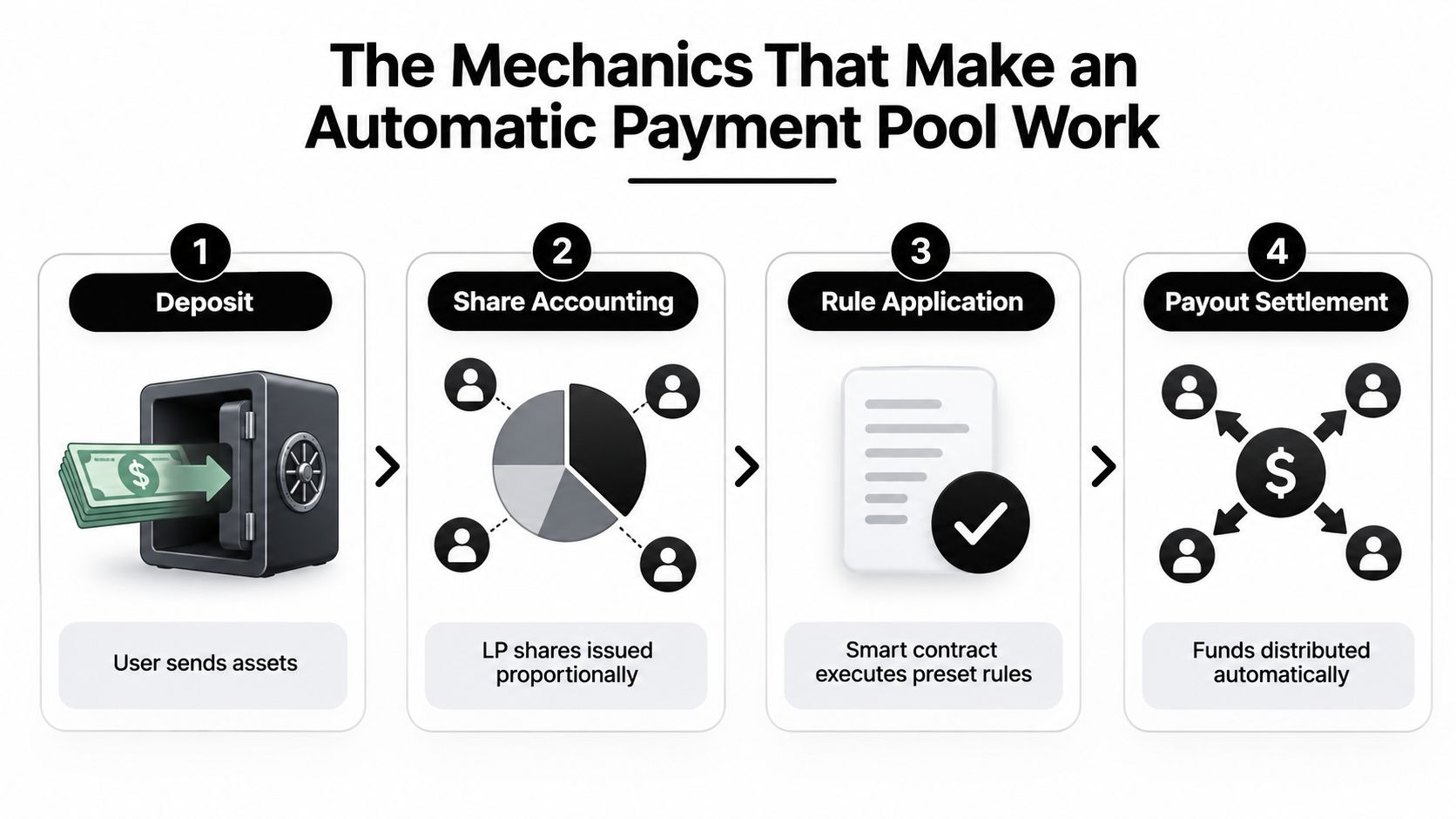
The technical details matter because a pool can only be trusted if the mechanics are hard to game. In production designs, the key controls are share accounting, unilateral exit, and slippage protection. Those are not fancy features. They are what stop the pool from becoming a black box.
Share accounting and unilateral exit
Share accounting means each depositor gets a claim that represents a proportional slice of the pool. If the pool collects fees or grows through its rules, the claim grows with it. If the pool shrinks, the claim shrinks too. That is the logic that keeps payouts fair without a human recalculating balances every time.
A Bitcoin payment-pool design goes even further. The research on Bitcoin pool mechanics describes a single shared UTXO, unilateral user withdrawal, and unspent funds staying inside the pool. In plain English, nobody has to ask permission to exit, and funds not withdrawn stay pooled for the rest of the participants.
A worked example
Say Alice deposits 1,000 USDC into a pool that issues shares based on contribution. If the pool later collects fees from activity routed through it, Alice's withdrawal is based on her share, not on a spreadsheet someone updates by hand. She walks away with her proportional claim plus any accrued value the pool design entitles her to.
That sounds simple, but the safety comes from rules around execution. On-chain AMM-style pools normalize deposit and withdraw messages to one asset pair and use fields like minimum LP quantity or minimum asset payouts to prevent bad execution when the state changes. That slippage protection matters because a pool can look fine at the moment of submission and still become worse by the time the transaction lands.
If you're reading contract docs, Yield Seeker's smart-contract explainer is a useful companion because it helps separate contract behavior from product promises. The core lesson is the same, a pool is only as reliable as its accounting and exit path.
Real Benefits and Honest Risks of Automatic Payment Pools
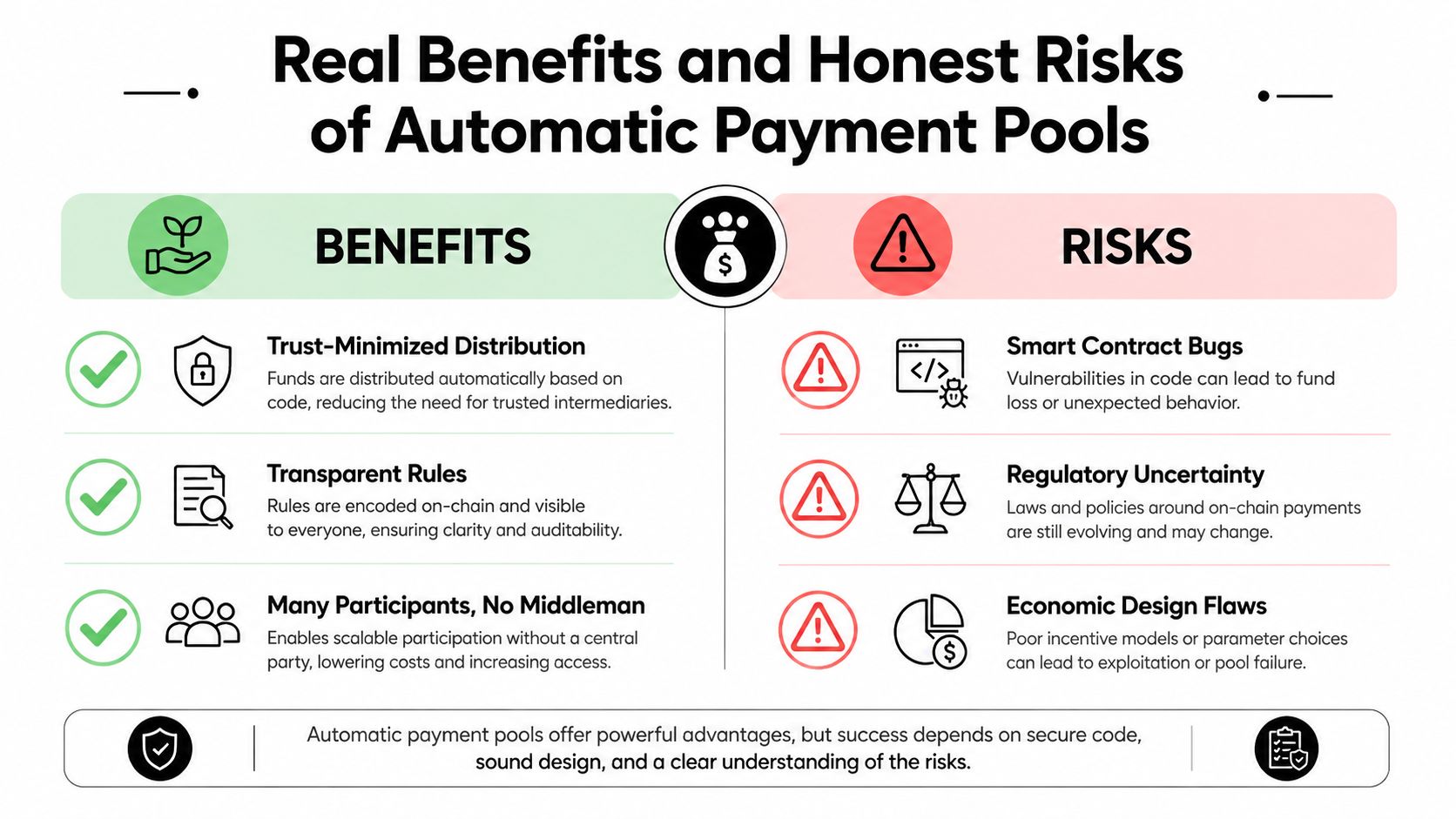
The strongest case for automatic payment pools is that they reduce trust friction. You no longer need to rely on one operator to remember the math, choose the recipients, and push the transfers. The contract does the repetitive part consistently.
What they do well
The first benefit is trust-minimized distribution. If the rule is encoded correctly, the pool applies it the same way every time. That helps in creator splits, team reimbursements, grants, and protocol distributions where fairness depends on predictable execution.
The second benefit is transparent rules. Participants can inspect how value moves, which is useful when people care more about process integrity than raw convenience. The third benefit is scale, because the pool can coordinate many participants without turning one person into a full-time admin.
What they do badly, or not at all
The marketing gets messy when pools are sold as passive income. Independent material still frames the underlying mechanism as liquidity provision, and one review notes that impermanent loss can reduce returns and that the strategy is not fully passive. That is the right mental model. Automation removes manual coordination, but it doesn't remove market risk, contract risk, or the need to monitor what you've deposited.
Automated doesn't mean unattended. It means the rule executes without hand-holding.
Smart-contract exploits remain a real concern, so audits, diversification, and insurance still matter. The fact that a pool is on-chain doesn't make it safe by default. It only makes the rules visible and the settlement deterministic, assuming the code behaves as intended.
There's also a behavioral trap. People hear “automatic” and assume “hands-off forever.” That's not how production DeFi works. The pool may distribute value on its own, but someone still has to understand the incentives, the risks, and the exit conditions.
Where Automatic Payment Pools Show Up in Real Life
A good way to understand pools is to follow the money paths people already use. The first is consumer group payments, where friends split travel, rent, or event costs. Cash App's 2025 launch announcement said market research found 60% of U.S. adults participate in some form of group money pooling, and Cash App is involved in about half of those cases, which shows how common shared-payment coordination has become in everyday life. The product framing itself is telling, because the point is to plan, collect, and track contributions before an expense occurs so nobody has to front the whole bill, according to the company's announcement at Cash App's launch page.
Creator and freelancer payouts are the second use case. A YouTube channel, a newsletter, or a DAO-funded project often needs to divide proceeds by role, contribution, or contract terms. That is exactly the kind of recurring distribution logic pools can handle more cleanly than a human revisiting the same split every cycle.
From treasuries to instant rails
The third use case is treasury distribution, especially in DAOs. Grant programs and protocol revenue share both need a rule for allocation, then a reliable way to settle it. If you've ever watched an ops lead reconcile contributor lists before a payout, you already know why this problem keeps showing up.
Brazil's Pix system shows that the same shift is happening in mainstream payments too. The central bank reported record settlement days of 239.93 million transactions on November 29, 250.56 million on December 6, and 252.13 million on December 20 in 2024, the highest daily total in Pix history, with Friday averaging 179.60 million settlements per day and Sundays averaging 113.54 million (SPI 2024 annual report). That doesn't describe crypto pools directly, but it does show that payment activity is moving toward fast, continuous, automated rails.
That's also why automatic payment pools and AI-driven yield tools shouldn't be confused. Pools automate distribution by rule. AI agents, like Yield Seeker's stablecoin product, automate yield allocation by monitoring protocols and rebalancing positions over time. I've found it useful to treat them as complementary layers, one handles who gets what, the other handles where idle capital should work.
If you're mapping this back to accounting workflows, the intercompany accounting guide is a good reminder that shared-value movements get messy fast when entities, rules, and settlement timing aren't aligned.
Implementation Checklist Before You Use Any Payment Pool
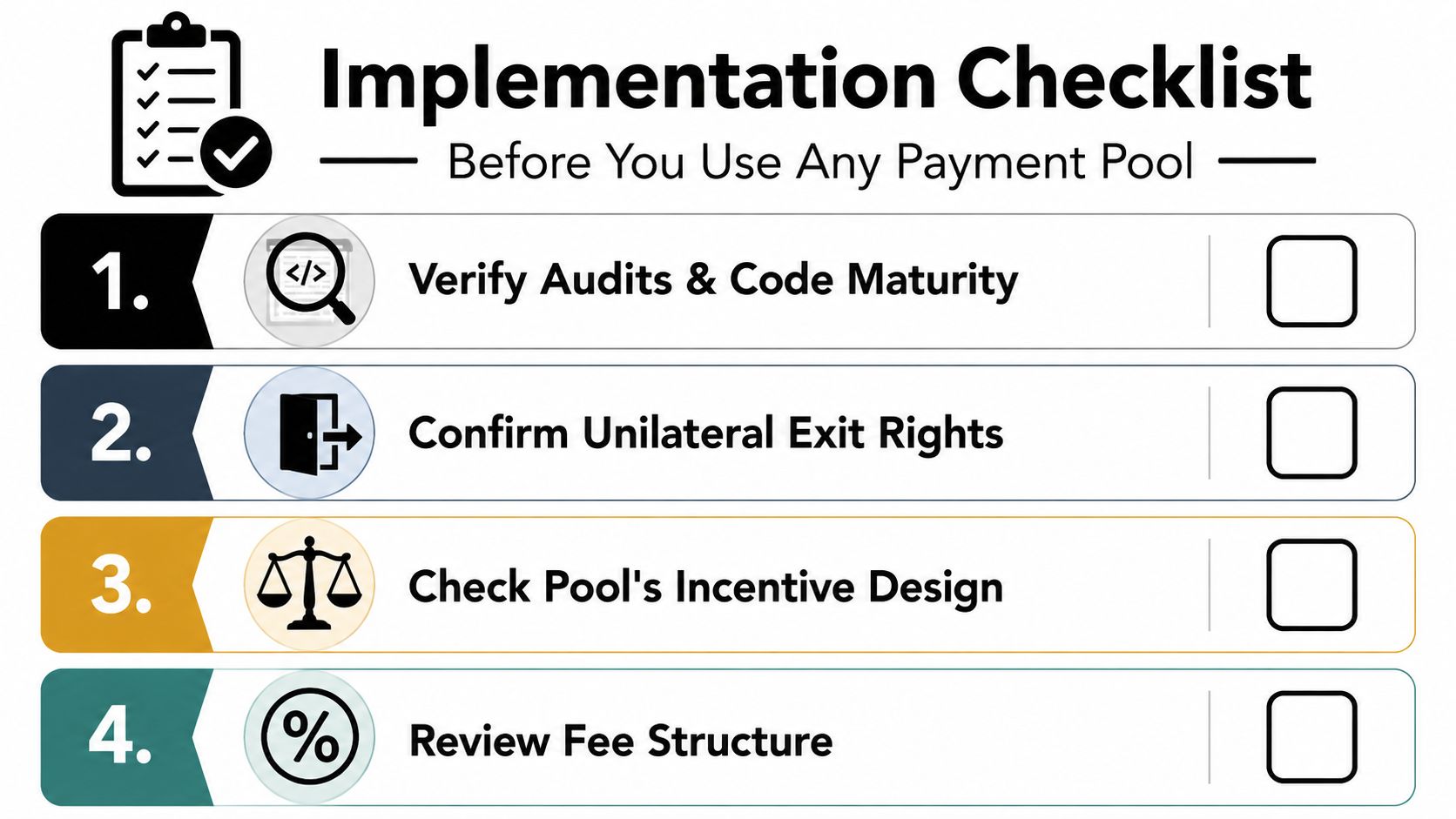
Before you deposit anything, start with the code, not the marketing. If the contract has not been audited, or the repo looks immature, you're taking on more risk than the interface admits. The question is not whether the product sounds automated, it's whether the automation is inspectable.
A practical due-diligence sequence
Verify audits and code maturity. Look for reviewed contracts, not just a polished landing page.
Confirm unilateral exit rights. If you can't withdraw without asking permission, the pool is too dependent on someone else.
Check diversification and allocation logic. You need to know what the pool is exposed to and how claims are computed.
Review capital sizing and fee structure. One review notes that starting with $100 is technically possible but that returns would be tiny, which means capital efficiency matters more than beginners expect, especially as payment rails get cheaper and fees get thinner, a point echoed in coverage of automatic payment pool economics.
If you can't explain the pool's allocation rule and exit path in plain English, don't deposit. That's the cleanest decision rule I know.
Decision test: if you need a thread, a Discord mod, or a support ticket to understand how your funds leave the pool, the design is too opaque.
For teams that want automation without surrendering control, Yield Seeker's treasury management best practices are a useful contrast point. Its no-lockup, no-withdrawal-fee approach shows how automation products can sit beside pools without forcing users to hand over custody or abandon flexibility.
Frequently Asked Questions About Automatic Payment Pools
Are automatic payment pools passive? No. They reduce manual distribution, but they do not remove smart-contract risk, market risk, or the need to monitor how the pool is behaving.
How much capital do I need for meaningful returns? There isn't a universal threshold, but small deposits are usually constrained by fee economics. If returns are tiny at a low balance, the pool may be a poor fit for your capital base.
How are pools different from AI yield agents like Yield Seeker? Pools execute preset distribution rules. AI agents watch protocols, compare opportunities, and reallocate capital dynamically. One is rule-based settlement, the other is active allocation.
Can you lose money in a pool? Yes. Smart-contract bugs, impermanent loss, and thin fee generation can all reduce or erase gains.
The takeaway is simple, automation is useful when the problem is coordination, not when the problem is guaranteed profit. If you want to keep learning how smarter allocation works in practice, explore Yield Seeker and compare rule-based pooling with AI-guided stablecoin yield management.