
Stablecoin yield looks simple until you're managing it. You open one dashboard for APYs, another for wallet balances, a third for protocol risk, then copy numbers into a spreadsheet and hope nothing changed while you were comparing them. By the time you decide, a better pool has already cooled, a fee spike has eaten the edge, or the safest-looking option has drifted into something you wouldn't have chosen on purpose.
That's the appeal of AI portfolio optimization in DeFi. It's not magic alpha. It's continuous monitoring, faster reaction, and rebalancing without the emotional lag that makes humans hold stale positions too long. The hard part is that DeFi doesn't reward raw speed by itself. It rewards speed after gas, slippage, liquidity fragmentation, and smart-contract risk.
The question worth asking isn't whether AI can optimize a portfolio in theory. It's whether it can beat a simple benchmark after costs in a market where conditions change fast and the frictions are real. That's a much harder bar, and it's the right one.
Why Stablecoin Holders Are Turning to AI Portfolio Optimization
A lot of stablecoin holders start the same way. They track a few pools, bookmark a few vaults, and tell themselves they'll rotate capital when the market shifts. Then life happens, a dashboard is left unopened for a day, and the opportunity that looked best last night is gone by morning.
That's where AI portfolio optimization earns attention. It doesn't just rank yields once and stop. It can monitor changes continuously, pull in fresh data, and propose reallocations when the spread between options matters. In practice, that means less spreadsheet juggling and more timely decisions.
The promise is attractive because DeFi yield is unstable by design. Liquidity migrates, incentives change, and one protocol can look great until everyone else piles in. AI helps by watching more inputs than a human can reasonably monitor at once, then surfacing when the trade-off has shifted.
But the skepticism should stay loud. A higher APY is meaningless if the rebalance costs more than the gain, or if the protocol behind the yield is carrying hidden fragility. AI doesn't cancel that math. It just gives you a faster way to confront it.
Practical rule: if an allocation system can't explain what it would do during a fee spike, a depeg scare, or a liquidity drain, it isn't a portfolio manager. It's a dashboard with ambition.
This is why the best DeFi use case isn't “let the model chase yield anywhere.” It's “let the model keep scanning, keep comparing, and keep the portfolio moving only when the net outcome still makes sense.” That framing is boring, but it's closer to how capital survives.
The Core Concepts Behind AI Portfolio Optimization
Traditional portfolio construction starts with a familiar tension, return versus risk. The classic Markowitz framework tries to find a balance between expected upside and volatility, which is still useful as a mental model even when the assets are stablecoins and yield-bearing DeFi positions. The difference with AI is that the model doesn't have to stop at a single snapshot.

From static allocation to feedback control
A good way to think about AI allocation is a thermostat. You set a target temperature, the thermostat measures the room, and it nudges heating or cooling when conditions drift. AI portfolio optimization works the same way, except the room is a changing market and the dial is your allocation.
That matters because a static spreadsheet doesn't react. It assumes today's yield, today's liquidity, and today's risk stay close enough to yesterday's assumptions. AI adds a feedback loop, so the system can revise its view as conditions change.
The shift is bigger than prediction. A model can forecast returns, but the portfolio engine still has to decide whether a new signal is strong enough to justify a rebalance. That decision layer is where most real-world implementations succeed or fail.
The three layers that have to work together
A production system usually needs three pieces.
Signal layer: this turns raw inputs into forecasts or scores, such as protocol yield changes, liquidity shifts, or volatility clues.
Decision layer: this converts signals into an actual allocation, which means choosing when to rotate, how much to move, and when to do nothing.
Risk layer: this blocks bad moves by enforcing concentration limits, liquidity checks, and other guardrails before capital moves.
Those layers are why a model that looks impressive in a notebook can still be useless in production. The signal may be sharp, but if the decision layer churns too often or the risk layer is too loose, the portfolio gets expensive fast. The useful mental model is simple. AI portfolio optimization is not a single algorithm, it's a control system.
Common Machine Learning Approaches Used in Practice
The three machine learning families that show up most often in allocation systems each solve a different problem. Reinforcement learning tries to learn how to act. Bayesian optimization tries to tune a strategy efficiently. Neural networks try to extract signal from noisy inputs. None of them is universally best, and in DeFi the production choice is usually narrower than the research literature suggests.
Reinforcement learning for policy learning
Reinforcement learning is the strategist. It learns by trying actions, observing outcomes, and adjusting its policy over time. In portfolio terms, that makes it useful when the problem is less about forecasting one number and more about choosing a sequence of actions under uncertainty.
It tends to need a lot of simulated experience, which is why it shows up more in research or in systems with strong scenario generation. For a DeFi allocator, that can mean learning when to rotate between pools, when to sit still, and when the expected gain is not worth the turnover. The weakness is obvious. If the simulation assumptions are wrong, the learned policy can be confidently wrong too.
Bayesian optimization for parameter search
Bayesian optimization is the tuner. It's useful when you already have a strategy structure and need to find the best settings without wasting live trials. That makes it practical for optimizing thresholds, weighting rules, or rebalance parameters when every experiment costs time or capital.
It works best when the search space is reasonably bounded and the objective can be measured clearly. In a DeFi setting, that can be a huge advantage, because you often don't need a model that invents a strategy from scratch. You need one that can tune an existing process without overfitting the latest market noise.
Neural networks for pattern extraction
Neural networks are the signal-extractors. They're strong when the input stream is messy, nonlinear, and mixed across sources, which is common in on-chain data. They can turn scattered information into a forecast or ranking that a simpler rule would miss.
The catch is production discipline. Neural nets can overfit easily, especially when the market regime changes and historical relationships stop behaving. That's why they're often best used as one part of a broader allocation stack instead of the whole stack.
If you're evaluating a small DeFi team, the most likely thing they'll ship is the simplest version that can run reliably. For a practical overview of how these approaches show up in trading systems, this breakdown of machine learning trading algorithms is a useful companion.
Designing Objectives That Actually Respect Risk
A lot of AI allocation systems fail before the model even matters. The objective is wrong. If the system is told to maximize raw APY, it will happily chase yield that looks great until the cost of moving capital, the drawdown profile, or the protocol risk makes the result unacceptable.
The objective function has to reflect the job. That means it should account for expected yield, volatility, drawdown limits, smart-contract risk weights, and concentration caps. If one of those pieces is missing, the optimizer is solving the wrong problem very efficiently.
The best objective in stablecoin yield is the one you would still defend after a depeg event.
Multi-objective optimization is the real game
In practice, the system shouldn't collapse everything into a single vanity number. Yield matters, but so do liquidity and survivability. A multi-objective setup lets the allocator trade off return against risk instead of pretending risk is a separate concern.
That also keeps the system honest when the market gets noisy. A strategy that looks marginally better on yield but increases exposure to a fragile protocol should not automatically win. Human operators understand this instinctively. The objective function needs to understand it too.
The cleaner the objective, the easier it is to reason about the model's behavior. This is why so much of the edge in AI portfolio optimization comes from engineering the rules, not from hunting for an exotic architecture.
For a concrete way to think about weighing return against risk, this guide to risk-adjusted returns calculation is a practical reference.
Backtesting and Evaluation Without Fooling Yourself
Most portfolio backtests look better than live trading because they're too polite. They run on historical data, optimize the path they already know, and then report a clean metric that hides the ugly parts. That's especially dangerous in DeFi, where the market structure from one regime can look nothing like the next.
Why naive backtests flatter the model
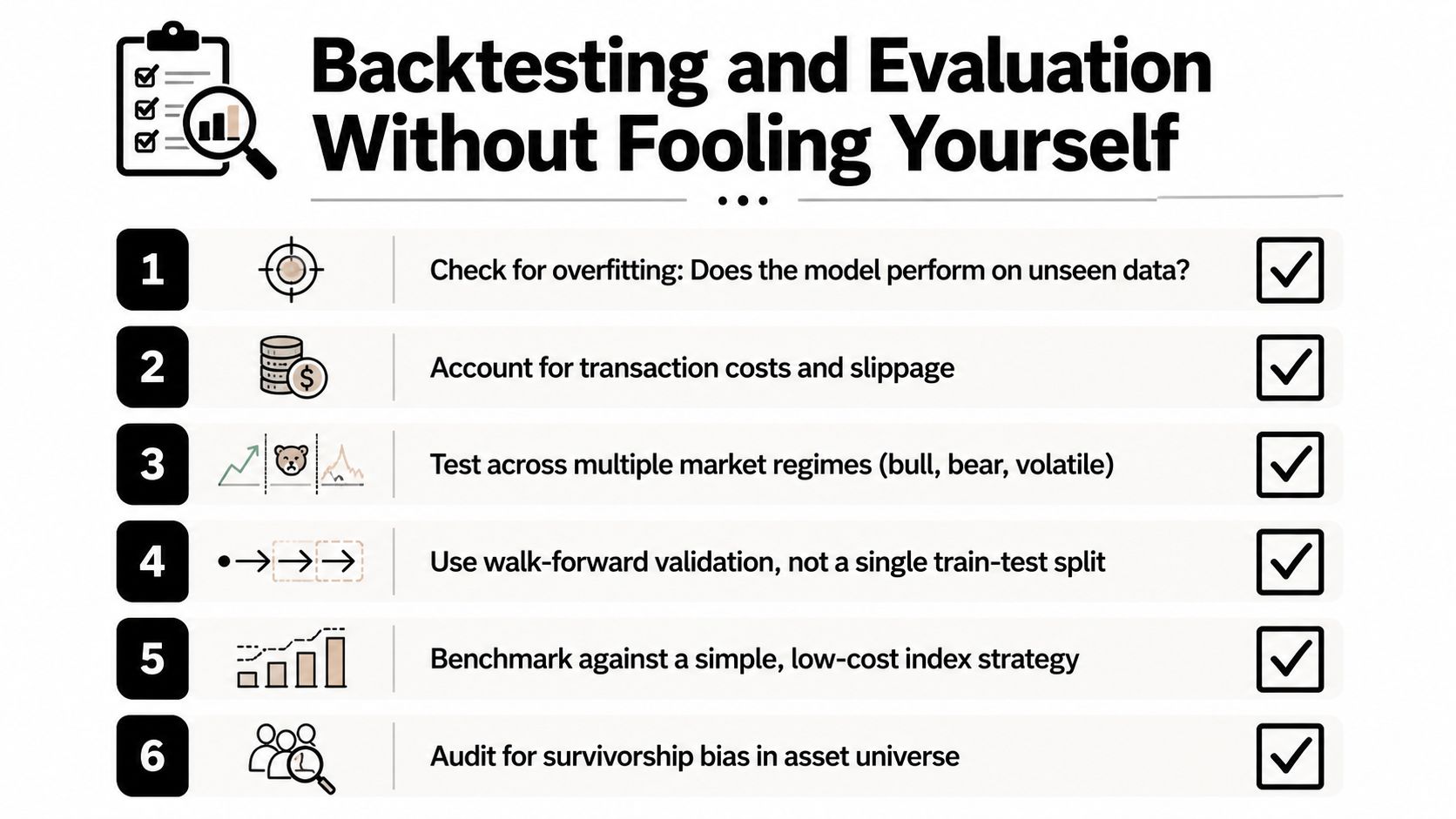
A model that sees only the survivors gets a distorted picture of the world. That's survivorship bias. If the dataset contains mostly protocols that are still around, the optimizer never learns how badly a broken protocol can hurt the portfolio.
Regime shift is the other trap. Correlations, liquidity, and fee conditions change, and a strategy tuned on one window may break as soon as the market structure changes. That's why a single train-test split is not enough.
Walk-forward validation is a better baseline. Rolling windows let you test the model repeatedly across changing conditions instead of assuming one historical split tells the whole story. It doesn't guarantee live success, but it's much closer to the truth than a one-and-done backtest.
A useful way to sanity-check the process is to compare against a simple, low-cost benchmark, not just another optimized portfolio. Tools that help investors compare portfolio tools for equity investors can be a good reminder that simplicity is often the standard to beat, not the fallback to ignore.
The questions the backtest has to answer
Before trusting any yield system, the team should be able to answer these plainly.
What was the benchmark? Without a simple comparator, the result has no context.
What period did you test? A short or convenient window can hide the fragile parts.
What happened to turnover and costs? If rebalancing frictions weren't included, the result is incomplete.
What was the worst drawdown? A smooth equity curve without stress testing can be misleading.
Did the model see the future indirectly? Leakage can creep in through features, timing, or bad data handling.
That checklist matters more than any single Sharpe number. If an AI yield platform can't answer it cleanly, the backtest is marketing, not evidence. For a more detailed operating view, this resource on automated portfolio rebalancing is worth reading alongside any model claims.
What Breaks in DeFi That Equity Models Never See
Equity models often assume the plumbing is boring. DeFi doesn't give you that luxury. A stablecoin can depeg and drain a pool in hours, a gas spike can make a rebalance irrational, and a withdrawal queue can trap capital right when you want out.
Those are not edge cases in DeFi, they're core design constraints. An allocator that ignores them is optimizing a world that doesn't exist.
Why the market microstructure changes the model
A yield source with attractive APY can still be a bad decision if the path in and out is messy. Slippage matters when liquidity is thin. Bridging costs matter when capital has to move across chains. Smart-contract risk matters because the yield exists only as long as the code behaves.
That means the optimizer needs to think in terms of effective yield, not headline yield. A pool that looks stronger on paper may be weaker once you account for execution costs and the probability that you can exit when needed. Equity-style models can miss that because the friction profile is different.
The practical consequence is blunt. DeFi allocators need protocol-aware scoring, not just market-aware scoring. They have to penalize concentration in fragile venues and avoid rebalancing into a fee structure that eats the advantage.
What a DeFi-native model has to monitor
A usable AI system should explicitly track the things that break stablecoin strategies.
Protocol risk: contract exposure, dependency chains, and operational fragility.
Liquidity depth: whether capital can move without creating its own problem.
Slippage and gas: the cost of execution, not just the expected return.
Withdrawal friction: how quickly funds can leave if conditions deteriorate.
That is the practical difference between DeFi and equities. The second you move from theory into on-chain execution, the optimizer has to care about settlement reality. Without that, it's just a prettier version of a broken spreadsheet.
The Case for Hybrid AI and Human Decision Making
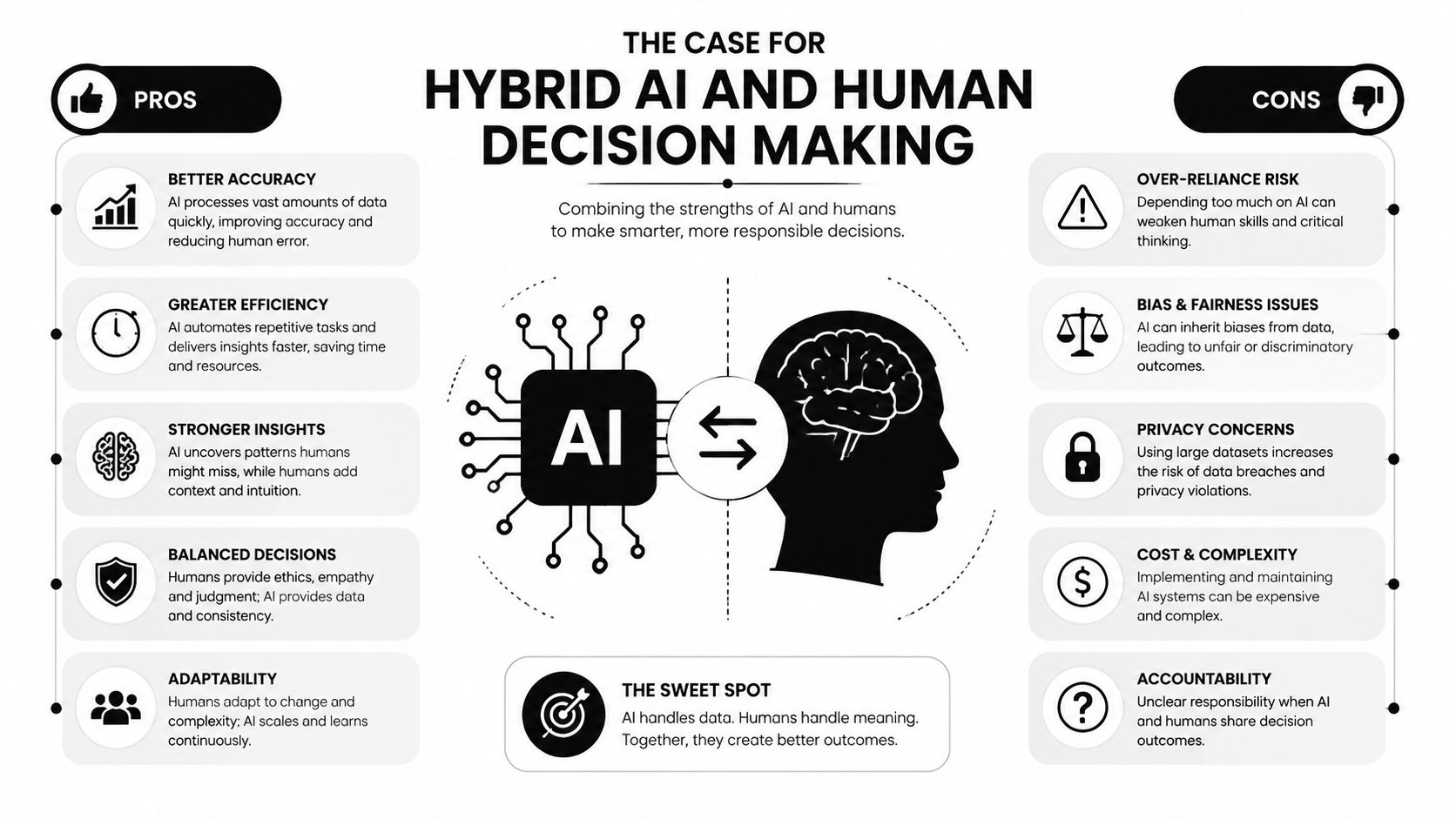
The best use of AI in portfolio optimization is often not full autonomy. It's a hybrid where the model handles scanning, scoring, and routine rebalancing, while humans or hard rules keep the boundaries explicit. That sounds less flashy than a fully autonomous agent, but it's usually easier to trust and easier to debug.
The reason is simple. AI is good at pattern extraction, but it gets less comfortable when the regime changes sharply or the data stops looking like the training set. Deterministic rules are less clever, but they're visible. In a yield system, visibility is often worth more than theoretical elegance.
Where the hybrid approach actually shines
Protocol allowlists are a good example. A model can rank opportunities, but a human-set allowlist decides which protocols are even eligible. That reduces the chance that a strange new venue sneaks into the allocation just because it looked attractive on a narrow feature set.
Drawdown circuit breakers belong in the same category. If performance deteriorates beyond a chosen threshold, the system should stop acting like a pure optimizer and behave like a controlled machine. Concentration caps do the same thing. They prevent a model from becoming too confident in one protocol or one liquidity source.
If you want a practical framing for that balance, this guide on when to use HITL vs automation maps well to DeFi operations. The useful insight is that human-in-the-loop isn't a weakness. It's how you keep AI useful after the market gets messy.
How to Evaluate Any AI Yield Platform or Agent
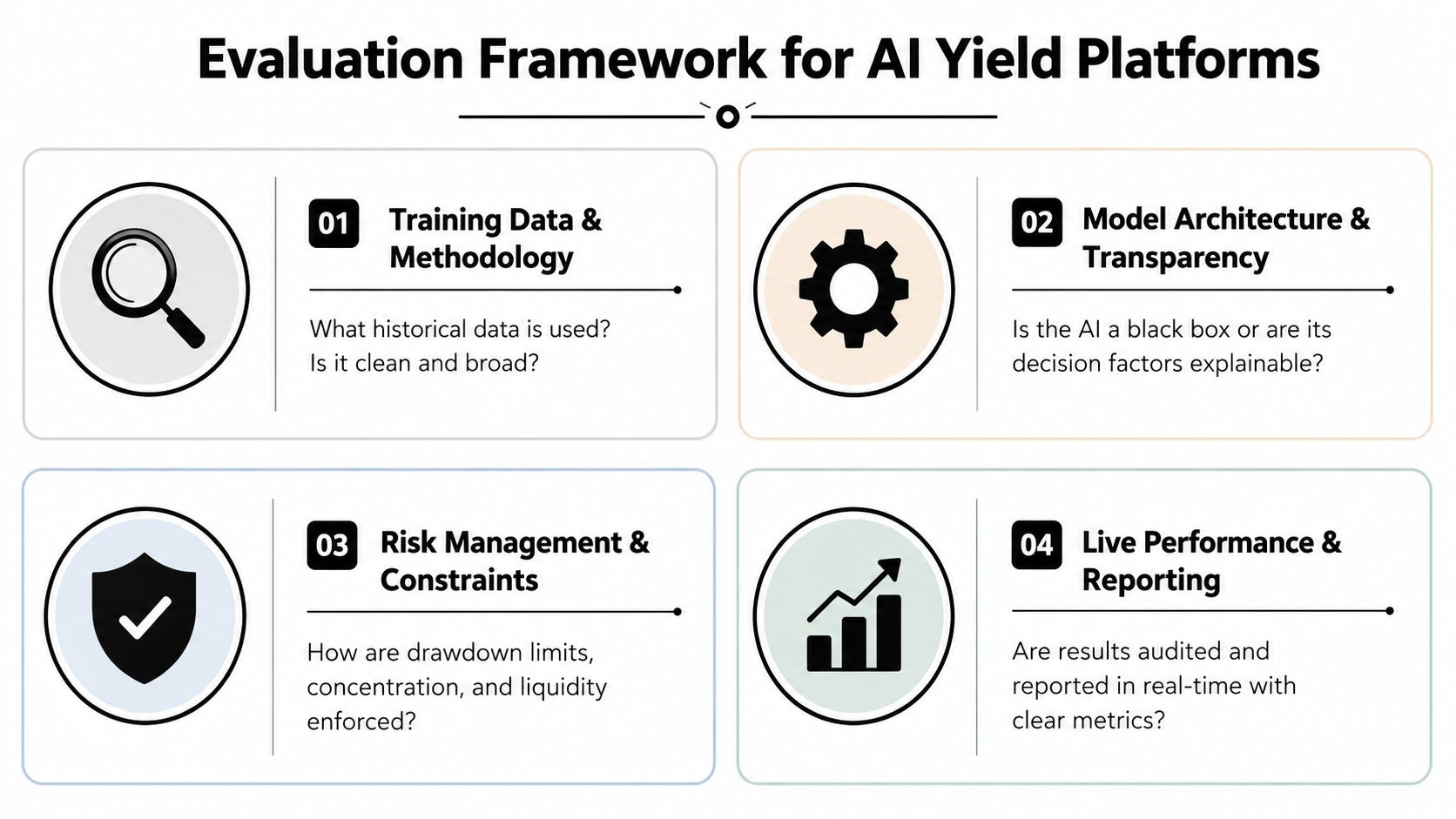
The fastest way to separate substance from pitch deck is to ask how the system behaves when it's wrong. A serious platform should be able to explain its training data, model design, risk controls, and live reporting without hiding behind vague language. If those answers stay fuzzy, the system is probably optimized for acquisition, not allocation.
The evaluation questions that matter
Start with the data. Ask what feeds the model, how fresh the inputs are, and whether the system accounts for on-chain liquidity and execution costs. Then ask what the objective optimizes, because “max yield” is usually too shallow to be useful.
Next, ask how often it rebalances and what happens when the model disagrees with the user's constraints. A good platform should expose risk, not bury it. It should also make clear whether funds remain accessible and whether the user keeps control of the capital path.
That's where a platform like Yield Seeker is relevant as an example of an AI allocation agent design. It keeps funds accessible, surfaces risk, and lets the user stay in control while the agent monitors and reallocates across DeFi protocols in real time. Used properly, that's the kind of design that fits the realities discussed above rather than pretending they don't exist.
If you're also thinking about the business side of building agents, this overview of AI agent revenue strategies is useful context for how products like this get packaged and sustained.
A simple checklist to keep nearby
Training data: Is the data clean, broad, and current?
Transparency: Can the system explain its decisions in plain language?
Risk controls: Are drawdowns, concentration, and liquidity enforced?
Live reporting: Are results visible in real time with clear metrics?
If you're evaluating stablecoin yield today, stop looking for a model that sounds clever and start looking for one that respects the cost of being wrong. Yield Seeker is built around that premise, with an AI agent that monitors DeFi opportunities, keeps capital accessible, and surfaces risk instead of hiding it. Visit it with the checklist above in hand, and compare what it does against the benchmark that matters most, your own net outcome after costs.