
A lot of people learned the wrong lesson from Terra. They decided every algorithmic stablecoin is a scam, full stop.
The better lesson is harsher and more useful. Purely reflexive designs break under pressure. Smarter hybrids can still be useful, but only if you treat them as risk products first and stablecoins second.
The Promise and Peril of Algorithmic Stablecoins
Algorithmic stablecoins still matter, even after their reputation was wrecked. As of early 2026, they account for $682.7 million of market value, or 0.21% of the $318 billion stablecoin market, yet 33% of crypto users held them in 2025, according to SQ Magazine's algorithmic stablecoin statistics.

That combination tells you something important. This category is small, but it isn't dead. Investors still come back because the core idea is powerful: create a dollar-like asset that doesn't rely entirely on a bank account full of reserves or a centralized issuer.
Why the idea is so compelling
A traditional stablecoin usually asks you to trust a custodian, its reserves, its banking partners, and its compliance stack. An algorithmic stablecoin tries to replace some of that trust with code. The protocol expands or contracts supply in response to market price, aiming to keep the token near one dollar.
That design offers two big attractions:
Capital efficiency because the system doesn't always need full fiat backing
Programmability because the monetary policy lives on-chain and can interact directly with DeFi
For builders, that's exciting. For investors, it's dangerous if you don't understand the mechanism.
Practical rule: If a stablecoin claims to be efficient, ask what absorbs the stress when demand disappears.
Where the danger starts
The same feature that makes algorithmic designs elegant also makes them fragile. If the peg depends on traders believing the system will recover, confidence itself becomes part of the collateral. That's fine in calm markets. It becomes brutal in a panic.
This is why algorithmic stablecoins are so controversial. They sit at the intersection of innovation and reflexivity. They can enable new forms of on-chain liquidity and yield, but they can also fail in ways that look stable right up until they aren't.
If you're evaluating one, don't start with the APY. Start with failure modes. A good primer on those risks is this breakdown of stablecoin risk factors.
How Algorithmic Stablecoins Try to Maintain Their Peg
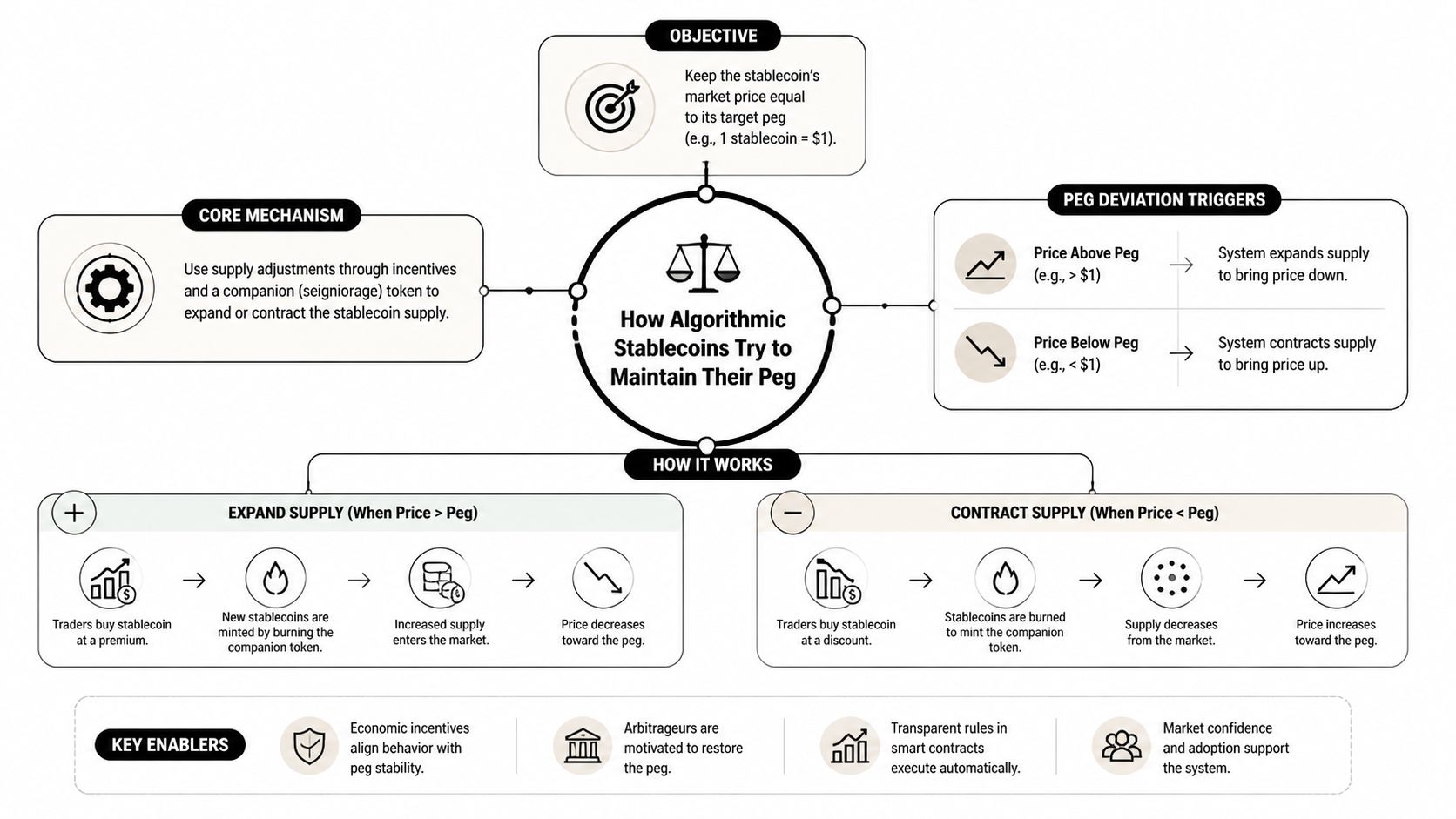
The simplest way to understand an algorithmic stablecoin is to think like a central bank, except the policy is hardcoded. The protocol watches price, then changes supply.
If the token trades above $1, the system tries to increase supply. If it trades below $1, the system tries to reduce supply. The entire category is built around that basic idea of supply elasticity.
Seigniorage systems
In a seigniorage model, the protocol uses incentives to pull price back toward the peg. When the stablecoin trades above one dollar, smart contracts mint more tokens. When it trades below one dollar, the system tries to remove tokens from circulation, often by offering discounted bond-like instruments or by routing losses into a secondary token.
Chainlink's explainer describes it this way: in a seigniorage system, smart contracts automatically mint tokens when the price is above $1 and create incentives like discounted bond tokens to burn tokens when the price is below $1. That same source notes that fractional-algorithmic hybrids like Frax maintained peg variance under 0.5% in volatile markets by backing 80-90% of supply with collateral such as USDC.
That last point matters. A seigniorage design isn't automatically reckless. What matters is whether the system has an actual shock absorber.
What happens above and below peg
Situation | What the protocol tries to do | What can go wrong |
|---|---|---|
Price above $1 | Mint more supply | New issuance can outrun real demand |
Price below $1 | Burn or lock supply through incentives | Incentives fail if nobody trusts recovery |
Sharp market stress | Push losses into a secondary mechanism | The secondary asset can collapse too |
A lot of investor confusion comes from treating these systems like reserve-backed dollars. They aren't. They're incentive machines.
Rebase systems
A rebase stablecoin works differently. Instead of relying mainly on a secondary token, it changes holder balances directly. If price is above target, wallet balances expand. If price is below target, balances contract proportionally.
That means your token count can change even when you haven't traded. The protocol is trying to preserve target purchasing power by adjusting supply at the wallet level.
For some traders, that's elegant. For most passive investors, it's awkward. Rebase systems can be hard to price mentally because the unit count changes while market sentiment still drives the token's actual trading behavior.
Why hybrid models changed the conversation
The strongest post-Terra designs aren't pretending code alone is enough. They blend collateral with supply adjustments. That gives the protocol a real reserve buffer while keeping some of the flexibility that made algorithmic systems attractive in the first place.
In practice, that usually means asking three questions:
What percentage is hard-backed? If collateral supports most of the system, the peg has a firmer base.
What absorbs volatility? A governance or secondary token can still help, but it shouldn't be the only line of defense.
How transparent is the mechanism? If you can't explain the mint-burn path in plain English, don't allocate meaningful capital.
The best modern designs don't try to eliminate trade-offs. They try to make them explicit.
Collateralized Coins vs Algorithmic Designs
The cleanest way to judge an algorithmic stablecoin is to compare it with the product most investors already know: the fully collateralized stablecoin. Think USDC on one side, an algorithmic or hybrid design on the other.
They solve the same problem in very different ways.

The core trade-offs
A collateralized coin wins on simplicity. You hold the token because you believe the issuer can redeem it and the reserves are there. The risk is mostly off-chain and institutional.
An algorithmic stablecoin moves more of that logic on-chain. That can improve capital efficiency and reduce dependence on a single custodian, but it also introduces market-structure risk. If incentives stop working, the peg can fail fast.
Side-by-side view
Design | Main strength | Main weakness | Best fit |
|---|---|---|---|
Fully collateralized stablecoins | Clear reserve logic and familiar redemption model | More centralized and less capital efficient | Cash management, low-complexity DeFi |
Pure algorithmic stablecoins | Maximum on-chain monetary flexibility | Most fragile under confidence shocks | Speculative strategies only |
Hybrid algorithmic stablecoins | Balance of collateral support and programmable supply | More moving parts to analyze | Risk-aware DeFi yield seekers |
Why some investors still choose the riskier model
The answer isn't ideology. It's utility.
Algorithmic designs can be more composable inside DeFi. They can route incentives differently, support protocol-native liquidity, and sometimes produce better yield structures because they aren't carrying the same reserve burden as a fully backed issuer. That doesn't make them safer. It makes them potentially more productive for the right use case.
Many beginners go wrong when they compare a hybrid algorithmic stablecoin to USDC as if both are just "digital dollars." They aren't. One is closer to cash. The other is closer to a strategy wrapped in a dollar target.
If you want something to park payroll or emergency funds, use the most boring stablecoin available. If you want on-chain yield, you need to accept a more complex risk stack.
For investors who want a baseline understanding of the most common fully backed option, it's worth reviewing how USDC works in practice.
The Catastrophic Collapse of Terra and the Rise of Hybrids
May 2022 changed how serious DeFi builders talk about algorithmic stablecoins. TerraUSD did not just lose its peg. It showed what happens when a stablecoin promises resilience but depends on confidence and a reflexive token loop to survive a bank run.
According to the World Economic Forum's analysis of stablecoin research, the Terra collapse wiped out over $40 billion, and the designs that followed shifted hard toward hybrid models that mix collateral with algorithmic controls. That change was not cosmetic. It reflected a basic lesson the market learned the expensive way.
How the death spiral worked
UST targeted one dollar through a mint and burn relationship with LUNA. If UST traded below $1, arbitrageurs could buy discounted UST, redeem it for $1 worth of LUNA, and sell the LUNA. In calm markets, that mechanism can pull price back toward the peg.
Under stress, it can break in exactly the wrong direction.
As redemptions surged, more LUNA hit the market. That pushed LUNA lower. A weaker LUNA made the backstop less credible, which led to more selling of UST, which created more LUNA issuance. Once traders stopped believing the loop would restore the peg, the mechanism stopped acting like a stabilizer and started acting like an accelerant.
That is the failure pattern investors need to understand. A design can look elegant in normal conditions and still fail fast when liquidity thins and trust disappears.
What changed after Terra
The strongest response to Terra was architectural, not rhetorical. Builders stopped treating pure reflexive design as a serious foundation for a dollar-pegged asset meant to hold size, support collateralized borrowing, or sit inside yield strategies for long periods.
Hybrid models came out of that reset. They usually combine three elements:
Partial or dynamic collateral backing
Algorithmic supply adjustment around the peg
Tighter risk controls on minting, redemptions, or incentive emissions
That mix introduces its own complexity, but it improves the failure path. If demand drops, the system is not relying only on market belief in a secondary token. There is at least some reserve base, some redemption logic, and usually more room for governance or automated controls to slow reflexive unwind.
Why hybrids deserve attention
A fractional system such as Frax is easier to take seriously because the peg does not rest on one volatile absorber token and a hope that arbitrage stays profitable. Collateral provides support. Algorithmic policy manages supply elasticity and capital efficiency around that support.
For yield-oriented investors, that matters. The post-Terra question is no longer whether "algorithmic" is good or bad. The critical question is whether the mechanism is conservative enough to stay useful during stress, while still producing better capital efficiency than a fully reserved stablecoin.
That is also why modern hybrid stablecoins are showing up in more disciplined on-chain strategies. They are not being treated as cash equivalents. They are being evaluated as structured DeFi instruments with a peg target, a collateral policy, and a yield profile that can make sense if the risk controls are strong enough.
When I review one of these systems, I focus on operational failure points first:
What happens if redemptions spike for 72 hours straight?
How transparent is the collateral, and how often does it change?
What asset or group absorbs losses if the peg slips?
Does the yield come from real usage, or mostly from subsidies?
Those questions matter more than branding.
Teams deploying larger balances should also assess how any hybrid stablecoin fits within reserve policy, liquidity needs, and rebalancing rules. This guide to stablecoin treasury management is a useful complement if you're evaluating these assets beyond a small speculative allocation.
A Practical Guide to Algorithmic Stablecoin Yield
If you're considering yield from an algorithmic stablecoin, the first job isn't finding the highest return. It's figuring out what the yield is paying you to tolerate.
That distinction matters because the best opportunities in this category usually come from complexity. A hybrid design can distribute value through lending demand, liquidity incentives, or seigniorage-linked mechanics. The return can be attractive, but only if the peg mechanism and collateral structure deserve your trust.
According to Stripe's resource on the category, hybrid algorithmic stablecoins like Frax can enable risk-adjusted yields of 5-15% APY, and 40% of new stablecoin TVL in 2025 flowed into hybrid designs. That's enough to explain why investors still care.
What to check before allocating
I use a simple screen. If a protocol fails any one of these tests, it doesn't belong in a passive yield bucket.
Peg behavior over time
Look for consistency, not marketing. A token that regularly wanders away from its target is telling you something about demand quality and mechanism strength.Collateral clarity
In a hybrid model, collateral is the first thing I want to understand. If backing exists but is opaque, that isn't much better than having none.Secondary token quality
If a second token absorbs volatility, study its role. Ask whether it has credible demand outside emergency peg defense. If it only exists to catch losses, that's a weak setup.Yield source
Separate organic usage from incentive farming. Lending demand and durable liquidity utility are different from emissions that disappear as soon as sentiment cools.
A workable decision framework
Better candidates
These usually share a few traits:
Transparent design
Visible collateral mechanics
A peg that behaves calmly in rough markets
Yield tied to actual protocol usage
Avoid or size very small
These deserve extra caution:
Opaque tokenomics
Heavy dependence on a volatile companion token
Yield that looks generous but is hard to explain
Mechanisms that require constant market optimism
Operator mindset: Treat every extra point of yield as compensation for a specific risk. If you can't name the risk, you shouldn't collect the reward.
How to size exposure
Even when I like a hybrid model, I still treat it as part of a diversified stablecoin allocation, not the entire allocation. That's the practical posture. You use algorithmic stablecoin exposure where the structure is good enough to justify the additional moving parts, then you keep liquidity accessible and monitor conditions.
For most investors, the edge isn't in predicting which mechanism sounds smartest. It's in staying disciplined. Good process beats clever narratives in this corner of DeFi.
Automate Your Yield Strategy with Yield Seeker
Individuals don't lose money in DeFi because they can't read. They lose money because they don't have time to monitor every protocol, every pool change, every peg wobble, and every shift in incentives.
That's especially true with an algorithmic stablecoin strategy. The research burden is higher. You need to compare collateral structures, watch yield sources, and decide when a stablecoin is functioning like cash and when it's functioning like an amplified bet on market confidence.

Yield Seeker is built for that exact problem. It uses an AI-powered agent to monitor DeFi opportunities and allocate capital across stablecoin yield strategies on Base, with a focus on practical usability rather than dashboard overload.
A few details stand out:
Low starting friction because users can begin with as little as $10 USDC on Base
No lockups or withdrawal fees so funds remain accessible
Live monitoring and allocation instead of manual protocol hunting
A clean interface and built-in terminal for users who want both automation and visibility
That setup matters because good yield management isn't just about finding returns. It's about reducing unforced errors. Automation helps when it handles the repetitive work, flags changing conditions, and keeps capital moving without making the user babysit every position.
For beginners, that means less guesswork. For experienced users, it means less tab-juggling and fewer missed reallocations. For teams holding stablecoin balances, it means a more consistent process around idle capital.
Good automation doesn't eliminate risk. It helps you respond to risk faster and with less friction.
If you want a simpler way to put stablecoins to work without manually tracking every protocol, Yield Seeker offers an AI-guided, low-friction path to automated DeFi yield on Base. It’s designed for people who want control and visibility, but don't want the full-time job of managing every move themselves.