
You're probably seeing the same thing a lot of stablecoin holders see. A DeFi app flashes a high APY next to USDC, the number looks far better than a bank account, and your first reaction is split in two. One part says, “I should move idle cash.” The other says, “What's the catch?”
That tension is healthy. In crypto, APY can describe a legitimate compounding return, a variable incentive that may change quickly, or a headline figure that looks stronger than what lands in your wallet. The difference matters most when you want hands-off stablecoin yield instead of a full-time research project.
The practical question isn't “what does APY stand for?” It's “if I park capital here, what will I earn, what could reduce that return, and how much work will it take to keep up?” That's the lens worth using.
What a High APY in Crypto Really Means
A high APY in crypto usually means one of three things.
First, the platform is offering a real yield source tied to lending demand, trading activity, or some other cash-flow-like mechanism. Second, the rate is boosted by incentives that may not last. Third, the number is technically correct in a narrow sense, but incomplete in a practical one.
That's why the banner number is only the start of the conversation.
The first thing most people notice
A busy professional opens a DeFi dashboard during lunch, sees a stablecoin vault advertising an eye-catching APY, and compares it mentally to a savings account. The instinct is reasonable. Stablecoins feel closer to cash than most crypto assets, so the offer sounds simple: deposit dollars in token form, earn yield, leave when you want.
In practice, the path from advertised APY to realized earnings can get messy fast.
A lending market might show one rate this morning and another later. A vault might rely on token incentives. A pool might involve additional risks that aren't obvious from the front page. None of that means the opportunity is bad. It means the number needs context.
Practical rule: Treat a high APY as a prompt to investigate structure, not as a conclusion.
What the number is trying to tell you
At its core, APY is meant to answer a simple annual-return question. If money stays in place and earnings compound, what does the full-year return look like?
That's useful. But crypto adds moving parts that traditional deposit products usually hide from the average saver. You may have changing rates, reward tokens, transaction costs, and protocol-level risks all affecting the result.
A smart operator reads crypto APY the same way a trader reads a spread. The top-line figure is important, but it's not self-sufficient.
What works and what doesn't
Here's the practical split I've seen matter most:
What works: Looking at how yield is generated, whether the asset remains liquid, and whether rewards arrive in the same stablecoin you deposited.
What doesn't: Chasing the largest APY on the screen without checking if the return depends on a token you wouldn't want to hold for even a week.
What works: Comparing opportunities over the same time horizon and with the same assumptions.
What doesn't: Comparing a relatively stable lending yield to a heavily incentivized farm as if both numbers mean the same thing.
If you remember one thing, remember this: high APY in crypto often signals complexity, not just generosity.
Unpacking the Engine of APY Compounding Explained
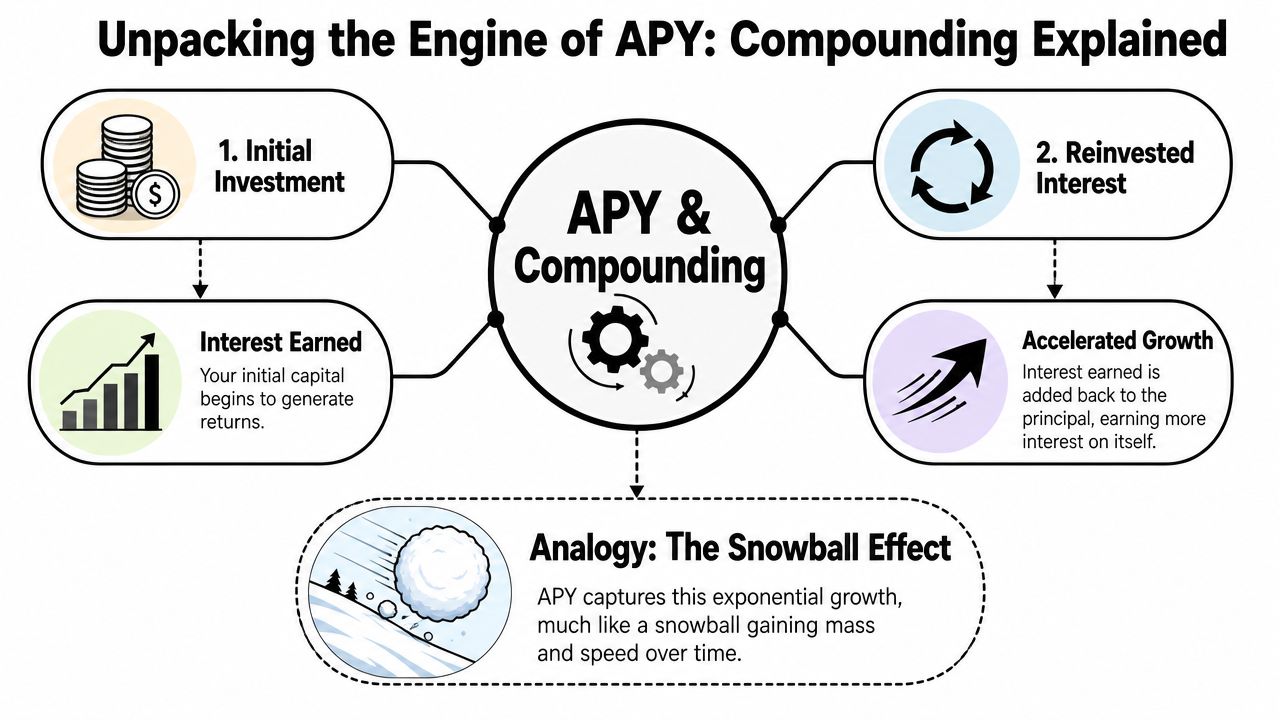
APY matters because of compounding. You're not only earning on your original deposit. You're earning on prior earnings too.
The easiest analogy is a snowball rolling downhill. At the start, growth is modest. As more snow sticks, the next rotation gathers even more. Compounding works the same way. Interest gets added back into the base, and future interest is calculated on that larger amount.
Why APY is different from a simple rate
The Consumer Financial Protection Bureau defines APY as the standardized way to express the true annual return on a deposit account because it includes compounding. Its formula uses interest, principal, and compounding frequency, and APY rises as compounding becomes more frequent over a 365-day year, as described in the CFPB's APY regulation.
That point sounds small until you apply it to real money.
A nominal interest rate tells you the base rate. APY tells you the annualized result after the compounding process does its work. If two products quote the same nominal rate but one compounds more frequently, the APY can be higher.
A concrete example
A savings account with a 4.0% nominal interest rate compounded daily produces an APY of 4.1%, because the account earns interest on previously earned interest, as shown in this consumer APY example.
That example is useful because it strips away DeFi jargon. The mechanism is plain. More frequent compounding nudges the actual annual return above the base rate.
The compounding engine is simple. What confuses people is usually the packaging around it, not the math itself.
How this translates to DeFi
In DeFi, the compounding idea is familiar, but the implementation varies. Some protocols auto-compound. Some require manual claiming and redepositing. Some display an APY that assumes rewards keep getting reinvested even though many users never do that consistently.
That creates a practical gap between the mathematical APY and the user's lived result.
A useful way to consider this is:
Term | What it tells you |
|---|---|
Nominal rate | The base earning rate before compounding effects |
APY | The annualized return with compounding included |
Your realized outcome | What happened after actual reinvestment behavior, timing, and platform conditions |
If the product compounds automatically, APY is closer to what you may experience. If you must manage the loop yourself, the displayed figure can be more theoretical than operational.
APY vs APR The Critical Difference for Investors
APY and APR sound close enough that many people use them interchangeably. They shouldn't.
APR is the annual percentage rate. In plain terms, it's the base annual rate without the compounding effect. APY includes compounding, which makes it the more useful measure when your earnings stay invested.
Side by side
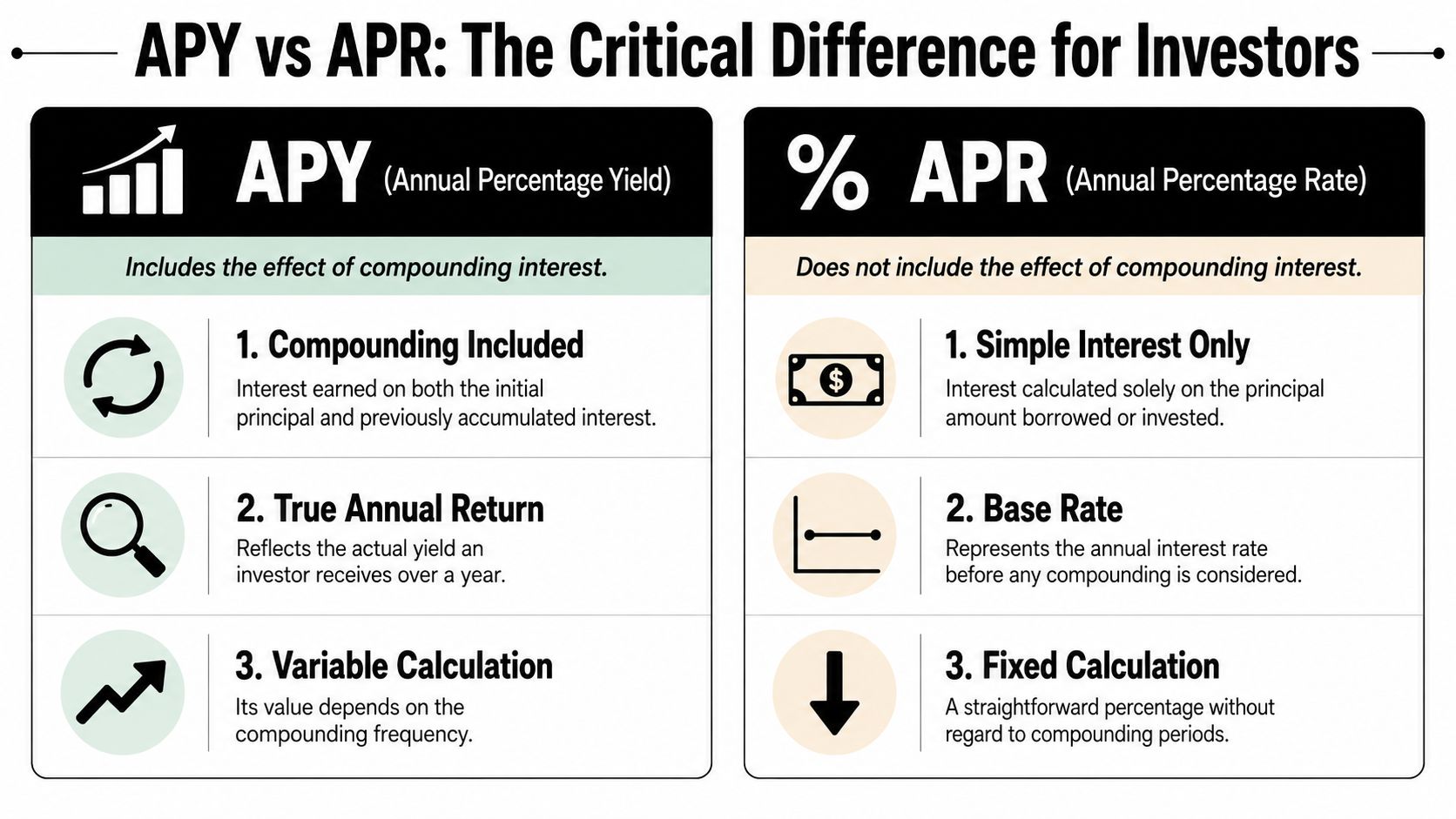
Here's the cleanest way to separate them:
Metric | Best read as | Includes compounding |
|---|---|---|
APR | The base yearly rate | No |
APY | The effective annual yield | Yes |
That distinction matters whenever returns are reinvested. If a platform quotes APR, you still need to ask what happens if rewards are added back in. If a platform quotes APY, you need to ask whether that compounding is automatic, manual, or implicitly assumed.
Why investors should care
For someone allocating capital, APY is usually closer to the fundamental economic question: what will the position look like over a year if earnings keep stacking?
APR is still useful. Borrowing products often use it. Some DeFi interfaces still display it for clarity around the base lending or staking rate. But if you're trying to compare one income-producing opportunity with another, APY is generally the better lens.
This short explainer is worth a quick watch before comparing platforms:
Where people get tripped up
The most common mistakes look like this:
Comparing unlike metrics: One app shows APR, another shows APY, and the user assumes the larger number is automatically better.
Ignoring compounding mechanics: A quoted APY looks attractive, but reinvestment isn't automatic.
Missing fee impact: The math may be right before costs, yet weaker after execution.
If two products look similar, but one quotes APR and the other quotes APY, pause there first. You may not be looking at an apples-to-apples comparison.
For investors, APY is usually the more honest shorthand. For operators in DeFi, it's still only shorthand.
APY in the Wild Stablecoins and DeFi Protocols
Once you leave textbook finance and open real crypto apps, APY stops looking neat. It appears in lending markets, staking pages, vault dashboards, exchange earn products, and liquidity interfaces. The label is the same, but the mechanics behind it can be very different.
That's especially true with stablecoins.
Where you'll see it
On lending protocols such as Aave-style markets, APY often reflects borrower demand and available liquidity. On liquidity venues such as Uniswap-style pools, the number may blend trading fees with incentive programs. On staking or vault products, the displayed yield may depend on strategy rotation, reward emissions, or automated harvesting.
The result is a crowded space where every front end says “yield,” but not every yield behaves the same way.

A clean dashboard helps because it removes some of the friction between a promising rate and a usable decision. Instead of juggling tabs across protocols, many users now prefer a single interface that shows balances, earnings, and current positions in one place.
Why stablecoin APY is so appealing
Stablecoin holders usually aren't trying to hit a speculative home run. They want idle capital to do something productive while staying relatively liquid. That makes APY one of the first numbers they look at.
But in the wild, APY is often variable. It can move with utilization, incentives, market stress, or token supply changes. A professional treasury manager and a solo retail user face the same basic issue: the number on the screen can change before they finish their coffee.
That's one reason AI-assisted tooling is gaining attention. If you want a broader view of how crypto firms are using automation, it's useful to discover Nexo's AI solutions and compare that direction with how newer DeFi-focused products approach yield operations.
What a modern workflow looks like
The practical workflow has shifted from manual hunting to monitored allocation.
One option in that category is Yield Seeker, which lets users deposit stablecoins, view balances in a simple interface, and rely on an AI agent to monitor and allocate capital across DeFi protocols in real time. That approach fits people who don't want to refresh five dashboards and manually move funds every time yields drift.
A usable APY workflow usually has these traits:
One screen for balances: You can tell what's deployed and what's idle without reconstructing it from wallet activity.
Visible earnings tracking: You don't have to guess whether the strategy is producing returns.
Low-friction movement: Capital can be repositioned without turning each change into a long operational task.
The core benefit isn't just convenience. It's decision quality. When APY data is fragmented, users overreact to headline rates. When information is consolidated, they're more likely to compare opportunities on structure rather than hype.
Reading Between the Lines Risks and True Yield Comparison
Headline APY is where many investors stop. It's not where a careful investor should stop.
In DeFi, the advertised number can diverge from what you ultimately keep. Trading costs, management fees, and reward-token price changes can all reduce realized return. Harvard Federal Credit Union's APY explainer notes that in DeFi and crypto yield products, the realized return can be materially lower after those factors, which makes net APY a more useful metric than the headline alone in many cases, as explained in its discussion of APY and net realized yield.
The questions that matter more than the banner
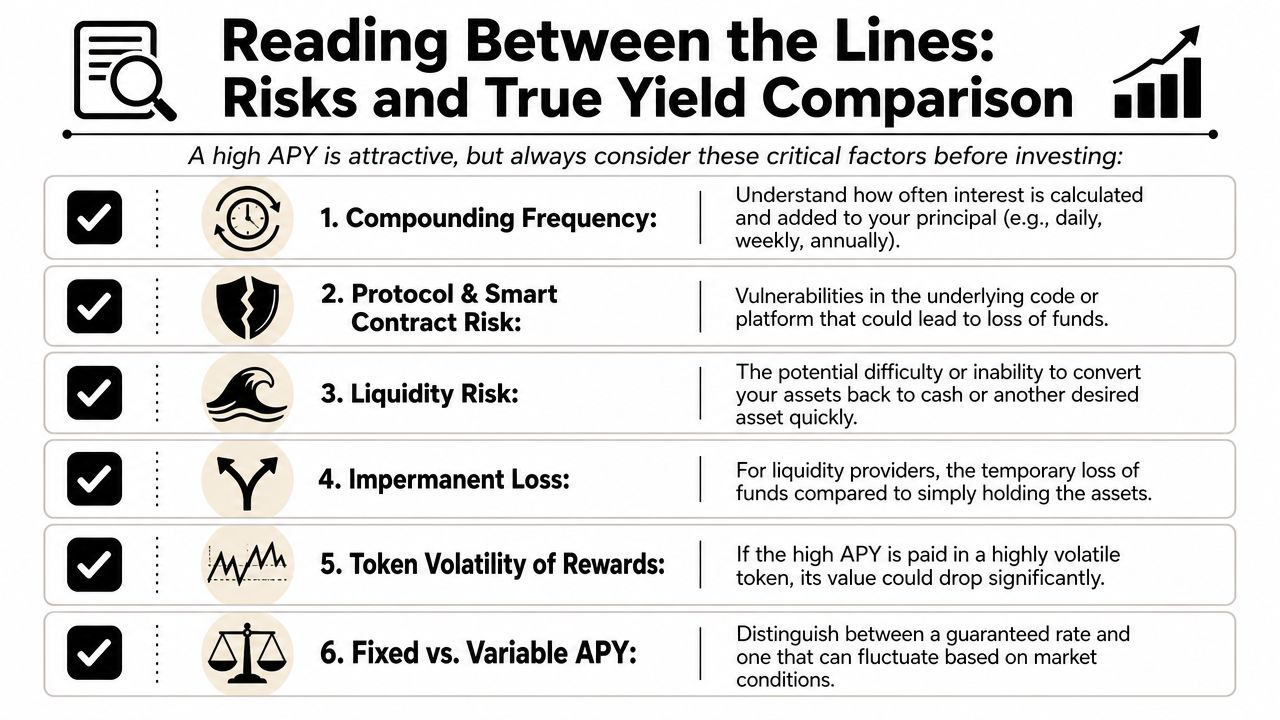
A useful APY review starts with a short checklist.
How is yield paid? If you deposit a stablecoin but earn rewards in a volatile token, your realized value may swing even if the displayed APY looked attractive.
Is the rate fixed or variable? A variable APY can move with market conditions, and some products update fast.
What costs sit in the path? Swaps, repositioning, vault fees, or other execution frictions can lower the amount you retain.
What risk sits underneath? Smart contract exposure, liquidity conditions, and strategy complexity all matter.
Can you exit cleanly? An attractive APY isn't useful if leaving the position is operationally painful or market-dependent.
Headline APY versus net APY
This is the distinction many guides skip.
Headline APY is what the product advertises under its current assumptions. Net APY is what remains after costs and real-world behavior. That gap can be the difference between a strategy that looks strong on social media and one that fits a treasury or personal cash-allocation plan.
A practical way to compare opportunities is to separate them like this:
Yield view | What it includes | What it can miss |
|---|---|---|
Headline APY | Posted annualized yield | Fees, slippage, token-price impact |
Net APY | Return after real costs and frictions | Still may not capture every protocol risk |
Risk-adjusted view | Net return weighed against strategy risk | Requires judgment, not just math |
For a deeper framework on evaluating those trade-offs, this guide on risk-adjusted APY in DeFi is a useful companion.
A stablecoin strategy should be boring in the right ways. If understanding the yield requires too many assumptions, the number is probably doing too much marketing work.
What works in practice
The investors who hold onto yield more consistently usually do a few simple things well.
They prefer rewards paid in the asset they already want to own, or at least they explicitly price the conversion risk. They account for frictions before deploying capital. And they treat very high APY as something to explain, not something to celebrate automatically.
What doesn't work is comparing every opportunity only on the top line. In DeFi, that's how people end up “earning” a strong paper APY while their actual wallet outcome tells a weaker story.
Smart Automation The Yield Seeker Approach to APY
Once you understand how APY works, the bottleneck shifts. The hard part isn't recognizing the term. It's keeping up with changing yields, checking risk, and deciding when moving capital is worth the effort.
Manual optimization often breaks down quickly.
Why manual APY management fails
Even careful users run into the same operational drag:
Too many tabs: Lending markets, vaults, bridges, wallets, and portfolio trackers each show part of the picture.
Too much monitoring: Rates change, and a good setup in the morning may not remain attractive later.
Too many small decisions: Reinvest now, wait, switch venues, claim rewards, hold the reward token, or sell it.
None of those tasks is impossible. Together, they turn passive yield into active maintenance.
What automation changes
The strongest use case for automation isn't just speed. It's consistency.
A system that monitors opportunities continuously can apply the same evaluation logic without fatigue. It can watch for better placements, keep balances visible, and reduce the chance that a user leaves funds sitting in a stale strategy because life got busy.
That's the appeal of an AI-assisted workflow for stablecoin yield. It narrows the gap between a theoretical APY opportunity and a process you can consistently follow.
For readers who want that model explained in more depth, this piece on automated APY discovery lays out the logic behind continuous monitoring and allocation.
Good yield operations feel uneventful. The system does the watching so the user doesn't have to build a weekly ritual around rate chasing.
There's also a second-order benefit. When balances, earnings, and position history live in one interface, record-keeping gets easier. That matters for anyone who eventually needs to review performance, explain strategy decisions internally, or prepare clean reporting.
If you want a lower-friction way to put stablecoins to work, Yield Seeker offers an AI-powered workflow for monitoring and allocating capital across DeFi yield opportunities without manually hunting rates across multiple dashboards.