
The most common advice about APY vs yield is also the least useful: choose the higher number. In DeFi, a quoted APY often annualizes a short-lived condition, assumes reinvestment without friction, and blends genuine protocol revenue with token incentives. The result is a polished number that may have little connection to what reaches your wallet.
A better question is, what produces the yield, how long can that source persist, and what remains after fees, slippage, emissions, and operational risk? APY still matters, but only after you understand the underlying return. A modest rate backed by borrowing demand can be more durable than an eye-catching rate paid mainly in a volatile reward token.
Measure | What it describes | Main limitation in DeFi |
|---|---|---|
Simple yield | Return on the original principal | Ignores reinvestment |
APR | Annualized rate before compounding | May not represent realized growth |
APY | Annualized return assuming compounding | Can overstate results when conditions change |
Net yield | Return after fees, losses, and friction | Requires careful calculation |
Risk-adjusted yield | Net return considered alongside protocol and market risk | Can't be reduced to one headline number |
The Headline APY Illusion in DeFi
A high APY on a dashboard can reflect strong recent fees, newly issued protocol tokens, or an unusual rate in a thin market. These sources behave differently. The displayed number may be mathematically accurate at that moment while offering little guidance about what a depositor will earn over time.
The main trap is short-window annualization. A vault can take a strong return from a brief interval and present it as if the same conditions persisted for a full year. Annualization helps compare opportunities, but it can make temporary performance look durable. Borrowing demand, liquidity, utilization, token prices, and incentive programs can all shift quickly in DeFi.
Practical rule: Treat APY as a current measurement, not a promise about forward returns.
Yield decay follows when the source of the quoted rate weakens. New deposits can dilute incentives, reward-token selling can reduce the token's value, borrowers can repay, and liquidity providers can withdraw. A strategy that ranked highly on a leaderboard may then deliver a much lower realized return, especially if the interface updates slowly or continues emphasizing an earlier estimate.
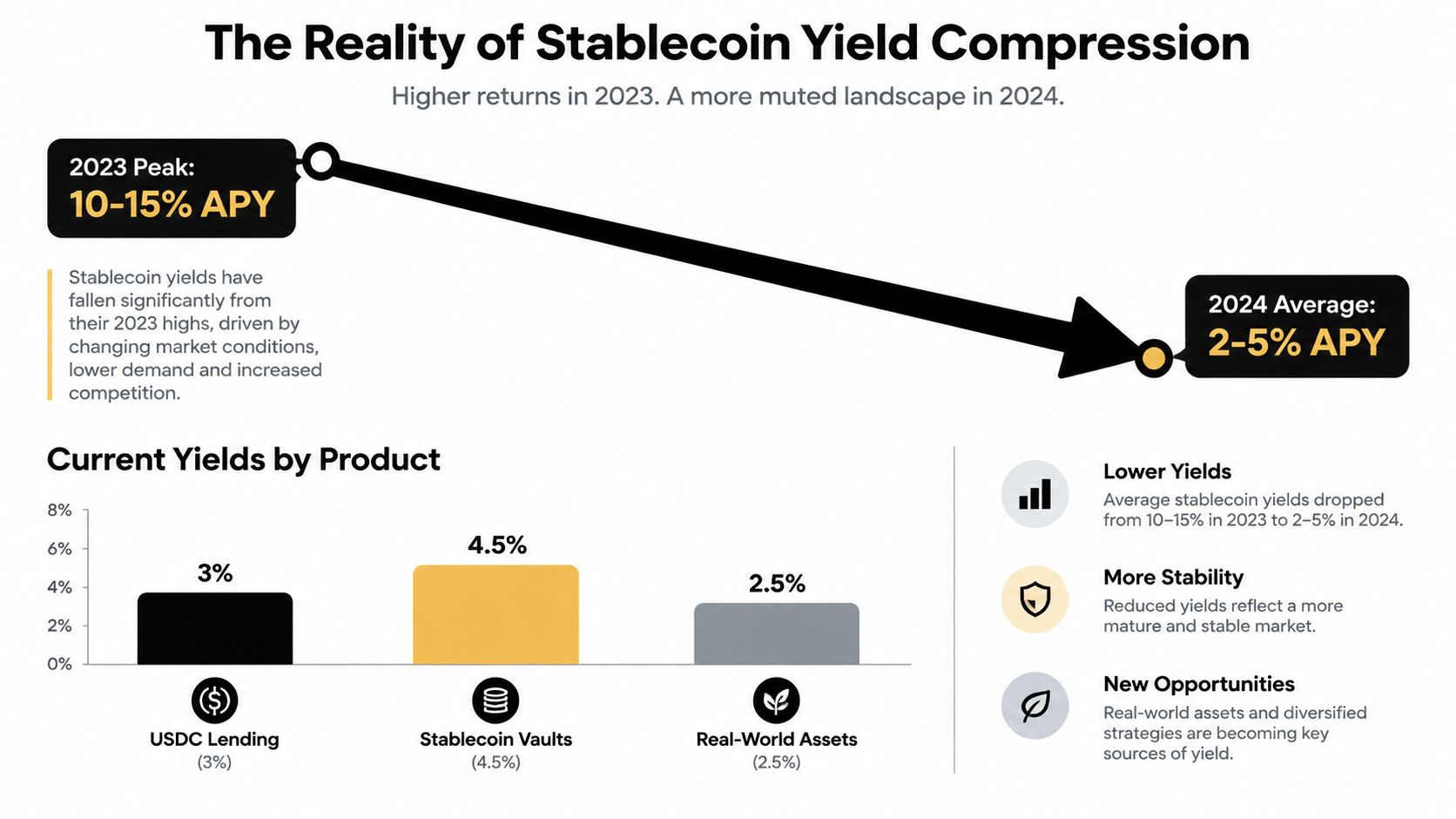
Stablecoin markets make the distinction clear. Research cited by Kraken's explanation of APY and interest rates says that “safe” stablecoin supply rates have converged to around 3%, with Aave USDC and USDT yields around 2%, while 58% of stablecoin vault TVL earns under 3% APY. These figures do not imply that every vault pays the same rate. They show why a dramatic outlier requires investigation. Durable yield should connect to borrower interest, trading fees, staking income, or another identifiable revenue source. Emission-driven APY can disappear as soon as token distributions slow or participants sell the rewards.
Before depositing, ask:
What is being paid? USDC, another stablecoin, a protocol token, or a mixture?
What creates the return? Borrowing interest, trading fees, staking income, real-world asset interest, or emissions?
What period does the APY represent? A longer operating history provides more context than a recent spike.
What can reduce the result? Fees, withdrawal constraints, smart contract exploits, depegging, and strategy losses all affect net returns.
A higher APY can be worthwhile when its source is transparent and the risks fit the position. The practical comparison is durability and net realization, not the brightest number on a dashboard. A lower rate backed by recurring protocol revenue may outperform a headline APY funded mainly by incentives once fees, slippage, token volatility, and risk are included.
Defining APY and Yield Mechanics
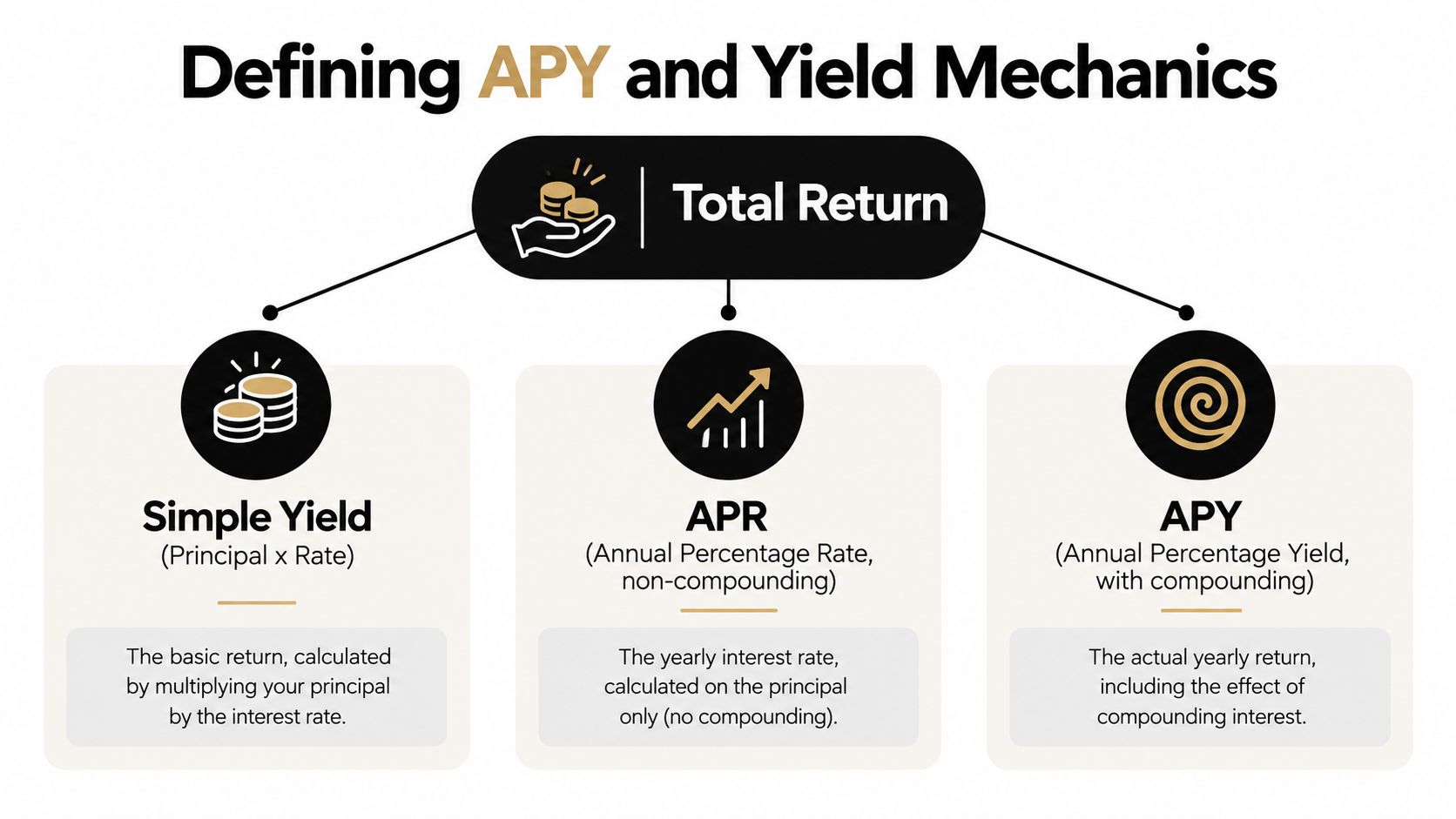
Yield is the return generated by capital over a specified period. In a lending market, it may come from borrower interest. In a liquidity pool, it may come from trading fees. In a vault, it can combine several sources, including incentives. The word itself doesn't tell you whether the return compounds, whether fees have been removed, or whether the rate is stable.
Simple yield applies a rate to the original principal. If capital earns a simple annual rate, the calculation doesn't add prior earnings to the balance during the period. The basic relationship is:
Simple return = Principal × rate × time
APR, or annual percentage rate, is generally a nominal annualized rate that doesn't include the effect of compounding. In DeFi interfaces, APR often describes the rate before rewards are reinvested. It can also refer to an incentive rate, even when the underlying reward is paid separately from the principal asset.
APY, or annual percentage yield, expresses the effective annual result when earnings are reinvested. The standard formula is:
APY = (1 + r / n)^n - 1
Here, r is the nominal annual rate and n is the number of compounding periods. The more frequently earnings are reinvested, the more the effective result can exceed the nominal rate, assuming the rate stays constant and every reinvestment is economical.
Why compounding assumptions matter
Consider a hypothetical 10% APR. If earnings compound annually, the effective annual result is 10%. If they compound monthly, the result is calculated by applying the rate in repeated monthly periods. If they compound daily, the balance is updated more frequently still. Daily compounding produces a higher mathematical APY than monthly compounding, and monthly compounding produces a higher APY than annual compounding, provided the nominal rate and all other conditions remain unchanged.
That last condition is where DeFi departs from a bank calculation. A protocol's rate usually moves with utilization, pool depth, market activity, reward schedules, and governance decisions. Reinvestment may also require a transaction, a swap, or a vault harvest. Gas costs and price impact can consume the extra return that the formula implies.
For a deeper walkthrough of the calculation itself, use this APY calculation guide. The useful distinction is between theoretical APY and realized return. Theoretical APY assumes a stable rate, uninterrupted access, perfect reinvestment, and no friction. Realized return reflects what your position earns after the strategy operates through changing market conditions.
Question | What to verify |
|---|---|
Is the rate APR or APY? | Whether compounding is already included |
What compounds? | Fees, base asset, reward token, or all of them |
How often does it compound? | Automatic vault reinvestment or manual action |
Is the rate variable? | How utilization and incentives change the quote |
Are costs included? | Gas, management fees, swaps, and withdrawals |
In practice, APY is a useful reporting format, not a complete investment thesis. You need the yield source and the mechanics behind it before comparing one opportunity with another.
The Reality of Stablecoin Yield Compression
Stablecoin yield is not a permanent product feature. It is a market price for borrowing demand, available liquidity, protocol utilization, trading activity, and token incentives. When those forces weaken or move closer together, the difference between ordinary opportunities shrinks. A high APY may then describe a temporary subsidy rather than a durable return.
Recent DeFi research places “safe” stablecoin supply rates near 3%, while Aave USDC and USDT yields sit near 2%. The same research reports that 58% of stablecoin vault TVL earns under 3% APY. The exact figures matter less than the pattern. Much of the market clusters around a compressed baseline, so a leaderboard can make small differences look more meaningful than they are.
Reading an outlier rate
An outlier APY requires source analysis before you size a position. It may come from a new incentive program, a small pool with limited capacity, a volatile reward token, or utilization that changes the rate quickly. These conditions do not automatically invalidate the strategy, but they do affect capacity, exit risk, and the return you can reasonably expect.
Compressed yields also make fees more important. If two strategies show similar gross rates, management charges, repeated swaps, gas, or costly rebalancing can decide which produces the higher net return. A narrow APY premium does not compensate automatically for smart contract risk, shallow liquidity, or difficult withdrawals.
Separate the quoted rate into five layers:
Base income, such as borrower interest or trading fees.
External incentives, including emissions paid in a protocol token.
Compounding effect, determined by whether rewards are reinvested automatically.
Friction, including gas, swaps, management charges, and withdrawal costs.
Loss exposure, including depegging, bad debt, liquidation events, or strategy-specific market risk.
The headline becomes useful only after these layers are identified. If base income is modest and incentives supply most of the APY, the rate can fall sharply when emissions change or liquidity grows. If earnings come from observable fees and borrowing activity, returns can still vary, but the underlying economic engine is easier to monitor.
Compression does not eliminate DeFi yield. It makes superficial comparison unreliable. The relevant question is whether an apparent premium pays you for measurable additional risk, or merely reflects an incentive program that may disappear.
Revenue-Backed vs Incentive-Backed Returns
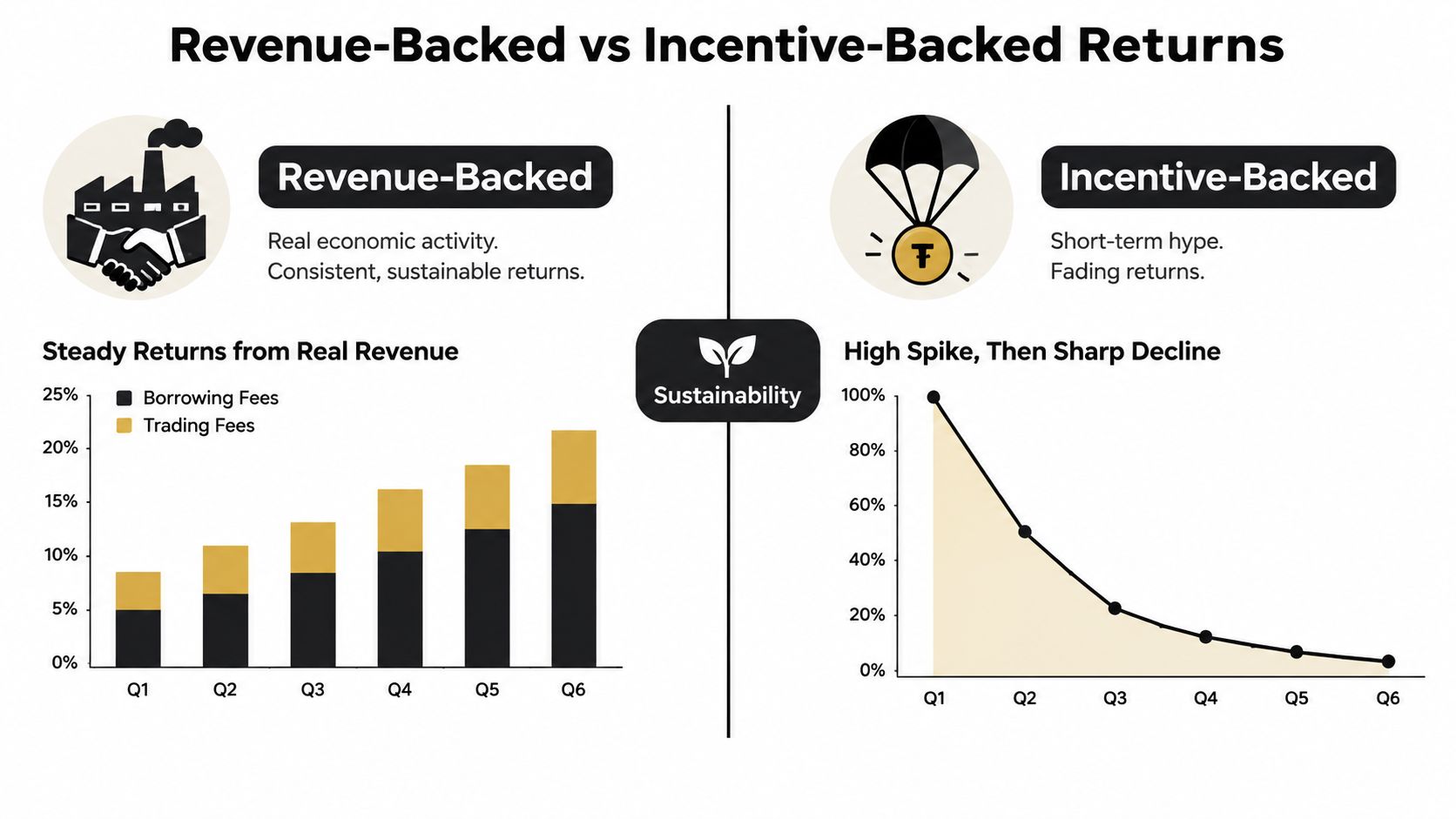
Two vaults can show similar APYs while exposing depositors to completely different sources of return. Revenue-backed yield comes from economic activity that users pay for, such as borrowing fees, trading fees, staking income, real-world asset interest, or funding markets. Incentive-backed yield comes from token distributions designed to attract liquidity or encourage a behavior.
Revenue-backed returns aren't risk-free. Borrower defaults, changing utilization, smart contract failures, liquidity shocks, and market structure can all reduce income. They do, however, offer a clearer connection between the return and a service that generates cash flow. If users stop borrowing or trading, the revenue falls, but the mechanism is visible.
Incentive-backed returns have a different profile. A protocol can distribute tokens at a rate that attracts deposits quickly, but depositors may sell those rewards, pushing down their market value. Governance can reduce emissions, the program can end, or new liquidity can dilute each participant's share. The displayed APY can decline even when the interface's formula remains unchanged.
A source-first comparison
Return source | What supports it | Main question |
|---|---|---|
Borrowing fees | Demand for loans and capital efficiency | Do borrowers remain active? |
Trading fees | Volume and liquidity usage | Is volume organic or temporary? |
Staking income | Network rewards for securing a chain | What are the validator and slashing risks? |
Real-world asset interest | Off-chain interest obligations | Who holds the asset and enforces payment? |
Token emissions | Protocol distribution schedule | What happens when subsidies decline? |
Industry coverage describes DeFi yield as coming from several areas, including funding markets, staking, lending, real-world assets, and delta-neutral strategies. It also points to rapid expansion in stablecoin and yield-bearing asset markets, including a report citing 300% year-over-year growth in yield-bearing stablecoin market capitalization and another describing products with TVL ranging from several hundred million to a few billion dollars, as summarized in The Defiant's analysis of on-chain yield. These figures describe a broadening market, not proof that every product offers durable income.
The strongest evaluation separates base APY from reward APY. Then examine the reward asset's liquidity, vesting, volatility, and emission schedule. A reward paid in USDC is easier to compare with your principal than a token whose value depends on future demand.
A higher APY is only better when the additional return survives the assumptions that produced it.
Revenue-backed strategies can still disappoint, and incentive programs can be rational bootstrapping tools. The mistake is treating both as interchangeable cash flow. Their sources, risks, and expected decay paths are different.
Auditing Provider Claims and Net Returns
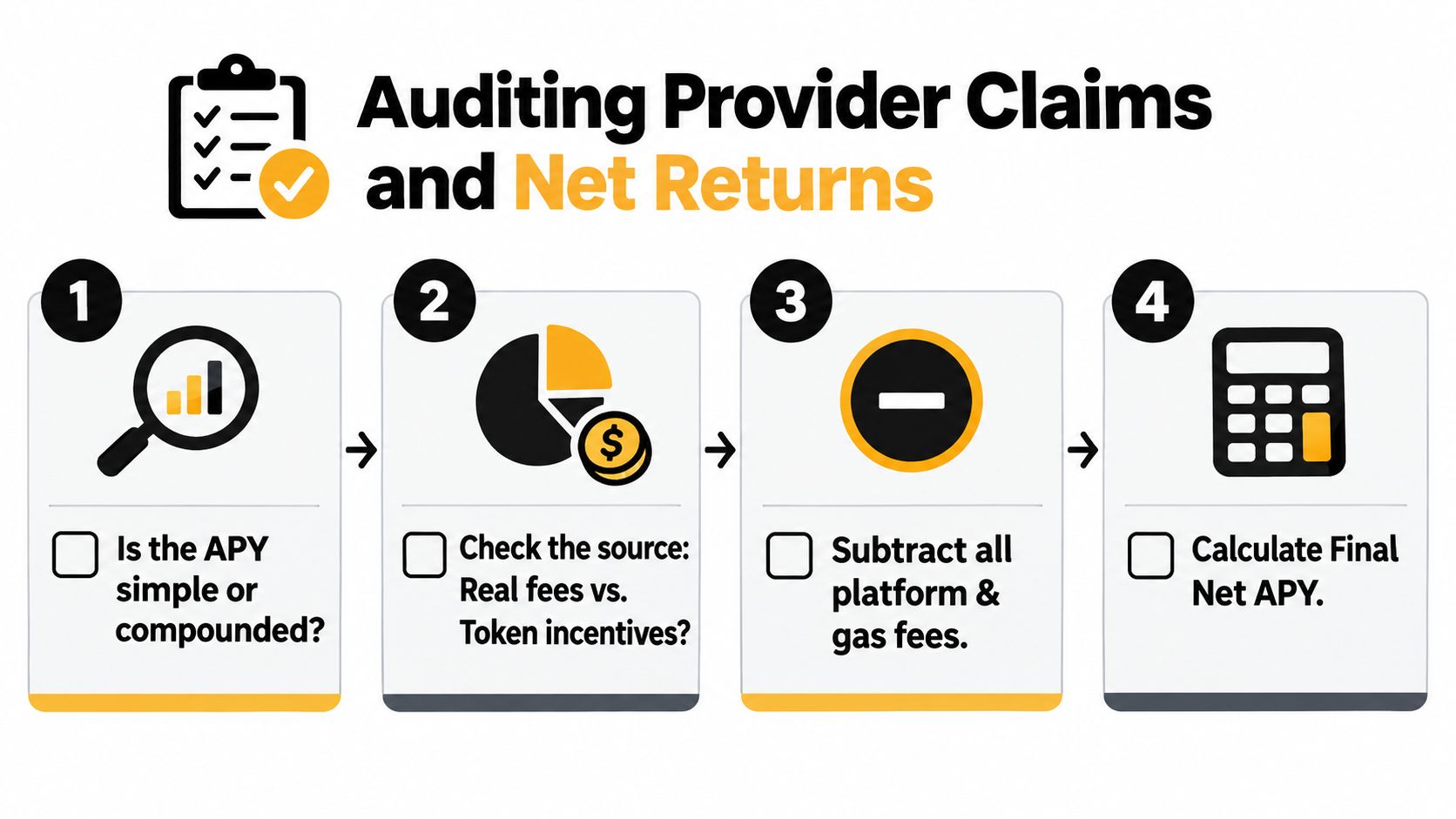
The number on a provider's landing page is a starting point, not the final answer. Before depositing, reconstruct how the provider calculated it and identify which costs or risks sit outside the displayed figure. A disciplined audit turns a promotional rate into an estimate you can use.
Start with the rate definition
First, determine whether the quote is APR or APY. If it's APR, model the reinvestment schedule yourself. If it's APY, ask how often the strategy compounds and whether the displayed rate assumes automatic harvesting. A vault that compounds rewards internally may have different economics from a wallet that must claim and reinvest manually.
Next, separate the components. Write down the base return, the incentive return, and any variable rate assumptions. If the provider doesn't explain where the yield comes from, the lack of transparency is itself a risk signal.
Subtract friction before comparing strategies
Build a simple net-return worksheet with these inputs:
Starting principal. Use the amount you intend to deploy.
Expected gross return. Apply a conservative rate range rather than assuming today's quote persists.
Platform charges. Include vault management fees, performance fees, and any deposit or withdrawal charges.
Execution costs. Account for gas, swaps, claims, and rebalancing transactions.
Strategy losses. Model possible depegging, liquidation, bad debt, impermanent loss, or failed hedges where relevant.
Liquidity conditions. Check whether you can exit immediately or must wait for a withdrawal window.
Tax treatment also deserves attention. Frequent compounding and reward claims can create more taxable events in some jurisdictions, so a gross APY can overstate the economic result after tax. The correct treatment depends on your location and circumstances, so obtain qualified tax advice rather than assuming every reward is handled the same way.
For a broader review of contracts, administration, upgrade permissions, and operational exposure, use this protocol safety analysis. The practical goal isn't to predict every failure. It's to understand which assumptions must hold for the quoted return to materialize.
Finally, compare the net return per unit of risk. A locked vault may offer a higher quote but remove your ability to react to a depeg or governance change. A liquid strategy with a lower gross APY may be more suitable if access to capital matters.
Automating Yield Allocation with AI Agents
Manual yield management demands repeated work. You need to compare rates across protocols, identify whether rewards are real or subsidized, monitor utilization and liquidity, estimate transaction costs, and decide when a rebalance is justified. Checking a dashboard once doesn't solve the problem because DeFi rates change while capital remains deployed.
AI agents can turn those repeated checks into an allocation process. A useful agent shouldn't just select the highest APY. It should evaluate the source of yield, protocol risk, liquidity, fees, asset exposure, and concentration, then apply rules that reflect the user's preferences. That approach connects the mechanics of APY with the more important question of risk-adjusted net return.
Automation also creates an audit trail. When an agent moves capital, users should be able to inspect the trigger, the selected strategy, and the result. A visual agent run trace view demonstrates the kind of execution history that makes automated actions easier to review and debug.
What good automation should handle
Opportunity discovery: Scan multiple venues instead of relying on one leaderboard.
Yield decomposition: Distinguish fee income from token incentives and convert rewards into a comparable base-asset view.
Risk filters: Exclude strategies with unacceptable contract, liquidity, depeg, or concentration risks.
Rebalancing discipline: Move capital only when the expected benefit exceeds execution costs and operational risk.
User control: Keep allocation rules visible and allow the user to understand or override decisions.
Yield Seeker is one example of this model. Its AI agent monitors and allocates USDC across DeFi protocols on Base, evaluates APY alongside risk factors, and presents adjusted APY metrics that convert rewards into USDC terms. The product's stated design keeps funds accessible without lockups or withdrawal fees, but users should still assess the underlying strategies and smart contract risks before using any automated allocator.
The right role for AI isn't to promise a permanent top rate. It's to reduce repetitive research, apply consistent rules, and make the difference between headline APY and durable yield easier to act on. Read more about the operating model in this guide to using AI agents.
Building a Sustainable DeFi Income Strategy
A sustainable DeFi income strategy starts with the source of return, not the size of the APY. Prioritize observable revenue, understand the compounding mechanism, and separate base income from temporary incentives. Then reduce concentration by spreading capital across vetted protocols and avoiding any position whose risks you can't explain.
Keep a written record of the assumptions behind each allocation. Note what would cause you to exit, such as a reward-program change, a liquidity restriction, a depeg, or a material deterioration in protocol health. Revisit those assumptions regularly rather than allowing an old APY estimate to become an invisible promise.
Automation can help with monitoring and execution, but it doesn't eliminate risk. It works best when the rules are transparent, the agent considers net and risk-adjusted returns, and you retain control over where capital can move. The objective isn't to win a leaderboard. It's to build a yield process that can keep operating when market conditions change.
Yield Seeker helps stablecoin holders automate USDC allocation across DeFi opportunities on Base while viewing yield in a more risk-aware, comparable format. Visit Yield Seeker to explore an AI-assisted approach that reduces manual rate hunting while keeping your capital accessible and your allocation decisions visible.