
Treasury money market funds are safer than general money market funds because their portfolio risk is concentrated in government bills and repo rather than bank obligations or commercial paper. But they're not the same as a bank deposit, and they can still feel stress when liquidity dries up.
The popular advice says, “If it's government-only, it's basically cash.” That's too simple. The key question is whether the fund can keep liquidity, stable pricing mechanics, and short maturity working together when markets get jumpy, which is exactly where the 2008 and 2020 episodes matter.
Why the Safety Question Is More Nuanced Than It Looks
The phrase “are Treasury money market funds safe” sounds like a yes-or-no question, but the answer depends on which kind of safety you mean. If you mean credit default risk, a government-only fund is structurally different from a prime fund, because its portfolio is concentrated in Treasuries and agency repo rather than bank obligations or commercial paper, and the academic work in the Quarterly Journal of Economics study on money market fund risk makes that distinction central.
Safety depends on the risk channel
A Treasury money market fund reduces exposure to the kind of private-credit losses that can trigger runs in riskier funds. The same study framed portfolio risk through “holdings risk” and “maturity risk”, and found that funds with more Treasury exposure were structurally less exposed to the credit-risk channel that drives run behavior in riskier portfolios. That's the first mental reset readers need, because the label government fund tells you almost nothing by itself.
Practical rule: if the portfolio is truly government-only, the main remaining risks are liquidity and interest-rate repricing, not private-credit default.
That matters because a fund wrapper is not a Treasury bill held to maturity. The fund still has to manage redemptions, keep pricing close to $1 NAV, and avoid being forced to sell into a bad market. Those are design problems, not issuer problems.
Why this guide focuses on structure
If you care about cash you might need next week, not next decade, the right question is, “What can break the plumbing?” That means looking at what the fund owns, how fast it can sell it, and how quickly its holdings roll over. It also means separating a Treasury fund from a bank deposit, because one relies on portfolio mechanics and the other relies on deposit protection and a different set of rules.
The stress stories from 2008 and 2020 are useful because they show two different failure modes. In 2008, a prime fund broke the buck because of private credit exposure. In 2020, even government-heavy funds saw pressure because the market for the assets itself got strained. That's the nuance the rest of this guide leans on.
What a Treasury Money Market Fund Actually Is
A Treasury money market fund is a regulated mutual fund that pools cash and puts it into short-dated government instruments. In practice, that usually means U.S. Treasury bills, agency securities, and overnight repo collateralized by those instruments, with a stated goal of preserving a stable $1 NAV while giving investors easy access to cash.

Imagine a cash parking garage with very strict height and weight limits. Only the short, high-quality vehicles get in, and the garage is designed so traffic keeps moving. That doesn't make it a vault. It means the rules are built to reduce the chance of a pileup.
Why the $1 NAV matters
The fund's share price is meant to stay near $1, but that stability comes from portfolio design and regulations, not from a sovereign promise that nothing can go wrong. The portfolio has to stay short-dated, liquid, and high quality so the manager doesn't need to sell assets at ugly prices just to meet redemptions. That's why weighted-average maturity discipline matters so much.
The NAV is stable because the portfolio is short and liquid, not because the wrapper has a magic guarantee.
For a quick primer on how a pooled fund structure works, the Everglow Prosperity MIS guide is a useful reference on managed investment schemes and why the legal wrapper matters. A Treasury money market fund is still a managed vehicle, which means the structure itself affects the outcome.
Government fund, prime fund, and T-bill are not the same thing
This distinction trips people up constantly. A government money market fund is not the same as a prime fund, because prime funds can hold broader short-term credit instruments. And a Treasury fund is not the same as buying a Treasury bill directly and holding it to maturity, because the fund has its own liquidity mechanics, pricing conventions, and shareholder flows.
If you want the high-level category map, the money market overview on Yield Seeker's blog can help you separate the wrapper from the underlying assets. The wrapper is part of the safety story, not just a container around it.

The Three Risks That Survive Even a Government-Only Portfolio
A government-only portfolio can remain fragile if the fund wrapper relies on slow liquidity or weak stress design. The underlying securities may be government-backed, but the fund still has to handle redemptions, pricing, and operations under pressure. That is where the true safety question lives.
Liquidity can fail before credit does
Liquidity risk is the first place stress shows up. If a wave of investors redeems at once, the fund may need to sell Treasuries or repo positions faster than the market can comfortably absorb. The manager may have to accept worse prices, and a fund that looks conservative on paper can still feel strain in real time.
That is why a liquidity buffer matters more than the label alone. If the portfolio has room to meet normal outflows without forced selling, the structure can absorb shocks better. If it does not, the fund can still become brittle even when every holding is high quality.
Short maturity helps, but it doesn't solve everything
A Treasury fund's weighted-average maturity matters because short maturities let the portfolio reprice faster and spend less time stuck with stale values. That improves flexibility, but it does not remove all risk. When rates move sharply, the fund still has to roll holdings into a new yield environment, and that changes the income profile even if the share price stays near par.
This is the part that people often miss. Short duration reduces sensitivity to rate moves, yet it does not prevent a rapid reset in yield. In practice, the fund can stay stable in price and still deliver a very different return profile from one month to the next.
Operations can become the weak link
The third risk is operational. Custody, settlement, transfer agent systems, sponsor health, and trading plumbing all matter. If those pieces are slow, misaligned, or under stress, the fund can experience friction even when the assets themselves are high quality.
That failure mode is easy to underestimate because it does not look like market risk at first. It looks like delays, breaks in processing, or a mismatch between what the portfolio owns and what the fund can deliver to shareholders. In a stressed environment, those frictions can matter as much as the asset mix.
A March 2020-style shock shows why this matters. Investors do not need a credit loss to create strain, they can pull cash faster than the market can comfortably absorb, and then the fund's own structure becomes the bottleneck. That is the part a DeFi treasury team would recognize immediately, because wrapper risk and exit mechanics can matter as much as the asset itself.
The same logic is why institutions hire for roles like digital asset risk jobs on Blockchain Jobs, because the path out of a position can be just as important as the position itself.
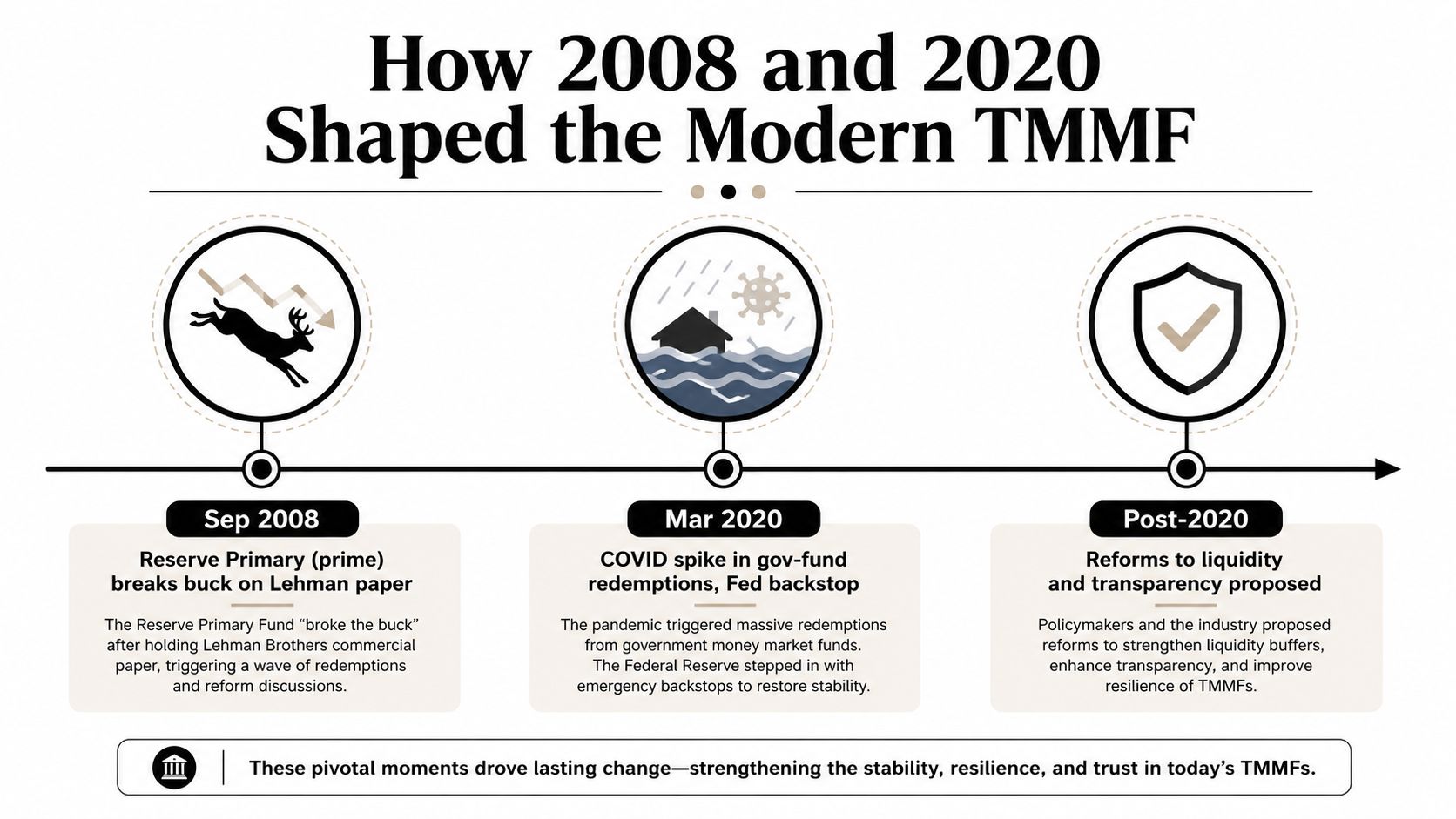
How 2008 and 2020 Shaped the Modern TMMF
September 2008 is the event that made money market funds impossible to think about casually again. The Reserve Primary Fund was a prime fund, not a government fund, and it broke the buck after holding Lehman commercial paper. That failure wasn't about Treasury exposure, it was about private credit risk inside a vehicle investors had treated like cash.
Why 2008 still matters
The Reserve Primary episode is still relevant because it exposed a core behavioral problem. Investors often assume a money market fund is a deposit-like product, then panic when the structure behaves like a fund instead of a bank account. That's exactly why the label alone is misleading.
March 2020 created a different kind of lesson. The problem there wasn't Lehman-style credit exposure. It was a dash for cash in the Treasury market itself, which made even government-focused funds feel redemption pressure and briefly strained pricing mechanics.
A government fund can still get caught in the market it owns
That's the part many overlook. A Treasury fund can own high-quality assets and still struggle if everyone wants the same thing at the same time. When the market for Treasuries gets illiquid, the fund's ability to meet redemptions smoothly becomes the true test.
The policy response followed the stress. The 2010 reforms tightened the framework, the 2016 changes split retail and government structures more clearly, and the later SEC updates kept focusing on liquidity mechanics instead of pretending credit risk was the only story. That direction tells you where regulators believe the weak points are.
The post-crisis lesson for readers
The big takeaway from both crises is simple. The assets can be safe while the wrapper is stressed. If you only look at what the fund buys, you miss the part that matters when cash is moving fast.
The next time someone says a Treasury fund is “as safe as cash,” ask a better question. Safe from what, exactly? Credit losses, yes, much more so than a prime fund. Redemptions and liquidity strain, not necessarily.

What the 2023 and 2024 Reforms Actually Changed
The most important thing the newer SEC changes did was push investors to think about liquidity design, not just headline yield. Morningstar reported that the SEC's 2023 reforms tightened liquidity requirements, removed automatic redemption gates tied to certain liquidity thresholds, added mandatory liquidity fees for certain funds, and strengthened disclosure and stress-testing. That set the stage for a much more practical way to judge a fund.
Read the factsheet like a mechanic
The changes matter because they alter the incentives around stress. If a fund can't automatically slap on gates just because liquidity dips, managers need to plan more carefully for redemption waves. If a fund can impose fees in certain cases, that fee becomes part of the stress tool kit rather than a surprise punishment.
The SEC's 2024 amendments went further for government money market funds by raising minimum daily liquid assets from 10% to 15% and lifting the tax-exempt threshold from 30% to 50%. Those numbers matter because they tell you regulators are prioritizing the ability to meet redemptions cleanly, not just the ability to say “we hold Treasuries.”
What to look for in a fund
A good factsheet today should help you judge whether the fund is built for stress or merely marketed for calm. The combination that matters is short WAM, large overnight liquidity, and transparent government-only holdings. Those features reduce forced selling and help the NAV stay close to par when markets get noisy.
If a fund's factsheet talks mostly about yield and barely mentions liquidity buckets or stress tests, you're looking at marketing, not risk design.
For a broader perspective on why capital preservation is a structure question, not a slogan, the capital preservation guide on Yield Seeker's blog is a useful companion read. It frames preservation as an engineering problem, which is exactly how to think about Treasury funds.
The practical takeaway is to read the factsheet through the lens of liquidity buffers, stress testing, and government-only holdings. Don't let the word Treasury do all the work.
TMMFs Versus Bank Deposits, T-Bills, and Stablecoins
The safest choice depends on what you're optimizing for. Bank deposits win on explicit insurance, Treasury bills held to maturity win on direct ownership, Treasury money market funds win on convenience and liquidity, and stablecoins win on programmability but bring a different trust stack altogether.
Feature | Treasury MMF | Bank Deposit | T-Bill to Maturity | Stablecoin |
|---|---|---|---|---|
Protection model | Portfolio rules and liquidity design | Deposit insurance framework | Direct government obligation held by you | Reserve and issuer model varies |
NAV mechanics | Aims for $1 NAV | Balance stays at par unless bank fails | Price is fixed if held to maturity | Token price targets stable value, but varies by design |
Yield source | Short government instruments and repo | Bank pays interest | Treasury coupon or discount income | Reserve assets, on-chain strategies, or protocol incentives |
Stress behavior | Can face redemptions and liquidity strain | Access depends on bank system, but deposit model is different | No fund wrapper, so no redemption queue | Can depeg or face reserve, custody, or smart-contract risk |
Best fit | Cash parking with liquidity | Everyday savings and transactional balances | Cash you can lock away until maturity | On-chain balances and DeFi-native cash management |
Where crypto-native readers usually get tripped up
Stablecoins are often compared to money market funds because both try to hold value near one unit. That's where the comparison ends. A Treasury fund is regulated fund plumbing built around short-term government assets, while a stablecoin is a tokenized reserve or mechanism that depends on its own issuer, reserves, and market trust.
Algorithmic and offshore stablecoins make that gap even more important, because the risk isn't just price drift. It can be the reserve quality, redemption path, or governance design. That's why many DeFi treasuries still use Treasury funds as a traditional finance benchmark yield, even when their operating cash lives on-chain.
For readers mapping alternatives, the Treasury yield alternatives guide on Yield Seeker's blog is a helpful way to think about what you give up and what you gain when you move away from government cash vehicles.
If you want the blunt answer, bank deposits are the simplest choice for insured cash, T-bills are cleaner if you can hold to maturity, and Treasury funds sit in the middle, between bank simplicity and direct bond ownership. Stablecoins are a separate category altogether. They're useful, but they're not a substitute for understanding the wrapper.
For a cautionary perspective on fund losses and recovery options, the Kons Law discussion of ultrashort bond fund losses is relevant because it shows how quickly a “low-risk” label can become a legal and operational question when losses occur.
A Practical Safety Checklist Before You Allocate
Start with the fund type. Make sure it is a true government money market fund under Rule 2a-7, not a prime fund that merely owns some Treasuries. That distinction matters more than the fund name on the brochure.
Check the mechanics, not the marketing
Look at weighted-average maturity and weighted-average life. Shorter numbers generally mean less repricing drag and less time for the portfolio to get stuck in the wrong rate environment. Then check the daily and weekly liquidity buckets to make sure they meet or exceed the current government-fund standards.
Next, read the sponsor and advisor disclosures. A strong sponsor won't eliminate fund risk, but weak operations make stress harder to manage. You also want to see clear stress-test disclosure, because that tells you the manager is thinking about redemption pressure before it arrives.
Finally, look for mandatory liquidity fees on certain redemptions. That's not a red flag by itself anymore, it's part of the post-reform tool kit. The question is whether the fee is clearly disclosed and whether the fund has built its liquidity policy to use it sensibly.
Confirm government-only holdings: verify that the portfolio is limited to Treasuries and agency repo rather than broader short-term credit.
Check WAM and WAL: shorter maturity profile usually means less structural fragility.
Review liquidity buckets: daily and weekly liquidity should be clearly disclosed and comfortably sized.
Inspect sponsor quality: strong operational infrastructure matters during redemption stress.
Scan stress-test language: if the factsheet ignores stress, treat that as a warning.
Look for liquidity fees: understand when they apply and why they exist.
A Treasury money market fund is safe when its plumbing is safe.
Matching the Right Vehicle to Your Persona
For an individual saver, the cleanest setup is usually a TMMF plus FDIC-insured deposits, with the fund handling idle cash and the bank account handling money you can't afford to risk in a market wrapper. For a DeFi treasury or Web3 team, a TMMF can serve as the TradFi benchmark layer, then stablecoin yield can sit on top when you want automation and on-chain flexibility.
Corporate treasurers need a different lens. They care about accounting treatment, intraday liquidity, and whether the sponsor clears internal counterparty review. A Treasury fund fits when the objective is boring, liquid cash management, not principal-at-all-costs certainty.
The key takeaway is that safe means different things to different balance sheets. If you need insured simplicity, use a bank deposit. If you need direct exposure to government cash flows, use T-bills. If you need pooled liquidity with a government-only portfolio, a Treasury money market fund can make sense, as long as you've checked the plumbing.
If you want a smarter way to manage stablecoin cash alongside your TradFi liquidity stack, Yield Seeker helps automate risk-aware yield allocation without forcing you to track every protocol by hand. It's a practical complement for treasury teams and stablecoin holders who want on-chain yield with less manual work and more control.