
You've got stablecoins sitting in DeFi, the APY looks decent, and then the small stuff starts bleeding you dry. A swap here, an approval there, a bridge move you didn't time well, and suddenly the portfolio is working harder just to stand still. How to reduce transaction costs isn't a one-tx question. It's a portfolio question, because every extra on-chain move is another cut into your return.
The right way to think about it is simple. Transaction costs are not just gas. They're approvals, slippage, bridge fees, routing mistakes, failed transactions, and the hidden drag of constantly rebalancing. The 2023 business informatization study argues that digitization and automation reduce transaction costs by lowering manual coordination, search, and enforcement burdens, which is exactly what DeFi users feel when they stop doing everything by hand (study on business informatization). The same logic applies here, if you move less often and move more intelligently, each transaction costs you less in practice.
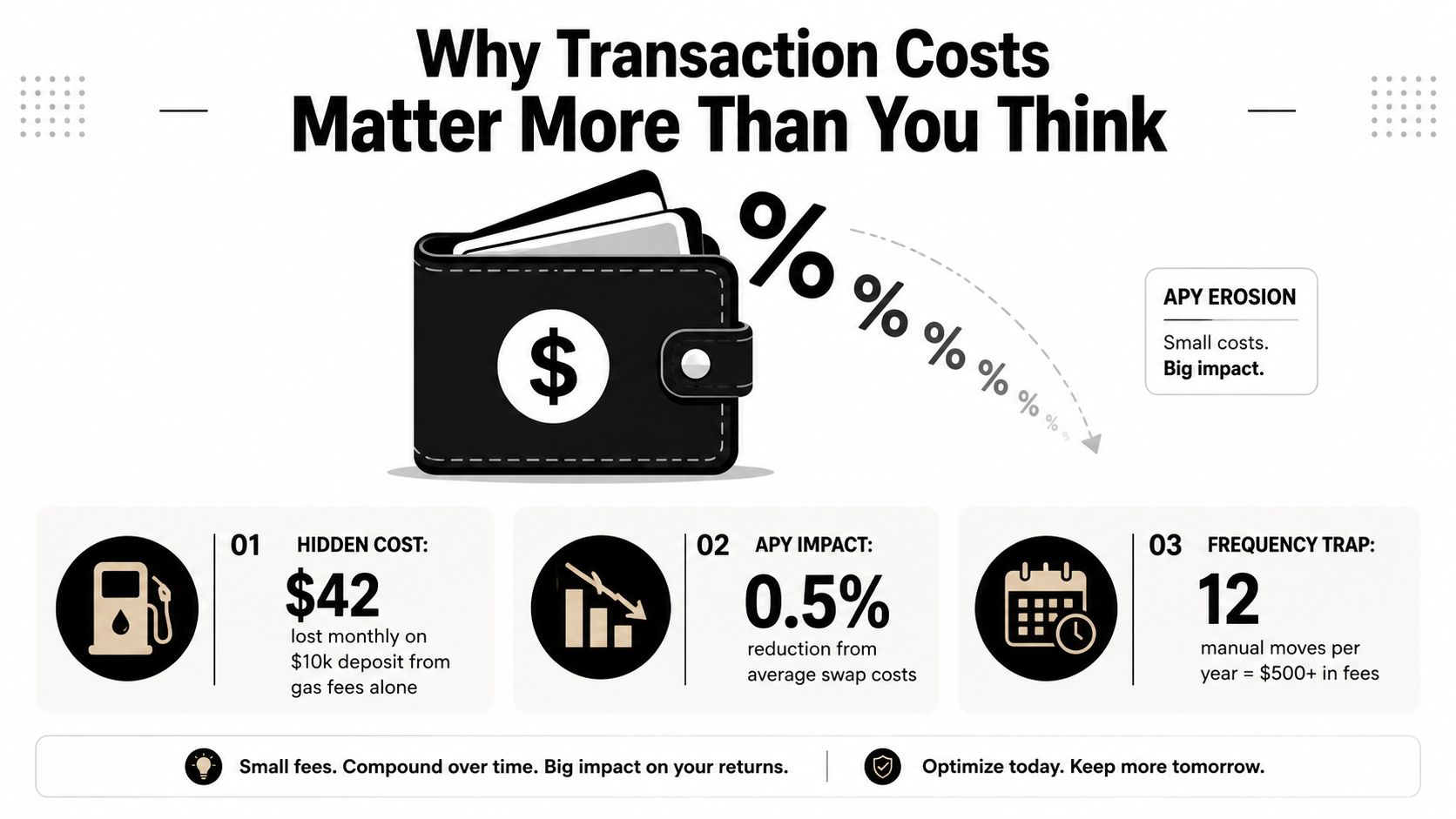
If you want the blunt version, this is the mistake most users make. They obsess over yield and ignore friction. A wallet that looks productive can still underperform if it makes too many expensive decisions. The fix is to reduce the number of on-chain decisions first, then make the remaining ones cheaper.
Why Transaction Costs Matter More Than Most Users Realize
Many DeFi users notice gas only after it hurts. They approve a token, claim rewards, swap into another stablecoin, then bridge again because the next vault looks better. Each move feels small on its own. Together, they create yield drag that slowly eats the gap between “good APY” and what ends up landing in the wallet.
The cost is not one fee, it's repeated friction
The cleanest way to frame transaction costs is as portfolio-level drag. That means the full cost of getting in, staying in, and getting out, not just the gas line you see in your wallet. In DeFi, that drag includes approvals, swaps, bridge fees, slippage, failed transactions, and the time spent checking whether another rebalance is worth it.
Practical rule: if a move does not materially improve your position, do not pay to make it.
Many users learn this the hard way. They split capital across several vaults, chase yield differences that look meaningful on a dashboard, then spend the next month paying to keep the setup optimized. The portfolio ends up working against itself. That is why tools like Yield Seeker exist, they cut the number of times a user has to manually hunt for opportunities and move funds around.
Transaction-cost reduction is also structural, not cosmetic. The business informatization research links lower transaction costs to better process design and automation, which maps cleanly onto DeFi workflows where software can replace repeated manual checks (study on business informatization). In practice, the cheapest transaction is the one you never trigger because you did not create the need for another move on-chain.
Stop thinking in single swaps
Here is the mindset shift. Do not ask, “How do I make this swap cheaper?” Ask, “How often do I really need to move on-chain?” If the answer is weekly, you are probably paying too much in friction. If the answer is monthly or event-driven, you are already in better shape.
That is the whole game. Fewer transactions, larger and better-timed decisions, less leakage. Once you see transaction costs this way, the path is obvious. Cut the number of decisions before you cut the fee on each one.
Choosing the Right Network for the Job
The network choice matters because not every chain deserves the same kind of flow. Mainnet Ethereum has the deepest liquidity and the broadest DeFi footprint, but it's usually the wrong default for small or frequent stablecoin moves. For most users, the right answer is to start on an L2 and only pay mainnet costs when the reason is specific and worth it.
Default to cheaper execution, not prestige
Use cheaper execution rails when the move is routine. Base and Arbitrum are sensible defaults for smaller stablecoin positions and sub-$5,000 moves because the whole point is to avoid paying premium settlement costs for ordinary portfolio activity. Polygon can make sense for high-frequency strategies where you care more about low ongoing friction than about having every possible blue-chip venue in one place.
Mainnet only earns its keep when the liquidity or protocol requirement is better there. If a vault, lending market, or execution path is materially stronger on Ethereum L1, pay the premium once and move with intent. If not, don't volunteer for expensive settlement.
Network cost snapshot for stablecoin DeFi | Typical swap fee | Bridge-in cost | Best use case |
|---|---|---|---|
Ethereum mainnet | Highest of the set | Highest of the set | Large moves, deepest liquidity, specific protocol access |
Arbitrum | Lower than mainnet | Lower than mainnet | Routine DeFi positioning, stablecoin vaults |
Base | Lower than mainnet | Lower than mainnet | Simple, low-friction stablecoin deployment |
Polygon | Usually low | Usually low | Frequent strategies and cost-sensitive rebalancing |
The exact number attached to each route will move around with congestion and pool depth, but the relationship usually stays the same. L2 transaction costs are typically a fraction of L1 costs, and that's the rule that should guide your default behavior. If you want a more tactical breakdown of when an L2 makes sense, this Layer 2 guide is worth keeping open in another tab.
Use the chain that matches your move frequency
A good rule is boring and effective. If you expect to touch the capital often, keep it on a cheap execution layer. If you expect to leave it alone, the network matters less than the quality of the strategy.
That's where a lot of users go wrong. They choose a chain first and a strategy second. Flip that around, then let the network serve the strategy.
Batching, Approvals, and Interaction Minimization
The cost is not just the fee on a single transaction. It is the habit of forcing your portfolio to touch the chain too often. Every extra approval, claim, deposit, and cleanup transaction adds more gas to the same position, which is how a cheap strategy turns into an expensive one over time.
Approve once, then stop paying for dust
An approval transaction gives a protocol permission to spend a token. A swap transaction moves value from one asset to another. Treating them as the same action leads to waste, because users keep re-approving the same token and keep sending follow-up transactions that should have been handled together.
That pattern burns gas for no real gain. Dust approvals, repeated claims, and tiny rebalances add up because they turn one portfolio decision into several on-chain events. If a protocol lets you set allowance once and stay inside a sane risk limit, use that setup. If it supports one-click deposits or multicall patterns, use those instead of stepping through every action one by one.
Fewer signatures mean fewer chances to overpay.
Keep the workflow tight. Group similar actions, avoid moving small balances unless there is a real reason, and stop rebalancing just because a position looks a little uneven. If you are moving three small stablecoin positions, wait until a single larger rebalance makes sense. One transaction usually beats three, because the gas bill tracks how often you force the portfolio on-chain.
Use protocols that compress interaction
The best DeFi interfaces reduce the number of times you have to sign and submit. Bundled deposits, multicall support, and one-click strategy actions cut the interaction count, which is the part of the bill most users ignore. That matters because every repeated on-chain step costs gas and adds more chances to make a mistake.
The same logic applies outside crypto, where automating financial workflows removes repetitive decisions from routine processes. In DeFi, the goal is narrower. Reduce the number of on-chain actions required to keep a position running, and stop paying gas for work the protocol can bundle for you.
Keep the rule simple. Approve once when the risk is acceptable, batch where the protocol allows it, and avoid turning every portfolio adjustment into a fresh chain interaction.
Gas Timing, DEX Routing, and Slippage Control
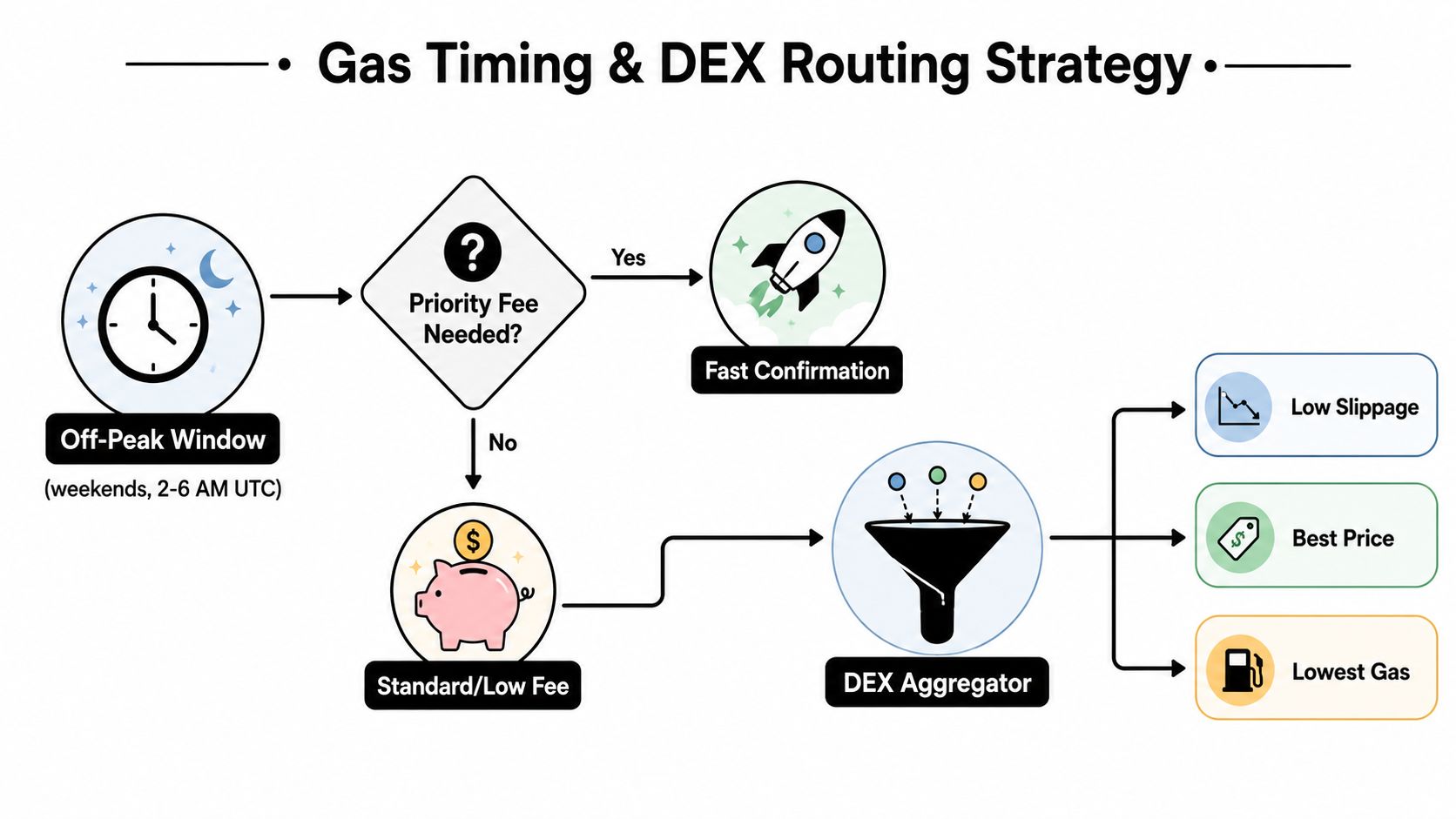
Timing still matters because gas markets don't price every hour the same way. If your move isn't urgent, send it when the network is quieter. Off-peak windows, especially weekends and low-activity hours, are the obvious place to start. If the transaction doesn't need priority, don't bid like it does.
Pay for speed only when speed matters
Priority fees exist for a reason. Sometimes you need certainty, not thrift. If you're protecting a position, closing risk, or trying to avoid a bad market move, paying for faster inclusion can be rational. If you're just rotating stablecoins, it usually isn't.
That same discipline applies to routing. A cheap chain with bad execution is still expensive if the swap suffers avoidable price impact. DEX aggregators help because they can split flow across pools, route around shallow liquidity, and find better execution than a single venue. That's often where savings show up, not in the headline gas number.
For Solana builders who care about transaction latency and execution quality, lower Solana RPC lag for devs is a useful reference point. The principle is the same across chains, faster and cleaner infrastructure can reduce wasted attempts and improve execution quality.
Slippage is a fee you create yourself
Stablecoin pairs should not need wide slippage tolerance. Keep it tight, because the price should be stable and the whole point is to preserve capital. Volatile pairs need more room, but that's a different trade-off and you should know why you're taking it.
A simple example makes this obvious. A $10,000 swap on a cheap network can still end up costing more in bad routing and price impact than a slightly pricier network with a better path. The gas bill is only one part of the cost. If routing is poor, the swap itself becomes the expensive part.
If you want a deeper look at the mechanics, the gas fees guide covers the cost drivers you're trying to avoid. The takeaway here is blunt, cheapest network plus bad routing is not cheap.
Bridge Selection and Cross-Chain Capital Movement
Bridges are not a side note. They sit in their own cost bucket, and they deserve their own decision rule. If you move capital across chains too often, the bridge bill can turn a strong strategy into a mediocre one. That matters because bridge friction is usually paid every time you rebalance, not once.
Don't bridge unless the destination really pays you back
Use a bridge only when the destination yield or execution quality clearly justifies the move. Evaluate the transfer against the time horizon you care about. If the better yield does not cover the bridge cost in a reasonable period, skip the move.
Canonical bridges give you the most conservative path, which is why they suit users who care more about settled infrastructure than speed. Third-party bridges usually move faster, and that speed comes with a different risk profile and more operational assumptions. Aggregator bridges can route around poor paths, but they also add another layer of complexity. Use the option that gives you the best mix of fee, settlement time, redundancy, and destination quality, then stick with that rule instead of improvising every time.
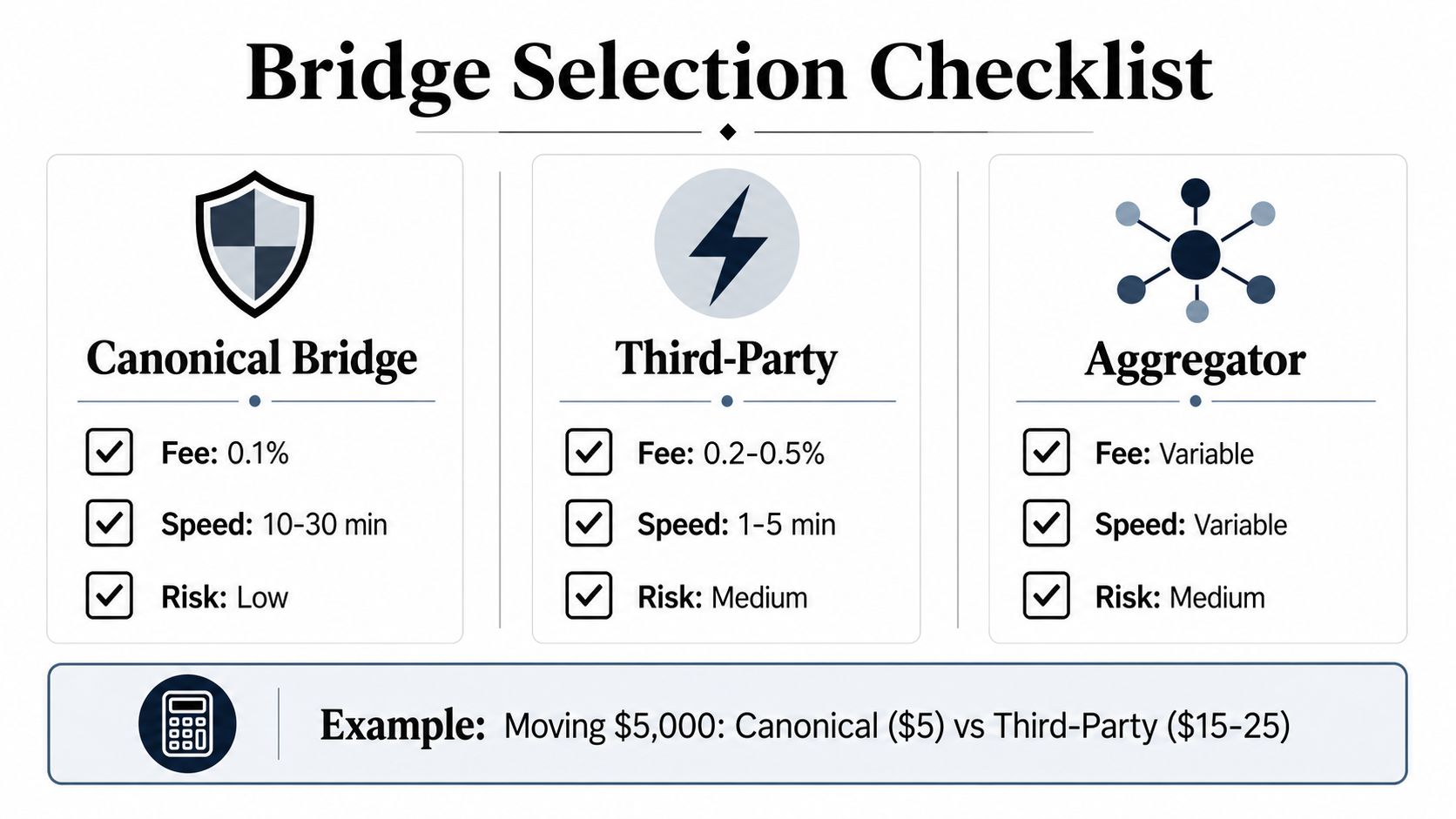
Savings come from cutting repeat moves. If you expect to rebalance three times in a week, the problem is usually the rebalance pattern, not the single bridge fee. One planned transfer is usually cheaper than a scattered series of small ones, and it leaves less room for bad timing.
Use a checklist, not impulse
Before you bridge, ask four questions.
Fee: What does the bridge cost once all layers are included?
Settlement time: How long until the capital is usable on the other side?
Route redundancy: If one path fails, is there a fallback?
Destination value: Does the new chain offer a better result after costs?
The practical rule is simple. If the destination does not beat the source after bridge friction, stay put. Good cross-chain capital movement protects the portfolio from needless churn, which is the point. If you want a more detailed treatment of transfer choices, the bridge guide is a useful companion reference.
Automating Yield So You Stop Rebalancing Manually
The biggest savings come from reducing the number of times you have to think about a move at all. Manual rebalancing looks active, but a lot of it is just paying to repeat the same decision with slightly different market noise attached. That's not optimization, that's churn.
Let systems do the checking for you
Automation comes in two useful forms. First, protocol-native auto-compounders reduce how often you need to collect and redeploy rewards. Second, AI-driven allocation agents can monitor positions and move capital when conditions justify it. That's the advantage, not magic returns, just fewer bad or unnecessary decisions.
Yield Seeker fits that model. It uses an AI Agent to monitor and allocate stablecoin deposits across DeFi protocols in real time, so users don't have to keep hunting for the next best vault by hand. It also sits on Base and is designed to keep funds accessible, which matters if you care about avoiding lockups while still reducing the manual transaction count.
The portfolio-level view matters most. If a user only touches a stablecoin position when the spread is worth the move, their effective transaction costs fall even if individual fees don't change much. Fewer moves, smarter timing, less leakage.
Manual oversight should be the exception
You still need judgment. No automation should run on autopilot without limits, especially when markets are volatile or protocol risk changes. But you should be spending your time on rules, thresholds, and exceptions, not on repetitive position maintenance.
That broader pattern shows up outside DeFi too. Anyone looking at automating financial workflows will recognize the same logic, remove repetitive manual work, keep humans on edge cases, and let software handle the routine path. That's exactly how transaction costs come down over time.
The cleanest setup is the one that keeps you from poking your portfolio every few days. If you're not making a meaningful improvement, leave it alone and let the system work.
Your Lower-Cost DeFi Checklist
Start with the cheap network, then prove you need something else. Batch approvals and deposits whenever the protocol supports it. Keep slippage tight on stablecoin pairs, especially when you're routing through a DEX aggregator. Time non-urgent swaps for off-peak gas windows. Bridge less often and only when the destination chain clearly earns back the cost. Let automation handle routine rebalancing so you stop paying for the same decision twice.
Default to L2s: Use Base, Arbitrum, or Polygon unless mainnet has a specific advantage.
Approve once: Avoid repeated allowance transactions.
Batch actions: Combine deposits, claims, and swaps where possible.
Route intelligently: Use aggregators and don't trust one pool blindly.
Tighten slippage: Keep stablecoin settings disciplined.
Time transactions: Send non-urgent moves when gas is quieter.
Plan bridges: Move capital with a clear destination and a clear payoff.
Automate the routine: Reduce the number of manual rebalances.
Main takeaway: transaction cost reduction is mostly about making fewer, smarter on-chain decisions, not chasing the absolute lowest fee on every single click.
If you want a cleaner way to manage stablecoin yield without constant manual rebalancing, Yield Seeker gives you an AI-driven setup that watches opportunities and allocates capital across DeFi for you. It's built for people who care about reducing both gas drag and decision fatigue. If that sounds like your current setup, go take a look and see whether it fits the way you move on-chain.