

Imagine having a financial autopilot for your crypto, one that constantly scans the market for the best ways to earn yield while you sleep. That’s automated liquidity management (ALM) in a nutshell. It's about using smart algorithms and software to actively manage your capital in DeFi, pushing for maximum returns while trying to keep risks in check—all without you needing to be glued to the screen.
Why Automation Is a Game-Changer for Modern DeFi
For a lot of stablecoin holders, Decentralized Finance (DeFi) feels like a frustrating paradox. The potential for great yield is there, but actually getting it feels like a full-time job. The space is a maze of protocols, each with its own set of risks, rewards, and confusing mechanics. Trying to manually track opportunities, shift funds around, and rebalance your positions isn't just a huge time-sink—it's incredibly stressful.
This is exactly the problem that automated liquidity management was built to solve. Think of it as your personal wealth manager, working around the clock to navigate the choppy waters of the DeFi markets for you. Instead of you burning hours on research and executing transactions, an automated system does all the heavy lifting.
The Headaches of Going It Alone
Without automation, the typical DeFi user is up against some pretty persistent challenges:
Mind-Numbing Complexity: The sheer number of protocols and strategies is overwhelming. Just trying to understand the nuances of each one requires deep technical know-how and constant market-watching.
The Constant Time Drain: Managing a portfolio manually demands non-stop vigilance. Market conditions can flip in an instant, and being a few minutes too slow can mean a missed opportunity or a painful, unnecessary loss.
The High Cost of Human Error: One wrong click, a forgotten rebalance, or a decision made out of FOMO or fear can have serious financial consequences. The pressure to make the perfect move every single time is immense.
A Jumbled, Fragmented Mess: You often end up juggling multiple dashboards, wallets, and platforms just to manage a single position. It creates a clunky, inefficient workflow that's anything but user-friendly. For a deeper dive into the foundational elements these systems manage, check out our detailed guide on what liquidity pools are.
An automated system takes the emotion and guesswork out of the equation. It runs on data, logic, and pre-set strategies, executing trades with a speed and precision that no human could ever hope to match consistently.
This shift from manual grunt work to intelligent automation is quickly becoming essential. And it’s not just for pro traders or big institutions anymore. Automated liquidity management is opening the door for busy professionals, Web3 treasuries, and everyday stablecoin holders to get involved in DeFi safely and efficiently. It transforms a complex, high-effort grind into a smooth, hands-off experience, letting you focus on your own goals while your capital works smarter, not harder.
Manual vs Automated Liquidity Management at a Glance
To put it simply, automation introduces a level of efficiency and precision that manual management just can't compete with. The table below breaks down the key differences.
Aspect | Manual Management | Automated Management |
|---|---|---|
Effort | High; requires constant monitoring and active trading. | Low; "set-and-forget" approach once strategy is defined. |
Speed | Slow; limited by human reaction time. | Instant; algorithms execute trades in milliseconds. |
Decision-Making | Prone to emotional bias (fear, greed) and human error. | Data-driven and logical, based on pre-set rules. |
Complexity | Overwhelming; difficult to track multiple protocols at once. | Simplified; manages complexity behind a user-friendly interface. |
Time Commitment | A full-time job for serious participants. | Minimal; frees up your time for other priorities. |
Risk | Higher risk of missed opportunities and costly mistakes. | Systematic risk mitigation through logic and diversification. |
Ultimately, automated systems are designed to handle the repetitive, high-stakes tasks that are poorly suited for human oversight, allowing you to benefit from DeFi's potential without the associated burnout.
Understanding the Foundations of DeFi Liquidity
To really get what automated liquidity management does, we first have to peek under the hood at the moving parts it controls. These are the core concepts that make Decentralized Finance (DeFi) tick, and once you see how they work together, it becomes obvious why automation isn't just a nice-to-have—it's essential.
At the very heart of DeFi is the Automated Market Maker (AMM). The easiest way to think about an AMM is like a perfectly balanced, two-sided scale for crypto assets. On one side, you have Asset A (like USDC), and on the other, Asset B (like ETH). When a trader wants to swap USDC for ETH, they add their USDC to one side of the scale, and the AMM protocol automatically gives them the equivalent value of ETH from the other side, keeping everything balanced according to a clever bit of math.
This simple but brilliant idea allows for trading without the old-school order books you see in traditional finance, creating decentralized markets that are always on. As a liquidity provider (LP), your job is simply to supply the assets for both sides of this scale, and in return, you earn a small fee from every single trade that happens.
Concentrated Liquidity: A Magnifying Glass for Your Capital
The first generation of AMMs had a big drawback: they forced you to spread your liquidity evenly across every possible price, from zero all the way to infinity. It was like trying to water a massive field with a single watering can—most of your capital was just sitting there, completely wasted in price ranges where no trading ever occurred.
Concentrated Liquidity changed everything. Imagine using a magnifying glass to focus the sun’s rays onto one tiny spot. That's exactly what concentrated liquidity does for your money. It lets you "concentrate" your funds within a very specific price range where you predict most of the action will happen.
This was a massive leap forward, making your capital work much, much harder. By focusing your funds in a tight, active range, you can earn a far bigger slice of the trading fees with the same amount of cash. But there's a catch: this precision requires constant attention. To keep earning, you have to actively manage your position, moving it to follow the market as prices shift.
This chart perfectly illustrates how automation tackles the headaches of modern DeFi. It shows the shift from a clunky, manual process to a clean, automated workflow—the very core of what we're talking about.
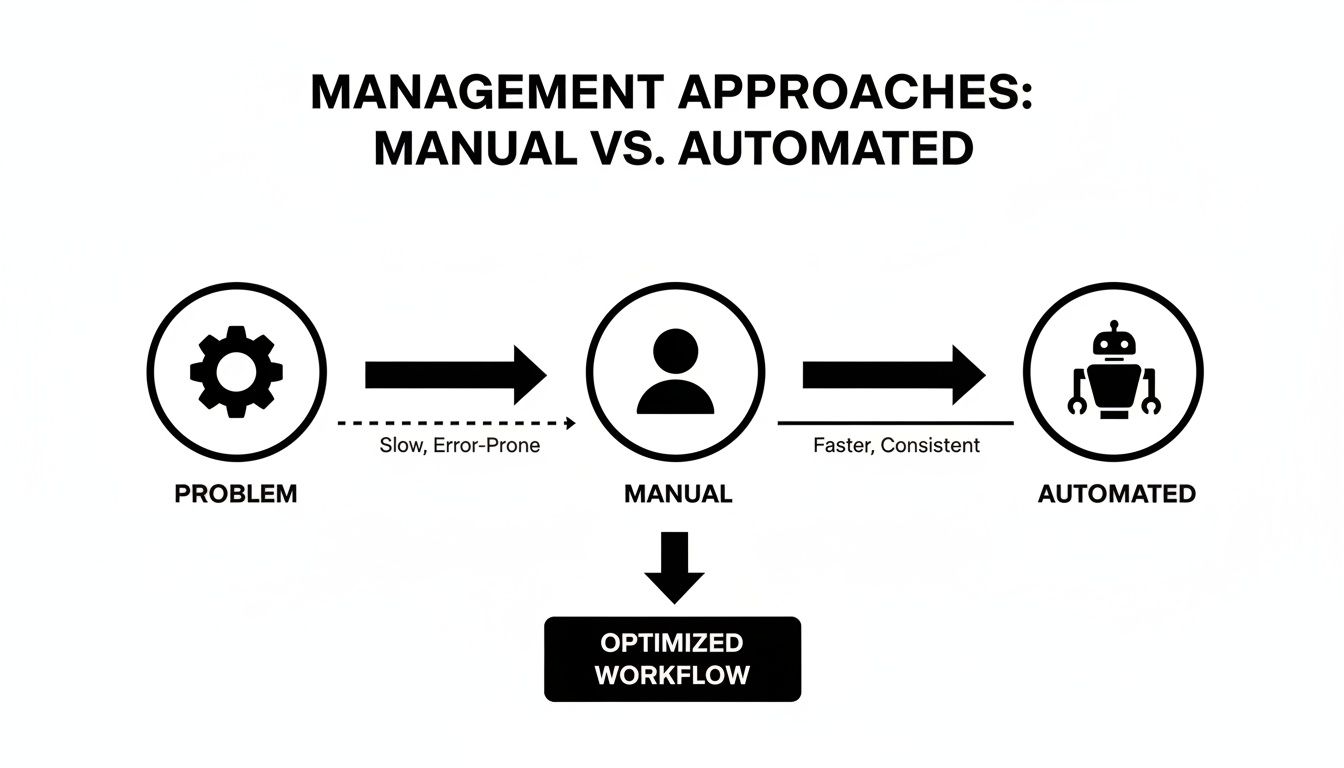
Ultimately, automation replaces slow, mistake-prone human clicks with fast, consistent, and logical execution.
Demystifying Impermanent Loss
Impermanent loss is probably one of the most misunderstood and intimidating concepts in all of DeFi. The name doesn't help, but it's really more of an opportunity cost than an actual, permanent loss from your initial deposit.
Let's walk through it. Say you deposit $500 of USDC and $500 of ETH into a liquidity pool. If the price of ETH suddenly doubles, the AMM's balancing formula will automatically sell some of your ETH for USDC to maintain that 50/50 value split. If you were to pull your funds out at that exact moment, the total dollar value would be less than if you had just held the ETH and USDC in your wallet.
Impermanent Loss is the difference in value between providing liquidity in an AMM and simply holding the assets. It only becomes a "real" loss if you withdraw your funds at that specific, unfavorable moment.
The good news is that the trading fees you earn over time can often more than make up for any potential impermanent loss. The crucial point here is that this is a risk you have to actively manage—and it’s yet another area where automated liquidity management really shines.
The Art of Rebalancing Your Portfolio
Finally, let's talk about rebalancing. Think of managing a liquidity position like tending to a prized plant in your garden. To make sure it grows healthy and strong, you have to regularly prune the overgrown branches and give the weaker ones some attention. Rebalancing in DeFi is the exact same idea, but for your assets.
As prices move, the value ratio in your liquidity position drifts away from your target. Rebalancing is just the act of buying or selling assets to get that ratio back to where you want it. For anyone using concentrated liquidity, it also means shifting your price range to "follow" the market so you can stay in the game and keep earning those fees.
This constant tweaking is vital for maximizing your returns and keeping risk in check. But trying to do it all by hand is a nightmare—it's tedious, time-consuming, and honestly, almost impossible to do perfectly. This is precisely why automated systems are so powerful; they can perform these rebalancing actions instantly and without getting tired, 24/7.
Diving Into Core Automated Liquidity Strategies

Automated liquidity management isn't some magic black box. It’s actually a mix of several powerful, interconnected strategies working together around the clock. These are the "brains" of the operation, executing complex actions 24/7 to keep your capital working as hard as possible.
Once you get what these core methods are doing, you’ll see how automation turns abstract DeFi concepts into real, consistent results. Each strategy tackles a specific headache for liquidity providers, from keeping positions in the green to harnessing the power of compounding.
Let's break down the most common techniques that drive modern ALM platforms.
Rule-Based Rebalancing Your Positions
At its heart, one of the most fundamental strategies is rule-based rebalancing. The best way to think about it is like a thermostat for your investment. You set your ideal temperature (your target asset allocation), and if things get too hot or too cold (the market moves), the thermostat kicks in automatically to get things back to where they should be.
In DeFi, this means an automated system keeps a close eye on your concentrated liquidity range. When the market price drifts outside your sweet spot, the system triggers a series of trades to shift your capital back into the profitable zone so you keep earning fees. This is a core part of traditional finance, too, where good portfolio rebalancing is key to staying aligned with your financial goals.
This solves a massive pain point of doing it all by yourself. Instead of being glued to charts and burning cash on gas fees for every little tweak, the system handles it with precision and speed. Better yet, it often bundles transactions together to make it more efficient.
Automated Yield Harvesting and Compounding
Another critical piece of the puzzle is automated yield harvesting. Picture a savings account with a tiny robot that collects your interest every few minutes and immediately puts it back in to earn even more interest. That’s compounding, and it can dramatically speed up growth over time.
This is exactly what yield harvesting does in the world of DeFi. As a liquidity provider, you earn trading fees that pile up as claimable rewards. An automated system jumps in to:
Claim Rewards Regularly: It collects these rewards at the perfect moment, weighing their value against the gas fees needed to claim them.
Reinvest Intelligently: The harvested fees are then put straight back into your main liquidity position, beefing up your capital.
Fuel Faster Growth: This creates a powerful feedback loop. Your bigger position now earns even more fees, which are then harvested and reinvested, and the cycle continues.
Trying to do this by hand is a nightmare. It's tedious, and for most people, the gas fees would eat up a huge chunk of the rewards, making it not worth the effort. Automation makes this powerful compounding effect accessible to everyone.
By systematically harvesting and compounding your yield, an automated platform makes sure not a single cent of your earnings is left on the table. It puts every part of your return to work, squeezing maximum efficiency out of your capital.
Intelligent Liquidity Routing Across DeFi
This is where things get really advanced. Intelligent liquidity routing is like having a sophisticated financial GPS for your capital. Instead of just managing your position in one pool, it scans the entire DeFi landscape to find the most profitable place for your money at any given moment.
This strategy involves crunching dozens of data points across multiple protocols in real-time, looking at things like:
Yield Opportunities: Comparing the annual percentage rates (APRs) across tons of different pools and lending platforms.
Trading Volume: Finding pools with lots of action, because more trades mean more fees.
Gas Costs: Figuring out the cheapest way to move capital between different protocols.
Based on this constant analysis, the system can dynamically move your funds from a pool that’s cooling off to one that’s heating up—all without you lifting a finger. This ensures your capital is always parked in the spot with the best possible risk-adjusted return.
If simple, rule-based automation was the first step, then adding artificial intelligence is the giant leap. We're moving beyond rigid, "if-this-then-that" scripts into a world where liquidity management can be proactive, adaptive, and genuinely intelligent.
Think of it this way: basic automation follows a preset list of instructions, no matter what. But an AI-powered system? It learns. It adapts. It can even start to anticipate where the market is headed. This isn't just a minor upgrade; it's a fundamental shift in how capital gets managed in DeFi. Instead of just reacting to price changes, these systems dig through massive datasets to find patterns and opportunities a human could never spot. You can explore some of the core ideas behind this shift in these AI Automation Principles.

This new generation of automated liquidity management introduces a layer of dynamic intelligence that was just out of reach before. It's the difference between using a basic calculator and having a dedicated financial analyst working for you 24/7.
From Rigid Rules to Personalized AI Agents
Imagine having a financial expert whose only job is to manage your stablecoin portfolio. This expert would get to know your personal goals and how much risk you're comfortable with, then build and run a strategy just for you. This is exactly what personalized AI agents are starting to do.
Instead of a one-size-fits-all strategy, these agents work on your behalf, making calls that actually line up with your profile. An AI agent can be set up to:
Learn Your Risk Profile: The AI watches how you interact with the platform or takes your direct input to figure out if you're a conservative, slow-and-steady type or someone who's okay with more risk for higher potential returns.
Adapt on the Fly: If the market suddenly gets choppy, an agent built for safety might automatically pull your funds into a stable lending protocol. On the other hand, an aggressive agent might see the volatility as a chance to jump into a high-fee pool.
Execute with Precision: These agents never sleep. They're constantly monitoring the market and tweaking your portfolio, free from emotion or fatigue.
This kind of personal touch means your automated strategy isn't some generic algorithm—it's tailored to hit your financial targets. The potential here is massive, and platforms like Yield Seeker are already showing how an AI yield aggregator can make this powerful tech accessible to regular users.
Real-Time Portfolio Allocation Powered by Data
The real magic of AI in this space is its ability to chew through huge amounts of data in real-time. These models aren't just looking at price charts and trading volumes. They're analyzing a whole spectrum of information to get a sense of where the market might be heading next.
This data-first approach makes real-time portfolio allocation possible. An AI can shuffle capital between different assets and protocols at a moment's notice, always hunting for the best possible risk-adjusted return.
An AI-driven system doesn't just react to the market—it anticipates it. By analyzing everything from on-chain transaction data to social media sentiment, it can identify emerging trends and adjust your portfolio proactively to either capitalize on an opportunity or mitigate a developing risk.
This predictive ability is a total game-changer. For instance, an AI might spot a surge in Twitter chatter about a specific DeFi protocol. It could cross-reference that with rising on-chain transaction volumes and predict that trading fees are about to spike. It could then slide some of your capital into that protocol's liquidity pool right before the action starts, letting you capture those higher earnings.
This isn't just theory. In traditional finance, studies have already shown that AI and automation give a huge boost to liquidity management. AI-driven models improve forecasting accuracy by 20–50% and get smarter with every new piece of data. This allows companies to safely shrink their idle cash buffers by 15–20%, freeing up a ton of capital.
The same principles are now being applied in DeFi, giving us a much smarter, more efficient way to manage our digital assets. By evolving from static rules to dynamic, AI-powered systems, automated liquidity management is becoming more personalized and way more effective.
Taking a Clear-Eyed Look at the Risks
Automating your DeFi activity is a huge step up from manually chasing yield, but it isn't a silver bullet. It doesn't magically erase risk; it just changes its shape. Getting a handle on these new risks is the key to making smart choices and, most importantly, picking platforms that actually put your security first.
With great power comes great caution. Let's be honest, any time you put money into a DeFi protocol, you're taking on some risk. Automation is no different. The trick is to know exactly what you’re up against and how to shield yourself. Let's break down what you need to watch out for.
Smart Contract Risk: The Code is Law
The first and biggest risk is baked right into the code. Every single thing in DeFi, from a simple lending pool to a sophisticated automated strategy, runs on smart contracts. These are just pieces of code that execute automatically on the blockchain.
If there's a bug or a weak spot in that code, a hacker could potentially exploit it and drain all the funds. This isn't just a "what if" scenario; we've seen massive, high-profile hacks that have cost users millions. This is exactly why rigorous security audits are an absolute must.
How to protect yourself: Stick to automated platforms that only work with well-known, battle-tested DeFi protocols that have been professionally audited. Good platforms are totally transparent about this and will link you straight to the audit reports so you can see for yourself.
Platform Risk: Who’s Really in Control?
When you hand the reins over to an automated platform, you’re putting a degree of trust in their systems and the team behind them. This is platform risk. You're counting on their algorithms to work as advertised and their infrastructure to stay online and secure.
One of the most important questions you can ask is: how much control does the platform really have? Can the developers just change the strategy whenever they want or, worse, get their hands on user funds? This is a form of centralization risk, and if it's not handled with complete transparency, it goes against the whole point of DeFi.
To keep yourself safe, here's what to look for:
Non-Custodial First: Does the platform ever actually hold your funds? The safest setups are non-custodial. That means you, and only you, ever control your private keys and your money.
Total Transparency: Does the company clearly lay out how its strategies work? If they're cagey about the details, that’s a massive red flag.
Freedom to Leave: Can you pull your funds out whenever you want, no questions asked? Platforms that don't have lockups or charge you withdrawal fees show they’re confident in their product and aligned with your interests.
Market Risk: The "Black Swan" Problem
Finally, you've got systemic market risk. This is the big, unpredictable stuff—the "black swan" events that can throw even the smartest algorithms for a loop. Think of a sudden, brutal market crash or a major stablecoin losing its peg. No automated strategy is built for that kind of chaos.
While you can't be 100% immune to market-wide meltdowns, a well-built platform will have safeguards baked in. This means setting conservative risk limits and having failsafes ready to kick in to protect your capital when things get wild. Honestly, choosing a platform that focuses on steady, risk-adjusted returns instead of just chasing the highest possible yield is almost always the smarter long-term move.
By getting your head around these risks, you can vet platforms like a pro and step into automated liquidity management with confidence.
Putting Theory into Practice with an ALM Platform
All this theory is great, but seeing it in action is where things really start to click. So, let’s walk through how a modern automated liquidity management platform can take all these complex DeFi strategies and turn them into a simple, hands-off experience for someone holding stablecoins.
Picture this: you're a busy professional. You've got some USDC you want to put to work, but you definitely don't have the time to become a full-time DeFi portfolio manager. Your journey with a platform like Yield Seeker would start with a simple deposit—often as little as $10—straight from your wallet. From that point on, the heavy lifting is completely off your shoulders.
Your Personalized AI Agent Takes Over
Once your funds are deposited, a personalized AI agent gets right to work. This isn't just some rigid, pre-programmed script; it's a dynamic system built to manage your capital intelligently. The agent’s main job is to constantly scan the DeFi landscape, crunching dozens of data points across a curated list of top-tier, audited protocols.
It's basically asking the same questions a savvy manual trader would:
Where are the most competitive, risk-adjusted yields right at this moment?
Which liquidity pools are buzzing with the highest trading volume?
What’s the most efficient way to move capital around to keep gas fees low?
Based on its real-time analysis, the agent allocates your USDC to the most promising spots. You never have to stare at multiple dashboards or sign a bunch of complex transactions. You just watch your balance grow through a clean, intuitive interface. If you're curious to peek under the hood and see how these systems pick the best opportunities, our guide on a modern yield optimization protocol takes a much deeper look.
This whole approach actually mirrors what’s happening in corporate finance. Big global treasuries are now using AI-driven platforms to consolidate their cash and get better at forecasting. By using predictive analytics, corporations can slash their idle cash reserves by 15–20%, putting millions of dollars back to work. For a stablecoin holder, a DeFi AI agent delivers a similar edge, making sure your capital is never just sitting on the sidelines. You can learn more about how AI is transforming corporate liquidity management on highradius.com.
A Focus on Security and Control
Let's be clear: the best automated liquidity management platforms are built on a bedrock of user security and control. This means they stick to a few non-negotiable principles designed to protect your assets and give you total peace of mind.
A core feature of any trustworthy ALM platform is that it’s non-custodial. This is huge. It means you—and only you—have control over your private keys and your funds, always. The platform is just there to execute the strategy, but it never actually takes possession of your assets.
This model is backed up by a strict no-lockup policy. Your money stays liquid and you can get to it whenever you need it, without getting hit with withdrawal penalties. That flexibility is critical, letting you react to personal financial needs or big market shifts on a dime.
By bringing together AI-driven optimization with a serious focus on security and user control, these platforms make sophisticated DeFi strategies accessible to pretty much anyone. They connect all the dots—from rebalancing and routing to yield harvesting—and wrap it all up into a single, powerful, and genuinely user-friendly experience.
Common Questions About Automated Liquidity Management
Let's dig into some of the most common questions that come up when people first hear about automated liquidity management. My goal here is to clear up any confusion and give you the confidence to figure out if these tools are right for you.
Is This Stuff Just for DeFi Degens?
Not anymore. It's true that the earliest versions of these tools were built by and for advanced traders running some seriously complex strategies. But the whole point of the newer platforms is to package all that complexity up and make it accessible to everyone.
They do the heavy lifting behind the scenes. This means regular investors and busy professionals can get the benefits of optimized DeFi yields without having to quit their day jobs to become full-time crypto analysts. The idea is simple: a hands-off experience powered by smart tech.
How Do I Know if a Platform Is Safe to Use?
This is the most important question, and your security should always be priority number one. The best way to protect yourself is to look for a few key green flags.
The gold standard for a safe platform is being non-custodial. This is a non-negotiable. It means you, and only you, ever have control of your private keys and your funds. The platform's software might move your assets between protocols, but it should never take ownership of them.
Beyond that, look for platforms that are totally transparent about their strategies and only work with well-known, audited protocols that have stood the test of time. Little things like not having fund lockups or withdrawal fees are also great signs that a project has your best interests at heart. As always, do your own homework on the team and their security setup before putting in any real money.
What Kind of Returns Can I Actually Expect?
This is the million-dollar question, and the honest answer is: it depends. Returns will always shift with market conditions and the specific strategies in play. The real goal of a good automated system isn't just about chasing the biggest, flashiest APY number. It's about generating solid, risk-adjusted yields.
These systems are built to consistently do better than just parking your money in a single lending protocol. The magic is in the continuous optimization—the platform is always scanning the market, looking for the best possible return for a sensible amount of risk. Any platform worth its salt will show you transparent, historical performance data to help you set realistic expectations.
Ready to put your stablecoins to work without all the manual hassle? Yield Seeker gives you a personalized AI Agent that finds and manages the best risk-adjusted yield opportunities for you. You can get started with as little as $10 and let automation take care of the rest. Explore smarter returns at https://yieldseeker.xyz.