
You already know the feeling. USDC sits in one protocol, a new vault looks better on another dashboard, and now you're checking APYs, TVL, and risk notes across tabs like you're running a tiny treasury desk. Automated portfolio rebalancing exists to turn that mess into a control loop, so capital moves only when the gap between your target allocation and your actual allocation is worth fixing.
What Automated Portfolio Rebalancing Does
A stablecoin holder usually does not need more charts, they need fewer surprises. One wallet may sit in a lending market, another position may be parked in a stable LP, and a third yield vault can start to look stale. Automated portfolio rebalancing keeps checking whether your current mix still matches your target mix, then trades only when the difference is large enough to matter.
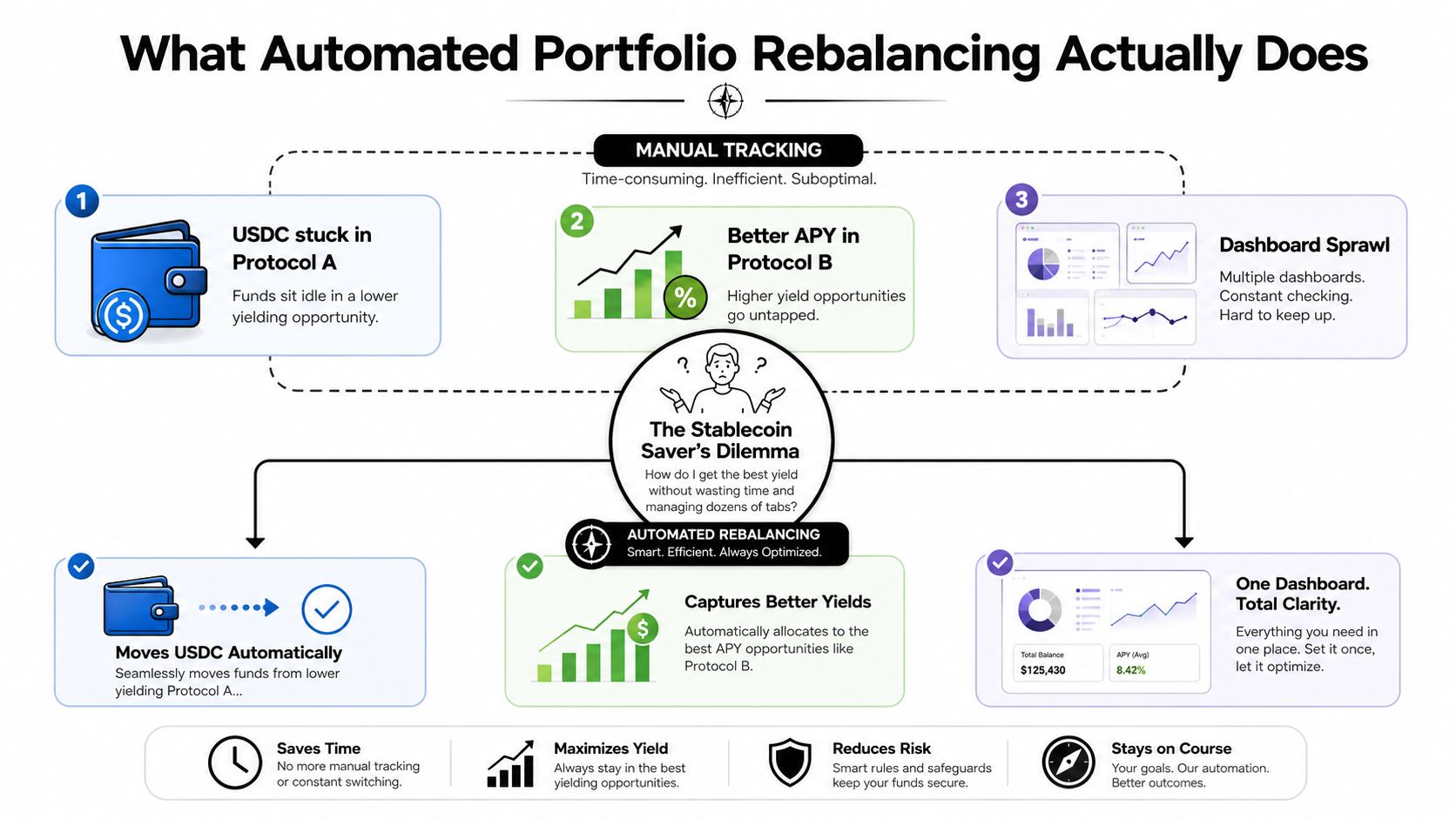
The simplest way to understand it is as a control system, not a guessing game. Manual tracking means you keep opening apps and asking whether USDC is still where you want it. Automated rebalancing keeps the portfolio aligned for you, then nudges weights back into line only when drift crosses the point you care about.
For DeFi, the core logic is straightforward. The system computes live weights from holdings and prices, compares them with target weights, measures drift, then generates offsetting buy and sell orders. That loop is the engineering difference between watching the market and running policy.
A small example makes the difference easier to see. If your target is 60 percent in one asset and 40 percent in another, but the first rises to 68 percent, the system can flag that gap and restore the original split. Without that step, the portfolio slowly stops matching the plan, even if the market moves for reasons that have nothing to do with your thesis.
Practical rule: if you can describe your allocation in one sentence, the rebalance engine should be able to test that sentence continuously.
That is also why dashboards get messy so quickly. Once you start chasing yield across protocols, the main problem is not finding a rate, it is keeping the portfolio aligned while those rates move. For a broader context on allocation choices before automation, see how to diversify a crypto portfolio.
How Drift Thresholds and Calendar Triggers Work
Drift thresholds define a tolerance band around your target weights. The engine watches those weights and only acts when an asset moves outside the range you set. Automated portfolio rebalancing uses that band to decide whether the portfolio has drifted far enough to justify a trade, often with a tolerance around 5% to 10% from target weight source.
The control loop in plain English
The loop is mechanical, not mystical. First it reads current holdings and prices. Then it compares current weights to target weights, measures absolute or relative drift, and decides whether to generate offsetting trades. In hybrid setups, a scheduled review, monthly, quarterly, or annual, adds one more check, so the system acts only when the calendar says “review” and the drift still says “act.”
That hybrid model matters because it cuts down on pointless turnover. A threshold-only system may wait for a band breach, while a calendar-only system may trade on a fixed date even when nothing meaningful changed. Using both lets you review on a cadence and still skip unnecessary trades when the portfolio is already close enough.
For a stablecoin-heavy DeFi portfolio, that difference is easy to see. If your weights are already near target and only small yield changes have occurred, a forced rebalance can create friction without improving the allocation. A drift band gives the system a reason to stay quiet until the move is large enough to matter.
What the trade count tells you
Analysts in a 29-year rebalancing study found very different trading intensities across rules, with 348 events for monthly calendar rebalancing, about 12 per year, 116 events for quarterly rebalancing, about 4 per year, 29 events for annual rebalancing, about 1 per year, and 28 events for a 5% threshold rule, also about 1 per year source. The same study reported Sharpe ratios of 0.68 for annual rebalancing, 0.71 for 5% threshold rebalancing, and 0.63 for quarterly rebalancing source.
Rule | Total Events | Events Per Year | Sharpe Ratio |
|---|---|---|---|
Monthly calendar | 348 | 12 | not reported in the verified data |
Quarterly calendar | 116 | 4 | 0.63 |
Annual calendar | 29 | 1 | 0.68 |
5% threshold | 28 | 1 | 0.71 |
Practical rule: if your allocation drifts slowly, a threshold can save you from trading just because the calendar says so.
The table shows the trade-off clearly. Calendar rules create a predictable review rhythm, but they can force activity even when the portfolio has not moved much. Threshold rules are quieter, because they wait for drift to cross a line you care about.
That is the value of drift logic. It reduces turnover while still correcting risk exposure when market moves change the shape of the portfolio. In stablecoin-heavy DeFi, that usually means you do not need to micromanage every APY change, you need a band that tells you when a move is worth the friction. For a closer look at how machine-learning systems can help decide when to act, see Yield Seeker's machine learning approach to DeFi portfolio management.
Algorithms Beyond Simple Threshold Rules
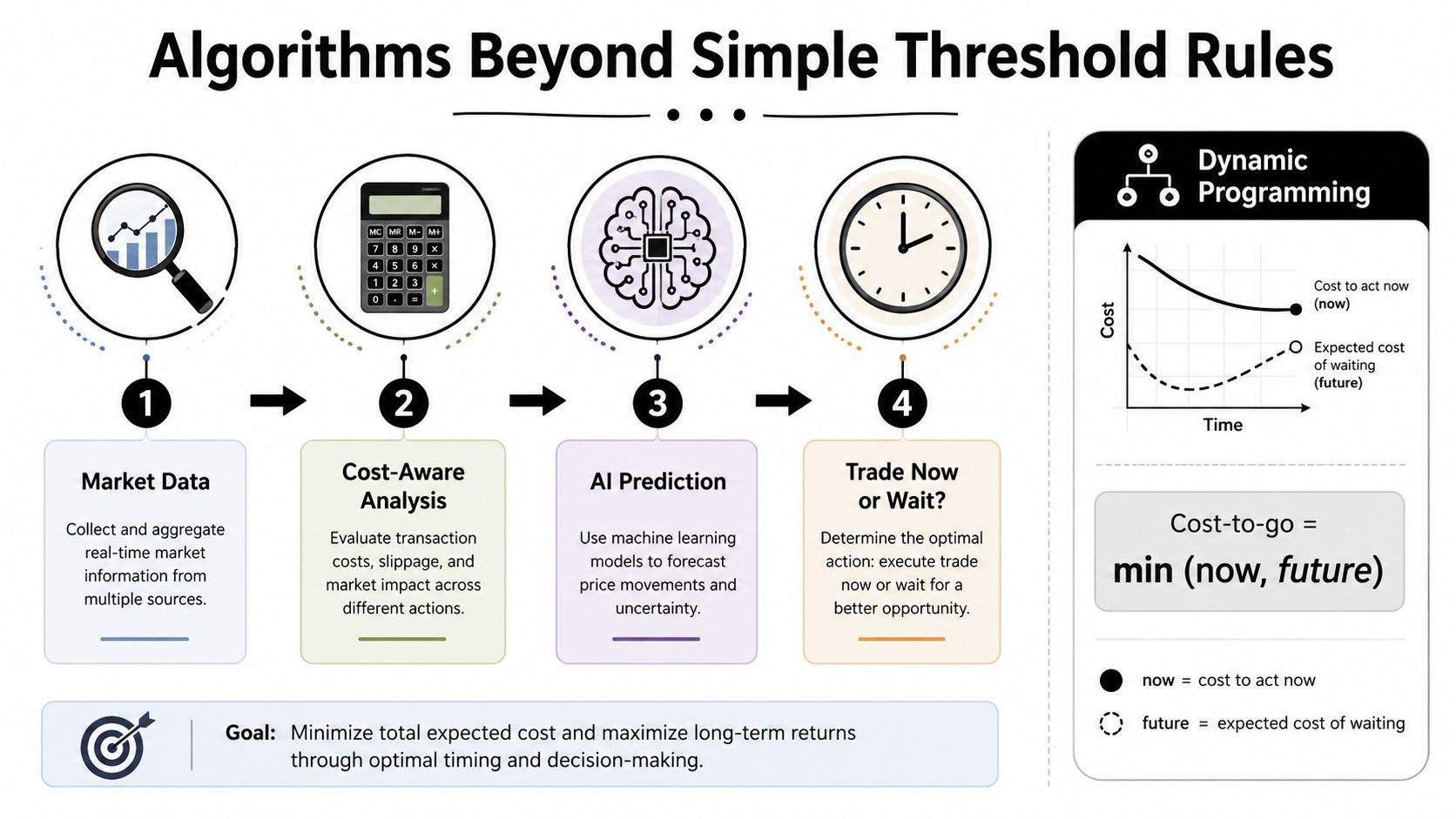
A threshold rule is useful, but it is still a blunt tool. It says to trade when drift crosses a line. A more advanced rebalance engine asks a harder question, whether the trade still makes sense after costs, taxes, and the value of waiting. That is where cost-aware optimization comes in.
Cost awareness beats mechanical matching
Research on dynamic programming frames rebalancing as a cost-to-go minimization problem. The algorithm weighs target allocation error against transaction costs before deciding whether to trade now or defer source. That is a better mental model than restoring weights at any price, because the cost of action can be larger than the benefit of perfect alignment.
A simple example helps. If a portfolio is only slightly off target, and the expected gain from fixing it is tiny, the better move may be to wait. If the drift is large, or if the mismatch raises risk in a way that matters, then the trade starts to justify itself. Cost-aware systems are built to separate those two cases instead of treating every deviation the same way.
Reinforcement-learning approaches push this further. The agent observes portfolio weights and market signals, then learns actions that maximize reward tied to return or risk-adjusted performance such as the Sharpe ratio source. In practice, that lets a rebalance system adapt to changing conditions instead of obeying one fixed sensitivity forever.
Production systems don't just sell winners
The smartest workflows do not begin with a sell order. They first ask whether new deposits can fix drift, whether lot-level tax cost makes the trade expensive, and whether multiple drift metrics agree. One technical workflow described in the research prioritizes incoming contributions before selling overweight positions, which is how a cash-aware system reduces friction source.
If you are comparing tools instead of building from scratch, it helps to treat bots and agents as control systems, not just signal chasers. A useful comparison is find the best trading bots, because the important question is not who trades fastest, it is who makes the fewest unnecessary trades.
Dynamic rebalancing rewards selectivity over activity.
The same logic applies in DeFi. If yield changes every few days, a fixed calendar can lag badly. If costs are high or the edge is thin, a smarter agent should wait. That tradeoff is the whole game.
A Stablecoin Yield Example in DeFi
Say you start with USDC spread across three places, one lending protocol, one stable LP position, and one yield-bearing vault. Your target is 40/35/25, because you want a mix of predictable lending exposure, some LP yield, and a vault allocation that can move quickly when opportunities shift. At first, the portfolio matches the plan.
Then the market changes. The lending market compresses, the LP leg gets more correlated with the rest of your stack, and a different vault starts looking more attractive. A manual setup means you notice the change late, log into multiple interfaces, and decide whether to trim, hold, or redeploy. An automated setup watches the same drift and handles the reshuffle without you needing to babysit each protocol.
What the rebalance cycle would do
The system would first compare actual weights to the 40/35/25 target. If the lending leg is now overweight because the other positions underperformed, it can trim that leg and route capital into the better opportunity. If fresh deposits are coming in, it can use those funds to correct underweights before touching existing positions, which keeps friction lower.
It also keeps an eye on signals that matter in yield markets, not just raw APY. APY drift tells you whether a leg is still competitive. TVL changes and risk score movements help explain whether the edge is durable or just a temporary spike. Correlation changes matter too, because two positions can look different on paper and still behave like one trade in stress.
Why this feels different from equities
In stock portfolios, rebalancing often protects against price drift. In stablecoin-heavy DeFi, it protects against yield drift. That sounds subtle, but it changes the logic a lot. You're not mainly deciding whether an asset is expensive or cheap, you're deciding whether the yield you're earning still justifies the capital you've tied up there.
That's why a rebalance in DeFi often looks more like treasury routing than investing in the old-school sense. The system is moving stable capital toward the best risk-aware use, then pulling it back when the edge fades. For a protocol user, that's less about market timing and more about keeping idle capital from staying idle.
When Automated Rebalancing Helps and When It Hurts
A portfolio that looks balanced on Monday can be out of shape by Friday. In stablecoin-heavy DeFi, that shift usually comes from yield moving, liquidity changing, or one leg becoming less attractive while the others hold steady. Automation helps most when it reacts to that kind of drift with discipline, not when it churns just to feel busy.
The common pitch says automation always helps because it removes emotion. That is too simple. A 2020 empirical study of German households found that automated portfolio rebalancing did not improve outcomes on average, with monthly rebalancing reducing mean annual return by 0.05 percentage points and annual rebalancing reducing it by 0.15 percentage points, while the median return change was 0 in both cases source. In plain English, more rebalancing was not automatically better.
The harder conclusion is the one many explainers skip. For static portfolios, the edge from tighter rules can be tiny, and in some cases effectively negligible once friction is included. Vanguard's guidance, as summarized in the verified data, says optimal rebalancing is neither too frequent nor too infrequent, with annual rebalancing often reasonable for many investors source. That fits a simple engineering idea. If the correction costs more than the drift, the correction is working against you.
Why DeFi changes the answer
Stablecoin yield portfolios do not behave exactly like stock and bond portfolios. The main driver is not price appreciation, it is spread and opportunity turnover. When yields shift quickly, a portfolio can drift into the wrong place faster than a human can track across dashboards.
That does not mean every allocation should be automated. It means automation has more value when the opportunity set changes faster than your attention can keep up. A stablecoin strategy can feel like a treasury desk with moving rates, where the job is to keep capital parked in the best risk-aware slot without paying unnecessary tolls on every move.
Costs matter here in a way many people underestimate. Every swap, every move, and every unnecessary reset can eat the very edge you were trying to capture. The system only helps if the improvement in expected yield is larger than the friction required to get there.
A useful decision filter
Use four questions before automating. How quickly do yield spreads change. What will swaps, gas, and execution friction cost. How much capital is sitting idle while you wait. And is the market in a regime where a narrow band makes sense, or one where patience is better.
If you want a broader list of automation tools and the tradeoffs they introduce, find the best trading bots is a useful comparison point. The right answer is to trade only when the edge survives the friction.
Designing Thresholds That Survive Regime Shifts
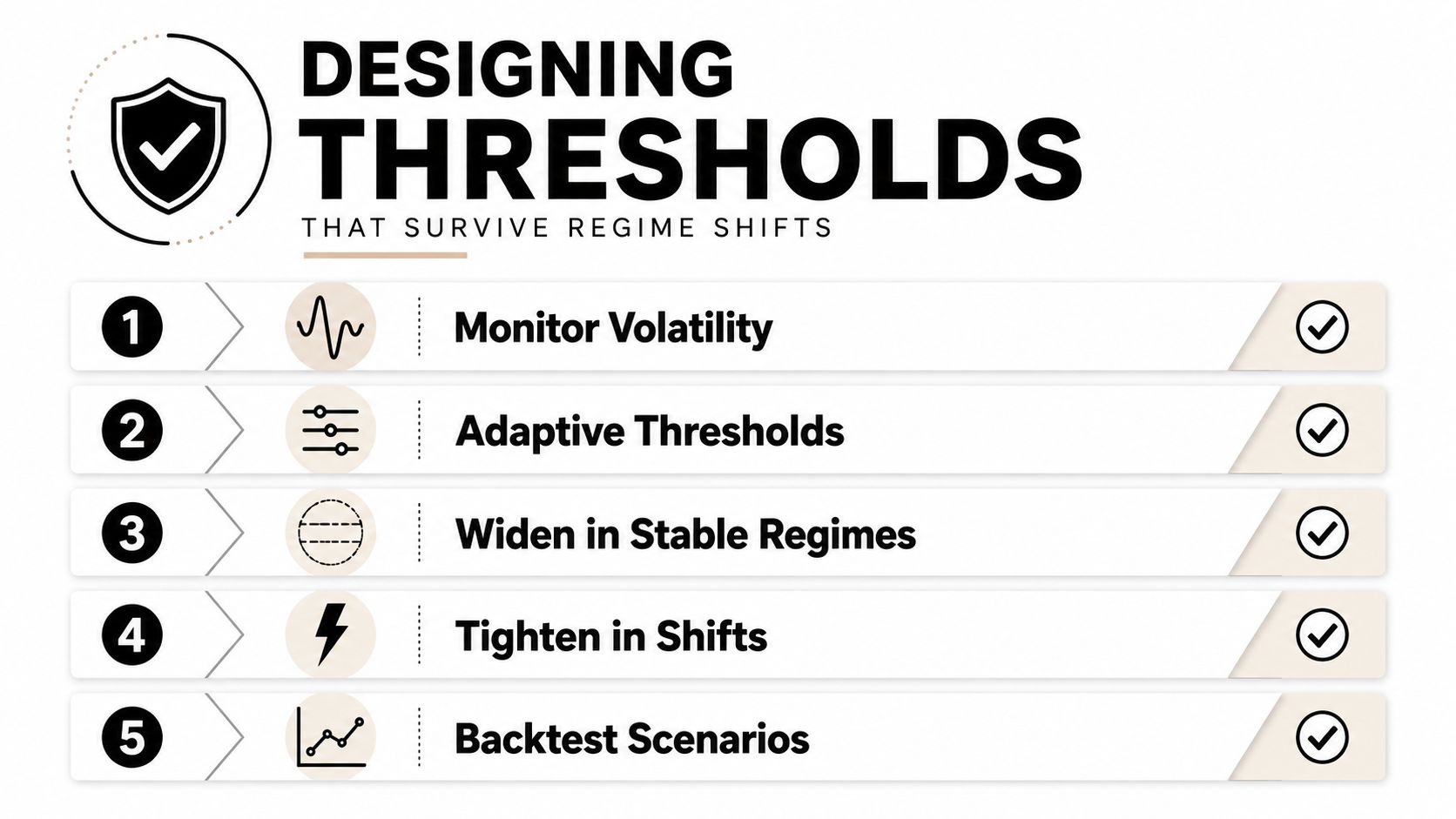
A threshold that works in calm conditions can break the first time yields gap out or liquidity thins. Stablecoin portfolios need rules that widen when the market is stable and tighten when conditions change fast. They also need exception handling, because the right move is sometimes to do nothing.
A practitioner checklist
Monitor volatility and yield spread changes. If the environment is stable, a wider band can avoid churn. If spreads are moving quickly, a tighter band helps the system react sooner.
Use adaptive thresholds. The band should not be frozen forever. A rule that ignores regime changes can become stale fast.
Prefer cash redeployment first. If new deposits or incoming funds can restore balance, use them before selling existing positions.
Hard-fail on liquidity problems. If a pool becomes hard to exit or execution looks stressed, pause rather than force a bad trade.
Require multiple signals. A drift trigger alone can be noisy. Let APY, liquidity, and risk indicators agree before action.
Practical rule: if the system would need to force a messy trade just to stay mathematically perfect, the threshold is probably too tight for that regime.
Regime-aware design matters most when the market is changing underneath the portfolio. In a stablecoin setting, a position can look attractive one week and ordinary the next, so the engine has to respect both opportunity and execution reality. That means no blind rebalancing into illiquid conditions, no automatic response to one weird data point, and no pretending that every overweight position should be sold immediately.
This is also where a good rebalance engine earns trust. It should know when to wait, when to use fresh capital, and when to stop itself before a bad trade turns into a bad week.
How Yield Seeker Automates the Whole Loop
A user deposits capital, the agent watches for changes in yield and portfolio weights, and it reallocates only when the setup justifies a trade. Yield Seeker applies that rebalance logic as a 24/7 agent on Base, while still keeping the workflow simple enough for a normal user to follow. You can start with as little as $10 USDC, then let the system track DeFi opportunities, compare them against the portfolio's current mix and risk preferences, and move funds when the numbers line up. The point is continuous monitoring with selective execution, which matters more than constant trading.

What the user sees
The workflow stays close to the ideas above. The agent computes weights, checks drift, and executes trades when the conditions line up. Users can see balances and earnings at a glance, and the built-in terminal plus walkthroughs make the portfolio logic visible instead of hiding it inside a black box.
That matters because automation only works when the user still understands what it is doing. A clean interface does not replace judgment, it gives you the context to review or override the agent when needed. Funds remain accessible, and there are no lockups or withdrawal fees, so the capital stays under user control.
That design is similar to the way Lynkro.io's approach to business AI frames automation as a practical workflow layer rather than a gimmick. The useful part is the discipline of turning recurring decisions into a system that can run consistently, more than the label “AI.”
For a closer look at the agent side of that workflow, see Yield Seeker's AI-driven DeFi agent. The logic is straightforward. Monitor fragmented yield opportunities, apply the rebalance rule, and keep the portfolio aligned without forcing you to manage every move by hand.
Choosing When Automation Adds Real Value
Automate when yield spreads change faster than you can monitor them, when manual decisions keep slipping because the dashboards are too fragmented, and when the cost of doing it yourself is higher than the drift you're trying to avoid. Don't automate just because a system can trade on your behalf.
In stablecoin DeFi, the best use of automation is steady exposure with disciplined exceptions. Yield Seeker fits that use case by watching opportunities across protocols, reallocating when the agent sees a better risk-aware setup, and leaving you free to review, override, or withdraw on your own terms. If you want to stop chasing APYs by hand and still keep control of your capital, visit Yield Seeker and see how the agent handles the rebalance loop for you.