
You've got stablecoins spread across several DeFi apps, each promising a different yield. One dashboard shows a tempting rate, another warns about utilization, and a wallet notification says an oracle feed has moved. By the time you compare the signals, the market has changed again.
That's the practical problem automated risk management tries to solve. It doesn't make DeFi risk disappear, and it can't guarantee a profitable outcome. Instead, it connects monitoring, decision rules, and on-chain actions so a yield strategy can respond to changing conditions without waiting for someone to check six tabs.
Why DeFi Users Are Turning to Automation
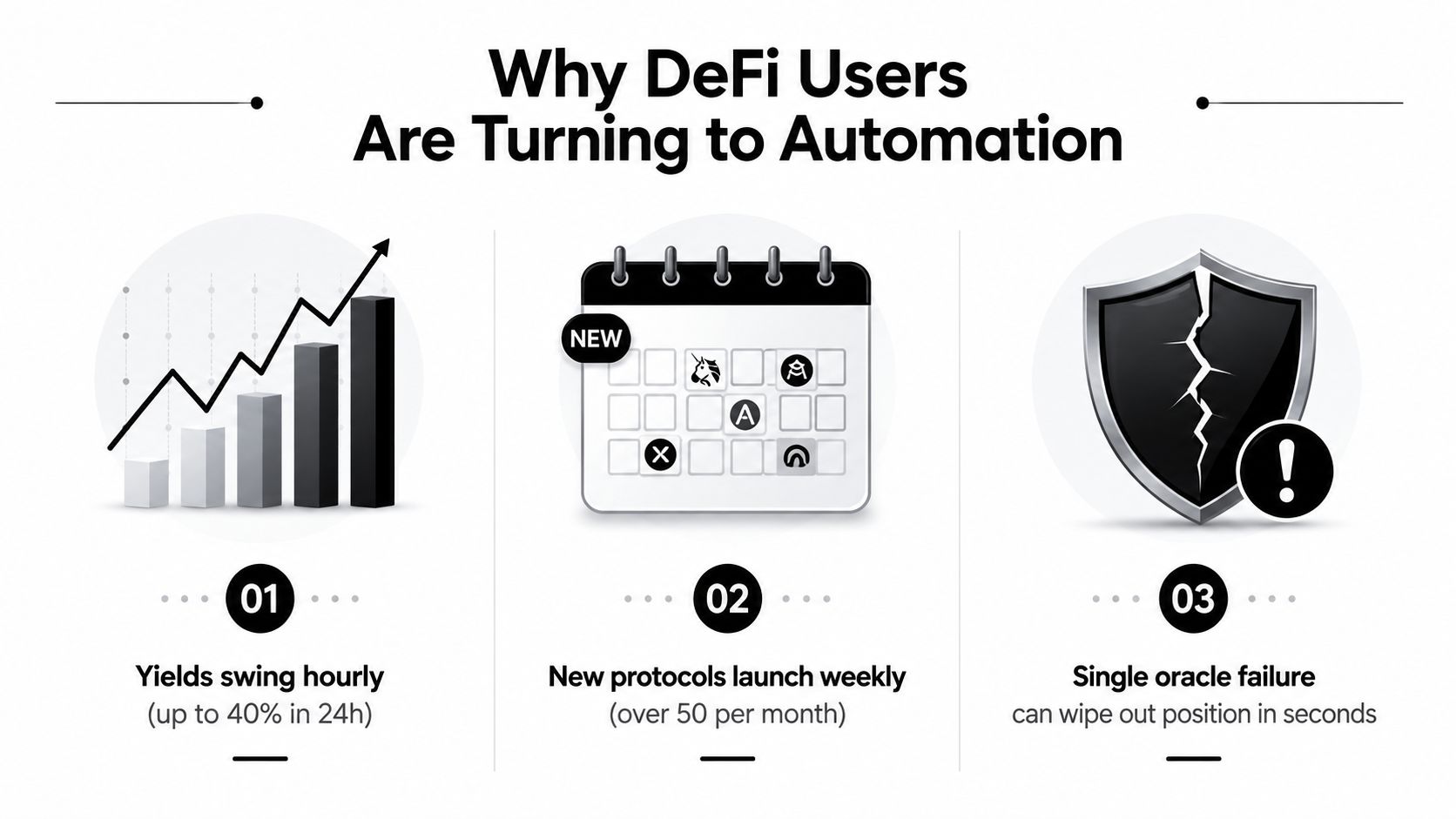
A typical yield farmer starts with good intentions. They compare lending markets, check liquidity, review protocol documentation, monitor stablecoin prices, and keep a spreadsheet of allocations. Soon, that routine becomes a second job. A Telegram alert arrives while they're working, a new incentive changes the apparent yield, and a position on another chain needs attention before the next block changes its health factor.
The difficulty isn't just the volume of information. DeFi produces several kinds of risk signals at once, including price divergence, utilization changes, liquidity conditions, smart-contract warnings, governance activity, and transaction execution problems. An experienced user may understand each signal individually, but human attention still has limits. People sleep, lose context, hesitate under pressure, and sometimes chase a high displayed APY after the underlying risk has already changed.
The danger becomes clearer when a stablecoin loses its intended peg or an oracle reports an unreliable price. A manual operator might notice the warning, decide whether it's real, prepare a transaction, wait for confirmation, and discover that the opportunity to reduce exposure has narrowed. In that environment, a spreadsheet records what happened. It doesn't protect the position.
From monitoring fatigue to predefined action
Automation addresses the specific points where manual management breaks down:
Continuous observation: Software can watch supported protocols, prices, liquidity, and wallet conditions without relying on a human refresh cycle.
Predefined responses: A policy can specify when to reduce exposure, withdraw funds, pause an allocation, or move capital to another venue.
Consistent execution: The system follows the same policy during calm markets and stressful markets, rather than changing its behavior because the operator is tired or anxious.
That's why automated yield management appeals to both beginners and experienced users. Beginners get a structured process instead of a maze of dashboards. Experienced users can encode their risk preferences once and avoid repeating the same checks manually. The broader idea is explored in crypto income automation, where automation is treated as an operating process rather than a single yield button.
Automation still needs boundaries. A poorly designed rule can react to a false signal, and a broken data feed can trigger the wrong action. The useful promise is narrower and more practical: a well-designed system can keep watching, apply agreed conditions, and act before manual attention becomes available.
What Automated Risk Management Really Means
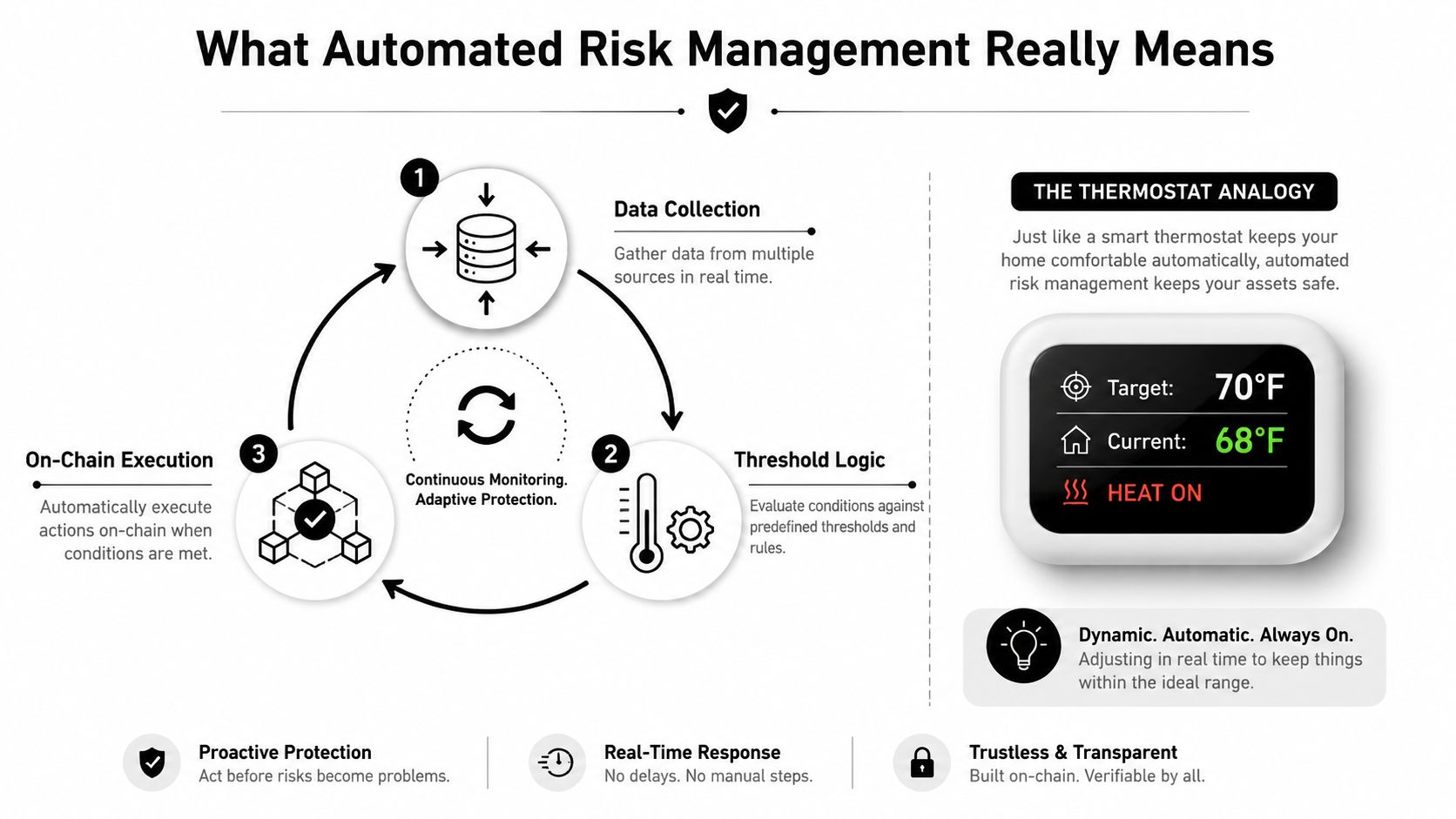
Automated risk management is a closed loop. The system collects data, compares that data with defined policies, and submits an action when a condition is met. If the action changes the portfolio, the system then observes the new state and repeats the process.
A thermostat offers a simple analogy. It reads the room temperature, compares the reading with a target, and turns the heating on when the room falls below that target. It doesn't need the homeowner to notice the temperature or remember to switch a button. A DeFi risk engine works similarly, although its inputs and actions are more complex.
The three parts of the loop
Data collection comes first. The system reads on-chain state such as pool balances, utilization, collateral values, wallet health factors, and transaction conditions. It may also consume oracle feeds, indexed blockchain data, governance information, and security alerts. Data quality matters because a flawless rule can still make a bad decision when it receives stale or manipulated input.
Threshold logic turns observations into policy. A portfolio might have a rule to reduce exposure when a stablecoin deviates materially from its target, or a lending position might require action when its safety margin narrows. More advanced systems combine several signals into an exposure score instead of reacting to one metric in isolation.
On-chain execution performs the response. A smart account, keeper network, or transaction service can call a vault, withdraw liquidity, repay debt, or reallocate capital. The execution layer also needs safeguards, such as transaction simulation, permission limits, gas controls, and a fallback process when a transaction fails.
Practical rule: Automation should make a policy easier to follow, not hide the policy from the person whose capital is at risk.
The value isn't speed alone. It's the consistent connection between signal, decision, and action. A useful comparison is traditional gestione del rischio finanziario PMI, where risk management also depends on identifying exposures, setting controls, assigning responsibility, and responding when conditions change. DeFi replaces some manual steps with code and on-chain execution, but the governance problem remains.
A 2020 Hong Kong Monetary Authority publication treated sound risk management practices for algorithmic trading as a formal supervisory requirement, with governance frameworks designed to keep automated risks within an institution's risk appetite. That history shows why automation shouldn't be viewed as a purely technical upgrade. It's a set of operating rules with financial consequences.
The Core Building Blocks of a Risk Automation System
A DeFi risk stack usually has four connected building blocks. Each one answers a different question: What's happening? How dangerous is it? What should happen next? Who or what executes the response?
Data inputs
The input layer gathers raw observations. On-chain data can include total value locked, pool utilization, oracle prices, wallet health factors, collateral balances, and liquidity depth. Off-chain inputs may include governance proposals, exploit warnings, audit updates, or operational status signals.
A lending vault illustrates the dependency. If the vault can't obtain a reliable collateral price, it can't calculate a meaningful loan-to-value ratio. If the data arrives late, the system may respond after the position has already become unsafe.
Risk metrics
Metrics translate raw observations into interpretable conditions. Common examples include peg deviation, collateralization ratio, drawdown, concentration, liquidity depth, and exposure by chain or protocol. Each metric captures a different failure mode.
A portfolio can have attractive yield but excessive concentration in one protocol. Another can hold diversified assets but face thin exit liquidity. A useful engine looks at the relationship between these conditions instead of treating APY as the main decision variable.
Thresholds and policies
Policies define acceptable boundaries. A rule can reduce exposure when utilization becomes too high, pause deposits when an oracle diverges from an independent reference, or limit the amount allocated to a single protocol. The exact threshold should reflect the user's risk profile, the asset, the chain, and the protocol's design.
Thresholds aren't automatically correct because they're precise. They need testing, documentation, and review. A rule that reacts too aggressively can create unnecessary swaps and slippage. One that reacts too slowly can leave the portfolio exposed during a fast market event.
Execution layer
The execution layer turns a fired policy into a blockchain transaction. Smart-contract modules can enforce limits directly. A smart account can authorize specific actions. Keeper bots can monitor conditions and submit transactions, while multisig controls can reserve sensitive changes for human approval.
Building Block | Role | Example Data | Typical Source |
|---|---|---|---|
Data inputs | Collects current portfolio and protocol state | Oracle price, utilization, wallet health factor | Oracles, RPC nodes, indexed blockchain data |
Risk metrics | Converts observations into exposure measures | Peg deviation, drawdown, concentration | Risk engine calculations |
Thresholds and policies | Defines when the system should respond | Exposure cap, liquidity condition, safety boundary | User settings and protocol rules |
Execution layer | Performs the approved action on-chain | Withdraw, rebalance, repay, pause | Smart contracts, smart accounts, keeper networks |
In a lending position, the loop can run continuously. The system reads the collateral price, recomputes the health factor, compares it with the protocol's safety requirements, and invokes the relevant liquidation or protection mechanism when the position crosses its permitted boundary.
The design principle is separation of duties. Data should be observable, policies should be understandable, and execution should be constrained. When all three are bundled into an opaque system, users can't tell whether a loss came from a bad feed, a flawed rule, or a failed transaction.
Algorithms and Metrics That Power the Decisions
Not every risk engine needs artificial intelligence. In practice, DeFi systems use a spectrum of approaches, from simple rules to statistical models and machine learning. The right choice depends on how explainable the action must be, how quickly the system needs to respond, and how much data is available.
Rule-based engines
Rule-based automation is the clearest starting point. It watches a metric and fires a predefined action when the metric crosses a boundary. Examples include reducing a lending allocation when utilization becomes too high, pausing a protocol after an oracle divergence, or limiting exposure to a single chain.
The strength is transparency. A user can inspect the condition and understand why the action occurred. The weakness is rigidity. A static threshold may miss a gradual deterioration, or it may react to a temporary data anomaly.
Statistical models
Statistical systems add context around the raw signal. They can analyze volatility, drawdown bands, risk-adjusted returns, correlations, and liquidity behavior. A model may recognize that the same utilization reading means something different when liquidity is deep than when withdrawals are already difficult.
These methods can identify changing risk regimes that a single rule misses. They also require careful assumptions, clean data, and clear handling of missing observations. A complex model isn't automatically more reliable than a simple policy.
Machine learning systems
Machine learning models can combine on-chain and off-chain features to identify patterns associated with protocol stress. They may help rank destinations, detect unusual behavior, or estimate which allocations deserve closer scrutiny. Their adaptability can be useful when many signals interact.
The trade-off is explainability. If a model recommends moving funds, the user needs more than a score. They need the relevant drivers, the confidence level, and the fallback policy when the model encounters a situation outside its training data.
Approach | Core Metrics | Strengths | Weaknesses |
|---|---|---|---|
Rule-based | Utilization, oracle deviation, exposure caps | Transparent, predictable, easy to audit | Can be rigid and sensitive to threshold design |
Statistical | Volatility, drawdown, liquidity behavior, risk-adjusted returns | Adds context and detects changing regimes | Depends on assumptions and historical data |
Machine learning | Multiple on-chain and off-chain features | Handles complex relationships and ranking tasks | Harder to explain and vulnerable to unfamiliar events |
Production systems often combine the approaches. Hard rules can serve as safety rails, statistical measures can shape portfolio sizing, and machine learning can rank opportunities within those boundaries. A guide to risk-adjusted returns calculation helps separate raw yield from the return a user receives after considering the risk taken to earn it.
The important question isn't whether a tool uses AI. Ask which decision each algorithm controls, what evidence it uses, and what happens when the evidence is incomplete.
How an AI Yield Agent Puts It All Together
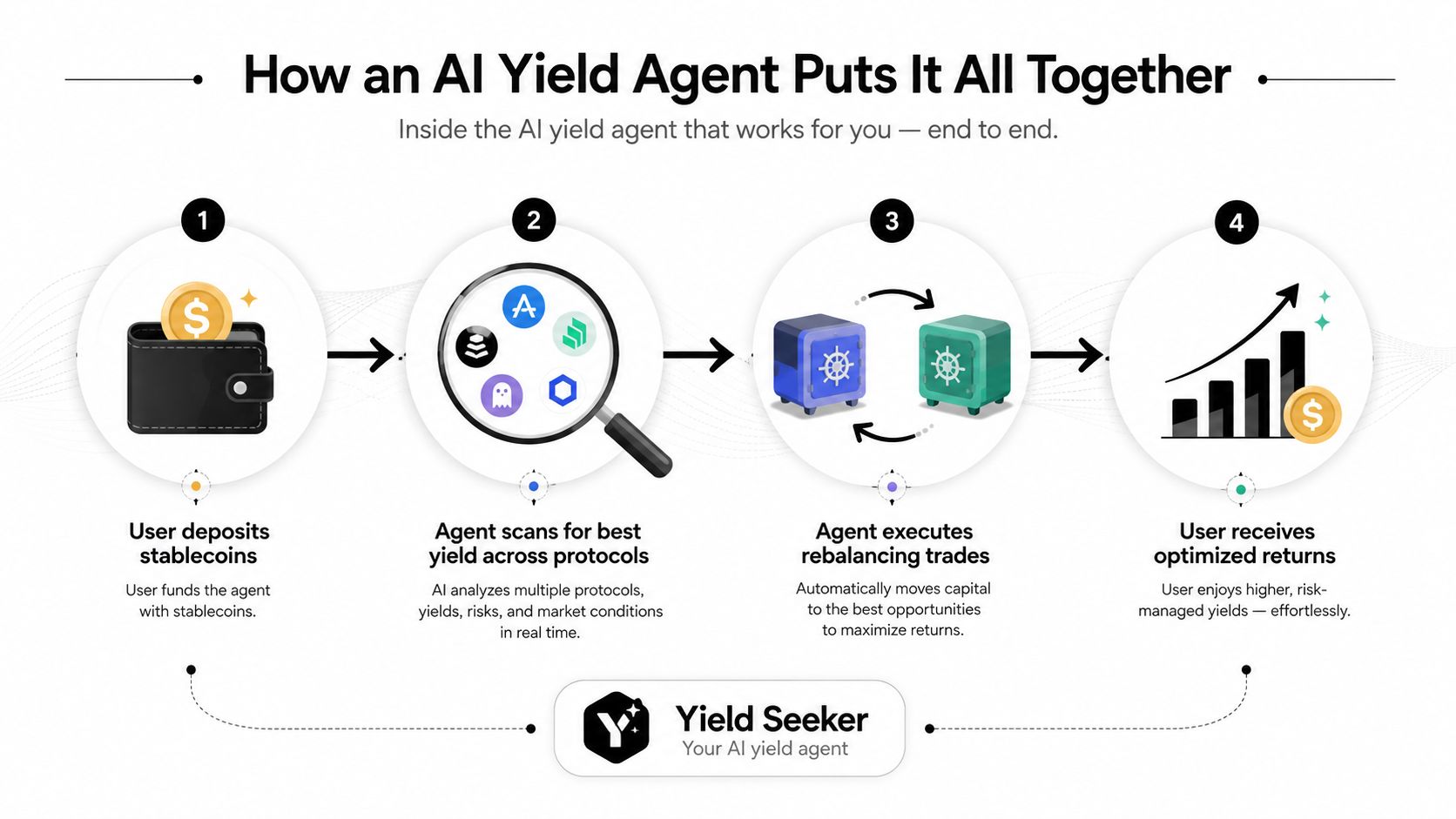
An AI yield agent turns the separate components into one recurring operating cycle. A user deposits stablecoins, sets a risk preference, and gives the system permission to work within defined limits. The agent then evaluates available destinations rather than treating the highest advertised APY as the automatic winner.
A continuous allocation cycle
First, the agent collects current information. That can include oracle prices, pool yields, liquidity depth, gas conditions, protocol configuration, and available security signals. It then normalizes those inputs so different protocols and chains can be compared more consistently.
Next, the risk module evaluates each destination. It may penalize concentration, weak liquidity, unstable pricing, or an exposure that doesn't fit the user's profile. The allocation engine combines that assessment with yield information and chooses a portfolio distribution within the permitted boundaries.
The execution layer submits the transactions through a non-custodial signing arrangement or another authorized transaction path. If the portfolio later crosses a policy threshold, the same cycle can trigger a rebalance, withdrawal, or reduction in exposure. The user doesn't need to approve every routine adjustment, although the system's permissions should remain limited and visible.
The agent isn't a crystal ball. It's a tireless operator following data, policy, and permissions.
The concept of production-ready AI agents serves as a useful design comparison. An agent needs more than a language model or a dashboard. It needs defined tasks, access controls, observable actions, failure handling, and a boundary between autonomous decisions and human review.
For a practical overview of an AI-powered DeFi workflow, see AI-driven DeFi agents. The key synthesis is simple: data ingestion identifies conditions, risk scoring interprets them, allocation chooses a destination, and execution changes the portfolio.
Here's a visual walkthrough of the experience:
An agent can make the process less demanding, but it doesn't remove the need for user judgment. Users still need to understand supported chains, contract permissions, withdrawal behavior, strategy limits, and the conditions that can pause or redirect capital.
Where Automation Still Falls Short
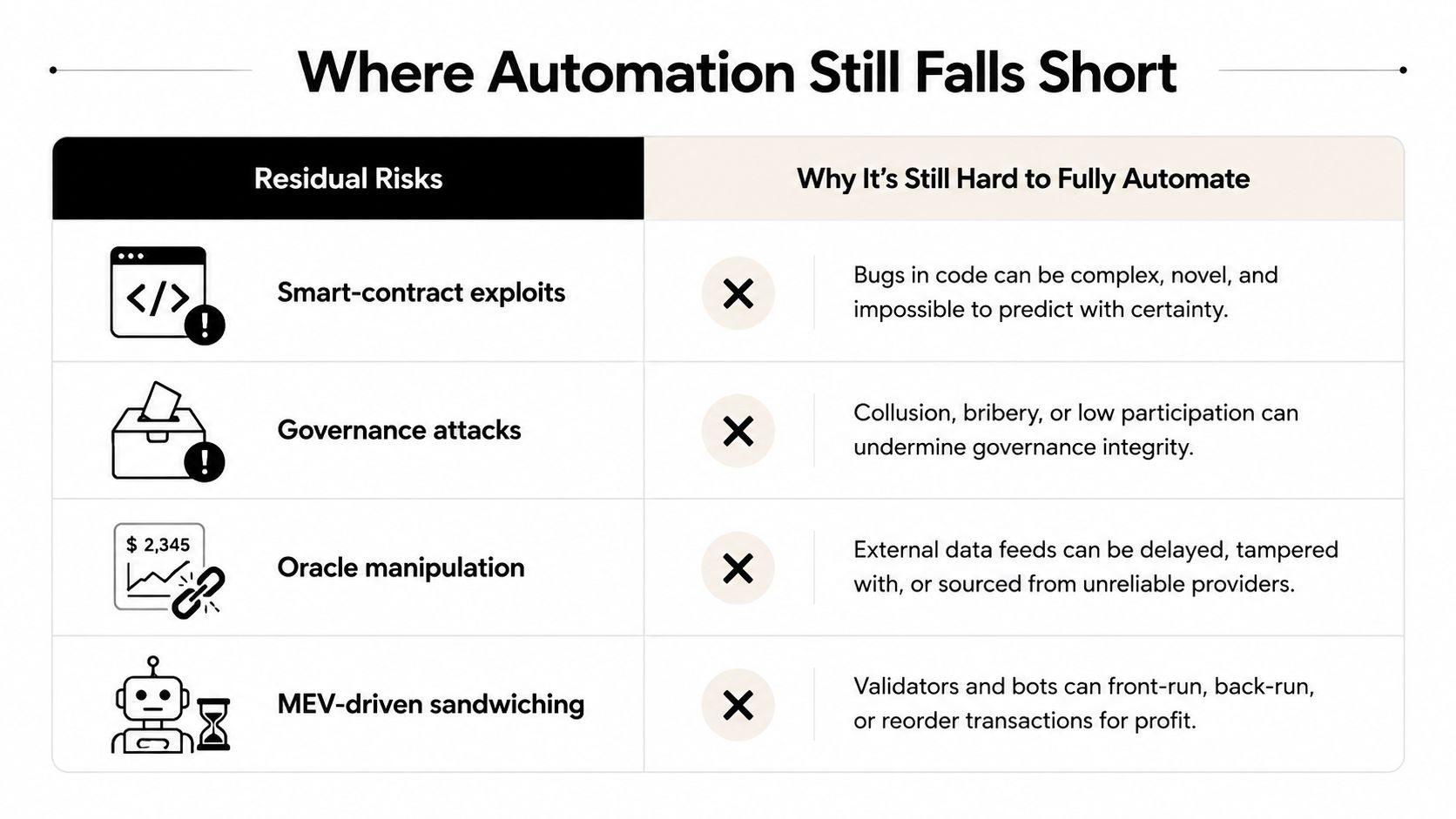
Real-time monitoring doesn't equal real-time protection. A system may identify a threat quickly and still fail to prevent a loss if the underlying protocol is compromised, the oracle is wrong, or the transaction can't execute.
The risks outside the model
Smart-contract exploits can bypass ordinary portfolio rules. A governance attack can change parameters after the risk engine has evaluated the protocol. Oracle manipulation can make a healthy position appear safe or an unsafe position appear healthy. MEV-driven sandwiching can also damage execution even when the agent has selected a sensible destination.
Historical data creates another boundary. Models learn from observed behavior, but a sudden stablecoin depeg, bridge failure, or unfamiliar liquidity shock can look unlike anything in the training set. The model may produce a confident ranking when the correct response should be to stop and request review.
Operational failures matter too:
Stuck transactions: A submitted action may remain pending or fail because network conditions change.
Bad configuration: An incorrect threshold can cause repeated rebalances or delay an essential exit.
Oracle outages: Missing or stale data can make automated decisions unsafe.
Cascading responses: One action can alter liquidity, pricing, or collateral conditions elsewhere.
Recent DeFi security guidance emphasizes controls such as mempool monitoring, oracle sanity checks, circuit breakers, and automated throttling or freezing. Those controls can reduce response time, but monitoring platforms still often focus on visibility and alerts rather than guaranteed loss prevention. Automated risk management is therefore a probability and response system, not an insurance policy.
Users should demand clear failure modes. If a feed disagrees with another feed, does the agent pause, reduce exposure, or continue? If a transaction fails, does it retry, use another route, or escalate for review? The answer should be documented before capital is deposited.
KPIs and a Checklist for Evaluating Any Tool
A risk tool should be judged by how it protects a strategy under changing conditions, not by how attractive its displayed yield looks. Start with the telemetry that connects decisions to outcomes.
KPIs that reveal actual behavior
Realized versus target APY gap: Compare what the strategy earned with its stated target after fees, slippage, and idle periods.
Drawdown versus benchmark: Track losses against a relevant passive or lower-risk reference, not just against the previous portfolio balance.
Rebalance frequency and slippage cost: Frequent activity can consume returns even when every transaction follows the rules.
Time to execution: Measure how long the system takes from a breached threshold to a confirmed on-chain action.
Oracle uptime: Record missing, delayed, or conflicting price observations.
Exposure concentration: Review allocations by protocol, asset, chain, and contract dependency.
A practical evaluation checklist
Before using a platform, ask whether it provides:
On-chain evidence: Can you verify the policies, permissions, and resulting transactions?
Independent data sources: Does the system rely on more than one relevant price or health signal?
Failure-mode documentation: Are pauses, retries, stale feeds, and failed transactions explained?
Transparent costs: Can you identify management, transaction, withdrawal, and performance-related charges?
A backstop: Is there insurance, reserve support, or another clearly described loss response?
Third-party review: Are contracts and critical components audited, with scope and findings available?
Incident history: Does the team publish clear post-mortems when something goes wrong?
Evaluation standard: If you can't see what the system measured, why it acted, and whether the action succeeded, you're reviewing marketing rather than risk controls.
Yield Seeker offers an AI-powered way to monitor and allocate stablecoin capital across supported DeFi opportunities, with risk-aware portfolio management and an interface designed to keep balances and activity visible. Visit Yield Seeker to explore how automated allocation can fit your own yield strategy, then review the permissions, supported protocols, and risk settings before depositing funds.