

You've got stablecoins sitting in a wallet, and the obvious question is why they aren't earning anything. Then you open DeFi and find Aave, Curve, Beefy, Convex, and several unfamiliar vaults, all showing changing rates, reward tokens, fees, and network conditions. By the time you've compared them, the opportunity may have moved, and the idea of checking dashboards every day feels less like passive income and more like an unpaid operations job.
That frustration created the demand for automated yield farming. The basic promise is simple: software and smart contracts handle deposits, strategy execution, reward collection, compounding, and, in some cases, rebalancing. The more important question isn't whether automation can chase a high APY. It's whether the strategy can preserve net returns, respond sensibly under stress, and remain worthwhile after costs for the balance you hold.
What Automated Yield Farming Actually Solves
Manual yield farming requires more than depositing an asset and waiting. You may need to compare lending rates, inspect pool liquidity, track reward emissions, estimate transaction costs, move funds between chains, and decide when a strategy has stopped compensating you for its risk. A stablecoin holder using several protocols can quickly end up managing a collection of dashboards rather than an investment strategy.
The problem became especially visible during DeFi Summer in 2020. Compound's COMP distribution on June 15 helped trigger a liquidity-mining wave, and DeFi total value locked rose from roughly $1 billion in June 2020 to about $11 billion by September 2020, then to around $15.8 billion by year-end. During that period, headline APYs often exceeded 1,000%, with some newly launched pools reaching 10,000%, as token incentives attracted capital rapidly. The history of DeFi Summer captures how quickly those incentives changed user behavior.
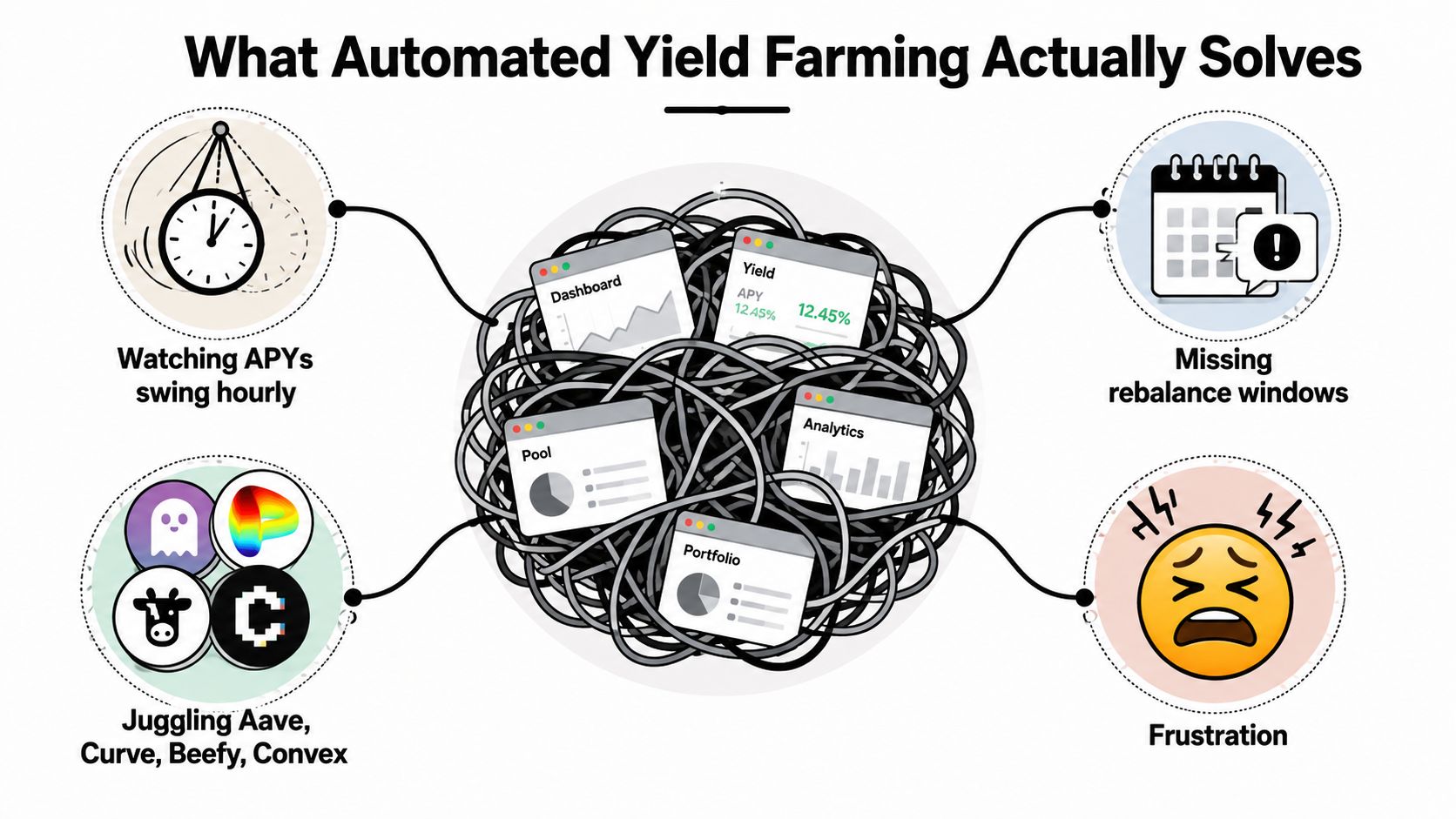
The hidden workload behind “passive” yield
A manual farmer typically has to handle four recurring tasks:
Monitoring rates: APYs change as liquidity, borrowing demand, and reward emissions change.
Harvesting rewards: Unclaimed rewards sit idle until someone claims and converts them.
Rebalancing capital: Funds may need to move when another pool offers better risk-adjusted performance.
Managing execution costs: A profitable harvest can become uneconomic if the transaction costs too much.
A vault turns those repeated decisions into programmable instructions. Its smart contract can route deposits, claim rewards, swap them, and reinvest without requiring the depositor to approve every action. Research on automated yield farming describes vaults as modular smart-contract systems that automate the wider farming workflow, including reinvestment, while shifting risk toward contract logic and governance settings. The ACM survey on automated yield-farming architecture explains that tradeoff.
The goal, then, isn't to display a larger number. Automation reduces operational friction. It gives a strategy a chance to compound consistently and respond faster than a distracted human, while still leaving the user responsible for selecting an acceptable risk envelope.
The Core Idea Without the Jargon
Think of a vault as a smart financial assistant with a rulebook. You deposit an asset, receive a claim on the vault's assets, and let the contract execute a defined strategy. The vault may lend the asset, provide liquidity, collect incentives, exchange reward tokens back into the target asset, and reinvest the proceeds.
That reinvestment is called auto-compounding. If a position earns rewards and those rewards are added back to the earning base, future returns can be generated on both the original deposit and the accumulated rewards. A one-time payout leaves the reward idle. Compounding keeps more of the capital working, although fees, slippage, and changing yields determine whether the extra activity improves the final result.
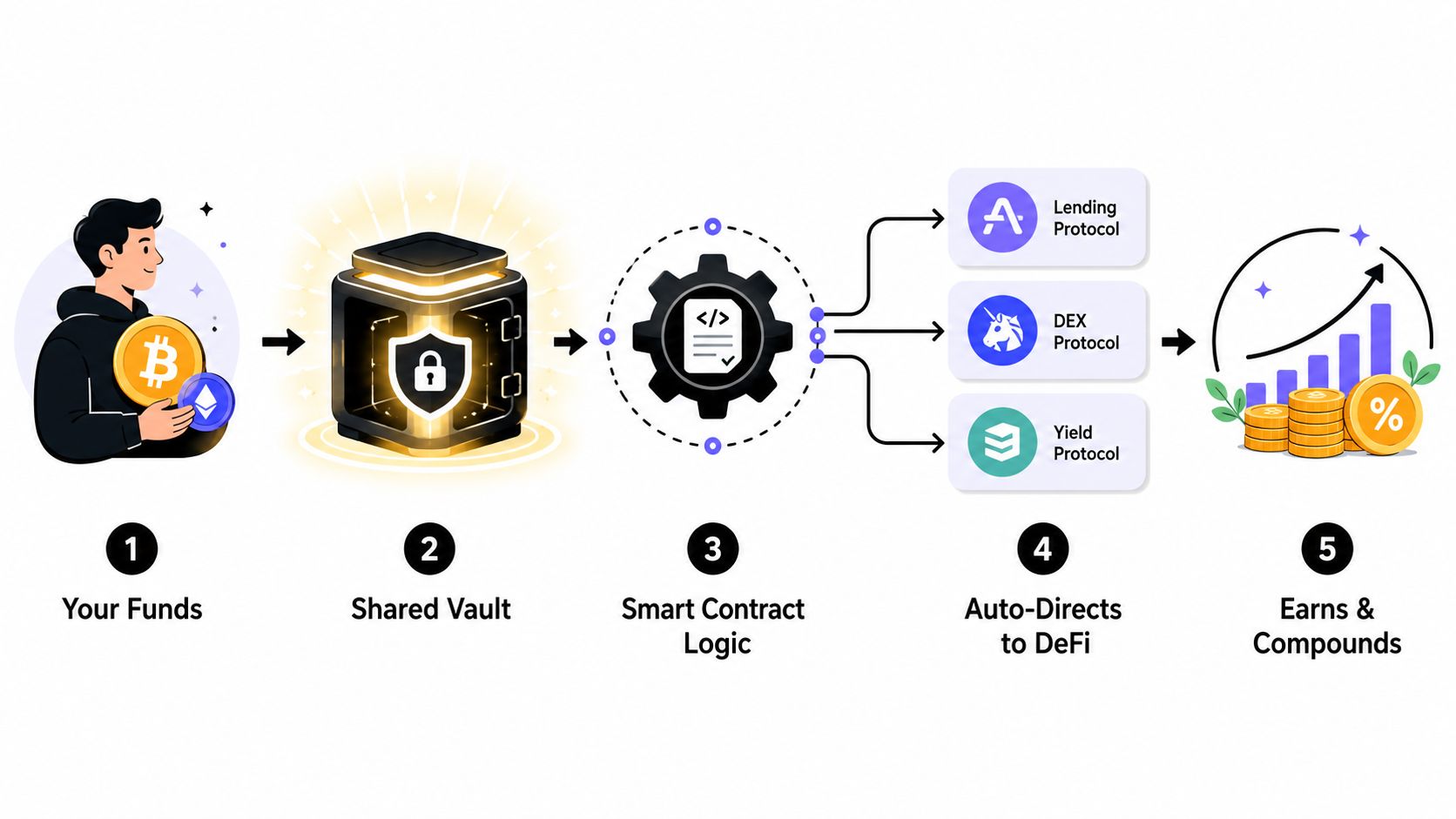
Three layers perform different jobs
It helps to separate the system into layers rather than treating every DeFi product as the same thing.
Underlying protocols provide the economic activity. Aave and Compound lend assets to borrowers. Curve and Uniswap facilitate swaps through liquidity pools. Pendle separates yield-bearing exposure into different components.
Aggregator vaults package those opportunities. Yearn, Beefy, and Convex can automate deposits, reward collection, strategy execution, or routing across supported opportunities.
AI agents sit above or alongside those systems. They can monitor changing conditions, compare opportunities, and recommend or execute allocation decisions according to programmed constraints.
The value flow stays understandable even when the implementation becomes complex:
Your funds enter, the strategy deploys them, rewards accrue, the system reinvests, and your vault share value changes.
A vault share isn't necessarily a fixed amount of the deposited token. It represents your proportional ownership of the strategy. If the vault earns after costs, each share may represent more underlying assets. If the strategy loses money or incurs expenses, the share value can fall.
Practical rule: Treat a vault as an active strategy, not as a savings account. The contract may automate the work, but it can't turn a risky protocol into a risk-free one.
Automation also doesn't guarantee the highest rate. A responsible system should compare net performance, liquidity, fees, and relevant benchmarks. Analytics platforms expose time-series APY, TVL, fees, rewards, and reference rates because headline APY alone doesn't describe what a depositor keeps. Vault analytics use cases show why operators compare fee-adjusted outcomes rather than isolated rate snapshots.
How the Mechanics Work End to End
Take a hypothetical $1,000 USDC deposit. The amount makes the flow tangible without implying that the outcome is guaranteed.
Deposit and share issuance
You approve the vault to use your USDC and deposit it through the interface. The vault issues shares that represent your portion of the pooled assets. Those shares matter because other users may enter or exit at different times, and the vault needs a way to calculate each person's claim fairly.
The contract then sends capital to the strategy router. A simplified allocation might place 60% in a Curve stable liquidity position, 30% in Aave lending, and 10% aside for compounding-related execution. That allocation is only an example of how a router might divide capital. Real strategies use their own rules, and many won't reserve funds in exactly this way.
Rewards and reinvestment
The deployed positions generate returns through lending interest, trading fees, or incentive tokens. A harvester periodically claims those rewards, exchanges eligible tokens back into USDC through available decentralized exchange routes, and adds the proceeds to the strategy.
That process creates the compounding effect. But every harvest can involve gas, price impact, and execution risk. A strategy that harvests too often may spend more on transactions than it gains from putting rewards back to work.
Fees and redemption
Vaults may charge performance, management, withdrawal, or other strategy-specific fees. The fee structure determines how much of the gross return reaches the depositor, and early exits can carry separate costs. The visible APY may already include some assumptions about compounding and fees, but you should verify the methodology before treating it as a forecast.
When you withdraw, the vault burns your shares and returns the corresponding amount of underlying assets at the current share value. That value can be higher or lower than your deposit because the strategy has earned returns, paid costs, suffered losses, or experienced changes in its underlying positions.
For a plain-language explanation of the code and permissions involved, review how DeFi smart contracts work.
Fee Type | Typical Range | When Charged |
|---|---|---|
Performance fee | Varies by vault | When the strategy realizes eligible gains or harvests rewards |
Management fee | Varies by vault | Over the period the funds remain under management |
Withdrawal fee | Varies by vault | When a user exits, sometimes only under specific conditions |
Network and swap costs | Market-dependent | During deposits, harvests, swaps, rebalances, and withdrawals |
The central distinction is gross yield versus net yield. If a dashboard advertises an APY but hides the costs required to achieve it, you're looking at a marketing surface rather than a complete return estimate.
Common Strategies and Instruments Explained
Different automated strategies earn from different sources, so they fail in different ways. Lending is usually easier to understand than liquidity provision, but its returns depend on borrower demand. Liquidity pools can collect trading fees, yet volatile pairs can create impermanent loss. Aggregators reduce manual work, but their additional layers can add cost and contract exposure.
The right comparison depends on whether you value stability, capital efficiency, or exposure to more complex yield structures. For a deeper explanation of pool mechanics, see this guide to liquidity pools.
Strategy | Yield Source | Typical APY Range | Where Automation Helps | Where It Breaks |
|---|---|---|---|---|
Lending with Aave or Compound | Borrower interest and, at times, incentives | Variable | Moves capital as lending demand changes and reinvests eligible returns | Rates can compress when borrowing demand falls |
Stable liquidity pools with Curve | Trading fees and token incentives | Variable | Claims rewards and can adjust pool exposure | Depegs, liquidity shifts, and contract risk can overwhelm fee income |
Volatile liquidity pools with Uniswap | Trading fees and possible incentives | Variable | Rebalances or harvests without constant manual action | Impermanent loss can exceed earned fees when prices diverge |
Aggregator vaults with Yearn or Beefy | A combination of lending, LP fees, and incentives | Variable | Routes capital and compounds across supported protocols | Extra fees and layered contracts can drag on smaller deposits |
Structured products with Pendle or Convex | Separated yield exposure, incentives, or boosted positions | Variable | Manages maturity, reward collection, and allocation rules | Principal behavior, maturity conditions, and incentive changes may be difficult to model |
Match the tool to the yield source
Lending works well for users who want a relatively direct connection between capital supplied and interest paid by borrowers. Its weak point is rate compression. When borrowing demand declines or supply grows, the rate can fall without any contract failure.
Liquidity provision is more active economically. A stablecoin pool may target assets that usually trade near one another, while a volatile pair exposes the provider to changing asset ratios. Automation can harvest fees and rewards, but it can't erase the pool's pricing mechanics.
Aggregators help most when several decisions must happen repeatedly. They become less compelling when the expected improvement is small and the deposit is too small to absorb fees. Structured products can express a specific view on future yield, but they require more attention to maturity, principal exposure, and reward design.
Rates also move dynamically rather than staying fixed. A practical overview of adjustable DeFi yield rates is useful for understanding why a strategy's displayed APY can change as liquidity and incentives shift.
The Risk Profile Most Guides Understate
A vault can remove human delay, but it can't remove the risks embedded in the protocols it uses. In some situations, automation reduces hesitation. In others, it makes a bad rule execute faster and across more capital.
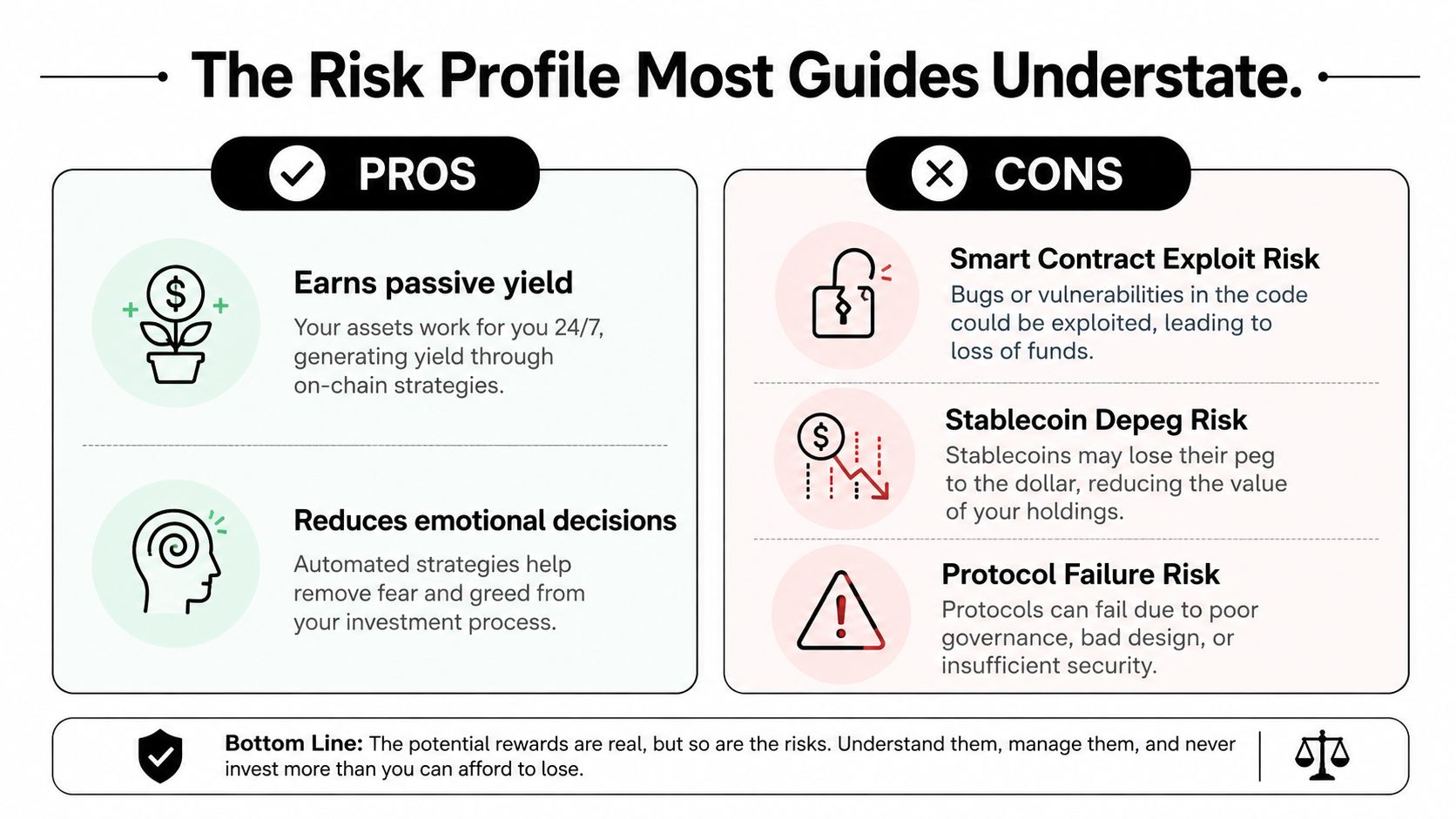
Scenario one, the contract fails
Suppose a vault or one of its underlying protocols contains an exploitable function. An automated strategy may continue depositing, harvesting, or rebalancing until a pause mechanism activates. Automation doesn't identify every vulnerability, and an audit doesn't guarantee that no exploit exists.
The key questions are practical:
Upgrade control: Who can change the contract?
Pause authority: Can operators halt deposits and withdrawals?
Exposure limits: Does the strategy cap capital in one protocol?
Recovery path: What happens if an underlying venue becomes insolvent?
Scenario two, the stablecoin depegs
Assume a stablecoin falls sharply below its intended value. A vault holding that asset may follow its normal rules, continue compounding, or attempt to exit into another asset. If the exit depends on shallow liquidity, a stale price, or a crowded route, users may receive far less than expected.
Automation can detect a price deviation sooner than a person checking a dashboard. It can also amplify the problem if many strategies execute the same exit simultaneously. A good design needs explicit stop conditions, not just a mandate to chase the highest available rate.
Scenario three, the oracle or bridge becomes the weak link
An oracle failure can report an incorrect price and trigger an inappropriate rebalance, liquidation, or collateral calculation. A bridge failure creates a different problem. The lending or liquidity protocol might remain intact while the bridge holding the asset becomes compromised.
Recent industry coverage continues to identify smart-contract, impermanent-loss, depeg, oracle, bridge, governance, and liquidation risks as core yield-farming failure modes. It also notes that frontend compromises and operator misconduct can damage returns even when the underlying code hasn't been directly exploited. This overview of DeFi yield-farming risks is useful because it treats operational failure as part of the risk surface.
Stress test your automation: Ask what the agent does when prices disagree, liquidity disappears, gas spikes, governance changes a parameter, or withdrawals become crowded. If the answer is “it keeps optimizing,” the strategy is incomplete.
Does Automation Actually Pay Off for Small Balances
Small deposits expose the weakness in the “set and forget” narrative. A strategy can show an attractive gross APY and still produce a poor net result after entry costs, harvest transactions, slippage, reward conversion, fees, and taxes.
Consider the hypothetical example shown below. A $500 deposit at 8% APY would produce about $40 in gross annual yield before costs. If entry costs total $15, and automated compounding costs total $45, the simple result is a $20 net loss before considering taxes. These figures belong to the supplied illustration, not to a universal break-even rule.
Why the arithmetic changes with size
The same transaction may represent a small drag on a larger position and a decisive drag on a smaller one. A $10,000 balance has a larger base on which yield can accumulate, while a $50,000 balance can make recurring automation more meaningful if the strategy remains profitable after costs. Those balances still face smart-contract, market, and tax risks, so scale doesn't make the strategy safe.
Tax treatment adds another layer. Some jurisdictions treat reward claims or compound transactions as taxable income or taxable disposals, while others apply different rules. If every compound creates a reporting event, frequent automation may increase administrative work even when it improves the displayed APY.
A break-even estimate must therefore include:
Entry and exit costs, not just the advertised rate.
Harvest frequency, including whether small rewards justify a transaction.
Slippage, especially when reward tokens are converted in thin markets.
Vault fees, which reduce gross performance.
Tax treatment, which depends on your jurisdiction and activity.
The useful question isn't “What's the highest APY?” It's “What balance and strategy can produce positive net returns after all friction?” For a small holding, a simpler lending position or even keeping funds liquid may be more rational than paying for elaborate automation.
How AI Agents Like Yield Seeker Change the Picture
Static vaults follow predefined strategies. AI-driven systems aim to add a monitoring and decision layer that evaluates changing conditions across supported protocols. The useful distinction isn't that an agent is magically intelligent. It's that the system can continuously process more variables than a person who checks a dashboard occasionally.
A capable agent may watch APY drift, reward-token emissions, liquidity depth, gas costs, pool imbalance, and protocol exposure. It can then decide whether to maintain an allocation, harvest, reduce exposure, or move capital under the rules built into the platform. The quality of that decision still depends on the data, risk limits, execution design, and underlying contracts.
Yield Seeker presents this model through a personalized AI agent for stablecoin yield on Base. Its Autoseek engine evaluates supported vaults, considers yield opportunities and portfolio risk, reallocates capital, and compounds rewards automatically, while the platform describes funds as remaining accessible without lockups or withdrawal fees. Those are product characteristics to verify against the current terms before depositing.
What adaptive automation should do
The important behavior is not constant movement. It's knowing when movement isn't worth the cost.
Rate drift: Reduce exposure when an APY falls below the strategy's threshold.
Reward decay: Harvest or rotate before emissions no longer justify execution.
Liquidity deterioration: Avoid entering or staying in a pool where exits could create material price impact.
Oracle divergence: Pause or de-risk when pricing data becomes inconsistent.
Gas friction: Delay micro-compounds when the transaction cost consumes too much of the reward.
This approach differs from a traditional aggregator that may require users to deposit into a pooled vault and accept the vault's strategy rules. An agent can instead manage allocation through a user-facing system designed around accessible funds, although users still need to understand the permissions and custody model.
For a closer look at the allocation concept, review AI yield optimization. The important caveat remains unchanged: AI can improve reaction time, but it inherits the risks of every protocol, oracle, bridge, and governance decision it touches.
Is Automated Yield Farming Right for You
The answer depends on three variables: balance size, available time, and risk tolerance. No strategy can optimize all three at once.
If your balance is under $1,000, friction deserves priority. The supplied risk analysis identifies small positions as especially vulnerable to gas, slippage, reward conversion, LP events, taxes, and operational overhead. A cautious holder may prefer a straightforward stablecoin lending position, fewer transactions, and easy access to funds.
A mid-sized holder who doesn't want to monitor several dashboards may find an aggregator vault more practical. The tradeoff is layered contract exposure and additional fees. Read the strategy documentation, check how rewards are generated, and confirm whether the displayed rate is gross or net.
For balances above $25,000, compounding can become more meaningful because recurring costs represent a smaller portion of the capital base. That doesn't automatically make complex strategies suitable. A stablecoin-only approach carries a different risk profile from a volatile LP, and neither should be selected solely because its APY is higher.
Use this decision filter:
Limited time, conservative risk: Favor simple, transparent stablecoin strategies with clear withdrawal terms.
More time, strong DeFi experience: Manual allocation may let you avoid aggregator fees, provided you can monitor risk consistently.
Desire for diversification without daily oversight: Consider an automated vault or AI-agent platform, then inspect its stop conditions, permissions, and supported protocols.
Need for immediate liquidity: Avoid lockups and confirm how quickly withdrawals settle during stressed markets.
In 2026, yield compression, changing incentive programs, regulatory developments, and AI-assisted allocation will make risk-adjusted return more important than a temporary emissions rate. The durable edge won't come from finding the biggest number on a dashboard. It will come from knowing when the system should compound, when it should rebalance, and when it should stop.
Yield Seeker offers an AI agent that monitors stablecoin opportunities on Base, allocates capital across supported DeFi strategies, and compounds eligible rewards while keeping funds accessible under its stated product terms. Visit Yield Seeker to explore the platform, review how its automated allocation works, and decide whether its approach fits your balance, time, and risk limits.