
A $315.3 billion global stablecoin market and roughly $3.0 billion in supply for tokenized money-market wrappers such as BlackRock BUIDL, as of June 2026, have changed the treasury question. Crypto teams aren't asking where to park USDC until the next payment. They're deciding how much liquidity belongs on which chain, with which issuer, custodian, venue, and redemption path. The shift in stablecoin treasury practice makes one point clear: crypto treasury management now resembles multi-venue liquidity and yield orchestration.
That change matters for DAOs, creator businesses, Web3 companies, and individual operators with meaningful stablecoin balances. A spreadsheet can show balances, but it can't enforce approvals, test withdrawal paths, reconcile wallets to books, or tell you whether an attractive yield position can fund tomorrow's obligation. The practical discipline is closer to traditional cash flow management strategies, adapted for programmable assets, continuous markets, and wallet-based control.
Why Crypto Treasury Management Changed in 2026
In 2024, a five-person DAO using USDC for contributor payments could operate with a secure wallet and a payment calendar. By 2026, that same DAO might coordinate stablecoins across several chains, hold a tokenized Treasury wrapper for surplus cash, and route transactions through multiple venues. The treasury's job now includes deciding where liquidity should sit and what risks accompany each location.
The market reflects this change. The global stablecoin market reached about $315.3 billion, while tokenized money-market wrappers such as BUIDL reached about $3.0 billion in supply by June 2026, according to industry coverage of stablecoin treasury management from 2024 through 2026. The operating model has also shifted, from holding USDC mainly for settlement convenience in 2024, to considering yield-bearing wrappers such as sUSDe and BUIDL in 2025, and then coordinating issuers, chains, and execution venues in 2026.

The spreadsheet problem
A spreadsheet remains useful for mapping obligations, expected receipts, and wallet ownership. It does not enforce approvals or reveal whether a lending venue changed withdrawal terms, a signer lost access, or a new payment address bypassed review.
That distinction separates portfolio tracking from treasury operations. Portfolio tracking answers, “What do we own?” Treasury operations also answer, “Who can move it, under what conditions, how quickly can we redeem it, and can accounting prove where it went?”
The principles in what treasury management means in practice provide a starting point, but a dashboard is not an operating control. Each balance needs a purpose, a liquidity classification, and an accountable owner. The team should also define reconciliation metrics, such as unexplained balance differences, stale wallet records, and unresolved transaction matches, before stress exposes gaps. Those records support practical cash flow management strategies when payment timing changes.
Operator rule: If you cannot explain how an asset funds a liability, who controls its withdrawal, and how the transaction reaches the ledger, you do not have a treasury allocation. You have an exposure.
Writing a Treasury Policy Before You Move Any Funds
A treasury policy should exist before the first transfer, not after the first incident. It translates broad intent, such as “preserve operating liquidity and earn reasonable yield,” into rules that a signer, approver, accountant, and auditor can apply consistently.
Start with the mandate. State what the treasury must fund, which assets it may hold, and what it must not do. A five-person creator collective might define its mandate around creator payments, production costs, tax obligations, and a reserve for unexpected expenses. It might prohibit unsecured borrowing, unapproved protocol interaction, and transfers to addresses that haven't passed review.
Put authority on paper
The policy should separate duties even when the team is small:
Requesters initiate payments and explain the business purpose.
Approvers verify the request, recipient, amount, asset, and available budget.
Signers execute the approved transaction through the designated wallet.
Record keepers match the transaction to the accounting ledger and retain evidence.
Policy owners review limits, approved venues, and signer access.
One person may hold more than one role in a small operation, but the policy should identify the overlap and define compensating controls. A collective could require two independent approvals for treasury movements, while allowing a narrower operating wallet for routine expenses within a defined cap. The point isn't bureaucracy. It's preventing one compromised device, one rushed decision, or one absent contributor from becoming a treasury failure.
Define the whitelist and the escalation path
Write an approved-asset and approved-counterparty list. Include the stablecoins, custodians, exchanges, protocols, chains, wallets, and banking partners the team has reviewed. For each venue, record the intended use, withdrawal route, monitoring owner, and conditions that trigger suspension.
Then define escalation thresholds. A routine payment may follow the standard workflow. A transfer to a new address, a change in custody, or an allocation into a smart-contract strategy should require additional review. The policy should also explain how emergency action works, who can pause activity, and how exceptions are documented afterward.
A practical policy skeleton includes:
Mandate and risk appetite, including permitted uses and prohibited activities.
Roles and access, including requesters, approvers, signers, and reviewers.
Asset and venue whitelist, including review evidence and suspension criteria.
Wallet architecture, including operating, reserve, and restricted balances.
Approval thresholds, including dual-control requirements and emergency powers.
Reconciliation and reporting, including records that must be retained.
Review and change management, including the cadence for updating the document.
Continuous governance matters because permissions, venues, and regulatory expectations change. Resources on continuous GRC in FinTech can help teams think beyond a static policy and build an ongoing control cycle. Review the policy quarterly, and review it sooner after a material incident, venue change, new chain integration, or change in the treasury mandate.
Building a Stablecoin Reserve Ladder That Matches Your Liabilities
The reserve ladder starts with liabilities, not yield. List obligations by expected redemption horizon, then assign assets according to the time at which the money must be available. A same-day payroll or vendor obligation shouldn't depend on a position that requires a withdrawal request, a market sale, or a bridge transaction.
The benchmark is conservative for a reason. The BIS noted that stablecoins purchased nearly $35 billion of U.S. Treasury bills in 2025, making short-duration government exposure a central reference point for treasury teams, as described in its analysis of stablecoins and safe-asset prices. That doesn't make every tokenized Treasury product interchangeable with cash. It does show why short-duration government instruments sit near the base of a disciplined reserve structure.
Map time to liquidity
Use a ladder that makes the liability match visible:
Liability Horizon | Asset Tier | Purpose |
|---|---|---|
Same-day and immediate outflows | Highly liquid operating cash and approved settlement balances | Fund payroll, urgent vendors, and routine transfers without relying on a sale |
Near-term obligations | Very short-dated government exposure and liquid Treasury wrappers | Preserve access while reducing idle-cash drag |
Forecastable obligations | Short-duration government instruments or carefully reviewed money-market structures | Match known spending windows without taking unnecessary duration |
Uncertain or longer-term surplus | Higher-yield venues approved by policy | Seek additional income only after core liquidity is protected |
The labels should reflect your actual payment calendar. “Near term” means something different for a creator business with irregular production costs than for a protocol with predictable grants. The team should set a minimum same-day buffer, then test that buffer against ordinary outflows, delayed receipts, and a sudden redemption wave.
Avoid duration mismatch
Duration mismatch appears when a liability can arrive faster than the asset can be converted. Consider a treasury that places funds needed for vendor payments into a wrapper with a withdrawal delay or into a lending market whose available liquidity depends on borrowers. If several obligations arrive together, the team may need to sell at an unfavorable price, accept a haircut, or borrow elsewhere.
That forced-selling risk is the control issue. The headline return doesn't compensate for an allocation that fails at the moment cash is needed. Monitor issuer concentration, custodian exposure, redemption mechanics, settlement timing, and chain dependencies continuously rather than checking them only during a monthly finance meeting.
Practical test: For every reserve tier, name the liability it serves, the person who can release the funds, the expected settlement path, and the failure alternative.
Comparing Yield Venues Beyond the Headline APY
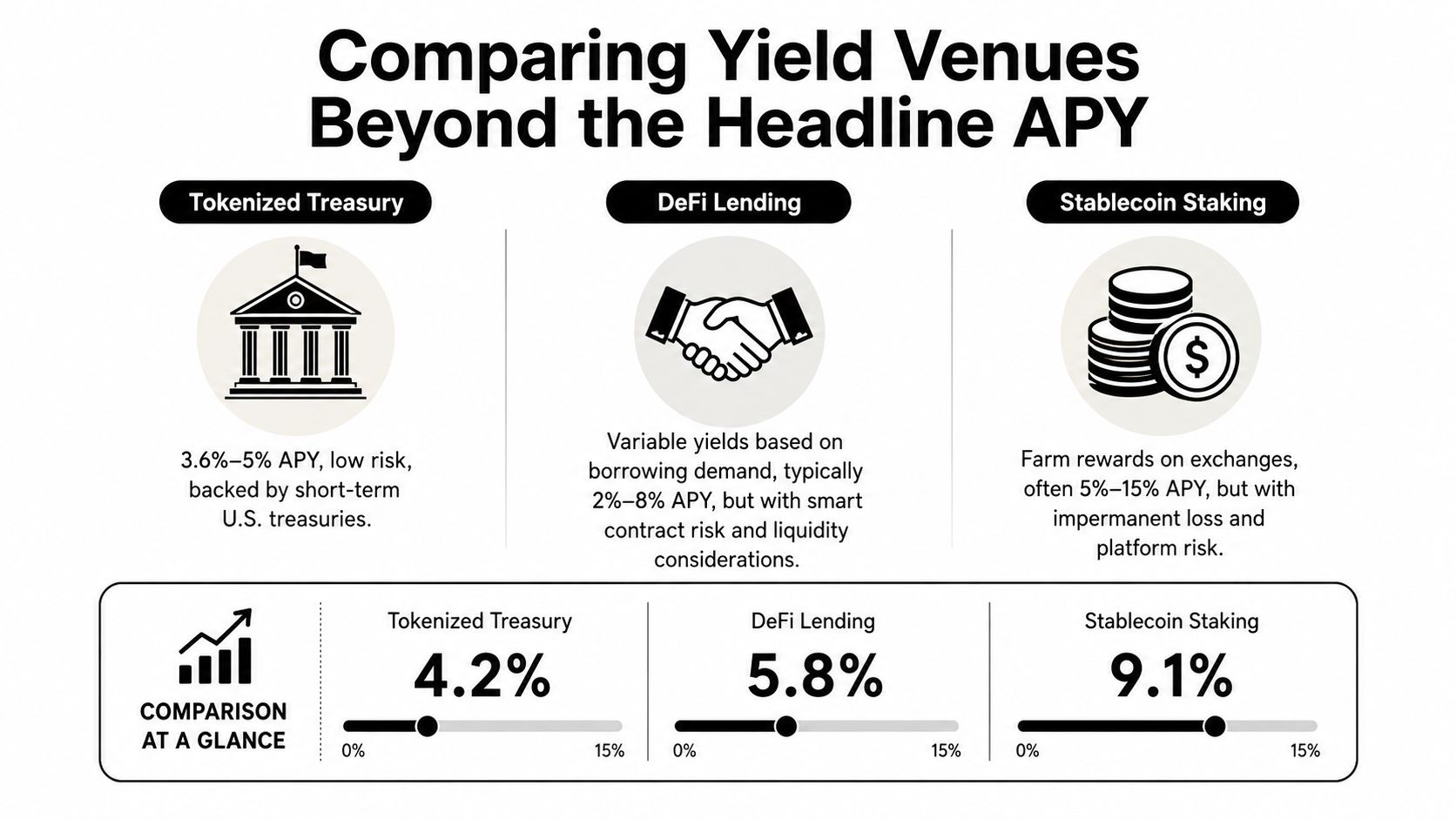
Yield isn't a single product category. It describes compensation generated by different underlying activities, and those activities carry different liquidity, counterparty, and implementation risks. A tokenized Treasury wrapper, a lending pool, and a synthetic-dollar strategy may display similar returns while exposing a treasury to very different failure modes.
Current mainstream options cluster around roughly 3.6% to 5% APY for tokenized Treasury products, 3.5% to 9% on reputable lending venues, and 4% to 25% for synthetic-dollar or higher-risk strategies, according to a 2026 comparison of stablecoin treasury practices. The same source cited BlackRock BUIDL at roughly $2.4 billion to $2.5 billion in AUM in 2026, a signal of institutional demand for regulated wrappers, not proof that every wrapper suits every treasury.
Ask where the return comes from
Tokenized Treasury products generally seek to pass through returns from short-duration U.S. government instruments. The relevant questions are wrapper structure, eligibility, settlement, redemption process, custody, and whether the product can support the treasury's required liquidity.
DeFi lending earns variable returns from borrower demand and market utilization. That income can compress when demand falls. It also introduces smart-contract exposure, oracle dependencies, liquidation mechanics, and pool liquidity considerations.
Synthetic-dollar and higher-risk strategies may derive returns from trading structures, incentives, or perpetual-funding basis trades. The yield can look compelling, but the treasury must understand what happens when funding reverses, liquidity thins, or a protocol changes its parameters.
Two venues with the same APY aren't necessarily comparable. One may offer a regulated wrapper around short-duration government exposure. The other may pay a variable return dependent on borrowers or trading conditions. That difference affects how the position belongs in a reserve ladder, how quickly it can be exited, and which control owner should monitor it.
Use a suitability scorecard
Before approving a venue, record:
Yield source: Treasury bills, borrower demand, incentives, or trading basis.
Liquidity: Redemption timing, withdrawal conditions, secondary-market depth, and chain requirements.
Counterparty exposure: Issuer, custodian, administrator, protocol governance, and execution venue.
Technical risk: Smart contracts, oracles, upgrade permissions, bridges, and wallet permissions.
Accounting treatment: Valuation data, transaction records, and evidence available for reconciliation.
Stress behavior: Expected response to depegs, utilization changes, chain congestion, or a paused withdrawal.
A framework for risk-adjusted APY is useful only if the inputs reflect operational suitability. Treasury teams shouldn't rank strategies by gross return alone. They should rank them by the return that remains after liquidity constraints, control workload, monitoring quality, and failure scenarios are considered.
Automating With AI Agents and DeFi Without Losing Control
Automation should remove repetitive work, not remove accountability. An AI agent can monitor opportunities, route transactions, and rebalance capital, but the treasury still needs to decide which assets, protocols, wallets, and counterparties are allowed.

The U.S. Treasury's DeFi risk assessment highlights AML/CFT and sanctions-enforcement challenges created by decentralized finance. A permissionless protocol can change governance, front-end access, liquidity, or transaction behavior without fitting neatly into a traditional counterparty review. That makes monitoring and documented controls more important, not less.
Run a narrow pilot
Use gates rather than a large launch:
Define one use case. Start with a limited stablecoin allocation for a clearly stated yield objective.
Whitelist assets and venues. Approve the exact token, chain, protocol, contract, and destination wallet.
Test controls with a small balance. Verify address screening, transaction simulation, wallet permissions, and withdrawal behavior.
Reconcile every movement. Match wallet balances and transaction IDs to the accounting ledger and internal allocation record.
Set failure thresholds. Track failed settlements, address-screening exceptions, reconciliation breaks, and unexplained balance changes.
Expand only after review. Increase scope when the controls work consistently and the team understands the strategy's failure modes.
Platforms such as Yield Seeker can fit into a controlled pilot when the mandate allows an AI-powered workflow to allocate USDC on Base across approved DeFi opportunities while keeping funds accessible. Its stated setup allows deposits starting at $10 USDC on Base, with no lockups or withdrawal fees, but those product characteristics don't replace the treasury's own whitelist, approval, and reconciliation requirements. Teams evaluating AI agents in crypto should treat the agent as an execution component inside the control framework.
The operating metrics matter more than the agent's claimed opportunity set. A strategy that produces attractive yield but creates frequent reconciliation breaks or unreviewed address exceptions isn't operationally suitable.
Keep an emergency stop procedure outside the automated workflow. The treasury should know who can pause allocation, where unallocated funds sit, how to revoke permissions, and how to recover if the protocol, agent, chain, or data feed behaves unexpectedly.
Reporting, Reconciliation, and Your Weekly Operating Rhythm
A treasury strategy becomes reliable through repetition. The weekly review shouldn't be a presentation built from screenshots. It should be a short control process that proves balances, movements, exposures, exceptions, and upcoming obligations.

Start by reconciling on-chain wallet balances to the accounting ledger. Investigate every break, including small differences caused by fees, pending transactions, valuation timing, or an incorrect wallet mapping. Then verify pending transfers, review authorization logs, and confirm that each treasury movement has a business purpose and an approved destination.
A useful weekly review
A practical operating rhythm can include:
Balance tie-out: Compare wallets, custodians, venues, and ledger entries.
Transaction review: Check pending, failed, duplicated, or unauthorized transfers.
Position monitoring: Review yield performance, redemption terms, and strategy changes.
Exposure review: Check issuer, custodian, chain, protocol, and venue concentration.
Compliance review: Resolve address-screening exceptions and document decisions.
Forward view: Match available liquidity to upcoming obligations and planned allocations.
Continuous monitoring matters because concentration can build between review meetings. A team may begin with diversified venues, then accumulate exposure through automated rebalancing or repeated deposits. Track those changes as part of the same reporting process used for financial clarity for internet businesses, especially when on-chain activity must connect cleanly to accounting records.
Watch the macro feedback loop
Stablecoin treasuries don't operate outside traditional markets. A Spark analysis found that a 1% increase in combined USDT and USDC market capitalization was associated with a 0.42 basis-point decline in one-month T-bill yields and a 0.50 basis-point decline in three-month T-bill yields, according to Spark's research on stablecoin treasury yield impact. The implication is important: stablecoin growth can interact with the rates that support Treasury-linked yield.
The same analysis reported that yield-bearing stablecoins grew from $9.5 billion to more than $20 billion during 2025. That expanding market can create more choice, but it can also compress returns, concentrate liquidity in particular rails, and make yesterday's assumptions stale. A weekly review should therefore include policy changes, issuer developments, market-rate changes, and strategy-level yield sources, not just the current balance.
Reporting standard: A trusted treasury report shows what changed, why it changed, who approved it, what remains liquid, and which exceptions still need an owner.
Common Mistakes and a Starter Checklist
The most expensive mistakes usually begin as reasonable shortcuts. A team treats protocol yield as portable across venues, assumes a stablecoin position is automatically liquid, or postpones reconciliation until audit season. Each shortcut hides operational work that will surface under stress.
Avoid these failure patterns:
Chasing headline APY: Check the yield source, liquidity terms, counterparty, smart-contract exposure, and exit path.
Ignoring duration mismatch: Don't place near-term liabilities into positions that may require a delayed withdrawal or forced sale.
Skipping segregation of duties: Keep requesting, approving, signing, and recording separate where the team can support it.
Scaling before testing: Prove address screening, transaction controls, and reconciliation with a small pilot first.
Relying on monthly visibility: Monitor concentration, issuer exposure, custodian health, and redemption conditions continuously.
Treating automation as governance: An agent can execute within rules, but it shouldn't define the rules.
A starter treasury can be simple without being casual. Draft the policy, assign roles, whitelist assets and venues, segment liabilities into a reserve ladder, establish a same-day buffer, and schedule the weekly reconciliation. Then run a small automated allocation, document every control result, and expand only after the operating evidence supports it.
The scale of corporate adoption reinforces the need for process. Corporate treasury holdings grew from 262,632 BTC in Q4 2023 to 590,649 BTC by the end of 2024, while Standard Chartered data cited in 2025 reported 61 publicly listed companies with bitcoin treasury strategies holding 848,100 BTC in the first half of 2025, about 4% of bitcoin supply, according to coverage of corporate bitcoin treasury adoption. Speed attracts attention, but disciplined liquidity, approvals, and reconciliation determine whether a treasury can keep operating through a difficult market.
Yield Seeker offers an AI-powered workflow for allocating USDC on Base across DeFi opportunities while keeping funds accessible, which can support a controlled stablecoin treasury pilot. Visit Yield Seeker to review its automated allocation experience, accessible balances, and tools for monitoring yield without manually tracking fragmented protocols.