
The highest yield isn't always the best fit. A stablecoin APY is only a snapshot, and rates can move sharply as liquidity, utilization, incentives, and governance decisions change. Independent coverage places mainstream stablecoin yields across roughly 4.1% to 11.8%, while reported APYs during 2025 moved between about 5% and 25%, with a median near 9% to 11%. Research on stablecoin yield strategies also describes lending rates moving more than 20% within 48 hours before returning near 2%, so a ranking based on today's headline number can become stale quickly.
The better question is what job you need the platform to perform. Compare the yield mechanism, fees, security signals, smart-contract exposure, liquidity, composability, interface quality, automation, and the amount of monitoring you can realistically provide. The seven best DeFi platforms below aren't interchangeable products. They cover automation, lending, native savings, liquidity provision, staking, stablecoin routing, and yield structuring. Yield Seeker is the automation-focused option for users who want an AI Agent to monitor and allocate across curated DeFi opportunities, but your risk tolerance and desired control still determine the right choice.
1. Yield Seeker
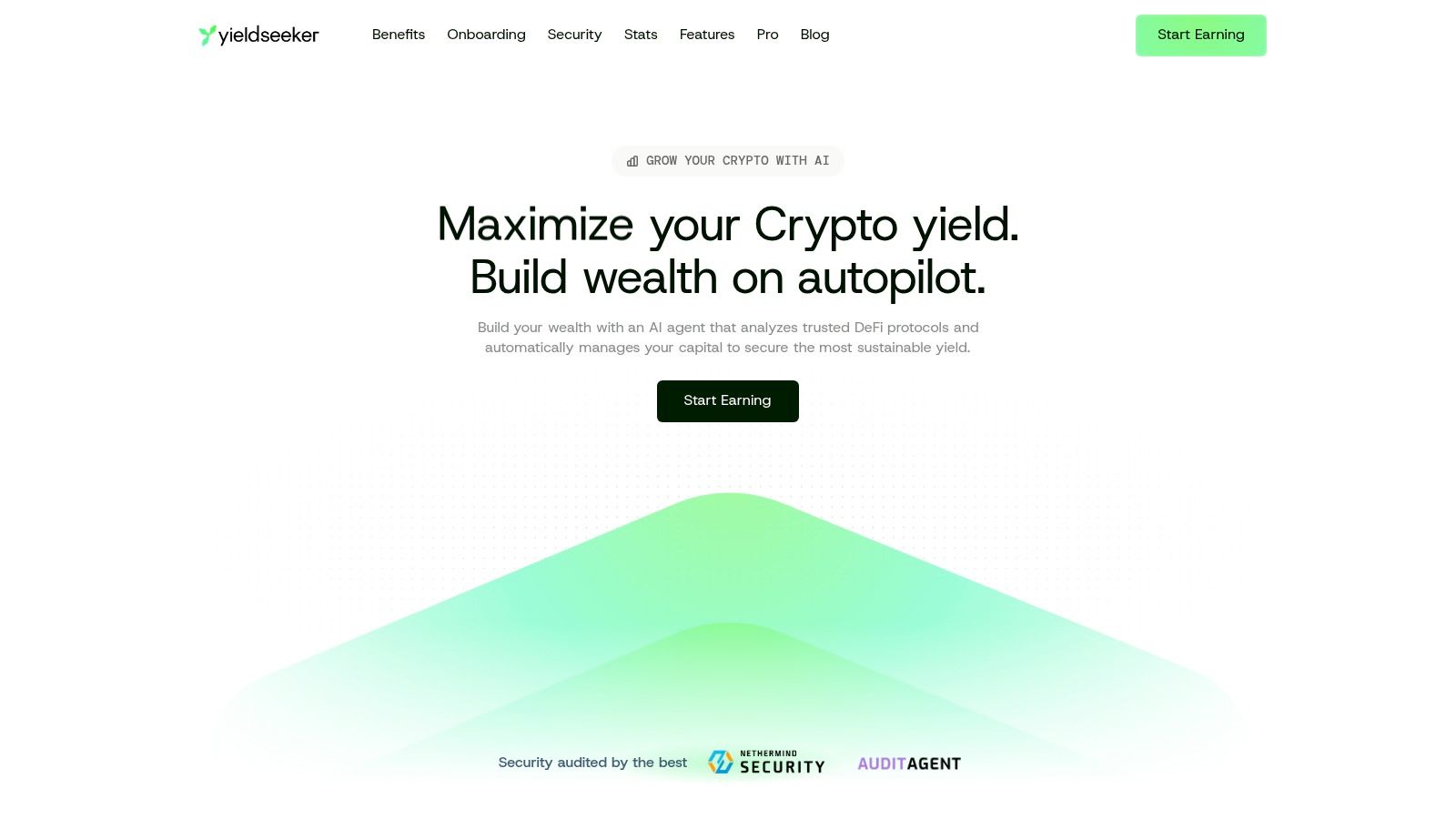
Yield Seeker is built for the user who wants stablecoin yield without manually comparing pools, moving funds between protocols, and watching rates throughout the day. After creating an account, you can deposit as little as $10 USDC on Base, then let a personalized AI Agent scan curated DeFi vaults and allocate capital according to risk-aware strategy rules. The platform reports an APY range of 3% to 14%, but those returns are variable and shouldn't be treated as guaranteed.
The practical advantage is automation with visibility. Yield Seeker's agents can optimize and auto-compound across curated, audited protocols, while the dashboard shows balances, performance, and agent activity. A built-in terminal and visual walkthroughs give more experienced users a way to inspect strategy behavior instead of treating automation as a black box.
Why automation changes the comparison
A hands-off strategy has a different success condition from a lending market. You aren't only asking which protocol offers the highest current rate. You're asking whether the system can identify changing opportunities, route transactions, rebalance capital, and keep the experience understandable when conditions shift.
Yield Seeker combines adaptive agents with a security-focused infrastructure. Its materials describe Coinbase Trusted Execution Environment isolated accounts, smart-contract audits by teams including Nethermind and AuditAgent, and public operational metrics such as 175,668 agent transactions, $202.7 million in agentic volume moved, and $1.4 million in assets under agents. Those figures are product-reported signals of activity, not proof that losses are impossible.
Practical rule: Automation reduces the research burden, but it doesn't remove DeFi risk. Review what the agent can access, where capital is deployed, and how you can withdraw before depositing.
Funds remain non-custodial and accessible, with no lockups or withdrawal fees according to the product information. The free Basic tier includes automated yield, multi-asset support for BTC, ETH, and USDC, plus the activity dashboard. Yieldseeker Pro costs $29 per month, with an early-bird offer using code EARLY-BIRD for three months free and roughly $19 per month during the first year under that offer.
The trade-off is scope. Onboarding emphasizes Base and USDC, so users seeking a broad multi-chain control panel may prefer a protocol-native interface. Audits and TEE isolation improve the safety posture, but smart-contract, stablecoin, execution, and strategy risks remain. Yield Seeker is the strongest fit for beginners, busy professionals, and treasury operators who value adaptive management more than choosing every pool themselves. Visit Yield Seeker to review the current product and supported strategies.
2. Aave
Aave is the clearest fit when the job is flexible lending and borrowing. You supply stablecoins or other supported assets to a non-custodial money market and receive interest-bearing aTokens. Borrowers deposit collateral and draw liquidity against it, while the protocol applies asset-specific risk parameters and market-driven interest rates.
That design makes Aave useful for more than passive stablecoin income. A user might supply USDC, borrow against ETH, or hold an aToken in another DeFi application. Aave v3 adds tools such as isolation mode, supply and borrow caps, and granular controls for individual markets. Its deployments span major layer-one and layer-two networks, including Base, which gives users more options when transaction costs or liquidity differ by chain.
What supply-side users need to monitor
Aave's supply rate is variable. It can decline when borrowing demand weakens and rise when utilization increases. That makes the platform transparent, but not passive in the strict sense. You still need to check the reserve page, utilization, incentives, and the stablecoin's own liquidity before treating the displayed rate as a durable income assumption.
The protocol's mature governance and broad integrations are major strengths. Deep markets for major stablecoins and ETH can make entry and exit more practical than using a thin pool, while public reserve information and third-party analytics help users verify live conditions.
Aave is a strong default for users who want control, liquidity, and composability, not a fixed return.
The main weakness appears when you borrow. A supplied stablecoin position is comparatively straightforward, but a collateralized loan introduces health-factor management and liquidation risk. Borrowers need to understand collateral prices, liquidation thresholds, interest-rate changes, and the consequences of a volatile market. The guide to DeFi lending explains that distinction in practical terms.
Aave works best for experienced users who want to manage a lending position directly, borrowers who need on-chain liquidity, and stablecoin holders who prefer a visible market mechanism over an automated allocation layer. It works less well for someone who won't check changing rates or doesn't understand liquidation mechanics.
3. MakerDAO and Spark
MakerDAO and Spark serve a different purpose from Aave. The core job is native savings exposure through DAI, rather than shopping across unrelated lending pools. MakerDAO governs DAI and its savings mechanism, while Spark provides a user-facing route into sDAI and related borrowing workflows.
A user can convert into DAI and deposit into the Dai Savings Rate, receiving sDAI as a composable representation of the position. Deposits and withdrawals are designed to remain available on demand, which makes the system suitable for users who want a relatively simple stablecoin savings primitive without a lockup. sDAI can also integrate with other EVM-based DeFi applications, so the position isn't limited to a single dashboard.
The rate is a governance decision
The key trade-off is that DSR income is policy-driven. Governance can adjust the rate through public proposals and executive votes, so the displayed return may change even when borrower demand hasn't changed. That gives users a transparent mechanism, but it doesn't provide a fixed promise.
The setup is appealing for a set-and-forget allocation. You hold or convert into DAI, deposit through Spark, and receive the savings exposure represented by sDAI. You don't need to select a stablecoin pool, manage a concentrated liquidity range, or monitor a borrowing health factor unless you use the collateralized borrowing features.
Risk lens: DAI savings is simple to operate, but you still carry DAI exposure, smart-contract risk, and governance risk.
The requirement to hold DAI is also a limitation. Users starting with USDC or another stablecoin need to complete a conversion, which introduces a swap and execution step. The DAI overview provides useful context for readers deciding whether that asset fits their strategy.
MakerDAO and Spark suit users who specifically want DAI-based savings and accept a governance-set rate. They aren't the best choice for someone seeking automatic cross-protocol optimization or a rate determined directly by current lending utilization. Before depositing, check the current savings conditions and understand that the rate can rise or fall as governance changes.
4. Uniswap
Uniswap is a liquidity provision and stablecoin-routing platform, not a savings account. Its central job is enabling decentralized swaps and allowing liquidity providers to earn fees from trading activity. Stablecoin pairs can be attractive because like-kind assets generally require less price-range management than volatile pairs, but the outcome still depends on the pool, fee tier, volume, and the behavior of the assets.
Uniswap v3 lets liquidity providers concentrate capital within selected price ranges. That can improve capital efficiency when the range remains useful, but it also turns liquidity provision into an active management task. Version 4 adds hooks that can embed custom pool logic, creating more flexibility for developers and liquidity managers.
Fee income is not the same as APY
Uniswap pools use different fee tiers, including 0.05%, 0.30%, and 1.00%, with some pools using 0.01%. Those figures describe the fee charged on trades in a pool, not a guaranteed return for liquidity providers. The automated market maker explanation helps clarify why trading fees, price movement, and pool rebalancing all affect realized results.
Stablecoin liquidity can be easier to reason about than volatile-asset liquidity, but it isn't risk-free. A stablecoin can lose its peg, trading can shift away from your chosen range, and a pool can experience adverse selection. On volatile pairs, impermanent loss becomes a central concern because the relative prices of the deposited assets change.
Uniswap's strengths are its swap experience, broad wallet and aggregator support, and developer ecosystem. It can work well for a treasury that needs reliable stablecoin conversion or for an experienced LP who wants precise control over price ranges and fee settings.
The weakness is operational overhead. You must select the right pool, understand the range, monitor whether capital remains active, and account for gas and withdrawal costs. Governance can also affect protocol fee settings. Choose Uniswap when the goal is earning from market-making activity, not when you want a simple, hands-off stablecoin savings product.
5. Lido
Lido belongs in a stablecoin-yield discussion when the strategy includes ETH staking exposure. It doesn't generate yield on a stablecoin deposit. Instead, users stake ETH and receive stETH or wstETH, liquid representations that can move through lending markets, decentralized exchanges, and structured products while the underlying position earns Ethereum staking rewards.
The practical benefit is convenience. You don't need to operate a validator or manage validator infrastructure, and you retain a liquid token that can be used elsewhere in DeFi. A user might hold stETH directly, supply it to a lending market, or combine it with another strategy. Each additional layer can increase potential utility, but it also adds another contract, price, and liquidation consideration.
Liquid staking adds an asset decision
Lido takes a protocol fee of 10% of staking rewards, so users should evaluate the net staking return rather than the gross network reward. The staking yield itself changes with network conditions, and stETH can trade away from ETH in secondary markets. That difference matters if you need to exit immediately or use stETH as collateral.
The strongest case for Lido is composability. stETH and wstETH are widely recognized across DeFi, which makes them useful building blocks for strategies that combine staking income with lending or liquidity provision. The weakest case is a user who wants stablecoin-denominated income without exposure to ETH price movements.
Portfolio check: A liquid staking token may be easy to deploy, but it remains an ETH-linked position. Don't compare its return directly with a stablecoin savings rate.
Validator-set concentration is another debated risk. Lido removes operational complexity, but it doesn't remove the need to assess protocol governance, validator distribution, smart contracts, and secondary-market liquidity.
Choose Lido when you want to keep ETH exposure while making the asset useful across DeFi. Don't choose it as a substitute for stablecoin yield unless you accept that the principal's dollar value can move with ETH.
6. Curve Finance
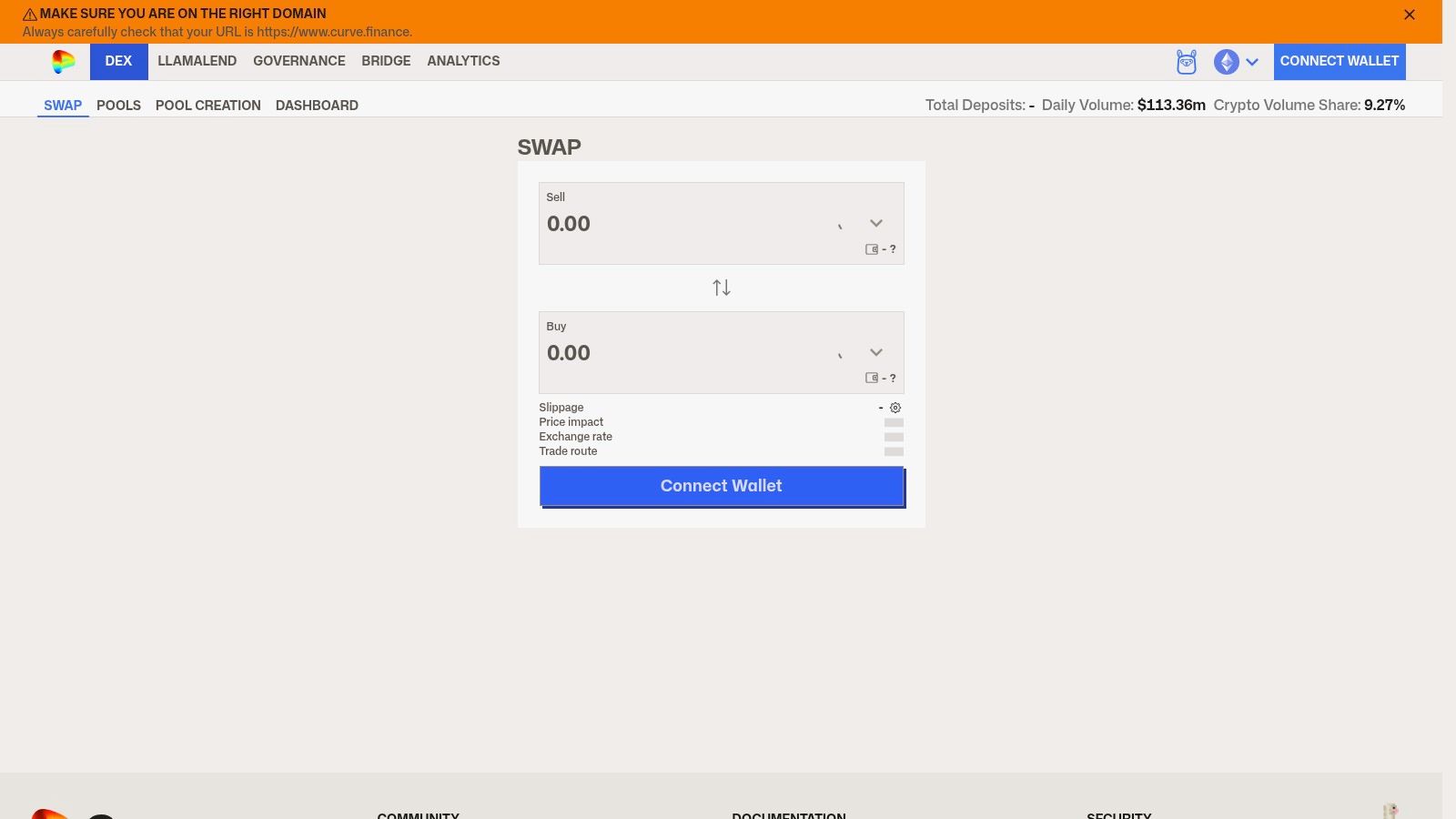
Curve is optimized for stablecoin routing and like-kind liquidity. Its automated market maker design focuses on assets that should trade near one another, including stablecoins and liquid staking tokens. That specialization can deliver low-slippage swaps when the pool has sufficient liquidity and the assets maintain their expected relationship.
For a stablecoin holder, Curve's role is often practical rather than purely income-oriented. It can provide an efficient route from one stablecoin to another, support treasury rebalancing, or serve as the liquidity layer beneath a broader farming strategy. Liquidity providers can also earn swap fees and incentives, but those returns depend on trading activity, pool composition, emissions, and the risks of the specific assets.
The incentive system takes work
Curve's gauge and veCRV structure rewards users who commit to the protocol's incentive system. That can make pool selection and boost management important for users pursuing yield rather than swapping. The mechanics are powerful, but they're less approachable than depositing into a single lending reserve.
Curve is particularly useful for treasuries, aggregators, and experienced LPs that value efficient stablecoin markets. Its multi-chain deployments and integrations can also make it a central routing venue for larger strategies. The trade-off is that a strong stablecoin pool isn't automatically a low-risk pool. You still need to inspect the assets, contracts, incentives, oracle dependencies, and chain deployment.
New users may find the interface and boost mechanics difficult to interpret. Historical DeFi exploits also reinforce the need for pool-specific diligence. A mature protocol doesn't make every pool equally appropriate.
Choose Curve when your job is exchanging like-kind assets efficiently or providing liquidity to a stablecoin market. If you want automated allocation across changing opportunities, a routing layer alone won't solve that problem. If you want predictable savings income, compare the pool's fee and incentive model with a native savings or lending primitive instead.
7. Pendle Finance
Pendle is the specialist choice for yield structuring. Rather than treating variable yield as one indivisible position, Pendle separates a yield-bearing asset into a Principal Token and a Yield Token. PT represents the principal claim through maturity, while YT provides exposure to the future yield stream.
That split creates strategy choices that standard lending markets don't offer. Buying PT at a discount can create a known return profile if held through maturity, subject to the asset and protocol risks involved. Buying YT expresses a view that future yield will be attractive. Users can also use the market to hedge or trade expectations about future rates.
Maturity matters
Pendle is powerful because it makes time part of the position. A user must understand the maturity date, the discount applied to PT, the decay of YT over time, and the liquidity available for the particular series. Those mechanics can be worthwhile for a treasury with a defined horizon, but they're unnecessary complexity for someone who only wants flexible stablecoin income.
Pendle's dedicated markets and integrations with sources such as sDAI and liquid staking tokens make it a useful layer above existing yield protocols. It can turn a variable-rate position into a more structured allocation, but it doesn't eliminate the underlying asset or smart-contract risks. It also doesn't guarantee that a secondary-market exit will be attractive before maturity.
Pendle is best used when you have a view on time, not merely a desire for the highest displayed rate.
Liquidity can be fragmented across different maturities and series, unlike a large lending market where deposits may remain continuously available. Experienced users and treasury managers may value that precision. Beginners should start by understanding PT and YT behavior with a small, appropriate allocation before adding margin or combining multiple positions.
Top 7 DeFi Platforms Comparison
Platform | Implementation Complexity 🔄 | Resource Requirements ⚡ | Expected Outcomes ⭐📊 | Ideal Use Cases 💡 | Key Advantages |
|---|---|---|---|---|---|
Yield Seeker | Low–Medium, turnkey AI agents automate allocation | Very low entry ($10 USDC on Base), non‑custodial funds | ⭐⭐⭐, reported APY 3–14%, auto‑compound, variable | Passive yield seekers, beginners, treasuries wanting hands‑off strategies | AI-driven optimization, low entry, audits & TEE, transparent metrics |
Aave | Medium, interact with lending markets and risk parameters | Moderate, supply/borrow capital, collateral management | ⭐⭐, market‑driven floating rates; deep liquidity reduces slippage | Lenders/borrowers, liquidity providers, composability use cases | Deep liquidity, audited, composable aTokens, granular risk controls |
MakerDAO (DSR via Spark) | Low, deposit DAI into DSR/sDAI via front‑end | Must hold/convert to DAI; on‑demand access | ⭐⭐, policy‑driven DSR yield, stable but variable by governance | Conservative stablecoin income, set‑and‑forget savers | Native protocol yield, simple UX, composable sDAI |
Uniswap | Low for swaps; Medium–High for active LPing (v3 range management) | Capital for swaps or LP positions; active management for v3 | ⭐⭐, fee income for LPs; swap UX best‑in‑class; variable returns | Traders needing low‑slippage swaps; active LPs seeking fees | Excellent routing/liquidity, broad integrations, customizable pools |
Lido | Low, one‑click staking to receive stETH/wstETH | ETH required to stake; no validator ops needed | ⭐⭐⭐, staking rewards net fees; composable liquid token | ETH holders wanting staking yield + liquidity for DeFi use | Widely adopted stETH, high composability, removes validator ops |
Curve Finance | Medium, pool/gauge selection and boost mechanics can be complex | Stablecoins or LSTs preferred; veCRV optional to boost rewards | ⭐⭐⭐, very low slippage on like‑kind swaps; gauge rewards available | Stablecoin traders, treasuries, LPs seeking efficient stable swaps | Extremely low slippage, deep stable/LST liquidity, mature incentives |
Pendle Finance | High, requires understanding PT/YT, maturities and discounting | Yield‑bearing assets and willingness to lock into series | ⭐⭐, can lock in fixed‑like returns or trade future yields; series‑dependent | Advanced users and treasuries seeking horizon‑based strategies | Tokenized yield primitives, fixed‑rate outcomes, hedging/directional tools |
Match the Platform to the Job
There isn't one universal winner among the best DeFi platforms because each one solves a different stablecoin-yield problem. Yield Seeker is the strongest fit for hands-off, AI-assisted allocation. Its value comes from monitoring and execution across curated opportunities, which suits users who want less manual research while retaining dashboard visibility.
Choose Aave when you want direct control over lending and borrowing, broad market access, and composable aTokens. It suits users who understand variable rates and, where relevant, health factors and liquidation management. Choose MakerDAO and Spark when you specifically want a direct DAI savings primitive and accept that the rate is determined through governance rather than continuously cleared borrower demand.
Uniswap is the choice for decentralized swaps and active liquidity provision. Curve is better suited to stablecoin routing and like-kind liquidity, especially when low-slippage market activity matters more than a simple deposit experience. Neither should be treated as a passive savings account. Their results depend on pool selection, trading activity, incentives, asset behavior, and the amount of monitoring you provide.
Lido belongs in a strategy that accepts ETH exposure and wants liquid staking assets for further DeFi use. It can support yield stacking, but its return isn't directly comparable with stablecoin income because the underlying asset's value moves. Pendle is the specialist option for maturity-based structuring, including PT positions for a more defined return profile and YT positions for directional exposure to future yield.
DeFi's history reinforces why resilience matters. TVL rose from millions to billions during the 2020 DeFi Summer, exceeded $180 billion by 2021, and Ethereum represented roughly 60% of DeFi TVL during the period when users reached about 5 million unique addresses by June 30, 2022. Global X's DeFi overview shows why scale, liquidity, and multi-chain access matter, but later cycles also show that growth doesn't remove drawdowns. TVL moved from about $54 billion in January 2024 to roughly $93 billion at the end of Q1, nearly $105 billion in mid-June, and about $87 billion by the end of October, before an estimate placed it near $129 billion by January 2025. Coverage of the DeFi TVL cycle makes the practical lesson clear. A platform should be judged by how it handles changing conditions, not just by its strongest rate.
Before depositing, define the asset you hold and the time horizon for the strategy. Decide how much control you want, check withdrawal conditions and fees, review liquidity and contract risks, and start with an amount appropriate for the strategy. Monitor realized performance, exposure, and rate changes instead of assuming any APY is permanent.
Yield Seeker offers an AI Agent that monitors curated DeFi opportunities and handles allocation and compounding for users who don't want to manage several dashboards manually. Visit Yield Seeker to explore its stablecoin automation experience, review the available controls, and decide whether hands-off yield management fits your strategy.