
Stablecoins can sit in your wallet for months, feel safe, and still leave money on the table. If you've got USDC, DAI, or another dollar-pegged asset and you're tired of watching it do nothing, the question isn't whether to farm yield, it's which stablecoin strategy fits how much risk and attention you want to carry. The best stablecoin yield farming setups in 2026 aren't the loudest ones, they're the ones that match your capital size, your time horizon, and how much protocol risk you're willing to tolerate.
The market has matured past chasing eye-popping APYs. Current USDC-focused opportunities are often sitting in the mid-single digits, with one 2026 roundup showing 4% to 7% APY on major venues and a USDC setup at 4% to 7% APY backed by $3.434 billion in TVL, while another top USDC opportunity on Jito was listed at 5.96% APY with $1.624 billion in TVL, and DAI-linked farming on Sky Lending was averaging about 4.00% APY with $4.6 billion in TVL (Stablecoin Insider). That's the backdrop here, moderate yield, large pools, and a lot of trade-offs hiding behind the headline number.
1. Yield Seeker
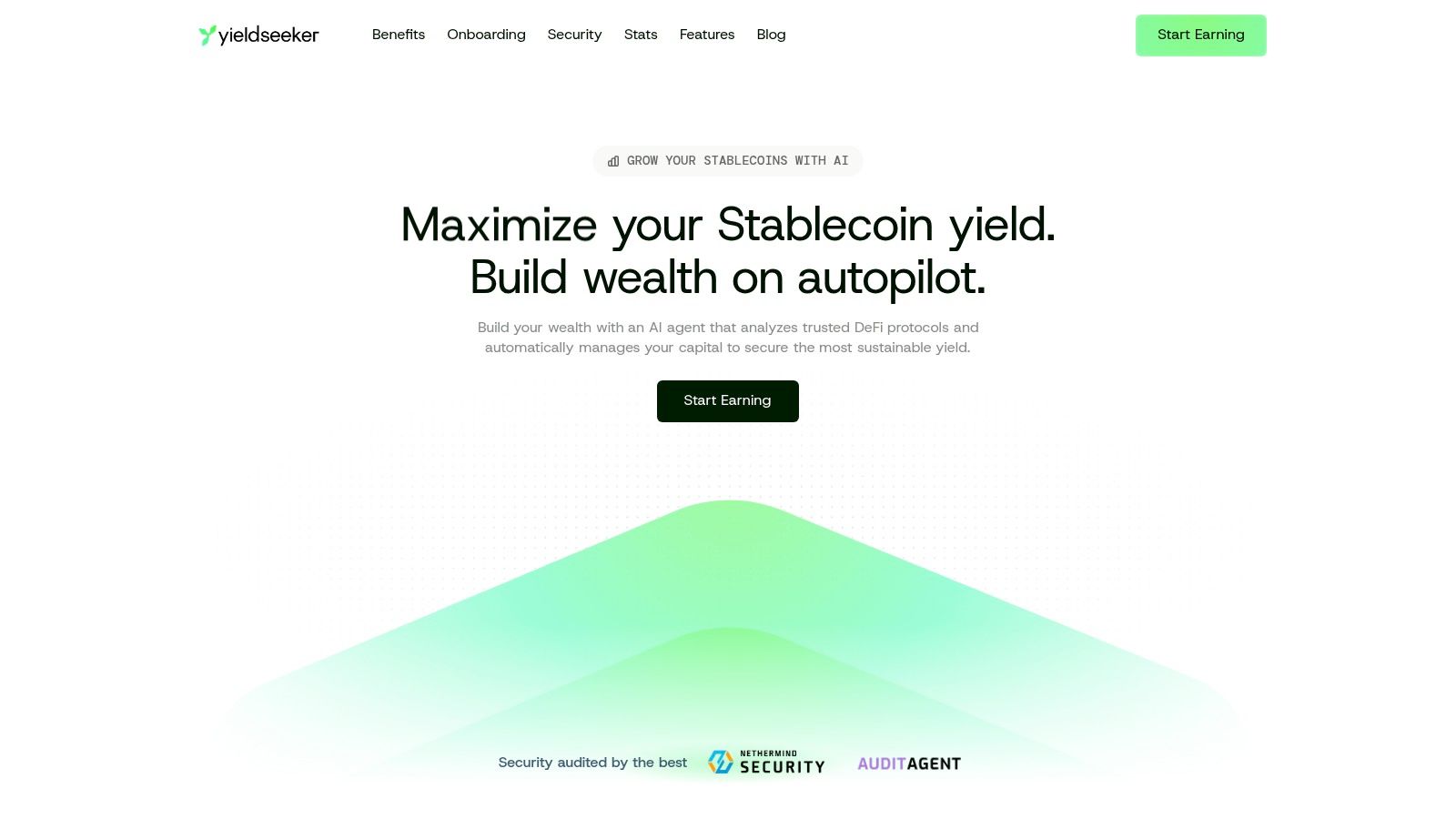
Yield Seeker is the cleanest fit for anyone who wants best stablecoin yield farming without spending their evenings comparing vaults, dashboards, and rate shifts. On Base, you can start with as little as $10 USDC, spin up a personalized AI Agent, and let it monitor a curated set of DeFi vaults and lending protocols while it reallocates capital toward risk-aware yield. The platform reports 175,668 agent transactions, $202.7M in agentic volume, and $1.4M currently managed, with real-world APYs roughly in the 3% to 14% range depending on settings and market conditions, so it's not pretending stablecoin yield is magic, just automated.
What makes it stand out is the combination of automation and control. Funds stay non-custodial, there are no lockups and no withdrawal fees, and the dashboard includes a verified activity log so you can see what the agent has done. For builders, treasury managers, and busy holders, that matters more than raw APY, because the cost of stablecoin yield farming is often the time spent researching and re-checking positions.
Why it beats manual hunting
Yield Seeker is built for a very specific user profile, someone who wants the upside of DeFi without babysitting it. It prioritizes low-risk, sustainable sources, auto-compounds earnings, and keeps the experience tight enough that you can enter and exit without friction. That combination is rare in stablecoin yield, where many tools force you to choose between simplicity and visibility.
Practical rule: if you want a stablecoin strategy you can actually keep using, pick the setup you can verify daily without feeling glued to it. That's where Yield Seeker earns its place.
Security posture also matters here. The platform says its smart contracts were audited by Nethermind, continuously analyzed by AuditAgent, and isolated accounts use Coinbase's Trusted Execution Environment. Built by long-time builders A Fox and Krishan Patel, it's clearly designed as a hands-off yield layer rather than a generic DeFi homepage. If you're starting from idle USDC on Base, this is the most direct “set it and monitor it lightly” option in the list.
2. Aave v3
Aave v3 is the baseline stablecoin lender for a reason. If you supply USDC or DAI on the official app, you're earning variable interest from borrower demand, and that model is easy to understand, easy to unwind, and still one of the least complicated ways to get exposure to onchain yield. The protocol runs across multiple chains, including Base, Arbitrum, Optimism, and Ethereum, and its risk controls, like isolation mode and supply and borrow caps, make it more disciplined than the average lending market.
The appeal is familiarity. You deposit, you watch the rate, and you withdraw when you want to move. That simplicity is a feature, especially for users who don't want to deal with LP tokens, expiry dates, or reward-boost mechanics. It's also why Aave is often where people land first before they branch into more advanced stablecoin yield farming strategies.
The trade-off is obvious. Rates float with market demand, so they can be modest in risk-off conditions, and the protocol still carries smart-contract and borrower liquidation risk even with its controls. For many users, that's acceptable, because Aave's long track record and deep liquidity make it one of the most reliable ways to keep capital productive without overengineering the position.
A practical way to use Aave is as your core parking lot. If you want a liquid position you can exit quickly, or you need a stablecoin asset that still feels close to cash, this is a strong default. It also pairs well with a more automated strategy elsewhere, especially if you want one tranche of capital in a straightforward lending market while another tranche is managed more actively.
For a deeper breakdown of lending mechanics and how they fit into a stablecoin stack, see the internal guide on lending protocols.
3. MakerDAO DSR via sDAI
sDAI is what stablecoin yield looks like when you strip away most of the noise. You hold DAI, wrap it into sDAI, and the token auto-accrues the Dai Savings Rate through Maker's system while staying composable as a normal ERC-20. That matters because it gives you a cash-like asset that can still move through DeFi without needing an LP position, a borrow loop, or any extra management layer.
The strongest argument for sDAI is structural simplicity. The rate source is set by Maker governance, the wrapper is easy to integrate, and the position doesn't require you to think about rebalancing or exit timing the way more active strategies do. For treasury-style capital, that's a real advantage, especially if the goal is steady yield with minimal operational overhead.
Still, the trade-offs are real. The DSR is variable, so governance can change it, and your exposure is effectively limited to the DAI ecosystem and the peg dynamics around it. That makes sDAI a good fit for users who value transparency and composability, but less attractive if they want higher potential returns or multi-chain flexibility.
Where it fits best
sDAI works best when you want one thing, simple passive yield on a blue-chip stablecoin. It's the kind of tool you can hold without checking a dozen metrics every week. It's also easy to use as a base asset elsewhere in DeFi, so you can keep capital productive without locking yourself into a closed product.
Practical rule: when your priority is preserving optionality, wrapper-based yield tends to beat cleverness. sDAI gives you that option without turning your stablecoin into a project.
That's why DSR exposure still belongs on any serious stablecoin farming shortlist. It isn't the flashiest option, but it's one of the cleanest.
4. Morpho Blue and MetaMorpho Vaults
Morpho Blue is where stablecoin yield gets more modular. Instead of stuffing capital into a generic pooled market, you can use isolated markets with defined collateral rules and parameters, which gives allocators more precision over what they're exposed to. MetaMorpho vaults sit on top of that and route deposits into chosen markets under specific supply caps, which means users can outsource part of the market selection process without giving up the onchain structure.
That modularity is the point. Blue-chip lending is fine, but some allocators want finer-grained control over risk and market composition. Morpho lets them get closer to that ideal, especially when they're trying to balance yield against how much exposure they want to any one market setup. The vault layer then makes it more practical for depositors who don't want to monitor every parameter themselves.
The cost is complexity in another form. Vault strategy matters, curator selection matters, and returns depend on market utilization and supply caps. That means you're not just picking a protocol, you're picking a market design and, in many cases, someone's judgment about how to allocate across it. That can work very well, but it's not the place to be casual.
Best use case
Morpho Blue and MetaMorpho fit users who want better risk segmentation than pooled lending and are willing to spend a little more time understanding the vault they're entering. If Aave feels too generic and DIY market selection feels too much, this middle layer is a strong compromise.
The practical edge is that vault routing reduces how often you need to intervene. You still need to understand the market, though, because curation doesn't remove risk, it organizes it. That makes Morpho a smart pick for more experienced allocators who want stablecoin yield with a tighter framework around market exposure.
5. Pendle Finance
Pendle turns future yield into something you can trade, which is why it matters so much for stablecoins. By splitting yield-bearing assets into Principal Tokens and Yield Tokens, it lets users lock in a fixed-yield position when they want predictability, or keep exposure to variable yield when they want to speculate on how returns move over time. That's a very different angle from plain lending, and it's one of the most useful advanced tools in the stablecoin yield farming stack.
For allocators, the benefit is clarity. If you want a known return profile from a yield-bearing stablecoin asset, Pendle lets you buy that outcome through the principal side at a discount. If you want to express a view on yield itself, the YT side gives you that exposure. The platform's concentrated-liquidity design is built for this kind of market, which is why it's become a serious venue for fixed-income style DeFi thinking.
The catch is complexity. Expiries matter, pricing matters, and exiting early can reduce what you realize. Pendle is not the best place for someone who just wants to deposit and forget. It's a tool for users who understand that stablecoin yield can be transformed into a more structured product.
I like Pendle when the goal is to make yield more predictable. That's especially useful when the market has compressed into a narrower band and you care less about squeezing out every extra basis point than about knowing what your position should do.
Why it belongs on the list
Pendle gives stablecoin farmers something most of the market still ignores, yield certainty as a design choice. That makes it valuable for more disciplined allocators and treasury-style users who can't afford to treat returns as a surprise every week.
If your style leans toward measured outcomes rather than constant repositioning, Pendle deserves serious attention.
6. Curve Finance and Convex Finance
Curve remains one of the most important places to farm stablecoins because it's built for low-slippage pools of like-assets. That design is exactly why it keeps showing up in serious DeFi stacks. If you're providing liquidity to major stablecoins like USDC, USDT, or DAI, Curve's pool structure is aimed at keeping peg friction low while letting you earn trading fees and protocol incentives.
Convex adds the other half of the equation. It simplifies staking and aggregates veCRV voting power, which makes reward boosting much easier to manage than doing everything directly through Curve. For depositors, that means you can tap into a more effective incentive layer without constantly dealing with every claim and boost mechanic yourself.
The drawback is the same one that applies to most LP strategies, you are taking on pool composition and depeg risk. Even if the pool is designed for like-assets, a sustained depeg event can still punish you. Yields also depend on emissions and incentive programs, which can change over time, so you're not buying a static return stream.
Where Curve and Convex shine
They shine when you want stablecoin exposure that still earns from fees plus incentives. That can work especially well if you understand the specific pool you're entering and why that pool exists. It's less attractive for passive users who don't want to think about LP tokens, gauges, or pool balance.
Practical rule: use Curve when you want stable liquidity, not when you want zero maintenance. LP positions are still positions, and they deserve monitoring.
The Curve and Convex stack remains core infrastructure for stablecoin farmers because it solves a real problem, how to earn from deep stablecoin liquidity without taking on unnecessary volatility. It's one of the more battle-tested ways to participate in DeFi yield, but it rewards people who respect the moving parts.
For users comparing LP mechanics across stablecoin strategies, the internal note on liquidity mining is a useful companion read.
7. Yearn Finance
Yearn is the classic answer for people who want stablecoin yield without micromanaging the venue list. Its vaults aggregate multiple strategies, then auto-route capital, harvest rewards, compound returns, and rebalance as opportunities change. That makes it attractive to users who understand that stablecoin farming isn't one strategy, it's often a rotating mix of lending, LP incentives, and other yield sources.
The main strength here is automation. A single deposit can expose you to a professionally organized strategy layer instead of forcing you to manually chase every new rate. That matters when the underlying opportunity set changes quickly, because you're not stuck copying trades by hand. Yearn's long DeFi history and open-source, audited codebase also give it a familiar, builder-friendly feel.
The trade-off is net returns and control. Vault APYs can swing as opportunities change, fees reduce what lands in your wallet, and you give up some granularity over exactly where capital is deployed. For users who want to choose every protocol themselves, that can feel too opaque. For everyone else, it's the opposite of a headache.
Why it still matters
Yearn is valuable because it captures a truth many yield seekers learn late, the best return is often the one you can maintain. If you don't want to monitor every vault and reward stream, a strategy aggregator is often better than a self-managed stack.
It also sits nicely between basic lending and fully automated AI allocation. Where Aave is a clean single market and Pendle is a structured yield tool, Yearn is a delegation layer that does a lot of the busywork for you.
For more context on vault automation and how these stacks work together, the internal guide on vault finance in crypto is worth a look.
Top 7 Stablecoin Yield Farming Comparison
Product | 🔄 Implementation Complexity | ⚡ Resource Requirements | 📊 Expected Outcomes / Impact | 💡 Ideal Use Cases | ⭐ Key Advantages |
|---|---|---|---|---|---|
Yield Seeker | Low, plug‑and‑play AI agents automate allocation | Very low entry (from $10 USDC); Base chain wallet; platform-managed agents | Moderate, risk‑aware APYs (~3–14% historically); auto‑compounding and transparent logs | Hands‑off users wanting automated stablecoin yield on Base | Automated AI reallocation, audited contracts, non‑custodial access |
Aave v3 | Low, simple supply/withdraw UX via official app | Standard wallet + stablecoins; multi‑chain support (gas per chain) | Variable, market‑driven interest (conservative in risk‑off markets) | Conservative lenders seeking simple on‑chain yield and liquidity | Deep liquidity, multi‑chain markets, built‑in risk controls |
MakerDAO DSR via sDAI | Low, hold/wrap DAI to sDAI (simple token flow) | DAI holdings; mint/wrap to sDAI (one extra step) | Stable, governance‑set DSR (variable via governance) with high composability | Cash‑like stable yield and protocol‑native exposure | On‑chain governed rate; ERC‑20 sDAI composability |
Morpho Blue + MetaMorpho Vaults | Medium, choose vaults/curators; understand market params | Moderate capital; interaction with permissionless vaults; gas | Tailored lending yields depending on market utilization and curator strategy | Users wanting finer risk isolation than pooled markets | Isolated markets, configurable LTVs, vault routing automation |
Pendle Finance | Medium–High, PT/YT mechanics and expiries require learning | Yield‑bearing assets as input; liquidity for PT/YT markets; active management | Can lock predictable fixed yields if held to expiry; pricing/liquidity dependent | Users who want to convert variable yield into fixed or trade yield exposure | Ability to securitize and fix future yield; tradable yield instruments |
Curve Finance + Convex Finance | Medium, LP + staking + boost mechanics to manage | Significant stablecoin capital for LPs; gas; manage gauge/boost positions | Potentially high when incentives active; fees + boosted rewards; emission‑dependent | Liquidity providers seeking fee income and enhanced incentive yields | Deep stablecoin liquidity, low slippage pools, Convex reward boosts |
Yearn Finance | Low, deposit into vaults; Yearn handles strategies | Deposit capital; trust in vault managers; protocol fees apply | Aggregated, rebalanced yields with automated harvesting and compounding | Users wanting diversified, hands‑off strategy exposure | Multi‑strategy diversification, automated compounding, audited vaults |
Automate or Actively Manage Your Path to Stablecoin Yield
Choosing the right stablecoin yield farming strategy comes down to three things, your capital size, your risk tolerance, and how much time you want to spend managing it. If you want the cleanest low-maintenance path, Aave v3 and sDAI are still excellent starting points, because they're easy to understand and easy to exit. If you want more structure, Pendle gives you fixed-yield precision, while Curve and Convex add liquidity-layer exposure for users who are comfortable with LP mechanics.
The bigger lesson is that the best stablecoin yield farming choice is rarely the one with the biggest APY on a screenshot. Recent market data shows the space has compressed into moderate-yield, high-liquidity venues, and that's a good thing because it forces allocators to think about yield source, protocol quality, and operational risk instead of just chasing a number (Stablecoin Insider). In practice, that means conservative users should favor passive wrappers and blue-chip lending, while more experienced users can step into modular vaults, LPs, or fixed-yield markets when the trade-off is worth it.
If you're still undecided, start with the least complicated option that fits your habits. You can always move up the stack later, but it's hard to justify a complex position you won't monitor. Stablecoin yield works best when it fits your life, not when it steals your attention.
If you want stablecoin yield without the manual grind, Yield Seeker gives you an AI Agent that monitors DeFi opportunities on Base, reallocates capital, and auto-compounds while you keep control of your funds. It's a practical way to turn idle USDC into a hands-off yield strategy with transparent activity logs and no lockups. Visit Yield Seeker to see how automated stablecoin farming can replace dashboard juggling with a cleaner, more disciplined workflow.