
You've got USDC sitting across chains and a dozen vault tabs open, and every dashboard looks convincing. The APYs blur together fast. What doesn't show up as clearly are the genuine differences: fee treatment, chain coverage, strategy complexity, and how painful it is to get out when you need the money back. The best yield aggregator for you depends less on the headline rate and more on how much control, clarity, and resilience you want from the platform.
This list ranks platforms by the reader type they suit best, not just by yield marketing. If you're a beginner, you'll want a guided setup and clean exit terms. If you manage treasury, you'll care about audit depth, liquidity, and operational failure modes. If you're a power user, the important questions are where the yield comes from, how fees are taken, and whether the strategy still works when market conditions change. A useful reminder from DeFi's early history is that incentives can move capital very quickly, but they can also make returns fragile, temporary, and hard to judge at a glance. Ethereum's TVL rose from about $800 million in April 2020 to about $10 billion in September 2020, while Uniswap's monthly volume jumped from $169 million to more than $15 billion over the same window, which is exactly why a vault's routing logic matters as much as its APY (Ethereum DeFi history).
1. Yield Seeker

A good first stop for stablecoin yield is the platform that keeps the workflow simple. Yield Seeker fits that use case well if you want stablecoin yield without living inside DeFi tabs. It starts with deposits as low as $10 USDC on Base, then uses a personalized AI agent to handle allocation and rebalancing in real time. That makes it a practical fit for beginners, busy investors, and treasury operators who want automation without handing over custody.
The stronger point is operational clarity. You can see balances, performance, and an auditable activity log in one place, and the built-in terminal plus chat layer let you inspect strategy choices instead of treating the vault like a black box. In a market where yield is split across many fast-moving sources, that kind of visibility matters as much as raw APY.
Practical rule: if you need to explain your yield workflow to a non-DeFi teammate, choose the platform that shows the least hidden machinery.
Why it stands out for different users
Beginners: The guided experience reduces the chance of making a poor routing decision.
Treasury managers: The non-custodial design and activity log support internal review.
Power users: The AI agent and built-in terminal make it easier to compare allocation choices without jumping between protocols.
Security is part of the appeal too. Yield Seeker uses non-custodial, isolated accounts secured via Coinbase Trusted Execution Environment, and the product says its smart contracts have been audited by Nethermind with continuous automated analysis from AuditAgent. Funds stay accessible at all times, with no lockups or withdrawal fees. That is useful when stablecoin cash needs change quickly. The trade-off is scope. It focuses on stablecoins, especially USDC on Base, so it will not suit users looking for broad multi-asset or wide-chain hunting.
Pricing is straightforward, with a free Basic tier and Yield Seeker Pro at $29/month for more active agents, more memory, and priority support. If you want a guided, AI-driven way to earn on stablecoins without losing sight of what is happening underneath, start with Yield Seeker and read its overview of the category in the platform's own guide to DeFi yield aggregation.
2. Yearn Finance
Yearn still feels like the reference point for the category because it treats vaults like infrastructure, not a gimmick. Its v3 vault architecture is ERC-4626-based, with deposits routed into one or more on-chain strategies per vault and transparent accounting handled onchain. That makes it a good choice for users who value process maturity over novelty.
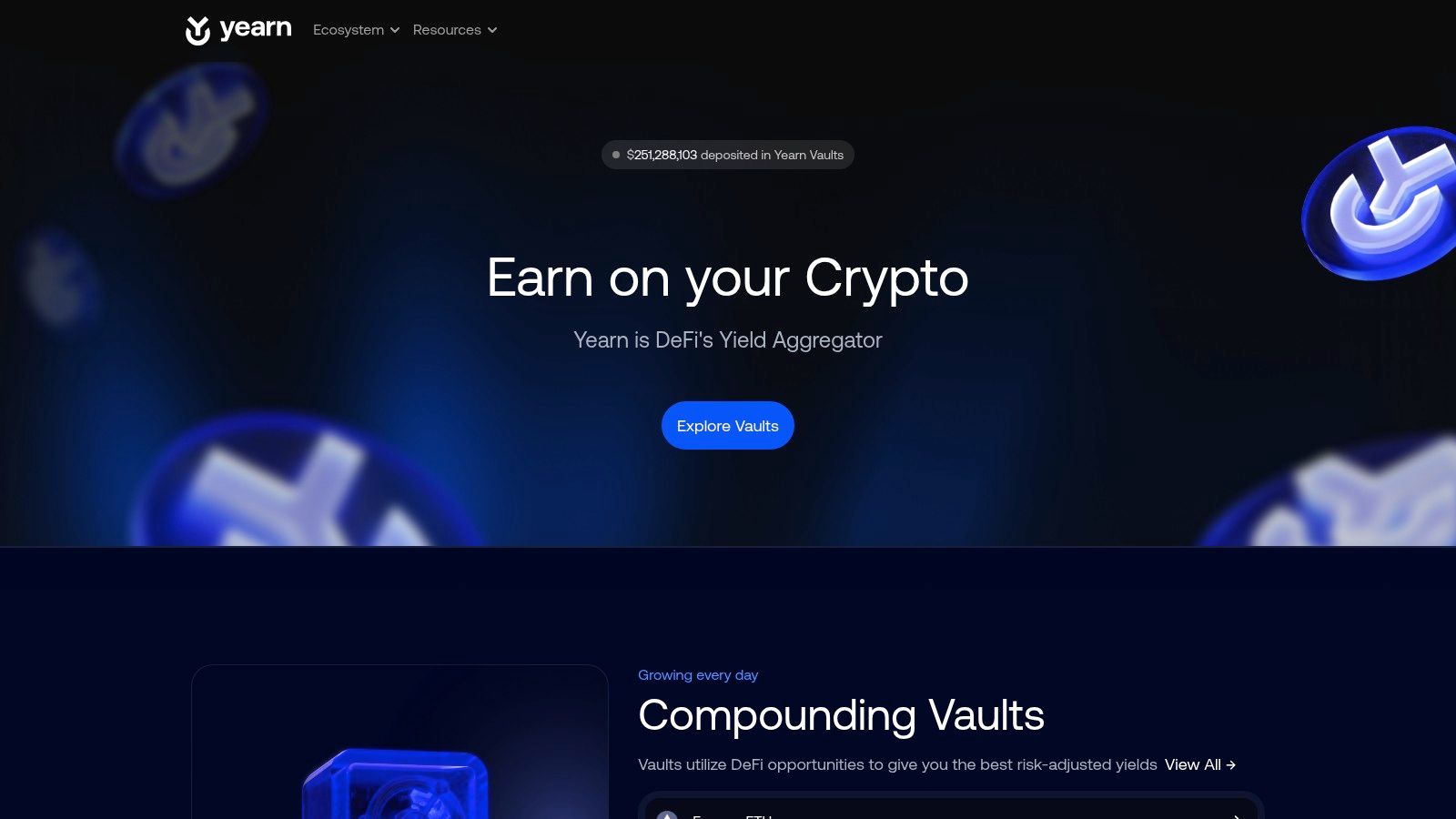
The biggest reason to use Yearn is trust in the operating model. You are not just buying APY, you're buying a long-running system for strategy development, reporting, and vault management. Its v3 setup also makes it easier to understand what the vault is doing under the hood, which is useful when you want stablecoin exposure that doesn't depend on a black box.
Where it fits best
Yearn suits users who want conservative, automated strategies on blue-chip assets. It's especially useful for people who already understand DeFi but don't want to babysit individual lending markets or LP positions. The trade-off is that a curated strategy set can lag more niche opportunities, and Ethereum mainnet gas can eat into returns for smaller balances.
What works well: clear separation between vault and strategy, with transparent reporting.
What doesn't: expecting the vault to chase every new incentive on the market.
Yearn is also one of the cleaner options if you care about composability. The ERC-4626 share model makes it easier to build around the vault token, and the protocol's public docs are strong enough that experienced users can audit the flow without guesswork. For stablecoin holders who want something battle-tested rather than flashy, Yearn remains one of the safest default answers.
3. Beefy Finance
Beefy is the choice I make when chain coverage matters more than a stripped-down interface. Its footprint is broad enough that cross-chain stablecoin and LP portfolios can sit under one roof, and that matters if you split capital across several networks. For broader context, see our comparison of leading yield farming platforms. The trade-off is straightforward. A multichain setup also means uneven risk from vault to vault.
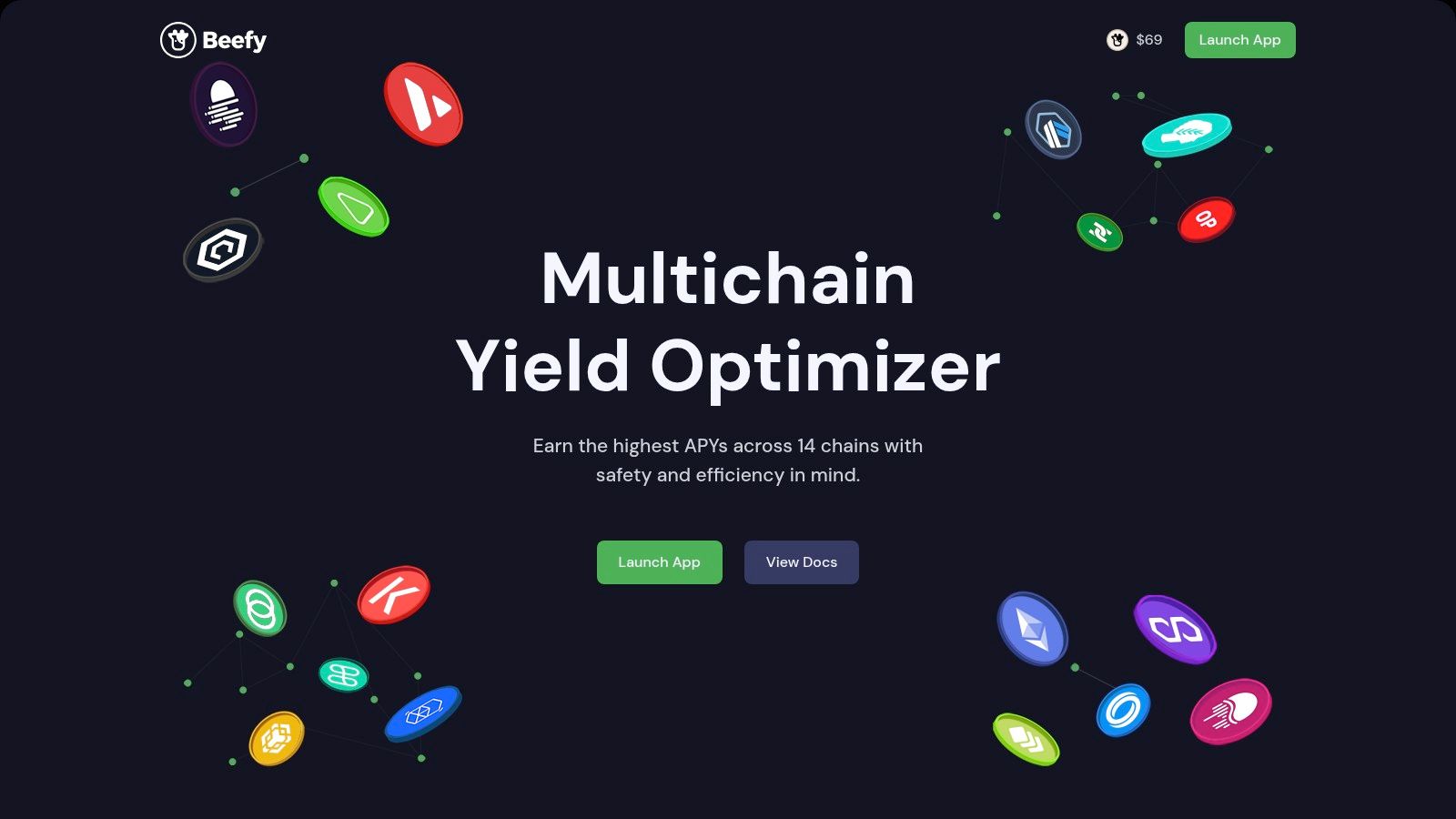
Beefy's appeal is operational. It auto-compounds, supports many chains, and keeps deposit flows simple enough for users who do not want to babysit harvests. If you move between Base, BNB Chain, and other EVM ecosystems, that kind of coverage saves time.
The limit is the same reason people like it. Some vaults depend on external incentives, so APY can move when rewards change. That does not make Beefy weak. It means you need to inspect each vault instead of assuming one rule fits all. If you want to keep compounding work off your plate, Beefy is practical. If you want returns that rest on stable borrower demand, you still need to check the strategy behind each position.
Good fit, weak fit
Good fit: cross-chain users who want wide vault access and automated compounding.
Weak fit: beginners who want one simple standard for every vault.
Good fit: users who already understand that APY changes when incentives change.
Weak fit: anyone who wants a single risk model across all chains.
For a beginner, Beefy can feel like a lot of moving parts. For a treasury manager, the appeal is coverage and the ability to run different vault types across networks. For a power user, the value is in choosing among many strategies without manually compounding each one. The fee structure is published, and the UX is easy to read once you know how vault labels work. The strength is coverage. The weakness is inconsistency under the hood.
4. Harvest Finance
Harvest is a useful choice for users who want frequent auto-compounding across several chains without a complicated interface. It supports Ethereum, Arbitrum, Base, Polygon, and zkSync Era, so it's relevant for people who don't want to think in terms of one network only. The platform also shows APY net of fees, which removes a lot of the guessing that makes vault comparisons annoying.
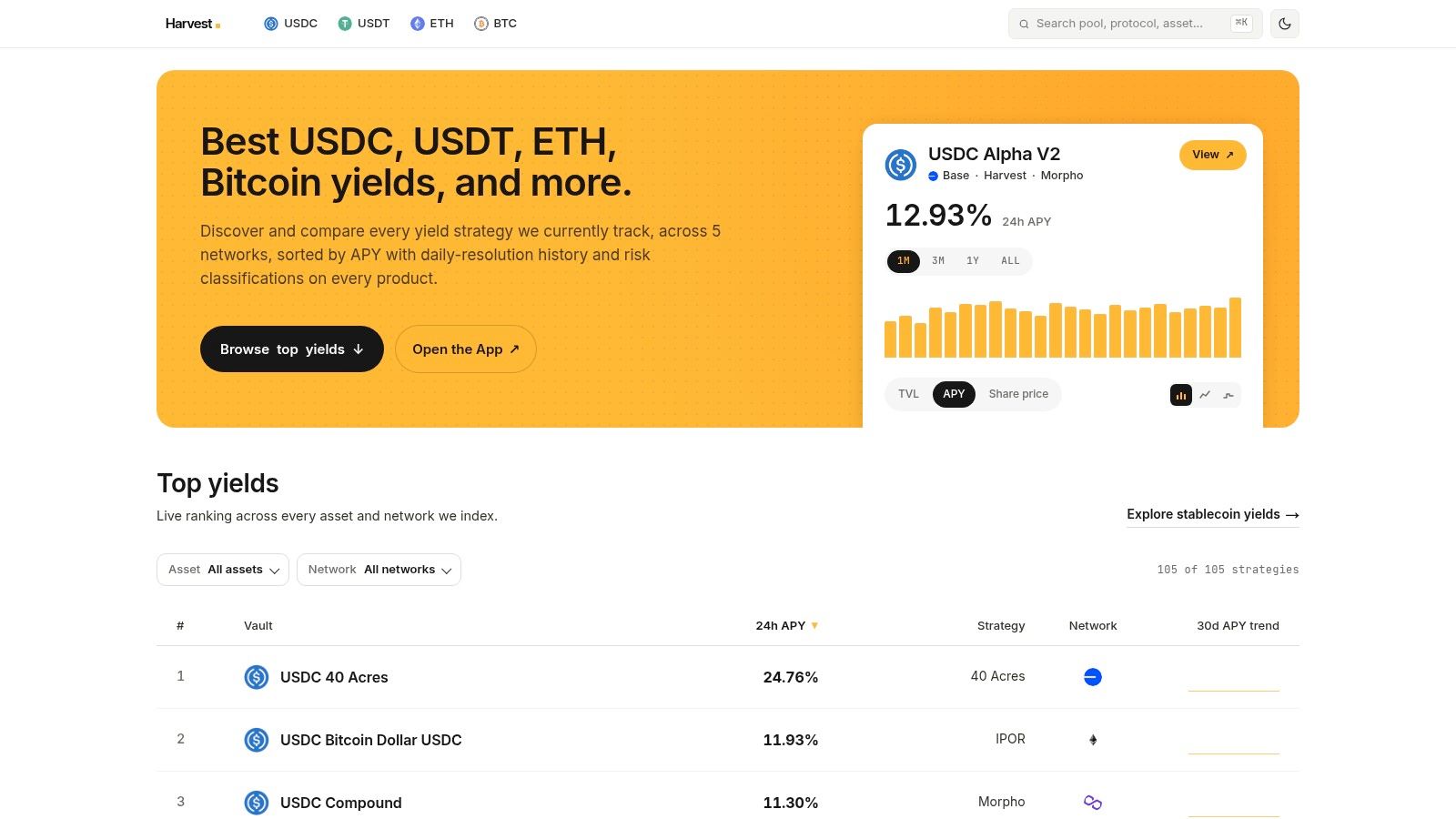
That fee disclosure is the story here. A lot of yield products make you reverse-engineer the take rate. Harvest is easier to read. The iFARM profit-sharing mechanics also give experienced users something to look at if they care about how protocol value flows through the system.
The practical trade-off
Harvest is attractive when you want the platform to keep working without constant intervention, but it's not a “set one vault and forget every chain forever” solution. Strategy sets change as incentives, wrappers, and integrations evolve, and some vaults get deprecated or migrated. That means you still need to watch the docs.
Practical rule: if the strategy list looks different from last month, assume the underlying incentive stack changed too.
Where Harvest wins is in its balance of multichain support and readable fee treatment. Where it loses is in complexity at the chain level. Each network has its own risk profile, and you can't treat a Base vault like an Ethereum vault just because the dashboard looks similar. For users who want a long-running aggregator with a clear fee story, Harvest is solid. For users who want maximum simplicity, it can still feel like a lot.
5. Idle Finance
Idle makes sense if you care about risk tiers, not just yield. Its best-yield vaults route funds automatically, but its Yield Tranches are the core differentiator because they let you choose between different risk and return profiles on the same underlying pool. That design is unusually useful for stablecoin holders and treasury teams.
The Senior and Junior split gives Idle a more finance-like structure than many vault aggregators. If you want lower-risk exposure, the Senior side is the obvious starting point. If you want more return and understand that downside gets absorbed first somewhere, the Junior side gives you that lever. That's a more honest way to think about stablecoin yield than just sorting by the highest APY on a homepage.
Idle's docs also help. APY is shown net of fees, and the product language is clear enough that a treasury manager can explain it internally without translating crypto jargon into plain English first. The limitation is breadth. Idle is not trying to outsprawl the biggest multichain platforms, so the menu is narrower and the range of chains is smaller.
The Yield aggregator crypto angle matters here because Idle is one of the better examples of how aggregation and tranche design can coexist. It doesn't pretend every user wants the same risk level. That makes it a more thoughtful platform than many “best APY” lists suggest.
6. Vesper Finance
Vesper is for users who want simple vault flows and don't want to spend time decoding hidden fees. Its Grow and Earn pools keep the product surface narrow, which is a strength when you're trying to move stablecoins in and out without friction. The platform's docs are also explicit about fee treatment, and that transparency matters more than people admit.
The main appeal is that what you see is close to what you get. APY reporting is net of protocol fees, and the deposit and withdrawal experience is straightforward enough for beginners to use without a long learning curve. If you're the kind of user who gets nervous when a dashboard starts adding tabs, Vesper feels calmer than many alternatives.
The limitation is obvious, though. It doesn't compete on breadth. You won't get the same huge strategy menu or multichain footprint that larger aggregators offer, and some pools do carry withdrawal or platform fees that need to be checked in the docs before you commit capital. That makes it a better fit for users who value predictability over maximal choice.
Best for
Beginners: clean deposit and withdrawal flows.
Fee-conscious users: APY presentation that stays close to net yield.
Smaller allocators: simple single-asset strategies without vault overload.
Vesper is not the loudest platform in the space, but it has a useful discipline. It tries to make the economics legible. In stablecoin yield, that's more important than fancy naming or oversized menus.
7. Autofarm Network
Autofarm is one of the better options for users who still care about auto-compounding but want a more veteran feel. It started on BNB Chain and grew into a multichain aggregator with a broad mix of LP and single-asset vaults. That history shows up in the product, which feels built for people who already know what they're doing.
What stands out first is the fee schedule. It's published, and that helps when you're comparing vaults across chains and trying to figure out what the platform is taking. That's not a flashy differentiator, but it saves time and reduces confusion. The other strength is simple vault coverage. If you want compounding across a lot of LP positions, Autofarm has the kind of breadth that rewards patient users.
The drawback is mostly the same one that comes with any large menu. It can get dense. New users may struggle to tell which vault is incentive-driven, which one is more stable, and which chain carries the most operational risk. Some pools are also more volatile because they rely on external emissions or short-lived incentives, so APY can move around quickly.
Practical rule: broad vault coverage is only an advantage if you're willing to read the vault notes.
For users who want a multichain compounding tool with a clear published fee structure, Autofarm is still worth a close look. Just don't confuse range with safety.
8. Convex Finance
Convex is not a general-purpose aggregator in the way Yearn or Beefy is. It is a specialist. If your stablecoin strategy lives inside the Curve and Frax ecosystems, Convex is often the cleaner way to capture boosted rewards without locking governance tokens yourself. That narrow focus is the entire point.
The platform works because it aggregates vote-escrowed power and simplifies the mechanics that would otherwise require you to lock assets, claim rewards, and manage governance exposure manually. That makes it especially appealing for users who want to stay in LP-heavy stablecoin strategies without learning every detail of veCRV or veFXS. For people already active in Curve-style liquidity, Convex is a familiar and efficient layer.
Its weakness is scope. You do not use Convex if you want broad stablecoin access across many unrelated venues. You use it when your strategy is already centered on Curve or Frax incentives. That makes it powerful for the right user and irrelevant for the wrong one.
A lot of users underestimate how much friction Convex removes. It doesn't magically create yield. It packages an ecosystem-specific yield path into something more usable. That's a meaningful difference, especially if you're managing more than one LP position.
9. Stake DAO
Stake DAO is strongest when you want boosted yield without locking capital into long governance positions yourself. Its Liquid Lockers and sdTokens give you a way to tap into protocol-level boosts while staying more flexible than a direct lock. That's useful if you care about meta-governance as part of your yield strategy.
The platform's “OnlyBoost” style mechanics are built around directing gauge weight and amplifying LP rewards. That makes it appealing to users who already know which ecosystem they want exposure to and want the platform to do more of the heavy lifting. It's not just about earning, it's about participating in the reward structure of a protocol family.
The downside is complexity. Stake DAO is not the first platform I'd hand to a newcomer because the menu of lockers, boosts, and strategies can feel layered fast. It also leans into ecosystems that have gauge and vote incentives, so it isn't a universal stablecoin aggregator in the broadest sense.
Practical rule: if you can't explain the boost source in one sentence, you probably need to slow down before depositing.
Stake DAO is a good fit for users who already think in terms of governance power, liquidity incentives, and liquid locking. If that language is natural to you, the platform can add real efficiency. If it isn't, the learning curve will get in the way.
10. Sommelier Finance
Sommelier is for users who want rules-based vault logic with on-chain execution instead of a vague promise that someone is “actively managing” the position. Its validator-set model is different from a multisig-controlled system, and that difference matters because it changes how rebalancing decisions are pushed onchain. For stable assets and majors, that's an elegant structure.
The platform makes the most sense if you like periodic, transparent rebalancing and prefer a strategy framework that doesn't depend on one off-chain operator making opaque calls. That puts it in a strong position for conservative users who still want active management. It's a tighter model than a lot of generalized yield platforms.
The trade-off is speed. Conservative rebalance cadence can trail fast-moving incentive windows, which means Sommelier may miss some of the sharpest short-term opportunities. That's not a flaw if your goal is stability and process clarity, but it is a limitation if you want the platform to chase every rate spike.
Best use cases
Treasury-oriented users: rules-based management with on-chain execution.
Stable asset allocators: conservative vault logic for majors and stables.
Transparency-first users: less reliance on opaque off-chain discretion.
Sommelier is a serious platform for people who care about process quality. It won't be the highest-energy option in the room, and that's part of its appeal.
Top 10 Yield Aggregators Comparison
Platform | Core features | UX & trust (quality) | Value & Price | Target audience | Unique selling points |
|---|---|---|---|---|---|
Yield Seeker 🏆 | AI agents auto-rebalance USDC on Base; non-custodial isolated accounts; real-time allocations | ★★★★★ (audited + Coinbase TEE; 175k tx; ~$202.7M volume) | 💰 Free Basic; Pro $29/mo; $10 min deposit | 👥 Beginners, busy pros, crypto natives, treasuries | ✨ AI-personalized agents; built-in terminal & walkthroughs; always-accessible funds |
Yearn Finance | ERC‑4626 tokenized vaults; v3 meta‑vaults; on‑chain strategies | ★★★★☆ (battle‑tested; public audits & reporting) | 💰 No subscription; performance fees vary; gas sensitive for small balances | 👥 Advanced DeFi users, long-term allocators | ✨ Composability & transparent on‑chain accounting |
Beefy Finance | 20+ chains; hundreds of auto‑compounding vaults; LP & single‑asset options | ★★★★☆ (broad multichain coverage; frequent harvests) | 💰 No sub; BIFI governance & revenue‑share | 👥 Cross‑chain users, LP farmers, set‑and‑forget investors | ✨ Very broad chain/pool footprint; simple compounding UX |
Harvest Finance | Multichain vaults (incl. Base); frequent auto‑compounding; iFARM rewards | ★★★★ (active compounding; APY shown net of fees) | 💰 No sub; APY net of performance fees | 👥 Multichain yield seekers, frequent compounding fans | ✨ iFARM profit‑sharing; network‑specific vaults |
Idle Finance | “Best Yield” vaults; tranches (Senior/Junior) for risk tiers | ★★★★ (transparent docs; risk‑tiered UX) | 💰 No sub; APY net of fees; institutional programs | 👥 Stablecoin holders, risk‑tier seekers, treasuries | ✨ Tranche products to customize risk/return |
Vesper Finance | Grow/Earn vaults with fee‑transparent APY reporting | ★★★★ (beginner‑friendly flows; clear fee docs) | 💰 No sub; net‑of‑fee APY display | 👥 Beginners, straightforward savers | ✨ “What you see is what you earn” APY clarity |
Autofarm Network | Multichain auto‑compounding; published vault fee schedule | ★★★☆ (wide vault menu; frequent compounding) | 💰 No sub; competitive documented vault fees | 👥 LP farmers seeking automated compounding | ✨ Clear fee schedule; competitive fees across chains |
Convex Finance | Curve & Frax optimizer; aggregates vote‑escrow boosts | ★★★★ (capital efficient for Curve ecosystems) | 💰 No sub; returns tied to gauge incentives | 👥 Curve/Frax LPs, yield maximizers | ✨ Boosts rewards without locking veCRV/veFXS personally |
Stake DAO | Liquid Lockers (sdTokens); OnlyBoost contracts; meta‑governance | ★★★☆ (active governance; growing product set) | 💰 No sub; fee framework for strategies/lockers | 👥 Users wanting boosted yields without long locks, gov players | ✨ Liquid exposure to locked positions; meta‑governance boosts |
Sommelier Finance | Validator‑executed, rules‑based vault rebalances on‑chain | ★★★☆ (transparent on‑chain execution vs multisig) | 💰 No sub; focused strategy set | 👥 Users preferring rules‑driven, conservative rebalances | ✨ On‑chain validator automation for rebalances |
Matching Your Balance, Risk Tolerance, and Experience to the Right Platform
The right best yield aggregator depends on what you're trying to solve. If you're a beginner with a small balance, guided products with clear fee disclosure and low friction matter more than squeezing out the last bit of APY. A platform like Yield Seeker is compelling there because it removes a lot of the manual work, keeps funds accessible, and makes the process easier to follow. Vesper also fits users who want simple flows and a smaller menu.
Treasury managers need a different lens. Audit depth, exit terms, liquidity, and chain coverage matter more than clever branding. That is where Yearn, Idle, Sommelier, and even Harvest can be useful, because they put more emphasis on structure, reporting, and predictable mechanics. Treasury users should also care about how yield is sourced. In stablecoin products, a quoted APY can come from borrower demand, token emissions, compounded strategies, or temporary incentives, and that distinction affects how durable the return really is.
Power users should look deeper still. Compare net-of-fee APYs, incentive dependence, strategy transparency, and failure modes. The research here shows why that matters. A 2025 taxonomy found about $5.02 billion in TVL across 364 yield-farming aggregator protocols, which tells you this is a fragmented infrastructure layer, not a single obvious winner (Token Research). The same research also notes that audited protocols were associated with roughly a fourfold reduction in exploit probability, which is a useful screening signal even though it doesn't remove smart-contract or oracle risk (Token Research). That kind of detail belongs in your decision, not just the APY display.
A smart process is simple. Shortlist two or three aggregators that match your profile. Confirm fees and withdrawal terms in each platform's documentation. Test with a small deposit first, then review yield, activity logs, and withdrawal behavior before scaling up. The difference between a platform that looks good on a dashboard and one that works in practice usually shows up in the first exit, not the first deposit.
If you want a stablecoin yield platform that reduces research overhead without taking control away from you, start with Yield Seeker. It's built for users who want automated, risk-aware allocation on Base, with clear logs, no lockups, and no withdrawal fees. For readers comparing the best yield aggregator options right now, it's a strong place to test a small deposit and see how guided DeFi feels in practice.