
You might be sitting on USDC right now and doing the same mental math a lot of people do. The money feels safer than holding a volatile token, but leaving it idle also feels wasteful. Then you open a DeFi dashboard, see pools, bridges, vaults, gas, APRs, smart contracts, and chain names, and close the tab five minutes later.
That reaction makes sense. Many individuals do not require another abstract definition of blockchain. They need to know what it is, why it matters for their money, and how it connects to something practical like earning yield without spending every night comparing protocols.
Blockchain matters because it powers a financial system where software can move, lend, swap, and track digital dollars without a bank sitting in the middle. Once that clicks, DeFi gets much easier to understand. And once DeFi makes sense, automated stablecoin yield stops looking like magic and starts looking like infrastructure.
Why Blockchain Matters for Your Money
If you hold stablecoins, you're already closer to blockchain than you might think. USDC on a blockchain isn't just a digital balance. It's a programmable asset that can interact with apps for lending, liquidity provision, and automated allocation.
That shift is why blockchain has gone from a niche idea to a serious part of modern finance. The global blockchain market was valued at $28.93 billion in 2024 and is projected to reach $216.82 billion by 2029, a 44.9% CAGR, according to SQ Magazine's blockchain statistics roundup. Those numbers matter because they show where attention, tooling, and infrastructure are going.
Why this feels confusing in practice
The hard part isn't usually buying or holding stablecoins. The hard part is deciding what to do next.
A beginner sees questions like these:
Which chain should I use: Ethereum, Base, or something else?
Which app is safer: a lending market, a DEX pool, or a vault?
What happens if yields change: should you move funds manually?
How much work does this take: do you need to monitor positions every day?
Those aren't small details. They're the difference between idle capital and active capital.
Blockchain isn't valuable just because it exists. It's valuable because it lets software coordinate money in ways that used to require a stack of intermediaries.
Where blockchain becomes useful
A simple way to think about it is this. Blockchain is the rail. DeFi is the set of financial apps running on that rail. Stablecoin yield is one of the outcomes those apps make possible.
If you're exploring how digital assets may fit into actual spending and commerce, not just investing, this guide on analyzing KNC price for crypto payments gives helpful context on how token utility and market behavior affect payment use cases.
For someone holding stablecoins, the practical question isn't "Should I learn everything about blockchain?" It's "Can I understand enough of it to make better decisions with my money?" The answer is yes. You don't need to become a protocol engineer. You need a clear model of how the system works.
Understanding Blockchain with a Simple Analogy
Think of blockchain as a shared digital notebook.
Not your private notebook. A public one. Many people keep copies of it, everyone checks that new entries are valid, and once a page is accepted, nobody can secretly rip it out and rewrite history.
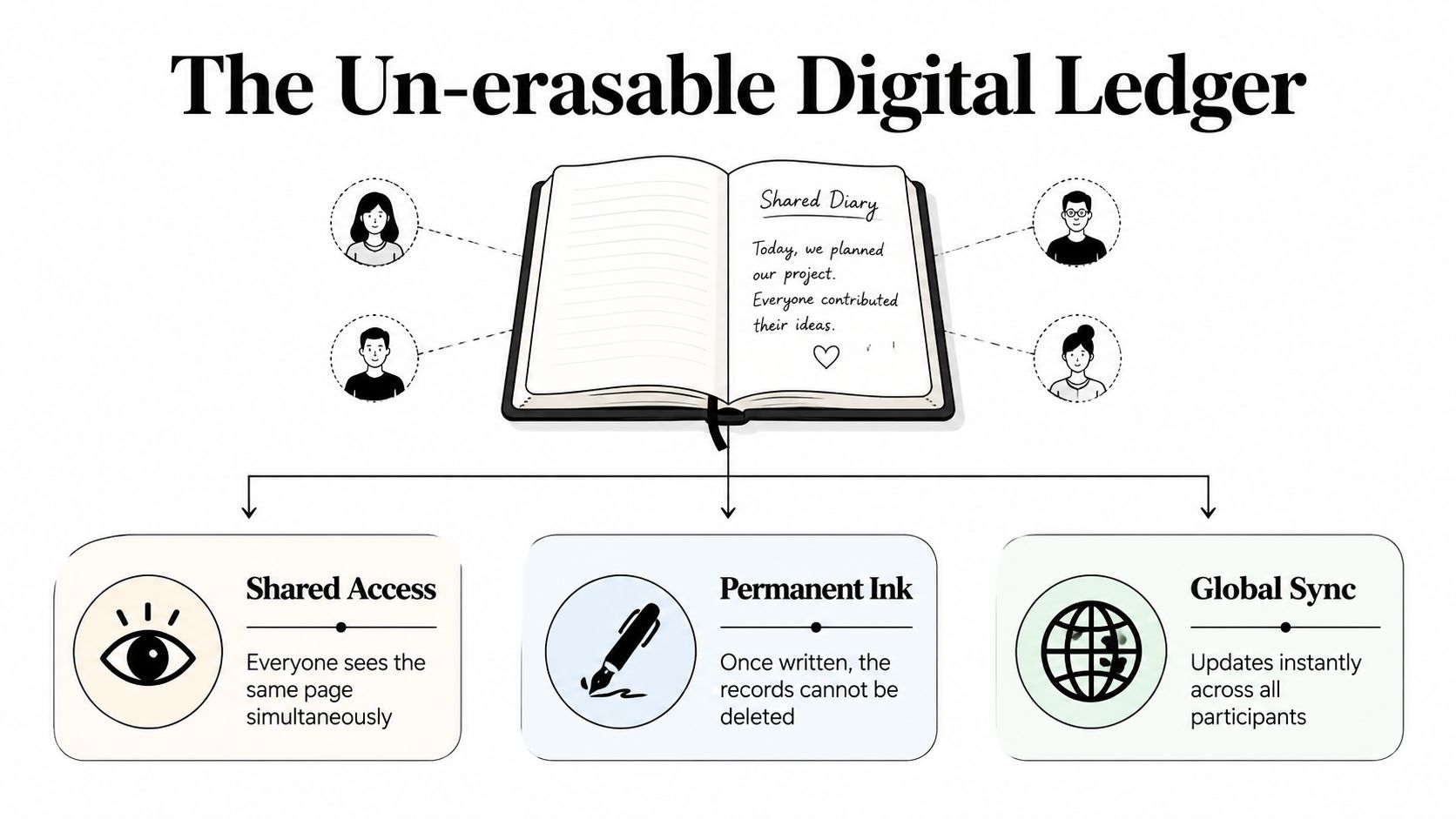
Shared access
If ten people all keep the same notebook, no single person gets to edit the record without notice. Everyone can compare copies.
That's the basic idea behind decentralization. Instead of one company controlling the ledger, many participants store and verify it. That doesn't remove rules. It changes who enforces them.
Permanent ink
Now add one more rule. Once a page is finalized, it can't be erased.
That's immutability. On a blockchain, old records are designed to stay put. If you want to correct something, you don't delete the past entry. You add a new entry that updates the state.
That matters in finance because records need continuity. If a lending protocol says you deposited funds, borrowed against collateral, or earned interest, the system needs a durable history of those actions.
Key takeaway: Blockchain keeps a financial record in a way that many participants can verify and nobody can casually rewrite.
Global sync
The notebook also updates across participants. When valid new information is added, everyone gets the same latest version.
That's what gives blockchain its shared source of truth. Different apps can read from the same ledger and react to the same state. A wallet, a lending market, and an analytics platform can all look at the same on-chain history.
The privacy part people often misunderstand
A lot of newcomers hear "wallet address" and assume blockchain is anonymous. That's not quite right.
The better word is pseudonymous. The record doesn't automatically display your real-world name, but the transactions themselves are visible and auditable. The European Blockchain Observatory notes in its paper on popular misconceptions in the blockchain industry that blockchain is often wrongly treated as completely anonymous, when it actually creates transparent, auditable records.
That transparency is part of what makes DeFi possible. Users can inspect contract activity, track wallet behavior, and review what happened on-chain.
Notebook idea | Blockchain meaning | Why it matters for yield |
|---|---|---|
Shared copies | Decentralization | No single company controls the ledger |
Permanent pages | Immutability | Financial history stays traceable |
Same updated version | Transparency and sync | Apps can coordinate around one record |
If you remember one thing, remember the notebook. It explains why blockchain can support money apps that strangers use together without needing to trust a central operator first.
How Blockchain Actually Works
The notebook analogy helps. But a blockchain isn't just a passive record. It's a live network that accepts new entries, checks them, and runs code.
Nodes keep the record
The people holding copies of the notebook are like nodes. A node is a computer participating in the blockchain network.
Some nodes focus on storing and sharing data. Others help verify new transactions and maintain the chain's rules. The key idea is that the system doesn't depend on one central server.
If you've ever wondered how cryptocurrency fits into this broader picture, this primer on how cryptocurrency works is a useful companion read because it connects the assets people hold with the networks those assets move on.
Consensus decides what gets added
If many people hold the notebook, they need a way to agree on which new page is the legitimate next page. That's where consensus comes in.
Consensus is the rule set the network uses to validate and order transactions. In plain language, it's the method for saying, "Yes, this update is valid. Add it."
You don't need to memorize every consensus model to understand the practical result:
Transactions get checked: the network verifies whether the sender can make the transfer.
Participants agree on order: the system needs one accepted sequence of events.
The record updates consistently: everyone moves forward from the same state.
Without consensus, two versions of history could compete forever.
A blockchain works because many independent computers agree on the same transaction history often enough to keep one ledger alive.
Smart contracts are the real unlock
The biggest leap from "digital ledger" to "DeFi" comes from smart contracts.
A smart contract is code stored on the blockchain that runs when specific conditions are met. Think of it as an automated rulebook.
If the rule says, "When someone deposits USDC, issue them a receipt token," it does that. If the rule says, "When a borrower repays, release their collateral," it does that too.
No clerk needs to approve the action manually. The contract executes the logic.
Why this matters for stablecoin yield
DeFi apps use smart contracts to automate core financial actions:
Lending markets let depositors supply assets and borrowers draw against collateral.
DEX pools let users provide liquidity so others can swap tokens.
Vaults and strategies move funds according to predefined rules.
Those systems only work if the ledger is shared, the network agrees on state changes, and contract logic executes predictably.
For a deeper walkthrough of these mechanics in a more technical-but-readable format, Yield Seeker's article on understanding blockchain technology is a solid next step.
The useful mental model is simple. Nodes keep the record. Consensus updates the record. Smart contracts turn the record into an active financial system.
The Blockchain Ecosystem L1s L2s and Base
Not all blockchains do the same job the same way. A lot of confusion comes from hearing "blockchain" as if it were one network.
It isn't. There are base layers, scaling layers, and app ecosystems built on top of them.

Layer 1 is the main road
A Layer 1, or L1, is the foundational blockchain itself. Ethereum is the example most DeFi users run into first.
L1s tend to prioritize security and decentralization. That's important, but it also means they can get crowded. When a lot of users try to transact at once, fees rise and activity slows down.
A road analogy works well here. An L1 is the main highway. It's reliable and heavily used, but traffic builds fast.
Layer 2 adds faster lanes
A Layer 2, or L2, is built to help scale activity without forcing everything onto the main highway. It handles transactions more efficiently while still relying on the underlying base layer for security guarantees.
That matters because blockchain adoption has grown fast. As of 2025, more than 560 million people globally use blockchain technology, with over 240 million active Web3 wallets, according to Wells Fargo Advisors' blockchain basics overview. More users and more wallets mean more demand for throughput, which is exactly why L2s matter.
Where Base fits
Base is an L2 designed to make blockchain use more practical for everyday applications. For someone moving stablecoins, testing DeFi apps, or automating strategies, the appeal is straightforward. Lower friction makes more frequent interactions viable.
That doesn't mean L1s stop mattering. It means the ecosystem has split roles:
Layer | Everyday analogy | Typical role |
|---|---|---|
L1 | Main highway | Settlement, core security, broad ecosystem |
L2 | Express lane | Faster and cheaper transaction flow |
App layer | Destinations on the map | Lending, swaps, vaults, payments |
Why this matters for yield strategies
If an app needs to rebalance funds, claim rewards, or move capital across opportunities, transaction costs and speed shape the user experience. Expensive, slow interactions can eat into returns or discourage smaller deposits.
That's one reason many modern DeFi users prefer L2s for stablecoin activity. They make blockchain feel less like infrastructure you have to wrestle with and more like software you can use.
For a helpful primer on this scaling sector, Yield Seeker's post on layer 2 scaling solutions breaks down the tradeoffs in plain language.
Base sits in that practical middle ground. It gives users access to blockchain-based financial apps without forcing every action onto the most congested layer.
Blockchain in Action DeFi and Stablecoin Yield
DeFi becomes much easier to grasp when you stop thinking of it as a separate universe. It's just blockchain plus financial rules.
A lending market is software that accepts deposits and manages loans through smart contracts. A decentralized exchange is software that lets users swap assets through on-chain liquidity. A yield strategy is software logic that moves funds where the risk and return profile looks attractive.

What stablecoin yield usually comes from
When you deposit stablecoins into DeFi, the yield generally comes from one or more of these sources:
Borrow demand: borrowers pay to access liquidity.
Trading activity: liquidity providers may earn fees when swaps happen.
Protocol incentives: some apps distribute token rewards to attract capital.
The reason people use stablecoins for this is simple. They want on-chain opportunity without taking full exposure to the price swings of assets like ETH or BTC.
Why manual yield hunting gets messy fast
The moment you try to do this yourself, the complexity jumps.
You need to compare protocols, watch changing yields, understand liquidity conditions, and keep an eye on risk. A strategy that looked attractive yesterday may look less attractive after incentives shift or market conditions change.
That challenge is where blockchain analytics becomes a real product layer instead of a buzzword. According to CelerData's guide to blockchain data analysis, advanced blockchain data platforms process petabytes of data across 30+ networks and can compute time-weighted APR and protocol TVL in near-real-time. The same piece describes infrastructure capable of reacting to yield opportunities within seconds.
For a normal user, that's not a workflow. That's an operations stack.
What automation changes
Tools can sit between the raw blockchain and the person holding stablecoins. Instead of asking a user to monitor every protocol manually, software can evaluate opportunities and move faster than a human dashboard routine ever will.
One example is Yield Seeker's stablecoin yield farming guide, which explains how automated systems approach on-chain yield from a user perspective rather than a protocol engineer's perspective.
A short visual walkthrough helps if this is your first time seeing the DeFi yield idea in action:
Practical rule: In DeFi, yield isn't just about finding a high number. It's about understanding where the return comes from, how fast conditions can change, and what risks sit underneath it.
That is the fundamental connection between blockchain and earning on stablecoins. Blockchain supplies the ledger, the contracts, and the composable apps. DeFi turns those ingredients into usable financial products.
How to Interact with Blockchains Safely
Most beginner mistakes in blockchain don't come from misunderstanding theory. They come from clicking through wallet prompts too quickly.
Safety starts with knowing what you're approving, where your funds live, and what a transaction does.

Your wallet is your control panel
A crypto wallet is less like a bank account and more like a keyring plus dashboard. It lets you sign transactions, hold assets, and connect to blockchain apps.
That also means a wallet puts responsibility on you. If you approve the wrong contract, sign a malicious transaction, or lose access to your recovery information, there usually isn't a customer support department that can reverse it.
A few basics make a big difference:
Protect recovery details: keep them offline and private.
Use separate wallets when useful: many people keep one wallet for everyday app use and another for larger balances.
Read prompts carefully: permissions matter as much as transfers.
Gas fees and permissions
A gas fee is the network cost for processing an action. This expense serves as a road toll. You're paying to use the network's resources.
A permission, often called an approval, is different. That's when you let a smart contract access a token in your wallet up to a certain limit. New users often confuse the two.
Here's the important split:
Action | What it means | Risk level |
|---|---|---|
Paying gas | You pay the network to process a transaction | Usually routine |
Approving a contract | You authorize a contract to move a token | Requires close attention |
Sending funds | You transfer assets directly | Final if confirmed |
Red flags worth respecting
Some habits sound boring until they save you from a bad interaction.
Check the app URL carefully: copycat sites are common.
Question urgency: if a site pushes you to act immediately, slow down.
Review token approvals: broad or unlimited access deserves extra scrutiny.
Prefer known tools and clear documentation: confusion is often where losses begin.
If you don't understand what a wallet prompt is asking for, don't approve it yet.
Where risk monitoring enters the picture
Even if you use trusted apps, protocol conditions can change after you've deposited funds. That risk isn't always visible from a polished front end.
Research discussed in the arXiv paper on machine learning for blockchain risk detection describes how AI agents can model transaction flows and identify anomalies that signal protocol risk. In practice, that means systems can watch for patterns tied to distress and respond by rebalancing away from weaker conditions.
For regular users, that doesn't replace basic hygiene. It complements it. Good blockchain safety is layered. You make careful approvals, use sensible wallet practices, and lean on tools that monitor protocol-level risk better than a human can by hand.
Putting It All Together with Yield Seeker
By this point, blockchain should feel less mysterious and more mechanical. It's a shared ledger, maintained by a network, updated through consensus, and activated by smart contracts. DeFi sits on top of that stack and turns it into lending markets, exchanges, and yield strategies.
For a stablecoin holder, the opportunity is clear. Blockchain makes it possible to put idle digital dollars to work. The friction is clear too. Chains differ, apps differ, yields move, and risk changes faster than typical users want to track manually.
That's where a tool can make sense. Yield Seeker is an AI-powered platform that lets users deposit USDC on Base and have an agent monitor and allocate capital across DeFi protocols in real time. In practical terms, that means the user doesn't need to manually hunt through dashboards, compare every opportunity by hand, or constantly rebalance.
That isn't the same as removing risk. Blockchain-based finance still requires care, and no interface changes the underlying reality that on-chain strategies depend on smart contracts and market conditions. What a platform can do is reduce research overhead, make activity easier to follow, and bring more structure to the decision process.
The useful takeaway is simple. You don't need to master every layer of blockchain to use it well. You need enough understanding to know what the system is doing, what risks exist, and why an automated, risk-aware approach can be more practical than trying to run a personal hedge fund from your wallet.
If you're ready to put stablecoins to work without manually chasing protocols, Yield Seeker offers a straightforward way to explore automated, risk-aware on-chain yield with USDC on Base.