

You hold USDC, maybe a treasury balance, maybe personal savings you moved out of market volatility. You like the idea of earning yield, but every time you open crypto Twitter or a DeFi dashboard, it feels like walking into a machine room with no labels.
That confusion makes sense. Ethereum gets discussed like a speculative asset, a political battleground, or a giant technical puzzle. But if you hold stablecoins, the more useful way to think about ethereum is much simpler. It's the financial infrastructure that makes onchain yield possible.
If a bank account pays interest because a bank lends your deposits, DeFi works because smart contracts let lending, trading, and settlement happen directly on a public network. That's the practical lens that matters. Not “Will ETH go up?” but “How does this system create real opportunities for my dollars onchain?”
Your Guide to Ethereum and Stablecoin Yield
A common starting point looks like this. You've moved funds into USDC because you want stability, but now the money is sitting still. It's safer than chasing volatile tokens, yet it also isn't doing much for you.
That's where ethereum becomes useful.
Ethereum is a blockchain, but for stablecoin holders it helps to think of it as a shared financial base layer. Developers build lending markets, decentralized exchanges, vaults, and payment rails on top of it. Instead of one company running the system, code and a distributed network handle the rules.
Why stablecoin holders care
If you deposit USDC into a DeFi lending protocol, borrowers can pay to access that liquidity. If you provide stablecoins to a decentralized exchange, traders pay fees to use that liquidity. Ethereum is the settlement layer that makes those actions possible without a traditional intermediary holding custody the whole time.
That changes the question from “Should I learn ethereum?” to “Do I want access to an open market for my stablecoins?”
Most people don't need to become protocol engineers. They need to understand enough of ethereum to tell where yield comes from, what risks they're taking, and which parts can be automated.
The practical promise
For a stablecoin user, ethereum matters in three ways:
It hosts the apps where yield is generated, including lending protocols and exchanges.
It enforces the rules through smart contracts instead of manual approval queues.
It supports lower-cost environments through Layer-2 networks, where smaller deposits and more frequent reallocations start to make sense.
If you've ever looked at Aave, Uniswap, Curve, Base, or Arbitrum and thought, “I know this matters, but I don't know how it all fits together,” you're in the right place. The system gets much easier once you connect the tech to the money flow.
Understanding Ethereum's Core DeFi Engine
A stablecoin deposit on Ethereum works more like using a set of open financial rails than sending money into a bank app. You connect a wallet, approve a transaction, and code handles the rules for lending, swapping, or distributing fees.
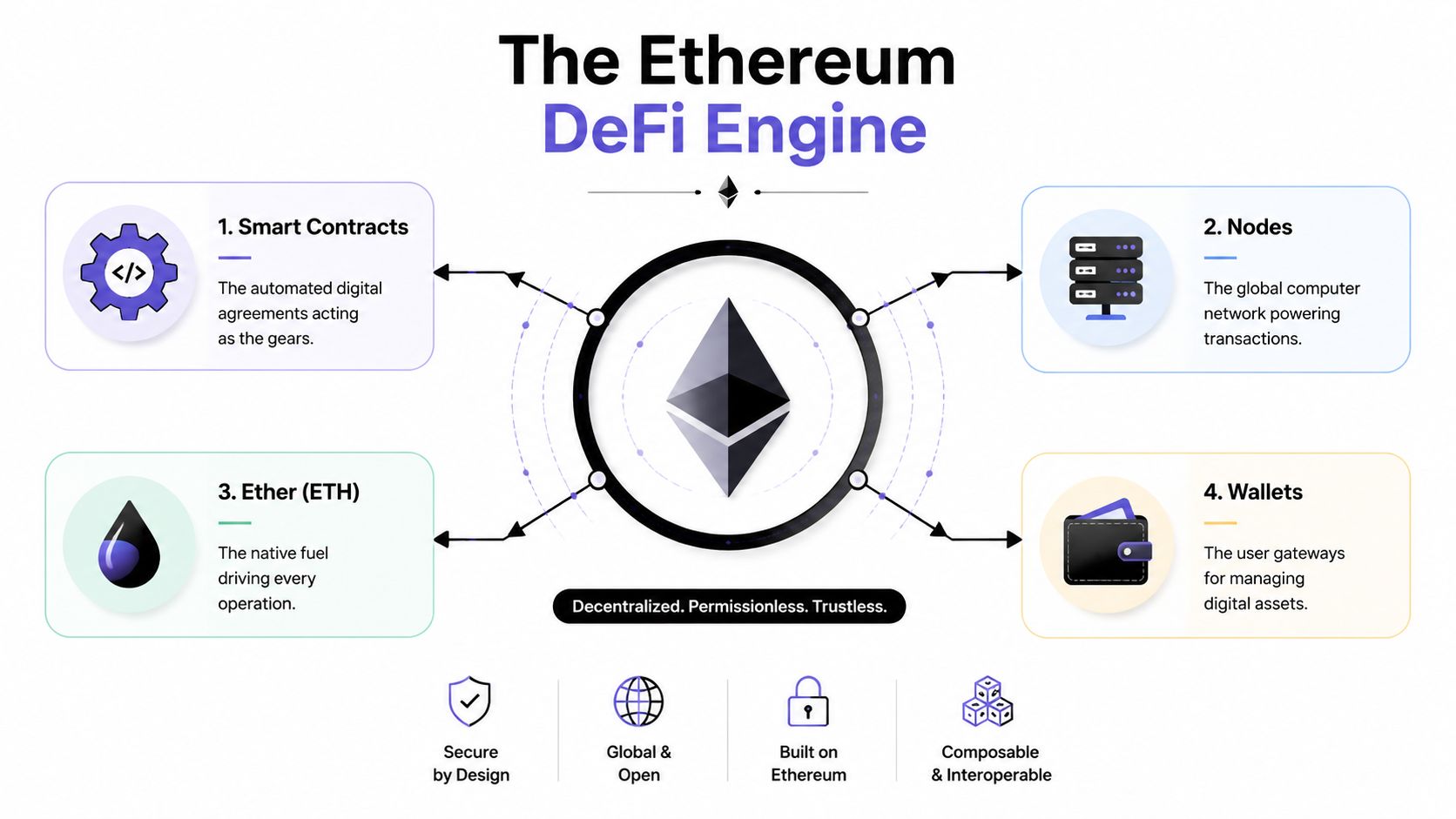
Smart contracts do the work
The core piece is the smart contract. A smart contract works like a vending machine. If you insert the right input, the machine follows preset rules and gives the matching output. No employee reviews your request. No operations team updates your balance by hand.
In DeFi, those rules can power actions like:
deposit USDC and receive a token that represents your claim
lend assets into a market where borrowers pay to use them
swap stablecoins or other tokens against pooled liquidity
post collateral and borrow another asset
send trading fees or incentives to liquidity providers
That matters for yield because the return does not appear by magic. It comes from specific onchain activity. Borrowers pay interest. Traders pay swap fees. Vaults reallocate capital according to coded rules. If you use an app on Base, Arbitrum, or mainnet, the same basic engine is doing the accounting.
Ethereum, ETH, tokens, and wallets
These terms get mixed together, which makes DeFi feel harder than it is.
Term | What it means | Why you care |
|---|---|---|
Ethereum | The network and execution environment | It runs the apps and settles the transactions behind DeFi |
ETH | The native asset of Ethereum | You use it to pay transaction fees on Ethereum mainnet |
ERC-20 tokens | A common token standard on Ethereum-compatible chains | Many stablecoins and DeFi tokens use this format |
Wallet | Your onchain control panel | It signs actions like deposits, withdrawals, approvals, and swaps |
If you already hold USDC on an Ethereum-compatible chain, you are close to the action. The missing piece is usually understanding what the app is doing with your funds after you click deposit.
The network keeps everyone on the same ledger
Ethereum runs across many independent computers that verify transactions and keep the system synchronized. For a stablecoin holder, the practical point is simple. Your deposit record is not sitting in one company database that can be edited behind closed doors.
That shared ledger is what lets an Aave market track lenders and borrowers, or lets a DEX pool track who owns what share of liquidity. Once a transaction is confirmed, every participant reads from the same history.
The result is a financial engine with transparent rules.
Why this matters for earning yield
Suppose you deposit USDC into Aave on Base. The protocol records your deposit, updates your claim, and starts reflecting lending income according to the market's usage. If you provide stablecoins to a DEX pool, the contract tracks your share and routes a portion of trading fees back to liquidity providers.
That is the connection many intros miss. Ethereum is not interesting only because it is programmable. It matters because programmability creates yield markets that can run continuously, with transparent rules, and without a bank deciding who gets access.
For stablecoin users, that changes how you evaluate opportunity. You are not just chasing the highest displayed APY. You are asking what activity produces the return, what chain the strategy runs on, and whether transaction costs leave enough net yield to matter. A gas-efficient allocation approach for stablecoin yield matters because the engine can create returns, but costs and execution still decide what you keep.
Decoding Gas Fees and Network Costs
Gas fees confuse almost everyone at first because the name sounds technical. In practice, gas is just the cost of using blockspace on ethereum. If smart contracts are the machines, gas is what you pay to run them.
A good analogy is a toll road. Every transaction enters the highway and pays a toll based on how much road space it uses and how crowded traffic is at that moment.

Why gas exists
When you swap tokens, lend USDC, claim rewards, or rebalance across protocols, validators and the network process that computation. Gas compensates for that work and helps prevent spam.
The important part for a stablecoin holder is economic, not technical. If a transaction costs too much, a perfectly good yield strategy can become pointless on a smaller balance.
The small-account problem
Suppose you want to move funds from one protocol to another because rates changed. If the move takes several transactions, your net return can shrink fast. That's why many beginners say DeFi “works for whales” but feels awkward for everyone else.
This is also why smart yield allocation needs cost discipline. Frequent movement sounds efficient, but if every rebalance burns value, the strategy can become self-defeating. A more detailed discussion of that tradeoff is in this guide to gas-efficient allocation strategies.
Fees got better, but cost still shapes strategy
Ethereum became more cost-effective in 2025. Average Ethereum transaction fees dropped 84% year-over-year, while daily transactions surged past 1.7 million in August 2025, according to SQ Magazine's Ethereum statistics roundup.
That's encouraging because it shows two things at once. Ethereum handled more activity, and users paid less on average. But it doesn't mean every action on the main chain is cheap enough for every account size or every yield workflow.
If your strategy depends on many small moves, costs matter as much as headline APY.
What readers usually miss
Gas isn't just an annoyance. It's one of the reasons the ecosystem evolved toward Layer-2 networks. Once you understand that, the next step in ethereum's story becomes obvious. People wanted the same DeFi tools with lower tolls.
Layer-2s The Express Lanes for DeFi on Base
You hold a few thousand USDC, spot a better lending rate, and want to move fast. On Ethereum mainnet, a strategy like that can still feel heavier than it should. On a Layer-2 such as Base, the same workflow is often cheap enough to make sense.
That difference is why L2s matter for yield.

Ethereum is still the settlement layer. Layer-2s are execution layers built on top of it. They process transactions in a lower-cost environment, then send the results back to Ethereum for final security. A useful comparison is a local tab at a cafe that gets settled later on the main register. You do not run every small action through the most expensive system in real time.
For stablecoin users, that changes the math in practical ways. Many yield strategies involve routine actions. Deposit USDC. Swap into a different pool. Adjust collateral. Exit one vault and enter another. None of those steps are complicated on their own, but repeated costs can erode returns. Lower-cost execution helps preserve more of the yield a strategy is trying to earn.
What Layer-2s actually change for stablecoin strategies
Networks such as Base, Arbitrum, and Optimism let DeFi apps serve smaller accounts and more active strategies because transaction overhead is lower. The benefit is not abstract. It shows up in the kinds of decisions you can justify making.
Smaller positions become more usable because fees take a smaller bite out of returns.
Rebalancing can happen more often when moving capital does not cancel out the rate improvement.
Multi-step strategies become realistic across lending markets, DEX pools, and automated vaults.
That last point matters if you use tools that monitor opportunities across protocols. Automation only helps if the underlying network is cheap enough to support frequent adjustments. L2s create the operating environment that makes that possible.
Why Base stands out for stablecoin users
Base has become a practical home for USDC-based DeFi because it combines Ethereum compatibility with lower transaction costs and a growing app ecosystem. If you already understand the basics of wallets, swaps, and deposits, Base usually feels familiar. The difference is that routine actions are easier to justify.
That matters for the kind of yield strategies stablecoin holders use. A simple lending position on Aave is one example. A USDC liquidity position on a DEX is another. A vault that shifts capital between opportunities is a third. On expensive rails, each adjustment needs to clear a higher cost hurdle. On Base, the hurdle is lower, so more strategies remain net positive after fees.
If you want a broader explanation of how these networks work, this overview of Layer-2 scaling solutions is a useful companion.
A short explainer helps if the batching idea still feels abstract.
Pectra made the express lanes better
Ethereum's Pectra upgrade was activated on May 7, 2026, and it improved Layer-2 data throughput and account abstraction for DeFi workflows. According to Amberdata's discussion of Ethereum upgrades and market structure, the added throughput can let rollups batch more transactions and reduce per-transaction gas costs on L2s by up to 50% depending on congestion.
For a stablecoin holder, the takeaway is straightforward. Better batching means lower cost per action. Lower cost per action means more of your gross APY survives the actual work of managing the position.
Here is the practical effect:
Activity | Mainnet effect | L2 effect |
|---|---|---|
Moving a small USDC position | Can still feel expensive | More practical |
Rebalancing often | Costs can stack up fast | Easier to justify |
Splitting funds across protocols | More operational drag | More manageable |
Lower transaction friction does not create yield on its own. It gives yield strategies room to work.
How DeFi Protocols Generate Real Yield
You bridge USDC to Base, open a yield app, and see three very different APYs. One comes from lending, one from a pool on a DEX, and one is mostly token incentives. They are all labeled "yield," but they are not the same product.
That distinction matters more than the headline number.
Stablecoin yield in DeFi comes from specific economic activity. Usually, someone is paying for liquidity, for borrowing access, or for faster trading. If you can trace that cash flow, the opportunity gets easier to judge. If you cannot, the APY is harder to trust.
Lending markets pay suppliers from borrower demand
Protocols like Aave and Compound work like onchain money markets. You deposit USDC into a shared pool. Borrowers post collateral, borrow from that pool, and pay interest for the privilege.
Your return comes from that interest.
The mechanics are technical, but the business model is familiar. Capital sits in a pool. Borrowers use it. Lenders earn a share of what borrowers pay. Smart contracts handle the bookkeeping, collateral checks, and liquidations, so there is no bank officer in the middle deciding who gets approved.
For a stablecoin holder, the practical flow looks like this:
You deposit USDC into a lending protocol.
The protocol makes that liquidity available to approved borrowers who have posted collateral.
Borrowers pay variable interest, and suppliers receive part of it.
This is usually the cleanest starting point for someone who already thinks in cash yields and stable balances. You are not trying to predict whether ETH goes up next week. You are getting paid because other users want dollar liquidity now.
Liquidity pools pay providers from trading fees
A second yield source comes from liquidity pools on exchanges like Uniswap and Curve. A pool works like an always-open exchange counter. Traders arrive and swap one asset for another against the pool, and the protocol charges a fee on each trade.
Liquidity providers earn a share of those fees.
That creates a different type of return than lending. In a lending market, your income depends mostly on borrowing demand. In a liquidity pool, your income depends mostly on trading volume and the fee structure of that pool.
Source of yield | Who pays | Common use case |
|---|---|---|
Lending interest | Borrowers | Depositing stablecoins in money markets |
Trading fees | Traders using the pool | Supplying liquidity to swap pairs |
Stablecoin holders often start with stablecoin-heavy pools because the price behavior is easier to follow than a volatile pair like ETH-USDC. You still need to understand pool design, but the source of revenue is at least visible. Traders are paying for execution.
A simple filter helps here. Ask, "Who is on the other side funding this yield?" If the answer is clear, you can keep evaluating. If the answer turns into vague talk about emissions and future growth, slow down.
Incentives can boost yield, but they are not the same as core yield
Many new users often find this aspect confusing. A protocol may show a high APY that combines real revenue with token rewards. Those rewards can be useful, but they are not the same as borrower interest or trading fees.
If a pool pays 3% from actual fees and another 7% in incentive tokens, only part of that return is tied to present economic activity. The rest depends on the value of the token reward holding up.
That does not make incentives bad. It changes how you should read the number. Real yield tends to be more durable because someone is paying for a service right now. Incentive yield can shrink fast if rewards are reduced or if too much capital piles in.
Why this matters more on Base and other L2s
Lower-cost chains did not invent yield. They made more of it worth keeping.
On Ethereum mainnet, frequent deposits, withdrawals, claim transactions, and rebalances can eat into returns, especially on smaller stablecoin positions. On Base and other L2s, those same actions are cheaper, which means simpler strategies can stay practical. As noted earlier, post-Dencun activity shifted more routine DeFi usage toward L2s because the cost structure became friendlier.
That is the link between Ethereum's core technology and stablecoin yield. Smart contracts make the markets possible. L2s make many of the strategies economical for ordinary position sizes. And tools like Yield Seeker can automate the scanning and routing work so users do not have to manually compare every pool and lending market by hand.
A grounded way to compare opportunities
Before depositing, ask four plain-language questions:
Who is paying the yield?
Borrowers, traders, token incentives, or a mix?What makes the rate move?
Lending APYs change with utilization. Pool fees change with trading volume. Incentives can expire.How much maintenance does this strategy need?
A decent gross APY can turn mediocre if it requires constant repositioning.What is the simplest version of this trade?
If two options offer similar return, the one with fewer moving parts is often easier to stick with.
Experienced DeFi users usually end up preferring understandable cash flows over flashy dashboards. That habit matters even more for stablecoin holders. The goal is rarely to find the most exciting number. It is to find yield that still makes sense after fees, after incentives fade, and after you explain it to yourself in one clear sentence.
Navigating Key Risks in the DeFi Ecosystem
You bridge USDC to Base, open a lending app, and see a yield number that looks far better than your exchange account. The screen feels simple. The risk usually is not.
That gap matters because stablecoin yield on Ethereum and its L2s comes from smart contracts, market incentives, and the asset you deposited. If you want to earn without turning your balance into a full-time research project, it helps to sort the risks into separate buckets and ask what can go wrong.
Smart contract risk
Smart contract risk is code risk. If the contract has a bug, weak upgrade controls, or a bad interaction with another contract, deposits can be frozen, drained, or mispriced.
A useful comparison is online banking versus a vending machine. Your bank has people who can reverse errors and pause systems. A smart contract behaves more like a machine that follows its rules exactly, even when those rules contain a flaw. The app design may look polished, but the real question is whether the contract underneath has held up under pressure.
Practical habits help:
Use established protocols first, especially for core stablecoin positions
Read the audit page, but treat audits as one input, not a guarantee
Prefer simpler strategies over multi-step loops with extra points of failure
Check admin controls so you know who can upgrade or pause the system
Protocol risk
Code can work exactly as written and a protocol can still break economically.
This is the difference between software risk and business-model risk. A lending market on Base might show an attractive USDC rate because borrowing demand is high today. If that demand drops, your yield drops with it. A pool may pay well during heavy trading, then cool off when volume leaves. Incentive tokens can make a strategy look healthy right up until the subsidy ends.
That is why experienced stablecoin users keep asking a plain question: who is paying me, and why does that payment continue next week?
On L2s, this shows up in familiar places. Aave-style lending markets depend on borrower demand and collateral quality. AMMs depend on trading activity and pool balance. Vaults and automated allocators add another layer because their logic depends on the protocols beneath them. More moving parts can improve returns, but each extra dependency adds another place where assumptions can fail.
Stablecoin risk
Stablecoins reduce one kind of volatility. They do not remove risk.
USDC, DAI, USDe, and other dollar-denominated assets each rely on different structures. Some depend on cash and short-duration treasuries held by an issuer. Others depend more heavily on crypto collateral, hedging, or protocol design. If the stablecoin wobbles, your strategy can suffer even when the app itself keeps running normally.
For stablecoin yield, asset selection is part of risk management. Chasing an extra bit of APY can make little sense if the underlying dollar asset is the weakest part of the trade.
DeFi security is a stack. Chain security matters, but so do contract quality, protocol design, and the stablecoin itself.
What Ethereum secures, and what it does not
Ethereum gives DeFi a strong settlement layer, and L2s like Base inherit part of their security from that foundation. For users, the practical takeaway is simple. You can get lower transaction costs on L2s without giving up the value of settling in Ethereum's broader security model.
But Ethereum only secures settlement. It does not certify that a lending market is well designed, that a vault manager made good decisions, or that a stablecoin will always hold its peg. The chain can process and finalize a transaction correctly even if the position itself was a poor risk.
That distinction is easy to miss. People often treat "built on Ethereum" as if it means "safe." It means the infrastructure is widely trusted. It does not mean every app on top deserves the same trust.
A practical risk filter for stablecoin holders
If your goal is earning yield on idle dollars, a short filter works better than reading every whitepaper:
Risk type | What can go wrong | What to check first |
|---|---|---|
Smart contract risk | Bug, exploit, bad upgrade process | Protocol age, audits, admin controls |
Protocol risk | Yield disappears or mechanics fail under stress | Source of yield, collateral rules, liquidity depth |
Stablecoin risk | Depeg, redemption stress, issuer or design problems | How the asset stays at $1 and what backs it |
Operational risk | Wrong network, wrong pool, wallet mistakes | Deposit flow, chain selection, withdrawal path |
Operational risk deserves more respect than it gets. A lot of losses are not dramatic exploits. They come from bridging to the wrong network, approving the wrong contract, parking funds in a thin market, or forgetting that a high APY requires active monitoring.
That monitoring problem is one reason automated tooling keeps gaining traction. Good systems do not remove risk, but they can reduce the amount of manual checking needed across markets and vaults. If you want a clearer sense of how automation fits into DeFi workflows, this guide to AI agents in crypto is a useful follow-up. The broader staffing lesson applies outside crypto too, which is why the AI hiring playbook for non-tech sectors is a helpful parallel for understanding how specialized monitoring gets built in practice.
Automating Your Yield Strategy with AI
The Ethereum stack starts to feel practical instead of overwhelming at this stage. Once you understand that yield lives across multiple protocols and often on multiple Layer-2s, the obvious next question is who does the monitoring.
For many users, the honest answer is nobody. They set a position once, forget about it, and hope the rate stays attractive and the protocol stays healthy.
What AI changes in practice
AI doesn't create yield from nowhere. What it can do is reduce the manual work around finding, comparing, and reallocating among opportunities.
That matters because the DeFi workload is repetitive:
checking rates across protocols
watching whether a lending market still fits your risk tolerance
deciding whether moving funds is worth the cost
keeping cash accessible instead of locking it into awkward workflows
While market commentators continue debating ETH price direction, stablecoin yields on L2s like Base can remain insulated from that volatility, and AI-driven systems can reallocate USDC across lower-risk lending venues in real time for a more hands-off experience, as described in this discussion of stablecoin treasury management during Ethereum volatility.

Why this looks familiar outside crypto
If you work in finance, retail, or healthcare, this pattern should feel recognizable. Teams use AI first to handle monitoring, routing, and recommendation tasks before they let it touch more sensitive operations. That same operating model shows up in DeFi. If you want a grounded comparison from outside crypto, DataTeams has a useful AI hiring playbook for non-tech sectors that explains how organizations adopt AI around decision support and workflow reduction rather than blind automation.
The same principle applies onchain. Good automation narrows the surface area for human error, but it still needs guardrails.
A realistic setup for stablecoin holders
An AI layer is most useful when it does a few things well:
Scans opportunities continuously instead of relying on occasional manual checks.
Applies risk filters so the highest displayed yield isn't automatically the chosen one.
Moves capital selectively only when the benefit outweighs the operational cost.
Keeps funds accessible so users aren't trapped in long lockups.
One example is Yield Seeker, which operates on Base and uses AI agents to monitor and allocate stablecoin capital across DeFi protocols. If you want the product mechanics behind that model, this explainer on AI agents in crypto workflows shows how automated decision layers fit on top of onchain infrastructure.
The bigger point is broader than any one tool. Ethereum provides the settlement layer. Layer-2s make transactions cheap enough to use. DeFi protocols create the underlying cash flows. AI becomes the coordination layer that helps stablecoin holders use the system without living inside dashboards all day.
If you want a simpler way to put these ideas into practice, Yield Seeker offers an AI-powered workflow for earning yield on stablecoins on Base. You can deposit USDC, keep funds accessible, and let an AI agent handle ongoing monitoring and allocation across DeFi protocols without manually checking every market yourself.