
You're probably in a familiar spot. You've got stablecoins sitting on one chain, you've found a better opportunity on another, and the only thing between you and that yield is the move itself. That's where users either click through too fast or get stuck overthinking the bridge.
A blockchain bridge looks like plumbing, but in practice it's part of portfolio construction. If your USDC is on Ethereum and the strategy you want lives on Base, your first real decision isn't the vault or lending market. It's how you get there, what asset you arrive with, and what risks you accept on the way.
That matters more than people admit. The bridge you use changes your settlement path, the trust model around your funds, and sometimes the exact token you receive on the destination chain. Those details affect what you can do next.
Your Gateway to High-Yield DeFi on New Chains
A lot of stablecoin holders see the same setup every week. Funds are parked somewhere familiar, usually because that's where they started, but the more attractive DeFi activity has shifted to another chain. Base is a common example. Good apps, active users, cheaper execution, and a simpler day-to-day experience than constantly operating on a more expensive chain.
The problem is simple. Your capital is on the wrong island.
A bridge is the transport layer that gets you from one onchain economy to another. But that undersells it. In practice, bridging is the first move in your yield strategy because it decides whether you arrive with a broadly usable asset, how much operational risk you take, and how much friction you'll deal with before you even deposit anywhere.
Practical rule: Treat the bridge selection the way you'd treat protocol selection. It's not a setup step. It's part of the strategy.
That's also why founders and treasury operators pay attention to cross-chain operations early. If you work with startup teams exploring regional ecosystems, this roundup of resources for Web3 founders in UAE is useful context for how teams think about infrastructure, distribution, and chain choice in practice.
Base has become relevant enough that it's worth understanding the environment before moving funds. This overview of the Base chain ecosystem is a good starting point if you want the operational picture rather than a marketing summary.
The good news is that bridging isn't hard once you understand the moving parts. What matters is knowing what the bridge is doing, which designs deserve more trust than others, and how to move stablecoins without creating avoidable risk for the yield strategy that comes after.
What Is a Blockchain Bridge and Why Do You Need One
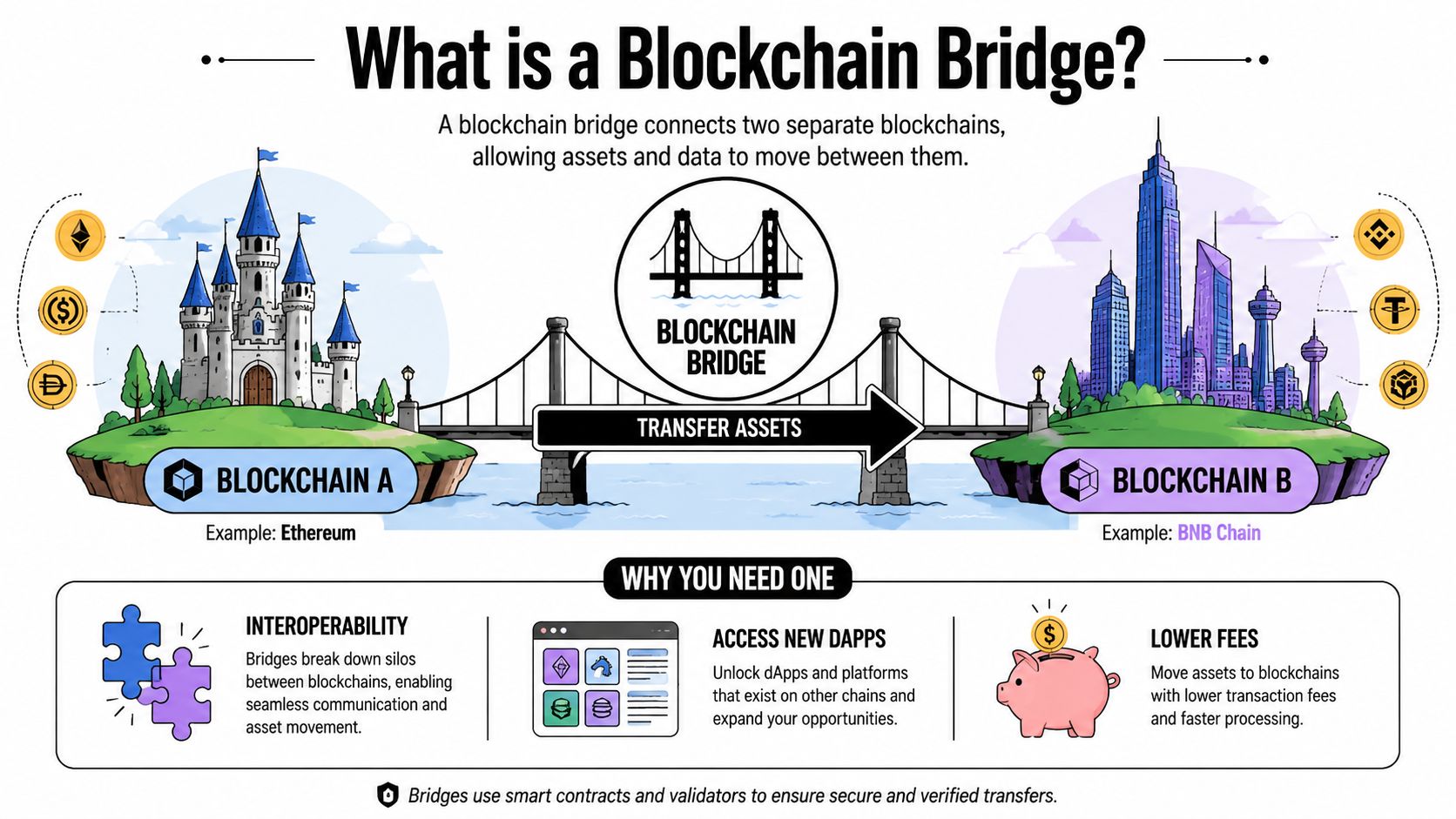
Blockchains don't share a single native ledger. Ethereum, Base, Arbitrum, and other networks each maintain their own state. If you hold an asset on one chain, another chain doesn't automatically know that balance exists.
That's why a bridge exists.
A good mental model is an airport currency desk. You don't walk into a new country and spend the cash from your home bank account directly in every local system. You use an intermediary process that recognizes what you own, then gives you something usable in the destination environment. A blockchain bridge does the same kind of coordination for assets and sometimes messages between separate networks.
The basic mechanism
Most users only need one conceptual model to avoid confusion:
You send assets on the source chain.
The bridge contract or bridge operator receives your tokens on the chain where they currently live.Those assets are locked, escrowed, or matched.
Depending on the bridge design, the asset is held in custody, locked in a contract, or offset against liquidity already available on the destination chain.You receive a corresponding asset on the destination chain.
That asset may be native, canonical, or a wrapped representation. This distinction becomes important later because it affects what protocols will accept it.
The key point is that a bridge is not a normal wallet-to-wallet transfer. You're not moving one token object through space. You're using a system that proves or assumes an asset position on one chain, then gives you usable value on another.
Why bridges matter in day-to-day DeFi
Without a bridge, your strategy set is smaller than it looks. You can hold the asset, swap within the same chain, or withdraw somewhere else. You can't directly access opportunities that live on a different execution environment.
That has practical consequences:
Access to apps: Some lending markets, vaults, perp venues, and stablecoin strategies are chain-specific.
Execution quality: Some chains are easier to use for frequent transactions because costs are lower and confirmations feel smoother.
Treasury mobility: Teams often need to rebalance stablecoins across ecosystems without fully off-ramping.
A bridge doesn't create yield by itself. It creates access. Access is what lets the rest of the strategy happen.
Once you see it that way, bridge choice stops being a technical nuisance and starts looking like an asset-routing decision.
Understanding Bridge Architectures
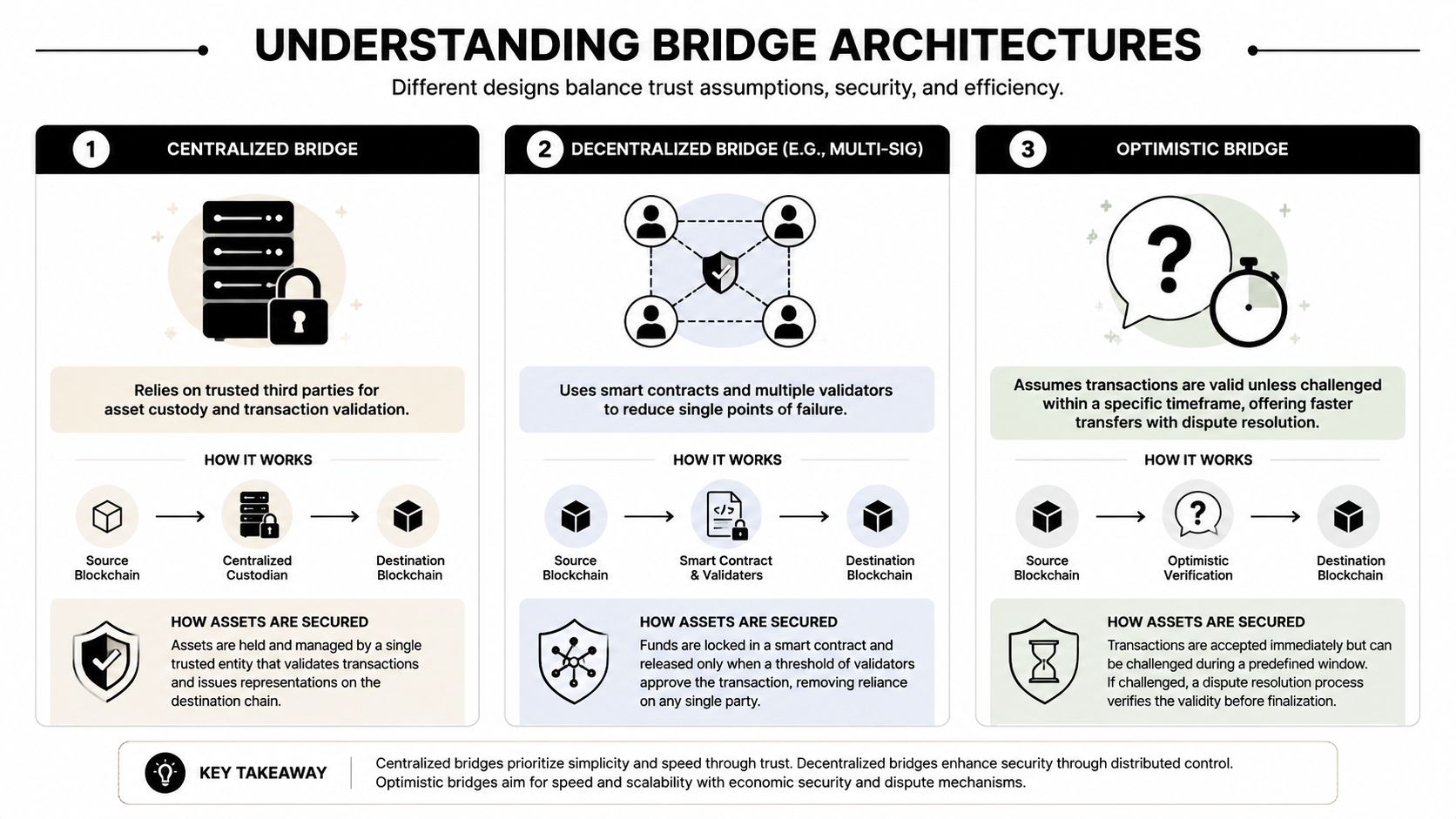
Not all bridges solve the same problem in the same way. Some optimize for speed. Some optimize for tighter trust assumptions. Some are really liquidity routers with a bridge interface on top. If you don't know the architecture, you can't judge the risk.
Custodial and non-custodial
The first question is simple. Who controls the funds during the transfer process?
A custodial bridge relies on a company, operator set, or tightly controlled validator group. You trust that group to secure funds, process transfers reliably, and stay operational. This model can feel smooth for users because the workflow is often cleaner and support is easier to understand.
A non-custodial bridge pushes more of the logic into smart contracts and protocol rules. In theory, that reduces dependence on one operator. In practice, it shifts your trust to code quality, validator design, message verification, and upgrade governance.
A quick comparison helps:
Architecture | What you trust most | What usually works well | What can go wrong |
|---|---|---|---|
Custodial | Operator or company | Simpler UX, faster support | Key compromise, censorship, operator failure |
Non-custodial | Smart contracts and protocol design | Reduced reliance on one actor | Contract exploits, weak validator design, bad upgrades |
Neither category is automatically safe. “Decentralized” doesn't mean harmless, and “official” doesn't always mean impossible to break. You still need to understand where the system can fail.
Optimistic and instant settlement
The second trade-off is speed versus verification style.
An instant bridge usually depends on liquidity already present on the destination chain or on a trusted validation path that lets the system release funds quickly. That's convenient when you need to move capital and deploy it right away.
An optimistic bridge assumes transfers are valid unless someone challenges them during a dispute window. This design can be elegant, but it often means a slower final path for some transfers. The upside is that the system doesn't require every message to be fully proven in the most expensive way up front.
Fast is good when you're rotating capital. Fast is not the same as low risk.
If your strategy depends on immediate settlement, instant routes can make sense. If you're moving larger balances and care more about minimizing trust in a relayer set, you may accept more waiting.
Liquidity-pool and rollup-native paths
This is the distinction many users miss, and it's one of the most important for yield.
A liquidity-pool bridge pays you out from liquidity that already exists on the destination chain. That's efficient, but it means your transfer depends on pool depth, routing design, and asset availability. When liquidity gets thin, transfers become less attractive or less reliable.
A rollup-native path is tied more directly to the destination chain's canonical system. That often produces the cleanest asset form on arrival, especially for users moving into a major Layer 2 environment.
Here's the practical difference:
Liquidity pool route: better when you value convenience and broad routing options.
Rollup-native route: better when you care most about ending up with the canonical asset many major apps prefer.
Hybrid aggregators: useful discovery tools, but you still need to inspect what route they choose.
A note on real engineering trade-offs
Bridge design reminds me of physical bridge engineering in one useful way. Once geometry gets more complex, behavior changes in ways people underestimate. Research on skew bridges shows effects become more significant above about 30°, with torsional rotations, shears, and moments rising, while maximum deflection shifts toward the obtuse corner according to this study on skew angle effects in bridge behavior. Cross-chain systems have a similar lesson. Small architectural differences can create very different stress points.
That's why broad labels aren't enough. You need to know the path your assets will take.
Common Bridge Risks and Mitigation Strategies
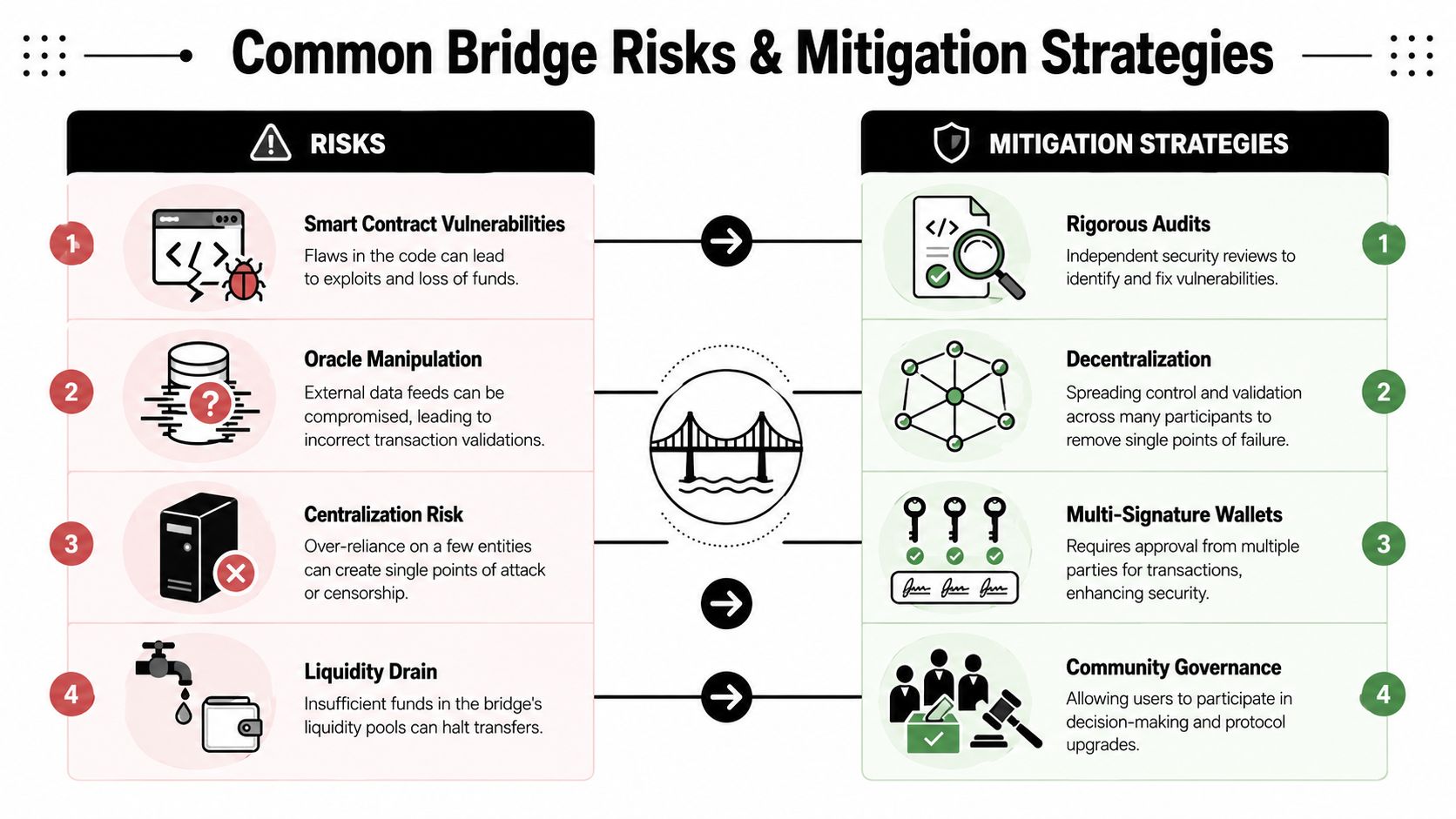
Bridges are attractive targets because they sit at high-value junctions. They hold funds, process cross-chain state, and often combine smart contracts with offchain or validator coordination. That's a large attack surface.
The right response isn't fear. It's disciplined usage.
Smart contract failure
If the bridge contract has a logic bug, bad upgrade path, or unsafe edge case, users can lose funds. This is the risk people usually think of first, and for good reason.
Mitigation starts with restraint:
Prefer established routes: Don't use a new bridge just because an aggregator surfaced it first.
Read the docs before moving size: You're looking for architecture clarity, supported assets, and whether the destination token is canonical or wrapped.
Check for visible security work: Audit reports don't guarantee safety, but missing security documentation is a bad sign.
Test with a small amount first: This catches wallet, network, token, and UI mistakes before they become expensive.
A useful companion habit is learning how smart contract risk shows up outside bridges too. This guide on managing DeFi smart contract risk covers the mindset well.
Validator, signer, or operator compromise
Some bridges depend on a signer set, relayers, multisig participants, or a central operator. If that control layer is compromised, the attacker may be able to authorize fraudulent transfers or freeze legitimate ones.
Many users make a category mistake. They think they're using a protocol, but they're really trusting a committee.
Use these checks:
Question | Why it matters |
|---|---|
Who can pause the bridge? | Emergency powers can protect users, but they also create censorship and governance risk. |
Who can upgrade contracts? | Unsafe or centralized upgrades increase operational trust. |
How is message validity determined? | This tells you whether the bridge depends on a narrow signer set or stronger verification. |
If the answers are hard to find, that itself is a signal.
Liquidity and destination asset problems
Some bridges don't fail because of a hack. They fail the user because the destination route is awkward. You arrive with a token that has thin liquidity, weak protocol support, or confusing ticker overlap.
That creates a second-order risk. You may need extra swaps, you may accept worse pricing, or you may deposit a less desirable asset into a strategy without noticing the difference.
A bridge can complete successfully and still leave you in a worse position than expected.
The mitigation is simple. Confirm the exact token you'll receive before you bridge. Not the symbol. The actual asset path.
User error
Plenty of bridge mistakes aren't protocol failures. They're operator errors. Wrong network selected. Wrong token variant. Wrong wallet connected. Approving the wrong action because the UI looked familiar.
A short checklist beats confidence every time:
Confirm the source chain and destination chain
Check the token name and contract in the interface
Keep gas tokens available on the source side
Wait for finality before assuming funds are lost
Use the official app entry point, not a random search result
Why battle-tested matters
In physical infrastructure, scale amplifies maintenance challenges. The United States has more than 623,000 bridges, with 49.1% in fair condition, 44.1% in good condition, and 6.8% in poor condition, while bridge-related rehabilitation needs are estimated at $191.3 billion, according to the ASCE bridge infrastructure report card. Crypto doesn't map directly to that world, but the lesson is familiar. Critical connectors need maintenance, scrutiny, and conservative assumptions. The bridges that survive are usually the ones that have seen real load and stayed operational.
How to Safely Bridge Your Stablecoins to Base
If your goal is to use stablecoins on Base, the safest habit is to optimize for asset quality first and convenience second. That usually means choosing a route that delivers the asset form major Base applications are most likely to accept cleanly.
Step 1 Choose the bridge before choosing the amount
Start with the bridge itself. Don't open an aggregator and immediately chase the quickest route. First decide what kind of asset you want to land with on Base.
For stablecoin users, the cleanest setup is usually the official route into the chain ecosystem when it delivers the canonical version you want to use. That reduces confusion later when you deposit into lending markets, vaults, or automation tools.
Ask three questions before clicking anything:
What token will I receive on Base?
Is this route considered canonical for that asset?
Will major Base protocols treat it as the standard version?
If you want context on the asset itself before bridging, this guide to USDC on Base is a useful reference.
Step 2 Connect the right wallet on the right network
At this point, users make boring mistakes that create stressful debugging sessions.
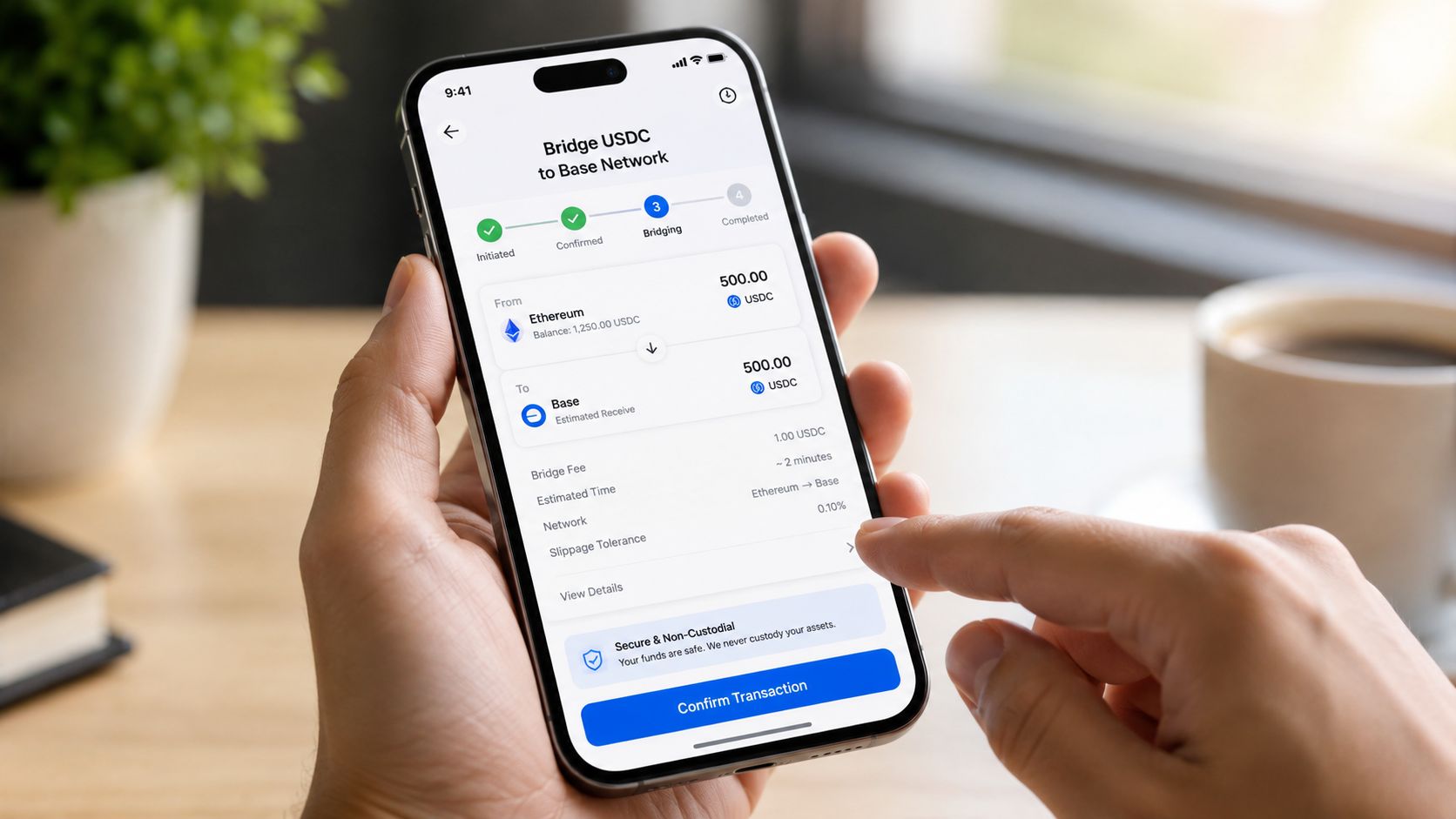
Connect the wallet you intend to use on Base. Then verify the source chain in the bridge interface. If your funds are on Ethereum, the bridge should clearly show Ethereum as the source and Base as the destination. Don't assume the site inferred it correctly.
Also check that you have enough native gas token on the source chain to complete the transaction. Stablecoins don't pay network fees for you. A lot of “bridge issues” are just failed transactions caused by missing gas.
Move slowly at the approval screen. Most preventable losses happen when users click through familiar wallet prompts without reading the network and contract details.
Step 3 Enter the amount and inspect the destination asset
Type the amount manually if needed. Then stop and inspect the quote.
You're looking for four things:
The exact asset received
Any warning about wrapped or third-party versions
Estimated arrival time
Any additional step required after the initial transaction
Some bridges are one-click from the user's perspective. Others involve an initiate phase and a claim phase. Neither is wrong, but you should know which flow you're using before you send funds.
Step 4 Do a small test transaction first
This step feels unnecessary until it saves you.
Send a small test amount. Watch it land. Confirm the token appears in your wallet on Base and that the destination app recognizes it the way you expected. If anything looks off, you've bought yourself a cheap debugging cycle instead of a painful one.
This habit matters more when:
You're using a bridge for the first time
You're moving to a chain you don't use often
You're dealing with a token that has multiple representations
You found the bridge through an aggregator rather than a known direct route
Step 5 Confirm in wallet and monitor the transfer
Once the test succeeds, repeat with the full amount you're comfortable moving.
Approve the token if required. Then sign the bridge transaction. After that, monitor the transfer in the bridge UI and your wallet. Don't panic if the destination balance doesn't show up immediately. Different bridges settle differently, and some wallets need the network refreshed or the token list updated before balances display clearly.
A walkthrough can help if you prefer seeing the flow in action:
Step 6 Verify arrival on Base before deploying capital
When the transfer completes, switch your wallet to Base and verify the balance. If the token doesn't appear, check whether the wallet needs the asset imported or the interface refreshed.
Don't deposit into a strategy until you confirm two things:
Check | What you want to see |
|---|---|
Wallet balance | The bridged stablecoin is visible on Base |
Protocol deposit screen | The app recognizes the token as the expected asset |
This final check matters because many users treat bridging as done once the transaction is signed. It's not done until the asset is usable in the exact app you plan to use next.
What usually works and what usually doesn't
What works is conservative and boring. Official interfaces. Canonical assets. Small test transfers. Reading what token arrives on the other side.
What doesn't work is shortcut behavior. Blind trust in an aggregator route. Assuming every “USDC” label means the same thing. Sending the full amount first because the UI looked polished.
Bridging stablecoins to Base isn't difficult. The difference between a smooth move and an annoying one usually comes down to whether you treated the bridge as infrastructure or as an afterthought.
How Your Bridge Choice Affects Your Yield Strategy
The bridge is upstream from your yield. That means it shapes what strategies are even available once funds arrive.
The biggest issue is asset quality on destination. If one bridge gives you the canonical stablecoin most major Base apps expect, and another gives you a wrapped representation with narrower support, those are not equivalent outcomes. They may share a ticker, but they don't give you the same strategic flexibility.
Native and wrapped assets are not interchangeable in practice
A native or canonical asset usually has the cleanest path into lending markets, vaults, swaps, and automation layers. It tends to be the version interfaces prioritize and liquidity clusters around.
A wrapped asset can still be usable, but you often pay for that convenience later:
Lower protocol compatibility: Some apps won't list it.
Extra swap friction: You may need to convert it before deploying.
More system risk: You now depend on the wrapper or third-party bridge design in addition to the protocol you use next.
That's why discerning users often make the bridge decision backwards from the destination. They don't start by asking which route is fastest. They start by asking which asset they need in the final strategy, then choose the bridge that gets them there with the fewest extra assumptions.
Your first yield decision is often made before you enter the vault. It happens when you pick the bridge.
The operational takeaway is simple. If you care about broad usability, cleaner liquidity, and fewer moving parts, prefer the route that lands you with the standard asset the Base ecosystem is built around.
Conclusion: Bridging Your Way to Smarter Yield
A bridge is easy to dismiss as a transport step. It isn't. It's the handoff between where your capital sits now and what it can do next.
If you understand the architecture, you can judge the trade-offs instead of relying on branding. If you understand the risks, you can use bridges with much better habits. And if you choose the route that delivers the right stablecoin on Base, you give yourself better odds of accessing stronger, cleaner yield opportunities without unnecessary friction.
There's a reason major physical bridges became symbols of engineering ambition. The Golden Gate Bridge opened to vehicular traffic on May 29, 1937 after construction began on January 5, 1933, and at the time it set records with a 4,200-foot main span and a total cost of $35 million in 1930s dollars, according to the Golden Gate Bridge facts and figures archive. Good connectors change what's reachable.
That's the right way to think about a crypto bridge too. Use one carefully, arrive with the right asset, and the rest of your strategy gets simpler.
If you want a simpler way to put bridged USDC to work once it's on Base, Yield Seeker helps automate stablecoin yield strategies with an AI-driven workflow designed for hands-off, risk-aware deployment.