
You go to deposit stablecoins into a yield strategy, confirm the transaction, and then pause. The network fee is big enough to make you rethink the whole move.
That reaction is rational.
For stablecoin holders, gas fees aren't just a technical detail in a wallet popup. They're a direct cost against yield. If you're earning on USDC, every approval, deposit, rebalance, claim, and withdrawal changes your real return. Gross APY may look fine on a dashboard. Net return is what matters after execution costs.
Many learn this the expensive way. They chase a decent rate, pay too much to get in, pay again to move, and end up with less than the headline number suggested. The fix isn't guessing or obsessively refreshing a gas tracker. It's understanding what the fee is, when it matters, and which choices have the biggest impact on take-home yield.
That Painful Moment You First Saw a High Gas Fee
The first time a DeFi user sees a surprisingly high network fee, the thought process is usually the same. "I'm just moving tokens. Why does this cost so much?"
It feels broken because the action looks simple on the surface. In reality, you're paying for a shared compute network to process your transaction, compete for block space, and finalize state changes. A wallet button says "swap" or "deposit." Under the hood, the chain is doing more work than the interface suggests.
A good analogy is gasoline. You don't think much about fuel when prices are stable. You definitely notice when they spike. U.S. gasoline was often around $1.15 per gallon in the 1990s, and the U.S. average hit $4.19 in 2022, which SoFi's historical summary shows as an increase of over 260% from that earlier benchmark (SoFi gas price history).
Why the analogy lands
Gasoline powers a car. Gas powers a blockchain transaction.
In both cases, the resource is necessary, the price moves with market conditions, and users notice it most when they need something done right now. If the road trip can't wait, you buy fuel anyway. If you need to move funds or catch a yield opportunity, you may end up paying the network rate in front of you.
Practical rule: If a fee feels irrational, it's usually because you're comparing it to the visible action, not the hidden compute and competition behind it.
This matters more in stablecoin yield than in speculation. A trader chasing volatility may tolerate higher execution costs because the expected upside is larger. A yield seeker working with modest, steady returns doesn't have that margin. The same fee hurts more when the goal is preserving and compounding a low-risk return.
What that first fee shock is really teaching you
That popup is your first lesson in DeFi unit economics.
You're not just evaluating APY. You're evaluating:
Entry cost for approvals and deposits
Maintenance cost for reallocations or compounding
Exit cost when you want your funds back
Timing cost if you transact during congestion
Once you see gas fees that way, the problem becomes easier to solve. You stop treating the fee as random punishment and start treating it like any other portfolio expense.
What Are Gas Fees and How Do They Work
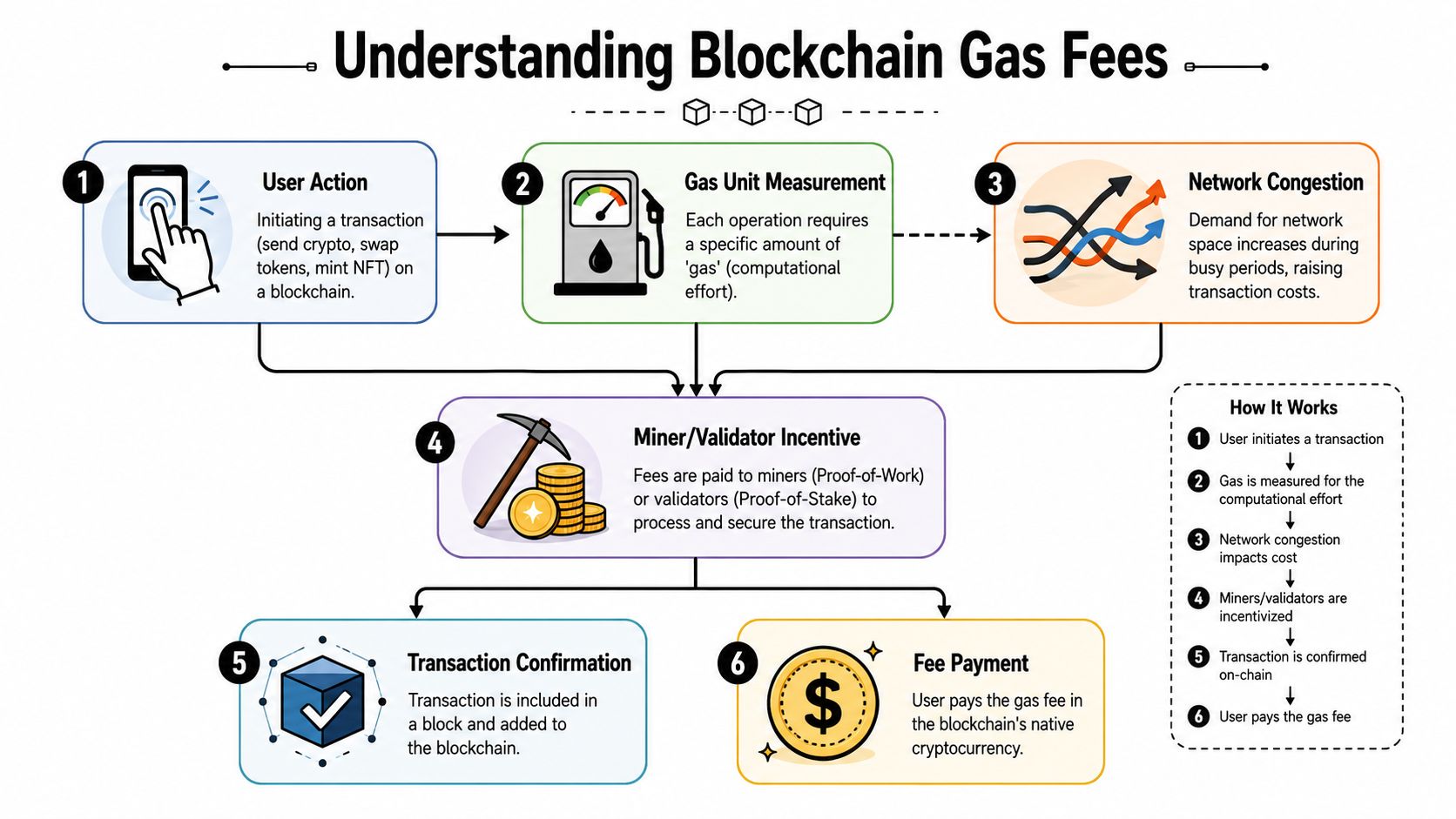
Every blockchain transaction consumes computational resources. Gas fees are the price you pay for those resources.
A simple token transfer uses less computation than interacting with a smart contract. A multi-step DeFi action, like approving a token and then depositing it into a vault, typically costs more because the chain has to execute more operations. That's why two transactions that look similar in a wallet can have very different costs.
On Ethereum, the fee model is now straightforward at a high level. The total transaction fee is gas units used × (base fee + priority fee). The base fee is set by the protocol, the priority fee is an optional tip for the validator, and users can set a max fee so any excess over the final executed cost is refunded (Ethereum gas documentation).
The fee has two moving parts
Think of block space like seats on a busy train.
The base fee is the fare set by network demand. If more people want space in upcoming blocks, that baseline rises. The priority fee is what you add when you care about getting included faster. It can improve speed, but it doesn't magically make a transaction cheaper.
That distinction matters because many users overpay by treating every transaction like an emergency.
You usually save more by choosing a calmer time to transact than by obsessing over tiny wallet settings.
Failed transactions still cost money
One painful part of Ethereum's design is that the network still charges for work done even if the transaction fails. If a DeFi action reverts because of slippage, stale pricing, or a contract condition, the computation already happened. You still pay for it.
That changes how you should operate:
Confirm the path first: Check whether a dApp needs an approval before deposit.
Avoid rushed clicks: Speeding through popups causes expensive mistakes.
Use max fee intelligently: It caps exposure, but it doesn't guarantee a low final cost.
Separate speed from price: A higher tip can help inclusion speed, not lower total network cost.
Why fees move in real time
Gas pricing isn't static because block space isn't static. Demand changes block by block.
Ethereum's gas model also uses small pricing units called gwei, which are tiny ETH denominations used to express micro-costs for computation. That makes the pricing readable for machines and wallets, but the user experience still comes down to a simple truth: when many users want execution at once, the network gets more expensive.
For yield seekers, the key takeaway isn't the jargon. It's the decision model. You pay for compute, you pay more when demand rises, and your biggest lever is usually whether the transaction needs to happen now.
How Gas Fees Can Destroy Your Stablecoin Yields
You move $2,000 of USDC into a vault showing a solid APY. The deposit goes through, the dashboard looks clean, and the strategy seems to be working. Then a few routine actions later, approval, deposit, one rebalance, one exit, a meaningful slice of that yield is gone.
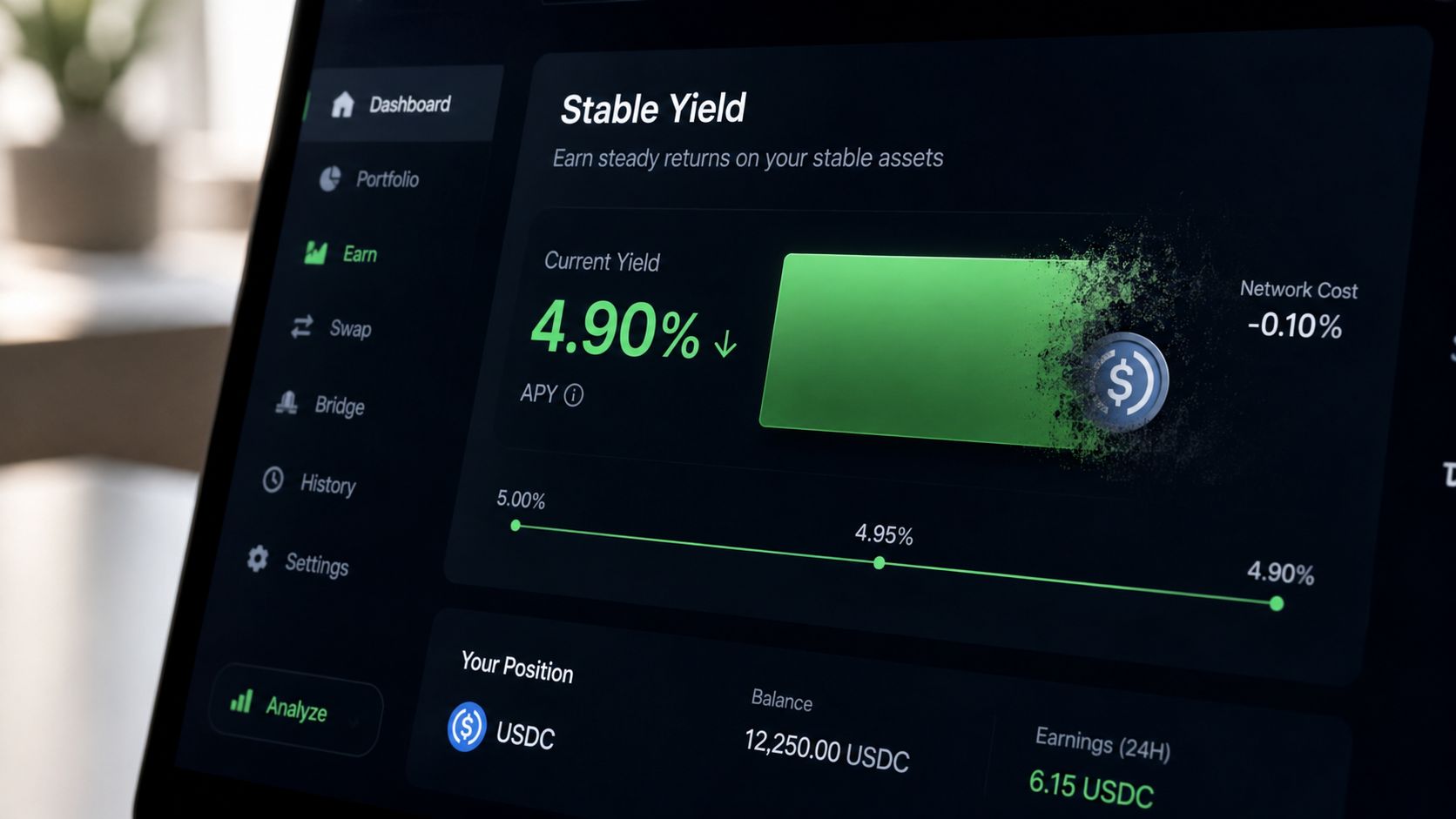
That is the part many yield dashboards hide. They show gross APY. Your wallet only receives net APY after every onchain action is paid for.
Gross APY is not net APY
Stablecoin yield works on relatively small spreads. You are usually earning a few percentage points for parking capital productively while trying to keep volatility and protocol risk under control. In that setup, operating cost matters a lot more than people expect.
A simple example makes the problem obvious.
If a strategy earns roughly 5% APY on a $2,000 stablecoin position, the annual return is about $100 before costs. A handful of transactions over the life of that position can take a noticeable bite out of that $100. If you enter, adjust, and exit manually, gas is no longer a side expense. It becomes part of the strategy's performance.
Small balances feel this first, but larger balances are not immune. The more often you rotate for an extra fraction of yield, the more your actual return depends on execution discipline rather than the headline APY.
Activity can erase the edge
Stablecoin users often lose yield through workflow, not protocol selection.
A typical path may include:
Approve token usage
Deposit into a vault or lending market
Claim rewards or compound manually
Move funds when another pool shows a better rate
Withdraw back to the wallet or exchange
Each step creates cost. Each extra click needs to earn its keep.
This is why chasing small APY differences often backfires. Moving capital for a slightly better rate can make sense on paper, but once you include entry, management, and exit costs, the improvement may disappear. I have seen plenty of stablecoin strategies where the main mistake was not picking the wrong pool. It was touching the position too often.
If you want a better framework for this decision, use a gas-efficient allocation approach for stablecoin strategies before moving funds.
The useful question is not, "What APY does the protocol advertise?" The useful question is, "After all required transactions, how much of that yield do I actually keep?"
A short explainer helps if you want to see the issue visually.
Why yield seekers feel this more than traders
A trader may tolerate ugly execution cost if the expected move is large enough. A stablecoin allocator usually works with thinner expected returns. That changes the math.
On a modest balance, even a decent APY can take time to earn back a few avoidable transactions. On a larger balance, gas hurts less as a percentage, but frequent reallocations can still drag performance, especially if you are switching strategies for marginal improvements.
The practical takeaway is simple. Stablecoin yield is a cost-sensitive business. If a strategy needs repeated manual intervention, every action should have a clear expected payoff. If it does not, the fee is not just annoying. It is directly reducing your APY.
Four Practical Ways to Reduce Your Gas Fees
You feel gas pain most when the position is small, the APY edge is modest, and the workflow asks for too many clicks. For stablecoin yield seekers, that is not a minor annoyance. It is return leakage.
The practical fixes are usually simple. Trade less often. Use cheaper rails when the strategy allows it. Cut unnecessary approvals and hops. Choose apps that do not turn one allocation decision into four transactions.
1. Wait for quieter blocks
Timing still matters, especially on Ethereum. Base fees rise when block space gets crowded, so a deposit that is fine this afternoon can look silly during a volatile market hour.
For yield moves, urgency is often overstated. If you are parking stablecoins for a strategy expected to earn over days or weeks, waiting for calmer conditions is usually the better trade-off.
A few habits help:
Check whether the move is time-sensitive: Many deposits are not.
Avoid obvious congestion windows: Major launches, sharp market selloffs, and meme coin bursts tend to push costs up.
Do not stack retries: Repeated failed or replaced transactions can turn one bad decision into several paid ones.
2. Choose the chain before you choose the APY
This is often the highest-impact decision.
A yield opportunity on Ethereum can look better on paper and worse in your wallet after entry, exit, and rebalancing costs. The same style of strategy on a lower-cost chain can keep more of the gross yield in your pocket, even if the headline APY is slightly lower.
A simple way to compare networks:
Network | Typical user experience on cost |
|---|---|
Ethereum | Can make small stablecoin moves hard to justify |
Base | Usually cheap enough for routine yield actions |
Polygon | Often workable for smaller balances |
BNB Smart Chain | Generally lower friction than mainnet, but strategy quality still matters |
The point is not "always use the cheapest chain." Liquidity, protocol quality, bridge risk, and available opportunities still matter. But if two strategies are broadly similar, the cheaper execution environment often wins on net yield.
If you want a framework for making that call before you move funds, use this guide to gas-efficient allocation for DeFi portfolios.
3. Reduce the number of transactions your strategy requires
A lot of gas waste comes from process, not price.
Stablecoin users often approve, deposit, test, withdraw, bridge, redeploy, then repeat for a tiny APY improvement. Each step might look manageable on its own. Together, they eat the spread you were trying to earn.
A better approach:
Batch decisions: Move when the expected gain is meaningful, not every time a dashboard updates.
Size positions sensibly: Very small balances get hit hardest by fixed transaction overhead.
Avoid constant manual rebalancing: A minor yield bump rarely justifies multiple onchain actions.
One extra transaction is not the problem. A workflow that requires six is.
4. Use apps and routes with cleaner execution
Some dApps are more expensive to use. More contract calls, messy approval flows, and unclear routing all raise the cost of getting into and out of a position.
Prefer tools that:
Keep the transaction path short
Make approvals obvious
Do not require frequent intervention to maintain the strategy
Be skeptical of strategies that look great only before execution costs. If the yield depends on constant micromanagement, the advertised APY is not the number that matters. The number that matters is what remains after every approval, deposit, rebalance, and exit.
Cheap execution is part of yield strategy design. If a stablecoin position needs constant paid maintenance, the APY is overstated for the person actually using it.
The Base Chain Advantage and Its Hidden Nuances
Base is attractive for stablecoin yield because lower transaction costs make more strategies viable. You can move, deposit, and rebalance without the same friction that pushes smaller users off Ethereum mainnet.
That changes user behavior in a good way. People can compound more comfortably, test strategies with less overhead, and keep more of what they earn. For anyone building around stablecoin cash management, that's a meaningful improvement.
Why Base works well for yield flows
The biggest win is practical, not ideological. Lower-cost execution makes routine actions less punishing.
That especially helps workflows like:
Entering yield positions without large upfront friction
Rebalancing between protocols when conditions change
Managing accessible stablecoin balances without lockup pressure
If you're new to the ecosystem, this overview of how the Base chain works in practice is a useful starting point.
Cheap doesn't mean free
This is the nuance many beginner articles skip.
Orchid's Ethereum fee explainer notes that even on low-cost Layer 2s like Base, gas fees are not zero because they inherit part of the Layer 1 posting cost and can still spike during high demand. It also points out that while simple transfers are cheap, multi-step DeFi actions can still become costly enough to affect smaller balances (Orchid on L2 gas fee nuance).
That matters because users often hear "use an L2" and assume the problem disappears. It doesn't. The economics improve, but the cost model still exists.
Where people still get caught
The trouble usually starts when a strategy gets more complex than the interface suggests.
A single transfer on Base can feel trivial. A chain of actions across approvals, deposits, zaps, reward claims, and reallocations adds up. If you're managing a smaller stablecoin balance, even low fees can still influence whether a strategy makes sense.
Base lowers the threshold for profitable DeFi activity. It doesn't remove the need to think about transaction count.
For practitioners, that leads to a better operating rule. Use Base because it reduces friction. Still design your workflow as if every transaction has a cost, because it does.
Automate Your Strategy and Eliminate Gas Friction
Manual gas management works, but it's tedious. You wait for calmer periods, pick cheaper networks, and try not to overtrade your own stablecoin strategy. That approach is fine if you enjoy micromanaging execution. Such hands-on execution is generally not preferred.
A better approach is to automate the parts that are predictable. In broader operations work, that's the same reason teams adopt tools like Wayfinder Agents on workflow AI. Repetitive decisions create drag, and software can handle them more consistently than a human clicking around dashboards late at night.
What automation changes for yield seekers
Instead of treating gas fees as a manual tax on every decision, automation can reduce unnecessary transaction count, improve timing, and keep funds on a lower-cost chain from the start.
One example is Yield Seeker, which helps users deposit USDC on Base and use an AI agent to monitor and allocate capital across DeFi protocols. In practice, that means users don't need to manually hunt rates, move funds for every minor change, or manage each tactical decision themselves. There's also a more detailed look at how AI agents handle DeFi execution.
The primary benefit isn't just convenience. It's net return.
When the workflow is automated, a user is less likely to burn yield on avoidable actions like emotional reallocations, constant app-switching, or poorly timed manual transactions. For stablecoin strategies, that's often where the money leaks out.
The goal is simpler than it sounds
You don't need to become a gas expert to stop overpaying.
You need a setup that does three things well:
Operates on a lower-cost chain
Reduces unnecessary transaction frequency
Makes execution discipline the default
That's how you protect stablecoin yield from hidden friction. Not by winning a settings battle inside MetaMask every day, but by using a workflow that keeps the cost problem small enough that it stops dominating your returns.
If you want a simpler way to earn on stablecoins without manually managing every approval, rebalance, and timing decision, take a look at Yield Seeker. It gives you a Base-native, AI-assisted workflow for putting USDC to work while keeping execution friction lower and the focus on net yield.