
You probably have some stablecoins sitting in a wallet right now. Maybe they're parked in USDC on Base, maybe spread across a few apps, maybe earning something, maybe earning nothing. On paper, that feels safe. In practice, idle capital is still making a choice. It's choosing low productivity.
That's where capital efficiency becomes useful. Not as a VC buzzword, not as protocol marketing, and not as a fancy way to justify specific financial strategies. It's a simple question: how much useful output are you getting from the capital you already have, after accounting for risk, effort, and friction?
For a stablecoin holder, this matters more than it first appears. Two people can both “earn yield” and have very different outcomes. One collects a headline APY but leaks value through bad timing, fragile protocols, and unnecessary transactions. The other earns a steadier return from a setup that stays productive with less babysitting and fewer hidden risks. Same asset class. Very different efficiency.
What Capital Efficiency Means for Your Digital Dollars
You hold $10,000 in stablecoins. One version of you leaves it scattered across a wallet and a few apps, earning little and requiring constant checking. Another version puts the same dollars into a setup that stays liquid, earns a steady return, and does not demand daily intervention. Same capital. Different output.
That gap is capital efficiency.

In traditional finance, the idea is simple. Investors and operators ask how much result a pool of capital produces relative to what was put to work. A business might measure profit against the capital tied up in operations. A DeFi user can apply the same logic at a smaller, more personal scale. Your stablecoins are your balance sheet, and the question is whether each dollar is earning enough to justify the risk, fees, and attention it consumes.
A familiar TradFi reference point is Return on Capital Employed (ROCE). ROCE focuses on how effectively capital produces returns. For a stablecoin holder, the translation is practical. Do your dollars sit idle, or are they placed in a strategy that produces dependable yield without creating extra weak points?
Yield is only one part of the equation
A high APY can make a position look efficient when it is not.
If a strategy pays more but requires frequent rebalancing, expensive transactions, thin liquidity, or exposure to incentives that can disappear overnight, the headline number hides the actual cost. That is the DeFi version of a business with strong revenue and poor margins. Activity looks impressive. The underlying machine is less productive than it seems.
A clearer way to judge your options is to separate yield into three categories:
Productive yield comes from a mechanism you understand, with risks you can explain in one sentence.
Fragile yield depends on conditions that can change fast, such as token emissions, shallow liquidity, or unstable borrowing demand.
Leaky yield gets chipped away by gas, slippage, bridging, taxes, or the time required to manage it.
That framework matters because capital efficiency is not reserved for funds, VCs, or protocol treasuries. It is a useful mindset for anyone holding stablecoins. You are making portfolio allocation decisions, even if the portfolio is just your personal onchain cash balance.
What efficient capital looks like onchain
In DeFi, efficient capital does more useful work per dollar while keeping risk within your comfort zone. Sometimes that means lending on a large, established market. Sometimes it means using an LP position where fees are steady and exit liquidity is deep. Sometimes it means doing less, because a complicated stack adds more operational risk than extra return.
A few simple comparisons make the idea clearer:
Idle stablecoins in a wallet preserve optionality, but they produce no income.
Stablecoins lent on a mature protocol may earn a lower rate than a new farm, but the return can be more reliable and easier to keep.
Layered strategies can improve returns, but only when each added step earns its place.
Market depth matters here too. Protocols with more staying power often have more liquidity, more predictable borrowing demand, and lower exit friction. If you want a companion concept, Total Value Locked in DeFi helps explain why capital tends to cluster in venues that can support larger and steadier flows.
The practical question is short. Are your digital dollars busy, or are they productive?
Capital efficiency starts as a finance term, but for a stablecoin holder it becomes a personal operating rule. You stop chasing the biggest number on the screen and start choosing the setup that gives you the best return after friction, with risks you understand.
The Metrics That Measure Capital Efficiency
A stablecoin strategy can show a high APY and still use your capital poorly.
The reason is simple. Yield is only one output. Capital efficiency asks a fuller question: how much useful return did each dollar produce after costs, delays, and risk?
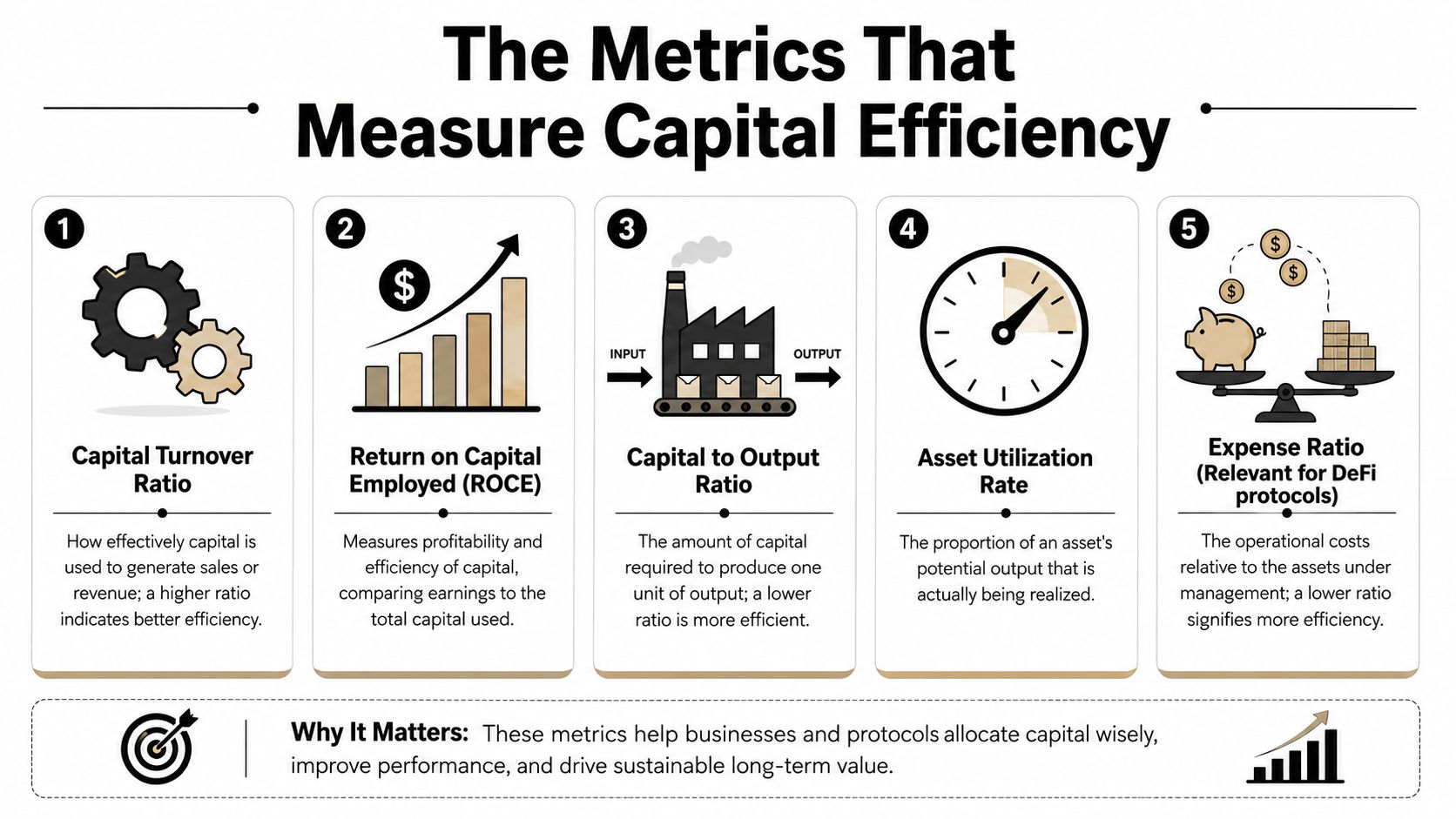
Traditional finance gives us a good starting frame. Businesses judge whether capital is working hard enough by comparing what the company produces against the capital tied up to produce it. Revenue, profit, and cash generation are different ways to view the same core idea: did this pool of money earn its keep?
One adjacent metric worth understanding is Return on Capital Employed (ROCE), which looks at how profit relates to the capital used to generate it. For a DeFi user, that framing improves your decision process. You stop asking only, “What does this pay?” and start asking, “What did I have to commit, tolerate, and risk to get that return?”
That shift matters because personal capital in DeFi works like a small operating business. Your stablecoins are the inventory. Gas is an operating cost. Slippage is leakage. Time spent monitoring a fragile position is labor. If a strategy earns more on paper but burns more of those resources, it may be less efficient than a simpler alternative.
Here is the translation:
Measure | In traditional finance | For a stablecoin holder |
|---|---|---|
Output | Revenue or profit | Net yield you actually keep |
Capital employed | Equity, debt, operating capital | Stablecoins deposited |
Conversion quality | Cash generated from capital used | Reliable earnings per dollar at acceptable risk |
Friction | Operating overhead | Gas, slippage, bridge risk, time |
Efficiency test | More output from the same capital base | Better risk-aware yield with less leakage |
The table helps, but the practical test is even simpler. Compare two ways to put $10,000 in stablecoins to work. Strategy A pays a lower headline rate on a large lending market and needs little attention. Strategy B pays more, but requires bridging, frequent harvesting, and trust in a newer incentive program. If Strategy B produces only a small extra return after those costs and headaches, your capital was busier, not better used.
For individual users, the metric that usually matters most is risk-adjusted return. That is the version of efficiency you can live with. A strategy only deserves your capital if the extra yield compensates for the extra complexity, smart contract exposure, liquidity limits, and monitoring burden. Our guide to risk-adjusted APY in DeFi is useful if you want a sharper scoring system for that tradeoff.
A good filter has four parts:
Base return. What does the strategy earn before temporary incentives or token rewards distort the picture?
Reliability. How likely is that return to persist without constant intervention?
Friction. What do gas, slippage, bridging, and time take away from the headline number?
Exit quality. How easily can you reduce or close the position when market conditions change?
Capital efficiency, for a stablecoin holder, is not an abstract protocol KPI. It is a personal discipline for judging whether your digital dollars are producing durable, usable return without asking you to accept hidden costs you would reject if they were stated upfront.
Why Inefficient Capital Is a Silent Portfolio Killer
Portfolio quality isn't typically lost in one dramatic blowup. It's lost through drift.
They leave stablecoins idle for too long. They hop between protocols for small incremental gains. They accept a headline yield without pricing in the cost of moving, monitoring, and worrying about it. None of those decisions feels catastrophic on its own. Together, they can turn a conservative stablecoin allocation into an underperforming, fragile mess.
The cost of doing nothing
Idle capital feels harmless because it doesn't create visible volatility. But capital that isn't producing anything still has an opportunity cost. If your goal is to preserve purchasing power and compound carefully, unproductive stablecoins are falling short of the job.
This matters even more when money has a real cost again. In a higher-rate environment, businesses and investors pay closer attention to whether capital is pulling its weight. Wellington notes that in a higher-for-longer environment, capital-efficient companies are seen as more resilient, and it points to the Rule of 40, where revenue growth plus profit margin should reach 40% or more, as a benchmark for balancing growth and efficiency in operating businesses, as discussed in Wellington's analysis of capital efficiency and rates.
The lesson for stablecoin holders is simple. When capital becomes more precious, sloppy deployment stands out faster.
The cost of doing too much
The opposite mistake is just as common. A user sees a better rate, moves funds, compounds rewards, swaps incentives, bridges somewhere else, then repeats the process next week. The strategy looks optimized. Often it's just noisy.
What usually gets missed:
Fees add up through swaps, approvals, and repositioning.
Execution risk grows when a strategy depends on several protocols behaving exactly as expected.
Attention gets consumed because every moving piece needs review.
Liquidity can thin out right when you want to exit.
Key insight: A strategy can be active and still be inefficient.
Yield chasing is especially dangerous with stablecoins because the category feels low drama. People drop their guard. They assume a stable asset means a stable setup. But protocol risk, counterparty design, governance shifts, and incentive decay can all hit a “safe” position.
Hidden leakage is still leakage
Inefficient capital usually leaks in places users don't track in a spreadsheet. It leaks through delay. Through overconfidence. Through complexity that doesn't earn its keep.
That's why the right question isn't “Am I earning something?” It's “Is this setup the best use of this capital for my actual constraints?” If you're busy, a strategy that demands constant intervention may be worse than one with a slightly lower raw return and much better reliability.
Stablecoins are supposed to simplify portfolio management. Used poorly, they can become a trap where caution turns into inactivity and ambition turns into overtrading. Capital efficiency protects against both.
Practical Strategies for More Efficient Yield in DeFi
DeFi gives you many ways to put stablecoins to work. The hard part isn't access. It's choosing a structure that fits your risk tolerance, time budget, and skill level.
The biggest upgrade in mindset is this: efficient yield is a portfolio construction problem. AQR's work on capital-efficient structures makes that point in a broader investment context, arguing that efficiency isn't just about spending less, but about using structures such as capital amplification or portable alpha to improve diversification and long-term outcomes through better capital mobility, as explored in AQR's research on capital-efficient investing.
That translates well to DeFi. Sometimes the best move isn't one “best” protocol. It's the right combination of simple, liquid, and selectively higher-octane exposures.
The main strategy types
Here's a practical comparison for stablecoin holders.
Strategy | Potential Return | Risk Level | Complexity |
|---|---|---|---|
Lending on protocols like Aave or Morpho | Usually moderate and easier to understand | Lower relative to more complex DeFi strategies, but still includes smart contract and market structure risk | Low |
Stablecoin LP on concentrated liquidity venues like Uniswap V3 | Can be attractive when ranges are well managed | Medium, with rebalancing risk and exposure to position management errors | Medium |
Yield vaults and automated aggregators | Often competitive because they optimize routing and harvesting | Medium, with added strategy and smart contract layers | Low to medium |
Delta-neutral or hedged carry trades | Can be efficient for experienced users who know the legs well | Medium to high because execution quality matters across multiple venues | High |
Leveraged looping on lending markets | Can raise output from the same base capital | High, especially if collateral conditions or borrowing terms shift | High |
When simple wins
Lending is often the cleanest place to start. You deposit stablecoins, earn supply yield, and preserve optionality. It's rarely the most exciting line on the dashboard, but it often scores well on clarity and low maintenance.
That matters because some of the best capital-efficient decisions are boring. If a strategy gives you understandable return, deep liquidity, and easy exits, it can outperform a nominally higher-yielding setup once you include management effort and downside scenarios.
Where advanced users can gain an edge
Concentrated liquidity and neutral carry strategies can make capital work harder, but only when the operator understands the mechanics.
Uniswap V3 is a good example in concept. Concentrating liquidity can improve how efficiently capital is deployed because funds sit in the range where trading activity is likely to occur. But the efficiency is conditional. If price moves outside your range, your capital stops being productive in the way you intended. If you don't monitor the position, the elegant design turns into idle exposure.
A more advanced user might combine:
A core lending sleeve for stability and immediate access
A managed LP sleeve where capital is actively positioned
A small experimental sleeve for tactical strategies with tighter oversight
That kind of structure treats your stablecoin balance like a mini treasury, not a pile of cash.
Good capital efficiency often comes from matching the strategy to the operator, not from picking the most complicated tool.
A practical decision filter
Before allocating, ask four questions:
Can I explain where the yield comes from? If the answer is fuzzy, the strategy is already weaker than it looks.
What breaks this trade? Smart contracts, liquidity conditions, incentive removal, oracle issues, and execution mistakes all belong on the list.
How much work does this require from me? A strategy that needs constant attention can be inefficient for a busy person, even if the gross return looks strong.
How clean is the exit? You don't fully own the yield if leaving the position is difficult under stress.
DeFi rewards precision. Capital efficiency helps you decide where precision is worth the effort and where simplicity is the better trade.
How Yield Seeker Automates Capital Efficiency with AI
Manual capital efficiency is possible. It's also exhausting.
A stablecoin holder who wants to optimize seriously has to compare venues, monitor changing rates, assess risk, track fragmentation across chains and apps, and decide when reallocation is worth the effort. That's manageable for a full-time DeFi operator. It's much less manageable for someone with a day job, a treasury to manage, or better things to do than reopen five tabs before bed.
This is the gap automation is meant to close.

What automation is really doing
The useful way to think about AI in yield management isn't “the bot finds the highest APY.” That's too shallow. A stronger model asks a more complete question: where can this capital be placed so that expected return, risk, and operational drag stay aligned?
That means automation can help with tasks human users often handle inconsistently:
Continuous monitoring across fragmented opportunities
Allocation decisions based on changing conditions rather than fixed habits
Rebalancing discipline so capital doesn't sit in stale positions
Friction control by avoiding unnecessary moves that look smart but erode net outcome
There's a parallel here to operational automation outside crypto. Teams that are building AI agent email infrastructure don't benefit merely because software sends messages faster. They benefit because the system handles repetitive judgment calls at scale and reduces manual overhead. Yield management has a similar shape. The value is in repeated, structured decision-making.
Why efficiency gets valued so highly
Public and private markets have become much stricter about efficiency signals. In SaaS, firms with Burn Multiple under 1x and Rule of 40 above the common threshold commanded 2.3x the revenue multiples of inefficient peers in Bessemer's 2025 Cloud 100 analysis, as cited by Waveup's review of capital efficiency metrics.
That isn't a DeFi statistic, but the principle carries over cleanly. When an operator can show that each unit of capital is being deployed more productively, observers treat that capital as higher quality. For an individual stablecoin holder, the equivalent is straightforward: a system that allocates thoughtfully is more valuable than one that merely stays busy.
What this looks like in practice
A good automation layer should do three things well.
First, it should reduce the research burden. DeFi opportunities are fragmented, and the cost of keeping up isn't just time. It's decision fatigue.
Second, it should align with risk-aware yield rather than raw yield. Chasing the top displayed number is easy to automate badly. A better system acts more like a cautious portfolio manager.
Third, it should preserve user control. Automation works best when it improves allocation without turning your capital into a black box.
For readers who want the technical view of this model, AI yield optimization in DeFi is the right place to go deeper.
A short product walkthrough makes the abstraction easier to see in action.
The important shift is conceptual. Capital efficiency used to sound like something meant for CFOs, venture investors, or protocol designers. Automation brings it down to the wallet level. It turns a high-level finance principle into a repeatable operating system for personal stablecoin management.
Conclusion Your Path to Smarter Automated Yield
Capital efficiency is a better lens than raw APY because it forces a fuller question. Not just what your stablecoins earn, but how they earn it, how much friction sits in the process, and whether the setup still makes sense when conditions change.
That shift matters. It moves you away from two common mistakes. The first is leaving digital dollars idle because “safe” feels sufficient. The second is chasing every incremental yield bump without pricing in risk, complexity, or the cost of your own attention.
The strongest DeFi users think more like treasury managers than yield tourists. They care about productive deployment, clean exits, understandable risk, and repeatable decision-making. Sometimes that leads to simple lending. Sometimes it leads to more advanced structures. The point isn't complexity. The point is fit.
Better capital efficiency usually comes from better judgment, not louder yield.
For stablecoin holders, that makes this concept unusually practical. You don't need to run a startup or manage an institutional fund to use it. You just need to ask whether your capital is working hard in a way that matches your goals and constraints.
That's why automation is such a natural next step. The more fragmented DeFi becomes, the more value there is in systems that can monitor, compare, and adjust without requiring constant manual work. Smarter personal treasury management won't look like endless protocol hopping. It will look like disciplined, risk-aware allocation done consistently.
If you want a simpler way to put this mindset into practice, Yield Seeker helps automate stablecoin allocation across DeFi so your capital can stay productive without constant manual monitoring.