
You probably already know the feeling. You hold stablecoins, you've heard there's yield in DeFi, and every path seems to create a new job for you. One dashboard for lending rates. Another for bridging. Another for wallet approvals. Then a thread warns about smart contract risk, a podcast warns about regulation, and a friend tells you the best opportunities vanish before you can even evaluate them.
That confusion is normal. Permissionless finance is powerful, but it doesn't look or behave like the financial system initially learned by many. It's closer to open software infrastructure than to a bank product shelf. That's why the upside can be real, and why sloppy participation gets punished fast.
The useful way to understand this space isn't through ideology. It's through workflow. How does value move? Who decides who can access a service? What can you build on top of it? Where do stablecoins fit? And what controls do you need before you trust it with real capital?
What Is Permissionless Finance and Why It Matters Now
Traditional finance usually starts with approval. A bank opens your account. A broker decides what market access you get. A payment network works through a chain of intermediaries that each apply their own rules, hours, and restrictions. Even when the user experience looks smooth, the system underneath is gated.
Permissionless finance flips that model. It runs on open blockchain networks where users can hold assets in wallets they control and interact directly with financial applications. No relationship manager has to whitelist you before you can send, swap, lend, or borrow. The network enforces rules through code, not through an institution reviewing your request one by one.
That matters now because this is no longer a fringe experiment. A key use case, stablecoins, reached $27.6 trillion in transfer value in 2024, and the New York Fed says that surpassed the combined value processed by Visa and Mastercard. The same analysis says that after excluding bot-like transactions, annual stablecoin volume rose from $3.29 trillion in 2021 to $5.68 trillion in 2024, roughly 80% growth. You can read that in the New York Fed's piece on permissionless payment infrastructure and stablecoin transfer volume.
Why busy professionals should care
If you manage personal cash reserves, crypto treasury, payroll buffers, or idle USDC, this changes the menu of available tools.
Access is global: A wallet can connect to open financial rails without needing a bank-by-bank rollout.
Markets run continuously: You're not waiting for office hours, wire cutoffs, or manual review queues.
Products evolve faster: New strategies can appear as software integrations instead of as long institutional launch cycles.
Practical rule: If you think permissionless finance is only about token prices, you'll miss its real importance. It's about open settlement, open interfaces, and direct asset control.
If you want a foundational primer before going deeper, Yield Seeker's guide on what decentralized finance is is a useful companion read.
The Shift From Permissioned to Permissionless Systems
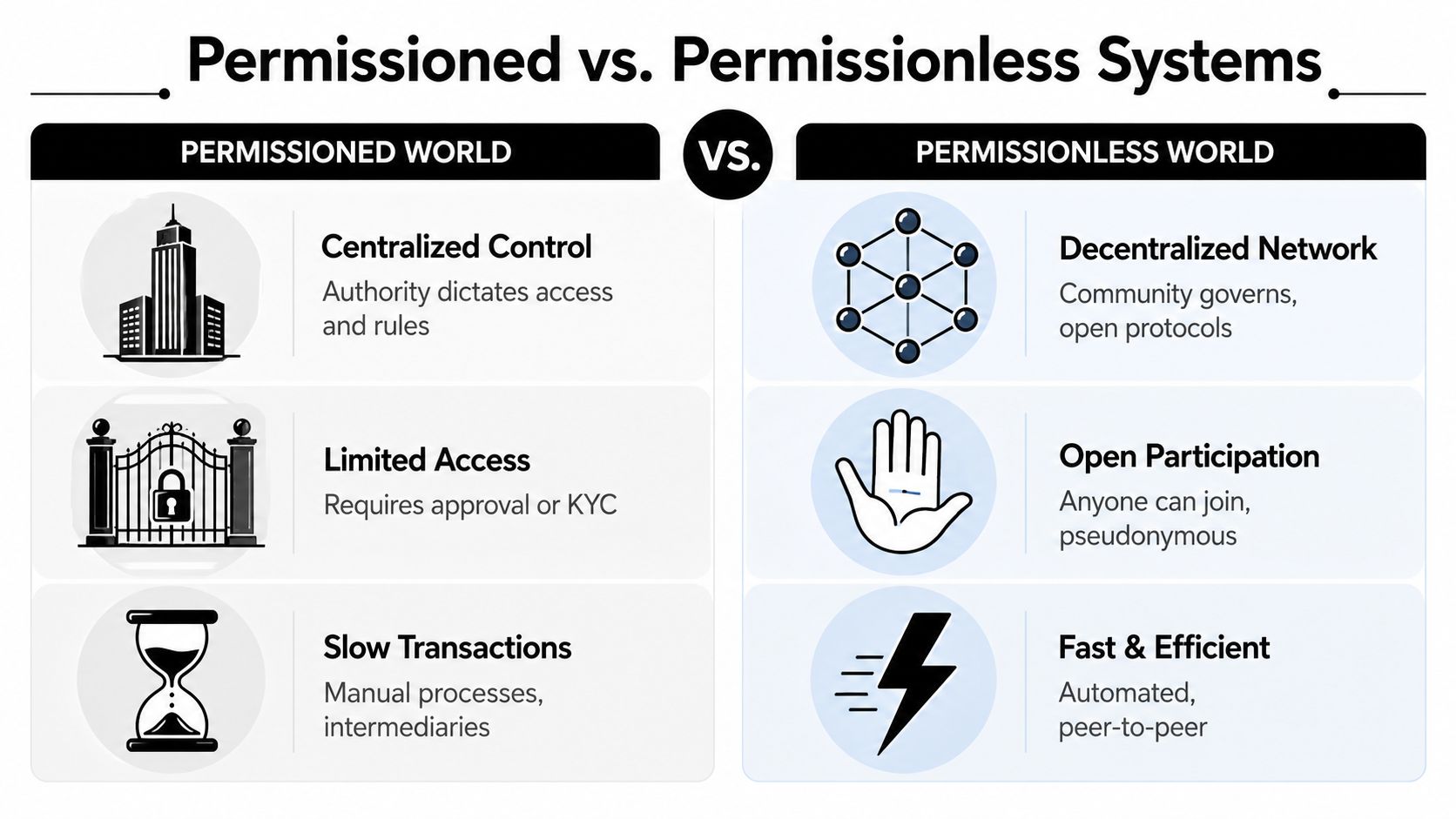
The cleanest analogy is the open internet versus a walled garden. In a permissioned system, someone decides who gets in, what gets built, and how data moves. In a permissionless system, the base layer is open. Anyone can join if they follow the protocol rules.
That difference sounds philosophical until you work with it. Then it becomes operational.
In traditional finance, institutions own the rails. They provide trust, but they also create bottlenecks. In permissionless networks, trust comes from shared software rules, public state, and distributed validation. The Federal Reserve describes a permissionless blockchain as a distributed system running a shared ledger under the same software rules. Fireblocks' 2025 whitepaper adds scale to that picture, stating that in December 2024, the top five permissionless blockchain networks had 180.4 million active user wallets, which is a useful proxy for real participation in open financial infrastructure. That figure appears in the Fireblocks whitepaper on permissionless infrastructure.
Where the models differ in practice
Permissioned systems optimize for controlled access, policy enforcement, and institutional accountability. Permissionless systems optimize for open participation, interoperability, and rapid software-driven innovation.
Neither model is automatically better. They solve different problems.
Aspect | Permissionless Finance (e.g., Ethereum DeFi) | Permissioned Finance (e.g., Traditional Banking) |
|---|---|---|
Access | Open to anyone with a compatible wallet | Restricted to approved customers and counterparties |
Account control | User-controlled wallets and keys | Institution-controlled accounts |
Product development | Developers can deploy and integrate without seeking platform approval | New products usually require legal, operational, and partnership approval |
Transparency | Transactions and contract activity are visible on public ledgers | Internal ledgers are mostly opaque to outsiders |
Operating hours | Continuous network availability | Often tied to business hours, banking rails, and regional processes |
Dispute handling | Harder to unwind once settled | Institutions can freeze, reverse, or mediate in many cases |
Governance | Shared among developers, nodes, users, and protocol stakeholders | Controlled by firms, regulators, and network operators |
What works and what doesn't
The open model works extremely well when you want fast integration, direct settlement, and broad reach. It works poorly if you assume there's always a help desk, guaranteed reversibility, or a central operator who can make exceptions.
Permissionless systems remove gatekeepers, but they also remove many of the cushions people rely on when something goes wrong.
That's the core trade-off. You gain access and flexibility. You inherit more responsibility.
Core Principles of Permissionless Finance
The engine under permissionless finance is not just open access. It's a set of design choices that make financial applications modular.
Open access and user control
A permissionless protocol doesn't ask a central operator whether you're allowed to use it. If you have a wallet, the right assets, and the ability to submit a valid transaction, you can interact with the protocol.
That changes user posture. You're not opening an account inside someone else's database. You're using software from your own wallet. If you've mostly used custodial apps, it helps to first understand the difference between self-custody and platform custody. Yield Seeker's article on non-custodial crypto access lays that out clearly.
Composability is the real superpower
The most important technical idea here is permissionless composability. Chainlink describes it as open interfaces that let developers combine protocols like “money legos” without seeking approval, which reduces integration friction and shifts innovation from rebuilding infrastructure to composing existing primitives. That framing comes from Chainlink's explainer on permissionless composability in DeFi.
In practical terms, one team builds a swap venue. Another builds a lending market. A third builds an automation layer. A fourth builds a yield optimizer that routes funds across all three. Nobody needs a platform owner to approve the combination.
That's why the space iterates so quickly. Developers don't keep rebuilding deposits, matching engines, collateral logic, or pricing rails from scratch. They plug into what already exists.
The upside and the pressure this creates
Composability makes innovation faster. It also means systems become interdependent. A strategy may look simple on the front end while relying on several protocols under the hood.
For founders building in this area, that open architecture changes fundraising and distribution too. Teams can launch on public rails and then find aligned capital later. If you're looking at the European ecosystem, Gritt.io helps find French Blockchain VCs and is a practical resource for mapping relevant investors.
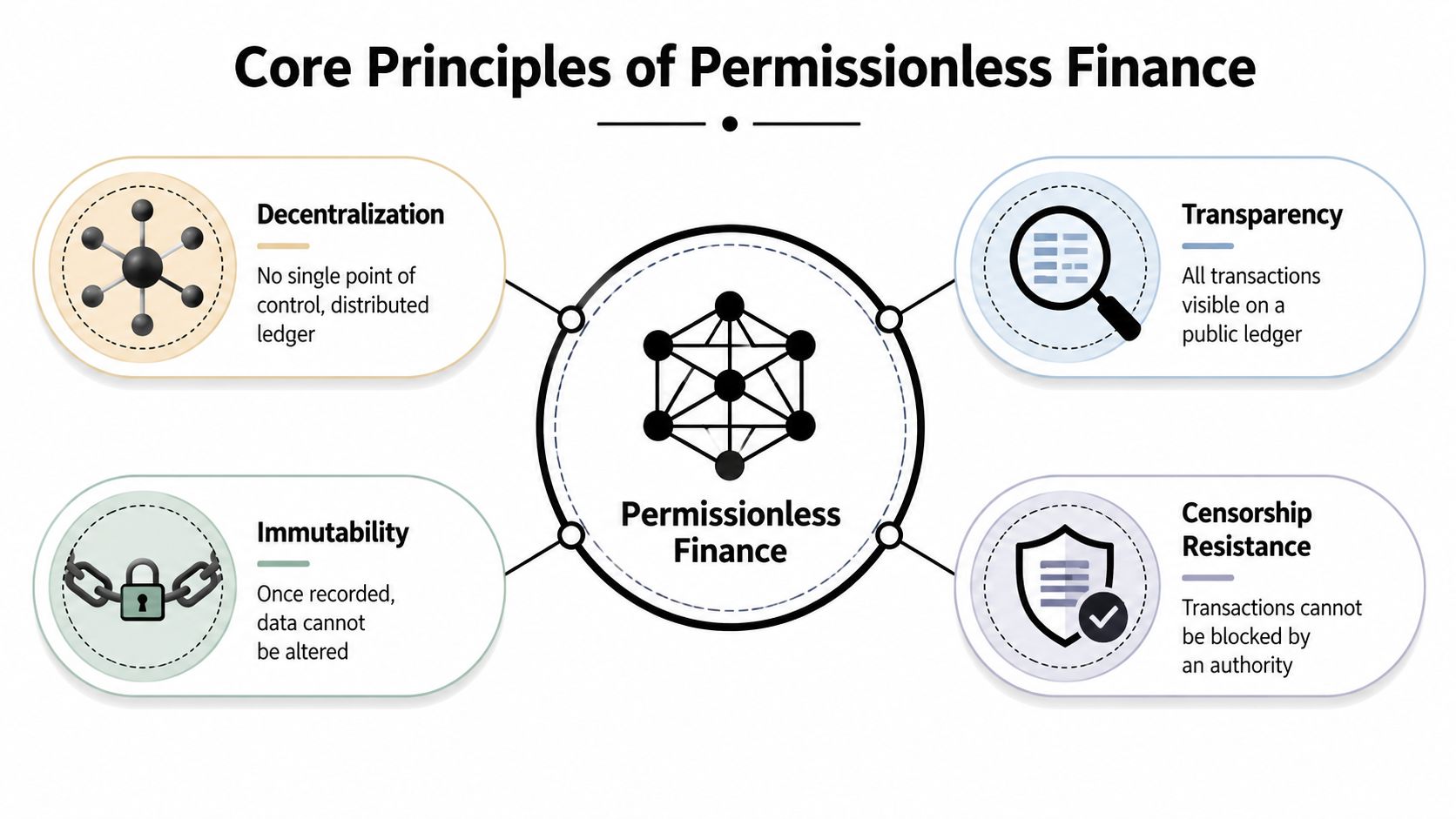
Here's the plain-English version of the core principles:
Decentralization: No single operator owns the ledger or approves every action.
Transparency: Users can inspect transactions and contract behavior on public infrastructure.
Immutability: Finalized records are difficult to alter retroactively.
Censorship resistance: A central party can't casually block valid transactions across the whole network.
Composability: Applications can connect to one another like shared financial building blocks.
Real-World Examples of Permissionless Protocols
The easiest way to understand permissionless finance is to follow what a user can do with it.
Swapping assets on a decentralized exchange
A decentralized exchange such as Uniswap lets a user swap one token for another directly from a wallet. There's no account application, no broker on the phone, and no order manually processed by an intermediary. The protocol uses liquidity pools supplied by users and prices trades according to its on-chain design.
That's useful when someone needs to move from one asset into another quickly, or when they want exposure to a market that doesn't exist inside their brokerage app.
What works here is speed, breadth of assets, and direct settlement. What doesn't work is treating every pool as equally safe. Liquidity quality varies. Slippage varies. A token being tradable doesn't mean it deserves trust.
Using a lending protocol
A lending market such as Aave lets users deposit assets and earn yield from borrowers, or post collateral and borrow against it. Again, the striking part isn't just that lending exists. It's that the process is handled by a protocol instead of a credit committee.
For stablecoin holders, this is often the first practical use case that clicks. Deposit USDC. Earn a variable return from protocol demand. Withdraw when needed, subject to market conditions and liquidity at the time.
The strength of this model is capital efficiency and constant availability. The weakness is that users need to understand collateral behavior, utilization changes, smart contract exposure, and liquidation mechanics if they borrow.
Moving stablecoins across open networks
Stablecoins such as USDC make the payment side of permissionless finance concrete. A user can hold dollar-denominated value in a wallet and move it across open networks without requiring a correspondent banking chain to process every transfer.
That's why stablecoins became the through-line for so much on-chain activity. They aren't only trading chips. They're the settlement asset for lending, liquidity provision, treasury movement, and many cross-border workflows.
When people say DeFi feels like software, stablecoins are a big reason why. They make value programmable in the same environments where applications already live.
A simple user journey
A typical path might look like this:
Fund a wallet with USDC.
Swap if needed on a decentralized exchange.
Deposit into a lending market to earn a base yield.
Track exposure across protocols and chains.
Exit back to stablecoins when market conditions or risk tolerance change.
No one institution owns that journey. The user assembles it from interoperable protocols.
Permissionless Finance and Stablecoin Yield Strategies
Stablecoin yield is where permissionless finance stops being abstract and becomes a portfolio workflow.
A simple version is straightforward. Deposit USDC into a lending protocol and earn whatever the market offers at that moment. But the reason yields vary across DeFi is that capital can move between protocols much faster than in traditional finance. Users, vaults, and automated strategies constantly reprice where funds are most useful.
How yield gets created
In practice, stablecoin yield usually comes from a few sources:
Borrow demand: Traders, arbitrageurs, and other users pay to borrow stable assets.
Liquidity provision: Users earn fees or incentives for providing assets to trading venues.
Strategy stacking: One protocol token or vault position becomes input collateral or routing logic for another protocol.
That last category is where permissionless finance becomes powerful and dangerous at the same time. Composability allows a strategy to layer multiple protocols together. You might deposit stablecoins into a lending venue, receive a receipt token, and then use that position inside another application. The upside is more ways to put idle capital to work. The downside is that each added layer introduces another contract, assumption, and failure mode.
What tends to work for real users
The durable approach isn't “find the highest number”; instead, it's to separate base yield from complex yield.
Base yield usually comes from large, established lending markets or conservative vault structures. It's easier to understand, easier to monitor, and easier to exit. Complex yield often depends on incentives, recursive borrowing strategies, thin liquidity, or several protocols behaving correctly at the same time.
A practical framework:
Start with asset quality: Stablecoin selection matters before strategy selection.
Prefer understandable flows: If you can't explain where the yield comes from, don't fund it.
Map dependencies: Ask what contracts, bridges, or wrappers sit underneath the front end.
Keep liquidity in mind: A strategy that looks liquid in calm markets can become sticky under stress.
Why this matters for treasury and personal capital
Permissionless finance creates a live market for stablecoin productivity. Idle on-chain dollars don't have to sit still. But “automatically productive” doesn't mean “automatically safe.” The job is to match strategy complexity with your monitoring capacity.
That's why many advanced users eventually stop chasing every new opportunity manually. The bottleneck becomes analysis, not access.
Navigating Risks and Regulatory Headwinds
The hardest mistake in permissionless finance is assuming openness reduces the need for controls. It does the opposite. Open systems need explicit risk discipline because many of the old backstops aren't there.

Technical and operational risk
Smart contracts are software. Software can fail. Code bugs, flawed upgrade paths, oracle dependencies, compromised admin controls, and poor integration design can all create losses even when the headline protocol looks reputable.
There's also settlement finality. The Basel Committee notes that permissionless systems introduce distinct risks: participant pseudonymity complicates KYC and AML, technical finality makes reversals difficult, and transparency can heighten liquidity risk for institutions. That guidance appears in the Basel Committee's paper on digital asset prudential treatment and permissionless blockchain risks.
That means wallet hygiene and transaction review aren't small details. They are part of the control stack.
Governance and compliance risk
A lot of users underestimate governance until something breaks. Then governance becomes the whole story.
The Federal Reserve has emphasized that governance in permissionless networks depends on multiple stakeholder groups such as developers, nodes, and users, while policy analysis has also flagged unresolved concerns around anonymous validators, unclear governance, probabilistic settlement, and security. The point isn't that these systems can't work. It's that governance has to be examined as an operating reality, not as a slogan. You can review that in the Federal Reserve note on governance of permissionless blockchain networks.
The protocol interface may look clean, but every serious allocation should include a governance question: who can change the rules, and how fast?
A simple risk checklist
Before using any protocol, check these areas:
Contract exposure: Is the strategy touching one contract or many?
Upgrade authority: Can admins pause, change, or migrate the system?
Liquidity path: Can you exit without relying on thin markets?
Stablecoin assumptions: What happens if the asset itself trades off target?
Compliance posture: Could changing policy or platform restrictions affect access?
If you want a more practical framework for reviewing exposure, Yield Seeker's guide on DeFi risk management is a good place to sharpen your process.
How to Participate Safely and Smartly
The safest entry into permissionless finance is boring by design. Use a self-custody wallet you understand. Start with small amounts. Stick to assets and protocols you can explain in one sentence. Don't stack complexity faster than your ability to monitor it.
A practical operating routine
Individuals need a repeatable process more than they need another token list.
Secure the base layer: Protect wallet access, review approvals, and separate experimental capital from core reserves.
Choose one stablecoin lane first: Don't start by juggling multiple chains, wrappers, and bridges at once.
Use simple strategies before nested ones: A direct lending position teaches more than a complicated vault stack.
Review position health regularly: Yield changes, liquidity changes, and protocol posture can change without notice.
That manual workflow is fine if you enjoy doing the research. Many experienced users do. But for time-constrained investors and teams, the friction compounds fast. You end up comparing protocols, checking dashboards, and deciding whether a yield difference is worth the extra dependency risk.
That's where tooling earns its keep. One option is Yield Seeker, an AI-powered platform that helps users allocate stablecoin deposits across DeFi protocols with a risk-aware workflow. According to the product information provided by the publisher, users can deposit as little as $10 USDC on Base, keep funds accessible without lockups or withdrawal fees, and use the platform's AI agent, terminal, and walkthroughs to monitor and manage yield opportunities without manually hopping across multiple apps.
A short walkthrough helps make that workflow more concrete.
What smart participation looks like
Good participation in permissionless finance isn't passive in the naive sense. It's structured.
Use software and processes that reduce avoidable mistakes. Favor transparency over hype. Keep capital mobile. Treat every yield source as a business model that needs explanation. And remember that open access is a feature, not a substitute for judgment.
Permissionless finance is already large enough to matter. The next challenge isn't access. It's operating well once you have it.
Yield Seeker fits that modern workflow for people who want exposure to stablecoin yield without turning protocol research into a second job. If you want a cleaner, AI-assisted way to monitor opportunities and keep control of your capital, explore Yield Seeker.