
You open your wallet, see a stablecoin balance that used to feel boringly safe, and then notice the protocol behind it is behaving strangely. Maybe withdrawals look slower than usual, maybe the peg is wobbling, or maybe the yield looks great just as the market gets nervous. That's the moment capital preservation stops being theory and becomes a live operating problem.
Capital preservation is the discipline of keeping losses bounded before they compound. It doesn't mean pretending risk is gone, and it doesn't mean chasing the highest yield and hoping for the best. In DeFi, where a “safe” position can be hurt by a depeg, an exploit, or an exit problem, preservation is the framework that tells you how much you can afford to lose, how you'll notice trouble early, and what you'll do before damage becomes unrecoverable.
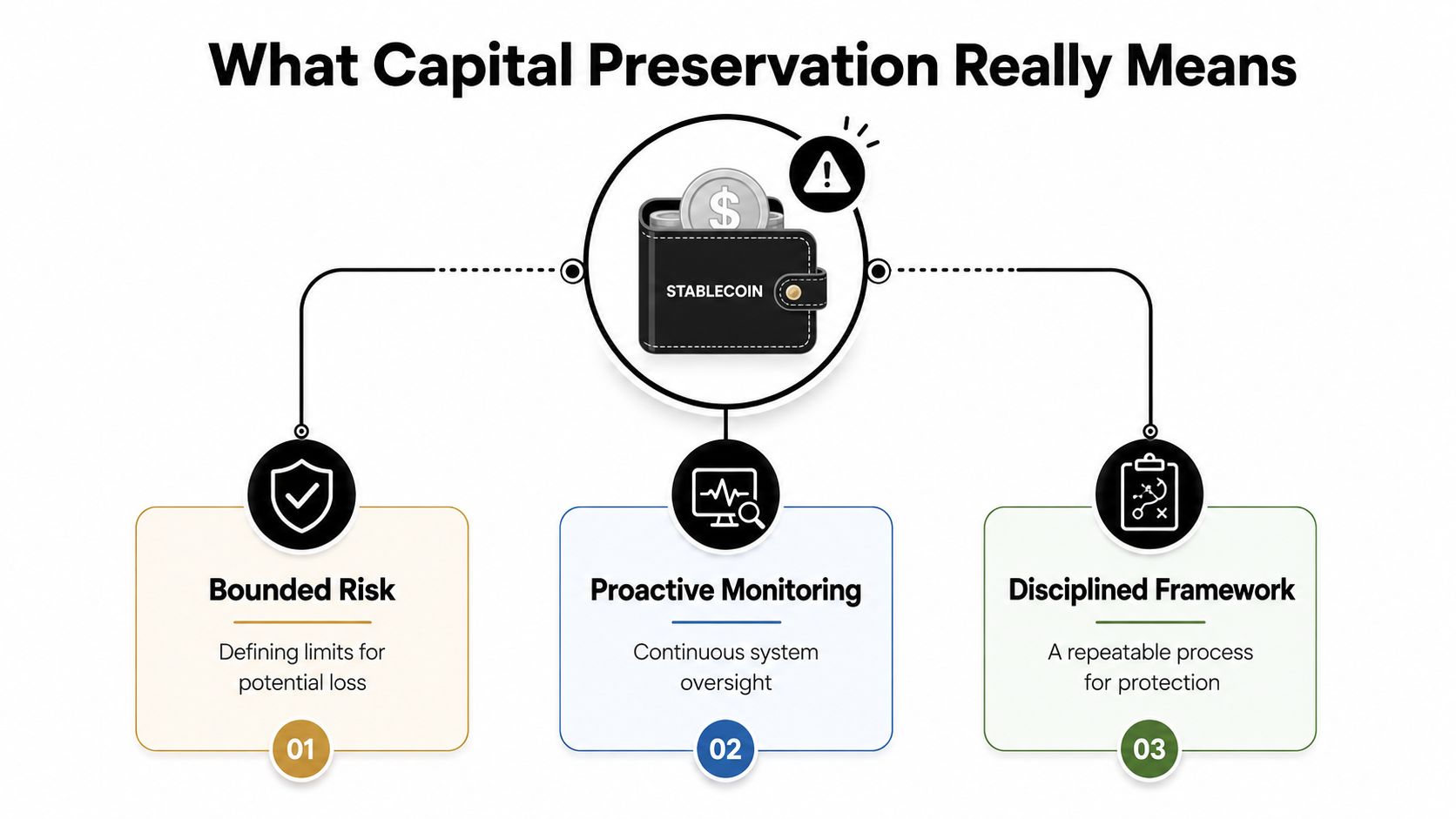
A useful way to think about it is recovery math. A 50% loss requires a 100% gain just to get back to break-even, and a 75% loss requires a 300% gain. That's why the old instinct to “stay in and win it back later” usually fails when capital is at stake, especially in markets that move fast and punish hesitation.
What preservation actually looks like in practice
In trading and treasury settings, the logic becomes simple. You set loss limits, size positions so one bad outcome can't sink the book, and watch for signs that a supposedly stable asset is no longer stable. The point isn't perfection, it's bounded downside.
That's the same mental model behind conservative treasury design in web3, where operating teams need structure, not vibes. A practical overview of those habits is laid out in treasury management for web3, and the core lesson is consistent, preservation is an active process, not a passive label.
If you need a personal baseline for reserve planning, keep a separate safety buffer for everyday liquidity, not just protocol exposure. A simple reference for that kind of planning is the guide on building an emergency fund, because capital preservation gets a lot easier when your spending runway isn't entangled with your on-chain positions.
Practical rule: if you can't explain how a position fails, how fast you'll know, and how you'll exit, you don't actually have a preservation plan yet.
What Capital Preservation Really Means
Capital preservation starts with one hard truth, your job isn't to eliminate risk, it's to make sure risk can't snowball. A stablecoin wallet can look calm for weeks, then one protocol issue or market shock turns “safe yield” into a recovery problem. That's why preservation is best understood as an operating discipline, not a product category.
The recovery-math lesson
The recovery math matters because losses don't reset cleanly. If a position falls by half, you need a full doubling just to get back to where you started. If it falls by three quarters, the climb back is much steeper, and that's before you account for the time and attention it takes to recover.
In DeFi, this matters because principal can leak in ways that don't always look dramatic at first. A stablecoin can depeg, a lending market can freeze, or a strategy can become illiquid right when everyone wants out. None of those outcomes require a total collapse to hurt you.
Preservation is bounded behavior
Good preservation strategies don't promise zero volatility, they impose rules on loss. Practitioners often frame that as risking only 1%–2% of account equity per trade and capping total intraday damage at about 3%–5% of equity. The point of those thresholds is simple, they're meant to stop one adverse move from turning into a drawdown that's hard to reverse, especially once volatility rises and recovery math works against you. See the capital-risk framing in capital preservation in trading.
That same logic maps cleanly to stablecoin portfolios. If a position's yield depends on a protocol staying liquid, solvent, and well-governed, then preservation means you size it so the worst plausible outcome stays survivable. You're not trying to “win back” losses later, because later may not be available.
The Five Risks That Erode Stablecoin Capital
A lot of people say “risk” as if it's one thing. It isn't. Stablecoin capital gets eroded through five different channels, and if you lump them together, you'll miss the warning signs that matter most.
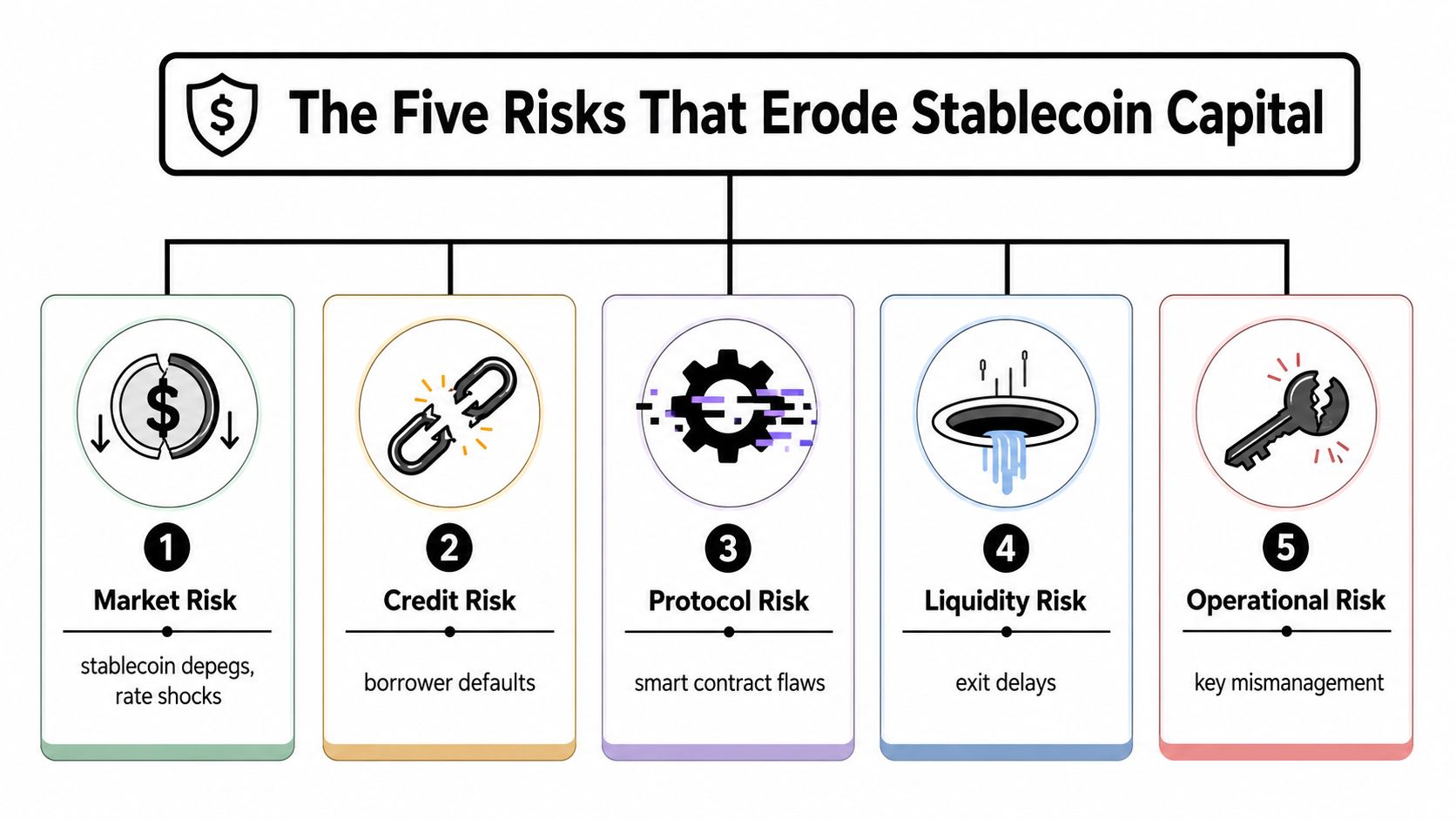
Market risk
Market risk is the risk that the asset's price or peg moves against you. In stablecoin land, that can mean a depeg or a rate shock that makes the position less attractive just when conditions shift. A clean warning sign is a stablecoin that stops trading like the stablecoin it claims to be.
Credit risk
Credit risk is the chance that a borrower or counterparty can't meet obligations. In DeFi lending, that shows up when a market relies on borrowers, vaults, or backstops that aren't as strong as they look. A sudden yield spike with no clear source often deserves suspicion, not celebration.
Protocol risk
Protocol risk comes from the code and governance itself. Smart contract bugs, bad upgrades, or governance attacks can hit even well-known systems, because code can fail and humans can make poor changes. If the protocol's rules can change quickly, your capital can be exposed quickly too.
Liquidity risk
Liquidity risk is the risk that you can't exit when you want to exit. Thin order books, trapped withdrawals, or a paused market turn a paper balance into something much less useful. The obvious cue is friction, when exits start taking longer or routes disappear.
Operational risk
Operational risk covers the plumbing, oracles, bridges, approvals, and key management. A protocol can look fine on the surface while a bridge exploit, oracle failure, or compromised key creates a real loss path. If your process depends on perfect operational hygiene, you should assume it won't stay perfect forever.
For a broader overview of how stablecoin exposure can go wrong, the breakdown in understanding stablecoin risks is a useful companion. It helps separate the story the APY is telling from the mechanics that protect principal.
If a yield source can't survive a pause in optimism, it probably wasn't capital-preserving to begin with.
Core Tools for Preserving Capital in DeFi
Preservation in DeFi works best when the toolkit is boring on purpose. You want shorter duration where possible, broad diversification, tight sizing, and a steady reminder that higher APY usually means higher risk. The job is to make risk legible before it becomes expensive.
Duration, diversification, and size
Short-duration positioning keeps you closer to cash and reduces sensitivity to rate moves. That's why preservation mandates often lean toward cash, Treasury bills, and short-duration high-quality fixed income, because price sensitivity rises with duration even when the asset itself looks conservative. The trade-off is obvious, you give up some yield and some inflation protection to reduce price shock, a logic described in capital preservation basics.
Diversification matters too, but not in a lazy “spread it everywhere” way. You want exposure across chains and protocols so a single failure doesn't define the whole portfolio. In DeFi, concentration risk can hide inside one ecosystem even when the positions look different on the dashboard.
Position sizing is the last hard control. A rule like “no single protocol above a fixed share of capital” gives you a ceiling before emotions start negotiating with the numbers. Once a position is large enough to hurt the whole book, the yield isn't the only thing magnified, the mistake is too.
What to check before you trust yield
On-chain diligence should be part of the process, not a separate hobby. Look at whether TVL is steady or unnaturally jumpy, whether the protocol has a long enough operating history to show behavior under stress, whether the audits are recent and relevant, and whether admin rights can move funds or change rules without broad consent. If the protocol's documentation hides these details, that's usually a signal in itself.
Insurance and audits help, but they're filters, not guarantees. A shiny badge doesn't remove protocol risk, it only changes how you think about it. The same goes for yield, if the return is there because the structure is taking hidden risk, the yield is part of the warning.
For a practical lens on what to monitor across vaults and markets, on-chain risk management is worth reading alongside your own checklist. It keeps the focus on observable signals instead of marketing language.
Sample Allocations for Different Investor Profiles
The cleanest way to make preservation useful is to match it to a real balance sheet. A solo holder with spare stablecoins doesn't need the same structure as a treasury with recurring payouts, and neither of them should use “low risk” as an excuse to ignore concentration.
Three profiles at a glance
Profile | Stablecoin Bucket | Lending / Money Market | LSDs and Yield Strategies | Risk Cap Per Protocol |
|---|---|---|---|---|
Conservative Preserver | Largest share stays in stablecoin reserves | Meaningful share in blue-chip lending and money markets | Small or none | Low single-protocol exposure |
Balanced Income Seeker | Split across reserves and productive positions | Core allocation in audited lending markets | Smaller sleeve in liquid staking derivatives and selective strategies | Tight cap, no single protocol dominating |
Yield-Oriented Treasury | More diversified across several strategies | One layer of conservative lending exposure | Larger but still controlled sleeve in yield strategies | Explicit ceiling per protocol |
How to read the table
The Conservative Preserver cares most about capital stability and access. That profile usually keeps the biggest share in stablecoin reserves and only uses well-known lending venues for a controlled amount of yield. The mental rule is simple, if the protocol stumbles, the portfolio should still function.
The Balanced Income Seeker accepts more moving parts. That profile spreads capital across audited lending and a smaller set of yield strategies, including liquid staking derivatives where the structure is understood and monitored. The rule that keeps it sane is concentration control, so one protocol can't become the whole story.
The Yield-Oriented Treasury is for teams that need income but still can't afford a single-point failure. It uses more diversification and stricter internal caps, because the more moving parts you have, the more important operational discipline becomes. If you're tracking ecosystem exposure closely, it helps to also track Avalanche ecosystem coins when that chain is part of your allocation universe, since ecosystem selection can change the risk picture.
A good allocation doesn't try to maximize every variable at once. It decides which variables matter most, then refuses to let the others dominate.
A Pre-Flight Checklist Before You Deploy Capital
Before you put funds into a new protocol, run the same checklist every time. This is the fastest way to separate a promising opportunity from a fragile one, because most failures show up in the design long before they show up in the returns.

The checks that matter
Protocol maturity: How long has it been live, and has it survived real stress?
TVL behavior: Is liquidity stable, or did it spike in a way that doesn't match the protocol's history?
Audit status: Were the contracts audited by reputable firms, and were the findings addressed?
Team and governance: Can you tell who controls upgrades, pauses, and parameter changes?
Economic model: Do the yields look sustainable, or are they mostly incentive-driven?
Those five checks don't replace judgment, but they remove a lot of avoidable mistakes. If a protocol is young, opaque, unaudited, and heavily dependent on incentives, the APY has to work much harder to justify the risk.
Decision rule: if three of the five checks fail, the yield probably isn't worth the capital risk.
A few extra questions sharpen the picture. Is there a bug bounty, or at least a public security process? Do admin keys allow unilateral upgrades or pauses? Are the oracles well explained, and what happens if they fail? Is there insurance coverage, and does it cover the thing you care about rather than a different layer of the stack?
That's the preservation habit, you don't ask whether something is safe in the abstract. You ask whether the failure modes are visible, bounded, and manageable before you commit capital.
Monitoring and AI Automation in a Preservation Workflow
Capital preservation breaks down when nobody is watching it. A position that was reasonable at entry can become sloppy later, and human attention tends to drift just when the portfolio needs discipline most. That's why monitoring needs to be built into the workflow, not added after a scare.
Alerts, triggers, and rebalancing
The simplest monitoring setup starts with alerts for peg deviations, TVL drops, and governance proposals that change risk. You can also define rebalancing triggers based on drift, not emotion, so a position is trimmed or moved when it crosses a rule you set earlier. That keeps decisions mechanical instead of reactive.
AI automation fits here as an execution layer, not as a yield-chasing shortcut. In a preservation workflow, the machine watches multiple opportunities, applies your filters, and updates allocations when your rules say it should. That matters most for busy investors and treasuries, because the cost of manual monitoring is usually inconsistency.
Where the workflow gets practical
A good setup keeps funds accessible, avoids lockups where possible, and treats monitoring as continuous. The goal is not to sit in front of dashboards all day, it's to make sure the portfolio behaves the way you intended even when you're not paying close attention. In other words, automation should enforce discipline, not replace it.
That is the upgrade from static preservation. Instead of choosing a “safe” allocation once and hoping it stays that way, you build a living process that checks, flags, and adjusts. The portfolio stays closer to the rules because the rules are no longer dependent on memory.
A 30-Minute Action Plan and Common Questions
Start by listing every stablecoin or DeFi position you hold right now. For each one, name the main risk family, write a hard loss limit, and set at least two alerts, one for peg or price behavior and one for protocol or governance changes. If a position can't be described in one sentence, it probably needs a closer look.
Then decide what you want the capital to do. If the answer is “sit safely,” lean harder into short-duration and liquidity. If the answer is “earn something while staying usable,” use tighter caps and keep the monitoring rules visible, because the preservation discipline only works when it's written down and checked.
FAQ
Does capital preservation mean very low yields? Not necessarily. It means you're choosing yield only after you've protected principal and liquidity, which is why the structure matters more than the headline return.
How do I avoid inflation eroding preserved capital? Don't confuse nominal safety with real safety. Cash-like assets can still lose purchasing power, so many investors pair preservation with inflation-aware instruments and reinvestment planning, as noted in the earlier section on the tension between safety and inflation.
What should I do if a stablecoin starts losing its peg? Treat it as a risk event, not a rumor. Reduce exposure, check redemption mechanics, and move faster if the peg weakness is paired with withdrawal friction or governance uncertainty.
Is AI automation safe enough for treasuries? It can be, if it's doing rule-based monitoring and allocation inside guardrails you control. Automation is most useful when it enforces your policy consistently instead of improvising.
Yield Seeker is built for this exact problem, turning preservation rules into a live, automated workflow for stablecoin capital. If you want a cleaner way to monitor opportunities, keep funds accessible, and stay inside your risk limits without hand-checking every protocol, visit Yield Seeker and see how the platform approaches stablecoin yield with discipline.