
You're probably holding stablecoins right now and asking a practical question: when a DeFi app says your funds are earning yield safely, what's keeping the system honest?
Most users look at APY, chain, and maybe audits. Fewer look at the oracle layer. That's a mistake. In lending markets, vaults, delta-neutral products, and many automated stablecoin strategies, the app's logic is only as reliable as the data feeding it. If the protocol gets bad prices, stale prices, or manipulated prices, the rest of the design can fail even if the smart contracts themselves are written well.
That's where Chainlink matters. Not because it's a buzzword, and not because “oracle” sounds technical, but because DeFi needs a way to know what's happening outside the blockchain. Asset prices, cross-chain messages, reserve data, and other external inputs don't appear onchain by magic. Someone has to fetch them, verify them, and deliver them in a way that doesn't create a giant trust hole.
For anyone earning yield on stablecoins, that's the primary lens for understanding Chainlink. It isn't just infrastructure in the background. It's part of the security model.
The Multi-Trillion Dollar Problem Chainlink Solves
A stablecoin vault can look conservative on the surface. Safe collateral ratios. Automated rebalancing. Audited contracts. Then one bad price update hits, liquidations fire at the wrong level, and users learn that "onchain" does not mean "correct."
That is the problem Chainlink was built to address.
Blockchains are very good at reaching consensus about transactions and state changes that happen inside the chain itself. They are not built to verify outside facts such as market prices, reserve balances, interest rates, proof of collateral, or messages from another chain. Smart contracts need those inputs to do useful financial work, but pulling data from a single API would recreate the same trust problem crypto is supposed to remove.
Chainlink was founded in 2017 by Sergey Nazarov and Steve Ellis to supply that missing infrastructure. Instead of asking one server for the answer, protocols can use decentralized oracle networks that fetch, compare, and deliver external data onchain in a way designed to reduce manipulation risk.
The scale tells you this is not a niche plumbing issue. On Chainlink's official site, the network is described as having enabled tens of trillions in transaction value, with thousands of data feeds used across DeFi and other onchain markets. That matters because the oracle layer often decides whether a lending market stays solvent, whether a synthetic asset tracks properly, and whether a yield strategy behaves the way depositors expect.
Why this matters for actual DeFi use
For yield seekers, the oracle problem is not abstract.
If a stablecoin strategy parks funds in lending protocols, collateral values need to be accurate enough to avoid unnecessary liquidations or underpriced risk. If a strategy uses wrapped assets, liquid staking tokens, or market-neutral positions, the protocol needs dependable reference prices to value positions and rebalance correctly. If capital moves across chains, the system also needs credible confirmation that assets really arrived and were not duplicated or spoofed in transit.
Without reliable external data, DeFi remains a closed system with limited usefulness. You can transfer tokens between wallets and contracts, but you cannot build credit markets, synthetic assets, structured products, or serious yield strategies around information the chain cannot verify on its own.
A practical way to assess protocol risk is simple. Do not stop at the smart contract audit. Check where the protocol gets its prices, how many sources feed those prices, how updates are triggered, and what protections exist if data turns stale or gets pushed off-market.
That is why Chainlink became part of the base infrastructure for so much of DeFi. It turns off-chain facts into inputs smart contracts can act on, and for anyone earning yield on stablecoins, that design choice is directly tied to capital preservation.
What Is an Oracle and How Does Chainlink Work
A smart contract can hold billions in collateral and still have one blind spot. It cannot check a market price, confirm bank reserves, or verify what happened on another chain by itself. If a yield strategy depends on any of that information, it needs an external input layer that can be trusted enough to act on.
That input layer is the oracle.
An oracle takes information from outside a blockchain and delivers it onchain in a format smart contracts can use. In DeFi, that usually means prices, proof of reserves, rates, and cross-chain messages. For a stablecoin yield strategy, those inputs shape basic decisions such as how positions are valued, when rebalancing should happen, and whether collateral is still safe.
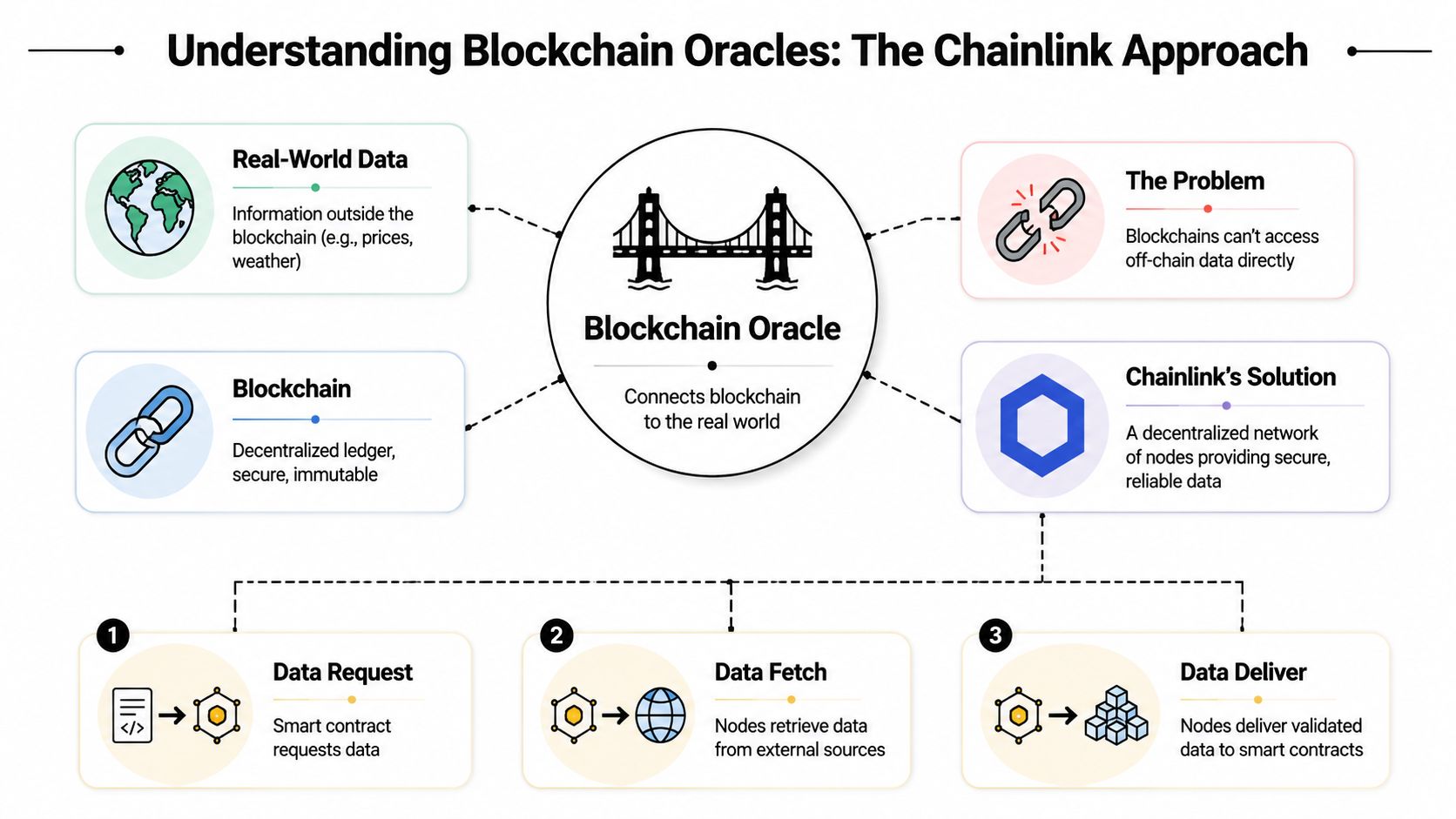
Chainlink handles this by using decentralized oracle networks, or DONs, instead of one server or one operator. Multiple independent nodes retrieve data from external sources, compare results, and produce a final answer that gets posted onchain. Chainlink explains that architecture in its overview of oracle network design and use cases.
The basic flow
The process is straightforward.
A protocol requests data. Chainlink nodes pull that data from one or more outside sources, apply aggregation rules, and submit the result onchain for the destination application to use. Those rules matter because they reduce the chance that one faulty API, one compromised node, or one outlier print becomes the value that a lending market or vault strategy relies on.
In practice, this design changes the risk profile. A centralized oracle may be cheaper and easier to run, but it also creates a single operational and security dependency. If that dependency fails during volatility, the protocol using it can fail with it.
For DeFi users, the difference shows up in places that affect returns and downside risk. Lending protocols use oracle inputs to determine collateral value and liquidation thresholds. Derivatives platforms use them for settlement. Cross-chain systems use them to validate messages between networks. Yield products built on top of those protocols inherit the quality of that oracle layer, whether users notice it or not.
Why Chainlink's design matters
Chainlink is best understood as trust-minimized infrastructure. Users still rely on real operators, real data providers, and real update mechanisms. The point is that no single actor should be able to control the outcome cheaply or without detection.
That matters a lot for yield strategies. If a stablecoin vault allocates across lending venues, wraps assets, or uses tokenized positions that depend on reference prices, oracle quality affects whether the strategy is pricing risk correctly. A bad feed does not just create a technical error. It can trigger avoidable liquidations, misprice shares, or distort rebalancing at the worst possible moment.
Chainlink shows up across DeFi because those failure modes are expensive. The network supports applications that need external data, off-chain computation, and cross-chain communication, including protocols such as Aave, GMX, and Lido, as noted earlier.
The practical takeaway is simple. Chainlink gives smart contracts a way to act on facts outside their own chain without handing that job to one party. For anyone earning yield on stablecoins, that is not background plumbing. It is part of the safety model.
The Four Pillars of the Chainlink Network
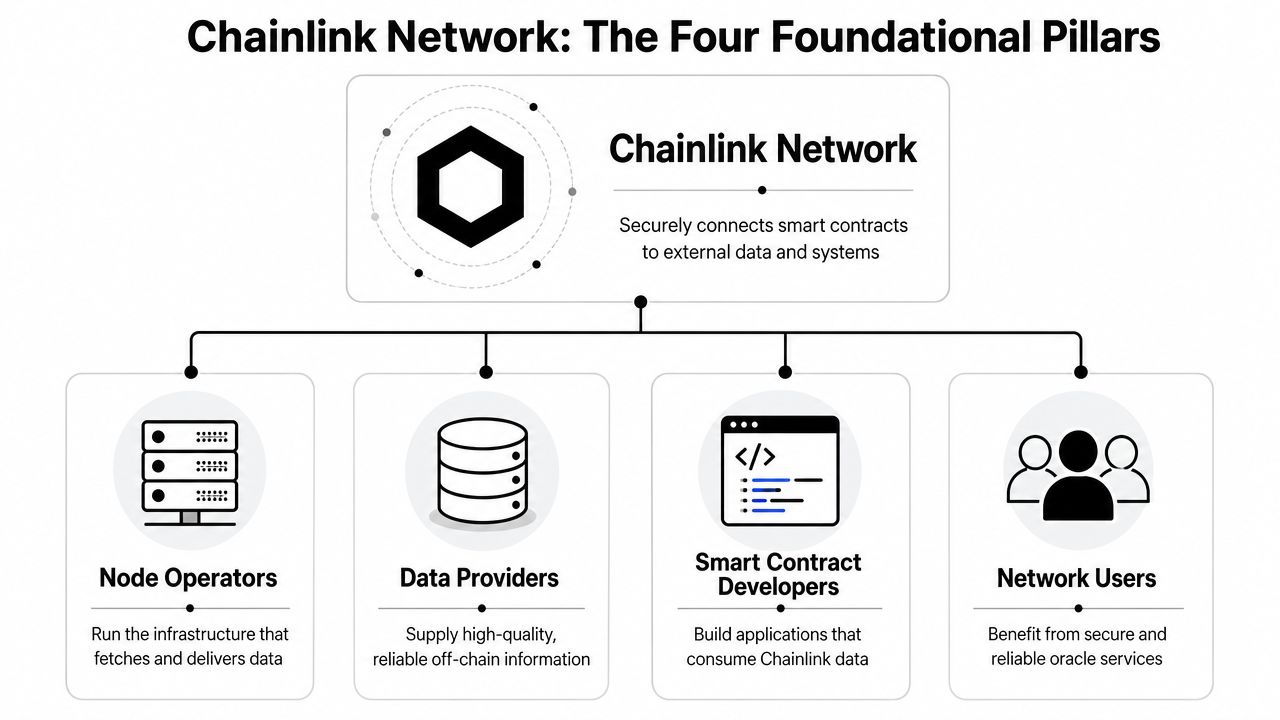
Chainlink's security model rests on four distinct layers working together. That division matters in practice. A yield strategy that depends on outside data is only as dependable as the weakest layer between the source and the smart contract.
Node operators
Node operators run the oracle infrastructure day to day.
They handle requests, pull data from external systems, sign reports, and deliver results onchain. Theoretical reliability becomes operational reality at this layer. If operators are careless, underprovisioned, or slow to respond during volatility, the quality of the network drops fast.
For DeFi users, that is more than backend trivia. A stablecoin strategy can look conservative on paper and still carry hidden risk if it relies on weak operational execution. Good oracle security includes uptime, redundancy, monitoring, and disciplined incident handling, which is the same logic behind on-chain risk management for DeFi strategies.
Decentralized oracle networks
A decentralized oracle network, or DON, is the coordination layer that groups multiple node operators around a specific job.
One DON may publish price data. Another may support automation, proof generation, or cross-chain messaging. That modular design gives Chainlink a practical advantage. Different services can use different operator sets, update patterns, and security assumptions instead of forcing every workload through one shared system.
That separation matters for capital allocation. A protocol securing large lending books does not want the same setup as a lightweight app that can tolerate delays or occasional stale data.
Data providers
Data providers supply the raw inputs that oracle nodes work with.
For price feeds, those inputs usually come from market data aggregators and trading venues. In other use cases, they can include reserve data, NAV calculations, or event outcomes. Node decentralization helps with delivery and verification, but it does not fix bad source material. If the underlying input is distorted, the network can still produce an answer that is wrong in a coordinated and well-delivered way.
This is one of the easiest mistakes to miss when evaluating DeFi risk. Teams often focus on the oracle brand and forget to ask where the data starts.
LINK token
The LINK token adds an economic layer to the network.
It is used to pay for oracle services and, in parts of the system, to support security incentives around honest performance. The practical point is straightforward. Oracle networks need more than software and good intentions. They need a way to reward reliable work and make poor behavior more expensive.
That matters for DeFi because financial systems fail at the margins. During calm markets, weak incentives can stay hidden. During stress, they show up.
A simple way to picture the whole stack
Pillar | What it does | Why DeFi users should care |
|---|---|---|
Node operators | Run the infrastructure | Weak operations can lead to delayed or unreliable updates |
DONs | Coordinate groups of operators for specific services | Security assumptions can be matched to the job |
Data providers | Supply external inputs | Source quality affects protocol pricing and risk controls |
LINK | Adds payment and incentive mechanics | Economic alignment supports reliable service |
The useful way to judge Chainlink is not whether each pillar sounds good in isolation. It is whether the full stack holds up when markets are moving hard, liquidations are close, and protocols managing user deposits need correct data on time.
How Chainlink Price Feeds Secure DeFi
A lending market can look healthy right up until the price feed slips. Borrowers appear safely collateralized, vaults keep rebalancing, and stablecoin yields keep flowing. Then the market moves fast, the oracle update lags or misfires, and a protocol finds out whether its risk controls were built for real conditions or for a calm chart.
That is why Chainlink price feeds matter in DeFi. They sit inside the decision loop for liquidations, collateral checks, settlements, and automated strategy logic. For users chasing yield on stablecoins, the feed is part of the safety system, even if they never touch borrowed capital directly.
What a feed is actually doing
Take an ETH/USD feed used by a lending protocol.
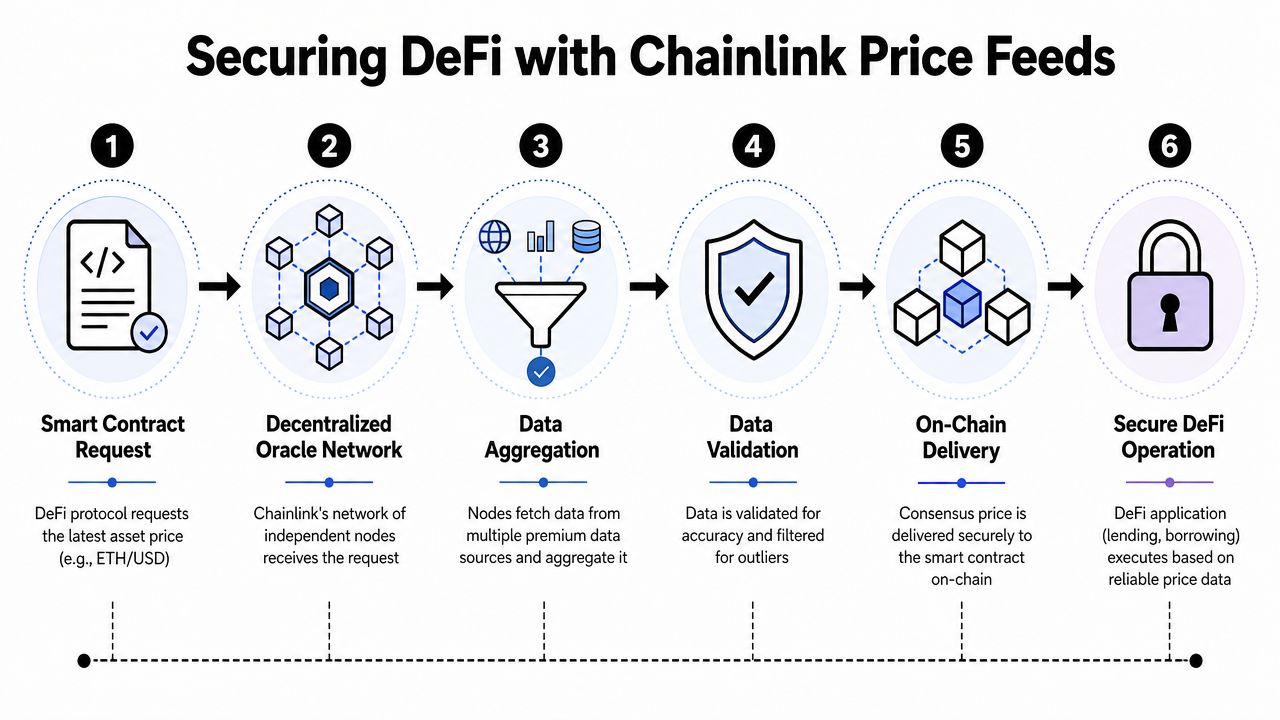
The protocol does not scrape exchanges itself. It reads an onchain answer produced by Chainlink infrastructure, which pulls market data from external sources, aggregates it across node operators, and publishes a price that smart contracts can use deterministically. That design matters because DeFi apps need a single answer onchain, but the market exists across many venues off-chain.
Chainlink's own overview of price feeds explains two mechanics that matter in practice. Deviation thresholds and heartbeat updates.
A deviation threshold triggers an update when the market has moved far enough from the last posted value. A heartbeat triggers an update after a set amount of time even if the market stays relatively flat.
Those settings shape the trade-off every protocol has to make. Tight update parameters can keep prices fresh, but they increase onchain update frequency and operating costs. Loose parameters reduce overhead, but they raise the chance that a liquidation engine or vault strategy acts on stale data. There is no universal best setting. A volatile long-tail asset and a deep stablecoin pair should not be configured the same way.
The useful question is not just whether a protocol uses Chainlink. The useful question is whether the specific feed setup fits the asset's liquidity, volatility, and role in the protocol.
A secure feed needs to do four things well:
Reflect current market conditions closely enough for borrow limits, margin checks, and settlement logic.
Reject bad inputs so a broken venue or obvious outlier does not distort the final answer.
Refresh predictably so contracts are not left relying on old prices during quiet periods.
Keep working during volatility because stress is when oracle assumptions get tested.
That last point matters most. Calm markets hide weak oracle design. Fast markets expose it.
How the process flows into DeFi logic
A practical walkthrough helps:
A protocol selects a feed for an asset tied to collateral, debt accounting, settlement, or strategy rebalancing.
Chainlink node operators source market data from external providers and trading venues.
The network aggregates those observations into a single answer that is meant to resist outliers and operational failures.
Update rules decide when to publish, based on market movement and elapsed time.
The value is written onchain, where smart contracts can read it without ambiguity.
Protocol logic acts on that price, whether that means allowing a borrow, triggering a liquidation, settling a derivative, or adjusting a vault position.
Later in the same workflow, it helps to see the visual explanation in action:
Why this matters for stablecoin yield
Stablecoin strategies often look low drama on the surface. Deposit USDC, earn a yield, let the system do the work. Underneath, many of those yields depend on lending books, collateralized positions, synthetic assets, LP exposures, or automated reallocations that all rely on accurate pricing.
If collateral is marked too high, a protocol can carry hidden insolvency risk. If prices update too slowly, liquidations can happen late and leave bad debt behind. If prices swing on poor inputs, users can get liquidated or strategies can rebalance into losses they should never have taken.
That is why oracle quality belongs in any serious review of on-chain risk management for DeFi yield strategies. The feed is not a background detail. It is part of the mechanism protecting deposited capital.
For platforms building yield products, Chainlink's design choices have a direct financial effect. Aggregation reduces dependence on any single venue. Scheduled and movement-based updates help balance freshness against cost. Onchain delivery gives every contract the same reference point. None of that removes risk completely, but it lowers the odds that a bad price becomes the reason a yield strategy fails.
For users, the takeaway is practical. If a protocol earns yield by taking market risk, oracle design is part of the strategy.
Understanding LINK Tokenomics and Staking
Chainlink can secure feeds technically and still fail economically if the people running those feeds have weak incentives. Tokenomics is the part that tries to prevent that.
LINK sits inside that incentive system. Oracle networks need node operators to fetch data, deliver it onchain, stay online during volatile markets, and protect their reputation over long periods. A token can help coordinate that work, but only if the economics make honest behavior more profitable than cutting corners.
That is why LINK matters beyond speculation. It is used to pay for services, and staking ties capital to performance. For anyone assessing DeFi risk, that matters more than the ticker. A yield strategy can depend on Chainlink every day without the user ever touching LINK directly, but the network still needs a credible way to reward reliability and penalize failure.
Why token design matters
Infrastructure tokens are harder to evaluate than simple app tokens. The key question is not just whether the network gets used. The question is whether usage creates durable demand for the token or strengthens the security model around the service.
Those are related, but they are not the same.
A lending market can rely heavily on Chainlink feeds and still leave investors debating how much value should accrue to LINK versus node operators, service revenue, or future staking demand. That gap is common in crypto infrastructure. Product-market fit and token performance do not always move together.
For readers newer to this topic, this explainer on crypto tokenomics and incentive design gives useful context for judging issuance, utility, and value capture together.
What staking adds
Staking adds economic weight behind oracle performance. Instead of relying only on reputation, the network can require participants to put capital at risk. If service providers perform as expected, they earn rewards. If they fail in ways the system is designed to punish, they can lose part of what they posted.
In practice, that gives LINK three distinct roles:
Payment for oracle services: data providers and node operators need compensation
Security collateral: staked LINK raises the cost of bad behavior
Incentive alignment: participants have direct exposure to the health of the network
The practical point for DeFi users is simple. If a protocol depends on Chainlink to value collateral or trigger liquidations, staking helps make those feeds more than a technical promise. It adds a financial backstop.
That does not remove risk. Staking systems have design limits, slashing conditions need to be enforceable, and the amount staked has to be meaningful relative to the value being secured. But the direction is clear. A stronger economic layer gives protocols another reason to trust the data they build on.
Why usage and LINK price can diverge
Many investors assume that wider Chainlink adoption should translate directly into LINK price appreciation. Sometimes it does. Sometimes it does not.
The missing step is value capture. A network can become more embedded in DeFi while the token still trades on a messy mix of expectations around future fees, staking participation, circulating supply, and market sentiment. That is normal for infrastructure assets. Railroads were useful before every railroad stock was a good trade, and oracle networks follow a similar logic.
AMBCrypto discussed this tension in its coverage of why reserve growth did not automatically push LINK higher. The broader lesson is the useful one. Adoption alone is not a complete investment thesis.
For DeFi users, the more relevant takeaway is operational, not speculative. If Chainlink's token model keeps high-quality node operators participating and gives the network stronger economic security, that supports the reliability of protocols built on top of it. And for stablecoin yield strategies, reliable infrastructure is not a side detail. It is part of what keeps a conservative-looking position from turning into an avoidable loss.
Chainlink's Evolution Beyond Price Oracles
A user deposits stablecoins into a yield strategy on one chain. The strategy rebalances collateral on another chain, checks a rate off-chain, and triggers an action only if risk stays inside set limits. Price data is still part of that flow, but it is only one part. The harder problem is coordination.
That is why Chainlink now matters as infrastructure, not just as a price feed provider. DeFi applications increasingly need a shared way to move data, send instructions, and automate actions across different networks without stitching together a fragile stack of custom tools.
From single-purpose oracle to operating layer
Price feeds made Chainlink famous, but modern DeFi asks for more than a market price every few seconds. Protocols need to verify events, pass messages between chains, and execute logic when specific conditions are met. If each team builds those rails from scratch, the attack surface grows and operations get messier fast.
Chainlink's broader stack addresses that operational burden. Oracle networks handle external data. Automation handles scheduled or conditional execution. CCIP handles cross-chain messaging and token transfers. Put together, those services start to look like core plumbing for onchain finance.
That shift matters for yield products in particular. Many DeFi yield farming strategies depend on more than a simple deposit-and-wait model. They rebalance, route liquidity, move assets between chains, and respond to changing market conditions. Each extra step creates another place where bad data, failed messaging, or delayed execution can turn an attractive APY into a real loss.
Where CCIP fits
CCIP stands for Cross-Chain Interoperability Protocol.
In practice, CCIP works like a standardized messaging rail between blockchains. An application can send an instruction from one chain to another, or move supported tokens alongside that message, without relying on a one-off bridge design for each route. That common framework matters because bridge logic has historically been one of the weakest parts of crypto infrastructure.
The trade-off is straightforward. Shared infrastructure can reduce custom integration risk, but it also concentrates trust in the quality of that infrastructure. For a protocol team, the question is whether it is safer to depend on a widely used system with clear security assumptions or to maintain bespoke cross-chain code that few people have battle-tested. In many cases, the first option is the more conservative choice.
Why the broader stack changes the DeFi equation
Chainlink's expansion beyond price oracles matters because DeFi products are becoming systems, not isolated apps. A lending market may need one service to read market data, another to trigger liquidations or rebalances, and another to communicate with contracts on a different chain. Treating those as separate problems often produces brittle architecture.
A unified stack does not remove risk. It changes where risk sits and how teams manage it. That distinction matters if you care about yield quality instead of headline yield.
For users, the practical takeaway is simple. A protocol that depends on accurate data, reliable automation, and secure cross-chain communication is only as dependable as the infrastructure behind those functions. Chainlink's evolution matters because yield strategies now depend on coordinated execution across many moving parts, and coordination failures are expensive.
Chainlink's Impact on DeFi Yield Strategies
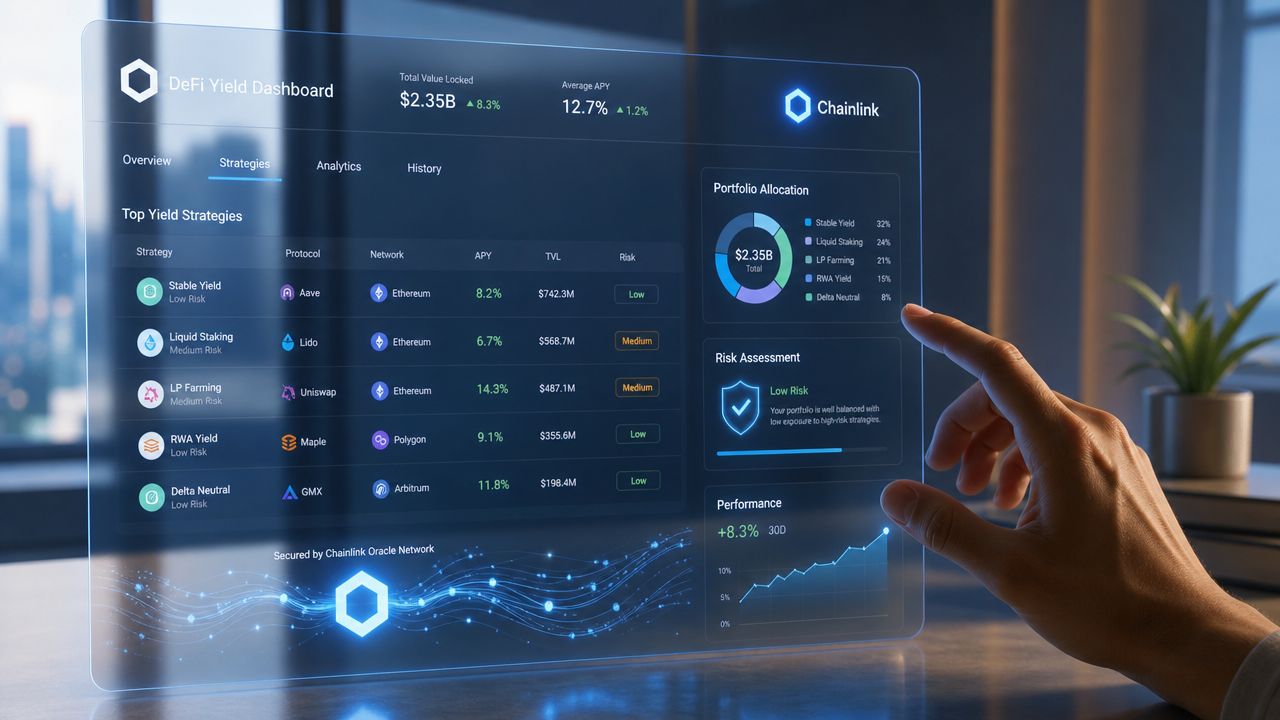
If you earn yield on stablecoins, oracle design isn't background trivia. It sits directly in your risk stack.
Most stablecoin strategies rely on protocols that evaluate collateral, debt, reserves, or cross-chain state. That could mean lending markets, debt-based loops, delta-neutral structures, vault reallocations, or strategies that move liquidity between chains and venues. In each case, the protocol needs trusted external inputs to decide what to do.
Oracle risk is yield risk
Suppose a stablecoin strategy deposits into a lending market that accepts volatile collateral. The lending protocol has to know when collateral values fall enough to require liquidation. If the oracle is wrong, the protocol can make the wrong call in either direction.
That creates two bad outcomes:
Liquidations happen too late, and the system accumulates bad debt.
Liquidations happen incorrectly, and users get hit even when their positions should be safe.
Neither outcome is academic. If your “stable” yield product routes through that market, your returns depend on the protocol surviving those conditions cleanly.
Why Chainlink's design choices matter
Chainlink's value to yield strategies comes from how it reduces common oracle failure modes.
A decentralized oracle network helps avoid the obvious single-server problem. Aggregation helps avoid overreliance on one data point. Update rules like deviation thresholds and heartbeats help balance freshness with consistency. When protocols handling real user funds choose infrastructure with those properties, they're reducing one important category of hidden risk.
That doesn't mean the strategy is automatically safe. It means one foundational layer has been thought through.
Here's the practical checklist I use when I look at a yield strategy:
Question | Why it matters |
|---|---|
What oracle does the protocol use? | Oracle selection affects liquidation and pricing risk |
Is the protocol dependent on one feed or multiple services? | Hidden complexity can create hidden failure points |
Does the strategy rely on cross-chain movement? | Messaging risk matters alongside price risk |
What happens if data is delayed or disputed? | Good protocols define fallback behavior |
If you want a broader framework for reviewing opportunities through this lens, this guide to DeFi yield farming strategies is a useful complement to any protocol-specific analysis.
What works and what doesn't
What works is boring, and that's the point. Strong DeFi infrastructure should feel uneventful most of the time.
Good oracle design usually means:
Reliable collateral pricing
Predictable liquidation behavior
Lower manipulation risk
Cleaner integration into high-value protocols
What doesn't work is the opposite:
Thinly designed custom oracles
Single-source dependencies
Feeds that lag badly in volatile markets
Cross-chain systems with unclear trust assumptions
If a protocol promises attractive stablecoin yield but can't clearly explain its oracle model, treat that as a risk signal, not a documentation gap.
For newer users, Chainlink can sound abstract because it runs under the hood. For experienced DeFi users, that's exactly why it matters. The most dangerous risks are often the ones hidden behind a smooth interface and a clean APY number.
Stablecoin yield is never just about the strategy logic. It's about the quality of every dependency underneath it. Chainlink matters because it improves one of the most important dependencies in the stack: the data and messaging layer that tells DeFi systems what reality looks like.
Yield Seeker helps stablecoin holders put this kind of risk-aware thinking into practice. If you want a simpler way to monitor and allocate capital across DeFi without manually tracking every protocol, market move, and infrastructure dependency yourself, explore Yield Seeker.