
You open your wallet or portfolio tracker and see a new prompt tied to a token you picked up from farming, an airdrop, or a liquidity position. There's a governance vote live. The title looks technical. The forum thread is long. The deadline is close.
Many overlook it.
That's usually a mistake, especially if you hold stablecoins and your return depends on protocols you don't actively monitor every day. A governance vote can change the fees you pay, the rewards you earn, the assets a protocol accepts, the risk settings behind a yield strategy, or the way protocol treasury money gets deployed. If your stablecoins sit inside DeFi, governance isn't background noise. It's part of your yield stack.
The practical question isn't “Are governance tokens interesting?” It's simpler. When a protocol changes its rules, do you understand how that change hits your stablecoin returns and your downside? That's what a governance token is really about.
Your First Governance Vote What Do You Do
You're holding a token tied to a lending market, DEX, or yield protocol. Maybe you earned it as incentives on top of your stablecoin APY. Then a notification lands: proposal up for vote.
The first reaction is usually one of three things:
Ignore it: it feels like DAO theater.
Sell the token: easier than reading ten pages of forum arguments.
Panic-read the proposal: then realize half the terms are unfamiliar.
A better response starts with one question: does this proposal touch cash flow, risk, or access? If yes, it matters.
A vote can change stablecoin collateral rules, incentive emissions, treasury spending, interface behavior, or liquidity-provider rewards. Those aren't abstract governance topics. They affect where your capital can go and what it can earn. If you're using multiple protocols, one proposal upstream can ripple through your whole strategy.
Start with the wallet and the asset path
Before you even read the proposal, trace where your stablecoins sit. Are they in a lending market? A vault? A DEX LP? A strategy wrapper built on top of another protocol? If you need a refresher on custody basics, this guide to how a DeFi wallet works is useful because governance only matters if you know which assets and permissions you control directly.
Then skim the proposal title and ask:
Does it alter fees or reward distribution?
Does it change supported assets or risk parameters?
Does it move treasury funds toward incentives, buybacks, grants, or operations?
Does it upgrade contracts or execution logic?
If the answer is no across the board, your vote may have limited economic value. If the answer is yes to any of them, this isn't spam.
Practical rule: Treat every governance vote like an earnings-call memo for a protocol you own exposure to. If it changes revenue, reserves, or risk policy, it deserves attention.
Busy investors often think governance only matters to token speculators. In practice, stablecoin holders feel the effects too. The protocol sets the rails. Governance decides how those rails move.
What Is a Governance Token Really
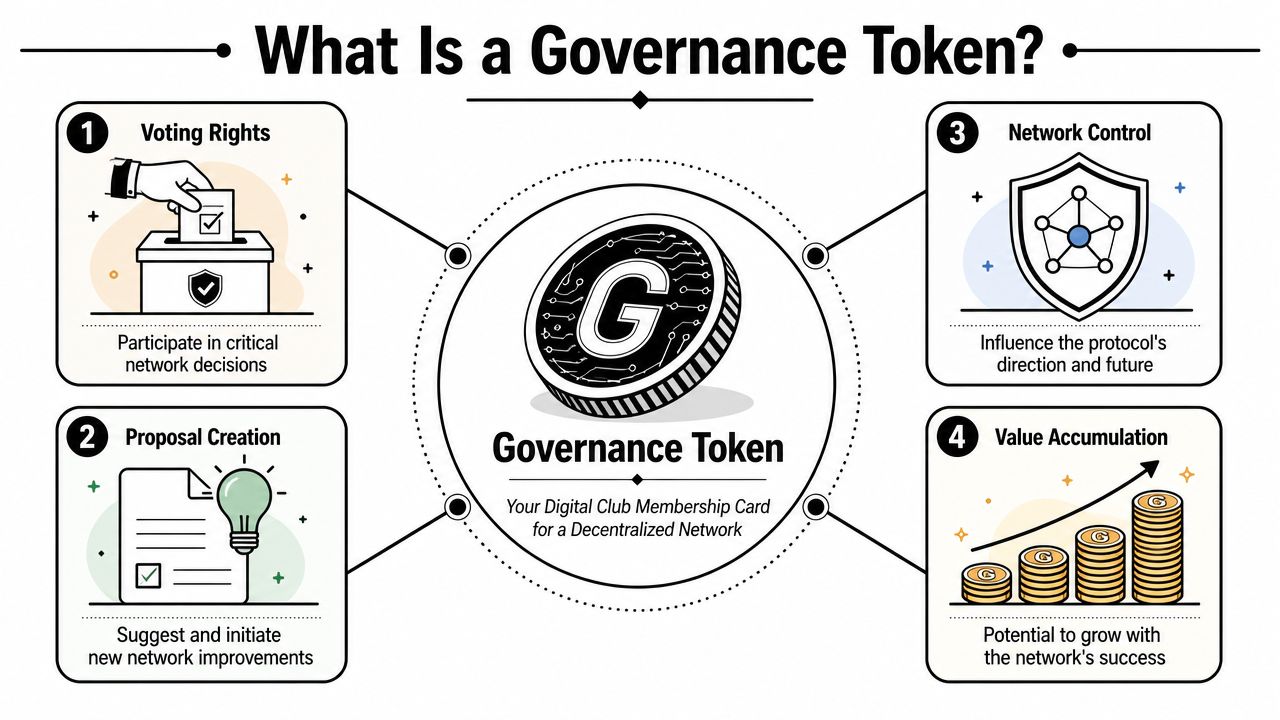
A governance token is the mechanism that lets holders participate in on-chain decision-making for DeFi protocols and DAOs, often through a one-token-one-vote model. Passed decisions can be executed automatically by smart contracts rather than manually by a company board, which creates a distributed governance layer in crypto, as described in MoonPay's overview of governance tokens.
The cleanest analogy is a digital co-op.
If a DeFi protocol were a normal company, management would decide fee policy, product changes, treasury use, and technical upgrades. A governance token changes that structure. Holders become the members with formal voting rights over the operating rules.
It's not just a badge
A lot of beginner explainers stop at “you get to vote.” That's incomplete.
What you're really holding is a claim on control over the protocol's future decisions. That can include software upgrades, treasury allocation, feature changes, bug fixes, compensation policy, liquidity rewards, and interface choices. In many systems, holders vote during scheduled periods, and the result is carried out by code instead of a central operator.
That's a big shift. It's why governance tokens became central to DAOs and DeFi rather than a side feature.
Coin ownership in this context is closer to membership power than to a coupon. Whether that power becomes valuable depends on the protocol's economics and whether governance can affect them in a meaningful way.
Why stablecoin holders should care
If you're yield farming with stablecoins, you may never plan to become a “governance participant.” But governance still reaches you in two ways:
Directly: you receive governance tokens as rewards.
Indirectly: the protocols producing your yield are steered by token holders.
That second point is more significant than often realized. You can earn stablecoin yield from a strategy today and still get blindsided later if token holders vote for looser risk settings, different incentives, or treasury decisions that weaken long-term sustainability.
For readers interested in exploring blockchain's applications beyond trading, governance is one of the clearest examples of how blockchains turn organizational rules into visible, executable systems.
A governance token also sits inside a broader economic design. If you want to evaluate it properly, you need to understand what tokenomics means in practice, because voting rights without sound distribution and value capture often don't hold up.
Governance tokens turned crypto products from managed apps into systems where users can help write the operating manual.
How Governance Mechanisms Actually Work
The mechanics matter because bad assumptions here lead to bad trades. Many investors think voting power equals the tokens in their wallet right now. In production governance, that often isn't true.
Protocols commonly use ERC20Votes-style snapshotting and delegation, which means voting power is recorded at a specific past block and users can delegate their full voting power to another address. Optimism's governance token spec explicitly uses this structure, and that design means the relevant balance is the historical one at snapshot time, not the live balance when execution happens, as documented in the OP Stack governance token specification.

The normal proposal lifecycle
Most governance systems follow a pattern even if the interfaces differ.
Stage | What happens | Why you care as an investor |
|---|---|---|
Discussion | Community members debate a change in a forum or chat | Early sentiment often tells you whether a proposal is symbolic or likely to pass |
Proposal submission | A formal proposal is posted with executable details | This is where the real economic impact becomes visible |
Voting window | Token holders or delegates cast votes | You learn who actually controls outcomes |
Execution | Approved changes are implemented, often after a delay | This is when yield, risk, or treasury changes become real |
That sounds simple. The edges are where things get serious.
Snapshotting and delegation
Snapshotting solves a manipulation problem. Without it, someone could move tokens around during voting in ways that distort power. By fixing voting power at a specific block, the protocol ties your vote to a historical balance.
Delegation solves a participation problem. Most holders don't want to read every proposal. So they delegate voting rights to a more active address, often a governance specialist, protocol insider, or researcher. In some systems, delegation is one-way and applies to your full balance.
That creates a practical split between economic ownership and active control.
If you hold the token but never delegate or vote, you still own the economics, but someone else may shape the rules that govern them.
Here's the embedded explainer if you want a visual walkthrough of governance mechanics:
The controls that separate good governance from chaos
Not every vote should lead to instant execution. Strong systems usually add friction in the right places.
Proposal thresholds keep random spam from reaching formal vote.
Timelocks create delay between approval and execution, which gives users time to react.
Execution contracts restrict how approved changes are carried out.
Off-chain discussion tools let ideas get challenged before they touch contracts.
What works in practice is boring by design. The best governance stack is one where proposals are easy to inspect, voting power is hard to game, execution is delayed long enough for review, and delegation is straightforward.
What doesn't work is symbolic decentralization. That's when a protocol advertises community control but makes participation so clumsy that only a tiny set of insiders can act.
The Economic Value of Governance Tokens
A governance token matters financially when governance controls something that can affect revenue, incentives, treasury usage, or market structure. If the token can't influence those levers, the governance story is thin.
Many yield-focused investors often trip up by treating governance rewards as a bonus they can dump immediately, without checking whether the token controls a meaningful economic machine. Sometimes selling is the right move. Sometimes it's the lazy move.
Control over parameters is economic value
A protocol's token holders may be able to direct treasury spending, adjust liquidity-provider rewards, influence compensation, set fee-related policies, or approve upgrades that make the protocol more or less competitive. Even when there's no direct payout to holders, governance can still determine whether the protocol compounds value internally or leaks it through bad incentives.
For stablecoin users, that matters because yield often comes from a chain of protocol decisions:
a market decides what collateral rules apply
a DEX decides how rewards are distributed
a treasury decides whether to subsidize growth or conserve resources
a governance body decides whether to turn temporary incentives into durable design
That chain shapes your return profile.
Token weight is only the starting point
Voting power is usually proportional to token ownership, but many protocols now add controls like locking duration, delegation, proposal thresholds, and timelocks to reduce concentration risk and tie influence to commitment, as outlined in Cube Exchange's discussion of governance token design.
That means the question isn't just “how many tokens exist?” It's also:
Who can lock them, and for how long
Who can delegate them
Who can get proposals on the ballot
How quickly approved proposals execute
A token with weak governance plumbing can have a famous brand and still deliver poor governance outcomes. A smaller token with disciplined execution rules can be far more relevant to your portfolio.
A practical lens for stablecoin holders
When you receive a governance token from incentives, evaluate it like this:
Check | What to look for | Why it matters |
|---|---|---|
Governance scope | Can holders influence fees, treasury, emissions, or risk settings? | Wider authority usually means stronger economic relevance |
Commitment model | Does voting require locking or wrapper mechanics? | Locking changes liquidity and your opportunity cost |
Execution safety | Are there thresholds and timelocks? | Weak execution design increases governance risk |
Participation path | Can you delegate easily? | Delegation makes passive ownership more useful |
Working heuristic: A governance token earns attention when it can influence the protocol's economics faster than market narratives can.
The mistake is to treat all governance tokens as equal. Some are soft-power assets. Some are operating keys.
Governance in Action Key Examples
The label “governance token” hides very different incentive systems. Uniswap, Aave, and Curve are often grouped together, but the holder experience is not the same.
The fastest way to understand the differences is to compare what each model optimizes for.
Comparison of DeFi Governance Models
Protocol | Token | Primary Governance Focus | Voting Power Source | Holder Rewards |
|---|---|---|---|---|
Uniswap | UNI | Treasury direction, protocol-level decisions, ecosystem priorities | Token holdings and delegated voting | Indirect upside depends on governance relevance and protocol trajectory |
Aave | AAVE | Risk management, market parameters, protocol operations | Token holdings, delegation, active governance participation | Economic value depends on how governance shapes protocol safety and utility |
Curve | CRV | Emissions control, gauge influence, operational power over incentives | Locked token model tied to commitment | Voting rights can be linked more directly to yield positioning and incentive capture |
Uniswap is the clean template many people picture first. The token signals ownership of governance rights over a major protocol. The practical question for a holder is whether governance can turn that power into durable value rather than endless debate over treasury spending.
Aave feels more operational. Governance there is less about symbolism and more about policy. If you use lending markets, this style matters because parameter changes can affect borrowing conditions, supported assets, and protocol risk posture.
Curve changed the conversation by pushing the vote-escrow model into the center of DeFi strategy.
Why the vote-escrow model changed incentives
Recent mainstream coverage has highlighted an emerging trend for 2026: vote-escrow models where tokens must be locked to gain voting rights and yield boosts. That shifts governance from community voice toward operational control and direct yield capture, as discussed in CoinGecko's governance token trend analysis.
That's the breakthrough stablecoin holders should pay attention to.
Under a simple token-weighted model, you can hold the asset liquid and still vote. Under a vote-escrow system, governance power often increases when you lock tokens. The trade-off is immediate:
keep liquidity and reduce governance influence
sacrifice liquidity and gain more say, and sometimes stronger economic alignment
For yield seekers, that changes the portfolio math. Governance is no longer just a side right attached to a token. It can become part of the yield engine itself.
A token that requires locking asks a harder question than “Do you support the protocol?” It asks “How much liquidity are you willing to give up to influence its cash flows?”
What this means in portfolio terms
If your stablecoin strategy routes through protocols shaped by these models, don't just track APY. Track the governance design underneath it.
A protocol with active treasury governance might direct incentives aggressively for growth. A protocol with strong risk governance might preserve safety but move slower. A vote-escrow design may reward committed insiders more than casual farmers.
Those are not minor design choices. They determine whether your stablecoin yield is durable, subsidized, or politically fragile.
Navigating Governance Risks and Attack Vectors
The sales pitch for governance tokens is decentralization. The practical application is often less clear-cut.
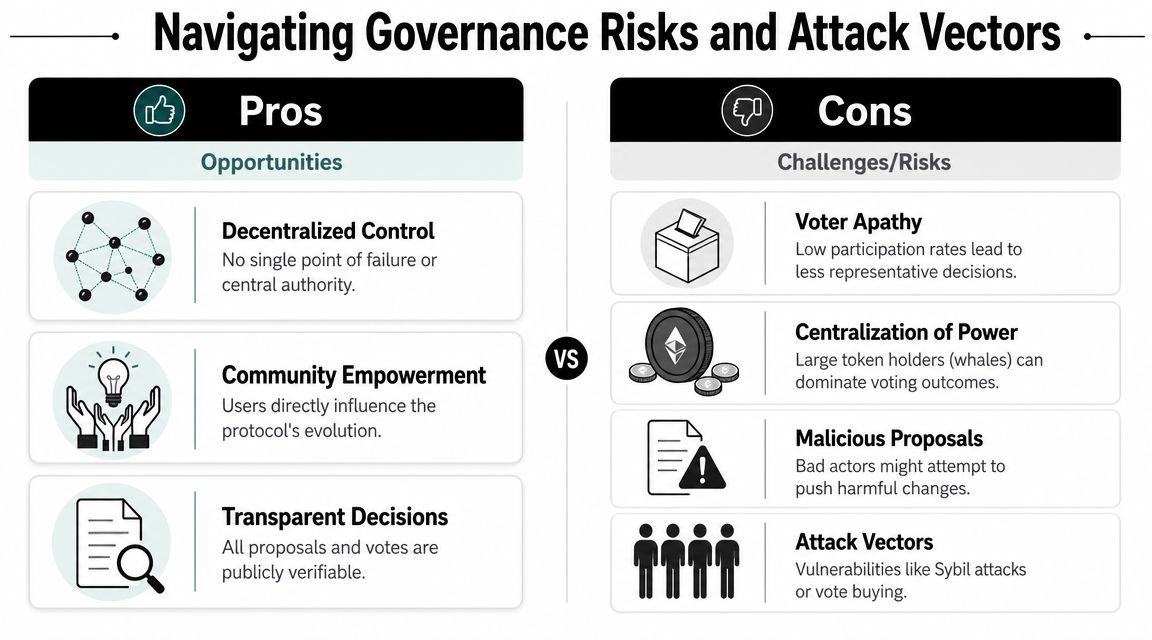
The core problem is simple: a protocol can distribute voting rights widely in theory and still end up controlled by a narrow group in practice. That happens through token concentration, low participation, passive holders, and delegated blocs that become semi-permanent centers of power.
A useful critique comes from the observation that the one-token-one-vote ideal often collides with voter apathy and concentrated ownership, which can let a small number of large holders dominate outcomes, as noted in World's explainer on governance token power concentration.
The risks that matter most
For a stablecoin investor, governance risk isn't philosophical. It's portfolio risk.
Voter apathy: if most holders ignore votes, motivated minorities can set policy.
Whale dominance: large holders can shape outcomes without broad consensus.
Proposal quality risk: bad code or bad economics can pass even without malicious intent.
Governance capture: alliances of delegates, insiders, or aligned funds can steer decisions consistently.
One of the most practical things you can do is pair governance review with broader protocol risk review. This primer on managing DeFi smart contract risk is helpful because governance failures and contract failures often interact. A proposal can authorize changes that alter your technical risk, not just your yield.
Red flags before you commit capital
You don't need to become a full-time delegate to spot weak governance. Watch for signs like these:
Red flag | What it usually signals |
|---|---|
The same small set of addresses drives every result | De facto centralization |
Proposals pass with little debate | Weak review culture |
Execution happens too fast | Limited time to exit or react |
Governance rewards favor locked insiders heavily | Reduced flexibility for ordinary holders |
Don't confuse visible governance with healthy governance. A public vote can still produce bad outcomes if power is concentrated and scrutiny is low.
The safest mindset is skeptical, not cynical. Governance can work well. But it works best when the protocol acknowledges power concentration as a design problem and uses thresholds, timelocks, and participation tools to constrain it.
Your Governance Playbook for Yield Strategies
Stablecoin holders don't need to vote on everything. They need a repeatable way to decide when to vote, when to delegate, and when to exit.
That decision starts with your actual source of return. If the token has no clear role in protecting or improving the yield path you care about, active participation probably isn't worth much. If the token governs the protocol rules that shape your stablecoin income, ignoring it can be expensive.
A simple decision framework

Use this filter when a governance token lands in your wallet or a live vote appears:
Check yield impact first
Ask whether the proposal changes fees, incentives, collateral rules, treasury deployment, or execution logic tied to your stablecoin positions.Assess control quality
Look at whether governance appears broad or concentrated. If a few holders dominate outcomes, your independent vote may matter less than your decision to stay exposed.Choose your mode
Vote directly if the proposal clearly affects your returns and you understand it.
Delegate if the protocol matters to your strategy but you won't track every thread.
Sell if the token's governance power looks weak, captured, or disconnected from economic value.
What usually works
For most investors, the practical setup is hybrid.
Hold and sell systematically when governance rewards are mostly extra compensation with limited strategic value.
Delegate when a protocol is core infrastructure for your yield strategy but active governance would consume too much time.
Lock and engage only when the economics justify giving up liquidity and the governance design has real operational power.
That last point matters. Locking for governance can improve influence and sometimes improve reward alignment, but it also reduces your freedom to rotate capital. Stablecoin strategies work best when you preserve optionality unless the compensation for giving it up is compelling.
Your governance token isn't just a vote. It's a decision about time, liquidity, and whether you trust the people who will shape the protocol around your capital.
Good governance analysis makes you a better yield investor because it forces you to ask where returns come from, who can change them, and how fast those changes can hit your portfolio.
If you want a simpler way to earn on stablecoins without manually tracking every protocol change, Yield Seeker helps automate risk-aware yield discovery and allocation so you can stay focused on results instead of chasing every DAO thread.