
Your stablecoins are probably sitting on one chain while the yield you want sits somewhere else. USDC on Base looks fine until a better lending rate appears on another network, or a new pool opens where your capital isn't already parked. That's the normal DeFi problem now. Not finding yield. Reaching it without adding more risk than the extra return is worth.
For stablecoin holders, cross-chain isn't an abstract infrastructure topic anymore. It's the operating layer behind basic decisions like where to park idle cash, when to move it, and whether the move still makes sense after bridge friction, wallet hops, and smart contract exposure.
The Challenge of a Multi-Chain World
Stablecoin yield used to be easier to scan. You compared a few protocols on one major chain and made a call. Today, the same dollar can earn in several places, but those places are split across separate networks with separate liquidity, apps, and user bases.
That fragmentation changes the job. You're no longer just picking a protocol. You're picking a chain, a route, and a security model.

Why fragmentation matters to yield
A stablecoin investor usually sees the same pattern:
Funds are idle on one network: Your USDC is ready to deploy, but current options on that chain are average.
Better opportunities appear elsewhere: A different chain has deeper incentives, a stronger market, or a newer venue.
Moving capital takes work: You need a bridge, gas on both sides, and confidence that the route is worth the hassle.
That's why cross-chain knowledge has gone from optional to practical. If you ignore it, you accept whatever yield exists on the chain you already use. Sometimes that's the right move. Sometimes it means leaving good opportunities untouched because the path is annoying.
Cross-chain activity is also far from niche. Chainalysis reported that monthly transaction volume bridged across chains hovered between $1.5 billion and $3.2 billion during 2024, showing sustained use rather than a small experimental corner of crypto, as detailed in Chainalysis's introduction to cross-chain bridges.
The investor problem is practical, not theoretical
Most stablecoin holders don't care about interoperability as a slogan. They care about whether moving funds improves net results.
Practical rule: A higher displayed APY on another chain isn't automatically a better trade. The route matters as much as the rate.
Many guides often miss the point. They explain bridging as if the main goal is technical freedom. For investors, the primary concern is capital efficiency. If liquidity is split across chains, your portfolio becomes harder to manage. If you want a deeper look at that portfolio problem, this breakdown of fragmented DeFi markets is a useful companion.
Cross-chain infrastructure exists because DeFi no longer lives in one place. The opportunity is real. The inconvenience is real too. And for stablecoin users, the difference between a smart move and a bad one often comes down to whether the extra complexity pays for itself.
What Is Cross-Chain Technology
Each blockchain operates like its own settlement environment, with its own rules, assets, applications, and liquidity. Funds do not move between those environments on their own. A separate system has to coordinate that transfer.
That system is cross-chain technology.
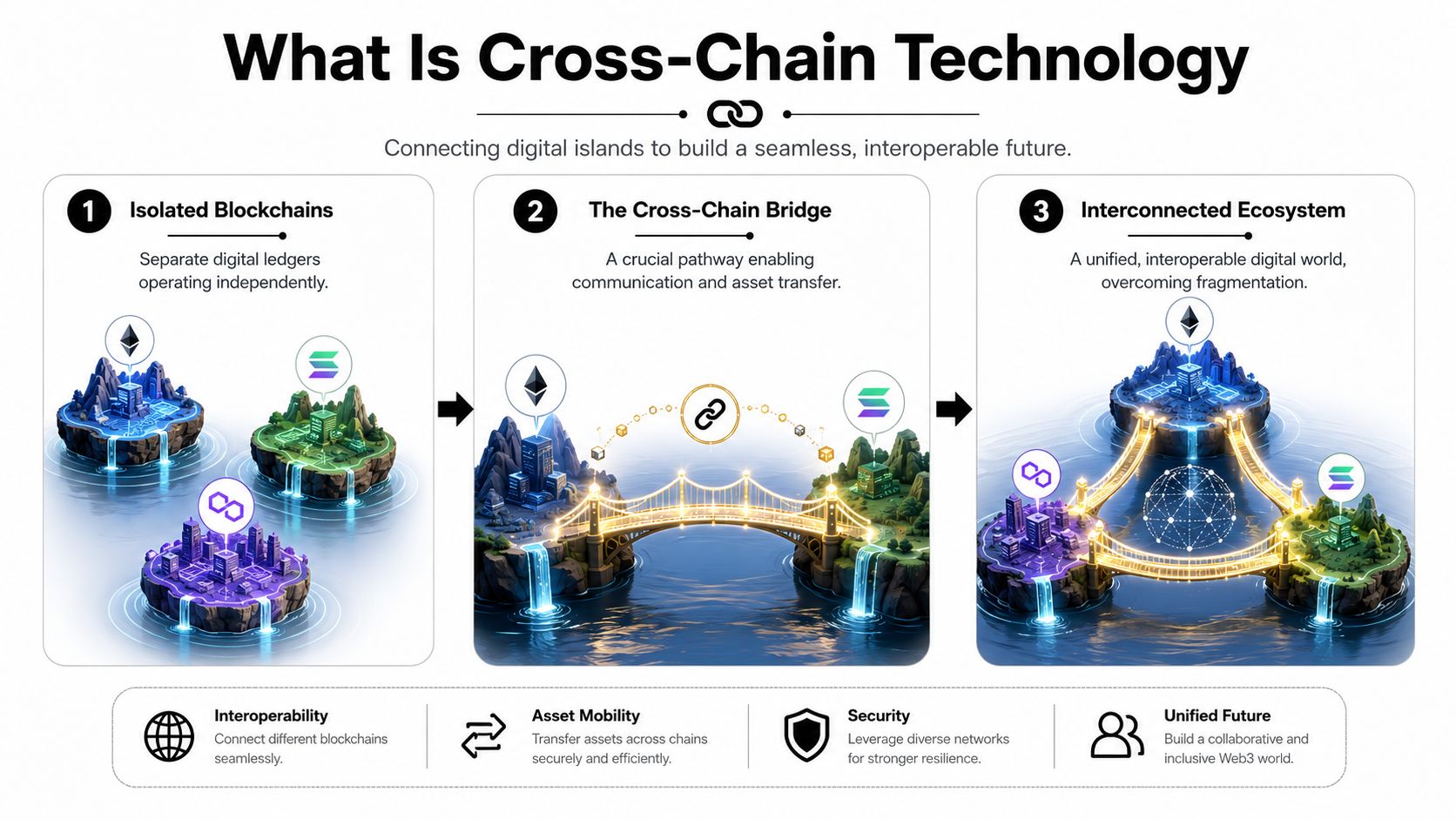
A simple mental model
In plain English, interoperability means one blockchain can interact with another in a way users and applications can rely on. That interaction might involve moving value, sending an instruction, or verifying that an event happened elsewhere.
For stablecoin investors, the practical point is simple. USDC on Ethereum, USDC on Base, and USDC on Arbitrum may share a ticker, but they do not live in the same market. The lending venues differ. The swap depth differs. The incentives differ. If you want a concrete example, this guide to using USDC on Base for yield opportunities shows how the chain itself changes what you can do with the asset.
Here's the simplest mapping:
Concept | Real-world analogy | In DeFi terms |
|---|---|---|
Blockchain | A country | A separate network with its own rules |
Native asset | Local currency | Tokens that belong to that chain |
Bridge | International banking rail | A tool for moving assets or messages |
Fragmentation | Money stuck in separate banking systems | Liquidity split across networks |
If you're still getting comfortable with how crypto venues fit into the broader flow of moving assets, Zaro's guide to crypto exchanges is a helpful starting point because it shows where exchanges, wallets, and transfer decisions intersect for normal users.
A visual model helps here:
Why this matters for stablecoins
Stablecoins make the limits of isolated chains obvious. The asset name stays familiar, but the operating environment changes around it.
That difference affects returns.
A stablecoin position is never just "cash in DeFi." It sits inside a specific chain, with specific protocols, specific counterparties, and specific exit routes. Cross-chain technology lets investors reach those other environments without first cashing out through a centralized exchange and rebuilding the position from scratch.
That does not make cross-chain activity automatically worth doing. For smaller portfolios, extra steps, bridge fees, gas costs, and smart contract risk can wipe out the benefit of a higher displayed APY. For larger portfolios, the same move can make sense if the destination chain offers deeper liquidity or better risk-adjusted yield.
Cross-chain technology matters because it turns separate blockchain economies into markets you can compare, access, and use. For a stablecoin holder chasing yield, that is the primary task. Not abstract interoperability, but deciding whether the better opportunity on another chain is still better after costs, delays, and risk.
How Assets Move Between Chains
When people say they “bridged USDC,” they usually mean one of a few basic mechanisms handled the move behind the scenes. The details vary by protocol, but the core idea is simple. Since blockchains don't naturally share state, a system has to prove that something happened on one chain before another chain acts on it.
The oldest mental model is still the most useful.
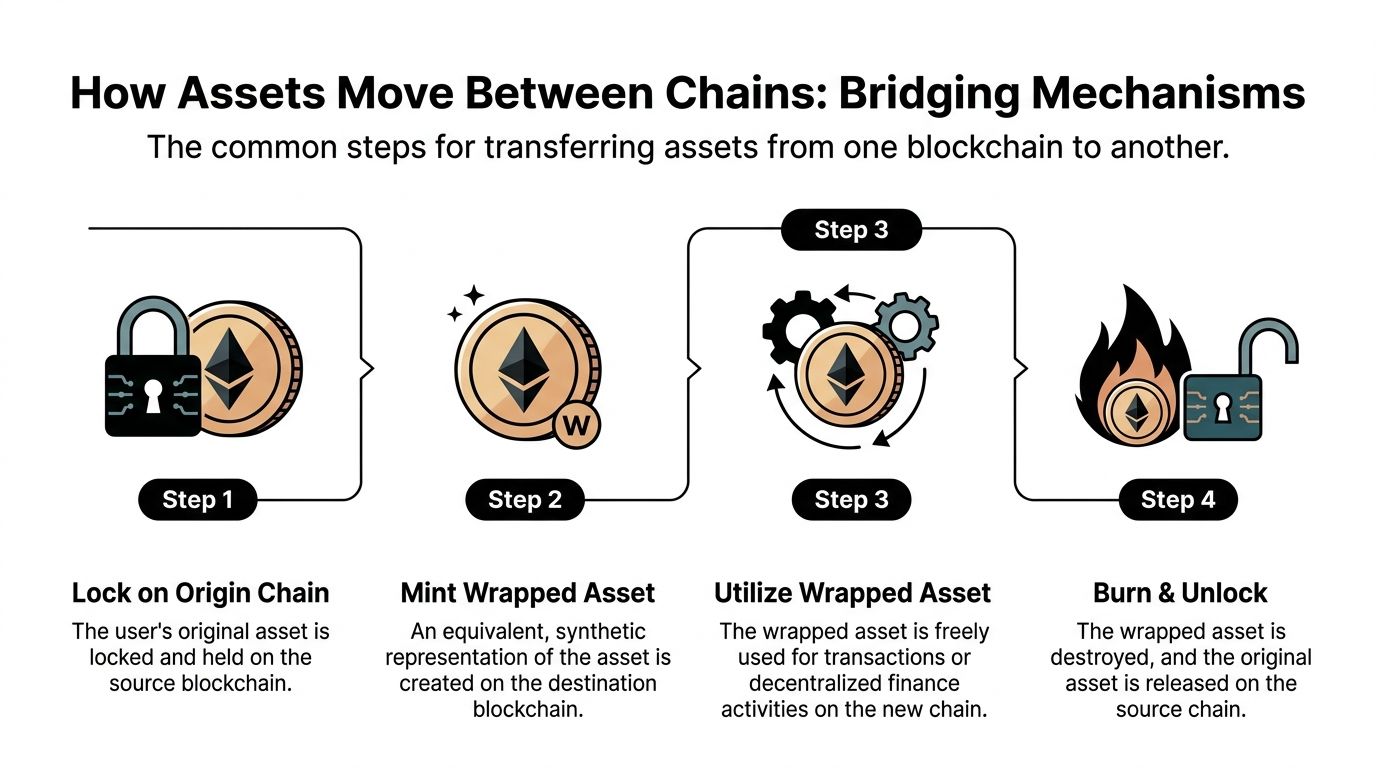
The classic bridge model
A common bridge flow looks like this:
You send assets on the origin chain. The bridge takes custody or records the transfer.
Those assets are locked or burned. They can't remain spendable in two places at once.
The destination chain receives a representation or release. That may mean a wrapped token is minted, or a corresponding asset is made available.
You use the asset on the new chain. From your perspective, the funds have “arrived.”
This lock-and-mint or burn-and-release design is the foundation many users interact with, even if the front end hides the mechanics.
From token movement to message passing
Cross-chain infrastructure has matured beyond simple token transfer. Chainlink describes the modern model as one where protocols validate source-chain state and relay the result to a destination chain, and it notes the launch of CCIP, a blockchain-agnostic standard for cross-chain communication and token transfers, in its cross-chain education overview.
That shift matters because moving money is only one use case. More advanced systems can move instructions too. A treasury can rebalance. A protocol can trigger automation. A DeFi app can coordinate actions across networks rather than forcing users to manually hop between them.
If you're mostly dealing with stablecoins, the difference shows up in user experience. A basic bridge gets assets from A to B. A messaging layer can support a workflow that starts on one chain and completes on another with fewer manual steps. For users focused on Base, this guide to using USDC on Base is useful because it grounds the theory in a chain many stablecoin holders already use.
A more technical example
Some sidechain systems take a different route. Horizen's Zendoo model uses SNARK-based proofs so the mainchain can verify sidechain state transitions without directly tracking every sidechain event. Backward transfers are grouped into a withdrawal certificate for each epoch, and the mainchain checks that the sidechain is active, the epoch is valid, and the proof evaluates true before including the certificate, as explained in Horizen's overview of cross-chain transactions.
You don't need to remember the proof machinery to use DeFi well. You do need to remember this: not all cross-chain systems rely on the same trust assumptions. The way assets move is also the way risk gets introduced.
Understanding Cross-Chain Security Risks
Cross-chain can improve access to yield, but it also creates one of the most fragile parts of DeFi. The simple version is that your funds are no longer exposed to one protocol on one chain. They're exposed to the logic that connects multiple systems, and that connection is where mistakes get expensive.
The risk isn't theoretical. Bridge design remains a major attack surface, and Chainalysis reported that bridge-related exploits accounted for a large share of stolen crypto in 2022, concentrating user risk in a small number of popular protocols, as noted in the provided reference discussing bridge exploit concentration.
Where the risk usually sits
When stablecoin users ask whether bridging is safe, the better question is: safe against what?
Here are the main buckets:
Smart contract failure: The bridge or router contract has a bug, weak upgrade path, or flawed verification logic.
Validator or relayer failure: A smaller group of actors signs or confirms messages incorrectly, or can be compromised.
Liquidity and market stress: The route works technically, but the asset you receive has weaker liquidity, wider slippage, or exit friction.
Operational mistakes: Users send to the wrong chain, choose the wrong token version, or approve unsafe contracts.
What works better in practice
A good cross-chain habit is boring. You trade speed and novelty for survival.
Better practice | Why it helps |
|---|---|
Use familiar routes | Mature routes usually have more scrutiny and more user testing |
Move in smaller test transactions first | Confirms the token, chain, and destination are correct |
Check what asset you'll receive | Bridged, wrapped, and native versions may behave differently |
Avoid stacking new risks | A new chain plus a new bridge plus a new farm is too much at once |
Don't evaluate a cross-chain move as one action. Evaluate it as a chain of dependencies.
That's the right mental model. Your stablecoins may pass through a bridge, land as a specific token form, then enter a lending market or LP. If any one layer is weak, the whole strategy weakens.
A practical risk filter
Before moving funds, ask:
What exactly am I holding after the transfer?
Who or what verifies the move?
Can I exit the same route if conditions change?
Is the extra yield compensating me for one new risk or several?
For users who want a broader framework for protocol exposure, this guide to managing DeFi smart contract risk pairs well with cross-chain decisions because bridging risk rarely exists in isolation.
The simplest mistake I see is chasing extra basis points while ignoring new failure modes. For stablecoin investors, the best cross-chain move is often the one that adds only one new variable at a time.
Real-World Cross-Chain Yield Strategies
Cross-chain makes sense when it expands your opportunity set without turning your portfolio into a full-time job. That sounds obvious, but many users do the opposite. They add bridges, chains, dashboards, and token wrappers just to chase a slightly better headline rate.
For stablecoin holders, the practical question is narrower. Does this move improve net yield after friction and added risk? The answer depends a lot on account size, patience, and how often you plan to rebalance.
The key user question has been stated plainly in the provided reference: if you have only a few hundred or a few thousand dollars in stablecoins, cross-chain routing may not meaningfully improve net yield after bridge fees, execution risk, and time costs. The benefit is uneven and can disappear for smaller balances, as noted in the referenced discussion of cross-chain trade-offs for smaller holders.
Three situations where cross-chain can help
One useful way to think about this is by scenario, not theory.
Moving to a stronger stablecoin market
You hold USDC on one chain where the available lending venues are shallow or uninspiring. Another network has healthier borrow demand, more active liquidity, or a venue you trust more. In that case, the chain move isn't about chasing novelty. It's about accessing a market with better structure.
That can be rational if you expect to stay there long enough for the move to matter.
Entering a new ecosystem early
Sometimes a newer chain or app attracts stablecoin liquidity with short-term incentives or unusually high demand. Cross-chain access lets you participate without first liquidating through a centralized venue.
This can work. It also tends to be where users underestimate risk, because the attractive rate is often tied to a younger protocol stack.
Consolidating fragmented positions
Cross-chain isn't only for yield hunting. It can also reduce clutter. If you've accumulated stablecoins across several networks, moving them into one better environment can improve visibility and simplify exits.
That's a yield decision too, because scattered capital often sits underused.
When it usually doesn't help
Small balances are where theory collides with reality.
The gain may be too small: If the advantage is modest, friction can wipe it out.
You may overtrade: Frequent movement turns yield farming into fee farming for everyone else.
Complexity compounds: Tracking token versions, approvals, and gas balances becomes its own burden.
A cross-chain strategy is strongest when the move is infrequent, deliberate, and tied to a clear reason to stay put.
For non-whales, that's the dividing line. Cross-chain can absolutely improve outcomes. But the benefit isn't evenly distributed, and it fades fast when the route gets complicated or the capital base is small.
Automating Your Yield with Yield Seeker
A common stablecoin scenario looks like this. Funds are sitting in a decent vault on one chain while a better opportunity opens somewhere else, but checking the spread, estimating bridge costs, and re-evaluating protocol risk feels like another job. For busy investors, that friction is often the primary cap on returns.
Automation helps when it reduces decision fatigue without taking away visibility.
What automation should solve
For cross-chain yield, the problem is not finding one attractive APY screenshot. The problem is keeping up with changing rates, different protocol risks, and the small costs that eat into returns. That matters even more for non-whales, where one unnecessary move can wipe out the edge.
A useful automation layer should help with a few specific jobs:
Tracking changing opportunities: Yield shifts fast, so last week's allocation can become a weak one.
Comparing net return, not just headline rate: Fees, slippage, and transfer costs decide whether a move is worth it.
Reducing idle stablecoins: Capital often sits unallocated because the research burden is higher than the expected gain.
Keeping exits clear: Users need to know where funds are deployed and how to pull them back out.
One practical option
Yield Seeker is built around that workflow. Users deposit USDC on Base, and the platform uses an AI agent to monitor and allocate capital across DeFi opportunities with a risk-aware approach. The product focuses on keeping funds accessible, avoiding lockups, and cutting down the manual work of checking protocols and chains one by one.
That appeal is practical, not theoretical. Many stablecoin investors do not need another dashboard full of routes and token wrappers. They need a focused system that can help spot worthwhile opportunities while keeping the setup understandable.
The key question is not whether automation sounds efficient. It is whether the tool improves your net outcome after costs and complexity. For smaller portfolios, that bar should be high. If automation saves time but pushes funds through unnecessary hops, the convenience is expensive.
Automation earns its place when it lowers research effort, keeps risk visible, and avoids moves that are too small to matter.
That is the standard worth using here. Good automation should help you make fewer decisions, but better ones. In cross-chain DeFi, that usually matters more than chasing every new yield spike.
Cross-Chain Frequently Asked Questions
How long does a cross-chain transfer take
It depends on the route, the chain pair, and the specific bridge or messaging system. Some transfers feel quick. Others take longer because the protocol waits for confirmation or finality conditions before completing the destination action.
For stablecoin users, the practical move is simple. Don't plan around instant settlement unless you've used that route before and know how it behaves.
Is a bridge the same thing as a cross-chain swap
Not always. A simple bridge usually moves the same asset, or a representation of it, from one chain to another. A cross-chain swap can include both the move across chains and a change of asset.
In plain English, bridging is often “take my USDC there.” A cross-chain swap is closer to “turn what I have here into what I need there.”
Can I send any token to any chain
No. Support depends on the protocol, the token standard, and whether the destination chain has a recognized version of that asset. Some tokens travel widely. Others only work on a limited set of routes.
This is why users should verify the exact asset received on arrival, not just the ticker they expect to see.
Why does the same stablecoin behave differently on different chains
Because the asset may be native on one chain, bridged on another, and supported by different apps and liquidity pools in each environment. The ticker can look identical while the market around it changes.
For yield seekers, that difference affects utility more than branding. What matters is where the token can be used safely and exited cleanly.
Is cross-chain worth it for smaller portfolios
Sometimes, but not automatically. For smaller balances, the added effort can outweigh the gain. Cross-chain tends to make more sense when the destination offers a meaningfully better opportunity, and when you plan to keep capital there rather than move it around often.
A patient move can work. Constant repositioning usually doesn't.
What's the safest way to start
Start with one known asset, one known chain pair, and one clear reason for moving. Avoid adding a new bridge, a new chain, and a new protocol all at once. If you're uncertain, a small test transaction is usually the cheapest form of due diligence available onchain.
Do I need to understand all the underlying cryptography
No. You need to understand the trust model well enough to know where failure could happen. For most users, that means knowing what asset is being moved, who verifies the move, and what happens if you need to unwind the position later.
That level of clarity is enough to avoid many of the worst mistakes.
If you want a simpler way to put stablecoins to work without manually tracking every protocol and chain, Yield Seeker offers an AI-powered workflow for depositing USDC and automating risk-aware yield decisions while keeping funds accessible.