
Let's be honest, trying to find the best stablecoin yield in DeFi feels like a wild goose chase. You're constantly jumping between chains, protocols, and pools, and by the time you find a decent APY, it's probably already vanished. A cross-protocol strategy engine is what cuts through this noise. Think of it as your own personal, automated financial analyst—one that works 24/7 across every corner of DeFi to find, execute, and manage the best opportunities for you.
The Search for Smarter DeFi Yield
DeFi wasn't built to be simple. It’s a fragmented world by design. Great yield opportunities are scattered across countless liquidity pools, lending platforms, and AMMs on chains like Base, Arbitrum, and Solana. For anyone with a life outside of crypto, keeping up with this is more than a full-time job; it’s basically impossible.
This constant churn is a huge headache. Manually moving your funds to chase the highest APY is not just slow, it's expensive and risky. Gas fees eat into your profits, and the mental energy it takes to track dozens of platforms is draining. You end up missing good opportunities and making mistakes. This is the exact problem a cross-protocol strategy engine was designed to fix.
Moving Beyond Manual Management
Imagine having a dedicated analyst who could monitor every single DeFi protocol at once, without ever needing to sleep. This analyst would instantly spot the most profitable, risk-adjusted places to park your stablecoins and then automatically execute all the transactions for you. That’s precisely what a cross-protocol strategy engine does. It takes the guesswork and manual grind out of DeFi.
This is a complete game-changer for a few key reasons:
Efficiency: It crunches thousands of data points to make decisions in milliseconds. No human can compete with that speed.
Access: It opens the door to complex, multi-step strategies that are just too impractical to pull off by hand, giving you access to a much wider range of opportunities.
Consistency: By constantly monitoring the market and rebalancing your funds, it aims to capture the best possible yield as conditions shift, smoothing out the unpredictable returns of manual "yield farming."
By automating the whole discovery and execution process, a cross-protocol strategy engine turns the chaos of DeFi into a structured, return-generating environment. It lets both seasoned pros and newcomers tap into sophisticated strategies without needing a PhD in smart contracts.
Platforms like Yield Seeker are built on top of this powerful engine to make smart, automated investing a reality for everyone. Instead of you hunting for yield, the engine does all the heavy lifting, turning a frustratingly complex process into a simple, hands-off experience.
Inside the Automated Yield Generation Process
To really get how a cross-protocol strategy engine turns the wild west of DeFi into a source of steady yield, you have to pop the hood and see what’s running inside. It’s not some magic black box; it's a logical, step-by-step process where every single piece has a job to do.
Think of it as your own personal, highly-specialized financial firm that’s working for you 24/7, never sleeping and never missing a beat. The whole point is to find and jump on opportunities way faster and more precisely than any human ever could. It takes the massive, complex job of finding yield and breaks it down into a clear sequence of steps, from gathering market intel to placing the trades and showing you the results.
This flowchart gives you a bird's-eye view of how the engine cuts through the DeFi maze to carve a direct path toward potential yield.
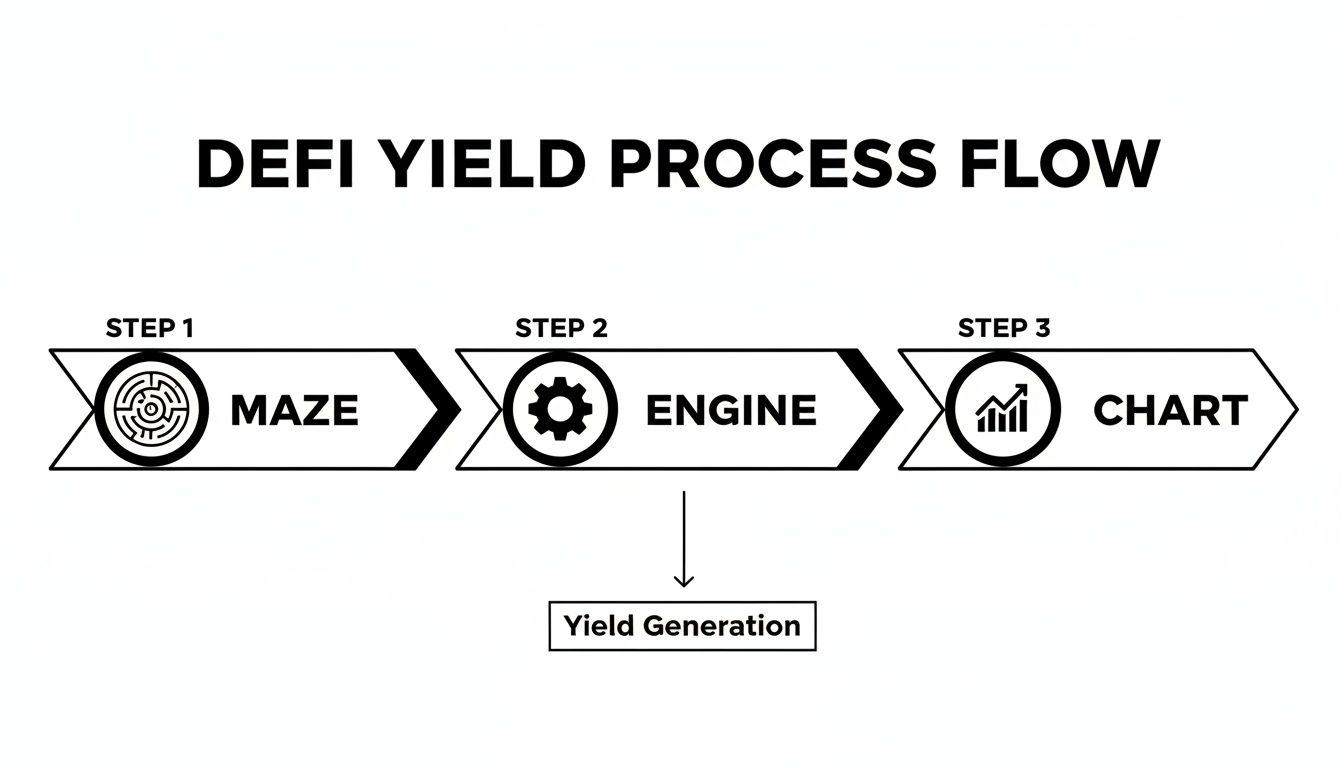
This process is all about systematically navigating the market's complexity, applying smart strategies, and ultimately, driving growth for your assets. Let's break down each of those core components.
To make this easier to grasp, the table below maps each technical component to a more familiar analogy, showing its main job in the whole operation.
Core Components of a Cross-Protocol Strategy Engine
Component | Analogy | Primary Function |
|---|---|---|
Data Ingestion | The Global Intelligence Network | Scans the entire DeFi market across multiple chains to collect real-time data on rates, liquidity, and transactions. |
AI Signal Generation | The Expert Analyst Team | Sifts through all the collected data to pinpoint specific, actionable investment opportunities, or "signals." |
Strategy Orchestration | The Central Command Center | Takes a signal and designs a detailed, step-by-step plan to act on it, including all necessary transactions. |
Execution & Risk | The Automated Trading Desk | Carries out the plan flawlessly while constantly checking against safety rules to protect your capital. |
Settlement & Reporting | The Accounting Ledger | Verifies every on-chain transaction and provides a transparent, real-time record of all actions and performance. |
Each of these parts works in concert, creating a seamless flow from raw market data to realized yield. Now, let's look at each one a bit closer.
Data Ingestion: The Global Intelligence Network
Everything kicks off with Data Ingestion. Picture a massive intelligence network with sensors plugged into every corner of the DeFi universe. This is the component that’s constantly soaking up huge amounts of data from different blockchains, protocols, and even off-chain sources.
And it’s not just looking at the advertised APYs. This stage is grabbing everything:
Liquidity levels in specific pools on AMMs like Uniswap.
Borrowing and lending rates on major platforms like Aave.
Transaction volumes and real-time gas fee spikes.
Smart contract event logs that can signal a change in a protocol’s status.
This raw data is literally the lifeblood of the engine. Without a constant, high-quality stream of market info, any strategy is just guessing. That's why the best engines are obsessed with real-time data feeds, making sure every move is based on what's happening right now.
AI Signal Generation: The Expert Analyst Team
Once all that data is collected, it's handed over to AI Signal Generation. If data ingestion is the intel network, this stage is the team of elite analysts who make sense of it all. Here, AI agents and machine learning models dig through the noise to find what really matters: actionable insights, or what we call "signals."
A signal could be a tiny arbitrage opportunity between two exchanges that only exists for a few seconds. It might be a sudden surge in demand for a specific stablecoin in a lending market, or a predictive indicator that a liquidity pool is about to become unbalanced. These signals are the little sparks of opportunity the engine is built to find and capture.
A cross-protocol strategy engine doesn't just react to the market; it anticipates it. By analyzing patterns across thousands of data points, its AI can identify profitable scenarios before they become obvious to the broader market.
Strategy Orchestration: The Central Command
With a clear signal in hand, the next stop is Strategy Orchestration. This is the central command center. It’s where the "what"—the opportunity—gets turned into the "how"—the detailed plan of attack. The orchestrator designs a specific, multi-step plan to take full advantage of the signal.
For instance, say a signal flags a high yield for supplying USDC to a lending protocol on the Base network. The orchestrator would immediately map out a strategy that might look something like this:
Withdraw the required USDC from a lower-performing vault.
If the source asset isn't USDC, execute a swap to get it.
Bridge the funds over to the Base chain if they aren't already there.
Deposit the USDC directly into the target lending protocol.
Every single step is mapped out with precision, from the order of transactions to gas fee estimates and even backup plans. If you're curious about how these kinds of automated actions affect liquidity pools, our guide on automated liquidity management dives much deeper into that topic.
Execution and Risk Management: The Trading Desk
With a solid plan locked in, the Execution & Risk Management layer takes the controls. This is the disciplined, automated trading desk that carries out the strategy without any errors or hesitation. It submits the transactions to the right blockchains, watches for confirmation, and makes sure every step happens in the correct sequence.
But just as important, this component is the engine's built-in safety net. It operates under a strict set of pre-programmed risk rules. Before a single transaction is sent, it runs through a final safety check:
Does the target smart contract pass our security standards?
Is the potential profit worth the transaction costs and associated risks?
What is the absolute maximum slippage we will accept for this trade?
If any of these checks fail, the whole operation is stopped cold. This built-in risk management ensures the engine doesn't just act fast, but acts safely, protecting your capital from bad situations.
Finally, Settlement & Reporting provides total transparency. Think of this as the system's own immutable accounting ledger. It verifies that every transaction settled correctly on-chain and then updates performance dashboards in real time. For you, this means a crystal-clear, verifiable record of every action taken and every bit of yield earned.
The Power of Real-Time Data and AI Agents
In DeFi, things move at lightning speed. A juicy yield opportunity might pop up and vanish in the time it takes you to blink. This is exactly why a cross-protocol strategy engine is built on two unshakable pillars: real-time data and the AI agents that act on it. These aren't just nice-to-haves; they're what separate automated, intelligent strategies from the slow, manual guesswork of the past.

Think of the data infrastructure as the engine's central nervous system. It's constantly processing an incredible amount of information from countless sources all at once—liquidity levels on Base, borrowing rates on Aave, and transaction fees across multiple chains. For the engine to make smart moves, this data can't be minutes or even seconds old. It has to be delivered in sub-milliseconds.
This isn't just about chasing yield. It's about survival. A sudden market shock, like a major stablecoin de-pegging, can trigger absolute chaos. An engine plugged into real-time data can spot the earliest tremors and execute protective actions, like pulling funds from a risky pool, long before a human could even find their laptop.
The Role of Autonomous AI Agents
With a steady stream of high-quality data flowing in, the second pillar kicks in: AI agents. These aren't just simple bots running "if-then" scripts. They are specialized, autonomous programs designed to perform tasks far beyond what any person could manage. They're your 24/7 team of strategists, analysts, and traders, all working in perfect sync.
Here’s what these agents are built to do:
Monitor Continuously: An agent can watch thousands of liquidity pools and lending protocols simultaneously without ever getting tired or distracted.
Analyze Complex Signals: They spot subtle connections between dozens of variables—gas fees, trading volume, interest rate volatility—to predict where the next best opportunity will show up.
Execute with Precision: Once a strategy gets the green light, an agent carries out the required multi-step transactions flawlessly, always optimizing for speed and the lowest possible cost.
For example, one AI agent might be dedicated to analyzing yield on lending platforms. It could detect that borrowing demand for USDC is spiking on one protocol while another has an excess supply. The agent then signals the orchestrator to cook up a strategy that moves capital to take advantage of this temporary rate difference. Spotting and acting on that manually in time? Nearly impossible. This is where a deep understanding of real-time APY optimization becomes absolutely critical for maximizing returns.
Why Sub-Millisecond Data Is a Necessity
The need for speed is about more than just chasing high APYs; it’s about accuracy and security in a market that never sleeps. The DeFi ecosystem now processes transaction volumes that blow past even the 2021 bull market highs, all while transaction costs have cratered. This high-throughput environment demands equally powerful data infrastructure.
Modern real-time cross-chain data platforms have become foundational. Some can achieve sub-30 millisecond latencies while handling up to 4,000 requests per second.
Without this high-speed data backbone, even the most intelligent AI agent is flying blind. It's the combination of immediate, accurate information and autonomous action that gives a cross-protocol strategy engine its decisive edge.
This leap in technology marks a huge shift from the old days of manual yield farming. Instead of a person constantly refreshing a dashboard, you have an entire system of intelligent agents fueled by live market data. They work tirelessly to optimize your strategy, turning the chaotic DeFi market into a field of manageable, data-driven opportunities.
Navigating a Fragmented DeFi Market
DeFi has certainly grown up, but it hasn't gotten any simpler. The opposite, really. It’s become a sprawling, fragmented ecosystem where the best opportunities are scattered, fleeting, and usually buried under layers of complexity. This fragmentation is the exact problem a cross-protocol strategy engine is built to solve.
Picture a huge city with hundreds of different street markets. They all sell the same stuff, but the prices change every minute. Trying to find the absolute best deal by sprinting from one market to the next would be exhausting and inefficient. You’d almost certainly miss the best prices anyway. That’s pretty much what it feels like to be a manual yield farmer in DeFi today.
The Illusion of Decentralized Opportunity
On the surface, DeFi looks like a world of infinite choice. You've got hundreds of exchanges, lending protocols, and liquidity pools all competing for your capital. It feels dynamic and open.
But that feeling masks a much tougher reality. Trading volume is spread thin across more and more venues, while the actual fee revenue—where real yield comes from—is getting more and more concentrated.
This creates a strange paradox. There are more places than ever to park your capital, yet the most profitable spots are controlled by just a handful of major players. This concentration means the best yield opportunities are usually found within these top protocols, but they're also subject to insane competition and change in the blink of an eye.
For example, a quick look at the market shows a clear power law at play. The top ten DeFi protocols generate roughly 60% of all fees, and the top twenty capture nearly 80% of total revenue. It’s even more extreme for stablecoins, where just two issuers, Tether and Circle, are behind nearly 75% of all DeFi revenue. You can dig into more of these numbers in this deep dive on DeFi revenue concentration from DL News.
Why Manual Yield Farming Fails
This market structure makes manual yield farming a losing game for most people. To actually succeed, you'd need to juggle an impossible set of tasks around the clock.
Constant Monitoring: You’d have to watch dozens of protocols across multiple chains, 24/7, just to spot an opportunity as it pops up.
Rapid Execution: Once you find something, you have seconds—maybe minutes—to act before it’s gone. That means navigating different UIs and transaction processes at lightning speed.
High Transaction Costs: Bouncing funds between protocols racks up gas fees. For smaller amounts of capital, these fees can easily wipe out any profit you hoped to make.
Elevated Risk: Every new protocol you interact with introduces more smart contract risk. Unless you’re doing deep technical audits on every single platform, you're exposing your funds to potential bugs and exploits.
In a fragmented market, the biggest advantage goes to those who can process the most information and act the fastest. For an individual, this is a losing battle against automated systems.
This is where a cross-protocol strategy engine comes in and offers a real edge. It’s not just a convenience tool; it’s a necessary piece of kit for navigating modern DeFi effectively. It systematically scans the entire ecosystem, figures out where the real yield is concentrating, and executes strategies with a speed and precision a human just can't match. By operating across the whole fragmented market, it’s never tied to the fate of a single platform and can always pivot to the most promising opportunity, wherever it might be.
Following Institutional Capital Flows
It's one thing to talk about a cross-protocol strategy engine in theory, but it's another to see it play out in the real world. And right now, it mirrors exactly where the "smart money" is heading. The big institutional players don't make careless bets. By watching where large-scale investors and "whales" are moving their funds, we get a powerful signal that this kind of automated, diversified approach is the future of DeFi yield.
The days of just parking billions in a single staking protocol and calling it a day are fading fast. Smart money is actively shedding that kind of concentrated risk. Instead, they’re building out dynamic, multi-chain portfolios, spreading their capital across different protocols to juice returns and—more importantly—to sleep better at night. This isn't just a trend; it's a fundamental shift in how the game is played.
The Great Capital Migration
This shift in capital is a clear sign that the market is growing up. Institutional adoption of cross-protocol strategies has exploded, with one recent analysis finding that $19 billion in capital has been strategically redeployed across multiple protocols.
Think about this: over the last year, 105 whale addresses pulled $3.5 billion from a single popular staking protocol. You'd think that would cause a panic, right? But total ETH staking actually grew by 5.8%. This data tells a powerful story: institutions aren't bailing on DeFi. They're just getting smarter about it, ditching the "all eggs in one basket" approach for something far more sophisticated. You can dig into the specifics in this in-depth institutional capital flow analysis.
This is compelling social proof. When billions of dollars are being managed with a cross-protocol mindset, it's a massive validation that this is the most sensible way to navigate today's market. These large players have entire teams dedicated to risk analysis and strategy—and their actions are all pointing in the same direction: diversification.
To really get under the hood and see what these institutions are doing, you have to go deeper than surface-level holdings. Methods like systematic 13F analysis reveal the subtle portfolio adjustments that define modern institutional investing.
Making Institutional-Grade Strategies Accessible
For a long time, these advanced strategies were completely out of reach for the average person. You needed expensive tools, deep market knowledge, and a serious bankroll to even attempt them. This is precisely why a cross-protocol strategy engine is such a big deal for everyone else.
A platform like Yield Seeker effectively democratizes the institutional playbook. It takes the same core principles—diversification, risk management, and rapid execution—and automates them, making them accessible to anyone.
Instead of needing a team of quants and analysts, you have an AI agent working for you 24/7. It performs the same functions that an institutional trading desk does, but at a scale and accessibility that was pure science fiction just a few years ago.
Systematic Diversification: It automatically spreads your capital across vetted protocols, so you're never over-exposed to a single point of failure.
Continuous Risk Assessment: The engine is constantly monitoring the health of the underlying protocols, a crucial job for protecting your capital. Doing this manually is exhausting, which is why we put together a guide on our own due diligence process for evaluating vaults.
Speed and Efficiency: It executes complex, multi-step transactions in seconds, capturing fleeting opportunities that a manual user would almost certainly miss.
By using a cross-protocol strategy engine, you aren't just using a clever piece of tech. You're aligning your own strategy with the proven methods of the most sophisticated players in finance, turning their blueprint for success into a simple, automated tool for your own portfolio.
Putting Your DeFi Strategy on Autopilot
Knowing how a cross-protocol strategy engine works is one thing, but actually putting it to use is another beast entirely. The good news? It's surprisingly simple to get started. The whole experience is built to take the heavy lifting off your shoulders and hand it over to your personal AI agent, essentially putting your DeFi game on autopilot.

Making that jump from theory to practice comes down to just a few clicks. With a platform like Yield Seeker, the goal is to get rid of the friction and let the engine do what it does best. It turns a ridiculously complex process into a simple, hands-off experience.
Getting Started in Three Simple Steps
The journey kicks off with a painless onboarding. You don't need to be a DeFi degen or have a massive portfolio to get in the game. It's designed for pretty much anyone to tap into automated yield generation quickly and safely.
Here’s how easy it is:
Create Your Account: A quick, secure setup gets you in the door without jumping through hoops.
Deposit USDC: You can get started with as little as $10 in USDC on the Base chain. This low barrier means you can test the waters without betting the farm.
Activate Your AI Agent: Once your funds are in, your personal AI agent takes the wheel. It immediately starts scanning the market and moving your capital to the best risk-adjusted opportunities it can find.
And that's it. Seriously. From that point on, the engine manages everything behind the scenes.
The core principle is simple: you provide the capital, and the AI provides the strategy. You retain full control and visibility while the engine handles the complex, moment-to-moment decisions of yield optimization.
Experience True Hands-Off Management
Once your agent is live, the focus shifts to transparency and control. You get a clean, intuitive dashboard that shows you exactly what your funds are doing and how they’re performing in real-time. No more juggling a dozen browser tabs or connecting to different dApps just to see where your money is. For those looking to fully automate their strategies, it's worth checking out what the Trading Bot Experts are building.
This approach brings some huge benefits that stand in stark contrast to the old way of manual yield farming:
No Lockups: Your funds are never locked away. You have the freedom to pull your capital out at any time without getting hit with penalties or weird fees.
Total Transparency: Every single move the AI agent makes is logged and visible to you. You can see exactly where your assets are deployed and the logic behind it.
Safety First: You are always in full control of your funds. The platform operates non-custodially, which is a fancy way of saying it never takes ownership of your assets.
This blend of simplicity, transparency, and control is what makes platforms like Yield Seeker so accessible. It takes sophisticated, institutional-grade strategies and turns them into a practical tool for everyone.
Frequently Asked Questions
Even after seeing how a cross-protocol strategy engine works, it's totally normal to have a few more questions pop up. Let's run through some of the most common ones to clear things up and show how platforms like Yield Seeker make this stuff safe and easy for anyone to use.
Is This a Safe Approach to DeFi?
Absolutely. Safety isn't just a feature; it's the foundation of the whole system. We're talking multiple layers of protection here.
First off, any smart contract a platform like ours even thinks about interacting with goes through a crazy amount of vetting and security audits. This is non-negotiable. It's how we filter out sketchy or unproven protocols right from the get-go.
Then you've got continuous, real-time risk monitoring. If the market gets weird or a protocol starts acting up, the engine can automatically pull your funds out to keep your capital safe. But the most important piece of the puzzle is that platforms like Yield Seeker are non-custodial. This means you, and only you, have full ownership and control of your funds. The engine can move assets for you, but it can never, ever take them.
How Is This Different From Manual Yield Farming?
It's like comparing a self-driving car to a horse and buggy. Manual yield farming is a grind—it's slow, you're bound to make mistakes, and you're limited by how much information one person can possibly track. A cross-protocol strategy engine completely changes the game.
This isn't just about making things more convenient; it’s a massive upgrade in what’s even possible:
Automation: The whole nine yards—from spotting opportunities to executing the trades—is done for you.
Speed: It works in milliseconds. We're talking about grabbing those flash-in-the-pan yield opportunities that a human would miss every single time.
Scale: It chews through massive datasets across the entire DeFi market all at once. No human could ever come close to replicating that.
Precision: It gets rid of those painful, costly mistakes. No more sending funds to the wrong address or messing up transaction fees that chew into your profits.
What Kind of Returns Should I Expect?
Returns in DeFi are always on the move, reflecting what's happening in the market right now—and anyone who promises you a fixed percentage isn't being straight with you. The point of a cross-protocol strategy engine isn't to guarantee some magic APY number. It's to consistently find and lock in the best risk-adjusted yields available at any given moment.
The engine's job is to optimize your returns based on what's actually happening in the market. It’s built to navigate volatility, automatically shifting your capital out of positions that are cooling off and into new opportunities as they pop up. The goal is a strong, consistent yield strategy over time.
Do I Need to Be a Crypto Expert?
Not at all. While the tech under the hood is seriously complex, the part you interact with is designed to be super simple and intuitive. Platforms like Yield Seeker are built for everyone, from hardcore DeFi natives to busy professionals who just want a hands-off way to make their stablecoins work harder for them.
You don’t have to get bogged down in the technical weeds of every single protocol or burn your weekends researching market trends. The AI agent takes care of all that complexity, giving you a straightforward way to tap into advanced DeFi yield opportunities without the crazy learning curve.
Ready to put your stablecoin yield strategy on autopilot? With Yield Seeker, you can deploy a personalized AI agent in minutes and start earning smarter, automated yield today. Get started at https://yieldseeker.xyz