
You're probably here because you saw a spread between two exchanges and thought the same thing almost everyone thinks the first time: this looks easier than directional trading.
That instinct makes sense. If the same asset trades at different prices in different places, buying where it's cheaper and selling where it's richer feels like the closest thing crypto has to a mechanical edge. No predicting narratives. No guessing macro. Just taking a mismatch and closing it.
The catch is that crypto arbitrage is simple in theory and operationally brutal in practice. The profit isn't in spotting the gap. It's in getting both sides done before fees, slippage, transfer friction, and timing failure eat the spread. Most beginner guides stop at the idea and skip the part where execution decides everything.
The Allure and Reality of Crypto Arbitrage
At a high level, crypto arbitrage is just market shopping. You find the same asset priced lower in one venue and higher in another, then try to capture the difference.
That's why the concept spreads so fast. It sounds like buying a product at one store and reselling it across town for a markup. The explanation is intuitive, and Alpha Scala's arbitrage insights do a good job grounding that basic logic in plain trading terms.
But crypto adds a nasty twist. The “stores” are exchanges, bridges, wallets, onchain pools, and derivatives venues, all moving at different speeds and charging their own tolls. A quoted spread is not a tradable profit. It's just the starting point for a calculation.
Why the idea keeps pulling people in
A few things make crypto arbitrage especially seductive:
It feels neutral: You're not trying to predict whether BTC or ETH will rip or dump.
It looks objective: You can see the spread on screen.
It sounds repeatable: If the mismatch happened once, your brain assumes it happens often.
All three are partly true. None of them guarantee money.
Practical rule: Treat every visible spread as an invitation to verify execution, not as proof of profit.
The professionals who survive in this niche don't romanticize it. They think in terms of inventory placement, venue risk, settlement timing, liquidity depth, and whether the opportunity still exists after the order hits the book.
That's the frame to use throughout this guide. Crypto arbitrage is real. The edge can be real. The easy-money version usually isn't.
What Is Market Inefficiency and Why Does It Create Opportunity
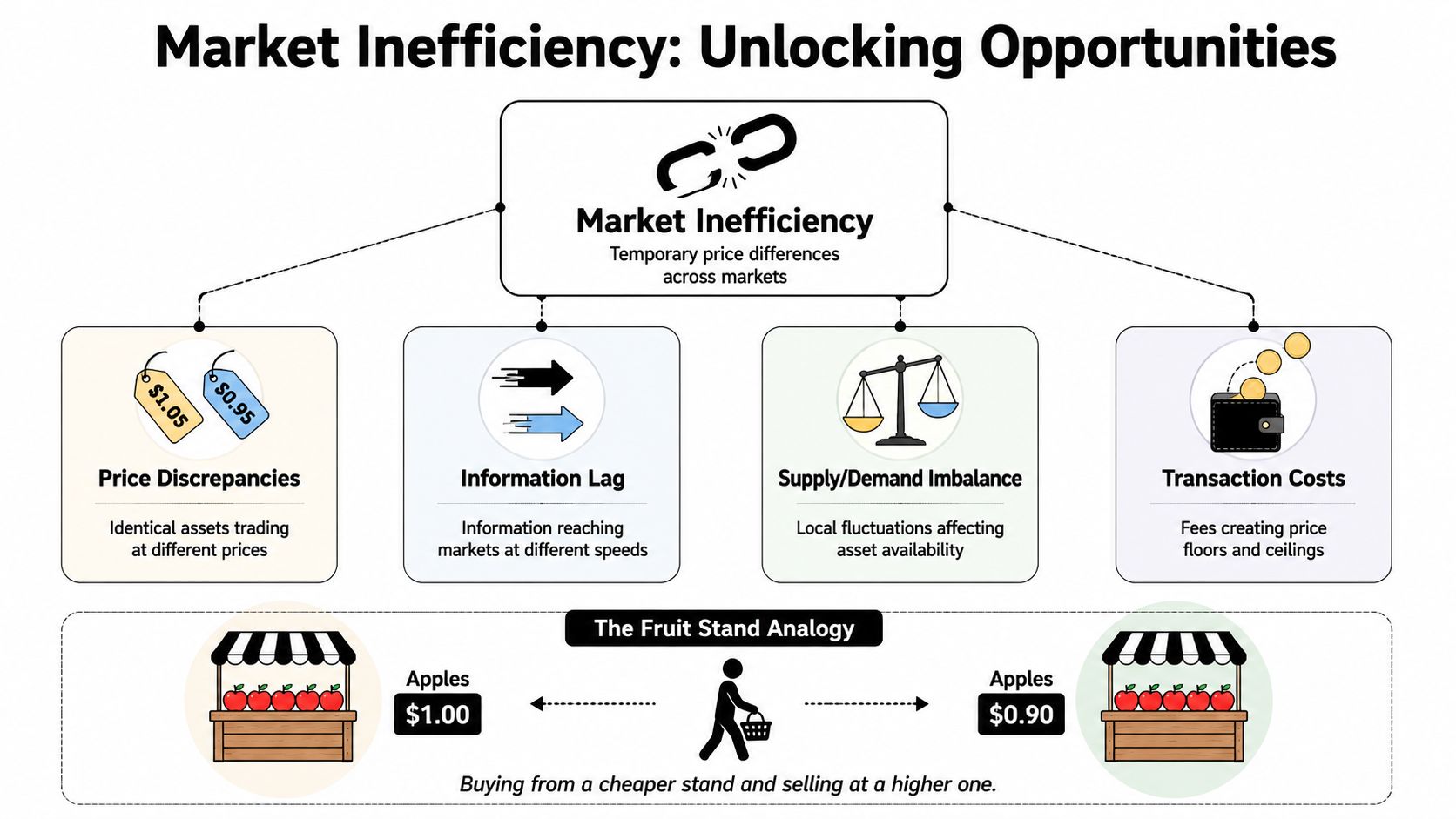
Market inefficiency means the same asset doesn't trade at the same effective price everywhere at the same time. In traditional terms, that sounds like a flaw. In practice, it's what creates arbitrage.
A simple analogy helps. Think of two farmers' markets selling the same apples. One has a local surplus and lower prices. The other has tighter supply and buyers willing to pay more. The product is the same, but local conditions distort the price. Crypto does the same thing across exchanges, chains, and pools.
Why crypto creates more of these gaps
Crypto markets are fragmented. Trading is split across centralized exchanges, decentralized exchanges, regional venues, and separate blockchain ecosystems. Liquidity sits in many pockets instead of one unified venue.
That fragmentation matters because price discovery isn't perfectly synchronized. MIT Sloan's CFI notes that cryptocurrency markets can exhibit large, recurrent cross-exchange price deviations, and that these deviations are much larger across exchanges than within a single exchange, which is why cross-exchange arbitrage remains structurally important in crypto microstructure, according to MIT Sloan CFI's analysis of trading and arbitrage in cryptocurrency markets.
If you're newer to this, it helps to understand what liquidity means in crypto, because a lot of “opportunity” is really a liquidity story. Thin books, uneven depth, and disconnected venues create temporary mispricing.
The core ingredients behind a spread
Here's what usually causes a visible price gap:
Driver | What it means in practice |
|---|---|
Liquidity fragmentation | Buyers and sellers are split across many venues, so prices don't align instantly |
Information lag | One market reacts to new demand before another catches up |
Local order flow | A burst of buying or selling on one venue pushes price away from the broader market |
Transaction costs | Fees and settlement frictions create a band where perfect convergence doesn't happen immediately |
A trader calls that gap the spread. But the more important concept is the tradable spread, which is the spread left after every cost and operational constraint is accounted for.
A market can be inefficient and still be unprofitable for you.
That distinction separates useful arbitrage from screenshot arbitrage. The market may offer a real discrepancy. Your setup may still be too slow, too small, or too expensive to capture it.
The Four Main Types of Crypto Arbitrage Strategies
Not all crypto arbitrage works the same way. Some versions are straightforward but operationally hard. Others avoid transfers but increase strategy complexity.

Simple cross-exchange arbitrage
This is the classic version. Buy an asset on Exchange A and sell the same asset on Exchange B where it trades higher.
It's conceptually clean, which is why most newcomers start here. The problem is that this strategy only works well when capital is already positioned on both venues or when execution is so fast that the window stays open long enough to complete both legs. If you need to move the asset after buying it, you're no longer trading a spread. You're racing settlement.
This version also creates a hidden inventory management problem. After a few trades, you can end up with too much cash on one venue and too much coin on the other. Rebalancing that inventory can erase a lot of your edge.
Triangular arbitrage
This happens inside one exchange. Instead of moving between venues, you rotate through three trading pairs and exploit inconsistent relative pricing.
A simple example would be moving from a stablecoin into BTC, then BTC into ETH, then ETH back into the stablecoin. If the implied exchange rates don't line up cleanly, there may be a narrow opportunity.
Why traders like it:
No transfer risk: Everything happens on one venue
Lower settlement friction: You're not waiting on inter-exchange movement
Cleaner automation path: APIs can handle this better than manual clicking
Why it's still hard:
Order book depth matters: The quoted route may not support your size
Fees hit multiple legs: You pay friction more than once
Timing still matters: One leg slipping can ruin the full cycle
For a visual walkthrough of how traders think about these setups, this primer is useful:
Funding rate arbitrage
This strategy pairs spot and perpetual futures positions to try to harvest positive funding while minimizing directional exposure.
It sounds elegant. In practice, it's more operational than most guides admit. You have to understand margin mode, collateral behavior, liquidation mechanics, and how the exchange calculates exposure across positions. Traders often call it “risk-free” because the market direction is hedged. That label is too loose. The price risk may be reduced, but the platform and execution risks are not.
A few common ways it goes wrong:
Account configuration mistakes: Cross-margin and isolated settings change liquidation behavior.
Capital fragmentation: Collateral locked in one venue can't help somewhere else.
Rate compression: The visible carry may not justify the overhead.
Statistical arbitrage
This is the most advanced category. Instead of reacting to obvious spreads, traders model historical relationships between assets or venues and bet on temporary deviations reverting.
You're not asking, “Is ETH cheaper here than there?” You're asking, “Has this relationship moved far enough from its normal range to justify a market-neutral position?”
This approach usually requires:
Requirement | Why it matters |
|---|---|
Reliable data history | You need enough market context to model mean reversion sensibly |
Execution tooling | Signals are useless if orders can't be routed quickly |
Risk controls | Statistical relationships can break and stay broken |
Ongoing monitoring | A model that worked last month can fail in a different regime |
For most readers, the practical divide is simple. Simple arbitrage and triangular arbitrage are easiest to understand. Funding and statistical arbitrage are where many retail traders underestimate complexity.
The Manual Arbitrage Gauntlet Hidden Costs and Risks
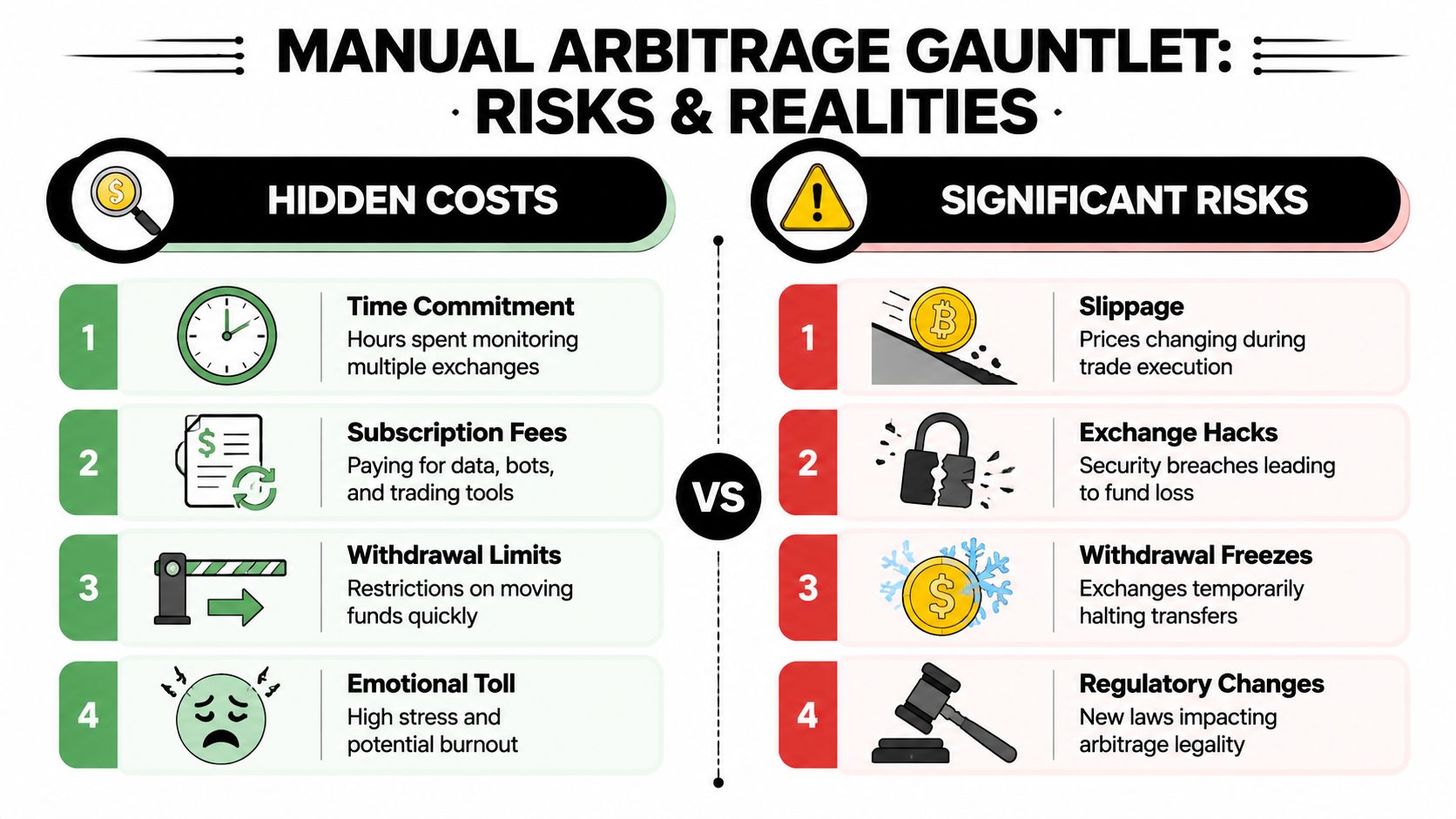
Manual crypto arbitrage looks clean on a whiteboard. On a real trading day, it becomes a gauntlet.
The first trap is believing the visible spread belongs to you. It doesn't. The spread belongs to the trader who can execute both sides cleanly, fast, and at size, while preserving enough margin after all costs.
The costs that quietly kill the trade
Manual traders usually focus on one number: the gross difference between the two prices. The market cares about a different number: net execution outcome.
That net result gets pulled down by several things at once:
Trading fees: Both entries and exits take a bite.
Withdrawal and deposit friction: Moving assets between venues isn't free and isn't always smooth.
Gas costs: Onchain routing can turn a decent idea into a bad one fast.
Bid-ask spread: The displayed last price may not be where your order fills.
Slippage: Thin liquidity means your own trade can worsen your fill.
If you need a refresher on the mechanics, this guide on what slippage is in trading is worth reading before attempting any manual strategy.
The most dangerous line in arbitrage is “the spread is there.” The real question is whether the spread survives contact with execution.
Speed isn't optional
A practical technical constraint is that arbitrage requires simultaneous or near-simultaneous execution of both legs. If traders must transfer assets between venues, price convergence can erase the spread before completion. Kraken and SoFi both emphasize that scanners and automation improve execution speed because arbitrage depends on capturing temporary inefficiencies before they disappear, as explained in Kraken's guide to crypto arbitrage.
That's the part many retail traders underestimate. Manual clicking is not a timing edge. It's usually a liability.
A rough decision table makes this clearer:
Manual condition | Likely effect |
|---|---|
Capital not pre-positioned | You're exposed to transfer delay and spread decay |
Illiquid pair | Quoted profit shrinks when the order actually fills |
Small account | Fixed costs take a larger share of the trade |
Multiple venues and wallets | More points of operational failure |
The stablecoin retail trap
This problem gets worse when small traders chase “safe” stablecoin arbitrage. The textbook version sounds ideal: no directional bet, modest spread, low drama. But stablecoin routes often fail on operational details, especially when fees and fragmented liquidity eat a large portion of the edge.
The hidden issue is the slippage versus fee trap. On small capital, even a trade that is “correct” in theory can be negative in practice because there isn't enough room for the net outcome to stay positive after all frictions. This is why many newer users get more value from tracking managed strategies and portfolio behavior rather than trying to run the whole process manually. If you want a live reference point for how a managed stablecoin product is represented in the market, you can Track Gauntlet USDC Prime performance on CoinStats.
Manual arbitrage is possible. But the edge usually goes to traders with pre-funded accounts, disciplined execution, and software doing most of the work.
A Tale of Two Trades Realistic Arbitrage Scenarios
Alex is new to DeFi and keeps a modest stablecoin balance plus a little extra capital for “opportunities.” One afternoon, Alex spots a spread on a popular pair and decides this is the perfect first crypto arbitrage trade.
The setup looks easy. Buy on one venue, move the asset, sell on the richer venue, pocket the difference. Alex places the first order, pays the first fee, and starts the transfer. Then the actual sequence begins: network confirmation takes longer than expected, the destination market tightens, and the eventual sale fills worse than the screenshot implied.
By the time everything settles, Alex hasn't just lost the expected profit. Alex has paid for the lesson that execution quality matters more than trade idea quality.
The failed beginner trade
What usually doomed Alex's trade wasn't a misunderstanding of arbitrage. It was underestimating operations.
A manual retail attempt often breaks at one of these points:
The spread was visible, not durable: It was already compressing when the first leg went live.
The displayed price wasn't the executable price: Order book depth didn't support the trade.
The route had too many moving parts: Wallet, chain, exchange, and market all had to cooperate.
The account size was too small to absorb friction: Costs consumed too much of the edge.
Alex did what most beginners do. Focused on the gross gap. Ignored the path.
The difficult professional win
Ben approaches the same market very differently. Capital is already pre-positioned. Ben monitors a shortlist of venues, knows the fee schedule from memory, and uses tooling that flags only spreads worth acting on after expected friction.
When the setup appears, Ben executes both legs quickly and gets out with a profit. It works. But the win still isn't glamorous.
Good arbitrage rarely feels exciting. It feels like logistics done correctly under time pressure.
Ben's day includes constant venue monitoring, inventory balancing, and the stress of knowing that a suspension, failed API call, or brief liquidity hole can flip a good trade into a bad one. Even success looks more like disciplined operations than genius.
That contrast matters. Alex loses because the trade was harder than it looked. Ben wins because the infrastructure was better than the idea itself.
From Manual Hustle to Automated Yield The Stablecoin Solution
Many who explore crypto arbitrage do not want to become execution specialists. They want the economic benefit of market inefficiencies without turning their week into a full-time monitoring job.
That's why the market has moved toward automation. Software can watch more venues, react faster, and evaluate net profitability more consistently than a human moving between tabs. For stablecoin holders, that matters even more because the goal usually isn't to chase adrenaline. It's to earn yield without adding unnecessary directional exposure.

Why stablecoin-focused automation makes more sense
A stablecoin-oriented system starts from a more practical objective. Instead of hunting flashy cross-venue moves on volatile assets, it can focus on preserving principal behavior while reallocating toward better risk-adjusted opportunities.
That changes the user experience in a few important ways:
Manual approach | Automated stablecoin approach |
|---|---|
You monitor spreads yourself | The system scans continuously |
You calculate net outcome manually | Logic can account for fees and route quality in real time |
You bear timing stress directly | Execution can happen without human reaction delay |
You juggle many dashboards | Allocation and monitoring sit in one workflow |
Automation doesn't remove risk. It changes the risk profile from “Can I personally catch and execute this spread right now?” to “Do I trust the system design, strategy logic, and controls?”
What a better setup actually does
A serious automated yield system should do more than just move capital around. It should evaluate whether an opportunity is worth taking after friction, monitor changing conditions, and keep capital accessible instead of locking users into opaque structures.
That's also why the most useful framing isn't “bot versus human.” It's process versus improvisation.
For readers who want a broader view of this model, this explainer on automated stablecoin investing lays out why automation fits stablecoin users better than manual strategy hopping.
A good stablecoin workflow should help with at least these jobs:
Opportunity scanning: Watching fragmented markets continuously
Net yield evaluation: Filtering out routes that only look attractive before costs
Adaptive allocation: Moving capital as conditions change
User clarity: Showing balances, earnings, and access without requiring a dozen tabs
The important shift is mental. You stop trying to win a speed contest manually and start using systems built for fragmented markets.
Is Crypto Arbitrage Right for You
If you're a full-time trader with technical skill, capital distributed across venues, and tolerance for operational stress, manual crypto arbitrage can still make sense. You're not buying a shortcut. You're running a small trading operation.
If you're a busy professional, a DeFi beginner, or a stablecoin holder who mainly wants reliable yield, the manual path usually isn't the right game. The issue isn't intelligence. It's fit. Manual arbitrage rewards speed, setup discipline, and constant supervision.
A quick self-test helps:
Choose manual arbitrage if: You're comfortable managing exchange risk, venue balances, execution tooling, and frequent trade review.
Choose automated access to arbitrage-like yield if: You want exposure to the underlying opportunity without spending your day routing orders and checking fills.
Avoid both for now if: You still find wallet management, order books, and transfer mechanics confusing.
The core idea behind crypto arbitrage is still attractive because market inefficiencies do exist. What's changed is the implementation. In a fragmented market, the smarter question isn't whether to engage with arbitrage. It's how much of the operational burden you want to carry yourself.
If you want the benefits of stablecoin yield without manually hunting protocols, managing transfers, and babysitting every move, Yield Seeker offers a practical alternative. You can deposit as little as $10 USDC on Base, let an AI Agent monitor and allocate across DeFi opportunities in real time, and keep funds accessible without lockups or withdrawal fees.