
Most guides sell crypto lending passive income as if it were a set-and-forget coupon. That framing misses the part that matters most, because the return you keep is what's left after gas, bridge costs, slippage, and withdrawals. For smaller balances, the headline APY can look fine while the net result shrinks.
The market itself has changed enough to make that distinction unavoidable. Galaxy Research estimated crypto lending at $64.4 billion in Q4 2021, then $14.2 billion at the Q3 2023 trough, and $36.5 billion by Q4 2024, still about 43% below the all-time high but up 157% from the bear-market low, with DeFi lending apps and CDP stablecoins holding a combined 69% share by the end of Q4 2024. That's not a side quest anymore, it's a market that now rewards people who understand structure, costs, and operational friction. Galaxy Research's crypto lending report
Why Most Crypto Lending Guides Get Passive Income Wrong
Crypto lending is often described like a savings account with better returns. That comparison breaks down fast once you start moving funds across chains, paying for approvals, or rebalancing positions just to preserve a quoted APY. The result is that many beginners optimize for the wrong number, gross yield, instead of the only number that matters, net yield after costs.
Headline APY is not your paycheck
A lot of beginner content still talks in broad ranges like 2% to 8% APY for lending, which is a useful directional signal but not a finished answer. The problem is that those numbers usually assume a clean setup, steady utilization, and no meaningful execution friction. In practice, smaller depositors can lose a noticeable chunk of that spread to network costs or bridging overhead before a single interest payment lands.
That gap matters most for stablecoin users because they're usually trying to be hands-off. If you're moving USDC around every few weeks to chase slightly better rates, you've already turned a passive strategy into an active one. The trade-off is simple, if the position takes repeated intervention, the yield is no longer purely passive.
Practical rule: if a lending position needs frequent hopping between chains or protocols, calculate the after-cost return first. Gross APY is marketing, net yield is what funds your account.
Passive income gets less passive as balances shrink
The smaller the position, the more likely fixed costs dominate the outcome. A deposit that looks attractive on a dashboard can become mediocre once a user pays for token approval, bridge movement, and later a withdrawal on a busy network. That's why experienced operators think in terms of minimum viable position size, not just nominal APR.
This also explains why “simple” strategies fail in real life. A beginner may split capital across multiple pools to diversify, then discover that the extra transactions erased most of the extra yield. For the set-and-forget audience, simplicity is not a nice-to-have, it's part of the economics.
The best lending strategy is often the one that produces the least operational churn.
How Crypto Lending Protocols Actually Generate Yield
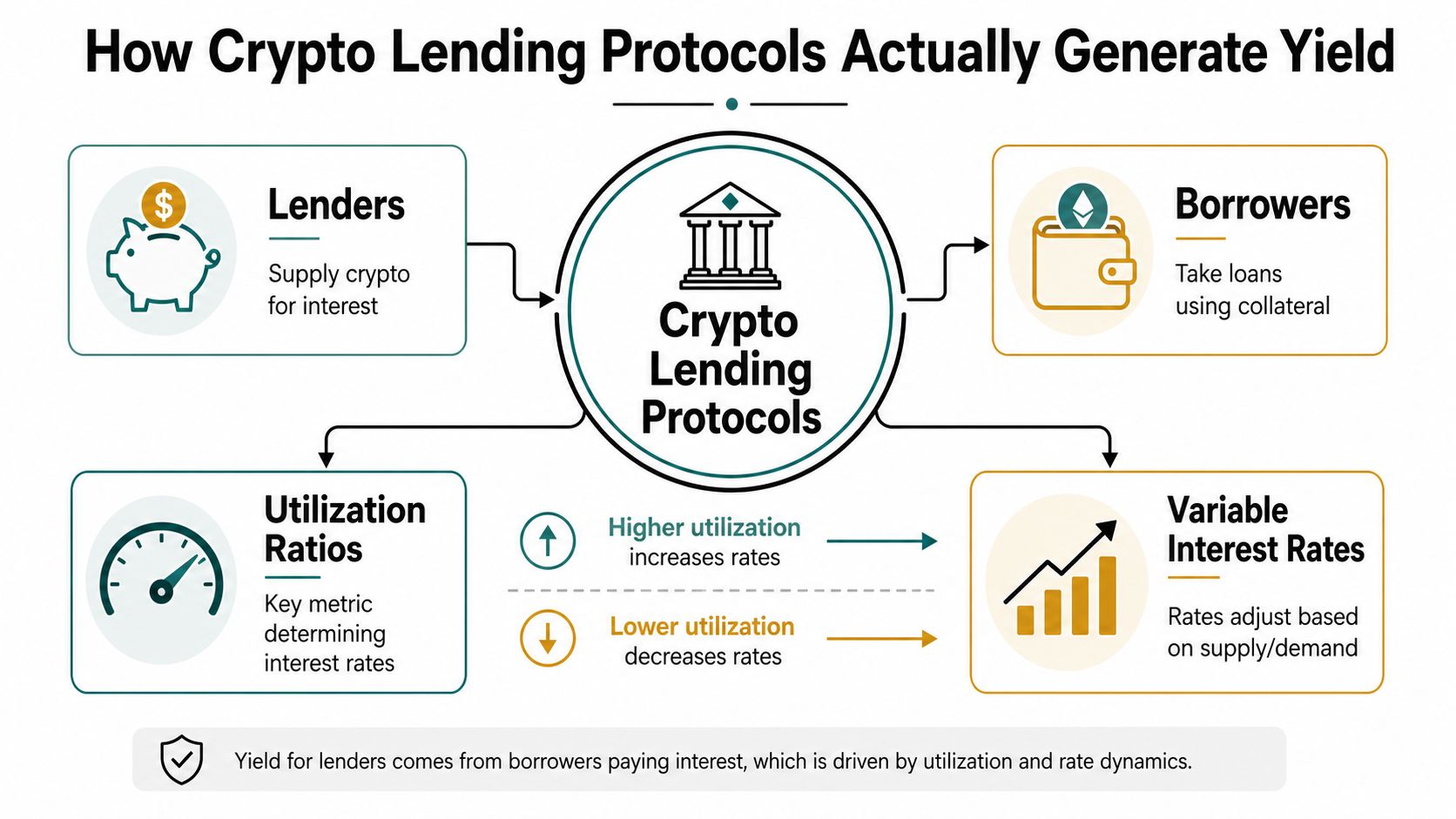
Lending protocols don't print a fixed return. They price capital based on how much of the pool is already in use, which is why the same market can feel calm one day and tight the next. The key variable is the utilization ratio, defined as borrowed capital divided by total supplied capital, and that ratio drives the interest lenders earn.
Utilization is the throttle
Think of a lending pool like a money market fund with an inventory problem. When borrowers have used only a small share of the supplied assets, there's plenty of idle liquidity and the rate can stay relatively low. As borrowed capital rises, lenders start earning more because the pool has less spare cash sitting around.
That's why the rate is usually variable, not fixed. Borrowers are bidding for scarce liquidity, and lenders get paid more when that liquidity becomes harder to access. Independent explainers note that lenders can earn roughly 2% to 8% APY depending on the protocol, asset, and lending duration, which is exactly why stablecoin yields move when borrowing demand changes. Mintos's overview of crypto lending mechanics
Why rates move, even when you do nothing
Variable rates are not a bug, they're the mechanism. If borrowing demand spikes, the pool tightens and the APY can improve; if supply floods in, yields compress. That means the lender's income is tied to the balance between people supplying capital and people borrowing it.
The right mental model is closer to a floating-rate bond than a bank savings account. You're not locking in a fixed coupon, you're taking the pool's current demand for liquidity. That's useful when demand is strong, but it also means a passive income strategy can soften without warning.
Bottom line: the rate you see today is a snapshot, not a contract.
For a more technical breakdown of market structure, the lending protocol primer at Yield Seeker's lending protocols guide is a useful companion read.
Comparing Centralized Exchanges and DeFi Lending Platforms
Choosing between a centralized venue and an on-chain protocol is a custody decision first, and a yield decision second. On one side, you hand assets to a company and let its account system move the funds. On the other, you keep control in a wallet and interact with smart contracts directly. Both can produce crypto lending passive income, but they fail in different ways, and the actual return depends on fees, slippage, and chain costs, not the headline APY.
What changes between CEX and DeFi
Centralized exchanges usually feel simpler. The interface is familiar, account setup is smoother, and the operational burden is lower for beginners who do not want to manage wallets or transaction approvals. The trade-off is custody, because you are trusting the platform to hold assets and process withdrawals under stress.
DeFi protocols push more responsibility to the user, but they also remove the middleman. That is why on-chain lending became the dominant structure in this category, with DeFi lending apps and CDP stablecoins capturing a combined 69% of the market by Q4 2024 in Galaxy Research's data. For a broader look at where different venues sit in the market, see Yield Seeker's best crypto lending platforms guide.
CEX vs DeFi Lending Comparison
Factor | Centralized Exchanges | DeFi Protocols |
|---|---|---|
Custody | The platform holds the assets | You keep control in your wallet |
Yield variability | Often simpler, but still can change | Usually more directly tied to utilization and supply |
Counterparty risk | Platform credit and withdrawal risk | Smart contract and protocol risk |
Withdrawal flexibility | Usually straightforward if the venue is healthy | Depends on chain conditions and protocol liquidity |
User effort | Lower, less technical overhead | Higher, more moving parts |
Transparency | Account-based, less on-chain visibility | Public, on-chain activity is easier to inspect |
For stablecoin holders, the table does not settle the question on its own. A CEX can be easier to use, but that convenience sits on top of platform risk and usually gives you less visibility into where the yield comes from. DeFi is messier to operate, yet it shows you the pool, the utilization, and the mechanics behind the rate.
The hidden cost is often the one beginners skip. On a cheap chain, a DeFi position can still beat a centralized account after fees and spread. On a congested chain, the same position can lose a lot of its edge before it ever starts earning. That is where hands-off automation matters. AI agents are starting to help stablecoin holders monitor rate changes, move liquidity when the net return justifies it, and avoid babysitting every deposit by hand.
What fits stablecoin holders
For stablecoin holders who care about predictability, the choice usually comes down to comfort with self-custody. A CEX can be easier to operate, but DeFi often gives better transparency into how rates are formed and what the pool is doing. The right answer is the one you can manage without making avoidable mistakes under stress.
If you are not comfortable with wallets, approvals, and chain selection, that friction can erase the convenience of DeFi. If you are comfortable with those steps, on-chain lending is often the cleaner long-term model, especially when you want direct visibility into how capital is deployed and the flexibility to use automated tools when your time is limited.
Setting Up Your First Stablecoin Lending Position
The cleanest first position is usually the one you can explain in one minute and unwind in one transaction. Start small, verify every step, and don't chase the most complicated route just because it advertises a slightly better APY. That mindset saves more money than most yield tweaks ever will.
Start with the plumbing
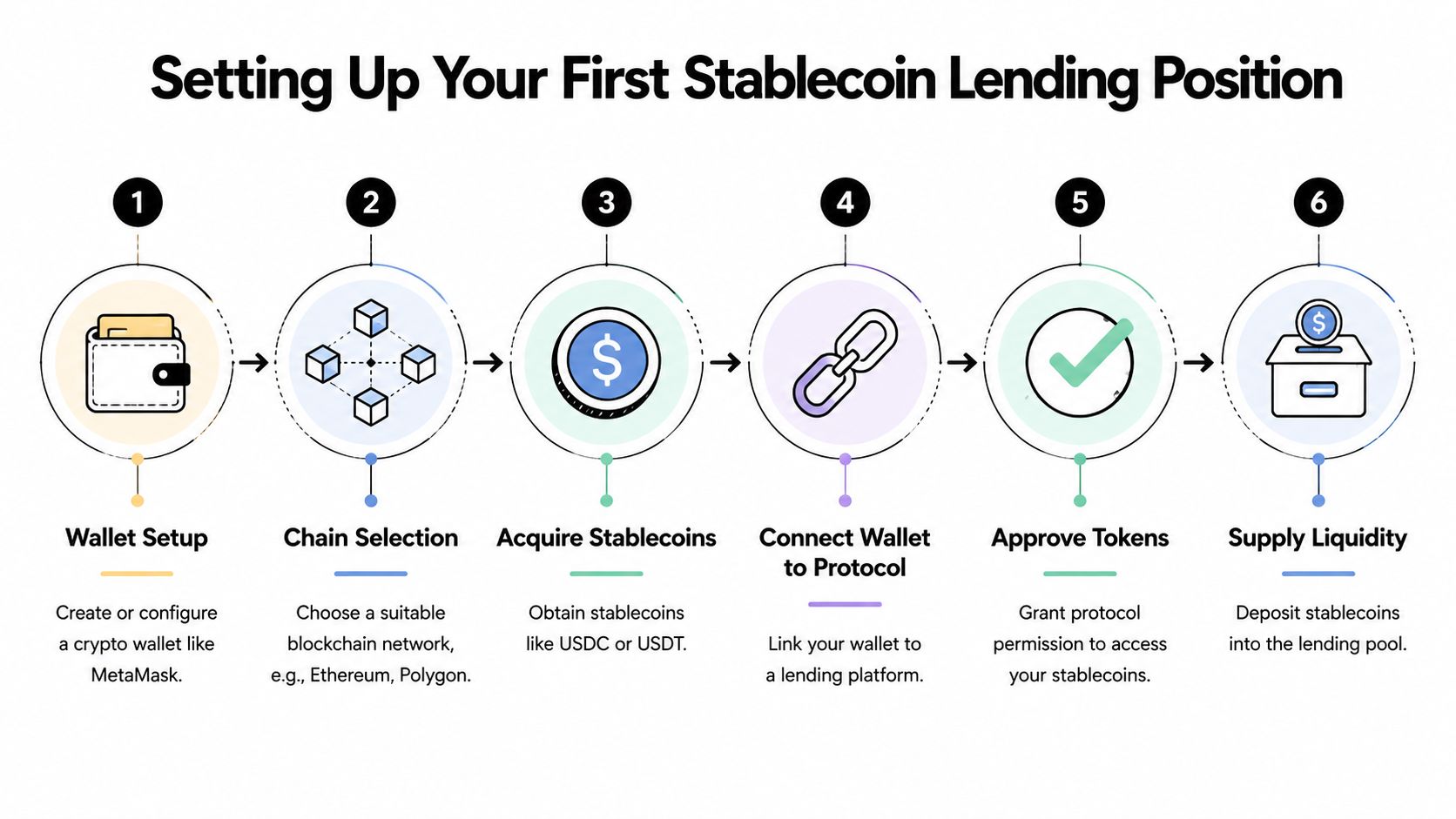
First, use a wallet you control and make sure you can sign transactions comfortably. Then choose a chain that matches your risk tolerance and fee budget, because chain costs affect net yield as much as the interest rate does. If you're testing the process, a small USDC allocation is enough to learn the workflow without overcommitting.
The actual sequence is straightforward, wallet setup, chain selection, stablecoin acquisition, protocol connection, token approval, then supply. The important part is not the sequence itself, it's verifying each transaction before you move on. One failed approval or the wrong network can create unnecessary fees and confusion.
Keep the first position boring
A first deposit should be a test, not a thesis. You're checking whether the protocol behaves as expected, whether the interface is clear, and whether you can withdraw without friction. That's the right time to learn, because learning with a tiny balance is cheap.
Good habit: before you deposit anything meaningful, confirm how you'll exit. Entry is easy, exit is where many users discover the real cost.
For a guided onboarding path, the walkthrough at Yield Seeker's DeFi getting-started guide is relevant if you want to compare your manual workflow with a more automated setup.
Check the boring details
Before you scale, review how the protocol handles withdrawals, how often yields accrue, and whether you'll need to move funds again later. Even for lenders, you should understand what happens when utilization changes or a pool gets crowded. That's not paranoia, that's basic position hygiene.
A tiny first win is better than a large first mistake. Once you've seen the full flow end to end, you can decide whether the strategy deserves more capital or just more caution.
AI Agents and Automated Yield Optimization
A significant change for stablecoin holders isn't just higher automation, it's less decision fatigue. Individuals often struggle with lending not because they can't grasp the concept, but because they can't keep up with fragmented rates, chain differences, and moving capital efficiently. AI agents are useful because they reduce the monitoring burden without forcing the user to become a full-time allocator.

What automation actually solves
Manual yield hunting works best for people who enjoy tracking protocols and rebalancing positions. For everyone else, it turns into a chore that effectively breaks the “passive” part of the strategy. Automated agents can watch for rate changes, assess where capital is most efficient, and move funds without the user living inside dashboards.
That matters even more when yields are fragmented across protocols and chains. A human can check a few venues, but an agent can keep scanning in the background and react faster. The point isn't magic alpha, it's preserving uptime and reducing the chances that a missed rate move leaves capital underutilized.
What to look for in an AI-driven setup
The important question is transparency, not hype. You want to know where funds sit, what the agent can and can't do, and whether you can exit without drama. If the product doesn't show balances and actions clearly, the automation isn't simplifying risk.
Yield Seeker fits that category as one option. It's an AI-powered platform that lets users deposit as little as $10 USDC on Base and have a personalized agent monitor and allocate capital across DeFi protocols in real time, with no lockups or withdrawal fees according to the publisher's product description. That kind of setup is relevant for time-constrained holders who want hands-off stablecoin management without giving up control.
Automation works best when it removes repetitive work, not judgment.
For busy users, the right tool can be the one that handles monitoring while still keeping exit rights simple. That's the practical edge AI agents bring to crypto lending passive income.
Common Mistakes That Destroy Lending Returns
The fastest way to ruin a lending strategy is to treat headline APY as if it were final income. I've seen users chase a rate, move capital twice, pay for approvals and bridges, then end up with less than they expected even before market conditions change. The problem usually isn't the protocol, it's the workflow.
The mistakes show up in predictable ways
One common error is overtrading a position to “optimize” it. Every extra move adds friction, and the yield has to earn back that friction before it becomes real income. Another mistake is concentrating into a single venue because the dashboard looks clean, then discovering that a rate spike was just temporary demand.
Users also underestimate chain movement. A bridge can be fine on paper and still be expensive enough to make a marginal yield improvement irrelevant. Withdrawal costs can do the same thing, especially if someone only notices them after the position has already sat for months.
Taxes and bookkeeping matter too
Crypto lending income can create reporting obligations even when the strategy feels passive. If you're collecting interest, you need records that match what happened on-chain and on the platform. That's why a practical tax workflow matters as much as yield selection.
For people who need a local reference point, the Jacksonville crypto tax guide 2026 from Bookkeeping and Accounting of Florida Inc. is a useful resource for thinking through recordkeeping and filing questions. The broader lesson is simple, if you can't reconstruct your flows, you're not really in control of the strategy.
Rule of thumb: if a position becomes annoying to explain, it's usually annoying to maintain.
Avoiding these mistakes doesn't require sophistication. It requires discipline, a willingness to leave marginal yield on the table, and a refusal to pay hidden costs just to feel active.
Building a Risk-First Framework for Sustainable Yield
A risk-first framework starts with a hard truth: the post-2022 to 2024 lending market is not the same market that early yield hunters used. The collapse of centralized lenders pushed the category toward DeFi and overcollateralized structures, which improved transparency but didn't remove risk. Today's income may be compensation for taking on risks that are less visible than they used to be.
Prioritize survival before yield
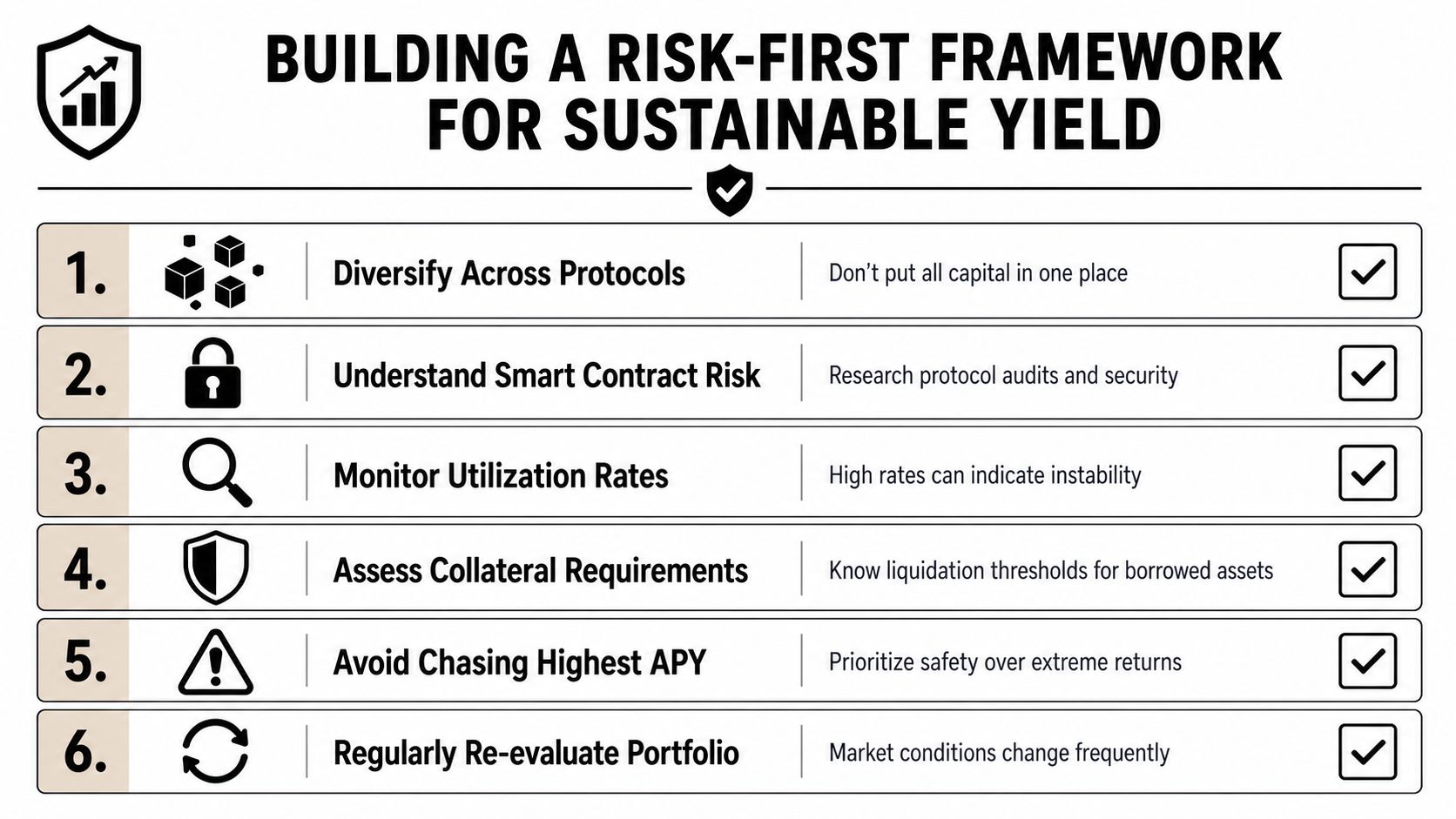
The first job is capital preservation. That means spreading exposure across protocols where appropriate, understanding smart contract risk, and keeping enough liquidity to leave when conditions change. It also means treating utilization spikes as a warning sign, not just an opportunity for a better rate.
Stablecoin lending can look reliable until capital crowds into a few dominant venues and rates compress quickly. That's when users discover that the yield they were counting on was really just temporary compensation for being early or being flexible. A safer framework assumes rates can fall and positions can become less attractive without warning.
Make exits part of the strategy
An emergency withdrawal plan belongs in the setup phase, not after a problem starts. Decide in advance how much capital can stay in motion, how much should remain immediately reachable, and which positions you'll close first if market stress appears. That kind of planning protects both net yield and peace of mind.
A practical checklist helps keep the strategy honest.
Diversify Across Protocols: don't leave all capital in one venue.
Understand Smart Contract Risk: review audits and security history before depositing.
Monitor Utilization Rates: crowded pools can shift quickly.
Assess Collateral Requirements: know how borrower risk can affect the market.
Avoid Chasing Highest APY: the best-looking rate is often the least stable.
Re-evaluate Regularly: lending markets change as capital rotates.
The market has already shown that passive income in crypto isn't just about earning. It's about staying solvent, staying liquid, and staying ready to exit when the story changes.
If you want a cleaner way to manage stablecoin yield without manually chasing every rate change, visit Yield Seeker and compare how an AI-driven lending agent handles monitoring, allocation, and rebalancing for you. It's built for users who want hands-off stablecoin yield with clear controls, so you can spend less time hunting protocols and more time deciding how much risk you want to take.