

You've got stablecoins sitting in a wallet after a client payment, a trade, or a treasury transfer. They're available, but they aren't earning anything. A crypto savings account promises to put those assets to work, yet the advertised APY can hide several different sources of return, each with its own durability and risk. The useful question isn't “What rate does this account pay?” It's “Where does that rate come from, and what happens when market conditions change?”
What a Crypto Savings Account Actually Is
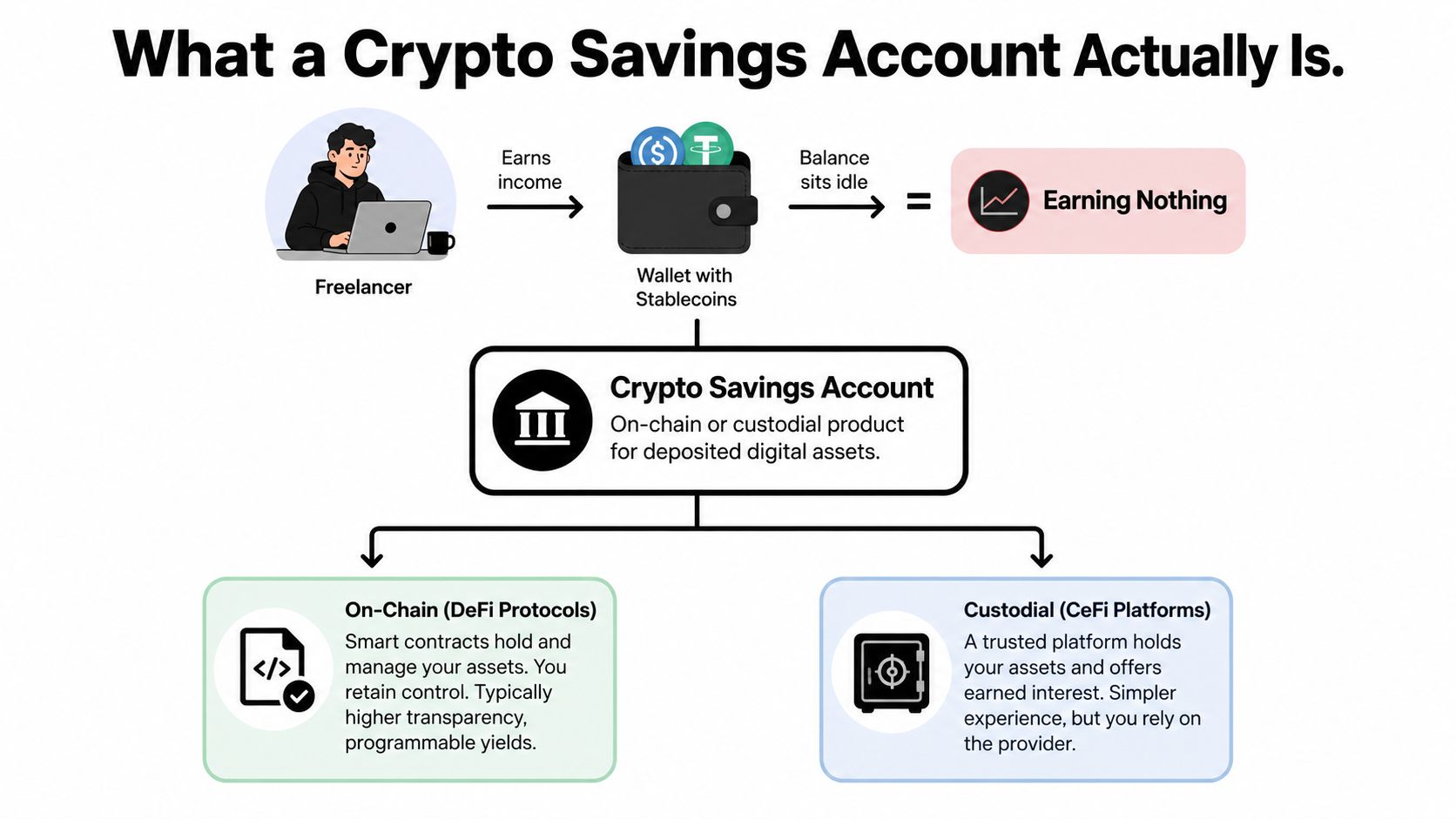
A crypto savings account is an on-chain or custodial product that puts deposited digital assets to work and pays the depositor a variable or fixed return. The assets might enter a lending market, a DeFi vault, a staking strategy, a tokenized real-world asset fund, or a centralized platform's internal lending operation.
That definition sounds simple, but the label covers very different products. A centralized finance, or CeFi, provider may take custody of your stablecoins and direct them toward loans or trading strategies. A decentralized finance, or DeFi, application may let you keep control of your wallet while a smart contract supplies funds to a lending pool. A hybrid service may combine a regulated custodian with an on-chain strategy.
Why stablecoins dominate the category
Stablecoins are common because they let users focus on the yield mechanism without taking the same level of directional price exposure associated with assets such as Bitcoin or Ether. A dollar-linked stablecoin can still lose its peg, face liquidity problems, or carry issuer risk, but its intended design reduces day-to-day price noise.
That makes the product easier to understand at first glance. If you deposit USDC, for example, the main question becomes whether the return comes from borrowers, trading fees, staking incentives, Treasury exposure, or a platform subsidy. The stablecoin doesn't eliminate risk. It changes which risks deserve your attention.
Crypto savings products also reflect a broader behavioral shift. By mid-2022, JPMorgan estimated that almost 15% of individuals had made transfers into crypto-related accounts, compared with a cumulative 3% before 2020 and 13% by June 2022. Most users held relatively small balances, with median flows below one week of take-home pay, while nearly 15% of users had net transfers exceeding one month of pay, according to the JPMorgan-related crypto account research.
Practical rule: Treat “savings” as a product label, not a guarantee. First identify who controls the assets, where the assets go, and which party pays the return.
The same headline APY can result from very different machinery. One rate may be mostly lending income that changes with borrower demand. Another may rely on newly issued reward tokens. A third may be supported by a temporary treasury subsidy. Understanding that composition is what separates an informed deposit from a hopeful one.
CeFi, DeFi, and Hybrid Accounts Compared
Choosing between CeFi, DeFi, and a hybrid account is primarily a custody and trust decision, not a contest between headline rates. Each model moves responsibility between the platform, the smart contract, the wallet owner, and external counterparties.
A custodial CeFi account feels closest to a neobank. You deposit assets into a company-controlled address, complete its onboarding process, and view a balance through an app. The provider may lend the assets, use market-neutral strategies, or route capital to other venues. You gain a simpler user experience, but you also accept the provider's custody, insolvency, operational, and compliance risks.
With non-custodial DeFi, you connect your own wallet and approve transactions directly. Smart contracts handle deposits, withdrawals, interest calculations, and sometimes automated allocation. You keep the private keys, but you're responsible for wallet security, transaction approvals, contract risk, and understanding the protocol's governance.
Hybrid products sit between those models. A custodian may hold the underlying assets while a separate protocol or vault generates the return. This can simplify reporting and access, but it creates more than one dependency. A failure at the custodian, strategy manager, bridge, or protocol can affect the same position.
Dimension | Custodial CeFi | Non-custodial DeFi | Hybrid |
|---|---|---|---|
Private keys | Platform or appointed custodian controls keys | User controls the wallet keys | Custodian and user responsibilities are split |
Yield routing | Provider chooses lending, trading, or other strategies | Smart contracts route funds according to published rules | A provider connects custody with selected on-chain strategies |
Main trust burden | Company solvency, operations, and disclosures | Code, governance, wallet security, and protocol liquidity | Both institutional and protocol layers |
User experience | Familiar account interface and support | More control, but more technical steps | Managed access with some on-chain transparency |
Withdrawal process | Depends on provider terms and internal liquidity | Depends on contract liquidity and transaction execution | Depends on both custodian and strategy |
Best fit | Users prioritizing convenience | Users comfortable with self-custody | Users wanting managed access with on-chain exposure |
Before choosing, beginners can use this guide to non-custodial yield platforms to understand the practical difference between holding keys and delegating control. The key question is not “Which model pays more?” It's “Which risks can I evaluate and manage myself?”
How Stablecoin Yield Is Generated
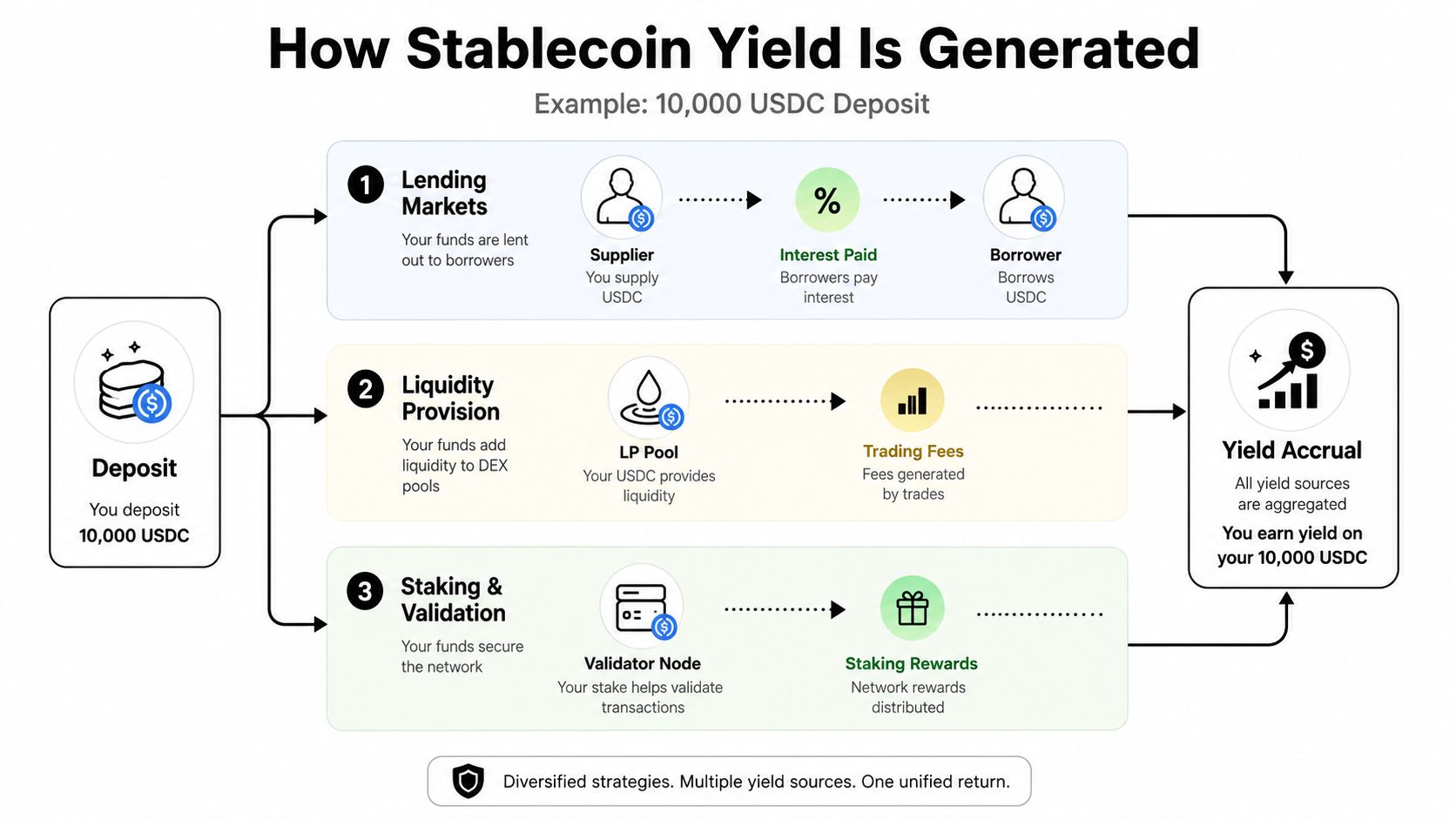
Suppose you deposit 10,000 USDC into a crypto savings account. The balance doesn't produce income by itself. The provider must deploy that capital somewhere that creates a cash flow, rewards liquidity, or receives an external payment.
Lending markets
In a lending market, your USDC becomes supplied liquidity. Borrowers deposit collateral and pay interest to access stablecoins or other assets. The protocol distributes part of that interest to suppliers, while retaining fees or reserves according to its rules.
This return is usually utilization-sensitive. When borrowers need more stablecoins, the supply rate can rise. When liquidity sits unused, the rate can fall. Independent comparisons describe recurring DeFi blue-chip stablecoin supply APYs around 3.5% to 7%, while some CeFi products advertise roughly 6.5% to 14%, with differences tied to funding sources, custody models, and risk premia, as shown in this crypto savings account comparison.
Liquidity provision
A vault may place the deposit into a liquidity pool used by traders. In return, liquidity providers receive a share of trading fees and possibly additional token incentives. The result depends on trading volume, pool design, asset prices, rebalancing costs, and any losses caused by price divergence between the deposited assets.
This route can look like lending from the outside because the account balance grows, but the underlying income is different. You're being paid for making markets, not for letting a borrower use your stablecoins.
Staking and real-world assets
Stablecoins themselves generally aren't staked in the same way as proof-of-stake network tokens. A provider may instead combine stablecoin liquidity with staking assets, liquid staking tokens, or strategies that earn rewards from validators and pass some return to depositors. The extra layers can introduce validator, token-price, slashing, and smart-contract exposure.
Another route uses tokenized real-world assets. On-chain funds or vaults can provide access to instruments such as short-duration Treasuries, repo, or private credit through an issuer and a specific legal structure. These products may offer a clearer external source of income, but they can include eligibility restrictions, settlement delays, issuer dependence, and limited redemption windows.
A useful DeFi protocols guide can help you identify whether a strategy earns from lending, liquidity fees, staking, or an off-chain asset. The source of payment matters more than the account's interface.
Each mechanism responds to a different market variable. Lending follows borrower demand, liquidity provision follows trading activity, and tokenized assets follow the income and redemption rules of the underlying instrument. Yield isn't magic. It's payment for placing capital somewhere useful, and every placement has a different failure mode.
Reading an APY Beyond the Headline Number
An APY should be read as a composition, not a single promise. A useful mental model separates the advertised return into base income, incentive emissions, and temporary subsidies.
The assigned visual uses a 9.2% USDC APY as an illustrative breakdown: 4.1% base lending rate, 3.0% token emissions, and 2.1% temporary subsidy. Those figures belong to the infographic's example, not to a universal market rate.
Three components behave differently
The base lending rate comes from actual borrower demand. It can change as utilization rises or falls, and it may respond quickly to liquidity conditions. It's often the most economically grounded part of the advertised return, but it still isn't fixed.
Token emissions come from a protocol's reward program. Governance may change the distribution schedule, the reward token may lose value, or participants may sell the token as soon as they receive it. A high displayed APY can therefore depend on an incentive whose purchasing power and duration aren't stable.
A temporary subsidy is usually the least durable component. A protocol, issuer, or marketing campaign may add a bonus to attract deposits, support a launch, or direct liquidity to a particular chain. Once the campaign ends, the displayed rate can fall sharply even if the underlying lending activity hasn't changed.
A high APY can be real today and still be a poor long-term estimate.
The market shows why decomposition matters. In 2026, Base USDC offerings ranged from about 4.81% at Aave V3 to 20.66% at Avantis, while Ethereum USDC and USDT yields varied from roughly 3.91% to 7.40% across major protocols, according to stablecoin yield market screens. The spread doesn't automatically identify a good or bad product. It signals that the underlying mechanisms, incentives, and risks differ.
Questions that reveal durability
Before depositing, inspect the protocol's governance proposals, reward-token schedule, treasury funding, and actual fee revenue. Ask whether the base rate remains competitive after emissions disappear. Check whether the displayed APY assumes you hold or reinvest a reward token.
For a deeper explanation of annual percentage yield and its limitations, use this APY guide. The most useful reframing is simple: APY has a half-life. The longer a return depends on incentives or subsidies, the more carefully you should estimate what remains after those payments decline.
Risks Most Comparisons Gloss Over
Suppose a stablecoin loses its peg on the same day a lending protocol pauses withdrawals. Your account can face both problems at once, even if its displayed rate never changes. A crypto savings account may also depend on a custodian, a smart contract, and an underlying strategy. The APY measures the quoted return, not whether each link in that chain will keep working.
The SEC's investor bulletin on crypto-asset interest-bearing accounts identifies risks including counterparty failure, volatility, illiquidity, regulatory changes, fraud, technical glitches, hacks, and the possibility that an asset stops being tradable.
The risk stack
Smart contract risk: A coding error or permission failure can drain funds or block withdrawals. Check the contract's audit history, upgrade authority, emergency controls, and prior incidents. An audit is evidence of review, not a promise that the code is safe.
Oracle risk: Lending protocols use price feeds to value collateral and liquidate unsafe positions. A distorted price can let borrowers withdraw too much or trigger liquidations of otherwise healthy positions. Review oracle providers, fallback design, and circuit breakers.
Depeg risk: A stablecoin can move away from its intended reference value. The UST collapse and an SVB-related wobble in USDC show different routes to lost confidence and reserve concerns. Examine redemption mechanics, reserve disclosures, trading liquidity, and asset concentration.
Counterparty risk: A CeFi provider can fail even when deposits were placed into lending activities. The Celsius and BlockFi bankruptcies show why you need to understand rehypothecation, asset segregation, creditor status, and insolvency procedures.
Regulatory risk: Changes in enforcement, licensing, or staking policy can affect product availability and withdrawals. Check where the provider is registered, which legal entity holds the assets, and which jurisdictions it serves.
Liquidity risk: A strategy can advertise a floating rate while applying a withdrawal queue, lockup, minimum, or exit gate. Test the withdrawal process before committing funds you may need soon.
An industry report cited about $22 billion in yield-bearing stablecoins and $116 billion in overall DeFi deposits in 2025, describing a large, fragmented category rather than a risk-free one. The risks can interact, so “5% yield” should not be read as “5% safe.” A durable base rate, temporary incentives, and subsidy each leave a different risk profile when conditions change.
Evaluating a Provider Before You Deposit
A provider's landing page tells you the rate. Your due diligence should tell you what supports it and how you get out.
Start with custody
Ask a CeFi provider whether customer deposits are segregated from corporate funds, whether the company can lend or rehypothecate them, which legal entity holds them, and what happens if that entity becomes insolvent. If the answer is vague, don't treat the account like a bank deposit.
For DeFi, identify the wallet you'll connect, the contracts you'll approve, the upgrade administrators, and the permissions granted to the vault. A multisignature setup can reduce dependence on one key, but it doesn't remove contract or governance risk. Proof-of-reserves material is useful only when you can connect reported assets with customer liabilities and understand what the attestation covers.
Then inspect the strategy
Look for named audit firms, audit dates, disclosed fixes, bug bounty terms, and prior incidents. Read the protocol's documentation rather than relying on a badge on the homepage. For the economics, separate organic revenue from emissions, identify performance and withdrawal fees, and check whether the incentive treasury can continue funding the quoted rate.
A token page such as the NEXO asset page can provide market context for a platform token, but it shouldn't replace analysis of the provider's custody terms, liabilities, or reward structure.
Finish with the exit test
Confirm supported chains and tokens, minimum withdrawals, settlement timing, lockups, cooling-off periods, and any conditions that can pause redemptions. Make a small deposit and complete a withdrawal before moving a larger balance. If you can't explain the exit path to another person, you don't understand the product well enough to use it.
Use this compact checklist:
Custody: Who controls the keys and who legally owns the deposited assets?
Code: Which contracts hold funds, and who can upgrade or pause them?
Revenue: What portion of APY comes from borrowers, fees, emissions, or subsidies?
Transparency: Can you verify reserves, treasury activity, and historical incidents?
Fees: What remains after performance, withdrawal, conversion, and network costs?
Liquidity: Can you exit when you need to, under ordinary and stressed conditions?
If a provider can't answer three or more of these questions confidently, treat its advertised APY as speculative rather than dependable.
Matching the Right Account to Your Profile
The suitable structure depends on your balance, technical skill, reporting needs, and ability to tolerate delayed access. There's no universal “best” crypto savings account because the same control that appeals to an experienced DeFi user can overwhelm someone protecting an emergency reserve.
Profile | Recommended Account Type | Target Allocation | Minimum Due Diligence |
|---|---|---|---|
Beginner with under 5,000 dollars to deploy | Simple custodial stablecoin account or guided, non-custodial product | Keep the amount limited to money you can afford to expose to crypto-specific risk | Complete a deposit and withdrawal, read custody terms, verify the yield source |
Experienced user managing a six-figure balance | Diversified non-custodial lending, liquid staking, and selected real-world-asset strategies | Split capital across structures rather than concentrating it in one protocol | Review contract permissions, liquidity, governance, reward durability, and chain exposure |
Treasury manager seeking predictable reporting | Institutional custody paired with tokenized Treasury or permissioned strategies | Match the structure to cash-flow needs and accounting requirements | Demand segregation details, reporting controls, attestations, redemption terms, and net-yield benchmarking |
For beginners
Start with a product whose withdrawal flow you can complete without assistance. A regulated CeFi structure may be easier to operate, but it still requires counterparty and custody review. Don't deposit money needed for near-term bills because the interface resembles a savings app.
Your first action should be operational, not financial. Read the terms, make a small test deposit, and withdraw it. Then identify whether the advertised return is paid in the stablecoin, a reward token, or a mixture.
For experienced DeFi users
A non-custodial lending position can offer composability and direct visibility into the contracts. You might combine that with a liquid staking allocation or a tokenized real-world-asset strategy, but each addition creates another dependency. Monitor utilization, oracle design, governance changes, bridge exposure, and withdrawal liquidity rather than setting an allocation and forgetting it.
For treasury managers
Predictable cash flow and auditability usually matter more than the highest gross rate. Evaluate institutional custody, permissioned access, segregated accounts, and tokenized Treasury products such as BUIDL. By February 2026, BUIDL had reached $2.8 billion, while yield-bearing stablecoins had surpassed $20 billion, with sUSDe at $3.67 billion and sUSDS at $4.6 billion, according to market reporting on yield-bearing stablecoins. The same reporting described common product yields around 4% to 8% APY, compared with traditional money market funds at about 4% to 5%, so compare net yield, liquidity, legal structure, and operational burden rather than gross APY alone.
Yield Seeker is one example of a guided approach: users can connect a wallet, deposit USDC on Base, and let an AI agent monitor and allocate capital across supported DeFi protocols. That model may suit someone who wants automated rate monitoring without manually tracking every pool, but the underlying protocol and smart-contract risks still require review.
Yield Seeker helps stablecoin holders automate yield research and allocation while keeping balances visible and accessible through a guided interface. If you want to compare strategies without manually hunting across fragmented DeFi markets, visit Yield Seeker and evaluate whether its approach fits your custody, liquidity, and risk requirements.