

You check your bank app after a rate change and find that the cash you keep “safe” is earning almost nothing. Across the screen, idle stablecoins sit on an exchange, doing nothing at all. That contrast leads to a reasonable question: if dollars can earn interest in a bank, can crypto dollars earn yield without handing custody to a centralized platform?
A DeFi savings account tries to answer yes, but the comparison with a bank account breaks down quickly. You must understand who controls the funds, where the yield comes from, and which risks the return is meant to compensate. The central question isn't whether a protocol advertises a higher APY. It's whether the extra return is sufficient after smart-contract, stablecoin, liquidity, and governance risks.
When Your Savings Stop Working for You
Your salary arrives, your bills are covered, and the remainder stays in cash for the next emergency or opportunity. Then your bank lowers its savings rate, and the balance continues to look reassuring while producing little income. At the same time, you may hold USDC or another stablecoin on an exchange, where it remains liquid but earns nothing unless you actively move it into an earn product.
That frustration often sends people looking for ways to protect against inflation. The appeal of DeFi is immediate: stablecoins are designed to track the dollar, and decentralized protocols let holders supply those assets to on-chain markets rather than leave them idle with a custodian.
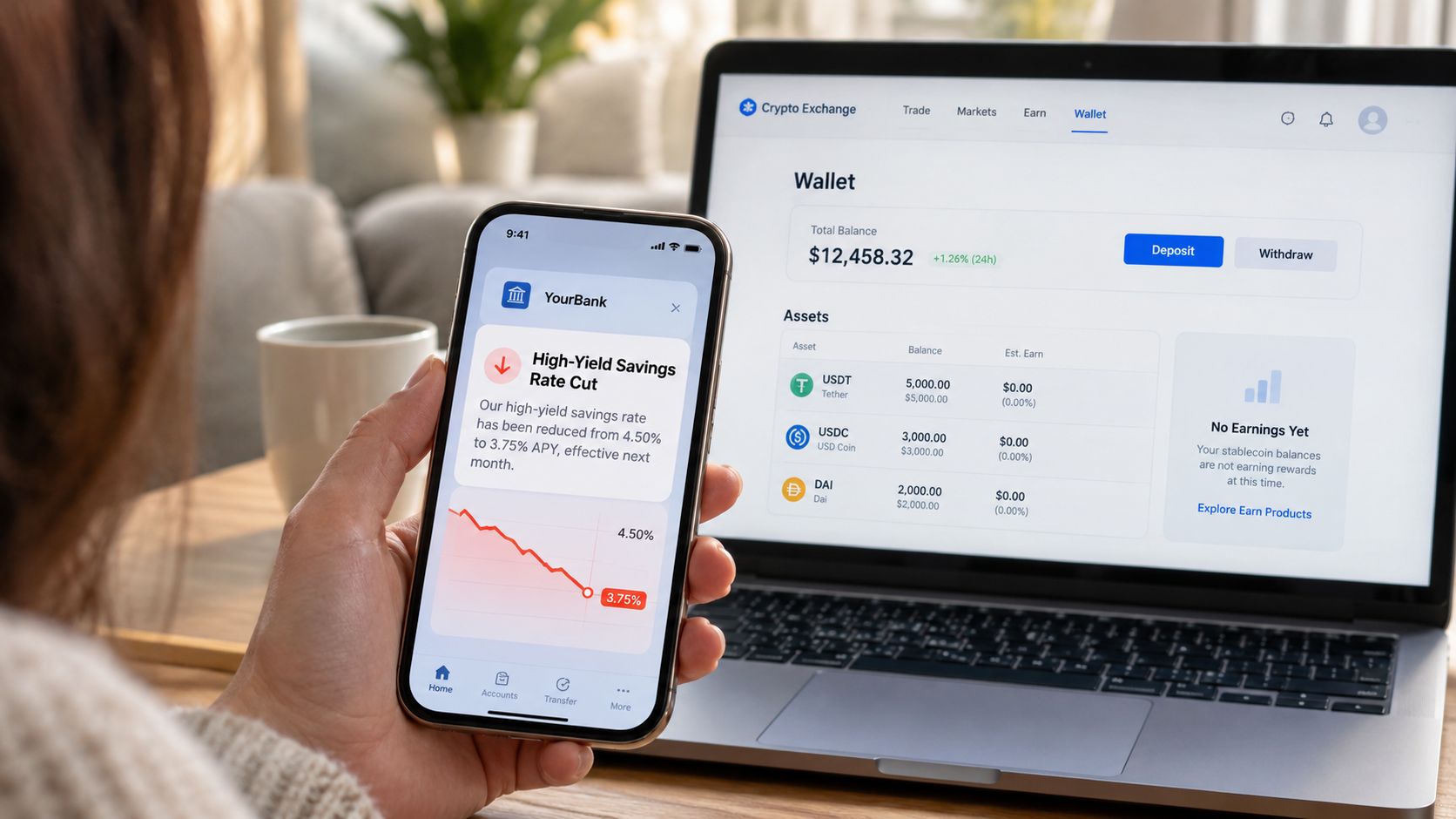
The attractive part is also the part that requires the most discipline. A bank absorbs operational complexity behind an account interface. In DeFi, your wallet, the protocol, and the underlying token all become part of the position.
Three questions behind the APY
Custody comes first. A bank or centralized crypto platform controls your assets and promises access under its terms. A DeFi protocol usually lets your wallet interact directly with a smart contract, so you retain control of the keys but also responsibility for approvals, transactions, and recovery.
Yield source matters just as much. A rate can come from borrowers paying interest, traders paying swap fees, or token incentives distributed by a protocol. Those sources have different durability. Borrowing demand can persist, while an incentive programme can change after a governance vote.
Risk determines whether the return is attractive. A stablecoin deposit may still face a temporary loss of dollar value, a contract exploit, an oracle failure, or a withdrawal bottleneck. DeFi TVL reached about $237 billion in Q3 2025, while daily unique active wallets averaged 18.7 million, down 22.4% from the prior quarter, according to Yahoo Finance's report on DeFi's record TVL. The scale is real, but scale doesn't turn a protocol into an insured bank.
A useful mental model is simple: DeFi can make idle capital productive, but it doesn't remove the cost of earning yield. It changes who carries that cost, and what can happen when the system fails.
What a DeFi Savings Account Actually Is
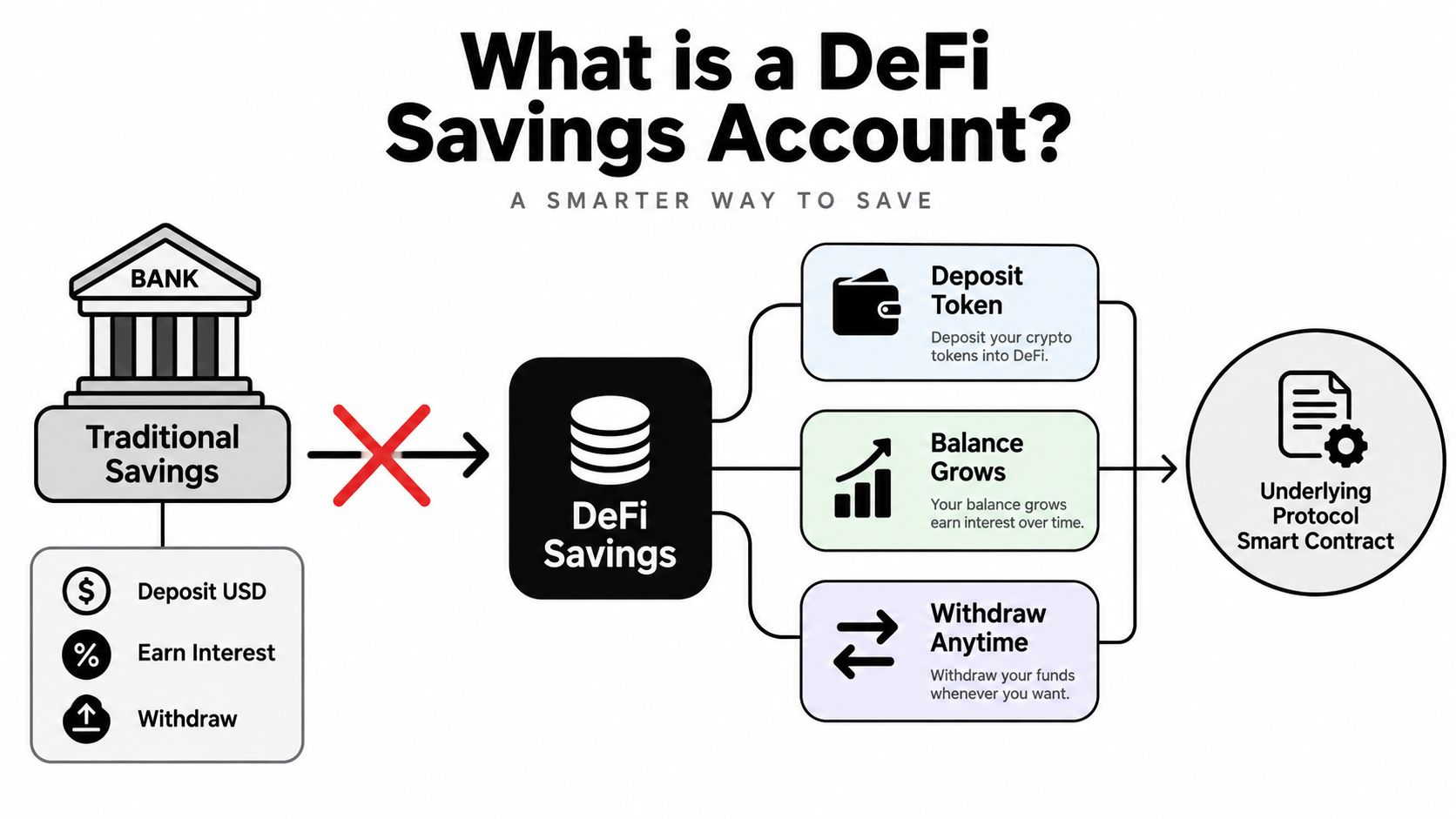
You deposit a supported token, see a balance change over time, and later withdraw it. The experience resembles a bank savings account, but the “account” is a position in software rather than an account held by a bank.
To create that position, you connect a self-custody wallet to a smart contract, approve the contract to use a token, and supply the token to a lending market, vault, or other strategy. The contract records your share and applies its rules automatically. No bank employee approves the deposit, and no company promises repayment from its own balance sheet.
The basic transaction
A typical lending deposit works like this:
You hold a supported token. USDC, USDT, DAI, or another accepted asset sits in your wallet.
You connect to the official application. Your wallet signs a connection request, followed by a token approval transaction.
You supply the token. The smart contract adds your funds to a pool used by borrowers or another strategy.
You receive a position token or vault share. It represents your claim on the deposited assets and any accrued yield.
You withdraw through the contract. The amount available depends on pool liquidity, market rules, and any lockup.
The rate usually responds to market activity rather than a central bank decision. In an overcollateralized lending market, the core formula is utilization = total borrowed / total supplied. As utilization rises, borrowers use more of the pool and suppliers generally earn more. When utilization falls, the supply APY usually compresses. The 2026 DeFi lending rates guide describes stablecoin supply yields commonly ranging around 3% to 8% APY across major protocols, with higher rates generally linked to tighter markets or optimized vaults.
That rate is an invitation to examine the trade-off, not a guaranteed paycheck. Compare the extra basis points with the return available from a Treasury, then ask whether they justify smart-contract, depeg, and governance exposure.
DeFi is not CeFi with a different logo
A centralized earn product, or CeFi product, puts funds under a company's control. The company may lend, invest, rehypothecate, or otherwise deploy the assets, then credit you under its terms. You rely on its solvency, internal controls, legal structure, and withdrawal process.
A DeFi savings position usually removes the corporate custodian, while leaving other forms of trust in place. You depend on code, audits, economic assumptions, price oracles, governance, and the stablecoin itself. There is no FDIC insurance, guaranteed rate sheet, or customer-support number that can reverse an exploit.
For broader context, see this guide to what decentralized finance is.
The bank analogy explains the familiar interface. The actual position is a wallet-controlled claim governed by software, so the yield must be judged alongside the risks that software introduces.
Where the Yield Really Comes From
A DeFi savings account doesn't manufacture interest. Someone, somewhere, must pay for the return, or a protocol must distribute an asset that it hopes will create future value. The APY you see is often a combination of economic revenue and subsidy.
Lending demand pays suppliers
In a money market such as Aave or Compound, suppliers deposit assets into a shared pool. Borrowers draw from that pool after posting collateral, often using volatile crypto assets to borrow stablecoins. Borrowers pay interest, and the protocol directs part of that interest to suppliers while retaining a reserve or protocol share.
The key variable is utilization. If many users want to borrow USDC while supply remains relatively constrained, the borrowing rate rises and the supplier rate typically follows. If deposits flood in and borrowing demand doesn't keep pace, utilization falls and the supplier APY declines. This is why a displayed rate is a moving market price, not a promise.
Liquidity providers earn trading fees
A second engine is liquidity provision. You deposit assets into an automated market maker, where traders swap between token pairs. Each swap can generate a fee, and liquidity providers receive a share according to the pool's rules.
The return depends on trading activity, pool composition, and price movement. A stablecoin pair may reduce directional exposure compared with a volatile pair, but it doesn't eliminate smart-contract risk or the possibility that the assets become imbalanced. Some pools add incentive tokens to attract liquidity. Those tokens can raise the headline APY while making the overall return dependent on emissions and market demand.
The mechanics are closely related to liquidity mining, where participants receive rewards for supplying capital to a protocol or market.
Staking rewards are protocol spending
Staking and reward emissions form a third source. A network or protocol distributes tokens to encourage users to secure the chain, supply liquidity, or adopt a new market. The recipient may see a high APY, but the protocol is often funding that return from a token budget rather than from borrower interest or trading fees.
That distinction matters. A lending market can earn revenue when borrowers pay. An emissions programme can end when governance changes the budget, the token price falls, or the protocol decides the subsidy no longer produces enough benefit. A vault that combines lending income, swap fees, and reward tokens may show one blended number, but each component has a different failure mode.
Trace the payment: Before depositing, identify the borrower, trader, or protocol treasury that funds each part of the displayed return.
For readers interested in the institutional side of DeFi market structure, roles such as an apply for director capital markets position can offer useful context on how lending liquidity, integrations, and capital markets connect. The same principle applies to a saver: follow the cash flow, not just the APY label.
The Risk-Adjusted Reality of DeFi Yields
A 5% stablecoin APY in DeFi isn't equivalent to 5% on a Treasury bill. The DeFi position carries additional risks that the Treasury doesn't carry in the same form, including contract bugs, oracle failures, governance changes, and stablecoin depegs.
The historical USDC stress event makes the point clearly. USDC traded as low as $0.87 during the March 2023 Silicon Valley Bank crisis before recovering, according to Spark's crypto savings account comparison. A saver could have earned interest while still experiencing a temporary loss in dollar value.
Recent comparisons also show why chasing the highest visible number can mislead. Headline stablecoin yields have compressed into roughly the 2.6% to 5% range on major venues, with some blue-chip lending pools near 2% and conservative strategies often in the 3% to 7% band, as reported by CryptoNews' DeFi yield analysis.
A simple comparison
The following example is hypothetical. It illustrates the decision method, not a forecast or measured historical result.
Strategy | Headline APY | Expected Loss | Risk-Adjusted Return | Risks Priced In |
|---|---|---|---|---|
DeFi stablecoin lending | 6% | Must be estimated by the saver | 6% minus expected loss and costs | Some rate risk, but contract, depeg, oracle, and governance exposure may remain |
One-year Treasury | Treasury rate must be checked at purchase | Depends on the instrument and jurisdiction | Yield minus applicable costs and taxes | Sovereign, duration, inflation, and access considerations |
If the DeFi strategy advertises 6%, the relevant calculation isn't “6% versus Treasury.” It's 6% minus expected loss, transaction costs, taxes, and the value of liquidity risk. If the remaining premium is only a few dozen basis points, the saver may be accepting a large technical risk budget for a small reward.
The same analysis noted that sustainable vanilla blue-chip DeFi may need to remain above roughly 5% to 8% to justify its risk premium, while a Morpho USDC vault reportedly fell from above 4% to about 3.05% in a week. Those figures show why the advertised rate should be treated as a current observation, not a steady-state assumption.
The saver's job isn't to find the biggest APY. It's to identify which risks the APY pays for, and which risks are free exposure.
DeFi vs Bank vs CeFi Savings Side by Side
The three options solve different problems. A bank gives you a regulated account relationship and a familiar recovery process. CeFi provides a crypto interface with centralized custody. DeFi gives you direct access to programmable markets, but puts the operational burden on you.
Dimension | Bank Savings | CeFi Yield, such as lending platforms | DeFi Savings Account |
|---|---|---|---|
Yield generation | Bank lending, securities, and balance-sheet decisions | Company-selected lending or investment activity | On-chain lending, liquidity fees, staking, or incentives |
Custody | Bank controls the account and funds | Platform controls the crypto | User generally controls the wallet keys |
Access | Account opening and jurisdictional requirements may apply | Requires platform account and supported region | Permissionless wallet access, subject to chain and token availability |
Insurance | May include applicable deposit protection | Terms vary, and crypto yield generally isn't equivalent to bank deposit insurance | No FDIC-style deposit insurance |
Counterparty risk | Bank solvency and regulatory framework | Company solvency, controls, and withdrawal policy | Smart contracts, oracles, governance, stablecoins, and liquidity |
Transparency | Bank reporting and regulatory disclosures | Company disclosures and policies | Transaction and contract activity can be visible on-chain |
Failure response | Customer service, regulators, and formal processes | Platform support and legal remedies may be available | Recovery depends on code, governance, and the user's own security |
Convenience and control point in opposite directions
Bank savings can offer low operational risk from the user's perspective, even when the rate is unattractive. You don't manage private keys, approve contracts, bridge assets, or decide whether a new governance proposal changes collateral parameters.
CeFi sits between the two. It can make crypto yield easy to use, but you hand a company control over the assets. Failures such as Celsius and BlockFi showed why convenience doesn't equal safety. A platform can offer a polished dashboard while its internal lending and liquidity decisions remain difficult for customers to verify.
DeFi provides the clearest access advantage. A user can connect a wallet, select a market, and transact around the clock without waiting for an account manager or a bank branch. That access is valuable, but the responsibility is real. If you approve a malicious contract or lose your keys, the system may not provide a practical reversal.
Convenience is a risk transfer. The smoother the interface, the more carefully you should ask who is carrying the complexity underneath it.
Common Protocol Strategies Worth Knowing
A stablecoin saver choosing a DeFi strategy should first identify where the yield comes from, then ask whether the added return justifies the extra smart-contract, depeg, and governance exposure. The strategy with the highest APY is rarely the simplest risk-adjusted choice.
Lending markets
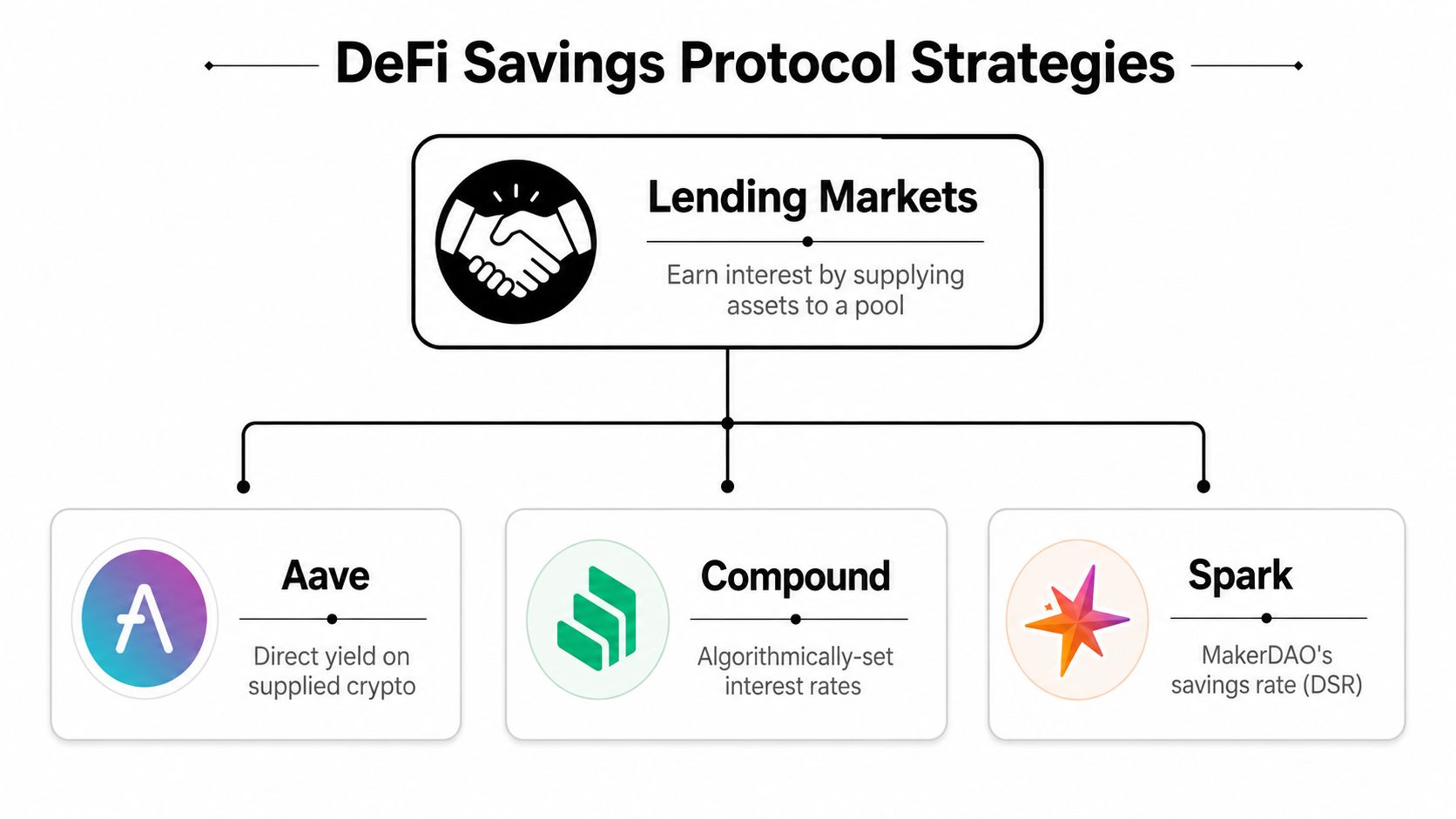
Aave, Compound, and Spark are direct starting points for stablecoin lending. You supply an asset to a pool, borrowers take loans against collateral, and the market sets the supply rate through utilization and protocol rules. The position is relatively easy to explain, and supplied assets can generally remain available for withdrawal, subject to pool liquidity.
Expected yield: variable, often moving as borrowing demand and available liquidity change.
Dominant risk: utilization shifts, contract vulnerabilities, stablecoin exposure, and governance decisions.
Best for: savers who want direct exposure to lending demand without adding several strategy layers.
The key question is whether the rate compensates you for those risks. A higher lending rate can reflect stronger borrower demand, thinner liquidity, or greater uncertainty, rather than free extra income.
Aggregators and auto-compounders
Yearn vaults and Convex-style products automate parts of the process. A vault may route deposits between markets, harvest incentive tokens, and reinvest proceeds. That saves operational work, but it also adds a vault contract, strategy manager, and sometimes another protocol to the dependency chain.
Expected yield: variable and strategy-dependent. Inspect the current holdings, reward sources, and fees instead of relying on a category average.
Dominant risk: layered smart-contract risk and dependence on token incentives.
Best for: users who understand that automation packages risk rather than removing it.
Liquid staking and restaking
Liquid staking products such as Lido issue a tradable representation of staked ETH. The underlying return comes from network validation, not stablecoin borrowing. Restaking products connected with EigenLayer-powered strategies add further economic and technical dependencies.
Expected yield: variable, tied to network rewards, validator performance, and additional strategy incentives.
Dominant risk: asset-price volatility, slashing or operator risk, liquidity stress, and protocol dependencies.
Best for: ETH holders seeking staking exposure, not savers seeking a dollar-like balance.
AI-managed and delta-neutral vaults
Newer vaults may automate allocation, hedge directional exposure, or adjust positions using market signals. A simple deposit screen can hide derivatives, funding rates, rebalancing rules, borrowing, and assumptions about execution.
Expected yield: highly variable and dependent on the specific strategy.
Dominant risk: model failure, heavy borrowing, liquidity gaps, and opaque implementation.
Best for: experienced users who can inspect how the strategy works and accept its complexity.
The most suitable category is the one whose mechanics and failure modes you can explain before depositing. Compare the extra yield with a lower-risk Treasury alternative, then size the position so one contract failure or depeg cannot decide your financial outcome.
Getting Started Safely in Your First Week
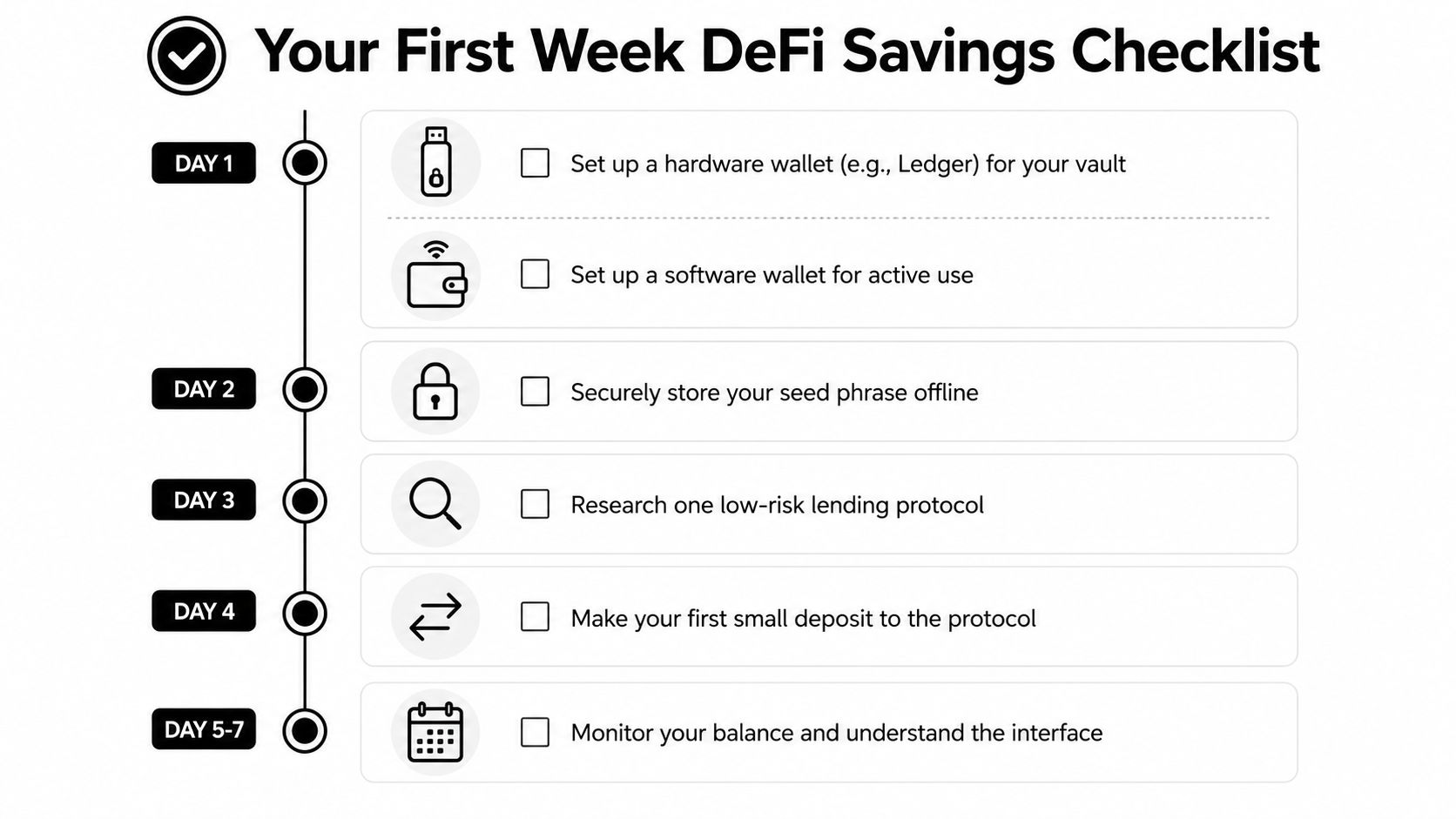
Your first week should be about learning the operating system, not maximizing yield. Treat the initial deposit as tuition you can afford to lose, and use every transaction to test your assumptions.
Days one and two
Set up two wallets if your funds justify the separation. Keep long-term capital behind a hardware wallet, and use a hot wallet for active DeFi interactions. Write the seed phrase on a durable offline medium, never store it in a cloud note, and send a small test transaction before moving meaningful funds.
Then choose a chain based on more than gas costs. Ethereum mainnet generally offers deep liquidity, while networks such as Arbitrum and Base can make smaller transactions more practical. A cheaper chain isn't useful if the stablecoin market you need has shallow liquidity or the protocol deployment lacks a strong security history.
Days three and four
Choose a familiar stablecoin and confirm that the protocol supports the exact network version you hold. USDC may offer broad liquidity, USDT may have deep market usage, and DAI presents different decentralization and collateral considerations. Avoid exotic or unaudited stablecoins because their displayed APY looks higher.
Start with one lending market, not a complex vault stack. A conservative position-sizing rule is to cap exposure at 1% to 5% of total assets per protocol, as outlined in the supplied market guidance, and never use emergency funds for an experiment.
Days five through seven
Bookmark the official application and monitor the position directly. Set alerts for unusual utilization changes, a sharp APY collapse, or governance proposals that alter collateral, caps, or risk parameters. Review the protocol dashboard and its TVL regularly, remembering that DeFi TVL fell from roughly $114.49 billion at the start of 2026 to about $71.77 billion by June 18, 2026, according to CoinLaw's DeFi market statistics.
Before adding a second position, practice the exit. Withdraw, bridge if necessary, confirm the destination wallet, and rebalance. A strategy isn't beginner-friendly if you understand how to deposit but haven't tested how to leave.
A Simple Framework for Choosing and Staying
Use four questions before approving a transaction.
Where does the yield originate? Separate borrower interest and trading fees from reward emissions. If incentives disappear, know what remains.
What can break? List smart-contract, oracle, depeg, governance, liquidation, and liquidity risks. “Audited” doesn't answer every question.
How quickly can you exit? Check for lockups, thin markets, withdrawal caps, and the cost of selling early. Liquidity is part of the return.
Does the risk-adjusted return beat a short Treasury alternative by enough? Compare the net yield after expected losses, fees, taxes, and the value of 24/7 market exposure.
A position should be small enough that you can tolerate an unpleasant outcome and clear enough that you can explain every dependency. Re-run the framework monthly. Trim exposure when a strategy shifts from market revenue toward temporary emissions, or when the rate falls below the premium you require.
The durable rule is simple: if you can't answer all four questions clearly, the position is too large. APY is a starting hypothesis, not a steady state.
Yield Seeker helps stablecoin holders automate allocation across supported DeFi protocols on Base through an AI-powered yield agent, while keeping funds accessible without lockups or withdrawal fees. Visit Yield Seeker to explore a guided way to monitor and manage risk-aware stablecoin yield without manually juggling multiple dashboards.