

You have USDC sitting idle, and every DeFi dashboard seems to promise a better use for it. One pool advertises an eye-catching APY, a lending market shows a quieter rate, and an automated vault claims it can move capital when conditions change. Then the questions start: Which return comes from protocol activity, which comes from newly issued tokens, and how much will remain after fees, slippage, and risk?
That confusion captures the core challenge of crypto yield farming. Depositing capital is simple. Measuring the return you keep is not. Sustainable stablecoin income comes from understanding where yield originates, how exposure can change, and when automation can remove repetitive work without hiding the risks.
Why Yield Farming Feels Overwhelming Right Now
A stablecoin holder usually starts with a straightforward goal: keep capital relatively stable while earning something on it. DeFi appears to offer that outcome, but the research process quickly becomes fragmented. You may compare lending markets on one dashboard, liquidity pools on another, vaults on a third, and token incentives somewhere else entirely.
The displayed rate can change while you're still investigating it. A high APY may include reward tokens rather than protocol revenue, while a lower-looking rate may come primarily from borrower interest or trading activity. Without separating those sources, you're comparing different economic products as if they were identical savings accounts.
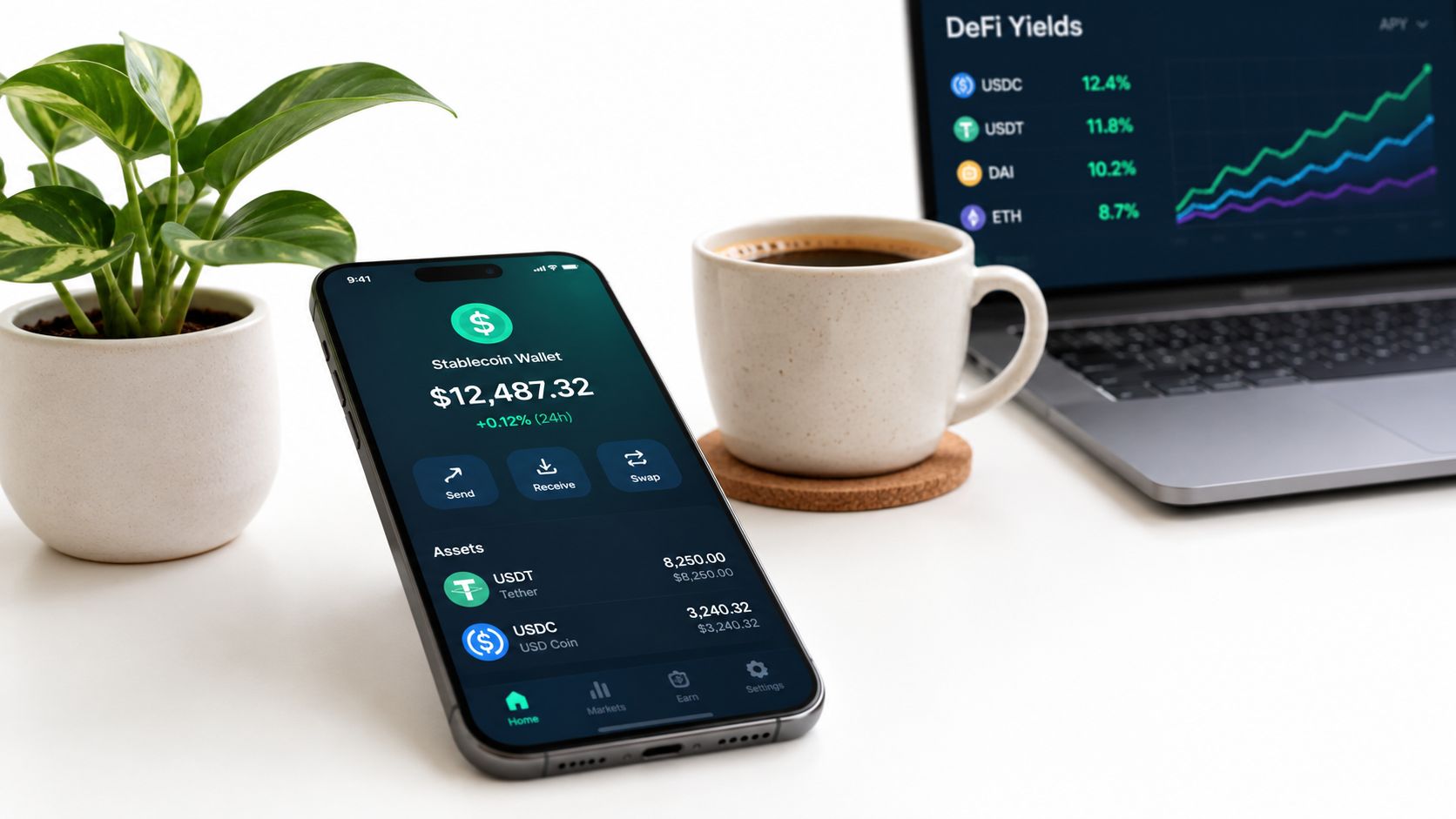
The work behind a simple deposit
Manual yield hunting involves more than finding a rate. You need to check contract history, asset composition, liquidity, withdrawal conditions, reward schedules, and the way the protocol changes parameters. You also need to revisit those checks because utilization, incentives, and market prices keep moving.
Practical rule: Treat every APY as a temporary observation, not as a promise about the return you'll realize.
Stablecoin strategies reduce one obvious source of volatility, but they don't turn DeFi into a bank account. A pool can expose you to a depeg, a contract exploit, delayed withdrawals, or rewards that lose value as participants sell them. A lending market can be easier to understand than a volatile LP position, yet it still depends on smart-contract design and available liquidity.
The sensible response isn't to inspect every opportunity forever. It's to create a repeatable process that asks three questions: Where does the yield come from? What can reduce the net return? How quickly can I exit if conditions change? Those questions provide a better starting point than sorting a dashboard by the largest advertised number.
How Crypto Yield Farming Actually Works
Yield farming is the practice of placing digital assets into DeFi protocols that use pooled capital for trading, lending, or other onchain activity. A useful analogy is a digital money market with dynamic pricing. Users supply capital, other users demand it, and the protocol adjusts the compensation according to activity and available liquidity.
There are two common routes.
Providing liquidity through an AMM
An automated market maker holds token pairs in a pool so users can trade without a traditional order book. Liquidity providers deposit both sides of the pair and receive a share of swap fees. Some protocols add reward tokens to attract more liquidity.
That arrangement creates significant exposure. If the relative price of the two deposited assets moves away from the ratio at entry, the pool rebalances the provider's position. The provider may receive more of the asset that has fallen relative to the other, creating impermanent loss compared with just holding the assets outside the pool.
The automated market maker model can work well when fee generation compensates for that rebalancing exposure. It can fail when the reward headline is high but trading fees are weak, token incentives fade, or the pair becomes highly volatile.
Supplying assets to lending markets
Lending protocols use supplied assets as liquidity for borrowers. Suppliers earn variable interest, and rates respond to utilization. A single-asset stablecoin deposit is usually easier to monitor than a two-asset volatile LP position because it doesn't require managing a changing pair ratio.
That simplicity doesn't eliminate risk. Borrower demand can shift rates, withdrawals can become constrained during stress, and the supplied stablecoin can lose its peg. The source of yield is also different from an AMM. Lending income is connected primarily to borrower interest, while AMM income comes from trading fees and may be supplemented by emissions.
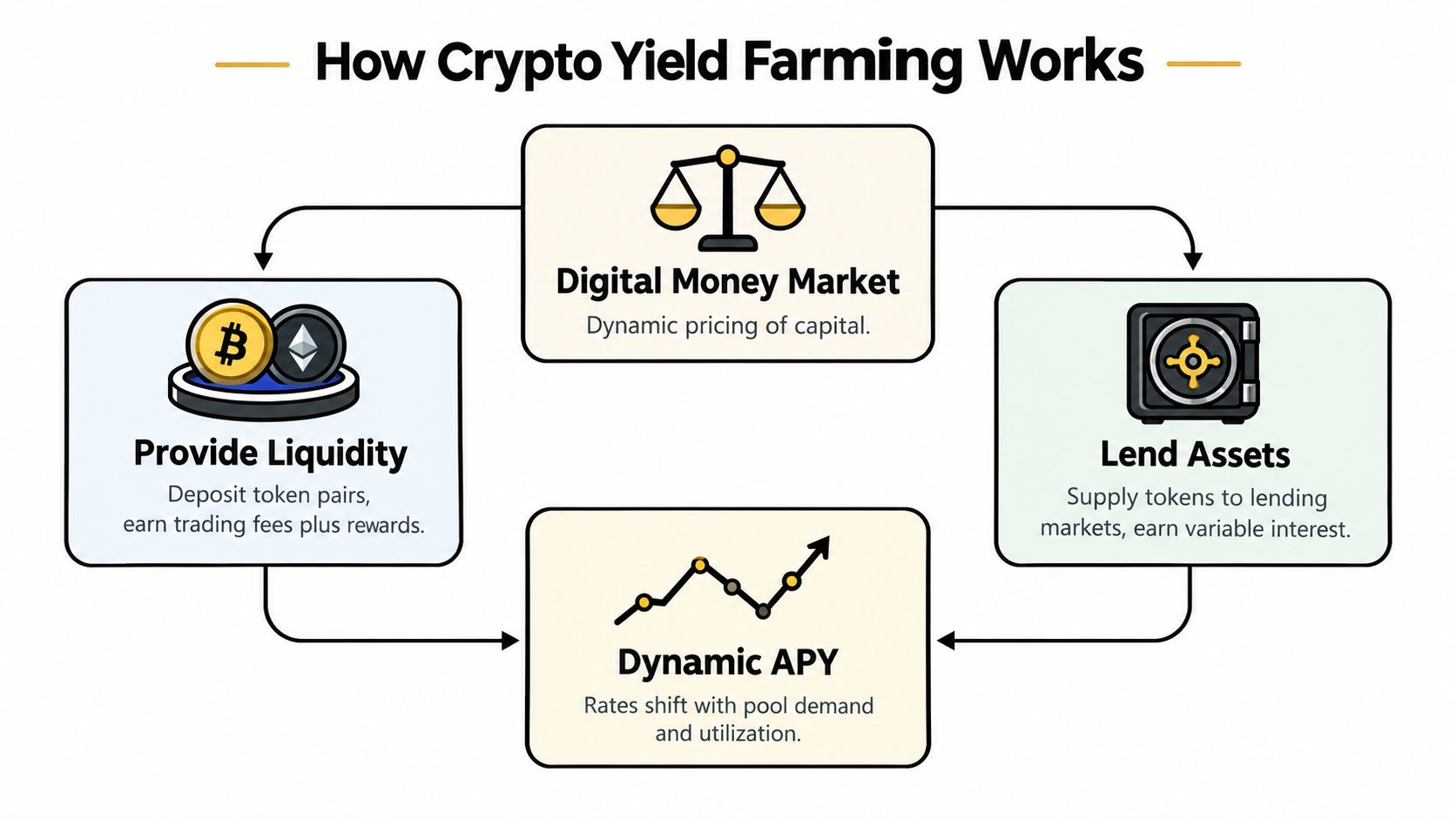
The core lesson is simple: gross APY isn't net return. In AMM-based farming, a pool can show positive gross APY while producing a negative net result if fees and incentives don't cover impermanent loss. Pair selection therefore matters more than the biggest number on the screen, as described in this academic treatment of yield farming mechanics.
This video provides a visual introduction to the same flow:
Comparing Protocol Types and Yield Strategies
Choose a strategy based on the return you need to realize, not the APY displayed at entry. AMM liquidity provision earns swap fees and sometimes incentives, but pair exposure and impermanent loss can reduce the result. Lending is easier to track with one stablecoin, though its rate depends on utilization, borrower demand, and protocol controls.
Strategy | Main income source | Primary exposure | Practical fit |
|---|---|---|---|
AMM liquidity provision | Swap fees and possible incentives | Pair rebalancing, volatility, token emissions | Users who understand LP accounting and can monitor positions |
Single-asset lending | Borrower interest | Smart-contract risk, utilization changes, depeg risk | Stablecoin holders prioritizing simpler exposure |
Yield trading with Pendle | Trading or holding separated yield components | Market pricing, maturity structure, protocol risk | Experienced users who understand fixed and variable yield behavior |
Automated vaults such as Fluid | Strategy execution across integrated positions | Contract, strategy, liquidity, and governance risk | Users who want fewer manual transactions but still need oversight |
Aave represents the lending-market route. Supplying a stablecoin avoids the changing pair ratio found in volatile LP positions, but the rate can move quickly as borrowing demand changes. Protocol failure and depeg risk remain, so simpler accounting does not mean safer capital.
Pendle separates yield characteristics into tradable components. Users can structure exposure around fixed or variable returns, but the market price, maturity date, and exit liquidity all affect the result. A quoted yield can look attractive while the position loses value before maturity.
Fluid represents an integrated, automated approach. Vaults can reduce manual transactions and help execute a defined strategy, but automation does not remove contract, liquidity, or governance dependencies. AI-assisted automation can also monitor rates, compare routes, and flag changes, yet it should support risk controls rather than chase the highest headline APY.
For familiar stablecoin options including Aave v3, Sky Savings Rate, and Fluid, newer comparison lists show live APYs in the roughly 4% to 6% range. Those figures come from Coin Bureau's stablecoin-yield coverage, and they are snapshots rather than promised outcomes.
Stablecoin strategies sit between simplicity and safety. They may avoid the impermanent loss associated with volatile pairs, while still carrying smart-contract, governance, utilization, withdrawal, and depeg risks. The useful comparison is net return after fees, slippage, exit costs, and losses, not the largest number shown on a dashboard.
What the Data Says About Yield Farming Returns
Yield farming outcomes are path-dependent. Entry timing, exit timing, asset volatility, fee generation, incentive changes, and the route capital takes through a protocol can all affect the realized result. Two users can enter the same pool under different conditions and experience different net returns.
One empirical study reported an average yield-farming alpha of 137.78%, as documented in the research on yield-farming investment performance. That figure shouldn't be read as a normal expectation for a stablecoin depositor. It illustrates how strongly sample selection, market regime, timing, and strategy design can influence reported performance.
Raw return and risk-adjusted return are different questions
Many liquidity pools can underperform buy-and-hold on raw returns. That result makes sense when price exposure and impermanent loss outweigh collected fees. Yet the same research indicates that some pools can deliver superior risk-adjusted performance when evaluated with measures such as the Sharpe ratio.
That distinction changes the decision process. A strategy that earns less in absolute terms may offer a more acceptable relationship between return and variability. A strategy with a spectacular displayed APY may rely on emissions that decline, a reward token that sells heavily, or a volatile pair whose loss isn't obvious until withdrawal.
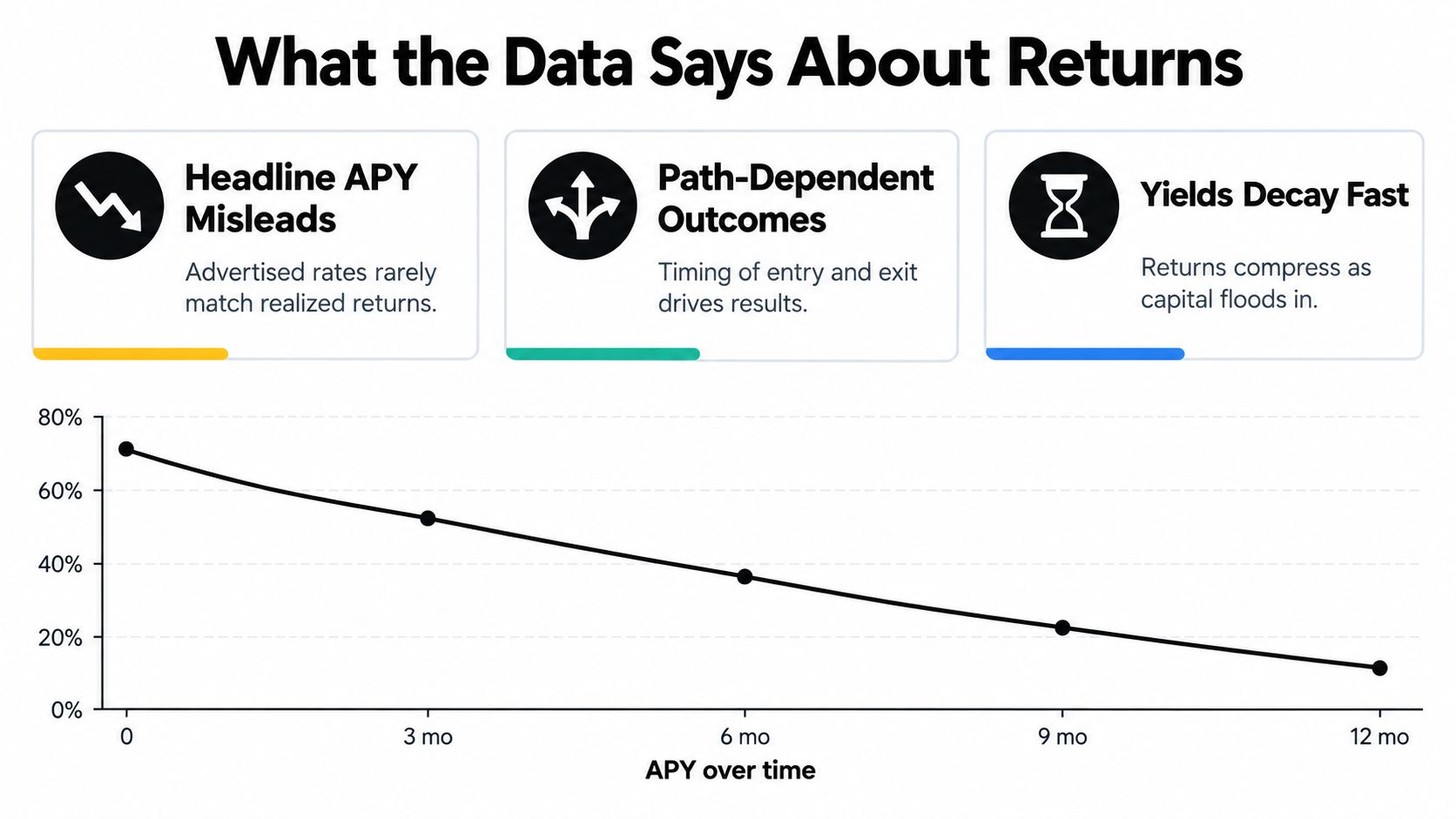
The useful question isn't, “Which pool has the highest APY?” It's, “Which pool combines fee income, incentive design, volatility, and liquidity in a way that can produce acceptable risk-adjusted performance?” Correlated or stable pairs may reduce impermanent loss, but they can still carry contract and depeg risk.
Onchain research helps answer that question because it exposes actual deposits, withdrawals, utilization, reward flows, and contract interactions. A practical onchain research workflow should record the source of the displayed return and compare it with what a user would retain after costs and exposure changes.
The data supports skepticism, not paralysis. Yield farming can produce attractive outcomes, but the result depends on the path taken, not merely on the rate shown at entry.
Understanding Key Risks of Stablecoin Yield
Stablecoin yield can appear safer than volatile-pair farming because the deposited asset aims to hold a stable value. That narrower price exposure helps, but it does not remove the risks beneath the strategy. A stablecoin label says little about how a product behaves when its protocol, market, or underlying asset comes under stress. The useful question is how much of the headline APY remains after losses, fees, delays, and changing incentives.
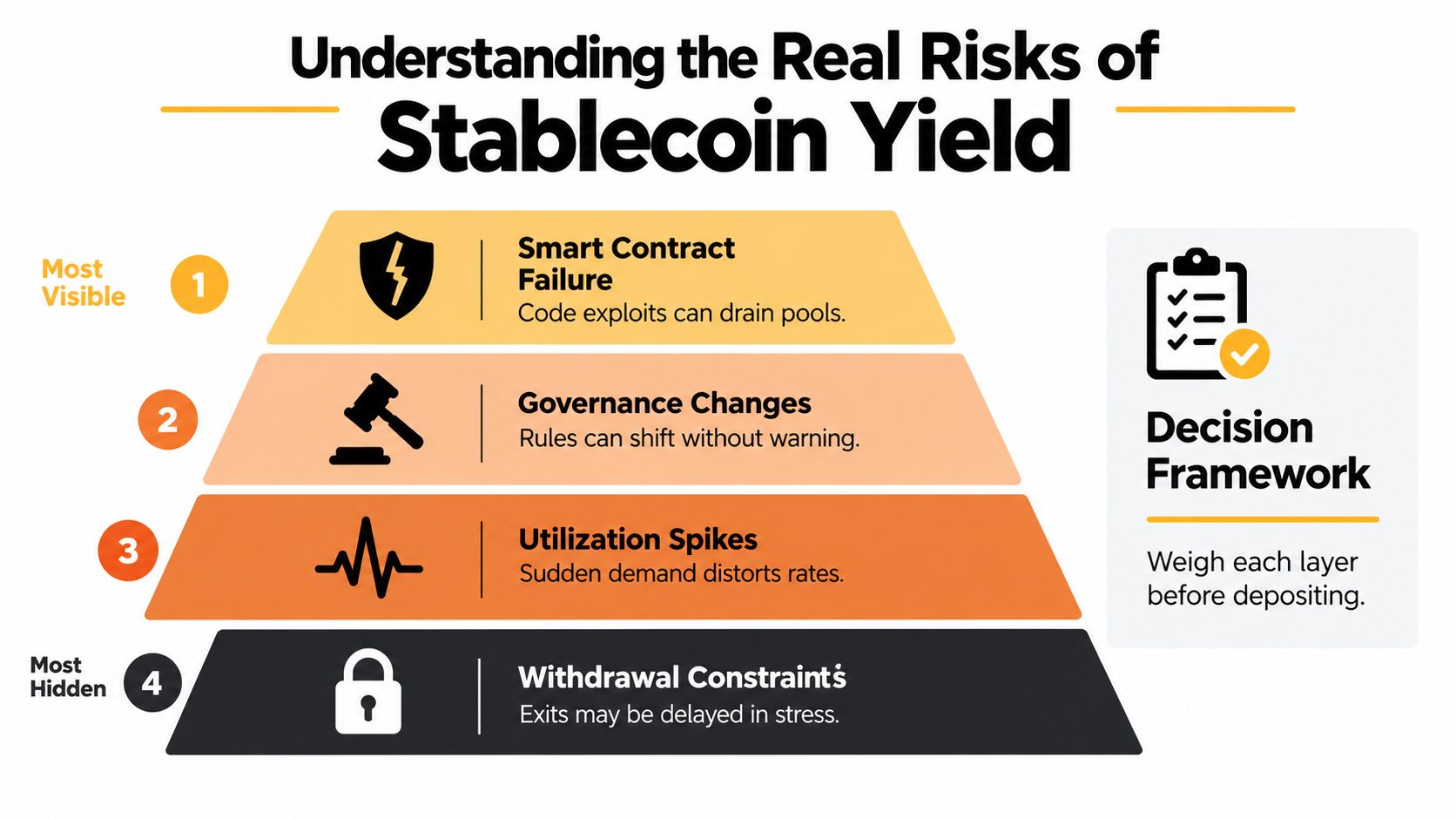
Rank the risks before ranking the yield
Start with the contract. A bug, exploit, or flawed integration can put deposited funds at risk regardless of the advertised APY. Check whether the protocol is upgradeable, how permissions are controlled, and whether the strategy relies on several contracts instead of one.
Governance introduces another variable. Token holders or administrators may alter incentives, collateral parameters, caps, or fee rules. A strategy that suits a stablecoin user today may become less suitable after one parameter change.
Utilization affects both the rate and access to funds. In a lending market, strong borrowing demand can raise the displayed rate while reducing immediately available liquidity. In a vault, a stress event can slow withdrawals when underlying positions cannot unwind quickly.
The stablecoin itself can depeg. A single-asset strategy can still lose value if that asset moves away from its target, or if its accounting and redemption systems depend on assumptions that fail during a market shock.
A practical decision grid
Criterion | More favorable profile | Warning sign |
|---|---|---|
Withdrawal speed | Direct, visible redemption path | Exit depends on an illiquid position or queue |
Depeg exposure | Clear reserve and collateral mechanics | Opaque backing or complex dependencies |
Liquidation risk | No borrowing on the position | Position can be liquidated after a price move |
Yield durability | Income linked to fees or borrower interest | Return dominated by newly issued rewards |
Advertised APYs often combine protocol revenue with subsidized token emissions. Coverage of emission-driven yield explains how rewards can inflate the displayed rate and fall as incentives fade. A stablecoin pool may therefore look conservative while delivering a weak net result, especially when users sell the reward token and absorb slippage or fees.
Ask how much of the displayed return survives after incentives, fees, slippage, and any change in the reward schedule.
Automated single-asset stablecoin yield is usually simpler to operate than manual LP farming because it avoids pair management. It is not automatically safer. Compare the exit path, asset mechanics, contract surface, and income durability before comparing APYs. A lower headline rate with clearer redemption and fewer dependencies can produce the stronger result for a user who measures what reaches the wallet.
How AI Automation Changes the Yield Farming Equation
Manual optimization fails for a practical reason: the work never stops. Rates change, incentives expire, liquidity moves, and opportunities appear across several protocols and chains. A person who checks one dashboard occasionally can miss a change that materially affects the net return.
AI automation can handle the repetitive monitoring layer. An agent can scan supported protocols, compare yield sources, evaluate selected risk parameters, and reallocate capital according to rules or preferences. That doesn't guarantee profit, and it shouldn't replace contract review or position limits. It can reduce the time spent collecting the information needed to make those decisions.
Automation should expose decisions, not hide them
Useful automation has three properties:
Clear allocation logic: You can see where capital is deployed and why a position changed.
Risk-aware constraints: The system accounts for supported protocols, assets, liquidity, and strategy limits rather than sorting only by APY.
Accessible reporting: Balances, earnings, and allocations remain visible without forcing you to reconcile several dashboards.
AI agents for yield management are most useful when they turn fragmented research into a repeatable operating process. The agent should monitor the opportunity set, while the user still decides how much capital to commit and what risks are acceptable.
Yield Seeker is one example of this approach. Its platform uses personalized agents to monitor and allocate stablecoin capital across integrated DeFi protocols in real time, with balances and earnings shown in a unified interface. The product also includes a terminal and visual walkthroughs, which can help users inspect strategies instead of treating automation as a black box.
Automation changes the labor equation, not the economics. It can't make an emissions-heavy strategy durable, eliminate depeg exposure, or turn an unaudited contract into a safe one. Its value comes from consistent observation and execution, especially for users who don't want to manually track every rate change.
Getting Started with Automated Stablecoin Yield
Start with a strategy you can explain in one sentence. For a beginner, that may mean supplying a single stablecoin rather than entering a volatile LP pair. The simpler the exposure, the easier it is to understand what changed when the balance moves.
A practical onboarding path looks like this:
Create an account: Review the permissions, supported assets, and withdrawal process before depositing.
Deposit USDC on Base: Yield Seeker supports deposits as small as $10 USDC on Base, according to the publisher information provided for the platform.
Choose your agent preferences: Let the personalized agent scan integrated opportunities and allocate according to its available strategy logic.
Inspect the allocation: Use the dashboard, terminal, and visual walkthroughs to see where capital is working and how earnings are presented.
Review before scaling: Confirm that the underlying protocols, asset exposure, and exit process match your tolerance before adding more.
The interface should make the important details easy to find. You want to know your current balance, where the capital sits, what return is being reported, and whether the allocation changed. A clean presentation doesn't replace due diligence, but it reduces avoidable operational mistakes.
Funds remain accessible through the stated product design, with no lockups or withdrawal fees. You still control the decision to deposit, adjust, or exit. Treat the first allocation as an operational test, not as proof that a strategy will perform through every market condition.
Building a Sustainable Yield Strategy for 2026
For 2026, a sustainable strategy starts with the income source, not the highest APY. Borrower demand and trading activity can support variable returns. Emissions-driven rates may fall quickly when incentives change. Stablecoin users should compare the advertised rate with the return left after fees, slippage, reward-token volatility, and operational costs.
Recent live comparisons have shown familiar stablecoin options in the roughly 4% to 6% range, according to Coin Bureau's comparison of DeFi yield options. That range is an observation, not a promise, and it does not remove protocol, smart contract, or stablecoin risk.
A durable operating model
Use a repeatable process:
Start with single-asset exposure: Understand deposits, earnings, and withdrawals before adding LP complexity.
Calculate net return: Subtract fees, slippage, reward-token losses, and potential impermanent loss from the headline APY.
Check the exit path: Confirm how withdrawals work and whether market stress could delay access.
Trace the income: Favor strategies tied to visible protocol activity, borrower demand, or another understandable mechanism.
Automate within limits: Let software monitor and execute known actions while you retain the risk decision.
AI automation can reduce the research and rebalancing burden, but it cannot turn weak yield into reliable profit. Set allocation limits, review protocol exposure, and judge performance by net return over time rather than the advertised rate.
Research on yield farming also shows why a single APY is an incomplete measure. Results vary by market path, while risk-adjusted performance may matter more than raw return. That supports disciplined allocation instead of rate chasing.
Yield farming can suit stablecoin holders, but passive income still requires active risk oversight. The strongest strategy is one you can explain, monitor, and exit.
Yield Seeker automates stablecoin allocation across integrated DeFi protocols while displaying balances, earnings, and strategy activity. Review the platform and its automated agents at Yield Seeker.