
Your stablecoins are probably doing less than you think. A balance sits in one lending vault, the displayed rate looks acceptable, and you stop checking until a better opportunity appears elsewhere. Then the rate compresses, a protocol changes its incentives, or a depeg turns a supposedly liquid position into an emergency exit.
The mistake isn't failing to find the highest APY. It's leaving all your capital exposed to one yield source, one issuer, one oracle design, or one liquidity condition. Portfolio allocation strategies give you a way to divide capital deliberately, measure the risks that matter, and automate execution without outsourcing every decision.
Why Your Stablecoins Need an Allocation Strategy
Suppose you hold USDC and deposit it into a single lending market. The position is simple, visible, and easy to withdraw. But simplicity can hide two separate costs. You may be accepting unnecessary protocol or issuer concentration while missing opportunities that arise across Aave, Morpho, Curve, or other venues.
That doesn't mean you should chase every new rate. A yield source can compensate you for smart contract risk, liquidity risk, market-making risk, or a strategy that depends on a fragile assumption. The practical question is whether your income comes from several risks that behave differently, or from several interfaces connected to the same underlying failure.
Practical rule: Treat a stablecoin balance as a portfolio of risk exposures, not as a digital savings account.
Traditional allocation theory starts with the same problem. The classic 60/40 portfolio, with 60% equities and 40% bonds, became widely used because it combined equity risk premium, bond income, diversification, and operational simplicity. A CFA Institute-hosted report found that since 1900, the strategy produced almost 5% annualized real return in the United States and Australia, more than 4% in the United Kingdom, around 3% in Japan and Europe, and about 4% globally, as reported in GMO's analysis of the 60/40 default.
Stablecoin portfolios need the same discipline, but the building blocks are different. You aren't balancing stocks against government bonds. You're balancing lending markets, stable pools, basis trades, real-world assets, liquidity reserves, issuer exposure, oracle dependencies, and smart contract surfaces.
Start by documenting the risks behind each position. The stablecoin risk framework is useful because it forces you to separate depeg risk from protocol risk and liquidity risk. Once those exposures are visible, allocation stops being an APY leaderboard and becomes a repeatable capital-management process.
The Building Blocks of Stablecoin Portfolio Allocation
Use four primitives to translate traditional portfolio construction into DeFi terms.
Yield source
A yield source is the mechanism producing return. Lending on Aave or Compound earns interest from borrowers. A Curve stable pool earns trading fees and possibly incentives. A basis trade seeks funding or price discrepancies. A tokenized real-world asset may distribute income from an off-chain credit or Treasury structure.
Don't group these by interface. Group them by what must remain true for the return to exist. A lending position depends on borrower demand, collateral controls, liquidation infrastructure, and protocol solvency. A stable LP depends on pool balance, pricing mechanics, liquidity, and smart contract behavior. Two products can display similar yields while carrying entirely different failure modes.
Correlation cluster
A correlation cluster contains positions likely to fail or underperform together. USDC lending on Aave and USDC lending on Morpho may look diversified because the protocols differ, but they can share issuer exposure, stablecoin liquidity conditions, and broad demand for borrowing.
USDC on Aave and USDT on Compound are also closer to duplicates than many dashboards suggest if your primary concern is stablecoin lending demand and issuer concentration. A Curve stable LP belongs in another cluster because it adds pool imbalance and liquidity-provider contract risk, even though it may still share depeg exposure with the lending positions.
Risk unit
Measure risk in units that can break. Useful inputs include:
Protocol exposure: How much capital depends on one contract system?
Issuer exposure: How much capital depends on one stablecoin issuer?
Oracle dependency: Does a price feed control liquidations or withdrawals?
Liquidity depth: Can you exit without relying on a thin market?
Audit and governance status: Who can change parameters, and how quickly?
A position with attractive expected yield can still deserve a small allocation if its worst-case loss is difficult to estimate.
Rebalancing trigger
A rebalancing trigger tells you when a position has become too large, too small, too risky, or no longer worth its operational burden. It can be a weight drift, a protocol-score change, a liquidity threshold, a depeg alert, or a yield difference after gas and execution costs.
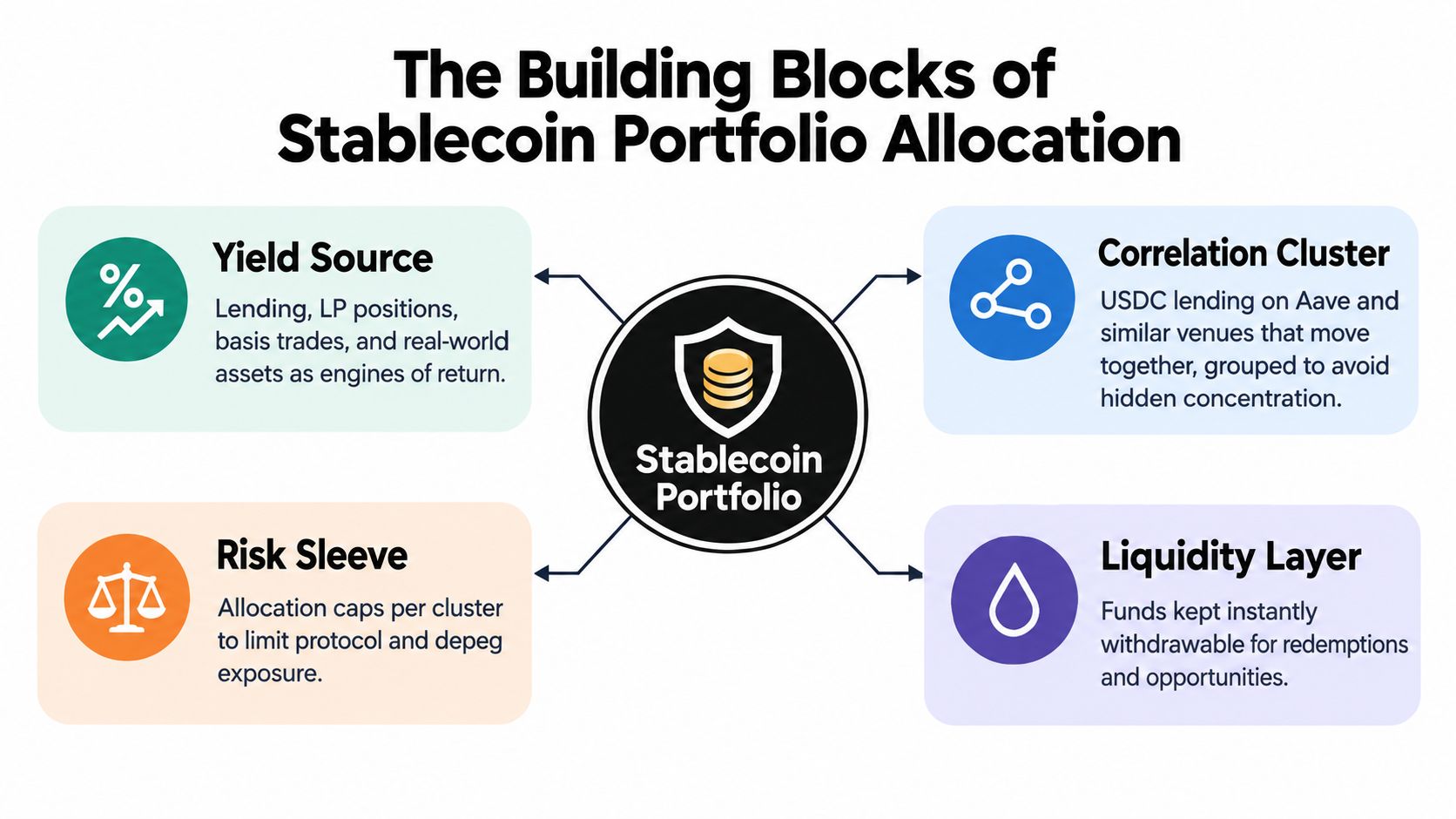
A 60/40 analogy breaks down when both legs depend on the same issuer or liquidity venue. In stablecoin-native risk parity, equal weights aren't the goal. Equalize expected damage, not expected yield. Your mental model should be simple: every position needs a return engine, a correlation cluster, a measurable risk unit, and a rule for leaving.
Risk Budgeting Without Spreadsheets
You can run a useful risk budget on one page. I use three layers: hard caps, portfolio-level loss tolerance, and protocol quality checks.
The first layer prevents concentration before it becomes a crisis. Set a maximum for any individual protocol, issuer, and correlation cluster. The exact figures should reflect your liquidity needs and confidence in the infrastructure, but starter caps make the framework executable rather than theoretical.
Layer | Metric | Suggested Cap | Trigger |
|---|---|---|---|
Protocol | Capital in one protocol | 25% | Trim above cap |
Issuer | Capital tied to one stablecoin issuer | 40% | Review and diversify |
Correlation cluster | Capital with similar failure modes | 40% | Rebuild sleeve |
Portfolio loss | Weekly NAV movement | 50 basis points | Immediate review |
Portfolio loss | Monthly NAV movement | 200 basis points | Halt new risk and investigate |
These are operating limits, not forecasts. They aren't guarantees that a portfolio will remain safe, and they shouldn't be treated as universal suitability advice. Their value is that they force a decision before a position becomes emotionally difficult to sell.
Size from loss, not APY
The second layer expresses risk in basis points of total portfolio NAV, not in displayed APY. A position promising a high rate doesn't belong in the portfolio unless you can estimate what happens if its underlying assumptions fail.
Use a simple sizing equation:
Position size = risk budget ÷ expected worst-case loss per unit of position.
For example, if you allocate a defined loss budget to a protocol sleeve and estimate that a severe incident could erase a material portion of that sleeve, the resulting position size should be smaller than a position with a clearer exit path and stronger liquidity. You don't need false precision. You need consistent assumptions applied across every sleeve.
Score the protocol
The third layer is qualitative but structured. Record the latest audit information you can verify, the oracle design, governance permissions, insurance or reserve arrangements, withdrawal mechanics, and previous depeg behavior. Score each item using the same scale, then reduce exposure when the score worsens.
This is how you survive an oracle incident without manual heroics. The system should know that a protocol-level change can trigger a withdrawal or a position cap even when the headline APY still looks attractive.
A high rate is an output. Your risk budget is a constraint. Never let the output rewrite the constraint.
Three Sample Allocations for Different Risk Profiles
You don't need to invent a portfolio from scratch. Pick a profile, apply the caps above, and adjust only after you've observed how the allocation behaves through normal rate changes and stressful conditions.
The conservative profile puts 70% into established lending markets such as Aave and Compound, 20% into a high-quality stable pool on Curve or Convex, and 10% into cash. It prioritizes liquidity and familiar mechanisms. It still has smart contract, issuer, and depeg exposure, so “conservative” describes the relative design, not a guarantee of capital preservation.
The balanced profile uses 40% lending, 25% liquid staking derivatives such as Lido stETH, 20% in a curated stable pool, 10% in real-world asset protocols such as Maple or Centrifuge, and 5% cash. This profile introduces more moving parts, including ETH-linked exposure and off-chain credit or asset structures. It can make sense for a holder who accepts more implementation complexity in exchange for broader return sources.
The aggressive profile allocates 25% to lending, 20% to liquid staking derivatives, 15% to stable pools, 20% to real-world assets including newer tokenized Treasury products, 10% to basis trades or funding-rate arbitrage, and 10% cash. It has more dependencies, more monitoring requirements, and more ways for a seemingly independent sleeve to become correlated during stress.
Risk Profile | Target APY Band | Max Drawdown | Complexity |
|---|---|---|---|
Conservative | Define from live net yields | Lower tolerance | Low |
Balanced | Define from live net yields | Moderate tolerance | Medium |
Aggressive | Define from live net yields | Higher tolerance | High |
I won't invent target APY bands for these profiles because rates change and a quoted gross APY can hide incentives, utilization changes, slippage, and protocol risk. Compare net yield after fees and execution costs, then ask whether the extra return compensates you for the additional failure modes.
Choose conservative if your cash needs are near term or a loss would change your plans. Choose balanced if you can monitor the system and tolerate more complexity. Choose aggressive only when you understand every sleeve well enough to explain its exit path. Change profiles when your liquidity needs or risk tolerance change, not because a dashboard makes one category look fashionable.
Rebalancing Cadence and Drift Rules
Set rebalancing rules before a stablecoin portfolio starts drifting. Calendar rebalancing reviews every sleeve on a fixed schedule. Threshold rebalancing acts when a sleeve moves outside its target band. Use both: the calendar catches slow concentration, while the threshold prevents one position from dominating before the next review.
Cadence is a cost decision, not a ritual. Dimensional reported that quarterly rebalancing produced about twice the turnover of annual rebalancing for a U.S. 60/40 portfolio from 1979 to 2019, using turnover as a proxy for cost, as summarized in Fidelity's rebalancing research document. Evaluate the strategy through out-of-sample performance, turnover, and tracking error rather than raw return alone, as recommended by this asset-allocation evaluation framework.
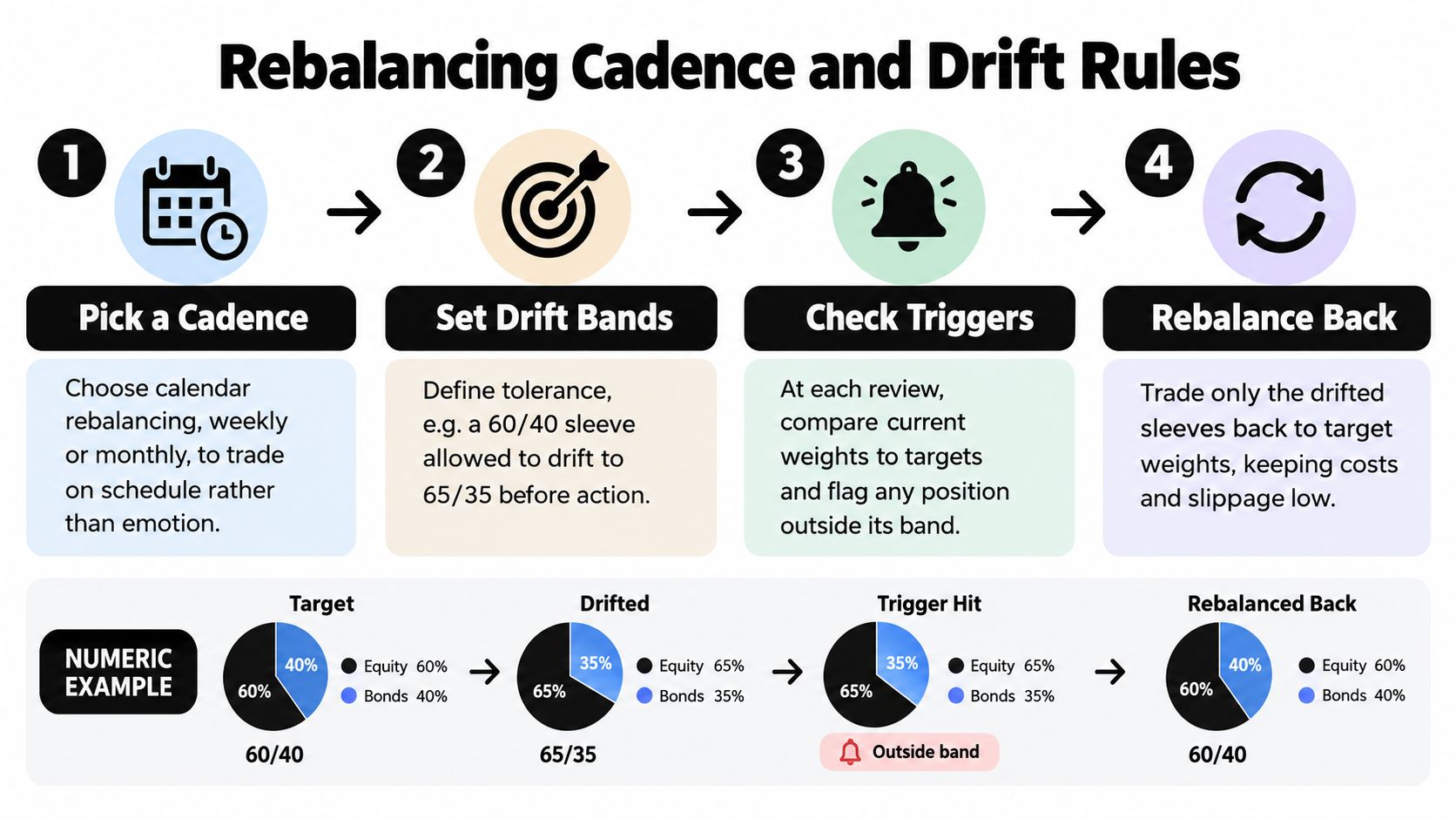
For a stablecoin portfolio, make a monthly review the default and add event-driven triggers. Keep any single protocol below 40% of capital. Set a sleeve cap at 20% above its target before trimming. Hold 5% to 10% in cash, giving you room to add to an underweight sleeve without immediately selling another position.
A worked example
Suppose lending has a 40% target and grows to 47%. First identify the cause: new deposits, yield accrual, or losses in other sleeves. If the position has breached its drift band, use the cash buffer to restore the target where possible. Send only the remaining adjustment through the cheapest safe execution route.
Do not trade every small movement. Set the boundary in advance, then act when the portfolio crosses it. Norges Bank Investment Management found that rebalanced portfolios produced higher returns and lower risk, including lower volatility and tail risk, than passive drifting portfolios, as reported in Fidelity's rebalancing research document. Translate that evidence into an operating rule: rebalance when a sleeve breaches its band or the scheduled review arrives, and record the cost of every adjustment.
Use this decision tree:
Small portfolio: Review monthly and trade only when drift exceeds the band or execution costs are negligible.
Medium portfolio: Review weekly, then batch non-urgent trades to reduce overhead.
Large treasury: Monitor continuously, require approval for new protocols, and execute in stages.
The portfolio rebalancing guide explains the mechanics. Set bands that control concentration without turning every rate change into an expensive or taxable event.
Automating the Strategy with an AI Agent
Once the rules are explicit, execution becomes the bottleneck. Someone has to watch rates, measure drift, compare net returns, check gas and bridging costs, decide whether a position still fits its risk sleeve, and submit transactions without creating unnecessary MEV exposure.
That is a reasonable job for an AI allocation agent, but not for an autonomous black box with unlimited authority. An agent should execute your policy. It shouldn't invent your policy.
Delegate the repetitive layer
A practical agent ingests target weights and constraints, scans live opportunities across venues such as Aave, Morpho, Pendle, and stable pools, and compares expected net outcomes after transaction costs. It can monitor drift, rebalance sleeves, and time entries or exits within the boundaries you set. An intent-based solver can route execution so the agent expresses what it wants rather than blindly broadcasting a sequence of trades.
Yield Seeker is one example of this model. It provides an AI-powered allocation engine that reallocates across integrated DeFi protocols according to user risk preferences, with persistent allocation rules and exposure constraints. The product details can change, so verify current functionality before depositing, and start with an amount whose loss wouldn't compromise your obligations.

Keep the authority boundaries clear
You retain control over the top-level risk profile, cash floor, maximum protocol exposure, approved venues, and kill switch. The agent can handle the execution layer, but it shouldn't be allowed to override a cap because one pool displays a better rate.
A realistic weekly cycle looks like this. On Sunday, the agent refreshes yields and risk inputs, detects a 6% drift in the lending sleeve, identifies available cash, and allocates 8% of that cash to restore the target if the trade passes the configured limits. It then routes execution through CowSwap or another approved path, checks the transaction result, and records the before-and-after weights.
Those figures are an example of an operating workflow, not a performance claim. The agent still needs human review when an oracle fails, governance changes control permissions, a stablecoin depegs, or your own risk tolerance changes. The right automation makes those events more visible and easier to act on. It doesn't make them disappear.
Follow the guide to using AI agents to define permissions, approved protocols, exposure limits, notification rules, and emergency actions before enabling automatic execution. Monitor allocation drift, realized net yield, protocol exposure, transaction costs, pending withdrawals, and alert status from one dashboard. If you can't explain why the agent moved capital, reduce its authority until you can.
Habits That Keep Your Allocation Healthy
Automation handles repetition, but healthy portfolios still need a human operating rhythm. The best routine is short enough to follow and strict enough to catch changes before they become losses.
Daily
Spend five minutes checking stablecoin prices, peg alerts, realized yield versus target yield, and protocol announcements. Don't read every governance thread. Look for changes that affect withdrawals, oracle inputs, collateral parameters, contract permissions, or liquidity.
Weekly
Compare actual weights with targets. Note which sleeve is moving toward its drift band, whether yield has changed after incentives, and how much recent rebalancing cost in gas and slippage. Also check whether positions that used to behave independently are now exposed to the same issuer, bridge, collateral, or liquidity condition.
Monthly
Run a full review. Reconfirm protocol caps, issuer concentration, emergency exits, withdrawal times, and the assumptions behind each yield source. Pull historical depeg scenarios and stress the portfolio against the failures you claim to be prepared for. If you can't explain how to exit a position, it isn't fully sized yet.
Use a manual override for oracle anomalies, governance attacks in progress, sudden yield spikes above 15% APY, or a stablecoin issuer freeze. The 15% threshold is an alert rule, not evidence that a yield is attractive. A sudden rate increase usually deserves investigation before allocation.
The wider lesson from retirement portfolio research is that withdrawal rate, time horizon, and glide-path design can materially change outcomes. One study reported a 74% success rate for a portfolio that moved from 30% equity to 80% over retirement at a 4% withdrawal rate, compared with 70% for a fixed 80% equity allocation, as shown in the retirement allocation study. Stablecoin holders face a different market, but the principle transfers: allocation rules and cash needs matter as much as headline returns.
Keep a written policy. Review it daily in miniature, weekly in operation, and monthly in full. Your AI agent should make that policy easier to enforce, not easier to forget.
Yield Seeker helps stablecoin holders define allocation rules, monitor live DeFi yields, and automate risk-aware rebalancing across integrated protocols while keeping user-set constraints in control. If you want to turn these portfolio allocation strategies into an executable system, visit Yield Seeker and start by testing the dashboard with a small amount.