

You’ve probably had a common experience with cryptocurrency. One day it sounds like a path to financial freedom. The next day it looks like a casino with better branding. You hear about Bitcoin, wallets, blockchains, stablecoins, DeFi, gas fees, hacks, and yield farming, and the whole thing starts to feel like a private club speaking its own language.
That confusion is reasonable. A lot of cryptocurrency content either stays too abstract or jumps straight into speculation. Neither helps if your real question is simpler: what is this technology, why does it matter, and how do you use it without turning your savings into a science experiment?
The useful way to think about cryptocurrency is not as a pile of tokens. It’s a new financial rail. People use it to hold value, move money, and run software-based financial services without relying on a bank to sit in the middle of every transaction. That shift is why adoption has grown so quickly. As of 2024, global cryptocurrency ownership has reached over 560 million people, or 6.8% of the world’s population, after a 99% compound annual growth rate from 2018 to 2023, compared with 8% for traditional payment methods over the same period, according to Triple-A’s cryptocurrency ownership data.
For a practitioner, that matters for one reason above all others. Crypto is no longer only about betting on price. It’s also about putting digital dollars to work in open financial markets that run around the clock. If you hold stablecoins, you can lend them, supply liquidity, and earn yield from actual on-chain activity rather than hoping some token goes up because social media got loud for a week.
That’s the gap most newcomers need help crossing. They don’t need another thread about moonshots. They need a clear mental model and a practical path.
From Confusion to Clarity Your Guide to Cryptocurrency
A new reader usually arrives with two competing beliefs. First, cryptocurrency seems important enough that ignoring it feels risky. Second, the space looks chaotic enough that participating feels reckless. Both instincts are right.
What changes the picture is separating infrastructure from speculation. If you treat all crypto assets as lottery tickets, the space never makes sense. If you treat cryptocurrency as software for storing and moving value, the pieces start clicking into place.
Why so many people still feel stuck
For many, the initial encounter with crypto comes through headlines about price swings. That creates the wrong entry point. It teaches them to focus on whether a coin is “up” or “down” before they understand what the network does.
That’s like judging the internet by meme stocks instead of learning what email, websites, and cloud servers are for.
A more grounded approach starts with three questions:
What is being owned: Is it a scarce asset like Bitcoin, an application platform like Ethereum, or a stablecoin designed to track the dollar?
Who controls it: Are you holding it in your own wallet, or is an exchange holding it for you?
How does it produce value: Does the asset rely on price appreciation, or can it generate income from lending, fees, or other protocol activity?
Practical rule: If you can’t explain where the return comes from, you’re not investing. You’re outsourcing your judgment.
The useful promise of cryptocurrency
Cryptocurrency became easier to dismiss when it was mostly discussed as a bet. It becomes harder to dismiss when you look at it as a financial system with open access. People can move funds globally, hold assets directly, and use applications that don’t close because a bank branch did.
That doesn’t make it simple. It makes it worth learning.
The practical payoff for beginners is that you don’t have to start with volatile assets. Stablecoins give you a lower-volatility way to enter the ecosystem. They let you learn wallets, transactions, and DeFi mechanics while staying closer to the behavior of cash than the behavior of a speculative token.
For teams managing treasury balances, freelancers paid in crypto, or individuals sitting on idle USDC, that’s the modern use case that matters. Not guessing which altcoin survives. Using digital dollars productively.
What competent participation looks like
A smart start in cryptocurrency usually looks boring. That’s a good sign.
It often means learning how wallets work, understanding custody, choosing a stable asset, and using protocols where yield comes from fees or lending demand. It also means respecting risk. Good operators in DeFi spend less time chasing the highest headline return and more time asking whether the return is understandable, liquid, and worth the operational exposure.
That’s the posture to bring into the rest of this guide. Not fear. Not hype. Just clear mechanics and better decision-making.
How Cryptocurrency and Blockchain Actually Work
A useful way to approach crypto is to start with the system, not the price chart. A blockchain is a shared database that records who controls which assets, and it does that without handing final authority to one bank, card network, or software vendor.
The comparison I use with new team members is a public ledger with strict write permissions. Thousands of computers can read it, store it, and verify changes. No one can edit the history on a whim. New transactions are added only when the network’s rules are satisfied.
The pieces that matter in practice
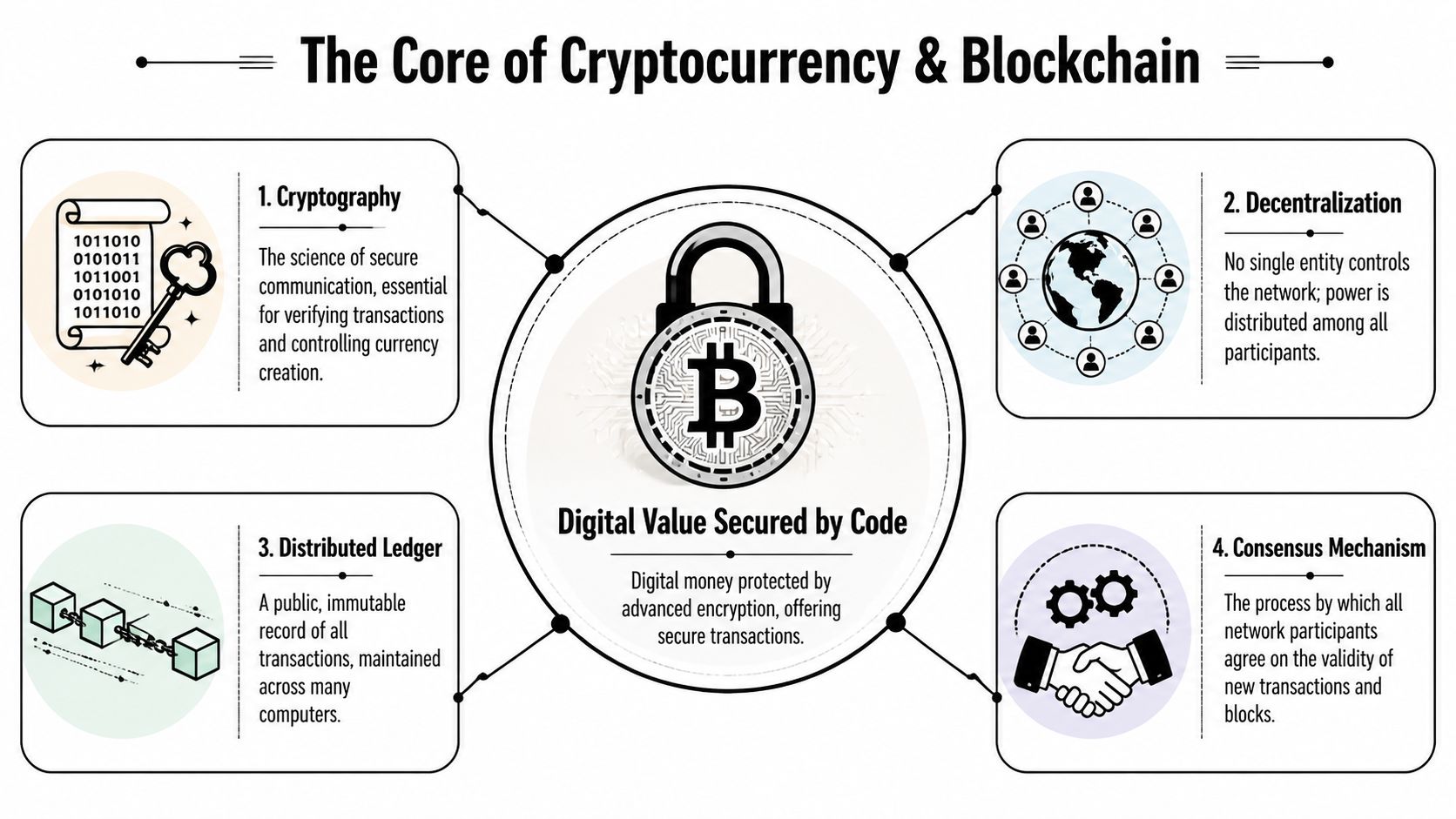
Under the hood, the system is simpler than the jargon makes it sound.
Cryptography secures control: Wallets use private and public keys. The private key authorizes a transaction, and the network verifies that authorization without exposing the key itself.
A distributed ledger keeps the record: Many independent machines store the same transaction history, which makes it harder for one party to alter balances or censor activity.
Consensus determines what counts as valid: The network needs a rule set for confirming transactions and preventing double spending.
Decentralization changes the trust model: Users rely less on a single institution’s database and more on open software, network incentives, and public verification.
That last point marks a significant shift. Traditional finance asks you to trust an intermediary to maintain the ledger correctly. Crypto asks you to trust the system design, the code, and the incentives behind the network.
Bitcoin was the first large-scale proof that this model could work. The Bitcoin white paper was published in 2008, and the network launched in 2009. Its monetary policy is capped at 21 million coins, as described in the Bitcoin white paper. That combination of open verification and fixed issuance is why Bitcoin introduced digital scarcity in a way earlier internet money projects did not.
Wallets are not bank accounts
A wallet does not store coins like a checking account stores dollars. The assets live on the blockchain’s ledger. The wallet stores the keys that let you prove control over those assets.
That distinction matters fast.
Custody model | What it means | Main trade-off |
|---|---|---|
Self-custody | You control the wallet keys | More control, more operational responsibility |
Exchange custody | A platform controls the keys for you | Easier access, more counterparty risk |
Self-custody gives you direct ownership, but it also gives you direct responsibility. Seed phrase backups, device security, phishing resistance, and transaction review all become your job. Exchange custody removes some of that operational load, but you now depend on a company to process withdrawals, stay solvent, and protect your account.
In practice, experienced users often split funds by purpose. Long-term holdings may sit in colder storage. Active trading balances may stay on an exchange. Working capital for DeFi usually sits in a wallet connected to onchain applications.
If someone else controls the keys, they control the funds.
If you want a deeper grounding in the security side of cryptography itself, especially from an operational or enterprise perspective, these top cryptology resources for IT managers are a useful complement to blockchain-specific reading.
What a transaction does
When you send crypto, you are not sending a file across the internet. You are signing a message that says, in effect, “I control this address, and I authorize this asset to move to that address.” The network checks the signature, confirms the sender has the balance to spend, and then records the update in the ledger.
That process is what makes crypto programmable. Once a blockchain can verify ownership and state changes without a central operator, developers can build more than simple payments. They can build exchanges, lending markets, collateral systems, and stablecoin rails on top of the same base layer.
For anyone interested in income rather than speculation, that is the practical takeaway. Blockchain infrastructure does not just move assets. It creates a system where digital dollars can be held directly, deployed into protocols, and monitored with clear onchain rules.
Beyond Bitcoin Exploring Different Crypto Assets
A new user buys Bitcoin, hears about Ethereum a week later, then sees a double digit yield on USDC and assumes all three belong in the same bucket. That is how expensive mistakes start. These assets live in the same market, but they do different jobs, carry different risks, and produce returns for different reasons.
If your goal is to use crypto as financial infrastructure instead of a casino, classification matters.

The three categories that matter most
A practical starting point is to sort assets by function.
Category | Example | Primary Purpose | Volatility |
|---|---|---|---|
Store of value | Bitcoin | Hold scarce digital value | High |
Smart contract platform | Ethereum | Run decentralized applications | High |
Stablecoin | USDC | Preserve dollar-like value for payments and DeFi use | Lower relative volatility |
That framework leaves out plenty of edge cases, but it is enough to keep a beginner from treating every token as a smaller version of Bitcoin.
Bitcoin as a reserve asset
Bitcoin is the cleanest asset to explain because its role is narrow. It is designed around scarcity, censorship resistance, and settlement. It is not the chain commonly used for day to day DeFi activity, and that is fine. Its market role looks closer to a reserve asset than an operating environment.
Lyn Alden argues in her analysis of crypto value accrual that Bitcoin captures a large share of value in the sector relative to many other crypto assets. That concentration is a useful reality check. Crypto is not one homogeneous category, and Bitcoin still shapes how much of the market thinks about trust, scarcity, and monetary credibility.
Smart contract platforms as onchain operating systems
Ethereum took the basic ledger model and turned it into a programmable execution layer. Developers can deploy code that handles swaps, loans, collateral, and treasury actions according to predefined rules. In practice, that makes Ethereum and similar networks the infrastructure layer for onchain finance.
That does not mean every smart contract platform deserves capital. Some chains attract real users and liquidity. Others attract short-lived speculation. If you are comparing ecosystems beyond the largest networks, tools that summarize activity and positioning can help. A resource like this Statiko Toncoin overview shows how one alternative ecosystem is tracked and presented.
The trade-off is straightforward. Smart contract platforms can have stronger utility than simple payment coins, but they also face more execution risk, governance risk, and competitive pressure.
Stablecoins are the working capital
For anyone focused on income, stablecoins matter more than headline tokens. They are the cash layer of crypto.
USDC, USDT, and similar assets are built to keep a dollar-like value, which makes them useful for settlement, collateral, payroll, cross-border transfers, and DeFi strategies. That stability changes how you interact with the system. Instead of trying to guess whether a token will double, you can focus on whether capital is sitting idle or earning a return.
That is why stablecoins are usually the starting point for practical onchain participation:
For new users: they make it easier to learn wallets, bridges, and protocols without large portfolio swings.
For operators and treasury teams: they provide a cleaner unit of account for budgeting and reporting.
For yield strategies: they let returns come from lending demand, liquidity provision, and market structure rather than pure price appreciation.
Teams that want to put stablecoins to work usually need more than a token list. They need a process for allocation, protocol selection, and position monitoring. A clear DeFi risk management framework for stablecoin strategies helps separate usable yield from yield that only looks attractive on a dashboard.
Different assets, different return drivers
Bitcoin tends to be driven by scarcity and macro demand. Smart contract tokens depend more on network usage, fees, and developer adoption. Stablecoins are different again. Their value comes from price stability and their ability to function as onchain dollars.
That distinction is where a lot of confusion clears up. A reserve asset is not the same as productive capital. A platform token is not the same as cash collateral. Once you sort assets by job, crypto stops looking like a blur of tickers and starts looking like a financial stack you can use.
Key Cryptocurrency Risks and How to Manage Them
The fastest way to lose money in cryptocurrency is to pretend risk is a side topic. It isn’t. Risk management is the main job. Yield, upside, and access matter only after you’ve decided what can go wrong and what you’ll do when it does.
That sounds conservative, but it’s how experienced operators stay in the market long enough to benefit from it.

Volatility is not just price movement
Volatility is often understood to mean “an asset can drop fast.” That’s true, but incomplete. Volatility also changes how much size you should take, how much liquidity you should keep, and how quickly a strategy can become inappropriate.
One common tool for measuring this is Average True Range (ATR). Higher ATR values signal increased volatility, which pushes traders and automated systems to reduce position sizes and widen stops. Lower ATR values indicate calmer conditions and can support larger allocations in stablecoin strategies, as described in this explanation of ATR in crypto technical analysis.
For stablecoin users, the point isn’t to become a chartist overnight. It’s to understand that serious systems react to market conditions. They don’t use the same risk posture every day.
Smart contract risk is software risk
When you deposit into a DeFi protocol, you’re trusting code. If the code has a bug, poor permissions, fragile assumptions, or bad upgrade controls, the protocol can fail even if your market view was correct.
That means “high yield” is never enough on its own. Before using a protocol, check for things like:
Audit visibility: Has anyone credible reviewed the code?
Operational maturity: Does the team communicate clearly about upgrades, incidents, and architecture?
Complexity load: Simple systems are easier to reason about than layered structures with hidden dependencies.
A risk-aware overview like this guide to DeFi risk management practices is useful because it frames protocol selection as an operational decision, not a hunt for the loudest APY.
Security in DeFi is rarely about one dramatic failure. It’s usually about a chain of small assumptions nobody challenged early enough.
Custody and personal security
A lot of crypto losses never come from a market move or protocol exploit. They come from bad operational habits. Weak wallet security, sloppy approvals, phishing, and overexposure to one platform still take people out of the game.
The practical controls are unglamorous:
Separate roles: Don’t use the same wallet for long-term holdings and frequent DeFi interactions.
Review approvals: Revoke permissions you no longer need.
Slow down on signatures: If you don’t understand what a wallet prompt is asking, stop.
Keep liquidity available: Don’t deploy every stablecoin you own into one strategy.
Regulatory and access risk
Rules can change. Platforms can restrict users by jurisdiction. On-ramps and off-ramps can become less convenient. Even if the blockchain stays up, your path into or out of a strategy can tighten.
That’s why experienced participants prefer flexible structures. They value liquidity, simple positioning, and the ability to exit without a chain of dependencies. In crypto, the best strategy on paper is often worse than the simpler one you can manage under stress.
The Mechanics of Earning Yield in DeFi
A lot of people hear “yield in DeFi” and assume it’s a black box. In practice, the mechanics are straightforward once you strip out the jargon. DeFi, or decentralized finance, is a set of financial applications running on blockchains. Instead of a bank matching savers and borrowers behind closed doors, software does the matching in public.
For stablecoin holders, this often looks like a global money market that never closes.
Where the yield comes from
The most important distinction in DeFi is this: some returns depend on asset prices rising, and some don’t. Stablecoin yield belongs to the second category when it comes from lending demand, trading fees, or protocol incentives tied to actual usage.
That difference matters because most content about “undervalued crypto” ignores a harsher reality. Many projects never build durable value. One analysis notes that 60% to 70% of projects fail to accrue value, and that 99% of cryptocurrencies capture minimal value. In contrast, stablecoin yield protocols generate returns through fees and lending rather than coin price appreciation, according to this discussion of undervalued crypto and value accrual.
That’s why stablecoin yield is worth understanding on its own terms. It isn’t a cleaner way to speculate on random tokens. It’s a different mechanism entirely.
Lending markets
The easiest example is a lending protocol. You deposit stablecoins into a pool. Borrowers post collateral and borrow from that pool. They pay interest. Suppliers receive a share of that economic activity.
The model is familiar because traditional finance does something similar. The difference is visibility. On-chain systems expose the rules and balances through code and public records rather than private bank infrastructure.
A practical checklist for evaluating a lending opportunity looks like this:
Asset quality: Stablecoins are usually easier to model than volatile collateral.
Exit liquidity: You want confidence that you can withdraw when needed.
Protocol design: Understand whether rates are variable, utilization-driven, or incentive-heavy.
Operational simplicity: If it takes five dashboards and constant manual intervention, your process risk goes up.
DEX liquidity and fee generation
Another source of yield comes from decentralized exchanges. Users trade against liquidity pools. The pool collects fees, and liquidity providers earn a share.
Beginners should be cautious, as not all fee strategies are clean fits for stablecoin holders. Some pools pair a stablecoin with a volatile asset, which introduces price exposure. Others pair stablecoins with stablecoins, which can reduce directional risk but still require understanding pool mechanics, incentives, and smart contract exposure.
That’s the recurring theme in DeFi. Yield is real, but it isn’t magic. It comes from someone paying for access, liquidity, speed, or capital efficiency.
If the return comes from lending, fees, or usage, you can analyze it. If it comes from “the token will go up,” you’re back in speculation.
Why manual yield farming breaks down
In theory, a person can manage all of this manually. In practice, that becomes tedious fast. Rates move. Protocol conditions change. Opportunities on one chain can become less attractive while another becomes more efficient. You end up checking multiple interfaces, reading governance chatter, and moving funds often enough that the process starts consuming real time.
That’s why many users eventually prefer guided systems and automation layers. A resource like this primer on DeFi yield farming mechanics is useful because it frames yield generation as process design, not a hunt for the flashiest number.
For readers also trying to understand adjacent token actions such as buying, swapping, and staking, this walkthrough on how to learn Klink token management is a practical example of how operational steps differ across crypto use cases.
The real mental shift
The beginner mistake is asking, “Which coin will make me money?” The better question is, “Which on-chain activity pays me for supplying something useful?”
Once you make that shift, stablecoin yield stops feeling mysterious. You’re supplying capital to a system that uses capital. The return may vary, the risks are real, and protocol selection matters. But the logic is much closer to financial plumbing than to internet folklore.
The Smart Way to Earn Automated Stablecoin Yield
Manual DeFi participation teaches you a lot. It also exposes the part many underestimate. The work isn’t only choosing a protocol. It’s monitoring changing conditions, checking liquidity, managing multiple interfaces, and deciding when not to move.
That’s where automation becomes practical rather than optional.

What manual management gets wrong
The biggest weakness of manual yield farming isn’t that people are lazy. It’s that the system is fragmented. One platform may offer attractive lending terms today. Another may become the safer place to sit tomorrow. A human can track that, but the process degrades quickly when life gets busy.
The common failure points are easy to recognize:
Research overload: Users spend too much time comparing protocols and not enough time defining their own risk rules.
Execution drag: Moving funds across opportunities can become operationally noisy.
Inconsistent discipline: People chase eye-catching returns and ignore whether the strategy still fits their liquidity needs.
Dashboard fatigue: A fragmented tool stack increases mistakes.
What automation should actually do
Good automation doesn’t just chase yield. It should monitor conditions, adapt allocations, and preserve access to funds. That means a system needs to care about risk, not only return.
One practical example is Yield Seeker’s automated stablecoin investing workflow. The platform lets users deposit as little as $10 in USDC on Base, then uses a personalized AI agent to monitor and allocate capital across DeFi protocols in real time. Funds remain accessible with no lockups or withdrawal fees, which matters because liquidity is part of risk management, not a convenience feature.
The operational appeal is simple. Instead of manually hunting protocols and rechecking rates, users can delegate the monitoring layer while keeping visibility into balances and earnings.
A short walkthrough helps make that model concrete.
What to look for in any automated option
Whether you use an AI-driven platform, a vault system, or your own semi-automated process, the evaluation criteria stay the same.
What to evaluate | Why it matters |
|---|---|
Strategy transparency | You need to understand the type of protocols involved |
Liquidity access | Lockups change your risk profile |
Asset focus | Stablecoin-based systems are easier to reason about than volatile token baskets |
User controls | You should be able to move in and out without operational drama |
Automation works best when it narrows the gap between opportunity and execution without hiding the underlying mechanics. That’s the line to watch. Convenience is useful. Blindness is not.
The right automated setup should reduce workload, not remove understanding.
A better default for busy users
For busy professionals, creators with treasury balances, or newer users holding stablecoins, the strongest case for automation is consistency. You don’t need to become a full-time DeFi operator to put idle digital dollars to work. You do need a process that respects liquidity, keeps the workflow understandable, and avoids turning every rate change into a manual project.
That’s where automated stablecoin yield has become one of the most practical entry points in cryptocurrency.
Your Next Steps in the World of Cryptocurrency
Cryptocurrency gets easier the moment you stop asking one giant question and start asking smaller practical ones. What kind of asset is this? Who controls it? What risk am I taking? What activity creates the return?
Those questions take you out of headline-driven thinking and into operating logic.
Start with function, not hype
If you remember one thing, remember this: not every crypto asset exists for the same reason. Bitcoin established digital scarcity. Smart contract platforms made on-chain applications possible. Stablecoins gave users a workable form of digital cash inside that environment.
For those seeking a sensible first step, stablecoins are the cleanest place to begin. They let you learn wallets, transfers, and DeFi mechanics without building your whole experience around price volatility.
Keep your first plan boring
A good first crypto plan usually includes a short list:
Learn custody basics: Know the difference between controlling your own wallet and trusting a platform.
Use stable assets first: Dollar-linked assets are easier to work with while you build confidence.
Favor understandable yield: Returns tied to lending or fees are easier to evaluate than narratives about future token demand.
Stay liquid: Access to funds matters, especially early on.
Add automation carefully: Use tools that reduce workload without hiding what your capital is doing.
That won’t make you the most exciting person in a crypto group chat. It will make you more likely to still have capital and clarity a year from now.
Treat cryptocurrency like a skill
The best users in this space don’t act like gamblers or evangelists. They act like operators. They develop pattern recognition. They learn how wallets behave, how protocols differ, and where convenience introduces hidden risk.
That mindset matters because cryptocurrency is still a live system, not a finished product. Interfaces improve. tools get better. Strategies evolve. The people who benefit most are usually the ones who stay curious without becoming reckless.
Start small enough that mistakes teach you, not punish you.
The practical path forward
You don’t need to master every corner of crypto to use it well. You need a clean mental model, a cautious process, and an entry point that matches your goals. If your goal is productive cash-like exposure rather than speculative token hunting, automated stablecoin yield is one of the most rational places to start.
That’s the bigger takeaway. Cryptocurrency is no longer just a story about price charts and early adopters. It’s a financial layer where digital assets can be stored, moved, and deployed. Once you understand the machinery, the space stops feeling mysterious and starts feeling usable.
If you want a simple way to put stablecoins to work without manually tracking protocols all day, Yield Seeker offers an AI-guided approach to earning risk-aware yield on USDC with a low entry point, no lockups, and funds that remain accessible as your needs change.