
DeFi yield routing is all about automatically finding the most profitable home for your crypto across the massive landscape of decentralized finance protocols.
Think of it as a smart GPS for your money. Instead of you manually figuring out the best route, it constantly scans the map and reroutes your funds to capture the highest possible returns in real-time. This solves a huge problem: idle assets just sitting around in a fragmented DeFi world.
Unlocking Smarter Returns in DeFi
In DeFi, hundreds of lending protocols, liquidity pools, and yield farms are all competing for your capital. Every single one offers different rates that can change in the blink of an eye.
Trying to manually chase the best yields is a losing game. It’s not just time-consuming; it's often impossible. By the time you spot a great opportunity, pay the gas fees, and move your funds, that juicy rate has probably vanished.
This is exactly where DeFi yield routing steps in. It swaps out all that manual guesswork for a systematic, automated engine that does the heavy lifting for you. You stop hunting for returns, and the system starts doing it 24/7.
The whole ecosystem has grown up a lot. Back in the wild days of DeFi Summer 2020, it wasn't uncommon to see yields soaring above 100% APY. But those returns were often fueled by risky incentives that could blow up in your face. Today, things are much more stable. Stablecoin lending pools now offer predictable APYs that average around 5%, making them a genuinely compelling alternative to traditional finance products. You can discover more about the state of on-chain yield to see just how much the market has evolved.
Manual Farming vs. Automated Routing
The difference between manually managing your assets and using an automated system is night and day. Going it alone means constant monitoring, deep market knowledge, and being ready to execute dozens of transactions at a moment's notice. Automated routing, on the other hand, boils this entire process down to a single deposit.
The goal of DeFi yield routing isn't just about chasing higher numbers; it's about finding the most efficient, risk-adjusted path for your capital without you needing to become a full-time portfolio manager.
Let's look at how these two approaches stack up. The table below really highlights the key differences between the old way of doing things and the new, automated approach.
Manual Yield Farming vs. Automated DeFi Yield Routing
Feature | Manual Yield Farming | Automated DeFi Yield Routing |
|---|---|---|
Time Commitment | High; requires daily monitoring and research. | Low; a "set-and-forget" approach. |
Efficiency | Inefficient; high gas fees from frequent moves. | High; batches transactions to minimize costs. |
Opportunity Cost | High; you can easily miss fleeting opportunities. | Low; algorithms capture opportunities instantly. |
Risk Management | Dependent on individual skill and constant vigilance. | Built-in; diversifies funds and monitors risk 24/7. |
Complexity | Very complex; requires understanding multiple protocols. | Simple; user-friendly interface for easy deposits. |
As you can see, automated routing takes care of the complexity, inefficiency, and time drain that comes with manual farming. It’s a shift from being a hands-on trader to a strategic investor, letting technology do what it does best: optimize outcomes at scale.
How Yield Routing Engines Find the Best Returns
To really get what makes DeFi yield routing so powerful, you have to pop the hood and see how it all works. These automated platforms aren't just guessing; they're using a couple of sophisticated engines that work together to constantly hunt down the best possible returns.
It’s like having a dedicated team of financial analysts and high-speed traders working for you around the clock, 24/7.
The two key players making this happen are yield aggregators and arbitrage engines. Each one has a different job, but they team up to get the most out of your capital.
The Role of Yield Aggregators
Think of a yield aggregator as the system’s "research department." Its sole purpose is to constantly scan the entire DeFi landscape. We're talking hundreds of lending protocols, liquidity pools, and staking opportunities to find the absolute highest yield for a specific asset, like USDC.
It’s basically a supercharged price-comparison site, but for financial returns instead of cheap flights. It crunches the numbers on interest rates, reward tokens, and fees in real time. To really understand what it's looking for, you need to be familiar with the Annual Percentage Yield (APY) in crypto, as this is the main metric aggregators are built to track.
An aggregator's analysis looks at a few key things:
Base Interest Rates: The starting APY you’d get from a lending protocol like Aave or Compound.
Protocol Incentives: Any extra token rewards dangled by protocols to attract liquidity. These can give the overall returns a serious boost.
Transaction Costs: It has to factor in gas fees to make sure moving your funds to a new protocol is actually going to make you money.
If you tried to do this all by yourself, you’d be pulling your hair out. The DeFi market is huge, and rates change literally every minute, making manual research a nearly impossible task.
By constantly monitoring and comparing opportunities, a yield aggregator ensures your capital is always positioned in the most lucrative spot, turning a chaotic market into a field of clear, data-driven choices.
The image below gives you a clear picture of just how different this automated approach is from trying to manage yields on your own.
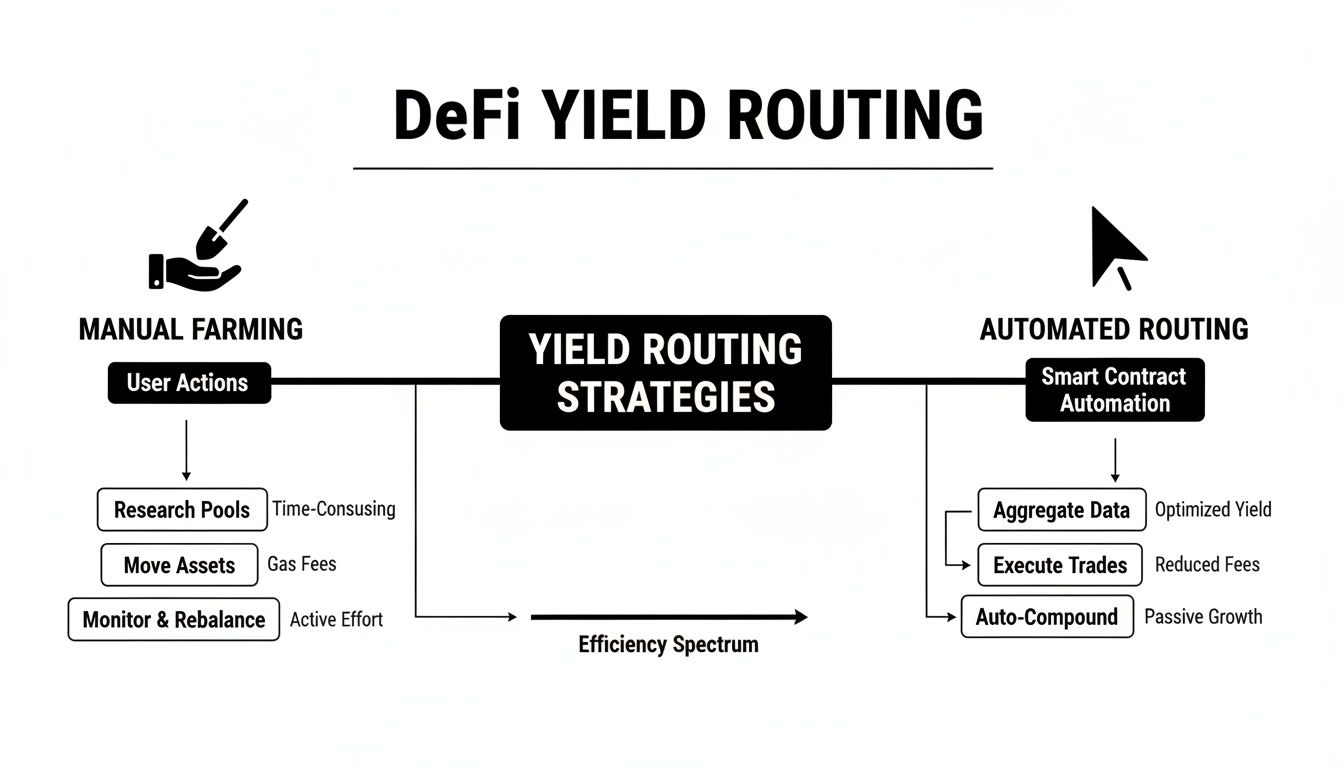
As you can see, automated routing cuts through the noise, turning a complicated manual headache into a straight, efficient line to better returns.
Capturing Fleeting Profits with Arbitrage Engines
So, while aggregators are busy finding the best long-term homes for your money, arbitrage engines are the system's high-frequency traders. They pounce on tiny, short-lived price and rate differences between different platforms—opportunities that often vanish in seconds.
For example, an arb engine might spot that the interest rate for borrowing USDC on one protocol is, just for a moment, lower than the rate for lending it on another. It can then fire off a series of lightning-fast transactions to skim a profit off that difference.
These engines are built to do three things, very quickly:
Identify Inefficiencies: Constantly scan for small rate gaps across dozens of exchanges and lending platforms.
Calculate Profitability: Instantly figure out if an opportunity is worth it after subtracting gas fees, slippage, and other costs.
Execute Trades: Automatically run complex, multi-step transactions to grab the profit before the market corrects itself.
When they work together, the yield aggregator finds the most fertile ground for your assets to grow, and the arbitrage engine swoops in to harvest small, extra profits from market jitters. This partnership creates a dynamic system that intelligently rebalances your funds, making sure your capital isn't just earning good returns, but the best possible returns at any given moment.
Proven Stablecoin Strategies for Lower-Risk Returns
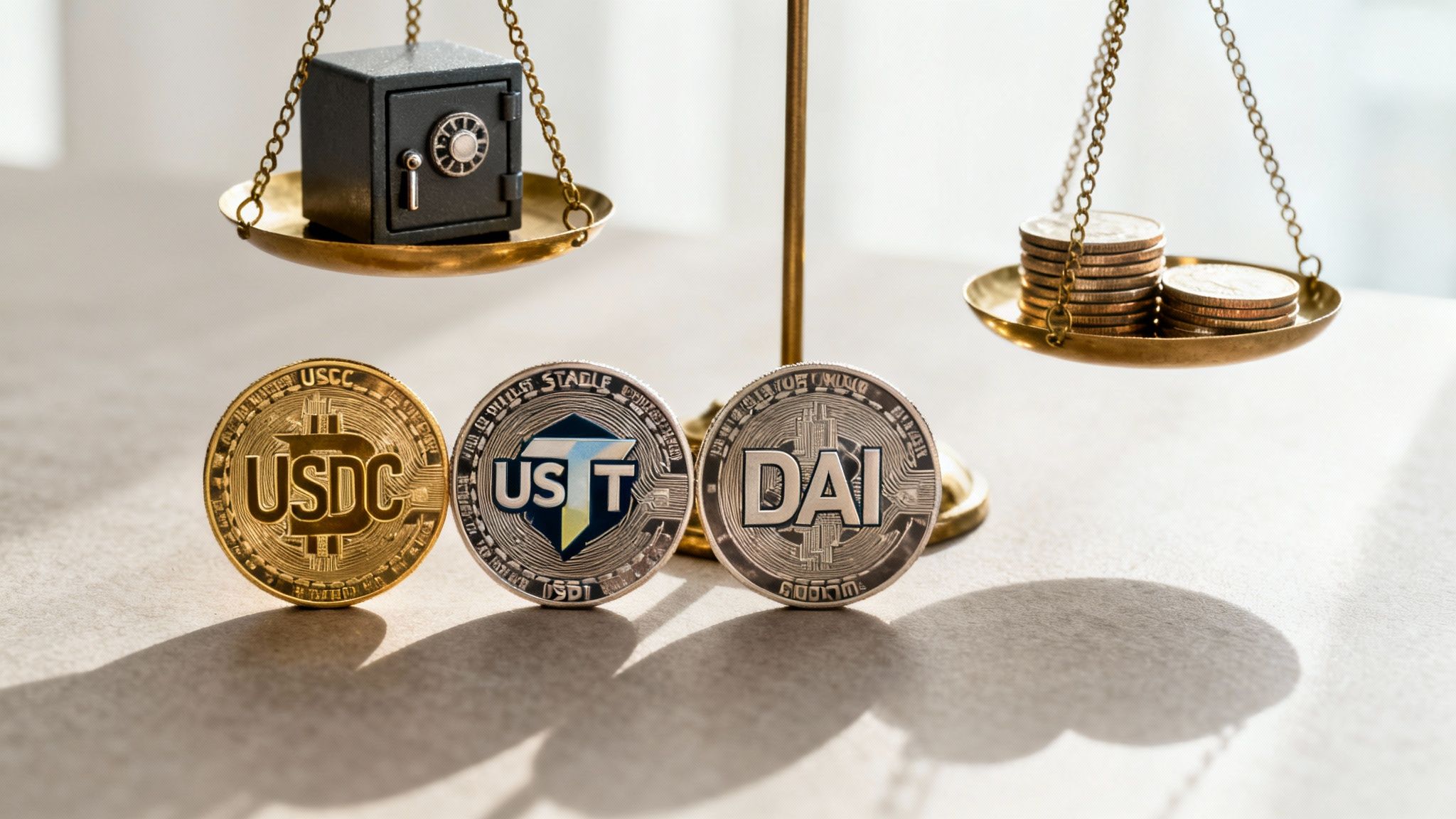
Stablecoins like USDC and USDT are the bedrock of countless DeFi portfolios for one simple reason: they're stable. But just letting them sit in your wallet is like leaving cash under the mattress—you're missing out on putting that money to work. This is where automated DeFi yield routing platforms come in, turning these steady assets into capital that actively earns for you.
These platforms are much smarter than just parking your funds in a simple lending protocol. They run multi-step strategies that are designed to boost your returns while keeping a tight leash on risk—the kind of complex moves that would be a massive headache (and expensive) to pull off on your own.
Let's break down two of the most common and effective methods.
Providing Liquidity in Stablecoin Pools
One of the most dependable strategies in the book is providing liquidity to stablecoin-only pools on decentralized exchanges (DEXs). Think of pools like USDC/USDT or DAI/USDC; they're the lifeblood for traders needing to swap between different stablecoins.
When you deposit your stables, you become a liquidity provider (LP). Every time a trader uses that pool, they pay a small fee, and you get a cut. This has a huge advantage over being an LP for more volatile crypto pairs.
Minimal Impermanent Loss: Because both assets in the pool are pegged to $1, the risk of impermanent loss (where your deposited assets are worth less than if you had just held them) basically disappears.
Consistent Fee Generation: Stablecoin swaps happen all the time in DeFi. It's one of the most frequent activities, which means a steady trickle of trading fees for you.
A smart yield routing engine is constantly on the lookout for the pools with the best fee-to-volume ratio, automatically shifting your funds to wherever the action is hottest. No manual intervention required.
Leveraging With Lending and Borrowing Loops
For those looking to dial things up a notch, there's a more advanced strategy known as lending and borrowing loops, or recursive lending. It’s a powerful way to multiply your yield by using your own deposit as collateral to borrow more funds, which you then put right back to work earning even more.
Here's how it plays out, step-by-step:
Supply: You start by depositing $1,000 of USDC into a lending protocol like Aave. This starts earning you a base supply APY.
Borrow: The platform then uses that deposit as collateral to borrow another asset, say $700 worth of USDT.
Redeposit: That borrowed $700 USDT gets deposited straight back into the lending protocol, and now it's earning yield too.
Repeat: This loop can be repeated several times, beefing up your total yield-earning position way beyond your initial $1,000.
This strategy is all about multiplying your exposure to yield-generating assets. An automated engine is non-negotiable here. It has to constantly monitor the loan's health to prevent liquidation while squeezing every last drop of net return out of the loop after accounting for borrowing costs.
The DeFi world is a patchwork of different opportunities, with yields varying wildly from one protocol to another. Some platforms have yields set by governance votes, while others are tied to volatile market funding rates. Still, in stable markets, many of the top strategies tend to average between 7-12% APY over a 30-day period. With the market spreading out beyond just a few big players, having an automated router to navigate this landscape is more critical than ever.
These automated strategies are what connect complex DeFi mechanics to real-world results. If you want to go deeper on how to get the most out of your dollar-pegged assets, check out our guide on stablecoin yield farming. By turning idle stablecoins into active, hard-working capital, DeFi yield routing offers a much smarter path to growing your digital wealth.
Navigating the Risks of Automated Yield Farming
While automated DeFi yield routing opens up a world of fantastic returns, it’s not a magic money tree. Let's be real: high yields never come without risk, and just because something is automated doesn't mean you can switch your brain off entirely. Acknowledging the potential pitfalls is the first step to making smarter, safer decisions in DeFi.
The risks here aren't your typical stock market swings. We're talking about vulnerabilities buried deep in the code that powers these platforms. Ignoring them is a recipe for disaster for any serious investor.

Understanding Smart Contract and Platform Risks
Every DeFi protocol runs on smart contracts—code that executes automatically. They're powerful, but they can have bugs. Even the biggest, most respected protocols can have a flaw that gets exploited, potentially wiping out all the funds locked inside. Hacks are, unfortunately, a persistent threat in this space.
On top of that, the routing platforms themselves add another layer of complexity. A good routing engine connects to dozens of different protocols, but each connection is another potential point of failure. The whole system is only as secure as its weakest link.
A core principle here isn’t just about chasing the highest APY. It's about finding solid returns within a universe of audited, battle-tested protocols. The real goal is to filter out the risky, unproven stuff and stick with the trustworthy players.
Mitigating Risk Through Smart Diversification
This is where a modern yield routing platform really shines—not just as a yield finder, but as a risk manager. Instead of dumping all your capital into one protocol and hoping for the best, these systems actively spread your funds across a curated set of vetted opportunities.
This diversification gives you a few layers of protection:
Reduced Protocol Exposure: If one protocol gets hacked or hits a bug, only a small portion of your capital is at risk.
Blended Risk Profile: By mixing different strategies like lending and liquidity providing, you're not overly dependent on a single source of yield.
Continuous Monitoring: The system doesn't just "set it and forget it." It’s constantly running health checks on every protocol it uses, ready to pull funds and reallocate them if it sniffs out any trouble.
If you're serious about managing the downside, digging into a comprehensive DeFi risk management framework is a must. It helps you understand the safety nets a platform should have in place.
Preparing for Market and Stablecoin Volatility
Even with flawless code, you still have to deal with the market. One of the biggest curveballs is a stablecoin de-pegging, which is when a stablecoin that’s supposed to be worth $1 suddenly isn't. If your strategy is all-in on one stablecoin and it wobbles, the value of your assets can take a serious hit.
To guard against this, the best platforms have automated defenses baked in.
Asset Diversification: They’ll intentionally spread capital across multiple top-tier stablecoins like USDC and USDT. This way, if one of them has a bad day, it doesn’t sink your whole portfolio.
Automated Deleveraging: If you're in a leveraged position, the system will automatically reduce borrowing or exit if the market gets too choppy and liquidation becomes a threat.
Circuit Breakers: Some platforms can even hit pause during moments of extreme market chaos. This protects your capital from cascading liquidations or oracle failures that can happen in a flash crash.
Look, no system can eliminate risk completely, but a well-designed yield routing platform acts like a vigilant co-pilot. It uses automation not just to chase rewards, but to build a strong, diversified, and responsive defense for your money.
The Future of Yield Is AI-Driven Automation
Simple, rule-based automation was a huge leap forward for DeFi yield routing, but it was really just the beginning. The next evolution is already here, and it’s powered by artificial intelligence and machine learning. This isn't just about making things faster; it's about making them smarter, predictive, and incredibly personal.
Think of it like having an AI agent managing your capital. This isn't science fiction anymore. These systems are designed to do what no human or simple algorithm possibly could: crunch millions of data points in real time to see where the market is headed before it gets there. They don't just react to today's APYs; they anticipate where the best yields will pop up tomorrow.
This is a fundamental shift from reactive to proactive capital management. AI engines can process massive datasets that go way beyond on-chain transactions. They’re looking at market sentiment on social media, developer activity on GitHub, and historical performance patterns during different bull and bear cycles.
Beyond Rules to Predictive Intelligence
Your typical yield aggregator follows a pretty straightforward set of "if-then" rules. For example, if Protocol A offers a higher APY than Protocol B, it moves the funds. Simple enough. But AI-driven systems operate on a completely different level, asking much deeper questions.
Is this high yield sustainable? An AI can dig into the source of the yield. Is it coming from genuine user demand or from short-lived token incentives that are about to run out?
What are the hidden risks? It assesses smart contract complexity, oracle dependencies, and liquidity depth to calculate a dynamic risk score that a simple APY comparison would totally miss.
How will market chatter affect this protocol? It can pick up on the early signals of trouble or growing confidence long before those feelings show up in the token price.
This kind of analysis allows an AI-powered platform to create a genuine "set-and-forget" experience. Your capital isn't just sitting in one place; it's being actively managed by an intelligent agent working 24/7 to protect it while hunting for new opportunities.
The core promise of AI in DeFi yield routing is to transform yield farming from a tactical, reactive activity into a strategic, forward-looking investment process accessible to everyone.
This advanced automation is making strategies that were once exclusive to quantitative hedge funds available to the rest of us. With a simple dashboard, anyone from a busy professional to a seasoned crypto degen can get the benefits of sophisticated, AI-driven portfolio management. You can get a better sense of how this works in our deep dive on the role of AI in yield aggregation.
This user-friendly interface from Yield Seeker shows how a complex AI engine can be presented in a clean, intuitive dashboard.
The screenshot highlights a clear, accessible view of earnings and balances, showing how AI can take the complexity out of DeFi without sacrificing its power.
Institutional Adoption and the AI Edge
The move toward AI-driven DeFi yield routing isn’t just a retail thing; it’s a critical piece for bringing big institutions into the fold. As large financial players dip their toes into DeFi, they demand efficiency, transparency, and solid risk management—all areas where AI shines. This institutional interest is helping DeFi yield routing grow into a massive market. Projections show the market hitting $238.54 billion in 2026 and growing at a 26.43% CAGR to $770.56 billion by 2031, with banks increasingly using DeFi vaults for collateral management.
Institutions are already using DeFi to power tokenized real-world assets (RWAs) like Treasuries, creating looping strategies that were just impossible in traditional finance. AI is the engine that makes these complex, multi-protocol strategies not just possible, but profitable and scalable.
AI-powered platforms offer a few key advantages that appeal to both large institutions and individual users:
Hyper-Personalization: The AI can tailor strategies to your specific risk tolerance. If you’re conservative, it might route your funds to audited, blue-chip lending protocols. If you're more aggressive, it can find newer, higher-yield opportunities that it has vetted for safety.
Serious Efficiency: AI can execute complex, multi-step transactions across different blockchains in the most gas-efficient way possible. Trying to optimize that manually is a nightmare.
Adaptive Risk Management: Instead of using static risk parameters, an AI can adjust its strategy on the fly. If the market gets choppy, it can automatically deleverage or shift assets to safer havens.
Ultimately, AI feels like the final piece of the puzzle for DeFi. It takes the powerful but often chaotic world of decentralized protocols and weaves it all into a coherent, intelligent, and automated system for growing wealth.
How to Choose the Right DeFi Yield Platform
Picking the right DeFi yield platform is a huge decision. It basically sets the stage for your entire earning experience. You've got a lot of options out there, from hands-on manual aggregators to slick AI systems, so you need a solid way to figure out what's best for you.
This isn't just about blindly chasing the highest APY you see advertised. A platform worth its salt cares just as much about security, transparency, and a smooth user experience as it does about raw performance. Let's break down what you should actually be looking for.
Security and Transparency
Before you even think about depositing a single dollar, your first question has to be about security. A platform's commitment to keeping your funds safe is an absolute deal-breaker, and thankfully, there are a few clear things you can check for.
Audit History: Look for a track record of smart contract audits from well-known security firms. Think of these audits as a third-party inspection, verifying that the platform's code is solid and not riddled with common bugs or exploits.
Protocol Vetting: How does the platform decide which protocols to interact with? A good one will be completely open about its vetting process, only plugging into protocols that are battle-tested, audited themselves, and have plenty of liquidity.
On-Chain Transparency: Every transaction and movement of your funds should be easily verifiable on the blockchain. This is non-negotiable. It means you can always see exactly where your money is and what it's doing, with no shady, behind-the-scenes stuff.
Fee Structure and User Experience
Fees can take a serious bite out of your net returns, so you need to get a clear picture of the costs. Most platforms will charge some mix of management fees (a small slice of your total deposit) and performance fees (a percentage of the yield they generate for you). Just make sure these fees are spelled out clearly and feel fair for the service you're getting.
Beyond the cost, the platform has to be usable. A clean, intuitive interface that shows you your balance, earnings, and current strategies without making you squint is a sign of a well-built product. And don't underestimate good customer support—it's a lifesaver when you run into an issue.
A great platform simplifies the complexity of DeFi without hiding the important details. It should empower you with clear information, not overwhelm you with jargon, allowing you to make confident decisions about your capital.
Comparing Different Platform Types
Not all yield platforms are built the same. The best one for you really depends on how hands-on you want to be and what kind of tech you're comfortable with. The table below breaks down the key differences to help you see where you might fit.
Here’s a look at how the main options stack up, which should make it easier to figure out what suits your style.
Choosing Your Yield Platform Key Feature Comparison
Feature | AI-Driven Platform (e.g., Yield Seeker) | Manual Yield Aggregator | Single-Protocol Vault |
|---|---|---|---|
Strategy Management | Fully automated and predictive; AI adapts strategies in real-time. | User-directed; presents options for you to choose and execute manually. | Fixed; follows a single, pre-defined strategy like lending or looping. |
Decision Making | "Set-and-forget"; the platform handles all routing decisions for you. | Requires active user involvement to move funds and chase yields. | One-time deposit; the strategy does not change or adapt to market shifts. |
Risk Handling | Proactive; uses AI to monitor risk and dynamically reallocate funds. | User-dependent; risk management is entirely up to your own vigilance. | Static; exposure is concentrated on a single protocol's risk profile. |
Best For | Investors seeking effortless, optimized returns with sophisticated risk management. | Experienced DeFi users who want to maintain full manual control. | Beginners looking for a simple, straightforward yield on a specific asset. |
Ultimately, choosing the right platform comes down to you. By using this checklist to dig into security, fees, and user experience—and by understanding how these different types of platforms work—you can pick a DeFi yield routing solution that feels like a perfect match for your investment style.
Frequently Asked Questions About DeFi Yield Routing
Diving into any new corner of crypto is bound to bring up some questions. When it's your money on the line with DeFi yield routing, getting solid answers is the only way to move forward with confidence. Let's tackle some of the most common things investors ask before they get started.
Is DeFi Yield Routing Safe for Beginners?
This is usually the first question people ask, and for good reason. While nothing in DeFi is ever 100% risk-free, automated yield routing platforms are designed to be one of the safest on-ramps for anyone new to the space.
Think of it this way: a good platform acts as a protective layer. It handles all the complex interactions with different protocols, which is where most beginners trip up and make expensive mistakes. It filters for audited, battle-tested protocols and spreads your funds across them, providing a built-in safety net that’s far more secure than going it alone.
How Exactly Is the Yield Generated?
The yield you see isn't pulled from thin air; it comes from real economic activity happening on-chain. A routing engine is constantly scanning and tapping into a few primary sources:
Lending Interest: This is the bedrock of DeFi yield. Your funds are supplied to lending markets where borrowers pay interest to use them.
Trading Fees: By adding your stablecoins to liquidity pools on decentralized exchanges, you earn a tiny slice of the fees from every single trade.
Protocol Rewards: Many protocols offer their own tokens as a bonus to attract capital. A good routing engine will automatically harvest these rewards and compound them back into your position for you.
An automated system just does the work of analyzing these sources around the clock, shifting your capital to wherever the best and most reliable returns are at any given moment.
What Is the Minimum Investment Needed?
One of the best parts about modern DeFi, especially on low-fee networks, is how accessible it's become. You don't need a huge bankroll to get in the game. It's common for platforms to let you start with as little as $10 or $20.
This lets you dip your toes in the water, see how the platform works, and watch your earnings grow in real-time without having to commit a significant amount of cash upfront.
The whole point is to make these sophisticated strategies available to everyone, not just crypto whales. Starting small is a great way to learn the ropes and build up your position as you get more comfortable.
Do I Need to Constantly Monitor My Funds?
Absolutely not—and that’s the entire appeal! The main reason to use automated DeFi yield routing is to get rid of the need to babysit your portfolio.
The platform’s engine, particularly an AI-powered one, takes on the 24/7 job of tracking interest rates, evaluating risks, and moving funds. You just make the initial deposit and let the system handle the rest. It turns what was once a stressful, active management job into a completely passive investment.
Ready to put your stablecoins to work without all the manual effort? Yield Seeker uses a personalized AI Agent to find and manage the best yield opportunities for you. Start earning smarter today.