
Your cash may already be onchain. It might be sitting in USDC in a wallet, parked on an exchange, or waiting for a better moment while you juggle work, markets, and a dozen open tabs. You know there's yield in DeFi, but every time you look into it, the answers split in two directions. One side makes it sound effortless. The other makes it sound like a full-time trading desk.
That gap is why so many smart people stay stuck. They don't need another hype thread about triple-digit APYs. They need a grounded explanation of what decentralized finance yield farming is, where the yield comes from, what risks matter, and what you really keep after fees and friction.
The short version is simple. Yield farming means putting crypto assets to work inside decentralized protocols that need liquidity. In return, those protocols share fees, interest, or incentive tokens with the users supplying capital. The long version is where things get interesting, because the headline rate you see on a dashboard is rarely the same as your real return after gas, slippage, reward decay, and pool-specific risk.
That's especially true for stablecoin holders. Stablecoin farming often makes more sense for professionals and treasury managers because it cuts one major source of chaos: spot-price swings between volatile assets. But even in stablecoin pools, the hard part isn't just finding yield. It's managing it without constantly watching the market.
Introduction From Idle Cash to Active Yield
A common DeFi story starts with a practical problem, not a philosophical one. You hold stablecoins because you want optionality. You want dry powder for markets, payroll runway for a team, a reserve for future investments, or a less volatile way to stay in crypto. Then the stablecoins sit there. Safe enough, accessible enough, but inactive.
That feels wasteful once you realize DeFi protocols are constantly looking for capital. Decentralized exchanges need liquidity so traders can swap. Lending markets need deposits so borrowers can draw funds. Other protocols need working capital to keep their own systems moving. In plain English, your assets can become part of the machinery instead of sitting on the sidelines.
Yield farming is the umbrella term for that process. You supply assets to protocols, and those protocols pay you because your capital helps them function. Sometimes the return comes from trading fees. Sometimes it comes from borrower interest. Sometimes it includes extra reward tokens designed to attract liquidity.
Practical rule: Start by thinking like an allocator, not a speculator. The first question isn't “What APY can I get?” It's “Why is this protocol paying me, and how durable is that payment?”
For many readers, the appeal isn't chasing the wildest number on a dashboard. It's finding a way to make idle digital cash productive without turning the process into another job. That's where a lot of educational content falls short. It explains the concept, but it doesn't help you answer the operational question that matters in real life: how to farm safely, compare net outcomes, and avoid spending your week moving funds between protocols.
What Is Decentralized Finance Yield Farming
The easiest way to understand yield farming is to picture a shared digital marketplace.
Traditional finance often relies on banks, brokers, and funds to move money around. DeFi replaces much of that with smart contracts. Those smart contracts still need capital to do useful work. Yield farming is what happens when users provide that capital and earn rewards for doing it.
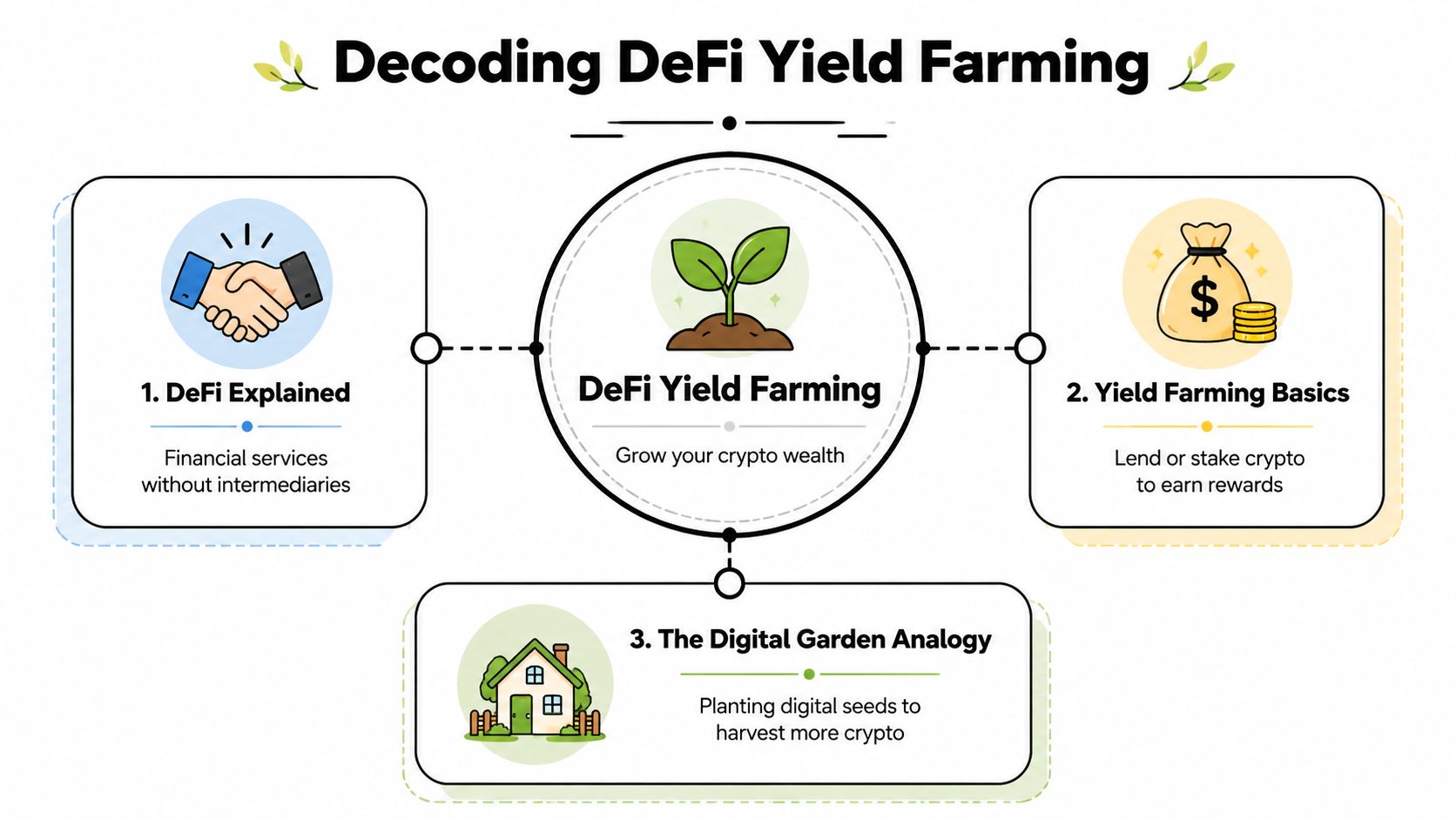
The digital garden analogy
A good mental model is digital sharecropping.
You aren't buying land and waiting for it to appreciate. You're putting your assets to work in someone else's productive field. The protocol supplies the rules, the rails, and the user demand. You supply the capital. When activity happens on top of that capital, you get a share of the harvest.
That's why “holding” and “farming” are different. Holding means your asset may rise or fall in price, but it isn't actively earning inside a protocol. Farming means your asset is participating in a system that pays for liquidity, lending capacity, or both.
Why protocols pay users
Protocols pay because liquidity is infrastructure.
A decentralized exchange without liquidity can't offer useful trading. A lending protocol without suppliers has nothing to lend. In both cases, the protocol needs users to deposit assets before it can serve other users. Yield farming is the incentive layer that attracts those deposits.
During the 2020 to 2021 boom, yield farming became one of DeFi's defining capital-allocation strategies. Total value locked in decentralized financial services reached $205.76 billion on October 11, 2021, and a 2023 academic paper noted that yield-farming strategies during that period produced “attractive returns,” with Sharpe ratios between 2 and 3 (academic paper on yield farming and DeFi TVL growth).
How it differs from staking
People often lump yield farming and staking together, but they're not the same.
Staking supports a network. You lock a token to help secure a blockchain or delegate to a validator.
Yield farming supports an application. You deposit assets into a DeFi protocol so trading, borrowing, or other activity can happen.
The return profile differs. Farming returns depend more directly on protocol usage, liquidity conditions, and incentive design.
That last point is what makes farming both interesting and tricky. The opportunity can be compelling, but the moving parts are real.
The Core Mechanics Driving Your Yield
The engine of yield farming becomes much clearer once you break it into a few pieces. Most confusion comes from trying to learn all the vocabulary at once.
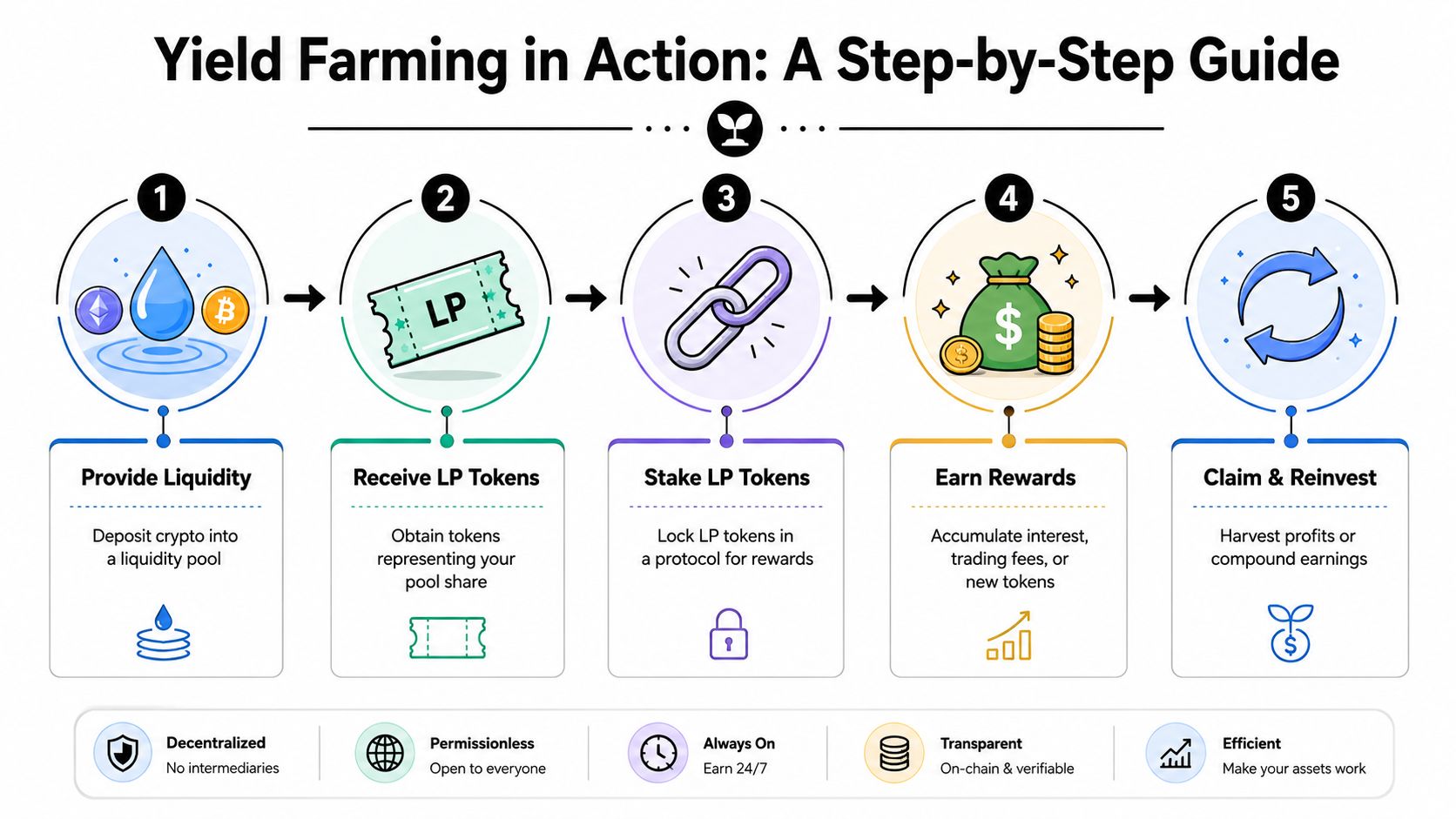
Liquidity pools and AMMs
Many farms begin with an automated market maker, or AMM. Think of an AMM as a community-owned exchange booth. Instead of one market maker quoting prices manually, the protocol uses smart contracts and pooled assets to let traders swap tokens.
A liquidity pool is the inventory inside that booth. Users deposit assets into the pool, and traders pay fees to access that liquidity when they swap.
If you provide assets to the pool, you become a liquidity provider, often shortened to LP.
LP tokens as your receipt
When you deposit into a pool, the protocol usually gives you LP tokens. These aren't magic yield by themselves. They're a receipt that proves your share of the pool.
That receipt matters because it tracks your claim on the pool's assets and fees. If your share is small, you receive a small piece of the fee flow. If your share is larger, you receive more. The protocol doesn't need to know your story or your account manager. It only needs to know what your wallet contributed.
Here's the practical flow:
Deposit assets into a liquidity pool.
Receive LP tokens that represent your share.
Hold or stake those LP tokens depending on how the protocol structures rewards.
Accrue fees and incentives while your capital remains in use.
A quick visual helps if this still feels abstract:
Where the yield actually comes from
The biggest misunderstanding in yield farming is thinking there's one fixed interest rate attached to a pool. There isn't.
Yield farming returns are typically made up of transaction-fee revenue plus incentive emissions, and the actual APY changes as pool liquidity and protocol usage change. In practice, more capital entering the same pool can push your effective return down because the same fee flow gets divided across more LPs (BitGo's explanation of how DeFi yield farming returns work).
A pool can show an attractive APY in the morning and look ordinary by evening if new liquidity floods in or incentive terms change.
That's why good farmers ask two separate questions:
Question | What it tells you |
|---|---|
How much activity does this protocol have? | Whether there's real fee generation from users |
How much of the return comes from incentives? | Whether the yield may fade when emissions slow |
The compounding layer
Some protocols let you stop at fee collection. Others add a second layer by letting you stake LP tokens to earn extra rewards. That's the “farming” part in the narrow sense. You're not only earning from the base protocol activity. You're also earning from the protocol's incentive program.
Returns can look exciting here, and discipline matters most. Extra rewards may help, but they can also mask fragile economics if the base activity is weak.
Understanding Key Metrics and Common Risks
Once you know how the machine works, the next job is learning how not to fool yourself. DeFi interfaces are good at showing projected upside. They're less good at making hidden tradeoffs obvious.
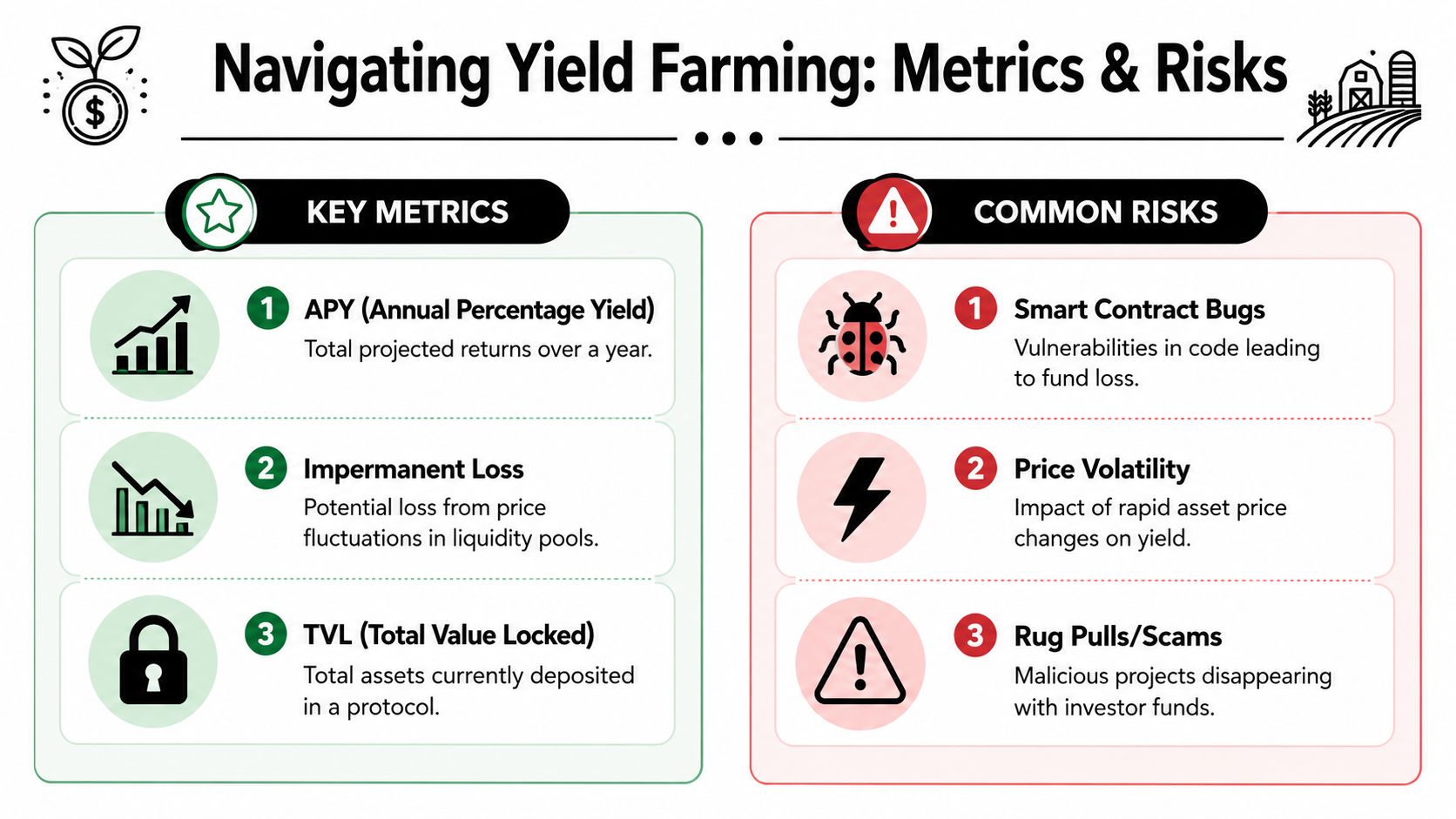
The metrics worth watching
Three terms appear everywhere, and each matters for a different reason.
APY reflects projected annual return with compounding assumptions baked in.
APR is the simpler rate before compounding effects.
TVL stands for total value locked, which tells you how much capital is currently deposited in a protocol.
TVL isn't a guarantee of safety, but it's a useful signal of scale. A larger pool or protocol often has more user participation and deeper liquidity. That can make exits smoother and price impact lower. It does not mean the code is safe, the economics are healthy, or the incentives are sustainable.
Impermanent loss in plain English
Impermanent loss is the risk many new LPs underestimate.
If you deposit two assets into a pool and the relative price between them changes, the pool rebalances your position. When you withdraw, you may end up with a different mix of assets than you started with. In some cases, that mix is worth less than merely holding the original assets outside the pool.
The pool keeps selling your outperformer and buying your underperformer as prices move. That's useful for traders using the pool. It isn't always great for you.
Stablecoin-focused yield farming is often favored because it reduces one of the largest non-smart-contract risks: spot-price volatility. Stablecoin pools commonly lower exposure compared with volatile token pairs, though advanced strategies can still employ borrowed funds or route capital across protocols to raise APY. Farming employing borrowed funds also increases liquidation risk (yield farming overview discussing stablecoin pools and leverage risk).
Risk lens: If you can't explain what would make a position lose money besides “the market went down,” you probably don't understand the farm yet.
Other risks that deserve respect
Not all losses in DeFi come from normal market movement. Some come from design flaws, operator behavior, or outright fraud.
Smart contract risk. Code can contain bugs or dangerous upgrade permissions.
Stablecoin risk. A stablecoin can de-peg, freeze, or behave unexpectedly under stress.
Liquidity risk. You may be able to withdraw in theory but take poor execution in practice.
Rug pull risk. Teams can launch projects with weak governance or malicious intent.
If you're trying to separate bad design from outright scams, the Kons Law Ponzi scheme guide gives a useful primer on the warning signs of schemes built more on incoming money than real economic activity. For a DeFi-specific checklist, this yield farming risk breakdown is a practical companion.
A quick evaluation frame
Before you deposit, ask:
Check | Why it matters |
|---|---|
What generates the yield? | Fees and borrower demand are different from pure token emissions |
What assets am I exposed to? | Stable pairs behave differently from volatile pairs |
Can I exit cleanly? | Thin liquidity can turn a paper gain into a messy withdrawal |
Who controls upgrades? | Admin power changes the risk profile materially |
A Beginner's Primer to Your First Farm
Your first farm shouldn't be the most exciting one you can find. It should be the one you can understand, enter, and exit without confusion.
For most beginners, that means using a self-custody wallet, choosing a chain with active DeFi usage, and sticking to a simple stablecoin strategy rather than a volatile pair. Complexity compounds faster than yield.
Set up your operating basics
Start with the boring foundation. It's boring because it matters.
Use a self-custody wallet. MetaMask is the tool many beginners start with because it works with a wide range of DeFi apps.
Fund carefully. Send a small test amount first when moving assets to a new wallet or chain.
Know your network. If you plan to use Base, make sure your wallet is set to the right chain before signing anything.
Keep records. Save transaction hashes and note which protocol you used. That helps when you later evaluate your actual outcome.
A new user often thinks the main risk starts after deposit. In reality, many mistakes happen before that. Wrong network. Wrong token. Fake website. Blind signature approval.
Start small enough that your first transaction feels educational, not stressful.
How to choose a first protocol
Protocol selection matters more than dashboard cosmetics.
Look for signs that a protocol is established and understandable. Read the docs. Check whether the team explains how yield is generated. Review whether the strategy is based on lending, liquidity provision, or a vault structure that does the rebalancing for you.
A sensible beginner checklist looks like this:
Read the protocol's own documentation. You want a clear explanation of what happens to your deposit.
Look for audit information and governance transparency. Audits aren't a guarantee, but silence is worse.
Favor simple pools first. Stablecoin pools are usually easier to reason about than volatile pairs.
Check the community footprint. If support channels are empty or full of confusion, treat that as data.
If you want examples of how people compare opportunities, this guide to high-APY yield farming options is useful as a research starting point. The key is not to copy the highest number. It's to understand what sits underneath it.
The actual first deposit
Once you've chosen a protocol, the workflow is usually straightforward:
Connect wallet.
Approve the token for use by the protocol.
Deposit into the selected pool or vault.
Confirm the transaction onchain.
Verify that your position appears in the dashboard.
After that, watch how rewards accrue and how the protocol reports them. Don't rush to compound. First learn where the rewards show up, how withdrawals work, and whether the reported yield aligns with your own expectations.
That first cycle teaches more than any thread or tutorial.
The Challenge of Manual Farming and Rise of Automation
Manual yield farming sounds manageable until you try doing it consistently.
You research a pool, deposit, track rewards, monitor governance updates, compare alternatives, check whether incentives are fading, and decide whether moving capital is worth the transaction cost. Then another protocol launches a new vault, a better rate appears elsewhere, or conditions on your current farm change. If you're doing this across more than one chain or more than one strategy, the process gets noisy fast.

Why manual farming breaks down
The burden isn't only technical. It's operational.
A key challenge in yield farming is managing positions in a fast-changing market without constant manual monitoring. Existing explanations often stop at “move funds where yields are better,” but the unanswered question is how to keep yield optimized safely and efficiently as capital remains fragmented across protocols and blockchains (Chainalysis on the operational challenge of DeFi yield farming).
That challenge shows up in everyday tasks:
Monitoring burden. Yields move, incentives decay, and strategies drift.
Fragmented information. You may need several dashboards to understand one portfolio.
Transaction friction. Every rebalance requires decisions, wallet actions, and fees.
Attention cost. Missing a regime shift can matter more than choosing the wrong pool on day one.
Why automation became inevitable
For active traders, constant monitoring may feel normal. For everyone else, it becomes a hidden tax.
The irony is that yield farming promises passive income, yet manual farming often demands active management. You need enough context to avoid obvious mistakes, enough patience to compare options, and enough time to keep positions current.
That's why yield aggregators, vaults, and automation layers became a natural evolution in DeFi. They exist because most users don't want to spend their week checking whether a pool still deserves their capital. They want systems that can watch conditions, apply rules, and reduce the number of manual choices required.
Automation doesn't remove risk. It changes the shape of the work. Instead of micromanaging every move yourself, you evaluate the automation framework, the assets it uses, the risk controls it applies, and the transparency it offers.
How AI Simplifies and De-risks Stablecoin Farming
The most useful shift in modern DeFi education is moving from headline APY to net yield. That's what you keep after costs, timing, and strategy friction.
This is one of the least served parts of the conversation. Research on yield farming has pointed out a practical gap around net yield after fees, slippage, and impermanent loss for small stablecoin deposits. Many explainers still don't answer the question users care about most: what remains after all costs are counted (Galaxy's discussion of the net-yield gap in yield farming education).
What AI changes in practice
AI is useful here because the problem is partly analytical and partly operational.
A system can continuously scan protocols, compare opportunities, watch for reward decay, and flag when a strategy no longer looks attractive on a risk-adjusted basis. That doesn't mean AI creates yield from nowhere. It means it can help allocate capital more intelligently and reduce the manual burden of chasing every change yourself.
For stablecoin farming, that's especially relevant because the margins can be tighter and the hidden costs matter more. If your deposit is modest, unnecessary moves can eat into returns. If your process is inconsistent, you may react too late or overtrade.
Where a tool fits
One example is AI yield optimization for stablecoins, where platforms monitor DeFi venues and help route capital with a focus on usability and risk-aware decision-making. Yield Seeker fits into that category. It's an AI-powered platform built around stablecoin yield management, with automated monitoring and allocation across DeFi protocols rather than requiring users to manually hunt opportunities.
Good automation doesn't just seek higher yield. It tries to preserve net yield by reducing wasted motion, avoidable friction, and poorly timed reallocations.
That matters for exactly the audience most likely to be interested in decentralized finance yield farming today: busy professionals, treasury managers, and curious newcomers who want onchain income without turning portfolio management into a second shift.
The sensible end state isn't “never learn the mechanics.” It's learning enough to judge the system you're using, while letting software handle the repetitive parts humans are bad at sustaining.
If you want a lower-friction way to put stablecoins to work, Yield Seeker offers an AI-assisted approach to monitoring and allocating capital across DeFi strategies while keeping the user experience simple and hands-on enough to stay informed.