

You're holding stablecoins and watching rates move around every week. Some pools look attractive, some borrowing markets look cheap, and the temptation is always the same, lock in extra yield without selling your principal. That's exactly where a DeFi borrowing strategy becomes useful, but only if you treat it like an operating plan, not a shortcut.
Borrowing onchain isn't a simple “take a loan and spend it” move. It's closer to managing an amplified position inside a live risk system, where collateral value, oracle feeds, utilization, and liquidation thresholds all matter at once. The upside is real. You can access liquidity, amplify yield, or keep exposure to an asset while still accessing spendable stablecoins.
The hard part is that most guides stop at the mechanics. They explain how to borrow, but they skip the parts that decide whether the strategy survives a sharp market move. That gap matters because DeFi borrowing has matured into a standardized market behavior, not a novelty. BIS researchers analyzing lending users from January 2021 to March 2023 found the borrowing multiplier typically ranged between 1.4x and 1.9x, and the most active users often exceeded a 2x borrowing multiplier in practice, which shows how established these borrowing patterns have become (BIS work1171).
A stronger approach starts with structure. You need to know what kind of collateral you're using, how conservative your LTV should be, what the exit looks like, and which metrics to watch before the position becomes fragile. You also need a simple question in the background of every decision, is this borrow helping my risk-adjusted outcome, or just amplifying your position for its own sake?
Introduction to DeFi Borrowing Strategy
Most stablecoin holders reach this topic at the same moment, they're sitting on assets they don't want to sell, but they also don't want idle capital. Maybe they've watched yield opportunities change from week to week. Maybe they're worried that selling creates friction they'd rather avoid. A borrowing setup can solve that problem by turning collateral into liquidity while keeping the original position onchain.
The basic appeal is straightforward. You deposit an asset, borrow a stablecoin against it, and use that borrowed liquidity for yield, spending, or a separate onchain position. The asset stays yours unless liquidation happens, which is why the plan has to be built around buffers, not optimism. DeFi lending works because protocols replace credit scoring with overcollateralization and automated enforcement, which means your borrower profile matters less than your collateral and your maintenance discipline (BIS bulletin 57).
That same design creates the central tradeoff. You get speed, transparency, and access without a bank, but you also inherit liquidation risk, rate volatility, and oracle dependence. The safest borrowers think like operators, not traders. They define the position first, then the controls, then the monitoring.
If you want a mental model, borrowing in DeFi is less like taking out consumer debt and more like running a secured margin book. The position can be simple or complex, but the rule never changes. The more you amplify your position, the more the market can force your hand. That's why the sections ahead focus on execution, stress behavior, and live monitoring instead of just the headline APY.
Understanding DeFi Borrowing Mechanics
Traditional lending often looks at the person first. DeFi looks at the collateral first. That difference is the whole system.
A house mortgage helps explain it clearly. In a mortgage, the house secures the loan, but the lender still evaluates the borrower's income, credit history, and ability to repay. In DeFi, the protocol usually doesn't know your income or identity, so it relies on the value of the collateral and the rules encoded into the market. If the collateral weakens too much, the protocol can liquidate part of the position automatically.
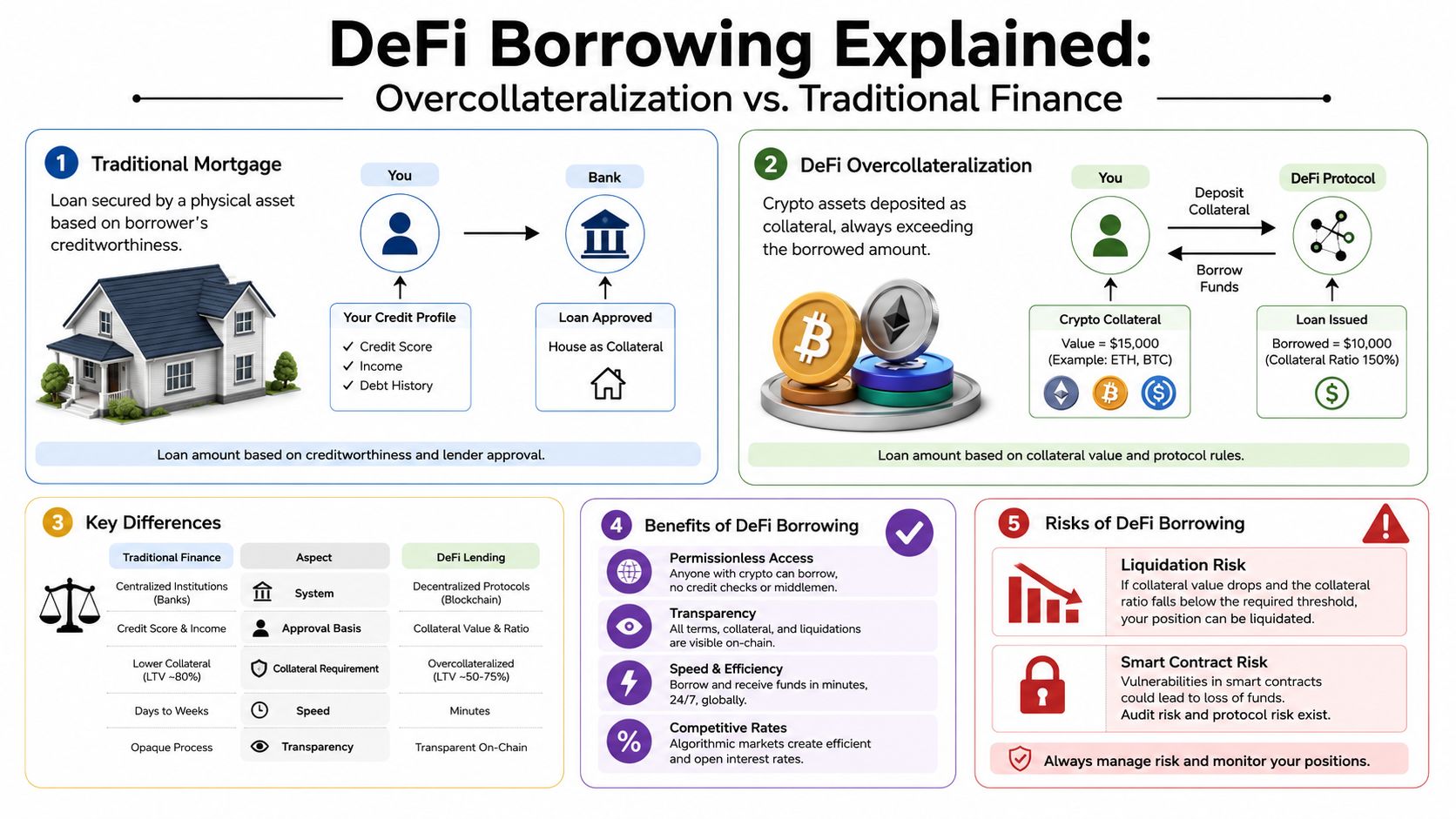
How collateral ratios work
The key number is loan-to-value, or LTV. If you deposit collateral worth more than the amount you borrow, the protocol sees a cushion. The bigger the cushion, the more room you have before liquidation pressure starts to build. In the source example, operators often use LST collateral at 75–82% LTV, but stop well below the cap because liquidation risk rises as price moves compress the health factor (Eco stablecoin borrowing strategies).
That conservative thinking shows up in established DeFi behavior. BIS researchers found that typical borrowing ratios for lending users sat between 1.4x and 1.9x, with the most active users often above a 2x borrowing ratio (BIS work1171). Those bands matter because they suggest real borrowing behavior clusters around repeatable levels, not random experimentation.
A simple way to think about it is this, your LTV is the distance between you and liquidation. The smaller the buffer, the more a routine market dip can push you into trouble.
Why health factor matters
Protocols also track a health factor or similar risk score. You don't need to memorize the math to use it well. You just need to know that it reflects how safe the position is at current prices. When the number compresses, your margin for error shrinks.
Practical rule: treat the borrowing threshold like the edge of a cliff, not a target. Good operators leave space between their actual borrow size and the protocol's maximum.
For readers who want a deeper collateral primer, the collateral reference at Yield Seeker's collateral guide is useful because it ties asset choice to practical borrowing behavior instead of treating all collateral as interchangeable. That matters when you're comparing ETH-linked collateral, BTC-backed borrows, or stablecoin loops.
The point is not to borrow as much as possible. The point is to borrow enough to make the position useful, while keeping liquidation unlikely under normal volatility.
Exploring High-Value Stablecoin Borrowing Strategies
Stablecoin borrowing becomes interesting when the borrowed asset has a job. If the borrowed USDC just sits there, you're paying for optionality. If it's deployed into a measured strategy, it can become part of a larger return stack. The four most useful patterns are collateralized borrowing, looping, debt-funded liquidity provision, and rate-spread arbitrage.

Collateralized borrowing
This is the cleanest starting point. You deposit an asset like wstETH, cbETH, or rETH, then borrow a stablecoin such as USDC, USDS, or DAI. The point is not to chase the highest possible borrow limit. The point is to preserve upside exposure while extracting liquidity. The Eco reference notes that 75–82% LTV is common for LST collateral, but that operators should stay meaningfully below the maximum (Eco stablecoin borrowing strategies).
A practical example is easy to follow. You hold an LST, need stable liquidity, and don't want to sell the asset. You borrow against it, then either park the stablecoins, deploy them into a separate strategy, or use them for offchain needs. The tradeoff is that your debt is now sensitive to collateral price and borrow-rate changes.
Leveraged looping
Looping is just repetition with discipline. You supply a yield-bearing asset, borrow against it, swap or redeploy the borrowed stablecoin back into the same or a similar position, then repeat. This can raise effective exposure, but it also raises fragility. The setup is especially sensitive when rates move or the underlying collateral becomes more volatile.
The same Eco reference notes BTC- or ETH-backed stablecoin borrows on Aave V3 can use 35% LTV as a conservative baseline (Eco stablecoin borrowing strategies). That's useful because it shows how much room cautious operators leave for volatility. The tighter the loop, the more the position behaves like an amplified carry trade rather than a simple borrow.
Debt-funded liquidity provision
Borrowed stablecoins can also sit in an AMM or lending pool as working capital. That can make sense when the pool's fee income and rewards justify the borrow cost. The dangerous mistake is to treat gross yield as net yield. Borrow costs, slippage, and rebalancing friction all matter, and they matter more when the position is thin.
Yield-focused routing tools can help here. One option is enterprise tokenization systems for bonds, especially when you're comparing how onchain liquidity and tokenized assets fit into broader treasury workflows. It's a different use case from retail looping, but the shared lesson is the same, capital needs a clear job before you borrow against it.
Rate-spread arbitrage
The fourth pattern is simpler than it sounds. You borrow where the rate is relatively cheap, then deploy the stablecoin where the return is relatively better. That spread can disappear fast, which is why operators treat it like a live market trade rather than a set-and-forget income stream.
For stablecoin holders who want a more automated route, Yield Seeker's USDC yield optimization flow is relevant because it points to the same operational idea, routing capital toward better risk-adjusted yield while keeping execution disciplined. The key question is never just “what pays more right now?” It's “what still works after borrow costs, slippage, and monitoring are included?”
Implementing Risk Management for Borrowing
Borrowing fails most often when people size for good weather and ignore storm behavior. DeFi doesn't forgive that mistake. When collateral drops quickly, liquidations can cluster, and the position can unravel before the borrower has time to react. That's why risk management isn't a separate skill. It's the strategy itself.

Individual controls that actually matter
Start with your own buffer. If the protocol allows you to borrow more, that doesn't mean you should. A conservative LTV gives you space for price swings, interest changes, and delayed reaction time. It also reduces the odds that a temporary move becomes a forced exit.
Keep enough margin so you can make a decision, not one so tight that the protocol makes it for you.
The BIS notes that collateral-only borrowing becomes fragile in stress markets because borrowing capacity swings with asset prices, which creates procyclical risk during rapid moves (BIS bulletin 57). This is a fundamental problem with overconfident borrowing plans. They look stable until the market starts moving against the collateral, then every small decline matters more than the last.
A practical control stack usually includes price alerts, a repayment plan, and a rule for adding collateral only when you can do it intentionally. If you can't explain what happens at different price levels, the position is too loose.
Protocol choice and oracle quality
The second layer is platform selection. You want strong security review habits, deep liquidity, reliable uptime, and oracle design that doesn't depend on weak price plumbing. If a protocol's borrowing market is thin, the rates and liquidation behavior can move faster than you expect. If the oracle design is fragile, a clean position can still get hit unfairly.
The same stress logic applies whether you're borrowing against ETH, BTC, or an LST. The protocol can only be as reliable as the data and enforcement behind it. That's why mature borrowers think in terms of failure modes, not just headline APR.
For a more hands-on framework, Yield Seeker's DeFi risk management notes are a good complement because they push the analysis toward monitoring and response, not just initial setup. That's the part most guides leave out, and it's the part that matters most when markets get choppy.
Choosing DeFi Platforms and Tracking Metrics
Not every lending market is equally suitable for a borrow strategy. Some have deeper liquidity, some have more conservative risk settings, and some are better suited to looping while others work better for simple collateralized borrows. The right choice depends on how much risk you want to carry and how actively you're willing to monitor the position.
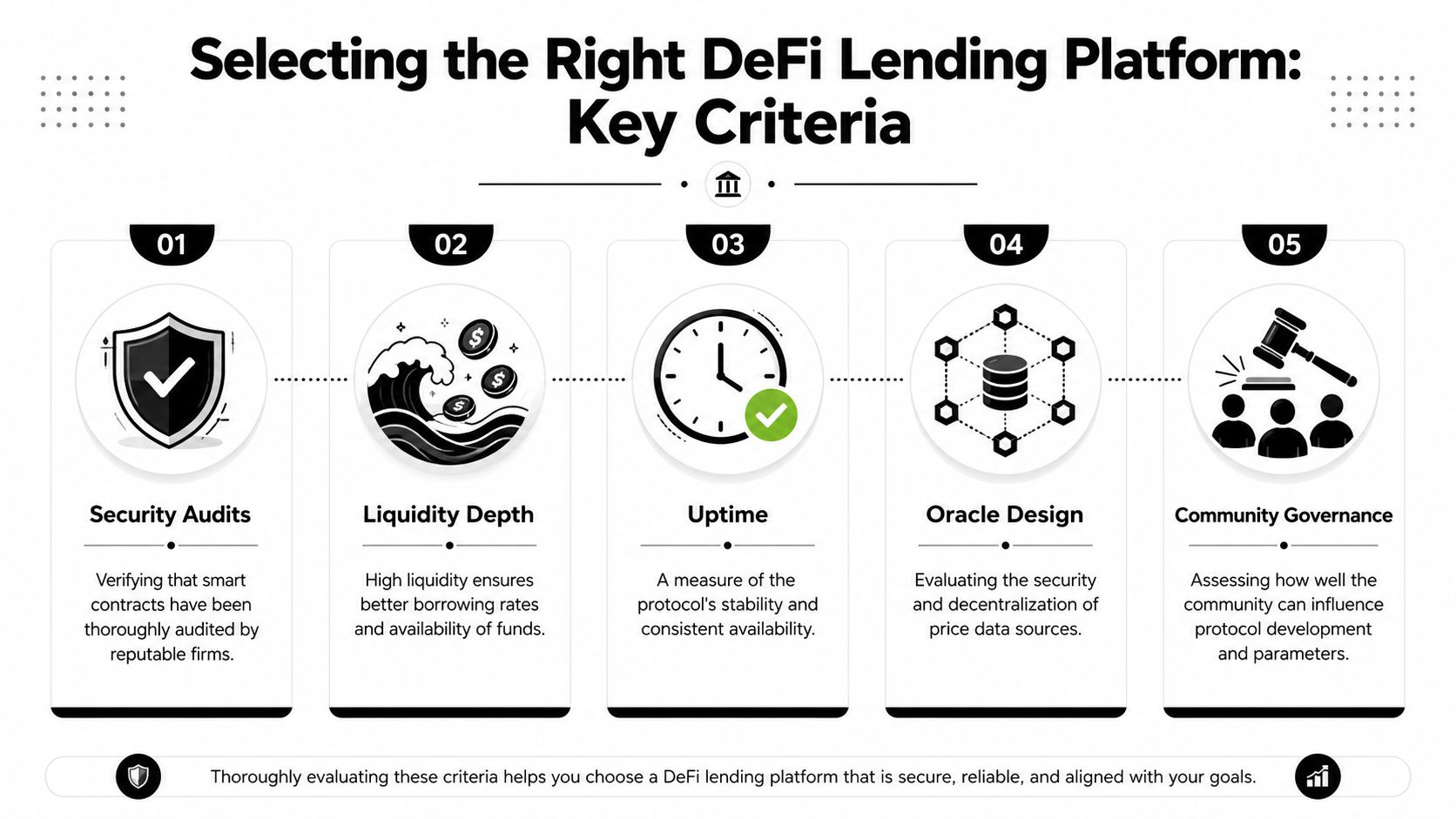
What to compare before you borrow
Security audits are table stakes, but they're not the whole story. You also want liquidity depth, uptime, oracle design, and governance quality. A protocol can look elegant in a dashboard and still be a poor fit if borrow liquidity is thin or rate behavior is unstable under load. For these reasons, comparison beats ideology.
By Q3 2025, lending protocols held about $89 billion in TVL, roughly 43% of total DeFi TVL, and on-chain borrowing reached about $19.1 billion, up from roughly $11 billion in CeFi at the end of 2024 (SQ Magazine lending protocol statistics). Those numbers matter because they show lending has become a major DeFi liquidity channel, not a side feature. Larger pools can support better execution, but they can also promote higher levels of capital amplification, so size alone isn't safety.
What to watch onchain
The most useful metrics are usually the simplest ones. Track utilization, because tight utilization can push borrowing costs higher. Watch health factor distributions if your tooling exposes them, because they show whether users are clustered close to the liquidation edge. Pay attention to borrowing APY trends, because rate volatility can turn a good strategy into a mediocre one very quickly.
A decision matrix helps here:
Criterion | What to look for | Why it matters |
|---|---|---|
Security audits | Independent review history | Reduces smart contract surprises |
Liquidity depth | Enough borrow capacity for your size | Makes execution cleaner |
Uptime | Stable protocol availability | Keeps positions manageable |
Oracle design | Robust price feeds | Lowers unfair liquidation risk |
Governance | Active, credible parameter control | Improves response to stress |
The best borrowing setups are usually the boring ones. They're the protocols with enough liquidity, sensible parameters, and monitoring tools that let you react before a problem becomes a forced unwind.
Building Your Borrowing Strategy Checklist
A good borrowing setup should read like a checklist, not a wish list. If a position depends on you remembering ten things during a volatile week, it's already too fragile. The goal is to make the strategy repeatable, so you can open it, monitor it, and close it without guessing.
Readiness checklist
Collateral choice: pick an asset you understand, including how it tends to behave in stress.
Borrow target: set a size that leaves room for drawdowns, not one that maximizes headline capacity.
Buffer rule: decide in advance how much collateral you'll add, or how much debt you'll repay, before things get tight.
Rate awareness: check whether the borrow rate is variable and how sensitive your plan is to changes.
Oracle check: confirm the protocol's price feed design is something you're comfortable relying on.
Exit plan: know in advance how you'll unwind if the trade stops making sense.
Deployment flow
Approve and supply the collateral.
Borrow the stablecoin in a controlled size.
Deploy the borrowed capital into the intended use case, or hold it if you need liquidity.
Set alerts for price, utilization, and health factor changes.
Review weekly, and also after any sharp market move.
A strategy only works if you can repeat the same decisions under pressure.
The Aave V2 literature shows that many retail users borrow mainly to chase yield rather than finance consumption, which raises a useful question about whether the use of borrowed funds is improving risk-adjusted outcomes (BIS work1183). That doesn't mean borrowing is bad. It means you should know why the position exists before it starts costing you money.
If you're using automation, keep the rules visible. A clear checklist beats a clever setup that no one can explain six weeks later.
Conclusion and Next Steps
A solid DeFi borrowing strategy comes down to a few durable habits. Choose collateral carefully. Borrow with a buffer. Match the borrow to a real purpose. Track the platform, the rate, and the health factor like they're part of the same trade, because they are. The investors who do this well don't chase the most aggressive use of borrowed funds, they build positions that can survive ordinary volatility.
Start small if you're new to the process. Open a controlled position, watch how it behaves, and learn how quickly the numbers move when the market changes. That experience matters more than theory, because DeFi borrowing is an operational skill as much as a financial one. If you're managing stablecoins regularly, use tools that reduce the research burden and make monitoring easier.
A CTA for Yield Seeker.