
You've probably felt this already. Your stablecoins sit in a wallet, three yield tabs are open, one dashboard looks promising, another feels stale, and by the time you check a third option the rate you wanted has already moved. That's the real reason passive income with AI has gone mainstream, it doesn't just promise “more income,” it promises a way to keep up with markets, platforms, and content channels that never sleep.
The appeal isn't novelty. It's power. AI can compress research, execution, and rebalancing into one layer, which matters whether you're publishing digital products or routing stablecoins through DeFi. A 2025 Yahoo Finance report said 53% of Americans want to use AI to generate passive income, which is a pretty clear sign that AI-assisted earning has moved from a niche experiment into normal financial planning Yahoo Finance report.
Why AI Income Now Feels Different
A late-night yield check used to mean opening a few tabs and trusting your memory. Now it often means comparing lending rates, watching chain conditions, and wondering whether a better route appeared an hour after you last looked. The pressure comes from fragmentation, not just from opportunity.
That's why AI feels different from older “make money online” tools. It can sit between you and the messy parts of the process, watching more often than a person reasonably can and reacting when the numbers shift. The chain keeps moving overnight, and human attention is the bottleneck.
The mainstream shift matters because it changes the frame around income. This isn't just about side hustles for hobbyists, it's about people treating AI as part of their financial stack. The Yahoo Finance figure, 53% of Americans want to use AI to generate passive income, suggests that enough people now see AI as a practical income layer, not a gimmick Yahoo Finance report.
Practical rule: if a strategy only works when you stare at it all day, it isn't passive, it's just delayed labor.
That's the useful mental shift. AI doesn't automatically create income, but it can reduce the amount of attention a strategy demands after launch. Once you see it as a support layer, the next question becomes simple: which models are truly worth trusting with your time or capital?
What Passive Income With AI Actually Means
Passive income means money that doesn't depend on you trading hours for dollars every single time. That definition gets fuzzy fast, because almost every real setup needs some work at the beginning. With AI, the promise is not zero effort, it's lower effort after the system is running.
Just as a thermostat automates climate control once you set the target, in passive income with AI, you define the rules, risk limits, or content direction, and the software handles the monitoring, drafting, allocation, or redistribution on your behalf.
Automation and passivity are not the same thing
A lot of people confuse “automated” with “fully passive.” Those aren't identical. Automation can still require human review, especially when content quality, compliance, or capital risk is involved.
That's why the income ladder matters. Independent 2026-focused guidance describes a common spectrum where beginners can reach $500 to $1,000 per month, while more advanced operators can reach $5,000 to $20,000+ monthly with AI-augmented systems Yahoo Finance report. The point isn't that every reader will land in that range, it's that AI-assisted income spans from modest supplement to serious cash flow depending on audience, product quality, and distribution.
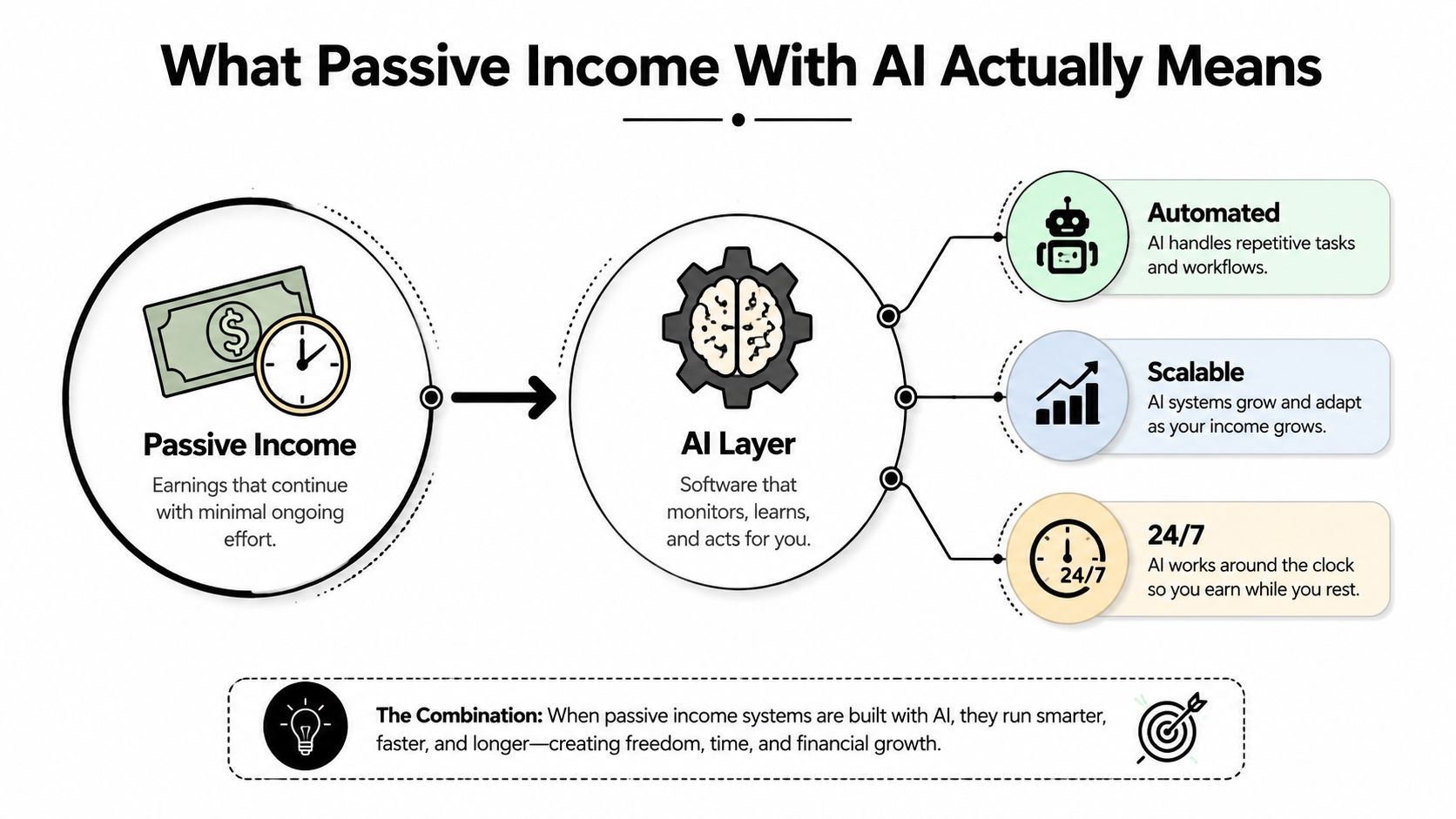
The real definition is operational
In practice, “passive” usually means setup once, maintain occasionally. For content models, that might mean reviewing drafts, updating offers, or checking conversion. For DeFi yield, it might mean setting parameters, watching for risk changes, and confirming the platform is still allocating where you expect.
Passive income with AI works best when you treat it like a system, not a shortcut.
That's the bridge between the two worlds. In creator businesses, AI helps you build assets. In DeFi, AI helps you deploy capital. In both cases, the machine handles repeatable work, but the human still owns the rules.
The Four Families of AI Passive Income
The easiest way to sort this is to split it into four families. Two of them are about building and selling digital assets. Two are about deploying capital and letting software optimize placement.
Creator models and service models
The first family is digital products and content. That includes AI-generated templates, ebooks, prompt packs, faceless video channels, and AI automation services. One guide says digital products can earn about $100 to $2,000 per month, while another creator-oriented path suggests you might target $1,000 monthly through a $99 to $299 template bundle, a newsletter with 100 subscribers at $10 per month, or a licensed AI agent sold to 2 to 3 clients at $500 per month each AIPreneurHub.
The second family is AI services and niche SaaS. These are subscription agents, chatbots, and automation agencies where you sell a workflow again and again. The economics are different from freelance work because the value sits in the system, not in a single delivery.
Capital deployment models
The third family is AI trading bots. These use price signals, momentum, or mean-reversion logic to open and close positions, often more quickly than a human would manage manually. The upside is speed and discipline, but the variance can be higher because the strategy is exposed to market movement.
The fourth family is DeFi yield aggregation. Here, AI agents route stablecoins across lending, liquidity, and market-making opportunities, then shift allocation as conditions change. If you want to look at a focused crypto angle on this category, browse AI driven DeFi forecasting tools can help you compare how forecasting and routing ideas fit together.
Useful distinction: the first two families are “build once, sell many.” The last two are “deploy capital, let AI allocate.”
That split matters because time, skill, and risk don't behave the same way across categories. A content bundle may demand more creation time up front, while a yield router may demand more attention to protocol risk and capital access. If you're trying to choose a lane, this is the first fork in the road.
How AI-Driven Yield, Bots, and Lending Work
A good way to think about DeFi yield aggregation is as a router. Your capital goes in one side, and the AI agent keeps reading rates, risk scores, and historical patterns, then sends funds to the most attractive option for the risk you accepted. When conditions change, the route changes too.
That is different from a trading bot. Trading bots usually try to profit from market movement itself, using signals to enter and exit positions over shorter timeframes. Yield aggregation is usually less about predicting price and more about optimizing where idle capital sits.
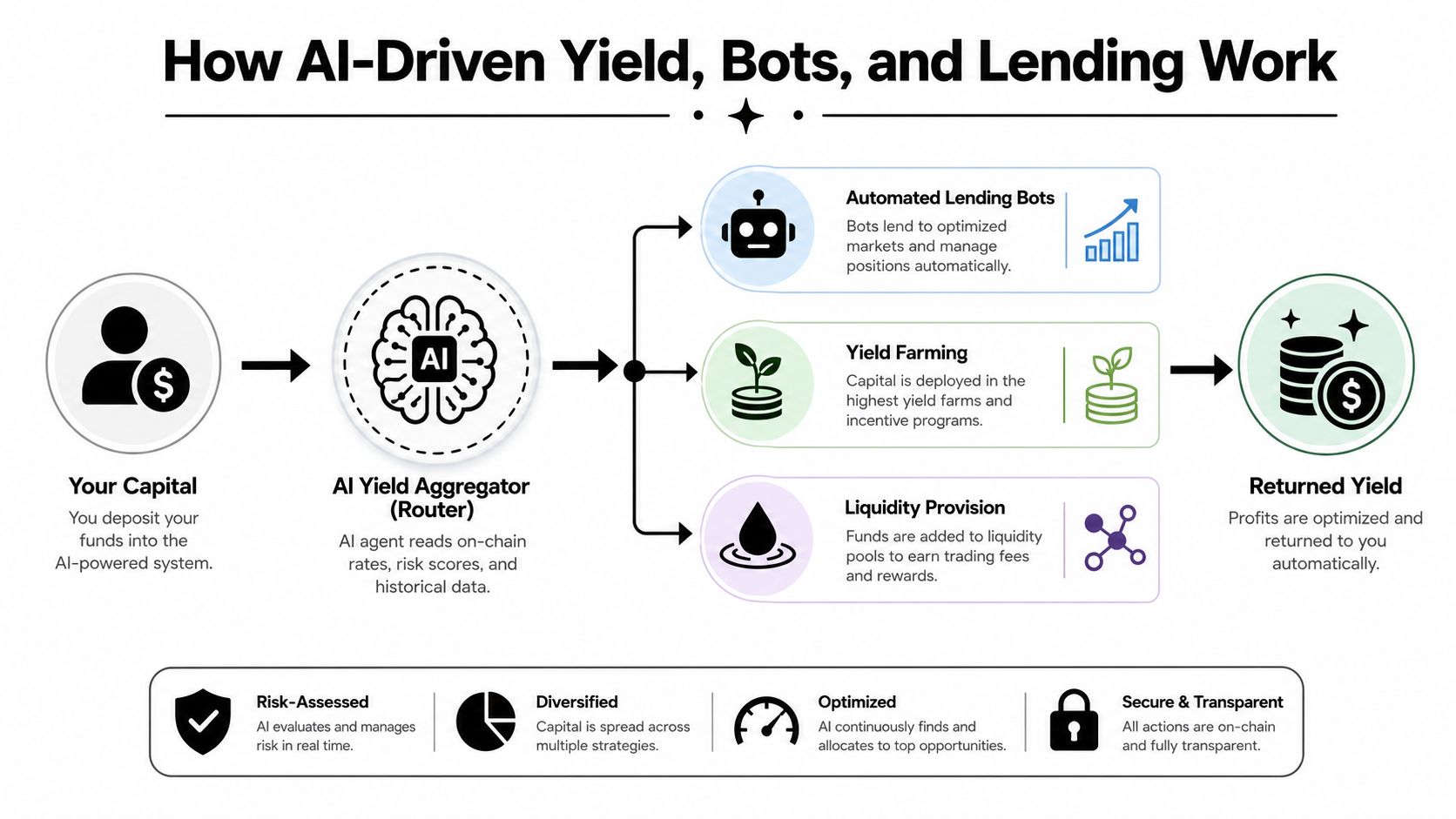
The water-and-bucket model
Think of your capital as water and DeFi protocols as buckets sitting at different heights. The higher bucket pays more, but maybe it's farther away, riskier, or only open under certain conditions. The AI is the pump that keeps moving water toward the bucket that best fits the rules you set.
Algorithmic lending and market-making work the same way at a high level. The software keeps pricing risk continuously instead of checking once and walking away. That continuous pricing is why these models feel more like infrastructure than speculation when they're done well.
What changes in practice
The main benefit is that the system can do the repetitive watching for you. The main risk is that the system can also make the wrong choice quickly if the inputs are bad or the protocol environment shifts. That's why readers comparing automated strategies often need to understand forecasting and routing logic, not just the headline APY.
If you're curious about AI tooling in the crypto lane, AI agents and forecasting workflows are worth studying before you commit funds. And if you want a deeper technical pass on how agents are used, how to use AI agents is a useful companion read for the broader automation mindset.
The simplest summary is this. Trading bots chase price behavior. Yield aggregators chase capital efficiency. Lending and market-making sit somewhere in between, because the machine is constantly deciding where risk-adjusted value looks best.
Realistic Earnings and the Time-to-Passive Reality
The earnings story gets distorted fast if you only read hype posts. A more grounded view starts with the published ranges. One source estimates digital products can earn about $100 to $2,000 per month, while YouTube automation channels can reach $200 to $3,000 per month after 6 to 12 months AIPreneurHub. Those aren't guarantees, they're useful anchors.
AI can also reduce the work behind those outputs. One source reports that AI-assisted workflows can cut content creation time by 40% to 60% compared with manual workflows Wealth from AI. That's the economic engine, not magic, just fewer hours spent producing drafts, assets, or repetitive material.
A simple comparison
Model | Typical Monthly Range | Time to First Earnings |
|---|---|---|
Digital products | $100 to $2,000 per month | Can start quickly after launch, but varies by offer and distribution AIPreneurHub |
YouTube automation channels | $200 to $3,000 per month | Often 6 to 12 months before the model matures AIPreneurHub |
AI-augmented systems | $500 to $1,000 per month for beginners, $5,000 to $20,000+ monthly for advanced operators | Depends on setup quality, audience, and distribution Yahoo Finance report |
What still requires human hands
The messy part is maintenance. Very few articles quantify the time spent fixing mistakes, updating offers, reviewing output, or checking whether a model still works. The better setups are usually semi-automated pipelines, where AI handles most drafting or generation and a human keeps accuracy, originality, and conversion quality intact Wealth from AI.
Rule of thumb: if the output could hurt trust, a human has to stay in the loop.
That's why “passive” is a spectrum, not a promise. AI can shrink the labor, but it doesn't erase the responsibility. The best systems remove daily grind, not judgment.
A Checklist for Evaluating Any AI Income Tool
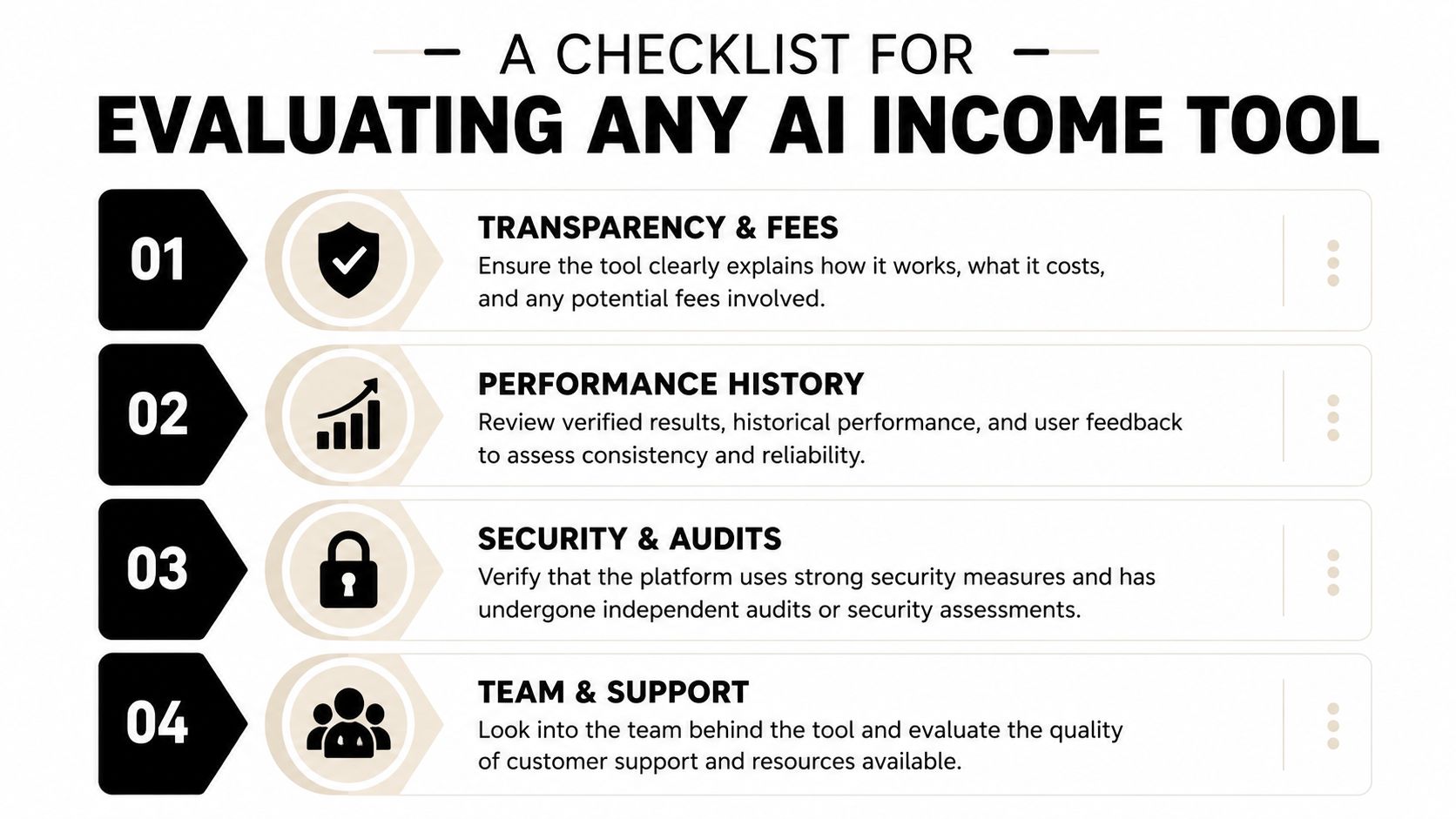
The fastest way to avoid bad choices is to judge every tool with the same scorecard. Whether you're looking at a content platform or a yield router, the questions are basically the same. What's different is where the risk lives.
The four checks that matter
Transparency and fees: Can you see how the tool works, where value is created, and what it costs to use?
Performance history: Does it show actual results or just marketing language?
Security and audits: Is capital protected by clear controls, or are you trusting a black box?
Team and support: Can you tell who built it, how they respond, and whether users can get help?
That framework also helps when you compare AI tools in crypto or content. If a platform hides routing logic, buries fees, or makes exit difficult, it's not giving you a passive system, it's asking for blind trust.
Apply the checklist before you buy
A few practical questions cut through the noise. Can you exit anytime, or are you locked in? Do you understand the chain or platform you're using? Can you inspect strategy changes, or are you expected to trust screenshots?
For a deeper look at risk-first evaluation in automated systems, automated risk assessment tools is a useful reference point. The right tool should make risk clearer, not hide it behind polished copy.
If you can't explain where the money comes from in one sentence, you probably don't understand the tool well enough to fund it.
Use the checklist the same way every time. That consistency matters more than chasing the newest model, because the newest model is often the one with the least real operating history.
Yield Seeker as a Worked Example
Yield Seeker fits the stablecoin side of this conversation cleanly because it turns the AI layer into a capital router. The platform says users can deposit as little as $10 USDC on the Base chain, with no lockups or withdrawal fees, and let a personalized AI Agent monitor and allocate capital across DeFi protocols in real time Yield Seeker.
The checklist applies pretty cleanly here. Accessibility is strong because the minimum is low and the capital stays available. Transparency is supported by a clean UI, plus a built-in terminal and visual walkthroughs that help users inspect what's happening instead of guessing.
The product also leans into the reality that passive doesn't mean zero supervision. Users still set their risk parameters, but the AI handles protocol selection and rebalancing, which is the part many people don't want to do manually. Founded by A Fox and Krishan Patel, the platform is positioned around safety, transparency, and continual improvement Yield Seeker.
After some context, the platform's walkthrough video is useful for seeing the interface in motion.
For a stablecoin holder, the practical value is simple. Instead of juggling dashboards and manually comparing routes, the platform does the repetitive scanning while you keep control over the account and the exit. That's a much more honest definition of “hands-off” than pretending the system runs with no oversight at all.
Choosing the Right Path for Your Time and Risk
The right path depends on the two resources you have, time and capital. Digital products and AI services are usually capital-light but time-heavy, because you need to create, test, and distribute something people will pay for. AI trading bots and DeFi yield agents are more capital-heavy but time-light, because the system matters more once you've funded it.
That's where a lot of people get stuck. They choose a model that looks passive on paper, then discover it needs a completely different kind of attention than they expected. A creator business can become a content treadmill if distribution is weak. A yield strategy can become stressful if you don't understand the risk surface.
A decision filter that helps
If you have more time than cash: focus on templates, newsletters, niche content, or AI services.
If you have more cash than time: look harder at capital deployment models like yield routing or systematic bots.
If you want the most control: favor semi-automated creator models with human review.
If you want the least daily work: favor systems that can operate with clear parameter settings and transparent controls.
The contrarian point is worth holding onto. AI doesn't remove concentration risk. In crowded content channels, it can even make saturation worse by increasing supply faster than demand. In DeFi, it can speed up allocation without eliminating smart-contract, protocol, or route-selection risk.
So define your own passive threshold first. Then choose one family that matches the time and capital you have, and score it with the checklist before you put in a dollar or a single hour. If you're looking for a stablecoin workflow that lets AI handle the routing while you keep control over access and risk settings, Yield Seeker is a practical place to start exploring that model.