
The loudest advice about AI income is usually the least durable. It sells speed, novelty, and “easy” monetization, but it skips the part that matters most, whether a model still works after everyone else copies it, the platform changes its rules, and margins get squeezed by fees and commoditization. That's why passive income using AI deserves a harder question than “what can I build?”, it's “what still earns when the first wave of hype is gone?”
Generative AI's rise after ChatGPT launched in November 2022 accelerated the whole category, and McKinsey later estimated that generative AI could add between $2.6 trillion and $4.4 trillion in annual value across 63 use cases including marketing, sales, software engineering, and customer operations McKinsey estimate. That scale attracted a flood of copycat ideas, which is exactly why durability now matters more than access to tools.
Why Most AI Passive Income Ideas Fail After the Hype
Most AI income ideas don't die because the tools stop working. They fade because the market fills up, the workflow becomes public knowledge, and the margin between “can build” and “can earn” collapses. A faceless channel, an AI-written ebook, or a template pack can look clever in week one, then become interchangeable by week twelve.
The real choke points are distribution and fees
A generic AI asset is easy to clone. If anyone can prompt the same model, upload to the same marketplace, and market with the same hooks, then the only moat left is distribution, audience trust, or a niche that's hard to copy. That's why broad tactics usually underperform once they've been widely shared.
Platform fees make that problem worse. A creator might get attention, but the revenue path can still be thin if marketplace cuts, ad rev-share, or payment friction eat into returns. In DeFi, the parallel is obvious, the protocol may be real, but if the strategy can't survive slippage, volatility, and changing incentives, the yield story turns fragile fast. For readers who already think in risk terms, the same mindset applies to yield mechanics and market access, and it's worth keeping that lens in mind alongside DeFi risk management principles.
Practical rule: if an AI income idea can be copied in an afternoon, it's not a business yet, it's a tactic.
Why early movers win, then lose
The first wave usually rewards whoever moves fastest. They collect the first clicks, the first buyers, and the first mention in a crowded search result. Then competition arrives, the product gets commoditized, and the advantage shifts from creation speed to positioning.
That's the part most “make money with AI” content avoids. The real filter is simple, can this model still attract demand after platform fees, copycats, and model improvements compress the easy gains? Yield-focused builders ask the same thing about any on-chain strategy, because yield that depends on a temporary gap rarely survives contact with the market.
A more useful frame is to treat AI income like infrastructure, not inspiration. Durable systems usually rely on a repeatable workflow, a narrow customer need, and a distribution path that doesn't disappear when the novelty does. Anything else is usually a short-lived arbitrage.
Comparing the Main AI Passive Income Models
The main models get lumped together too often, but they behave very differently. Some are capital-light and content-heavy. Others are capital-based and dependent on trust, execution, and risk control. A useful comparison starts with the structural question, not the headline promise.
Four models, four different economics
Model | Setup Complexity | Capital Required | Defensibility | Time to First Revenue |
|---|---|---|---|---|
DeFi yield automation | Medium | Medium to high, depending on deposit size | Moderate, if the workflow is risk-aware and transparent | Fast once deployed |
Trading bots | High | Medium to high | Low to moderate, because strategies get copied quickly | Unclear, often slower than expected |
Content and SaaS automation | Medium to high | Low to medium | Moderate if niche data or distribution exists | Medium |
Affiliate or lead generation systems | Medium | Low | Low unless the audience or channel is unique | Medium to fast |
DeFi yield automation stands out because it can monetize capital without forcing you into constant content production. It's still exposed to protocol risk and market changes, but the model can be durable if it emphasizes transparency and control. That's one reason many DeFi builders now prefer systems that monitor opportunities rather than manually chase them.
Trading bots sound attractive because they feel mechanical, but that's also the problem. Once a strategy becomes obvious, it gets copied, arbitraged, or outpaced by better execution. Unless there's a proprietary edge, bot-driven income tends to degrade.
Content and SaaS automation work better when they're tied to a specific workflow. Generic AI articles, generic SEO sites, and generic templates usually get crowded quickly. For a more practical lens on automation in service businesses, the automation guide for small business accountants is useful because it shows how narrow workflow wins often beat broad “AI content” plays.
Affiliate and lead generation systems can still work, but only when the traffic source is defensible. If the entire model depends on the same SEO keywords everyone else is targeting, the economics get thin fast. If you want a cleaner comparison of operational trade-offs, the breakdown in DeFi dashboards versus AI agents helps separate manual monitoring from true automation.
Bottom line: the best model isn't the one with the flashiest AI layer, it's the one where the edge survives copycats.
Evaluating Risk and Reward in AI Income Opportunities
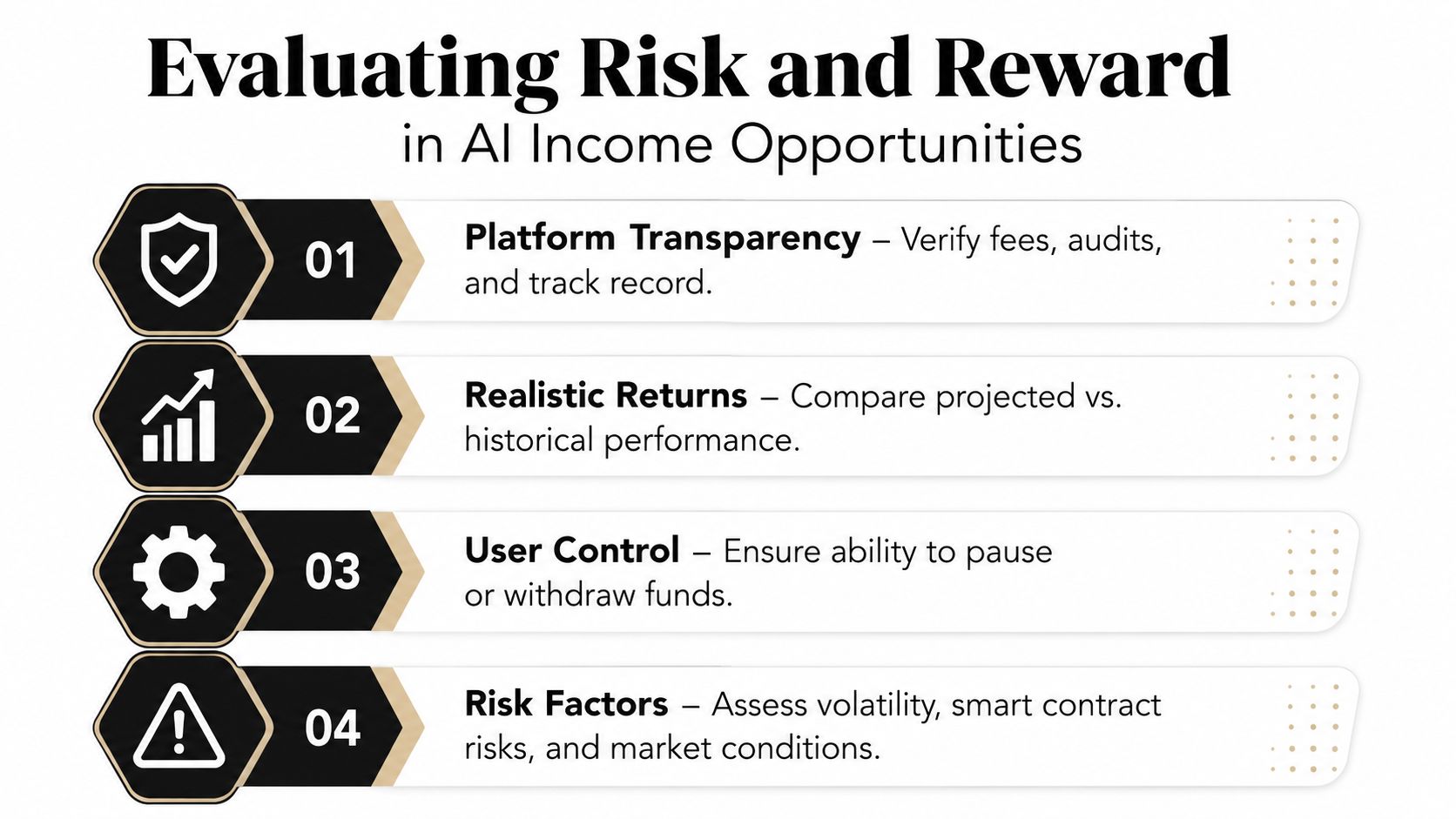
A durable AI income opportunity should answer four questions before it ever promises upside. Who controls the funds or workflow, how visible are the fees, what breaks when the market changes, and what makes this harder to copy than the last thing everyone tried? If those answers are vague, the opportunity is probably selling convenience more than resilience.
What to check before you commit
Platform transparency matters first. If a platform can't clearly explain fees, audits, or how it routes decisions, you're taking on hidden risk before you've earned anything. In AI content systems, the equivalent red flag is opaque monetization, no real ownership, and no clarity on where traffic or revenue comes from.
Realistic returns matter just as much. A projection that ignores churn, slippage, ad costs, or protocol changes is a marketing claim, not a plan. The stronger systems make it easier to compare expected results against actual behavior, which is more useful than chasing impressive-looking numbers.
User control is where many passive models fail. If you can't pause, adjust, or withdraw without penalty, the system is passive for the operator, not for you. That distinction matters in both DeFi and AI subscription businesses.
Risk factors should be explicit. Volatility, smart contract exposure, platform policy changes, and market saturation can all destroy a good-looking setup. If a vendor talks only about upside and never about what goes wrong, they're not managing risk, they're hiding it.
Green flags and red flags
Green flags usually look boring. Clear documentation, visible controls, conservative claims, and a strategy that doesn't depend on a single traffic source or a single protocol are all signs of durability. Those systems may not sound exciting, but they tend to survive longer.
Red flags are usually loud. A “guaranteed” return, a workflow everyone can duplicate instantly, or a platform that locks up funds without giving you much visibility should get a hard pass. So should any model that only works while the promotional cycle is hot.
The simplest test is whether the system still makes sense if acquisition costs rise, competition increases, or the underlying model becomes mainstream. If the answer is no, then the upside is likely temporary.
Selecting and Setting Up AI Platforms and Agents
Good platforms make the workflow visible, keep the user in control, and reduce the amount of manual maintenance needed to stay productive. That doesn't mean they remove risk. It means they let you understand the risk before you deploy capital or effort.

What a sensible setup looks like
A useful platform should show what it's doing, not just what it's promising. For stablecoin automation, that means clear balances, visible earnings, and a way to inspect the agent's decisions rather than blindly trust a black box. Yield Seeker is one example of this approach, it lets users deposit stablecoins on Base, monitor an AI agent, and keep funds accessible without lockups or withdrawal fees.
The setup itself should stay simple. Create an account, deposit only what you're comfortable keeping liquid, and verify that you can see where the agent is allocating capital. If the platform buries those basics, the friction is probably intentional.
A practical setup checklist
Verify control first. Make sure you can withdraw or pause activity without waiting on a manual approval cycle.
Inspect the fee logic. If you can't easily understand how the platform makes money, your returns may already be discounted.
Check the action trail. The more visible the agent's decisions are, the easier it is to trust the workflow.
Start small. A small deposit forces you to watch behavior closely before scaling exposure.
Use one tool for one job. Broad platforms often look flexible, but narrow systems are easier to audit and manage.
A useful setup also depends on the surrounding education layer. If a platform provides walkthroughs, terminal views, or explainers for strategy behavior, that lowers the learning curve and makes mistakes less expensive. The guide to using AI agents is worth reading if you want to understand how automated agents behave before assigning them capital or responsibility.
Most beginners overcomplicate the start. They want the perfect strategy, the best asset pair, and the cleanest backtest. A better move is to choose a platform that makes mistakes visible, then learn from actual behavior instead of theory.
Real-World Workflow AI-Powered DeFi Yield Agent in Action
A stablecoin holder deposits funds, the agent scans available DeFi markets, and capital gets routed toward the most attractive risk-adjusted opportunities it can find. That sounds abstract until you watch the workflow move from one protocol to another based on real conditions instead of fixed rules. The value isn't magic, it's continuous decision-making without constant manual intervention.
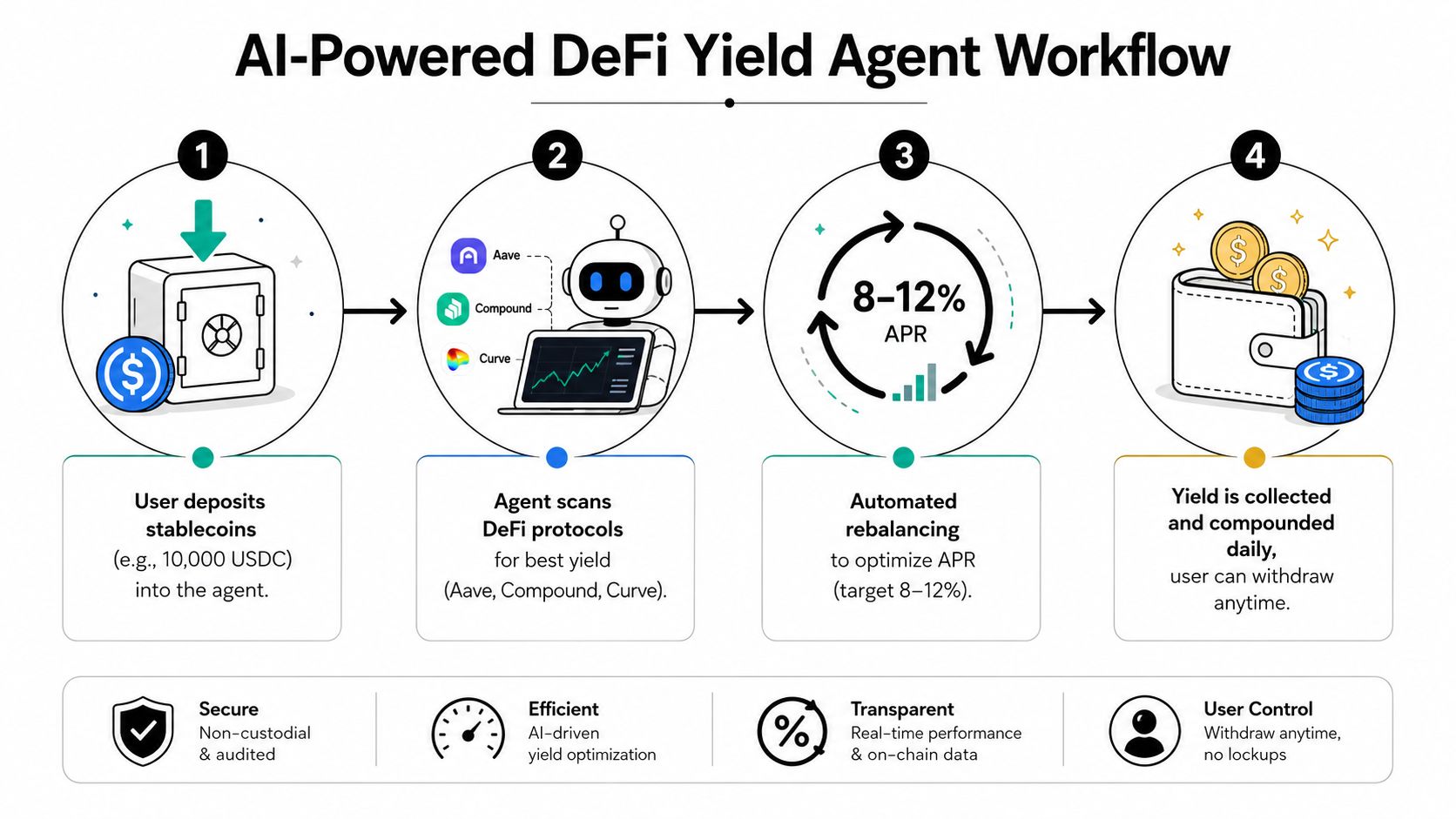
The usual path is straightforward. Funds enter the agent, the system checks lending protocols, liquidity pools, and yield aggregators, then it reallocates based on current conditions. If one route becomes less attractive, the agent can move capital elsewhere instead of leaving it idle.
In practice, that means the user isn't chasing every change by hand. The system can keep scanning, updating, and compounding while the user watches the results and reviews the logic when needed. That's a different operating model from the old “set it and forget it” pitch, because the better systems still expose the work being done.
What the agent is actually doing
A good agent is not merely “finding yield.” It's balancing expected return, available liquidity, and practical risk factors while avoiding unnecessary manual churn. If the market changes, the agent can re-evaluate instead of waiting for the user to log in and react.
That workflow is most useful when the user wants capital to remain productive without babysitting dashboards all day. It also works best when the platform keeps performance visible so the user can review what happened, not just trust a final number on a screen.
The key test is consistency. If the agent can keep operating through changing conditions without turning into a maintenance burden, it has a real role in a passive income stack. If it needs constant correction, then it's just automation theater.
Monitoring, Optimization, and Long-Term Positioning
A passive system still needs monitoring, but monitoring doesn't have to mean obsession. The goal is to catch degradation early, make small corrections, and avoid the trap of over-managing a strategy that was supposed to save time in the first place. That balance matters more as markets get crowded and workflows get copied.
What to watch and when to move
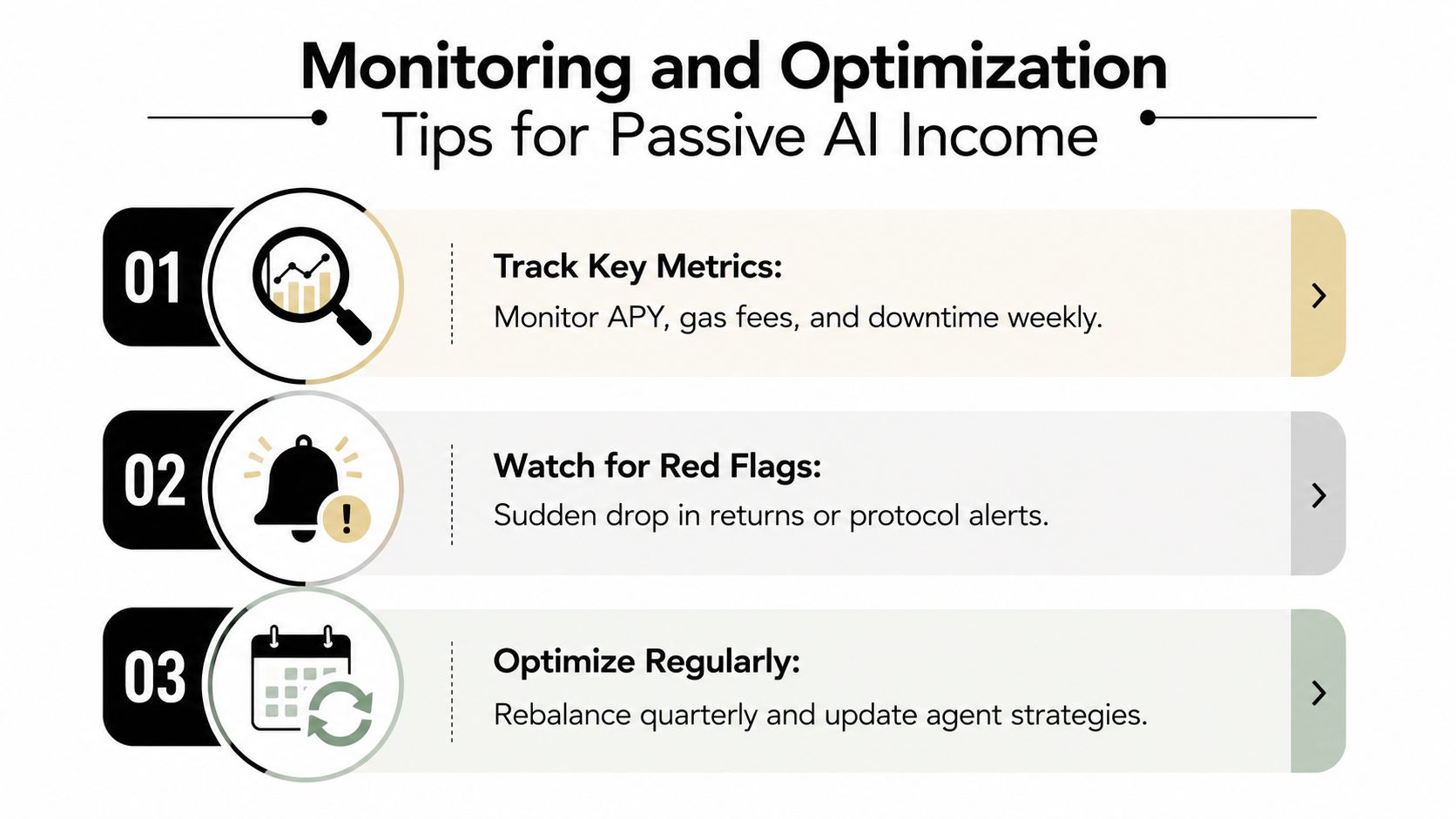
Track the basics on a regular cadence. If returns drift, fees rise, or downtime increases, something in the setup is degrading. Those are the kinds of changes that matter more than whatever the marketing page says this week.
Watch for concentration risk too. A strategy that works only because one platform is hot, one token is being incentivized, or one traffic source is still fresh is fragile by design. When those inputs weaken, the income stream usually weakens with them.
Practical rule: intervene when the system's assumptions change, not every time the numbers wiggle.
Building something that lasts
Long-term positioning usually comes from a narrow edge, not broad reach. In AI income, that edge can come from niche specialization, proprietary data, or a community that trusts your workflow enough to stay through market cycles. In DeFi, it can come from choosing systems that preserve user control and make risk visible.
The strongest setups don't try to win everywhere. They focus on one user type, one problem, and one repeatable way to deliver value. That's how an AI income stream survives commoditization, because the product becomes harder to replace than the underlying tool.
The biggest mistake is treating AI as the business instead of the operating layer. The business is still distribution, trust, and a clear reason to choose your system over the next copycat. AI just lowers the labor cost of delivering that value.
If you want to build passive income using AI without getting trapped in the usual hype cycle, start with a system that keeps funds accessible, shows its work, and doesn't depend on novelty to survive. A tool like Yield Seeker fits that narrow brief for stablecoin holders who want automated DeFi yield with visible controls, and it's worth testing only if that workflow matches your risk tolerance and time horizon.