

At its core, a DeFi protocol is just an automated financial service that lives on a blockchain. It lets you lend, borrow, and trade without having to go through a traditional bank or broker.
Think of them like digital vending machines for finance. They're built with code called smart contracts that run all by themselves.
What Are DeFi Protocols and How Do They Work?
Decentralized Finance, or DeFi, is a whole new way of looking at finance. It gets rid of the middlemen—the banks, the brokerage firms—and replaces them with automated software. The heart of this new system is the DeFi protocol.
These protocols are basically just rules and programs (smart contracts) that live on a blockchain. Most of them are on Ethereum or its faster, cheaper Layer-2 cousins like Base and Arbitrum. They automate all the financial stuff we normally count on people and big companies for.
Instead of filling out paperwork for a loan at a bank, you can borrow straight from a lending protocol. Instead of placing an order on a stock exchange, you can swap digital assets on a decentralized exchange (DEX). If you want to get a better handle on the basics, you can check out our full guide on what is decentralized finance.
The Engine of DeFi: Smart Contracts
The real magic behind all this is the smart contract. A smart contract is just a program that sits on the blockchain and automatically runs when certain things happen.
The vending machine analogy works perfectly here. You put in money (your input), you press a button for a snack (the condition), and the machine automatically gives you what you picked (the output). A smart contract is the same: you deposit funds, you tell it to make a trade or a loan, and the contract follows its pre-written rules to a T. No humans needed.
This automation is what makes DeFi so powerful. It opens the door for people to interact directly with each other, from anywhere in the world, creating a much more open and accessible financial system.
This new way of doing things is fueling some absolutely massive growth. The DeFi market is expected to explode from about $26.94 billion in 2025 to over $1,417 billion by 2033. This growth is all thanks to the core protocols that handle everything from loans to trades without anyone needing to be in the middle. You can read the full DeFi market analysis from Grand View Research to see the whole picture.
The Main Types of DeFi Protocols
There are thousands of protocols out there, but you’ll find that most of them fit into a few main categories. Getting a grip on these is the first real step to finding your way around the DeFi space.
Before we dive into the details, here’s a quick overview to get you started.
Quick Guide to Common DeFi Protocol Types
Protocol Type | Primary Function | Real-World Example |
|---|---|---|
Lending Protocols | Act as money markets for earning interest or borrowing assets. | |
Decentralized Exchanges (DEXs) | Allow users to swap assets directly with each other (peer-to-peer). | |
Liquid Staking | Earn staking rewards while keeping your assets "liquid" to use elsewhere. |
This table gives you a bird's-eye view, but let's quickly break down what each of these actually does.
Lending Protocols: These are basically decentralized money markets. You can deposit your assets to earn interest from borrowers, or you can put up your own assets as collateral to borrow against them. Aave and Compound are two of the biggest names here.
Decentralized Exchanges (DEXs): These platforms let you trade digital assets directly with other users, cutting out the central company that usually runs an exchange. Uniswap and Curve really pioneered this whole space.
Liquid Staking Protocols: These are a bit more advanced. They let you earn rewards for helping to secure a blockchain network (a process called staking), but they also give you a "liquid" token back. You can then take that liquid token and use it in other DeFi protocols to earn even more yield. Lido is the absolute giant in this category.
Alright, so we've covered what DeFi protocols are. But the million-dollar question remains: where does all that yield actually come from? It's not magic internet money; it's the result of real economic activity happening on-chain.
When you put your stablecoins into a DeFi protocol, you're not just parking your cash. You're actively providing a service that other people need and are willing to pay for. Think of these protocols less like abstract bits of code and more like bustling, automated marketplaces. Once you grasp how these marketplaces work, you’ll see exactly how your money starts earning for you.
This diagram gives a great bird's-eye view of the three main ways DeFi protocols make money.
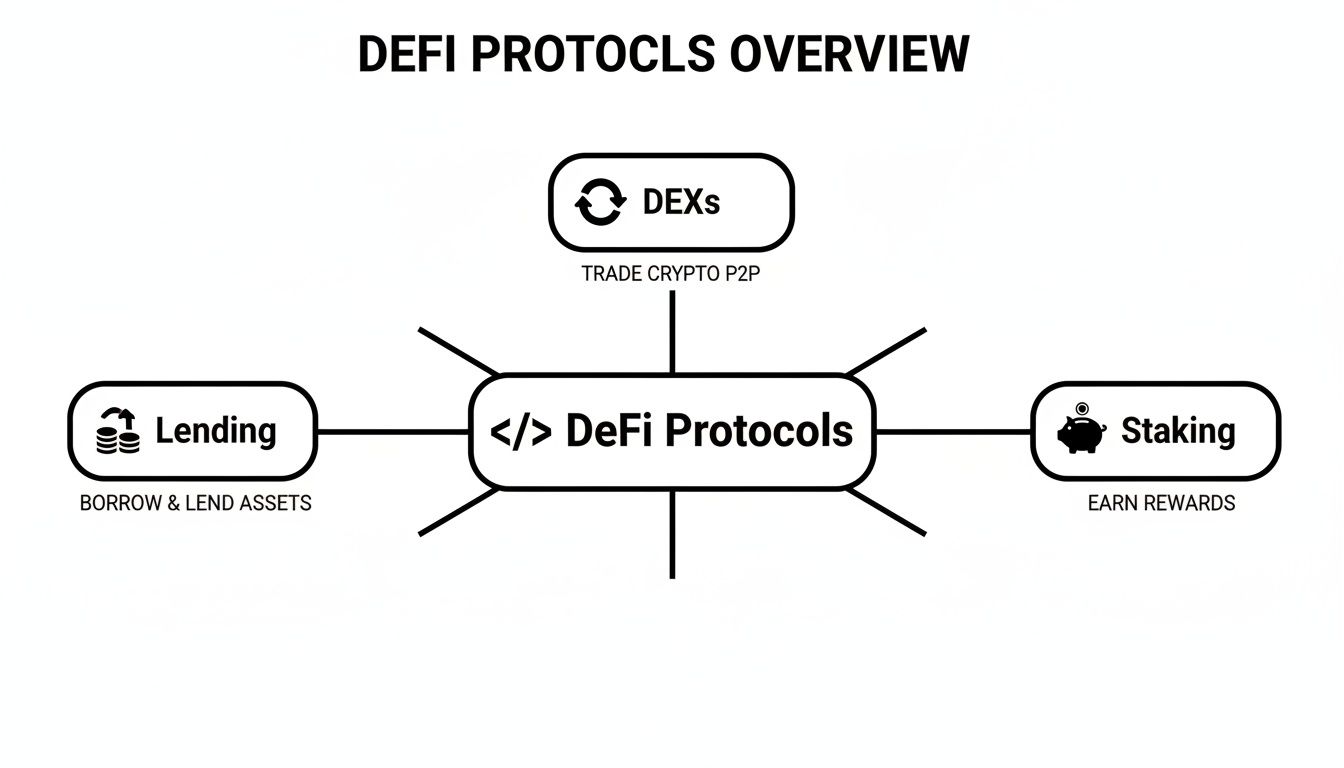
As you can see, it really boils down to three core functions: lending, decentralized exchanges (DEXs), and staking. Let's break down how each of these turns your deposit into an income stream.
Method 1: Lending and Borrowing
The most classic and straightforward way to earn in DeFi is through lending protocols. Imagine them as fully automated, peer-to-peer banks that never close. When you deposit your stablecoins, say USDC, you’re adding them to a big pool of capital.
Other users can then come and borrow from that pool. To do so, they have to put up collateral, which is usually a more volatile crypto asset like Ethereum. They pay interest on that loan, and the majority of that interest gets paid out to you and all the other lenders in the pool.
Your Role: You become the bank. The interest paid by borrowers is your yield. The protocol is just the automated middleman, making sure the rules are followed and that borrowers have enough collateral to back their loans.
This whole system is incredibly efficient because smart contracts run the show. They automatically adjust interest rates based on supply and demand, watch over the collateral, and divvy up the earnings. If a borrower’s collateral value dips too low, the smart contract steps in and sells it to pay back the lenders, keeping your principal safe.
Method 2: Providing Liquidity to DEXs
Another huge source of DeFi yield comes from decentralized exchanges, or DEXs. Unlike the old-school exchanges with their order books, most DEXs run on a model called an Automated Market Maker (AMM). An AMM works by using pools of assets contributed by users like you, who are called liquidity providers.
When you provide liquidity, you deposit a pair of assets—for instance, USDC and ETH—into a liquidity pool. For providing this service, you get a cut of the trading fees every single time someone swaps between those two assets.
It’s a bit like being a mini-shareholder in a currency exchange booth. You provide the cash to make the exchanges possible, and you get a slice of every transaction fee.
How Liquidity Pools Generate Fees:
User A wants to trade their USDC for ETH. They connect to the DEX and make the swap.
The protocol charges a small fee on that trade, maybe 0.3%.
This fee is then shared among all the liquidity providers in that USDC/ETH pool, proportional to how much they contributed.
The more people trade in a pool, the more fees it generates for the liquidity providers. It’s a powerful way to make your capital work for you, especially in popular trading pairs where there's constant activity.
Method 3: Liquid Staking
The third core method is liquid staking. This is a clever way to earn rewards for helping secure a blockchain network without having to lock up your funds. Many modern blockchains, like Ethereum, use a Proof-of-Stake (PoS) system where users "stake" their crypto to help validate transactions and keep the network secure.
Stakers get rewarded by the network for doing this. The catch with traditional staking is that it often requires you to lock your assets away, making them illiquid and impossible to use for anything else.
Liquid staking protocols fix this. When you stake an asset like ETH through a platform like Lido, you get a "liquid staking token" (like stETH) in return. This new token represents your original staked ETH and automatically collects all the staking rewards for you.
The real magic is that you can then take this liquid token and use it elsewhere in DeFi. For example, you could deposit your stETH into a lending protocol to earn even more interest or use it as collateral for a loan. This idea of earning yield on top of your already-yielding asset is a foundational concept in DeFi known as "money legos."
By understanding these three engines—lending interest, trading fees, and staking rewards—it becomes clear that DeFi yield isn't just pulled from thin air. It's the direct payment you receive for providing essential services to a decentralized financial world. Getting this is the first major step to putting your stablecoins to work intelligently.
Getting Real: A Look at DeFi's Biggest Players

It's one thing to talk about lending, exchanges, and staking in theory. It’s a whole other ball game to see how these ideas actually work in the wild. The titans of DeFi aren't just concepts on a whiteboard; they are real, functioning financial tools that millions of people use every day.
So, let's take a tour of three protocols that didn't just join their categories—they defined them. Each one is a perfect example of how the concepts we’ve covered become powerful, working platforms.
Aave: The Decentralized Money Market
When you think of DeFi lending, Aave is probably the first name that comes to mind. Think of it as a huge, open-source piggy bank that runs itself. It lets anyone, anywhere, lend out their crypto to earn interest or borrow assets by putting up collateral.
The real beauty of Aave is how simple and powerful it is. Someone can deposit their stablecoins, like USDC, into an Aave liquidity pool. In return, they get a receipt token (in this case, aUSDC) that represents their deposit and starts racking up interest instantly, in real time.
On the flip side, someone else might need USDC but doesn't want to sell their Ethereum. They can deposit their ETH into Aave as collateral and borrow USDC against it. The interest they pay on that loan is exactly what generates the yield for the lenders.
Aave was the pioneer behind "flash loans"—a mind-bending concept where you can borrow millions with zero collateral, as long as you pay it back within the same single blockchain transaction. It’s a tool for advanced developers, but it shows the kind of stuff that's only possible when code runs the show.
This whole system is peer-to-peer and managed by smart contracts, creating a compelling alternative to traditional banks. It gives asset holders a way to put their money to work and gives borrowers access to capital without all the red tape.
Uniswap: The Automated Market Maker
Uniswap completely flipped the script on how we trade tokens. Before it came along, decentralized exchanges were clunky and often had no liquidity. Uniswap introduced the Automated Market Maker (AMM) model we touched on earlier, making it incredibly simple for anyone to swap assets or become a liquidity provider.
Instead of matching buyers and sellers with an order book, Uniswap uses liquidity pools. For any trading pair, like ETH/USDC, users can deposit an equal value of both assets into the pool.
By doing this, they become liquidity providers (LPs) and earn a slice of the 0.3% fee charged on every single swap that uses their pool. This brilliantly solves a massive headache: how to make sure there’s always someone on the other side of a trade, even for brand-new or niche tokens.
Uniswap's Impact:
Permissionless Listings: Anyone can fire up a new market for any token, which really sparks innovation.
Deep Liquidity: By giving users a reason to pool their assets, it creates deep liquidity and reduces price slippage for traders.
Passive Income: It offers a straightforward way for people to earn passive income just by holding assets and collecting trading fees.
Uniswap's model was so successful that it's been copied by countless other exchanges, but it remains a foundational pillar of the entire DeFi ecosystem.
Lido: The Liquid Staking Dominator
When blockchains like Ethereum shifted to Proof-of-Stake, a new problem popped up. Staking your assets meant locking them away, making them totally illiquid. Lido swooped in with a solution called liquid staking and quickly became the dominant player in the space.
Here’s how it works: when you stake your ETH with Lido, you get stETH (Staked Ether) back in return. This stETH token is your claim on the staked ETH and automatically collects all the staking rewards. But the best part? The stETH token is "liquid"—you can trade it, lend it, or use it as collateral in other DeFi protocols, all while it continues to earn that sweet staking yield.
This single innovation has been a massive driver of growth. DeFi protocols have exploded in popularity, with the total value locked (TVL) across all platforms surpassing $100 billion as of early 2026, signaling massive user demand. This milestone reflects how protocols like Lido, Aave, and Uniswap are reshaping finance. Lido leads the pack with a TVL hitting $38.321 billion, dominating the ETH staking market by letting users stake assets while keeping them liquid. Discover more insights about these DeFi trends and their impact on the market.
By "unlocking" all that staked capital, Lido lets users stack their yields by participating in multiple protocols at once—a concept people in DeFi call "money legos." These three examples show how the DeFi protocols we've explained in theory become powerful financial tools in practice, forming the backbone of a new, open financial system.
Understanding DeFi Risks and How to Manage Them

Those juicy yields you see in DeFi look great, but it’s crucial to remember they don’t come for free. This space is still the Wild West in many ways, and jumping in without understanding the risks is like driving a race car without a seatbelt—thrilling, for sure, but you're asking for trouble.
The good news is that these risks aren't some unknowable boogeyman. Once you know what to look for, you can start making much smarter, safer moves with your capital. Let's break down the big ones you'll run into and how to actually protect yourself.
H3: Smart Contract Risk: The Code Is Law
The single biggest and most unique risk in DeFi comes straight from the smart contracts themselves. At the end of the day, these protocols are just code. A single bug, a tiny oversight, or an unexpected loophole can lead to a complete disaster. If a hacker finds that one weak spot, they can potentially drain every last dollar from the protocol.
Don't think this is just a problem for small, unknown projects. Even the big players aren't totally immune. In late 2023, Balancer, a massive DeFi protocol, was hit with a devastating exploit. Attackers managed to get away with over $128 million. The culprit? A tiny rounding error in the code that, when exploited over and over, let them manipulate prices and walk away with the funds.
This incident is a sharp reminder: even protocols with multiple security audits can have hidden flaws. As attackers get more sophisticated, they hunt for these tiny edge cases, making continuous vigilance essential.
H3: Market and Stablecoin Risk
Beyond the code, the market itself throws another wrench in the works. Wild price swings can cause a domino effect across the whole DeFi ecosystem. This is a huge deal for stablecoins, which are supposed to be the safe, boring part of your portfolio.
A de-peg event is when a stablecoin loses its 1:1 value against its underlying asset, usually the US Dollar. If the stablecoin you're earning yield on suddenly tanks to $0.90, the real value of both your principal and your yield takes a 10% nosedive along with it.
To guard against this, you should:
Diversify your stablecoins. Don't put all your eggs in one basket. Spread your holdings across different types like USDC, USDT, and DAI.
Stick with highly-collateralized stables. Favor the ones that have a long, proven history of holding their peg, even when the market is going crazy.
H3: How to Evaluate and Mitigate DeFi Risks
While the risks are very real, they aren't impossible to manage. If you have a clear framework for checking out a protocol, you can seriously cut down your risk and interact with DeFi a lot more confidently. And you don't need to be a developer to spot the obvious red flags.
First, always check for security audits. Any reputable protocol will pay third-party security firms like Trail of Bits or Certora to pick their code apart. You should be able to find these audit reports on the protocol's website. It's not a 100% guarantee of safety, but a project with no recent audits is a massive warning sign.
Second, take a look at the Total Value Locked (TVL). A high TVL—we're talking hundreds of millions or even billions—is a strong signal. It means a lot of other people trust the protocol with their money, acting as a kind of social proof that it's been battle-tested and has a solid community.
Finally, get a feel for the project's documentation and team. Is the team public with a track record? Is the documentation crystal clear on how the protocol works and what the risks are? Projects with anonymous teams and vague, hand-wavy explanations should be treated with extreme caution. They carry a much higher risk of being a rug pull, where the developers just disappear with everyone's money.
For a much deeper dive, our guide on comprehensive DeFi risk management lays out even more detailed strategies.
How AI Is Making DeFi Safer and Simpler
Trying to navigate the world of DeFi protocols can feel like juggling three jobs at once—you're a day trader, a market analyst, and a security expert. Manually hunting down the best yields, judging the risks, and moving your capital around is a full-time gig. But what if you had an expert co-pilot working for you 24/7?
This is exactly where Artificial Intelligence is changing everything. AI is taking the DeFi experience from a high-stress, manual grind to something that’s genuinely simpler, safer, and more open for everyone. It’s the bridge between the wild complexity of DeFi protocols and your straightforward goal of earning passive income.
Think of an AI agent, like the one we've built into Yield Seeker, as your own automated strategist. It tirelessly sifts through thousands of data points across countless protocols, checking everything from yield rates and gas fees to smart contract health and market chatter. It does this around the clock, something no human could ever realistically manage.
Your Personal DeFi Analyst on Autopilot
For busy professionals, this kind of automation is a massive time-saver. Instead of losing hours every week chasing the best yields, the AI does the heavy lifting for you. It pinpoints the best risk-adjusted spots for your stablecoins, taking all the guesswork out of the process.
For beginners, an AI co-pilot makes the whole thing less intimidating. You don't need to become an expert on every shiny new protocol that pops up. The AI handles the tricky analysis, giving you a clean, simple dashboard to watch your earnings grow without getting lost in the technical weeds. You can dig deeper into this in our article on AI-powered yield optimization.
Even DeFi veterans get a leg up. The AI can pull off complex strategies that would be too fast or intricate to manage by hand, like automatically compounding rewards or zapping funds between protocols to catch a fleeting opportunity. It’s like having a whole team of analysts working just for your portfolio.
"An AI in DeFi acts as a constant vigilance system. It doesn’t sleep, get distracted, or make emotional decisions. Its only job is to analyze data and execute strategies based on predefined rules for safety and performance."
Enhancing Safety Through Continuous Monitoring
Maybe the most critical job for AI here is making things safer. As we've covered, the DeFi space is loaded with risks, from sneaky smart contract bugs to sudden market dumps. An AI agent gives you an essential layer of automated protection.
Key Safety Functions of an AI Agent:
Real-Time Threat Detection: The AI is always watching on-chain data for red flags, like strange transaction patterns or spikes in social media chatter hinting at a potential exploit.
Automated Reallocation: If a protocol starts looking shaky, the AI can automatically pull your funds and move them to a safer, pre-vetted alternative, protecting your capital before disaster strikes.
Risk Parameterization: You set your own risk tolerance, and the AI works within those guardrails. It ensures your portfolio never takes on more risk than you're comfortable with.
This nonstop monitoring is a powerful shield. Take the $128 million Balancer exploit back in late 2025. An AI system could have spotted the first suspicious on-chain moves and started withdrawing funds long before the full scale of the hack was public. This proactive defense turns a potentially catastrophic loss into a managed risk, making DeFi a much safer place for the average person.
Alright, you've wrapped your head around the different DeFi protocols. Now, let's talk about actually putting that knowledge to work.
Getting your feet wet in DeFi doesn't have to feel like you're jumping into the deep end. With an automated platform like Yield Seeker, you can start small and let your own personalized AI agent handle the heavy lifting.
The whole point is to make it dead simple. You can get going with as little as $10 in USDC on the Base network, which is one of the cheapest and fastest blockchains out there right now. Once you're in, your AI Agent takes the wheel, sniffing out and moving your funds to solid, risk-managed yield opportunities.
A Clear View of Your Earnings
Forget about having a dozen browser tabs open with confusing dashboards for every protocol you're in. The goal here is a single, clean interface where you can literally watch your money grow in real-time.
Here’s a sneak peek of what that looks like. The dashboard lays it all out: your total balance, how much you've earned over time, and the live annual percentage yield (APY) your capital is pulling in.
This single screen saves you the headache of manually tracking everything across DeFi's fragmented world. It gives you a quick, honest summary of how your assets are performing for you, with a big focus on clarity so you always know exactly where you stand.
Complete Control and Flexibility
One of the most powerful ideas in crypto is that you should always be in control of your own money. This isn't like old-school finance where your funds get locked away for months or years. Modern DeFi tools put your freedom first.
With a platform like Yield Seeker, you have total freedom to pull your funds out whenever you want. There are no lock-up periods, no withdrawal fees, and no waiting around. Your capital stays liquid and is there for you when you need it.
This is how you go from just reading about DeFi to actually doing it. You can take everything you've learned about how DeFi protocols are explained and apply it in one of the easiest and most secure ways possible. By letting an AI agent handle the risk and constant portfolio shuffling, you can confidently take that first step and start turning your passive stablecoins into a real source of yield.
A Few Common Questions About DeFi Protocols
Even after diving into the world of DeFi protocols, it's natural to have a few questions lingering. Let's tackle some of the most common ones to make sure you walk away with a solid grasp of the essentials.
Is DeFi Just for Volatile Crypto Like Bitcoin and Ethereum?
Not at all. While DeFi certainly got its start on Ethereum, the space has exploded to include other blockchains like Base and Solana. A massive slice of the DeFi pie now revolves around stablecoins, like USDC, which are designed to hold their value against traditional currencies like the US Dollar.
This is a game-changer. It means you can jump into DeFi protocols and start earning yield without having your initial capital exposed to the wild price swings of assets like Bitcoin or Ethereum.
What’s the Deal with Total Value Locked (TVL)?
You'll see Total Value Locked (TVL) mentioned everywhere, and for good reason. It’s a crucial metric that shows the total amount of money users have deposited into a DeFi protocol. Think of it as a public scoreboard for a protocol's trustworthiness.
A higher TVL is a strong signal. It generally means more people trust the protocol to be secure and reliable. It suggests the platform has been battle-tested over time and has built up solid network effects, making it a key indicator of a protocol's health and popularity.
What Happens If a Protocol I’m Using Gets Hacked?
This is the big one. If a protocol gets hacked, there's a real risk that user funds could be stolen and lost forever. This is known as smart contract risk, and it's one of the most significant dangers in DeFi. Even protocols with multiple audits aren't completely bulletproof against a clever attack.
To keep yourself safe, stick to established, well-known protocols that have been around the block and have several security audits under their belt. This is also where an AI-powered platform can give you a serious edge, as it can constantly watch for new threats and automatically shift funds to safer options based on live security data.
Ready to put your stablecoins to work without all the manual research and constant monitoring? The Yield Seeker AI Agent is your co-pilot for navigating the world of DeFi yield. You can get started with as little as $10 on Base and let our AI find and manage the best risk-adjusted yields for you.