

You've probably had this exact experience. You park stablecoins on an exchange or in a wallet, decide they shouldn't sit idle, open a few DeFi dashboards, and immediately hit a wall of moving rates, obscure vault names, token incentives, bridge choices, and risk disclaimers. The capital feels simple. The decision tree doesn't.
That confusion is why a lot of people either stay in cash-like positions earning little, or swing too far in the other direction and chase whatever headline APY looks highest that day. Both are usually mistakes. Good DeFi yield isn't about finding the flashiest number. It's about understanding what pays you, what can break, and what trade-offs you're accepting in exchange for return.
Introduction Beyond the Hype of DeFi Yield
The old mental model for DeFi yield is outdated. For a long stretch, many users learned to associate DeFi with inflated token rewards, farming loops, and yields that only worked as long as new buyers kept showing up. That phase trained people to either become hyper-speculative or very skeptical.
The market has matured. A 2025 research summary noted that 77% of DeFi yield in 2024 came from real fee revenues rather than token emissions, and it also noted that established protocol yields compressed from roughly 15% to under 5% as the space matured, signaling a shift toward sustainability according to Plasma's review of DeFi yield origins.
That shift matters because it changes how you should evaluate opportunities.
Practical rule: If you can't explain who is paying the yield and why they would keep paying it, treat the yield as temporary.
For stablecoin holders, the useful part of DeFi today looks less like a casino and more like a fragmented money market. Borrowers pay to access liquidity. Traders pay swap fees. Vaults route capital across strategies. Specialized protocols even let users separate principal from future yield and trade each piece independently. That's a real financial stack, not just a reward program with a token attached.
What works now is usually boring by design. Sustainable DeFi yield tends to come from recurring economic activity, transparent mechanics, and systems that survive after incentives cool off. What usually doesn't work is blind yield chasing, over-concentration in one protocol, or assuming a stablecoin position is automatically low risk just because the asset name sounds safe.
The opportunity is still real. The workflow just has to be more disciplined than it was a few years ago.
Decoding the Language of Yield
A lot of mistakes in DeFi start with simple vocabulary. People compare numbers that don't mean the same thing, then wonder why the actual return in their wallet looks different from the screenshot they saw.
APR and APY are not interchangeable
APR is the simpler number. It tells you the annualized return without assuming your rewards are reinvested.
APY includes compounding. If the protocol or vault keeps recycling earned yield back into the position, APY shows the effect of earning on top of prior earnings.
Think about a bank savings account. If the bank paid interest once and left it there untouched, you'd be looking at something like APR. If the bank kept adding interest to your balance and then paid the next round of interest on the larger amount, you'd be closer to APY.
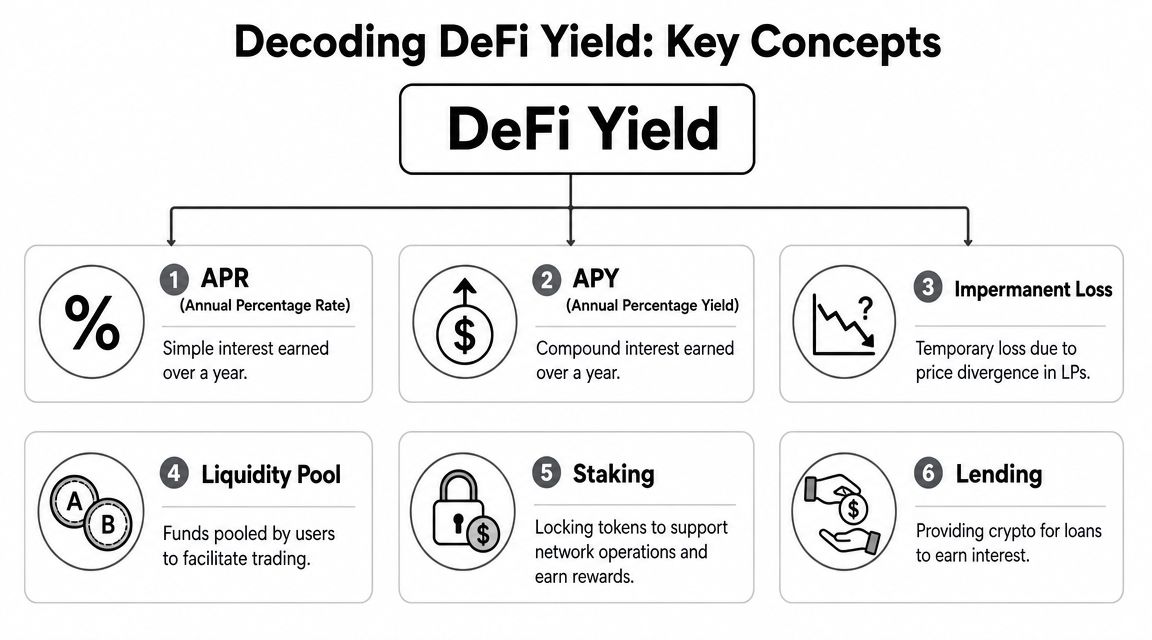
In DeFi, that difference matters even more because compounding can be manual, automated, frequent, irregular, or not happening at all. Some positions distribute rewards that you must claim and redeploy yourself. Others do the compounding inside a vault. A headline APY only makes sense if the compounding assumptions are realistic.
The terms that actually affect your wallet
A few concepts matter more than the rest:
Yield source means where the money comes from. Borrower interest, trading fees, staking rewards, and token incentives are not equivalent.
Payout asset means what you're earning. Getting paid in the same stablecoin you deposited is very different from getting paid in a volatile governance token.
Lockup and exit conditions determine whether you can leave when market conditions change.
Net return is what remains after gas costs, slippage, withdrawal frictions, and any losses from the strategy structure itself.
Here's a simple comparison:
Term | What it means in practice | Common mistake |
|---|---|---|
APR | Simple annualized rate | Assuming it compounds automatically |
APY | Annualized return including compounding | Assuming the posted APY is guaranteed |
Variable yield | Return can move as market conditions change | Treating it like a fixed coupon |
Fixed return structure | Return is implied by structure and timing | Ignoring how price can move before maturity |
When you compare two opportunities, compare the mechanism first and the number second.
Why yield literacy matters
The best operators don't just ask, “What's the APY?” They ask, “What has to happen for me to realize that return?”
That question filters out a lot of noise. It pushes you to notice whether a strategy depends on constant manual maintenance, whether rewards arrive in a token you don't want, and whether the posted figure only looks attractive because it assumes ideal compounding conditions.
In practice, DeFi yield becomes easier once you stop treating it like a scoreboard and start treating it like cash flow analysis.
The Pillars of DeFi Yield Generation
Open a yield dashboard and ten different APYs compete for attention. Underneath those numbers, the cash flows usually come from a small set of mechanisms. Once you know which engine is producing the return, it becomes much easier to judge whether the yield is durable, cyclical, or mostly marketing.
Lending is usually the cleanest source of yield
Lending is the simplest place to start because the income source is easy to identify. Borrowers want onchain liquidity. Lenders supply capital and earn interest for making that liquidity available.
For stablecoin holders, this is often the closest DeFi gets to a floating-rate cash product. Demand rises when traders need borrowed funds, market makers need inventory, or users want liquidity without selling other assets. Rates then adjust with utilization. High utilization can lift lender returns quickly, but it can also signal crowded conditions and sharper rate swings.
That matters in practice. A 6% lending rate backed by steady borrowing demand is a very different asset from a 12% rate that only exists because emissions are masking weak organic usage.
Liquidity provision pays you for warehousing inventory
Liquidity provision generates yield from trading activity, not borrowing demand. You deposit assets into a pool, traders swap against that inventory, and the pool distributes a share of fees back to liquidity providers.
The business model is straightforward. You are getting paid to stand ready on both sides of a market.
The trade-off is also straightforward. Your inventory shifts as prices move. In a stablecoin-stablecoin pool, that may be manageable. In a volatile pair, fee income has to outrun the drag from adverse price movement and rebalancing effects. Anyone evaluating LP yield should understand pool design, fee tier, and expected volume before chasing the headline number. If you want a clean primer on the mechanics behind this, crypto liquidity explained is a useful starting point.
Vaults turn manual strategy work into a product
Vaults sit on top of lending markets, DEX pools, and derivatives venues. They package the operating work that active users would otherwise do themselves: harvesting rewards, compounding, rebalancing, reallocating, and sometimes hedging.
That convenience has real value. It also changes what you need to analyze.
With a vault, the question is no longer just "where does the base yield come from?" It is also "what is the strategy layer doing to improve or protect that yield?" Some vaults automate repetitive tasks. Others magnify exposure, loop positions, or route across multiple protocols. The second category can improve returns, but it also introduces more assumptions, more dependencies, and more ways for execution to go wrong.
This is one reason automation is becoming a dividing line in DeFi. Manual yield farming still works for operators who watch positions daily. For everyone else, the winning products are increasingly the ones that can monitor conditions, adjust allocations, and reduce operational drag without hiding the underlying risks. Yield Seeker fits into that shift by helping users treat yield capture as a repeatable process instead of a tab-heavy scavenger hunt.
Yield itself has become a market
A newer pillar of DeFi yield comes from separating principal from future income and letting each trade on its own terms.
Pendle-style structures are the clearest example. A yield-bearing asset can be split into a Principal Token, or PT, and a Yield Token, or YT. PT generally trades at a discount and converges toward face value at maturity. YT represents the future variable yield stream, as described in Galaxy's research on the state of onchain yield.
Allocators gain more precision as one user can lock in an implied fixed return by holding PT to maturity. Another can buy or sell exposure to future yield itself. That starts to look less like simple farming and more like fixed income and rates trading onchain.
Taken together, these pillars form a practical framework. Ask what activity is producing the cash flow, what conditions support it, and what extra layers are being added to increase it. That is the difference between collecting yield and understanding its intricacies.
Navigating the Major Risks in DeFi Yield
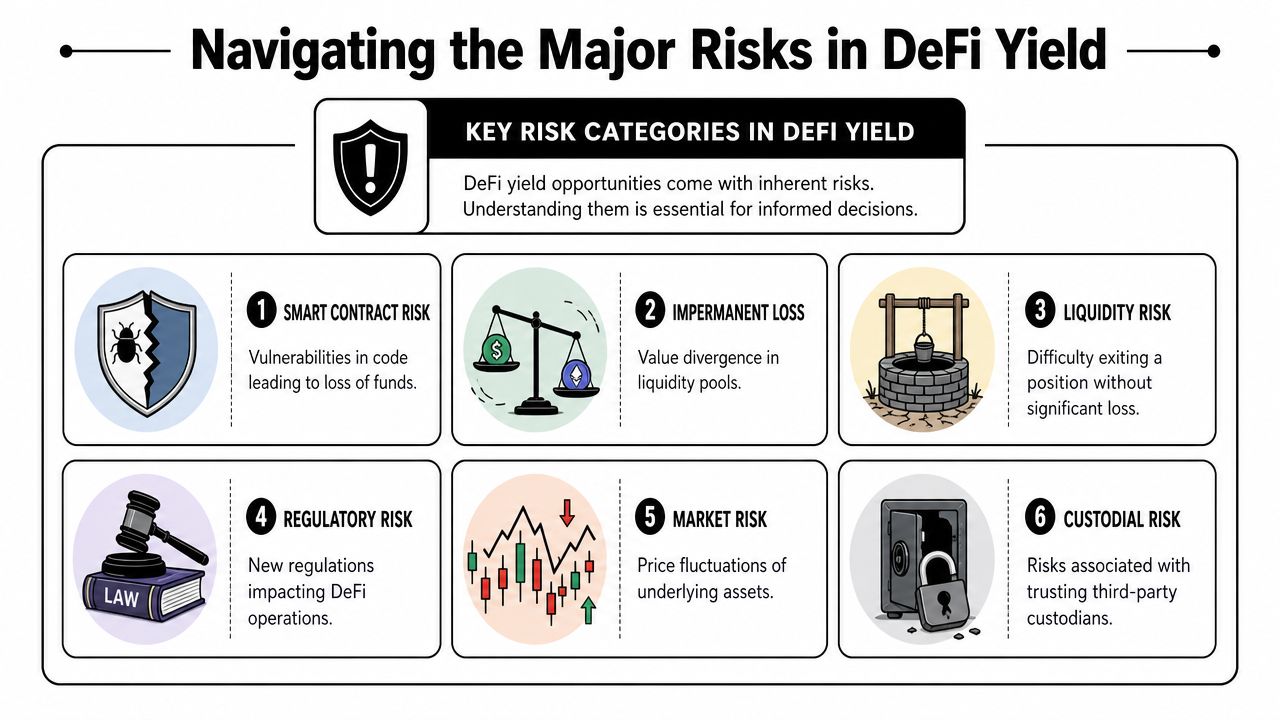
Yield only makes sense if you map the failure modes. In practice, most losses don't come from misunderstanding the upside. They come from underestimating what can go wrong between deposit and withdrawal.
Smart contract risk is software risk with money attached
A DeFi protocol is code that controls capital. If the code has a vulnerability, users can lose funds even if the strategy idea was sound.
That's why audits matter, but audits aren't a force field. A protocol can be audited and still fail. A vault can use reputable integrations and still inherit risk from something further down the stack. The practical takeaway is that complexity compounds risk. A simple lending position on a battle-tested market is usually easier to reason about than a layered strategy involving wrappers, bridges, and multiple incentive tokens.
Lending markets have credit structure, not magic
Overcollateralization is one of the main protections in DeFi lending. Borrowers typically post collateral worth about 150% to 200% of the loan value, and if collateral falls too far, automated liquidations sell it to protect lenders according to RebelFi's guide to where DeFi yield comes from.
That system works well in normal conditions. It can still struggle during violent market moves, oracle problems, or liquidity crunches.
A useful way to think about it is this: overcollateralization is a shock absorber, not a guarantee. It gives the protocol room to react. It doesn't eliminate tail risk.
The important question isn't whether a protocol has liquidations. It's whether liquidations can actually clear under stress.
For a broader breakdown of loss scenarios beyond the headline warnings, this guide on yield farming risks is worth reading before you size any position.
Stablecoins can fail in stablecoin-specific ways
A stablecoin position adds issuer, collateral, redemption, and market-structure risk. That's true even when the protocol itself is fine.
If a stablecoin trades below its intended value, your yield may not compensate for the principal impairment. This is why “earning on stables” should never be treated as synonymous with “risk free.” The asset and the protocol each carry separate risk layers.
Impermanent loss catches people who think in dollar terms only
Liquidity providers often learn this the hard way. If you deposit into a pool with two assets that move relative to each other, the pool rebalances you away from the stronger performer. You may still earn fees, but your final portfolio can lag a simple hold strategy.
That's not a bug. It's the economic cost of continuously quoting liquidity to traders.
Some risks are operational, not protocol-level
A strong strategy can still go wrong because of wallet security, approval sprawl, rushed bridging, or poor monitoring.
A few practical examples:
Approval risk means old token approvals can remain open longer than intended.
Liquidity risk shows up when you can technically exit, but not at a price you like.
Regulatory risk can change access, counterparties, or product availability with little warning.
Custody mistakes happen when users rely on convenience setups that weaken key control.
Risk management in DeFi yield is partly about choosing protocols. It's also about choosing habits.
How to Evaluate Protocols and Yield Quality
A vault shows 18% on the homepage. Deposits are climbing, CT is excited, and the docs look polished. The essential question is simpler. What has to stay true for that 18% to keep showing up next month?
Start there.
Yield quality comes down to durability. Borrower demand, trading activity, and liquidation fees can support returns because they come from actual protocol usage. Token incentives can still be useful, especially for bootstrapping a market, but they behave more like a subsidy than income. If the subsidy fades, the headline APY usually drops with it.
That is why I separate yield into two buckets before I look at anything else. Base yield is what the strategy can earn from real activity. Incentive yield is the extra layer paid to attract deposits. Mixing those together hides the trade-off. A strategy paying 7% from lending and 5% from emissions is very different from one paying 2% from usage and 10% from rewards.
A practical review usually answers five questions fast:
What pays me? Interest, fees, basis spreads, and liquidation revenue are easier to trust than a token printed by the same system.
How many moving parts sit between deposit and exit? Every wrapper, bridge, oracle, and external dependency adds another place for assumptions to fail.
How reflexive is the strategy? If the yield depends on the protocol token holding its price, you are often underwriting sentiment as much as code.
Can I get out cleanly? A good position is not just easy to enter. It needs credible withdrawal liquidity under stress.
How does the team behave under pressure? Incident writeups, parameter changes, and risk disclosures tell you more than launch threads.
Docs matter here, but not because polished docs signal quality. Good docs explain edge cases, limits, and ugly scenarios in plain language. Marketing promises upside. Operators explain what breaks.
I also look for evidence that the team runs a real risk process. Audit logos are a starting point, not a conclusion. The better signal is whether the protocol monitors collateral quality, adjusts parameters when conditions change, and communicates clearly when markets get disorderly. This breakdown of protocol safety analysis is a good reference for what that review should include before capital goes onchain.
Category confusion creates a lot of bad comparisons. Lending, staking, delta-neutral vaults, and LP positions can all show an APY, but the path that produces that number is completely different. Comparing them on yield alone is like comparing bond coupons, option premiums, and rental income because all three are percentages. They are not interchangeable exposures. If you are screening staking-style products alongside DeFi income strategies, Coiner Blog's crypto staking insights can help frame how reward mechanics differ across categories.
Yield Seeker fits well at this stage because the hard part is not finding opportunities. It is screening them consistently. A repeatable evaluation process beats instinct, especially once you are tracking several protocols across chains and trying to separate stable base yield from temporary incentives.
The standard I use is plain. A good protocol does not need perfect conditions to keep paying. It needs understandable cash flows, manageable dependencies, and a team that acts like risk is part of the product.
A Risk-Aware Workflow for Earning Stablecoin Yield
A stablecoin holder doesn't need a giant strategy map. They need a process they can repeat without improvising under pressure.
Use a sequence, not a hunch
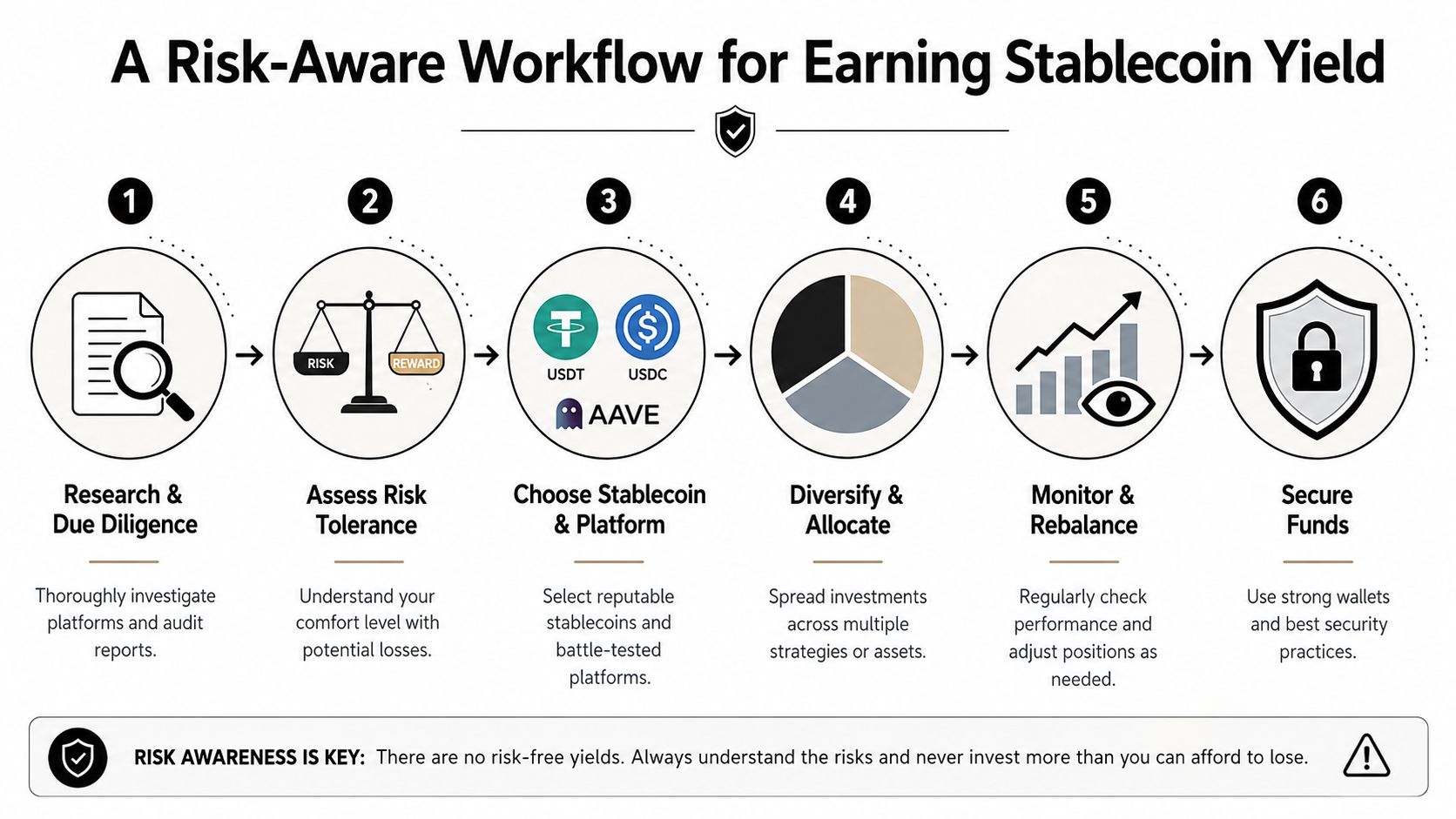
The easiest way to make bad DeFi decisions is to shop by APY first. A better approach is to force each position through the same workflow.
Set the risk boundary first
Decide what kinds of risk you'll accept before looking at opportunities. For many stablecoin holders, that means starting with simple lending and avoiding LP exposure, newer chains, or heavily structured products.Choose the asset before the protocol
Pick the stablecoin you trust to hold. A strategy built on an asset you don't trust is already compromised.Start with battle-tested venues
Early allocations should favor established lending markets and straightforward mechanics. You can always add complexity later. It's much harder to unwind complexity after something breaks.
Size small and learn from live exposure
Test deposits are underrated. A small onchain position teaches more than hours of dashboard browsing because it forces you to check deposit flow, wallet approvals, reward accounting, withdrawal friction, and settlement timing.
I'd much rather see a user make one small live deposit, withdraw it, and verify the full loop than commit a larger amount on day one because the interface looked polished.
Here's the operating version of that idea:
Run a deposit test: Confirm the path from wallet to protocol works as expected.
Run a withdrawal test: Don't assume exits are smooth. Verify them.
Track the actual experience: Note gas, timing, and whether rewards land the way you expected.
Watch for drift: If the strategy needs frequent attention, treat that as part of the cost.
Diversify across failure modes, not just logos
Spreading stablecoins across several protocols can help, but only if those positions fail differently. Holding the same kind of exposure through multiple wrappers often creates the illusion of diversification.
A more useful mental model is this:
Decision area | Better approach | Weak approach |
|---|---|---|
Protocol choice | Mix simple, understandable venues | Stack similar hidden dependencies |
Position sizing | Increase after operational confidence | Go large immediately |
Monitoring | Review assumptions regularly | Set and forget completely |
Automation is becoming part of the workflow
Manual DeFi yield management is possible, but it becomes work fast. You end up checking rates, reassessing protocol risk, comparing venues, and rebalancing more often than you expected.
That's why some users now use tooling instead of juggling tabs themselves. Yield Seeker is one example. It lets users deposit stablecoins and have an AI agent monitor and allocate capital across DeFi protocols in real time, while keeping funds accessible and avoiding lockups. That doesn't remove the need for judgment, but it does reduce the mechanical burden that causes many users to either overtrade or do nothing.
The Future Is Automated Simplifying DeFi with AI
Manual yield management breaks down for the same reason manual treasury management does. The market is fragmented, conditions change quickly, and the work that looks simple from the outside turns into constant small decisions.

That's where AI starts to matter. Not as a magic box, but as a way to turn a repeatable workflow into a system. Research, screening, monitoring, and reallocation all follow rules. Once those rules are defined well, software can handle a lot of the grind more consistently than a distracted human switching between dashboards after work.
If you want a broader sense of how this shift is playing out outside crypto too, Zephony's AI automation insights are a useful reference point. The pattern is familiar. People don't automate because they hate judgment. They automate because repetitive decision support is where software shines.
A deeper look at that direction in DeFi is covered in this piece on AI yield optimization.
For a quick walkthrough of the product experience, this overview helps:
The practical end state is straightforward. You keep control of funds, define the kind of exposure you want, and let software handle more of the scanning and adjustment work that used to require constant manual effort.
Yield Seeker helps stablecoin holders put that workflow into practice with AI-assisted yield management, real-time protocol monitoring, and a low-friction interface built for both beginners and experienced DeFi users. If you want a simpler way to pursue risk-aware onchain yield without manually hunting every opportunity yourself, explore Yield Seeker.