
Your crypto may be doing nothing right now.
That's common. A wallet holds ETH, BTC, or stablecoins for months while the owner waits for the next move, but idle assets have an opportunity cost. In traditional finance, people expect cash to earn something in a savings account or money market fund. In crypto, the same idea exists, but the mechanics are different, the risks are sharper, and the quality gap between good and bad opportunities is much wider.
That's why passive income crypto deserves a more practical lens than most guides give it. The question isn't just “where's the highest yield?” It's “what is paying me, what risks am I taking, how much work does this require, and can I repeat this safely?”
Why Your Crypto Should Be Working for You
A lot of portfolios have a dead zone. Assets sit in self-custody or on an exchange, fully exposed to market moves, but not producing anything. If you already accept crypto risk, leaving productive assets idle often makes less sense than people realize.
The strongest reason to care about passive income crypto is simple. Returns can come from activity, not only from price appreciation. Some strategies pay you because you help secure a network. Others pay you because you supply capital that traders or borrowers use. That distinction matters because it changes how you evaluate performance.
Idle crypto is still making a decision
Holding cash in a checking account is a decision. Holding USDC, ETH, or other assets with no yield is also a decision. Sometimes it's the right one. If you need instant liquidity, expect to trade soon, or don't trust the available venues, staying idle can be rational.
But if your time horizon is longer, idle balances deserve scrutiny.
Practical rule: Don't ask “Can this earn yield?” first. Ask “Why is this asset in my portfolio, and what constraints matter most?” Liquidity, volatility, and security come before yield.
That's especially true for busy professionals. They don't want another full-time dashboard to monitor. They want a method that fits around work and life, not a strategy that turns every weekend into protocol research.
Yield only matters if the setup is sustainable
A serious approach to passive income crypto starts with three filters:
Source of yield: Is the return coming from real protocol activity, borrower demand, or network rewards?
Operational burden: How often do you need to rebalance, claim rewards, bridge assets, or manage approvals?
Failure mode: What happens if the protocol breaks, liquidity dries up, or your assumptions were wrong?
If you want a broader starting point for the concept itself, this guide on how to make passive income is useful background. The practical version, though, is this: productive crypto only helps if the strategy survives contact with reality.
How Crypto Generates Passive Income
Crypto yield isn't magic money. Somebody is paying, or a protocol is issuing rewards for a reason.
A useful mental model is a digital vending machine owned by a community. That machine needs security, maintenance, inventory, and liquidity so people can use it. If you help provide one of those things, the system may pay you.
Network rewards
In proof-of-stake systems, validators and delegators help secure the chain. Their compensation usually comes from protocol issuance plus transaction fees. That's the economic engine behind staking.
The important caveat is that posted rewards aren't the same as realized returns. LiteFinance's staking explainer notes that realized APR is diluted by validator uptime, commission rates, and the amount of stake securing the network, and that staking rewards are usually paid in the same asset and are more predictable than DeFi farming.
That “paid in the same asset” point is easy to miss. If you stake a token and earn more of that token, you've increased coin count, not necessarily preserved dollar value. If the asset drops hard, your reward stream may not offset the drawdown.
User-paid fees
The second source is simpler. You provide capital, and users pay to access it.
That happens in lending markets when borrowers post collateral and pay interest. It happens in decentralized exchanges when traders pay swap fees to use a liquidity pool. In both cases, your income depends on platform activity and market demand.
A good primer on the mechanics is this explanation of what DeFi yield is. The short version is that you're either renting out capital, helping price discovery happen, or both.
Here's the embedded walkthrough if you prefer video over prose:
Yield is compensation for doing a job inside the system. If you can't identify the job, treat the yield as suspect.
Why this matters in practice
Once you understand those two engines, most passive income crypto products become easier to judge.
Staking products wrap network security rewards.
Lending products pass through borrower demand.
Liquidity strategies monetize trading activity.
Farming products usually combine fees, incentives, and active repositioning.
That clarity helps you stop comparing everything as if it were the same instrument. It isn't. A staking position and a stablecoin lending position may both show an annual yield, but their risk drivers are completely different.
The 4 Main Crypto Passive Income Strategies
Most passive income crypto strategies fit into four buckets. The labels matter less than the mechanics. What you need to know is what you're contributing, who pays you, and what can go wrong.
Staking
Staking is the cleanest place to start conceptually. You lock or delegate a proof-of-stake asset so validators can help confirm transactions and maintain the chain. In exchange, you receive rewards in that same asset.
This isn't a niche activity anymore. CoinTracker reports that by November 2025, more than 33 million ETH had been staked, worth roughly $100 billion, which shows how large proof-of-stake yield had become in major markets.
That scale tells you two things. First, staking is a core part of modern crypto market structure. Second, it's mature enough that convenience and validator quality matter as much as raw headline APR.
What works: Staking can fit long-term holders who already want exposure to the asset and don't mind earning rewards in the same token.
What doesn't: It's a poor fit if you need stable dollar-denominated income or want zero exposure to token price swings.
Lending
Lending is closer to traditional finance. You deposit assets into a centralized or decentralized venue, borrowers take loans against collateral, and you receive a share of the interest.
This tends to be easier for professionals who think in cash-flow terms. The logic is straightforward: capital is useful, so borrowers pay for access to it. Operationally, it's often simpler than running a liquidity position because you usually don't need to manage token pairs.
A key distinction is custody. In centralized setups, you're trusting the platform's balance sheet and controls. In DeFi, you avoid that layer but take smart contract risk instead.
Liquidity provision
Liquidity provision means depositing a pair of assets into an automated market maker so traders can swap between them. In return, you earn a share of trading fees.
Many people get surprised. A pool may generate fees, but the value of your position can still lag simple holding if one asset moves sharply relative to the other. That's the core issue behind impermanent loss.
The easiest way to think about LP positions is this: you're not just investing in two tokens. You're agreeing to let a pool continuously rebalance between them.
That can be attractive in active markets with healthy trading volume. It can also become frustrating if you chased fees without understanding the path-dependent risk.
Yield farming
Yield farming is the umbrella term for actively moving capital across DeFi protocols to capture the most attractive available returns. Sometimes that means rotating between lending markets. Sometimes it means stacking LP fees with extra incentives. Sometimes it means using vaults that automate compounding and repositioning.
This is the most misunderstood category because the word “passive” becomes blurry. Farming can be passive if a vault handles execution. It can be very active if you're manually watching incentives, token emissions, and market conditions.
A practical way to split it:
Manual farming: More control, more effort, more room for mistakes.
Vault-based farming: Less operational drag, but added strategy and contract layers.
Incentive-heavy farming: Potentially attractive on paper, but often fragile if the reward token weakens.
Yield farming only makes sense once staking, lending, and LP mechanics are already understood. Otherwise, it involves stacking complexity on top of incomplete intuition.
Comparing Risk and Reward Across Strategies
A busy investor can earn 12% on paper and still lose in practice. The usual failure is not picking the wrong category. It is picking a strategy whose risks, maintenance burden, or security demands do not fit real life.
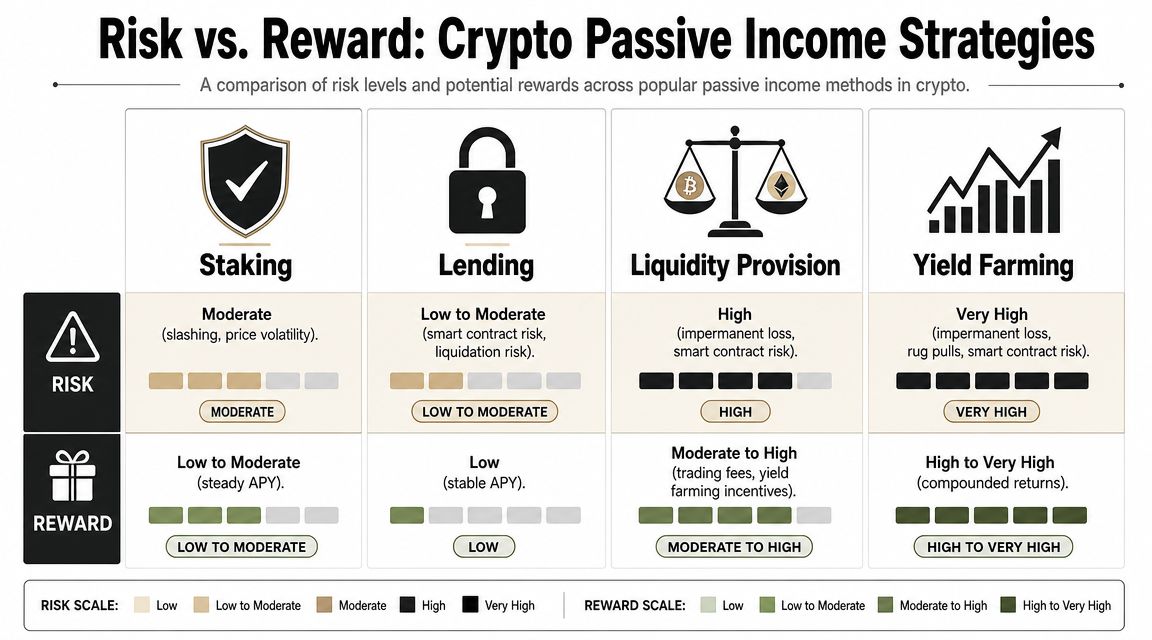
A useful comparison uses four filters: yield quality, principal stability, technical risk, and time required. That framework matters because two strategies with similar headline returns can behave very differently once markets move or a protocol needs attention.
Stablecoins change the decision in an important way. They do not remove risk. They cut one major variable by reducing direct price volatility relative to the dollar, which makes it easier to judge whether the yield is compensating you for smart contract, protocol, and platform risk.
Stablecoins are often the most practical starting point
Earlier sources in this article noted that beginner-friendly crypto income strategies often cluster in the low-to-mid single digits annually, with stablecoin lending frequently sitting in that range. That is not exciting cocktail-party material. It is useful portfolio construction.
For someone with a full-time job, stablecoin strategies are often easier to benchmark, easier to size, and easier to automate responsibly. That is why stablecoin automation tools such as Yield Seeker make sense for a certain type of investor. The goal is not chasing the highest number on a dashboard. The goal is building a process you can maintain without turning passive income into a second job.
The comparison that actually matters
Strategy | Typical return profile | Key risks | Complexity |
|---|---|---|---|
Staking | Moderate, network and token dependent | Token price volatility, validator issues, lockups, slashing on some networks | Moderate |
Lending | Usually lower than aggressive farming, but easier to model, especially with stablecoins | Smart contract risk in DeFi, counterparty risk in CeFi, collateral and liquidation dynamics | Low to moderate |
Liquidity Provision | Can be attractive in active pools with real trading demand | Impermanent loss, pool design risk, smart contract risk | Moderate to high |
Yield Farming | Highest variability. Strong returns can fade fast | Incentive decay, smart contract risk, strategy risk, underlying LP risks | High |
The table is only the starting point. What matters is how each strategy fails.
Staking usually fails through token exposure. The yield may arrive as expected while the asset drops enough to erase it. Lending is simpler to reason about, but simplicity can hide concentration risk if too much capital sits in one protocol, chain, or stablecoin. LP and farming strategies add path dependence. A position can look healthy at entry and still underperform because of price divergence, weak incentives, or execution mistakes.
Matching the strategy to the investor
Staking fits investors who already want long exposure to a proof-of-stake asset. The income and the asset thesis point in the same direction.
Stablecoin lending fits investors who care more about preserving dollar-denominated principal and building a repeatable yield process. It works well for people who value consistency over upside and are willing to trade some return for fewer moving parts.
Liquidity provision and yield farming suit investors who can monitor positions, understand AMM behavior, and quickly tell the difference between durable fee revenue and temporary token subsidies. Without that skill set, complexity becomes hidden risk.
A simple rule helps: choose the simplest strategy whose downside you can explain clearly in two minutes. If you need a whiteboard and three tabs open, the position is probably too complicated for passive capital.
Before allocating meaningful funds, use a clear protocol safety review process for DeFi yield strategies. Higher yield only helps if the system holding your capital deserves trust.
How to Evaluate DeFi Protocols and Yields
A polished app and a high advertised yield tell you almost nothing on their own. Good protocol evaluation is mostly about rejecting bad opportunities before they can hurt you.

Start with the yield source
Before you look at dashboards, answer one question: where does the money come from?
If the answer is borrower interest, swap fees, or staking rewards, you're dealing with an understandable economic loop. If the answer is mostly incentive tokens with weak organic demand, the yield may collapse as soon as emissions slow or users leave.
A sustainable protocol can still fail. An unsustainable one usually doesn't need much time.
Use a practical due diligence checklist
This is the baseline process I'd use before depositing meaningful capital:
Check audits, then read beyond the headline: An audit isn't a guarantee. It's a signal. Look for who performed it, whether issues were fixed, and whether the code changed after the review.
Look at TVL as a rough trust signal: Large usage doesn't prove safety, but it does tell you whether experienced users have touched the system. Treat it as context, not proof.
Review team transparency: Public founders and active builders don't eliminate risk, but accountability matters when something breaks.
Inspect documentation quality: Good docs usually correlate with operational discipline. Bad docs often hide confusion inside the protocol itself.
Study withdrawal mechanics: Can you exit quickly? Are there queues, lockups, caps, or hidden frictions?
Understand the chain you're using: Bridge risk, wallet support, and transaction costs shape user experience.
For a more structured framework, this guide to protocol safety analysis is a useful companion.
Watch for false comfort
People often replace one kind of diligence with another. They'll skip contract review because a protocol has a big community, or ignore strategy risk because the UI looks clean.
That's backwards.
A simple product can hide a complicated strategy. In DeFi, simplicity of interface and simplicity of underlying risk are not the same thing.
The safest habit is to size new positions modestly, test deposits and withdrawals early, and assume that every approval you sign deserves scrutiny.
Your Passive Income Starter Checklist
You deposit stablecoins into a protocol on Sunday night, expect to "set it and forget it," and by Friday you are checking rates, wallet approvals, gas balances, and three different dashboards. That is the gap most beginners miss. Getting into a yield strategy is usually easy. Keeping it efficient, safe, and worth your attention is the actual job.
The manual path
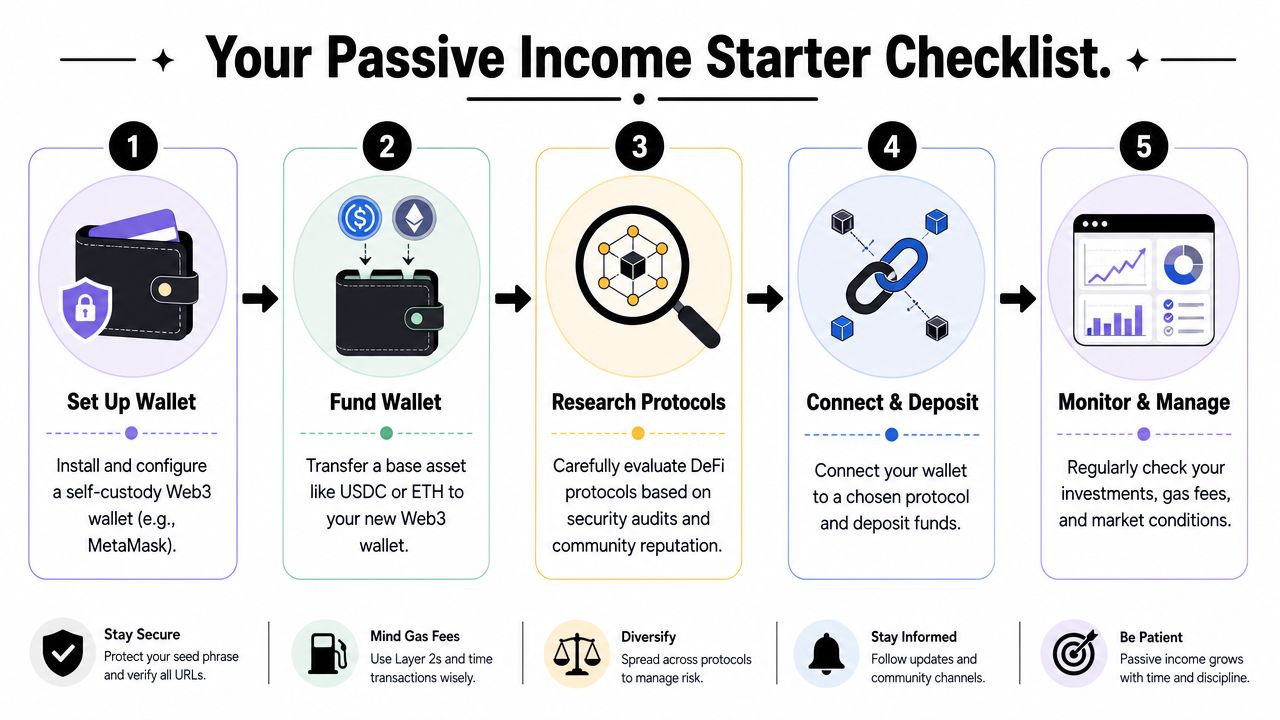
A workable starting process looks like this:
Set up a self-custody wallet
Use MetaMask or Rabby. Store the seed phrase offline, verify the official app or extension, and bookmark official protocol sites before you fund anything.Fund the wallet with the asset you plan to use
Stablecoins are usually the cleanest place to start because you can evaluate the yield without mixing in token price swings. Keep enough of the chain's gas token on hand so you can approve, deposit, and withdraw without getting stuck.Pick one simple protocol
A plain lending market is easier to assess than a strategy built from multiple tokens, reward loops, and bridges. Simpler products usually make it easier to understand what can go wrong.Test the full flow with a small amount
Make a small deposit first. Then confirm you can track accrual, claim if needed, and withdraw without surprises.Review the position on a schedule
Passive does not mean unattended. Rates change, incentives expire, and protocol risk shifts, so set a routine to check whether the position still deserves your capital.
Where beginners lose time
The friction shows up after the first deposit.
Manual yield management means comparing rates across protocols, watching for changes in terms, keeping wallet permissions clean, and deciding when a higher APY is worth the extra smart contract and operational risk. For someone with a full-time job, a business to run, or family responsibilities, that ongoing maintenance becomes part of the cost basis.
Automation starts to make sense at that point, especially for stablecoin strategies where the goal is steady yield rather than constant experimentation. One option is Yield Seeker, a platform focused on stablecoin yield that uses an AI Agent to monitor opportunities and allocate capital across DeFi protocols, while keeping funds accessible without lockups or withdrawal fees.
What a sane beginner setup looks like
A practical setup is boring in the right ways:
Start with stablecoins: They make it easier to judge whether the strategy itself is working.
Change one variable at a time: New wallet, new chain, new bridge, and new protocol is too much uncertainty for day one.
Keep records immediately: Label wallets, save exports, and note why you opened each position.
Use a process you can repeat: If the workflow depends on constant checking, it is probably too complex for the amount of capital involved.
Treat legal and promotional claims carefully: A few minutes spent on understanding securities fraud can help you spot offers that deserve extra skepticism.
The best starter strategy is not the one with the highest displayed yield. It is the one you can understand, monitor, and exit cleanly.
Essential Security and Tax Considerations
A good passive income crypto strategy can still fail if your security habits are weak. Use a hardware wallet for meaningful balances. Review token approvals regularly. Treat direct messages, search ads, and “urgent” wallet prompts as hostile until proven otherwise.
Security isn't only technical. It's legal and procedural too. If you're evaluating token offerings, platform claims, or suspicious yield promotions, it helps to spend a few minutes understanding securities fraud so you can recognize when marketing crosses into territory that should make you slow down.
Taxes matter just as much. In many jurisdictions, crypto income is taxable, and swaps, claims, and reward receipts can all create reporting obligations. Keep records from the beginning, export transaction history often, and talk to a qualified tax professional before your activity gets too messy to reconstruct.
The people who last in this market usually aren't the ones who chased every new yield source. They're the ones who kept custody tight, sized risk sensibly, and stayed organized when everyone else got sloppy.
If you want a lower-friction way to put stablecoins to work, Yield Seeker offers an AI-powered workflow that monitors DeFi opportunities, allocates capital with a risk-aware approach, and keeps the experience simple enough for busy investors who don't want to manage the process by hand.