
You've probably seen the same pattern: your stablecoins sit in a wallet while you compare lending markets, liquidity pools, and staking opportunities across several dashboards. One protocol offers a tempting rate today, another looks better tomorrow, and every move requires a new approval, transaction, or risk decision. The process can turn passive investing into a part-time job.
A DeFi yield aggregator is designed to simplify that work. You deposit an asset into a vault, and programmed strategies allocate capital across selected DeFi protocols, harvest rewards, and may reinvest them automatically. The idea is similar to using a managed account, except the rules execute through smart contracts rather than a traditional financial institution. If you're new to the wider ecosystem, this guide to decentralized finance provides useful background on the protocols and services that make these strategies possible.
The convenience comes with an important qualification. An aggregator doesn't remove risk. It can add another layer of smart-contract logic and connect your funds to several systems at once. This guide explains how the model works, where hidden cross-protocol risks arise, how popular examples differ, and how AI-assisted monitoring can help you evaluate automated stablecoin strategies more carefully.
Introduction to DeFi Yield Aggregators
A DeFi yield aggregator helps stablecoin investors automate the repeated work of comparing and managing yield strategies. Instead of checking lending rates, liquidity incentives, pool depth, and withdrawal conditions across separate dashboards, a user deposits an asset into a vault and lets programmed rules handle selected actions.
Manual farming requires more than choosing the highest displayed APY. The investor must identify where the return comes from, which contracts control the funds, what assets support the position, and how quickly the position could be exited during a market shock. Transaction costs, reward-token volatility, and dependencies between several protocols also affect the outcome. A beginner can review the wider system through this guide to decentralized finance.
The vault may lend stablecoins, provide liquidity, stake assets, claim incentives, or move capital when predefined conditions change. In exchange for the deposit, the user generally receives vault shares or another representation of the position. The automation saves time, while the investor still carries the risks created by the strategy and its connected protocols.
Practical rule: A higher displayed yield isn't automatically a better investment. First identify the strategy, the dependencies, the fees, and the conditions for withdrawal.
The key risk is often spread across protocol boundaries. A vault can depend on a lending market, an exchange mechanism, an oracle, and reward systems at the same time. A weakness, liquidity problem, or failure in one component can affect the broader position, even if the vault itself continues operating. AI-assisted monitoring may help organize changing yields, contract dependencies, and warning signals, but it does not remove the need for independent review.
The category is now a recognizable part of DeFi infrastructure. Yearn Finance launched in 2020, and its continued presence illustrates that yield aggregation is more than a temporary farming tactic. It is a distinct way to automate capital allocation, with convenience tied directly to the risks of its connected systems.
Understanding DeFi Yield Aggregator Concepts
A stablecoin investor may see one deposit button, while several moving parts operate behind it. The main pieces are the vault, the strategy, the underlying protocol, and the share-accounting system. Understanding their roles makes it easier to judge both potential returns and hidden dependencies.
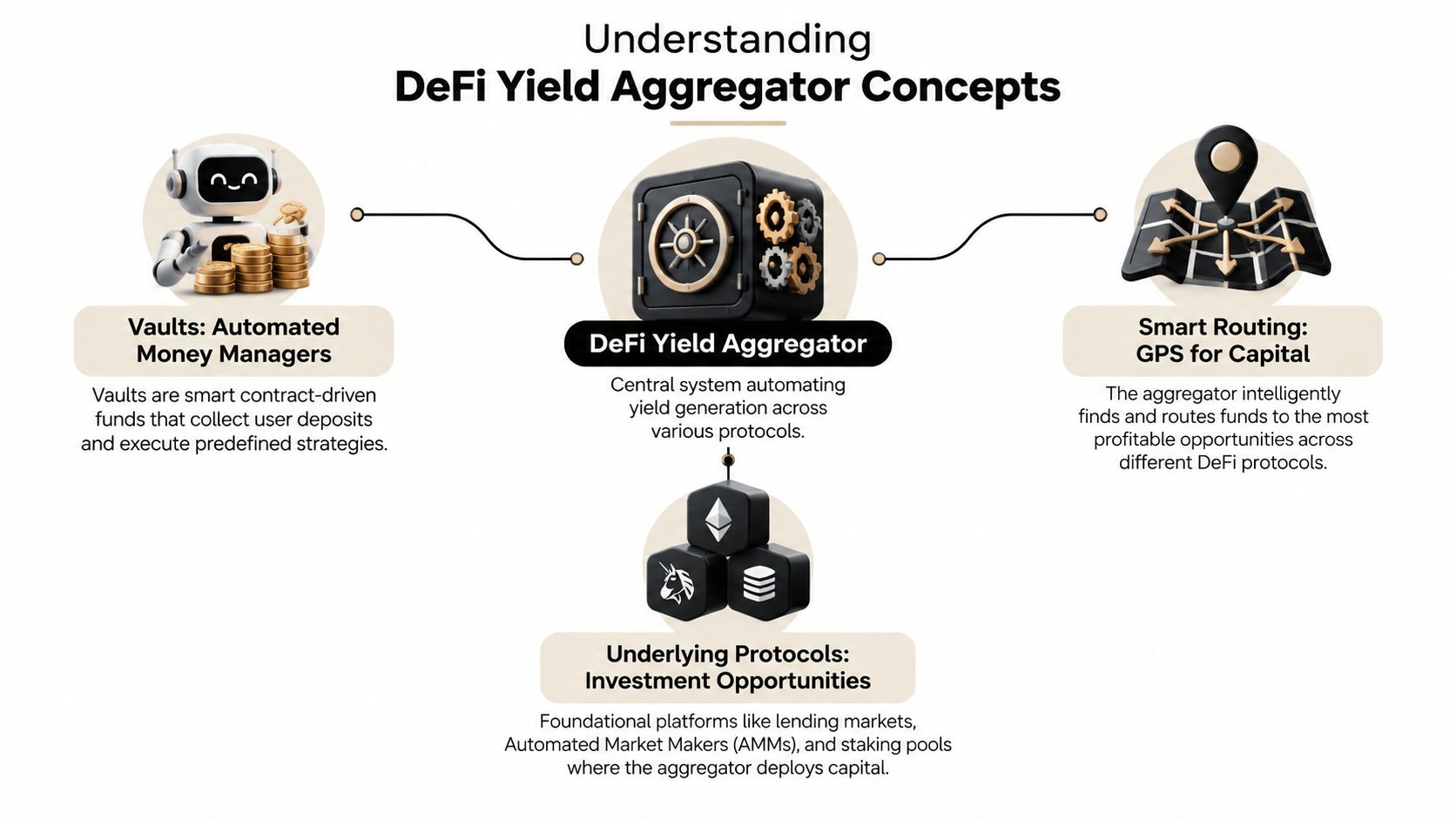
Vaults as automated money managers
A vault is a smart contract that accepts deposits and follows predefined strategy rules. Deposit USDC, for example, and the vault may supply it to a lending market, collect interest, and reallocate funds when those rules permit.
The vault can coordinate multiple positions rather than hold all assets idle in one place. Your claim is usually represented by shares, which record your proportional interest in the vault's assets. As the positions gain or lose value, the value represented by each share changes.
The convenience comes from automation, not from removing risk.
Smart routing as a GPS for capital
Smart routing determines where the aggregator sends capital. Like a GPS comparing routes by traffic and distance, an aggregator compares possible destinations using expected yield, liquidity, asset compatibility, and the vault's operating rules.
A route may lead to a lending protocol, an automated market maker, a staking pool, or several protocols in sequence. The selected route does not automatically produce the highest return. Execution conditions, available liquidity, and rapidly changing rates also affect the decision.
This creates a cross-protocol risk that can be easy to miss. A stablecoin vault may depend on a lending market, an oracle, an exchange mechanism, and a reward system at once. A weakness or liquidity issue in one component can affect the whole position, even when the vault contract itself continues to function. AI tools may help organize yield changes, contract relationships, and warning signals, but they cannot replace reviewing the strategy and its dependencies.
Auto-compounding as a snowball
Auto-compounding reinvests earned rewards instead of leaving them unused. A stablecoin strategy may earn interest, claim a reward, convert it when permitted, and add the proceeds back to the position. The process resembles a snowball gathering more snow, while fees, market conditions, liquidity, and losses determine the actual result.
Direct farming requires you to monitor positions and decide when to harvest or rebalance. An aggregator assigns those tasks to code and a strategy manager within defined limits.
Historical usage illustrates this capital-allocation role. An academic analysis recorded deposits of $15,663,293 into Yearn's USDC vault and $53,996,952 into Cian's stETH vault, with 86.9% and 99.7% of those deposits allocated to active yield generation, respectively, during the study's observation window (academic analysis of DeFi yield aggregators). The broader lesson is that aggregators program capital deployment rather than merely storing assets.
Mechanics of DeFi Yield Aggregators
Clicking Deposit may trigger several smart-contract actions in sequence. The interface hides the machinery: the vault records your position, receives permission to move the asset, calls its strategy, and connects with external protocols.
The deposit and share process
You first connect a wallet, choose an asset, and enter an amount. After you approve the transaction, the vault receives the asset and calculates how many vault shares to issue. The calculation considers the vault's current assets and total share supply.
Vault shares work like tickets representing a proportional claim on the strategy. If the strategy earns interest or fees, each share can represent more underlying value. If losses reduce the vault's assets, each share represents less.
Strategy bundling and fund routing
The vault then follows its strategy instructions. It may keep part of the deposit available for withdrawals and supply the remainder to a lending market. Another strategy may send assets to an AMM for liquidity provision, or place a liquid-staking asset into a staking-related position.
Smart-contract calls perform these actions. The strategy may claim rewards, swap tokens, change allocations, or rebalance positions. Each action adds a dependency to inspect. A vault using a lending market, price oracle, reward-token exchange, and AMM carries the combined assumptions and failure points of those components.
That cross-protocol connection is easy to miss. A strategy can appear straightforward in the vault dashboard while its outcome depends on several contracts, markets, and pricing systems working together. AI tools can help map those relationships and flag changes in allocations or dependencies, but they still require human review of the strategy and its permissions.
Yield, compounding, and withdrawal
Underlying protocols produce returns through different activities. Lending markets receive interest from borrowers, AMMs distribute trading fees, and staking systems issue rewards. The aggregator does not create those returns. It automates access to them and coordinates the transactions that maintain the position.
A harvest transaction can collect rewards and reinvest them. A rebalance can reduce exposure to one venue and increase exposure to another. During withdrawal, the vault burns or deducts your shares and returns the available underlying asset. The result depends on liquidity, strategy design, and market conditions.
An academic study found that deposited assets in Yearn's USDC vault and Cian's stETH vault were largely allocated to active yield generation (the study's vault allocation findings). Active allocation helps explain the convenience of aggregators, while also showing why investors should examine where funds go, which protocols are involved, and how the vault responds when one dependency changes.
Security Risks and Best Practices
An aggregator adds a second smart-contract trust layer above the protocols it uses. If you lend directly through one protocol, you face that protocol's contract, oracle, governance, and liquidity risks. If a vault routes your funds through several systems, you face those risks plus the vault's own logic and permissions.
The hidden risk stack
Lending risk can arise if borrowers default, collateral falls sharply, or the lending protocol contains a vulnerability. Oracle risk appears when a price feed reports an incorrect value or an attacker manipulates the data used for valuation and liquidation. Vault-mechanics risk includes flawed share accounting, incorrect withdrawal logic, unsafe upgrade permissions, or errors in automated strategy calls.
The most overlooked category is composability risk. A strategy may work correctly in isolation while failing when several protocols interact. An oracle error in one component can produce an incorrect valuation elsewhere. A governance change can alter an underlying market while the vault continues following its old assumptions. An exploit in one dependency can therefore affect the vault's broader position.
Academic surveys identify lending and borrowing risk, liquidity and liquidation risk, individual smart-contract risk, and composability risk as major DeFi failure modes. They also explain the cause and effect clearly: each additional dependency creates more exploitable states and more ways for a localized failure to become a vault-level loss (academic survey of yield-farming risks).
A practical review before depositing
Don't treat an audit badge as a complete safety assessment. Review:
Contract coverage: Check whether audits cover the vault, strategy contracts, and important integrations.
Permission design: Look for multisig controls, timelocks, emergency pauses, and clearly documented upgrade authority.
Strategy disclosure: Identify every underlying protocol, asset, oracle, bridge, and reward mechanism involved.
Liquidity conditions: Confirm how withdrawals work if capital is lent out or locked in a position.
Stablecoin response: Understand what the team can do if the deposit asset depegs or an underlying asset loses liquidity.
Operational transparency: Look for transaction history, allocation details, incident communication, and change notices.
The smart-contract security audit guide can help beginners understand why audit scope and permissions matter. The broader threat is substantial. Security coverage reports that over $650 million was stolen from DeFi in 2025 through flash-loan attacks, oracle manipulation, and related exploits (security coverage of yield aggregators and farming projects). That figure doesn't predict the safety of a particular vault, but it does show why layered evaluation is necessary.
Examples of Popular DeFi Yield Aggregators
A stablecoin investor comparing Yearn, Beefy, and Yield Seeker is comparing different systems, not identical savings accounts. Chain access, vault design, fees, permissions, and underlying protocols can vary by product and even by individual strategy. The platform name is only the starting point.
Yearn Finance is the historical reference point for automated DeFi vaults. Launched in 2020, it became known for strategies that allocate capital across available DeFi opportunities. Its classification as a yield aggregator by DefiLlama reflects the continuing relevance of that vault model. Each vault still requires its own review, since its assets and integrations may differ.
Beefy focuses on multi-chain auto-compounding. Users can access automated strategies on supported networks without manually collecting and reinvesting rewards. That convenience does not remove underlying risk. A vault may still depend on a lending market, liquidity pool, bridge, oracle, or strategy contract. Review those connections individually rather than treating multi-chain coverage as a safety feature.
Yield Seeker uses a stablecoin-focused, AI-assisted allocation model. Personalized AI agents monitor integrated DeFi opportunities, route capital, and rebalance according to user preferences. AI can reduce the time needed to compare changing opportunities, but it cannot make cross-protocol dependencies disappear. Users should examine the assets, integrations, permissions, and withdrawal conditions behind each strategy. In practice, AI is most useful as a monitoring and comparison aid, while the investor remains responsible for accepting the connected risks.
The available brief does not verify management fees, performance fees, or chain counts for these products. Use the table as a due-diligence template, then confirm the current terms for the exact vault or strategy before depositing.
Aggregator | Management Fee | Performance Fee | Chains Supported |
|---|---|---|---|
Yearn Finance | Confirm current vault terms | Confirm current vault terms | Confirm for the selected vault |
Beefy | Confirm current vault terms | Confirm current vault terms | Confirm for the selected vault |
Yield Seeker | Confirm current platform terms | Confirm current platform terms | Confirm for the selected strategy |
Fee check: Compare the charges applied to your actual vault, rather than relying on a platform-wide headline. Fees may cover management, performance, withdrawals, swaps, or underlying transactions.
Net yield also depends on how rewards are paid and how the strategy operates. Check whether rewards arrive in the deposited asset or a volatile token, how often compounding occurs, and whether capital can move between protocols. A lower stated rate with fewer connected contracts may suit a cautious stablecoin investor better than a higher rate that relies on several interacting systems.
Choosing the Right DeFi Yield Aggregator
Start with the asset, not the advertised APY. A USDC holder should first ask whether the vault keeps exposure to USDC, introduces another stablecoin, supplies funds to a lending market, or provides liquidity against a volatile asset. The answer determines the type of risk you're accepting.
Five questions for comparison
What exactly generates the yield? Interest, trading fees, staking rewards, and incentive tokens have different risk profiles. If the explanation is vague, pause before connecting your wallet.
Which contracts control the funds? Read the vault documentation and identify the aggregator contract plus every material dependency. A strategy with more integrations may offer broader opportunities, but it also creates more points of failure.
How transparent is the allocation? You should be able to understand where capital is deployed, what limits apply, and who can change the strategy. Transparent reporting is more useful than a generic claim that the vault is “optimized.”
What happens during stress? Check whether the system can pause deposits, reduce exposure, protect remaining liquidity, or communicate an incident quickly. Stablecoin investors should pay particular attention to depeg procedures and withdrawal mechanics.
How do fees affect the result? Look beyond the gross rate. Management fees, performance fees, swaps, gas, and slippage can reduce the amount you receive.
A comparison framework such as this DeFi platform comparison guide can help organize the review. The point isn't to pick a platform from a ranking. It's to compare the exact strategy you plan to use.
Where AI can help
AI can reduce the monitoring burden by scanning changing rates, allocation data, liquidity signals, and protocol conditions. It can also flag unusual activity or suggest that a strategy no longer matches your risk preferences. That support is useful because humans often focus on the visible APY and overlook the dependencies underneath.
AI doesn't replace due diligence. A model can miss an emerging exploit, rely on incomplete data, or make a poor allocation decision. Treat AI as a monitoring and decision-support layer, not as a guarantee against loss.
For a beginner, a sensible process is to verify the official application URL, review the strategy, start with an amount you can afford to lose, and monitor the first transactions. Keep records of deposits, shares, fees, and withdrawals. If you can't explain where the yield comes from, don't deposit until the documentation becomes clear.
Conclusion and Next Steps
A DeFi yield aggregator can turn fragmented farming tasks into one automated vault experience. The trade-off is additional smart-contract and cross-protocol exposure, so compare strategy dependencies, permissions, liquidity, fees, and emergency controls before depositing. Start with a small test, confirm that withdrawals work as expected, and monitor changes to the underlying protocols. Treat AI monitoring as useful assistance, while keeping final responsibility for your risk decision.
Yield Seeker offers automated, AI-assisted stablecoin allocation that monitors DeFi opportunities and rebalances capital according to defined preferences. Visit Yield Seeker to review the platform, understand its stablecoin strategies, and decide whether its guided approach fits your investing process.