
You set a portfolio target, then stop looking. Months later, a strong move in one asset has changed the risk you're carrying. A portfolio that began at 60/30/10 can end up at 71/22/7, not because you approved a new strategy, but because prices moved, yield accumulated, and new money followed the easiest route.
That's the problem rebalancing solves. It brings your holdings back toward the risk profile you chose instead of letting market movement make the decision for you. In DeFi, the principle is simple, but the execution isn't. Gas, slippage, taxable swaps, withdrawal queues, and liquidity conditions decide whether a rebalance helps or drains returns.
Why Portfolios Drift and What Rebalancing Actually Solves
A target allocation is a risk control. It isn't a promise that every sleeve will produce the same return, and it isn't a prediction about which token wins next. If you assign 60% to a core asset, 30% to a defensive or income sleeve, and 10% to higher-risk strategies, you're defining how much damage and volatility you're willing to accept from each part of the portfolio.
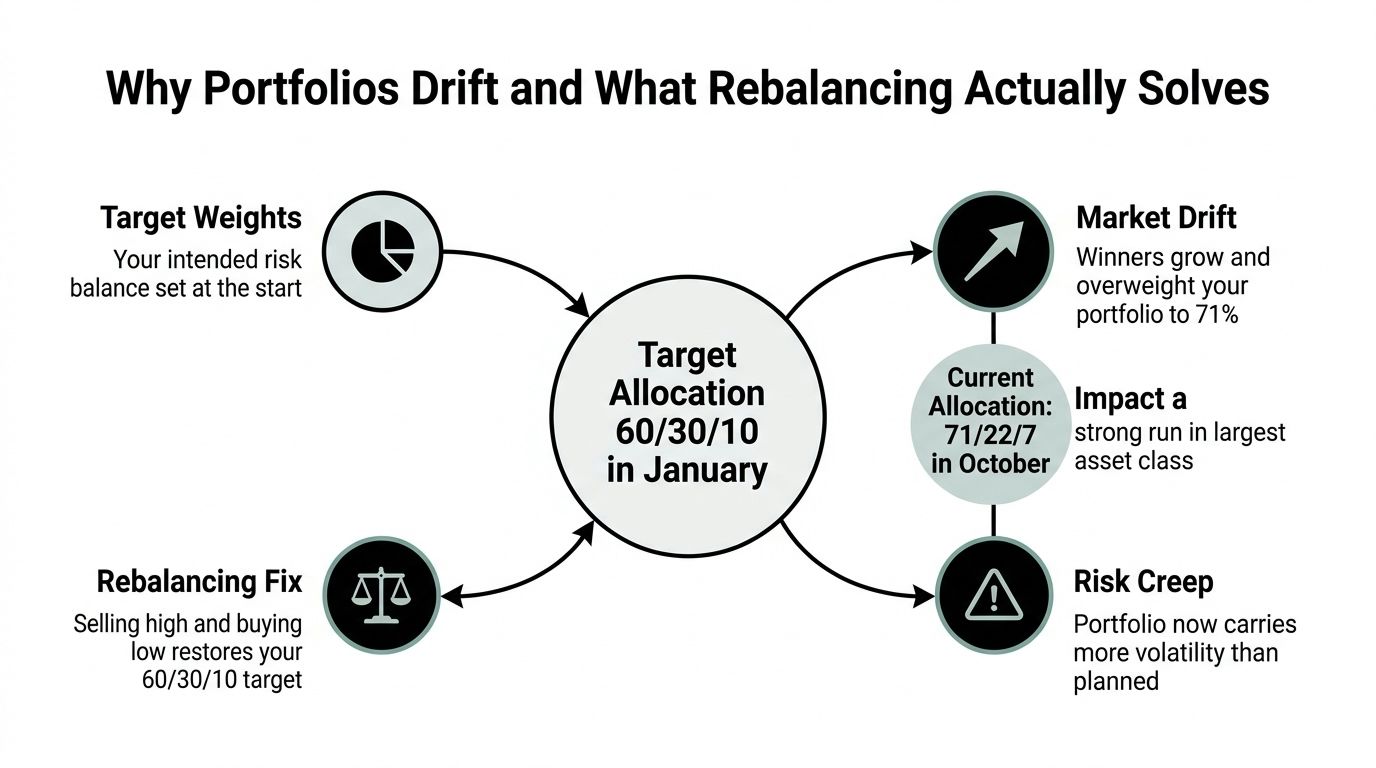
Three forces create drift
Price appreciation is the obvious one. If your largest asset rallies while the rest of the portfolio lags, its weight rises even if you never buy more. You now have more exposure to that asset than your original plan allowed.
Yield accumulation creates a slower form of drift. Stablecoin lending, liquidity fees, staking rewards, and incentive tokens can pile up in one strategy while other sleeves remain unchanged. The balance grows, but the portfolio's relative weights move.
Lazy contributions compound the problem. New capital often gets deposited into the same wallet, pool, or token because it's convenient. Without a target-aware allocation rule, contributions reinforce whatever already feels familiar.
Rebalancing means selling part of an overweight position and adding to an underweight position. You're not trying to punish winners or predict bottoms. You're restoring the mix that matched your original risk decision.
Practical rule: Drift is the mechanism that changes your portfolio. Rebalancing is the deliberate reset.
Start by listing your intended categories, such as core assets, stablecoin strategies, liquidity positions, and speculative governance tokens. A resource covering key asset allocation categories can help you think in portfolio roles rather than isolated tokens.
The Three Core Rebalancing Methods Compared
There are three workable ways to decide when to trade. None is universally correct. The right choice depends on volatility, account tax treatment, portfolio size, liquidity, and the cost of touching each position.
Calendar rebalancing uses a fixed review date. You might inspect the portfolio monthly, quarterly, or annually, then trade if the allocation has moved enough to justify action. It's easy to follow and creates an audit trail, but it can force trades when drift is immaterial. Vanguard's research found that annual or semiannual monitoring with a 5% threshold can provide a reasonable balance between risk control and transaction costs for many investors, while also warning that a calendar alone ignores how far allocations have moved (Vanguard research).
Percentage-threshold rebalancing waits for a position to move outside a defined band. A 5% absolute band around a 40% target means action begins when the position reaches 45% or 35%. This approach fits volatile crypto exposure because it responds to actual drift, not an arbitrary date. The trade-off is monitoring, plus the risk of repeated triggers during choppy markets.
Hybrid rebalancing combines both. The calendar provides a backstop, while the threshold determines whether a trade is justified. This is my default for a multi-strategy DeFi book because it preserves discipline without turning every scheduled review into a transaction.
Method | Trigger | Strengths | Weaknesses | Best For |
|---|---|---|---|---|
Calendar | Fixed review date | Simple, predictable, easy to document | Can trade when drift is minor and costs are high | Taxable accounts and investors who need routine |
Percentage threshold | Allocation leaves a defined band | Responds to real drift and can reduce unnecessary trades | Requires monitoring and can trigger repeatedly in chop | Volatile crypto sleeves |
Hybrid | Calendar review plus threshold breach | Balances discipline and responsiveness | Adds rules and tracking complexity | Multi-strategy DeFi portfolios |
A historical analysis found that rebalanced portfolios could outperform buy-and-hold with slightly lower risk across several stock-bond mixes, but it also showed how narrow thresholds create far more transactions. One analysis recorded about 127 events with a 1% threshold, 28 at 5%, and 12 at 10% over its stated sample (historical rebalancing study). That's why portfolio construction and implementation belong in the same conversation. A useful guide to building a multibagger portfolio can inform asset selection, but your rebalancing rules still need to account for execution costs. For automated allocation ideas, see AI portfolio optimization.
Building Your Rebalancing Workflow Step by Step
Use thresholds as the working example. The workflow is repeatable, auditable, and flexible enough for both a wallet and a traditional brokerage account.
Start with targets and bands
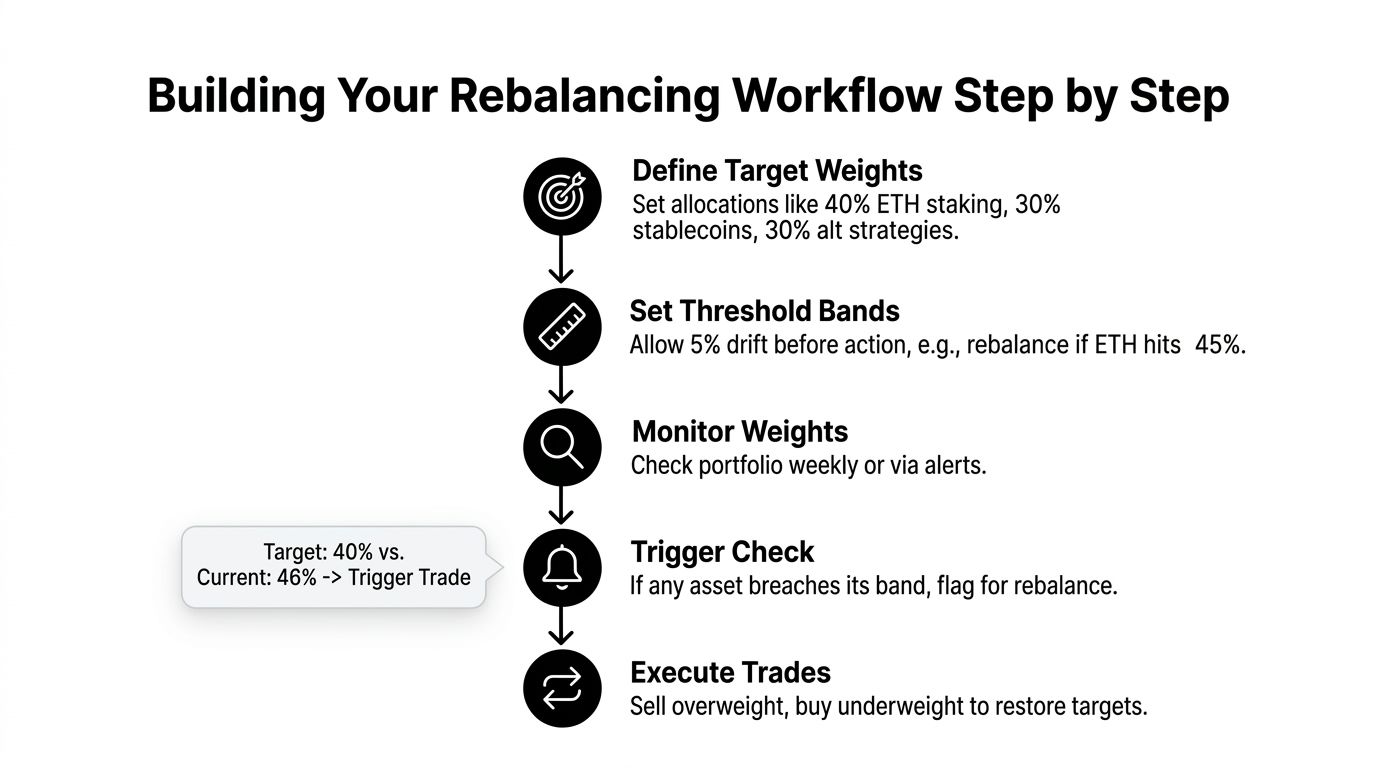
Define target weights. Write down the portfolio before you inspect current prices. A DeFi example might be 40% ETH staking, 30% stablecoin lending, 20% LP positions, and 10% governance tokens. These are operating constraints, not a list of assets you're emotionally attached to.
Set tolerance bands. Use a 5% absolute band for larger positions and a 20% relative band for smaller ones. Define the rule precisely. “5% drift” should mean percentage points around the target, not a vague relative move.
Monitor consistently. Check weekly or monthly, or use on-chain alerts. Record each position's current value, target value, and portfolio weight. A tracker such as a DeFi portfolio tracker can reduce the manual work, but you still need to verify balances, pending rewards, and positions that don't display cleanly.
Calculate, prioritize, and execute
Calculate the trade size. The basic formula is:
Trade amount = current value minus target value
A positive result identifies an overweight position to reduce. A negative result identifies an underweight position to fund. Calculate against the portfolio's current total, not the balance from your last review.
Stage trades by drift. Handle the position furthest outside its band first. Don't scatter small transactions across every sleeve if one large deviation explains most of the risk change.
Execute with friction in view. Check gas, route depth, price impact, withdrawal terms, tax lots, and reward claim mechanics before signing. In DeFi, “sell overweight, buy underweight” may require withdrawal, approval, swap, bridging, and redeployment. Each action can add cost or operational risk.
Log the result. Record the date, prices, positions, trade sizes, gas, slippage, taxes to investigate, and post-trade weights. Your log will reveal whether you're correcting persistent drift or repeatedly trading noise.
The same sequence works with calendar triggers. Only monitoring changes. On a calendar schedule, you review on the chosen date. With thresholds, you review continuously enough to catch breaches.
The operational standard is clear: rebalancing should be a process, not a mood. Norges Bank Investment Management's analysis of strategies over 1970 to 2011 found that rebalanced portfolios delivered higher returns and lower risk than a passive drifting portfolio in its sample, while the exact schedule mattered less than maintaining the discipline (NBIM analysis).
Watch the execution walkthrough below for a visual reference before automating any live process.
When Rebalancing Quietly Hurts Returns
Rebalancing isn't automatically profitable. It improves portfolio control, but every trade creates friction. A strategy that looks correct on a spreadsheet can be a bad transaction once you include the cost of getting from the current state to the target state.
The first drag is gas. Layer 1 execution can make a small correction uneconomic. The second is slippage, especially when the token pair has thin liquidity or your route crosses volatile pools. The third is taxation. In many jurisdictions, swapping one token for another can create a taxable disposal, even when you're only restoring an allocation.
The fourth is opportunity cost. Selling a winner to buy a laggard may reduce concentration risk, but it also changes your exposure to future upside. You shouldn't pretend that this trade has no economic consequence.
Cost Component | What It Looks Like in Practice | Typical Drag |
|---|---|---|
Gas | Multiple approvals, withdrawals, swaps, and deposits | Network fees that can make a small rebalance uneconomic |
Slippage | Thin liquidity or a poor route | A worse execution price than the displayed quote |
Taxable event | Selling or swapping an appreciated position | Realized gains and additional reporting |
Opportunity cost | Reducing a position that keeps outperforming | Less exposure to continued upside |
Protocol friction | Queues, utilization, or pool mechanics | Delayed or incomplete execution |
Crypto adds traps that don't appear in a simple two-fund portfolio. Curve LPs can carry impermanent-loss exposure. Pendle PT positions can have withdrawal or maturity mechanics that don't align with your review date. Aave markets can experience utilization spikes that make exits more difficult at the size you want.
Consider a $5,000 rebalance that costs $80 in gas and creates $250 in short-term gains. Those figures don't prove the trade is wrong, but they force the correct question: does the risk reduction justify the known cost and the possible future opportunity cost? The latest discussion of expected returns is useful context because an expected outcome is not a guarantee, as explained in this Artul.ai blog.
Rebalance because the portfolio's risk changed enough to matter, not because a dashboard flashed a different number.
A practical test is to estimate all-in cost before signing. If the position is only slightly outside its band, wait. If the overweight exposes you to a risk level you can't tolerate, execute the smallest trade that meaningfully improves the portfolio rather than forcing a perfect reset.
A Stablecoin and DeFi Rebalancing Walkthrough
Take a representative $100,000 stablecoin book with four sleeves:
Aave USDC supply, 40%, or $40,000, as the stable yield base.
Morpho ETH-correlated vault, 25%, or $25,000, for ETH-linked growth.
Pendle PT-stETH, 20%, or $20,000, for a fixed-yield position.
Curve 3pool LP, 15%, or $15,000, for liquidity provision.
The target is 40/25/20/15. After a quarter, the Morpho sleeve has grown to 31%, a 7-point drift from target. The other allocations have fallen in relative terms, even if their dollar values haven't declined.
The threshold decision
With a 5% band, the Morpho position is outside its permitted range. The operator doesn't sell the entire difference between the current allocation and the original target blindly. First, they verify the vault's withdrawal terms, the current value of the receiving stablecoin, the available swap route, and the tax treatment of the sale.
The sequence is:
Withdraw enough from the overweight Morpho position to fund the correction.
Swap the withdrawn asset into the stablecoin required by the underweight destination.
Redeploy that stablecoin into the sleeve furthest below target, such as Curve 3pool LP.
Claim unclaimed rewards only when the claim transaction improves the total operation after gas.
Recalculate every weight after settlement.
A calendar-only trader might execute on the quarterly date even if the Morpho sleeve had stayed inside its band. The threshold trader skips that transaction because the portfolio's risk hasn't moved enough to justify gas, slippage, and tax exposure. That restraint is the point. Research summarized in an SSRN study found that thresholds at 5% or more were superior to narrower bands in the examined stock-bond portfolios, while more frequent schedules could underperform in restrictive periods (SSRN study).
The same logic can be implemented manually or through automated portfolio rebalancing. Automation can route and schedule actions, but it can't make an uneconomic withdrawal profitable. The rules still need to include protocol risk, execution cost, and the possibility that a position cannot exit when the portfolio wants it to.
Your Quarterly Rebalancing Checklist and Cadence
Use a fixed operating window: the first Sunday of each quarter, 30 minutes, and the same wallet. Consistency matters because you want comparable snapshots, not a sequence of ad hoc decisions made after price shocks.
Run the checklist in order:
Pull on-chain balances. Export wallet balances, staked positions, LP shares, lending deposits, pending rewards, and debt.
Compute current weights. Value every position consistently, then compare each weight with its target.
Flag band breaches. Mark any allocation outside the 5% band you defined. Don't trade positions that remain inside the band merely to make the spreadsheet look tidy.
Estimate gas and slippage. Check the live route, pool depth, approvals, withdrawal fees, and expected execution price.
Confirm exit liquidity. Verify that Aave withdrawals, Pendle exits, LP removals, and vault redemptions can settle at the intended size.
Execute and log. Sell the overweight sleeve, buy the underweight sleeve, then record post-trade weights and all costs.
Three rules override the checklist:
Skip if gas exceeds 1% of the rebalance size. Wait for a cheaper execution window or batch the trade with another necessary operation.
Skip if the trade triggers short-term gains on more than 40% of the transaction. Review tax lots and consider using new contributions or another account where appropriate.
Defer if Aave utilization is above 90%. A high-utilization market can make a planned exit unreliable, so don't force the transaction merely because the calendar says it's time.
Maintain a simple log:
Date, total value, target weights, current weights, breached bands, planned trades, executed trades, gas, slippage, tax-lot notes, post-trade weights, next review date.
That record turns rebalancing from a recurring opinion into an operating dataset. It also shows whether the same sleeve repeatedly drifts, which may indicate that the target or strategy itself needs review.
Key Takeaways and Common Rebalancing Questions
Set explicit target weights before the market gives you a reason to improvise. Choose a trigger method that matches your costs. In crypto, threshold-based rules usually make more sense than automatic calendar trades when gas and slippage are meaningful, but taxable portfolios need jurisdiction-aware planning. Don't trade while drift remains inside your band just to feel active.
A 2012 NBIM analysis found that the decision to rebalance mattered more than the precise schedule, with annual, quarterly, and other regimes showing relatively small differences in risk and return in its sample (NBIM discussion note). The operational lesson is simple: a good rule followed consistently beats a perfect schedule you abandon.
Common questions
How often should a small portfolio rebalance?
Review it on a schedule, but don't assume every review requires a trade. Small portfolios should prioritize fee efficiency, use new contributions to correct drift where possible, and avoid transactions that don't materially improve risk.
Does rebalancing work in sideways markets?
It can restore targets after relative moves, but sideways conditions often produce noise and repeated reversals. Wider bands and a hybrid review process help prevent churn.
What if a target asset becomes unavailable?
Don't force the original trade. Pause, document the constraint, and use a predefined substitute only if it has a comparable portfolio role, liquidity profile, and risk budget. Otherwise, hold the proceeds in the closest liquid sleeve until the target becomes executable.
Do Enzyme or Set Protocol-style automation change the decision?
Automation can monitor positions, route transactions, and apply rules faster than a human. It doesn't remove gas, slippage, tax consequences, liquidity constraints, or smart-contract risk. It removes execution friction from your schedule, not economic friction from the strategy.
Yield Seeker's agent handles strategy execution, transaction routing, and portfolio rebalancing for deposited funds, with monitoring designed to weigh expected improvement against transaction costs and the user's profile. Visit Yield Seeker to explore an automated stablecoin workflow that keeps rebalancing decisions tied to yield, risk, and execution cost instead of guesswork.