

Portfolio rebalancing is the act of selling what has grown and buying what has lagged to bring your holdings back to the target mix you originally chose. Research on U.S. stock and bond portfolios found that rebalancing improved returns versus buy-and-hold while also producing slightly lower risk, with threshold rules of 25% annually or 30% annually identified as optimal for long-run investors (UNBC empirical study).
You may already be doing the opposite without realizing it. You deposit USDC for yield, hold some ETH for upside, and keep a liquid staking token such as stETH for additional exposure. Then the market moves, yield accrues, and one position becomes much larger than planned. Your wallet still looks familiar, but its risk profile has changed.
That's the practical meaning of the question what is rebalancing a portfolio? It's portfolio maintenance. In a DeFi account, the process can involve swapping tokens, moving funds between lending markets, or directing fresh deposits toward an underweight position. The objective isn't to predict the next pump or crash. It's to keep your chosen allocation from being rewritten by market prices and yield differences.
The Core Idea Behind Rebalancing a Portfolio
Maya is a DeFi saver with a simple plan. Last winter, she built a portfolio containing 70% USDC, 20% ETH, and 10% stETH. The large USDC position gave her stability and liquidity, while ETH and stETH added exposure to Ethereum-related growth and staking activity.
After a strong ETH rally, Maya checks her wallet. Her allocation has shifted to 45% USDC, 40% ETH, and 15% stETH. She hasn't borrowed more, changed protocols, or made a new investment decision. ETH's price rose faster than the other holdings, so it now occupies a much larger portion of the portfolio.
That gap between Maya's chosen mix and her current mix is portfolio drift. Rebalancing means selling some of what has grown, then buying or adding to what has become too small, until the portfolio returns to its intended weights. Maya isn't declaring that ETH will fall. She's restoring the risk profile she selected before the market moved.
For a stablecoin holder, this distinction matters. A portfolio that began as stablecoin-heavy can become an aggressively crypto-exposed portfolio after a rally. If the market reverses, Maya may discover that she was taking more downside risk than she meant to accept.
Practical rule: Rebalancing is a maintenance decision, not a market forecast.
The same principle applies when you're designing the portfolio in the first place. A useful starting point is to think about diversification across assets, protocols, and sources of yield, rather than treating every DeFi position as interchangeable. This guide to diversifying a crypto portfolio can help frame that initial allocation.
The target mix is your policy. The current mix is your reality. Rebalancing is the action that brings the two back together.
How Portfolio Drift Actually Works
Start with a $10,000 portfolio divided between two assets. You choose 60% Asset A, worth $6,000, and 40% Asset B, worth $4,000. You don't trade for a while.
Asset A then doubles in price, while Asset B stays at the same value. Your $6,000 holding becomes $12,000, and Asset B remains worth $4,000. The portfolio is now worth $16,000, with Asset A representing 75% and Asset B representing 25%.
Nothing was bought or sold, but the portfolio changed from 60/40 to 75/25. Asset A now drives more of the account's daily movement. If Asset A is the more volatile asset, your overall risk has risen even though you never consciously increased the position.

Reading the gap
Drift is the difference between a holding's current weight and its target weight. If an asset's target is 25% and its current allocation is 30%, the drift is five percentage points. That may be acceptable if your tolerance band allows it.
A move from 25% to 40% creates a 15-point gap. That's more significant because the position has gained a much stronger influence over the portfolio. The exact action depends on your policy, taxes, liquidity, and trading costs, but the larger gap deserves a deliberate review.
The pie analogy helps. The portfolio is a pie divided into slices. When one slice grows faster, it takes up more of the whole pie. Rebalancing cuts that oversized slice down and gives the proceeds to the slices that have fallen behind.
The reset
To restore the $16,000 portfolio to 60/40, Asset A should be worth $9,600 and Asset B should be worth $6,400. You'd sell $2,400 of Asset A and move that value into Asset B.
That trade feels uncomfortable because it asks you to trim the recent winner. Yet the purpose is not to punish performance. It's to stop the winner from becoming an accidental concentration.
The same reset can happen in DeFi. A stablecoin position can shrink as a percentage when ETH appreciates, or a vault can become overweight when its yield compounds faster than the rest of the account. Rebalancing closes the percentage gap.
Rebalancing Methods, Benefits, and Real Risks
There isn't one universal schedule. Most investors choose among calendar rebalancing, threshold rebalancing, and cash-flow rebalancing, then adjust the method for fees, liquidity, taxes, and account size.
Method | Trigger | Main Benefit | Main Risk |
|---|---|---|---|
Calendar | A recurring review date | Simple to remember and audit | Can create unnecessary trades |
Threshold | A holding crosses a chosen drift band | Trades only when the allocation needs attention | Requires monitoring and clear rules |
Cash-flow | New deposits, rewards, or withdrawals | Can reduce selling and trading costs | Only works when fresh capital is available |
Calendar rebalancing
With a calendar approach, you review the account on a fixed date, such as the first day of a month or quarter. If the portfolio has drifted, you restore the targets. This method is easy to explain and easy to document, which makes it useful for people who don't want to monitor their wallets constantly.
The weakness is that the date becomes the decision-maker. Your portfolio might be almost perfectly aligned, yet the calendar still prompts a series of swaps. In DeFi, that can mean unnecessary gas, aggregator fees, slippage, and smart-contract exposure.
Threshold rebalancing
A threshold rule waits until an allocation moves outside a permitted band. For example, you might review a position only after it moves more than five percentage points from its target. This approach focuses on material drift rather than activity for its own sake.
Thresholds also make your risk policy explicit. You decide in advance how much deviation you'll tolerate, then act when the condition is met. The trade-off is operational. You need a dashboard, alert system, or scheduled review that can detect the breach.
For a deeper look at measuring portfolio outcomes rather than focusing only on raw yield, explore this explanation of risk-adjusted returns calculation. Readers comparing different strategies may also find PolyBackTest rebalancing insights useful for thinking about how rules behave under changing conditions.
Cash-flow rebalancing
Cash-flow rebalancing uses money already entering or leaving the portfolio. If USDC is underweight, you direct the next deposit or earned reward toward USDC instead of selling an overweight asset. If you're withdrawing money, you can take it from the position that has grown too large.
This is often the least disruptive method because it can avoid a sale. It won't solve every situation, though. If your portfolio receives no new capital, cash-flow rebalancing has nothing to work with.
Research from Norges Bank Investment Management using data from 1970 to 2011 found that rebalanced portfolios delivered higher returns, lower volatility, and lower tail risk than passive drifting portfolios, while differences among rebalancing rules were relatively small (NBIM analysis). The practical lesson is to choose a rule you can apply consistently, then keep its trading costs under control.
Rebalancing a Classic 60/40 vs a Stablecoin Portfolio
A traditional portfolio might begin with 60% stocks and 40% bonds. If stocks rise strongly while bonds move less, the allocation can shift toward 70% stocks and 30% bonds. An investor who wants to restore the original policy would trim stocks and add to bonds.
A stablecoin DeFi portfolio follows the same logic, even though the assets and risks are different. Consider a starting mix of 60% USDC lending, 25% stETH, and 15% RWA yield. Interest accrual, token price changes, vault distributions, and withdrawals can move the live portfolio toward 68% USDC, 22% stETH, and 10% RWA yield.
In that case, the investor would move value away from the overweight USDC lending position and toward stETH and the RWA allocation, subject to protocol availability and risk limits. The transaction happens on-chain, but the decision remains the same as in the stock-bond example. Restore the exposure you intended instead of letting recent relative performance choose it for you.
Dimension | Classic 60/40 | Stablecoin DeFi |
|---|---|---|
Core assets | Stocks and bonds | USDC lending, stETH, RWA yield |
Main source of drift | Relative market performance | Price moves, yield accrual, distributions, and withdrawals |
Execution | Broker or fund transactions | Wallet transactions, swaps, or vault moves |
Key friction | Taxes, spreads, and trading costs | Gas, slippage, protocol fees, and smart-contract risk |
Liquidity experience | Depends on the broker and market | Depends on the chain, protocol, pool, and asset |
Risk policy | Target stock-bond exposure | Target liquidity, yield, protocol, and token exposure |
The tax distinction
A 60/40 investor commonly sells an appreciated asset inside a taxable account, which may create a capital gains tax liability. A DeFi swap may be tax-free in some jurisdictions, but you can't assume that outcome. Tax rules differ by location and transaction type, and a token swap, vault withdrawal, or reward event may have reporting consequences.
A stablecoin rebalance may settle on-chain quickly, but speed doesn't remove execution risk. You still need to check the contract, quote, route, liquidity, and permissions before approving a transaction.
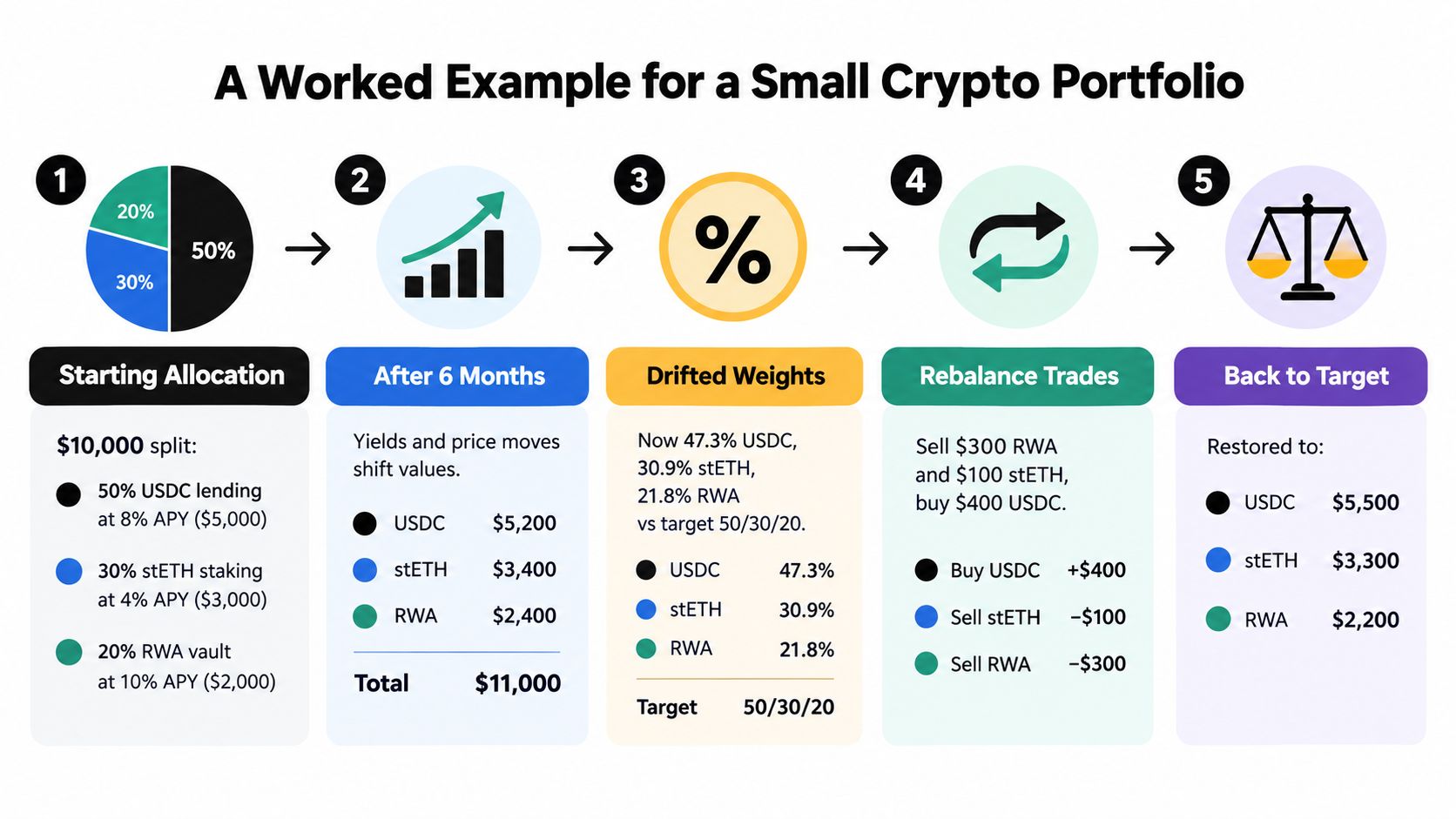
A Worked Example for a Small Crypto Portfolio
Take a $10,000 portfolio with three targets:
50% USDC lending, or $5,000, earning 8% APY
30% stETH staking, or $3,000, earning 4% APY
20% RWA yield vault, or $2,000, earning 10% APY
After three months, USDC has earned roughly $200 in yield. stETH has also appreciated in price, while the RWA vault has paid out. For this example, assume the live allocation is approximately 46% USDC, 35% stETH, and 19% RWA.
The target dollar values are $5,000 for USDC, $3,000 for stETH, and $2,000 for RWA. The current dollar values depend on the portfolio's total value and the precise market prices, so use your wallet's marked-to-market values rather than copying a trade mechanically.
A sensible sequence
First, confirm that the drift crosses your chosen tolerance. Then inspect withdrawal rules, redemption timing, price impact, and the tax treatment of each move.
A possible manual sequence is:
Withdraw approximately $80 of USDC from the lending position if the account's actual values support that adjustment.
Sell roughly $90 of stETH into USDC if stETH remains above its target weight.
Leave the RWA position mostly unchanged if its slight underweight is small enough to correct with the freed USDC.
Redeploy the available USDC into the underweight allocations until the target mix is restored.
Those figures describe the planned trade direction from the scenario, not a universal order size. A real rebalance should use the current portfolio total, live token prices, and exact target values. If the total has changed materially, the amounts needed to restore the percentages will change too.
The cost check
You can't calculate the net result without the actual gas quote, protocol charges, swap fee, and slippage for the chosen route. A small portfolio may find that several transactions consume too much value, especially when the drift is modest.
The economic question is simple: will restoring the allocation improve your risk control enough to justify the execution cost? A manual sequence that touches lending, staking, a vault, and a swap may also expose you to more contracts and approval steps. An automated rebalancer may compress those actions into a single transaction, but that convenience still requires contract review and sensible limits.
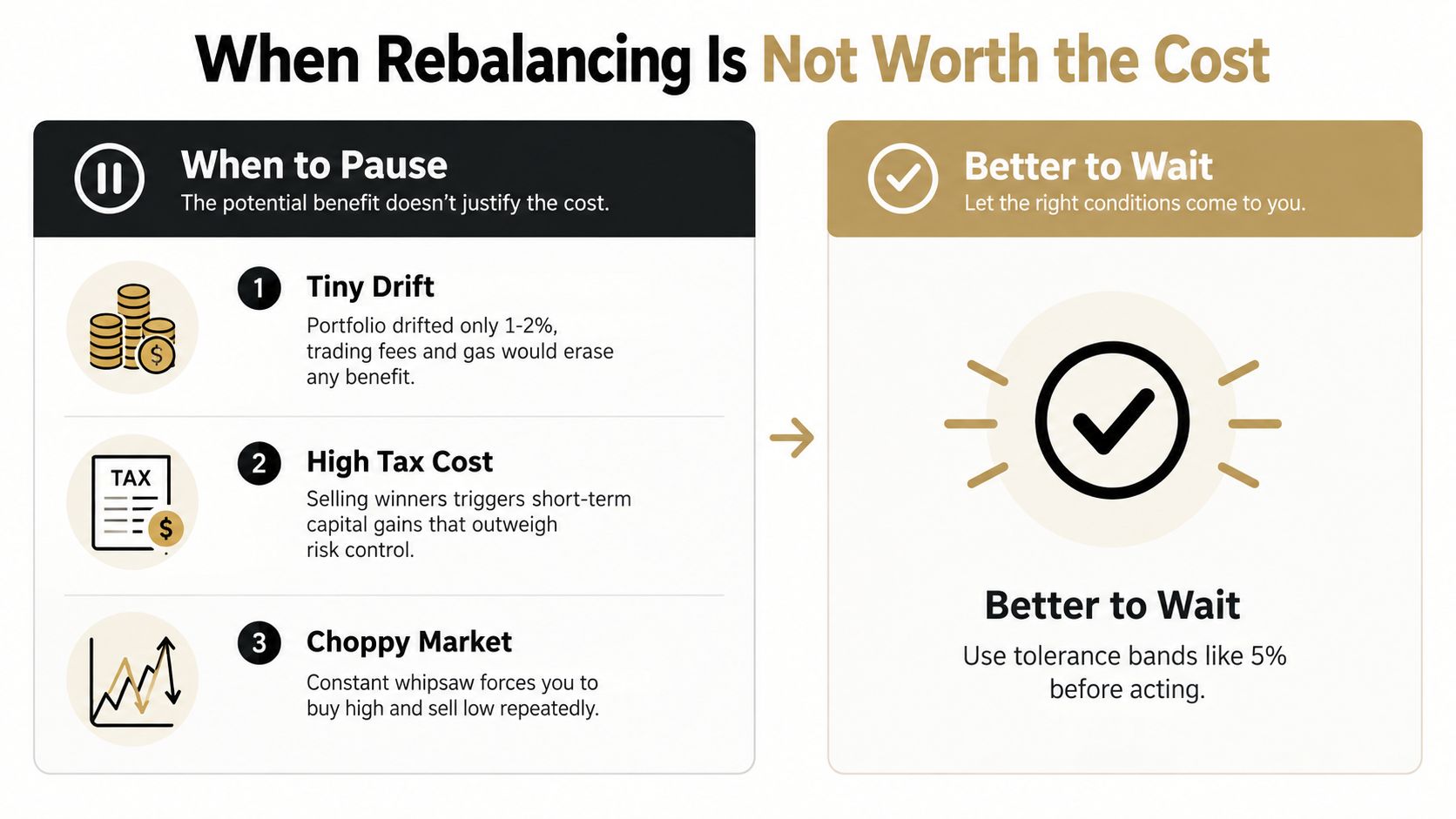
When Rebalancing Is Not Worth the Cost
Frequent trading isn't automatically disciplined investing. If a portfolio has moved only one or two percentage points, the benefit of correcting the drift may be smaller than the gas, spread, swap fee, or operational risk created by the trade.
The same applies to taxes. Selling an appreciated position in a taxable account can create a liability, and that cost can outweigh the value of restoring a slightly different allocation. Tax lots, holding periods, account location, and available cash all matter before you decide to sell.
A simple fee example shows why account size matters. A 0.10% swap fee on a $5,000 position equals $5. The same fee on a $500 position equals 50 cents, but a small portfolio may have less potential benefit from correcting a minor drift in the first place. The percentage is identical, while the decision depends on the size of the adjustment, the number of transactions, and the overall risk being controlled.
Three reasons to pause
Tiny drift: A small gap may not justify paying for a transaction, especially if new deposits can correct it.
Tax exposure: A sale of an appreciated asset may reduce the value of the rebalance after taxes.
Choppy markets: Repeated threshold breaches can cause you to trade back and forth if prices reverse quickly.
Research on transaction costs finds that proportional trading costs can allow cheaper buy-and-hold approaches to dominate unless costs are sufficiently small. A separate factor-investing analysis estimated two-way turnover costs at about 6.7 basis points for each 1% of volume traded, showing why execution friction deserves a place in the policy (transaction-cost research).
In DeFi, a rebalance may be tax-free in some jurisdictions, but it still carries gas costs, slippage, protocol charges, and smart-contract risk. A practical policy can use a tolerance band, such as acting only when an allocation moves more than 5 percentage points from its target. That isn't a rule for every investor. It's a starting point for avoiding trades that fix a number without improving the portfolio.
Automating Rebalancing and Putting It Into Practice
Automation turns a recurring judgment into a set of rules. A rule-based bot can check a wallet on a schedule and trade when a percentage condition is met. A smart-account or vault-based rebalancer can move funds across supported DeFi positions through an on-chain transaction. An AI agent can add monitoring across venues, expected yield, gas costs, and the user's configured risk profile.
The important distinction is between automation and delegation. Automation executes the policy you define. It doesn't decide whether your target weights still make sense, whether a protocol remains trustworthy, or whether a sudden market move justifies changing your risk limits.
A basic setup looks like this:
Define targets: Write down the intended weights for USDC, stETH, RWA exposure, or any other supported asset.
Choose a trigger: Select a calendar review, a drift threshold, or a combination of both.
Set guardrails: Add slippage caps, gas budgets, maximum trade sizes, and rules for paused or unavailable assets.
Connect monitoring: Use alerts to see when a position crosses its band and when an execution completes.
Review the record: Log the first cycle, including the route, fees, prices, and resulting allocation.
Yield Seeker is an AI-powered platform for automated stablecoin yield. Its personalized AI Agent can monitor supported DeFi opportunities and portfolio positions, then allocate capital across protocols and rebalance when the expected improvement fits the user's configured profile and justifies transaction costs. The automated portfolio rebalancing guide offers further context on using automation for this task.
Guardrails matter more than speed
Don't give an automated system unlimited discretion. A sensible configuration should pause when liquidity is poor, a price quote exceeds the slippage limit, gas rises beyond the budget, or a protocol becomes unavailable. Notifications should tell you what triggered the action, which assets moved, and what costs were charged.
Start with a small allocation and observe one complete cycle. Then review whether the rule traded too often, ignored meaningful drift, or moved funds into a venue you no longer want to use.
This week, define your target weights, select a rebalancing method, choose a tolerance band, compare tools, record the first review, and revisit the rules after 30 days. That turns “what is rebalancing a portfolio” from a definition into a controlled operating habit.
Yield Seeker helps stablecoin holders monitor DeFi yield opportunities and automate allocation and rebalancing decisions across supported protocols, while keeping funds accessible without lockups or withdrawal fees. Visit Yield Seeker to set up a guided stablecoin strategy and explore a more hands-off way to manage portfolio drift.