
You deposit USDC into DeFi and find one pool offering 3% APY while another advertises 28%. Both appear to promise passive income, yet the numbers describe very different mixtures of lending demand, trading fees, token incentives, smart contract exposure, and market risk. The larger number may be temporary, while the smaller one may be easier to realize after costs and changing conditions.
The useful question isn't “What's the highest APY?” It's “What yield can I reasonably keep?” This guide breaks down how DeFi yield farming rates are formed, why they move, how to compare lending with liquidity provision, and how automated tools can reduce the burden of monitoring fragmented opportunities.
Why DeFi Yield Farming Rates Feel So Confusing
A stablecoin holder usually encounters the rate before the explanation. One dashboard highlights a conservative lending market, another promotes a liquidity pool, and a third adds reward tokens to the displayed return. The interface may show all three as APY, even though the underlying income comes from completely different activities.
That's why comparing the numbers directly can lead you astray. A lending rate generally reflects interest paid by borrowers. A DEX pool can combine trading fees with token rewards, while a points campaign may advertise an estimated return whose value depends on future conditions. The headline number is a starting signal, not a promise of what your wallet will earn.
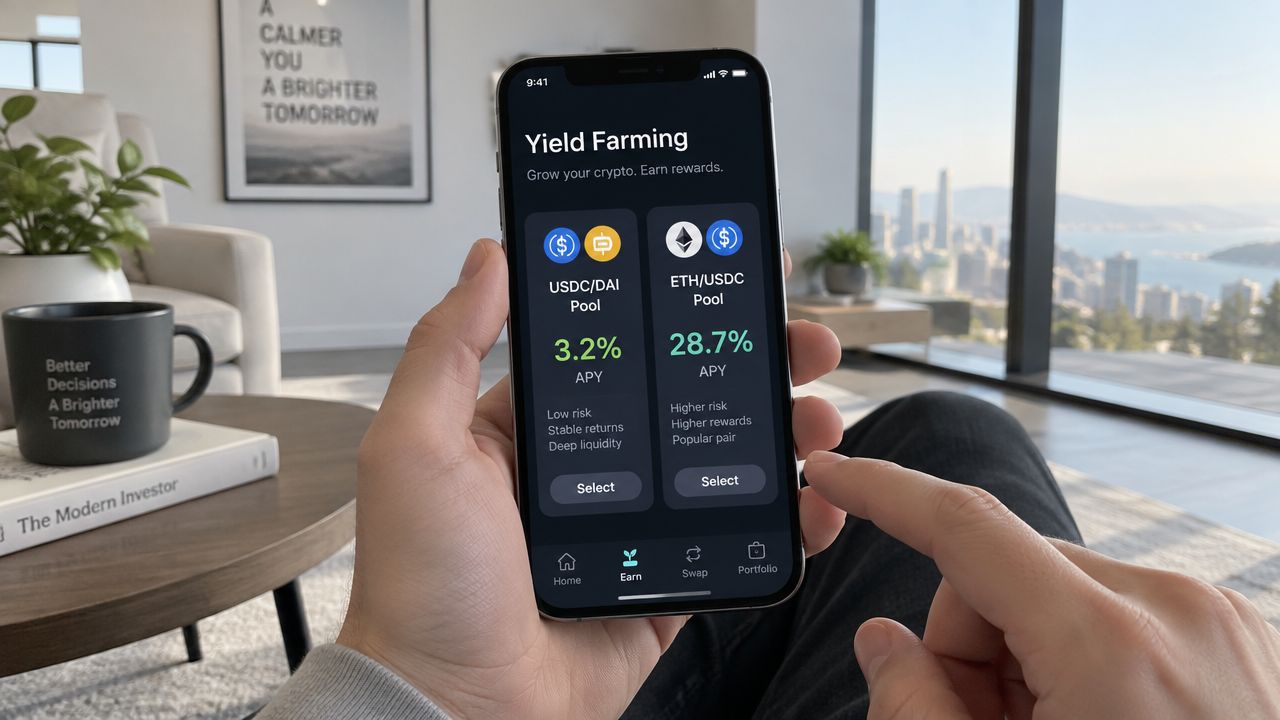
The same APY can hide different risks
Suppose you compare USDC lending with an ETH/USDC liquidity position. Lending may expose you primarily to protocol, liquidity, and stablecoin risks. The LP position adds price divergence between the two assets, which can create impermanent loss even when the pool continues collecting fees.
The advertised APY also may not tell you whether rewards are paid in the asset you deposited or in a volatile incentive token. If that token loses value, your realized return can fall while the dashboard continues showing the original estimate.
A useful explanation of this distinction appears in the guide to yield versus rate. The rate is the visible offer at a moment in time. Yield is the outcome your capital produces after the strategy operates.
A calmer way to read the number
Start by asking four questions:
Where does the income come from? Is it borrower interest, swap fees, token emissions, or a combination?
What can reduce the return? Look for protocol fees, transaction costs, price divergence, and reward-token volatility.
How persistent is the rate? A high number supported by a short incentive campaign may decay quickly.
What can I lose besides yield? Smart contract failure, liquidity limits, and asset depegging can matter more than the APY.
Once you separate those questions, DeFi yield farming rates become less mysterious. You're no longer comparing two isolated percentages. You're comparing two economic machines and asking which one fits your capital, time, and tolerance for loss.
How DeFi Yield Farming Rates Actually Work
Think of a traditional savings account. The bank may quote an annual interest rate, but the amount you receive also depends on when interest is credited and whether you leave the earnings in the account. DeFi uses the same basic idea, but protocols calculate and distribute returns through smart contracts, lending markets, automated market makers, and reward systems.
APR and APY are different lenses
APR describes a simple annualized rate without assuming that earnings are reinvested. APY includes the effect of compounding. If a protocol quotes APR and you manually claim and redeposit rewards, your effective result can differ from the displayed figure because every transaction has a cost and the rate may change before the next reinvestment.
Practical rule: Treat APY as an estimate based on a compounding assumption, not as a fixed return on your deposit.
A simple illustration makes the distinction clear. Suppose a strategy earns a 12% APR and compounds daily, with the rate staying unchanged and no costs. The effective APY would be approximately 12.75%, calculated as (1 + 0.12 / 365)^365 - 1. That example demonstrates the mathematics, not a promise that any DeFi strategy will maintain its rate.
Three common sources of yield
Lending interest comes from borrowers using pooled assets. When demand for a stablecoin rises, borrowing costs can rise too, increasing the income available to suppliers. If borrowers repay or supply grows faster than demand, the rate can fall.
Trading fees compensate liquidity providers who supply assets to an automated market maker. The pool earns when traders swap through it, but the provider's final result also depends on how the asset prices move relative to one another.
Token incentives are additional rewards distributed to attract liquidity or encourage a specific behavior. They can lift the displayed APY quickly, but the return depends on the reward token's market value, emission schedule, and the amount of capital competing for the distribution.
The protocol's display may combine these components into one number. Before comparing it with another opportunity, open the details and identify the portion backed by fees or interest and the portion backed by incentives.
For a broader explanation of how onchain rates respond to utilization, liquidity, and market conditions, see this overview of DeFi interest rates.
The most important habit is to avoid treating every APY label as equivalent. A fee-only pool, a lending market, and an emissions-heavy farm may all display annualized returns, but they pay you for different risks and depend on different sources of demand.
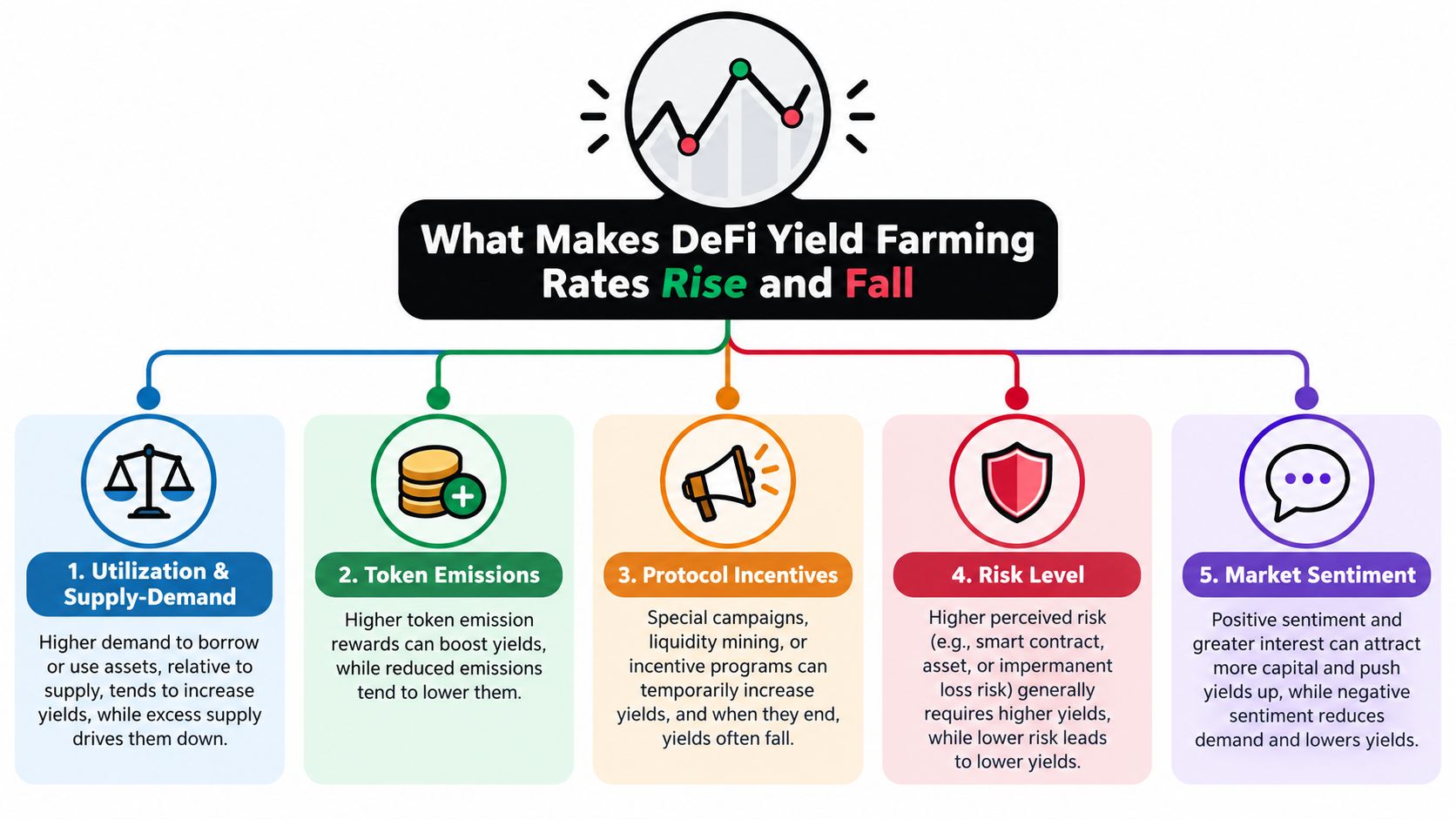
What Makes DeFi Yield Farming Rates Rise and Fall
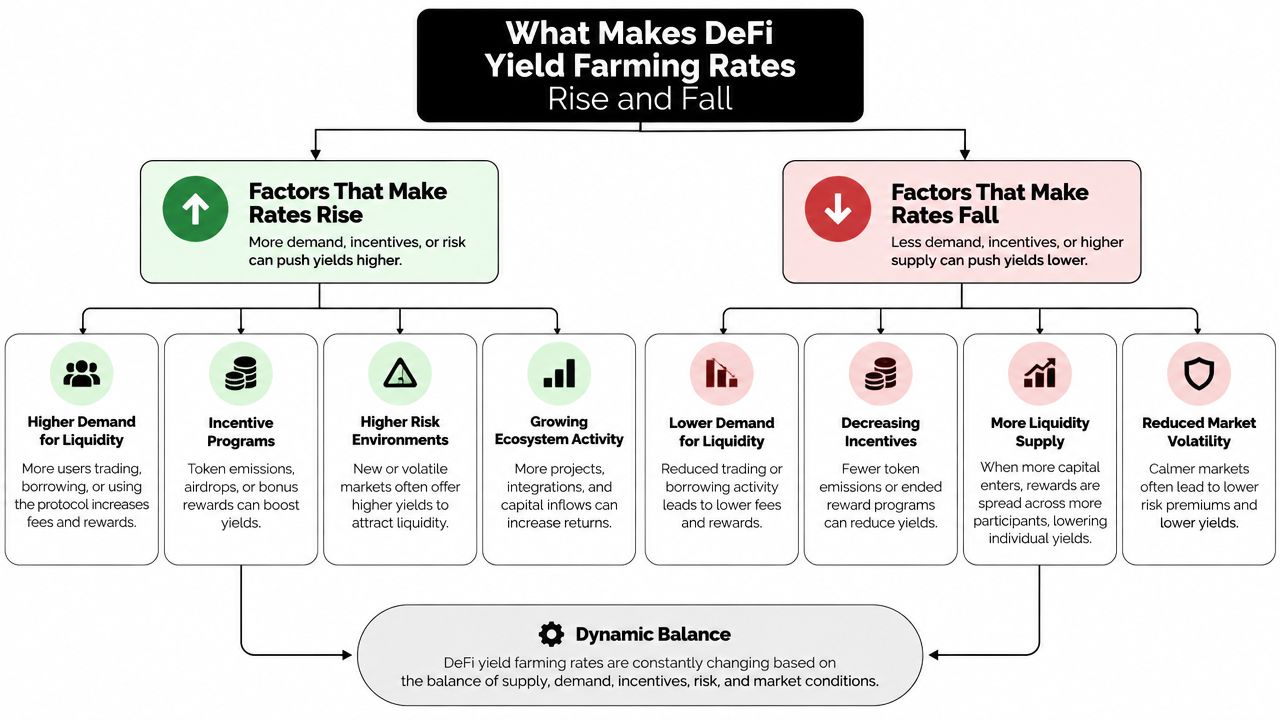
DeFi rates behave like prices in a busy marketplace. They change when users borrow, trade, supply liquidity, claim incentives, or move capital elsewhere. The displayed APY is therefore a snapshot of current conditions, not a permanent property of the protocol.
Utilization and supply-demand pressure
Lending markets respond directly to utilization. When many users want to borrow a stablecoin and available supply is limited, borrowing rates generally rise. Suppliers may then receive more income. If additional deposits arrive while borrowing demand remains quiet, the protocol has more idle liquidity and the supplier rate can compress.
The same logic appears in liquidity pools. Trading activity creates fee income, but capital entering the pool shares that income with more providers. A pool can therefore remain active while the return per dollar declines.
Token emissions create fast but fragile rates
The first major yield-farming wave showed how powerful incentives could be. On June 15, 2020, Compound began rewarding lenders and borrowers with COMP, a model that spread across protocols and helped push DeFi from roughly $1 billion to $15 billion in total value locked, as documented in the history of DeFi Summer. Many advertised APYs above 100% were largely driven by newly minted tokens rather than underlying cash flow.
That period established the playbook of liquidity mining, token incentives, and rapid capital rotation. It also exposed the weakness of emission-led returns. When more capital chased the same rewards, emissions were diluted across a larger base and rates could collapse quickly.
Fees depend on actual activity
A liquidity provider earns sustainable fee income only when users trade through the pool. High advertised rewards can attract deposits, but they don't automatically create volume. If trading activity falls, fee income can weaken even if the interface continues to display an incentive component.
This distinction helps explain why a lower fee-only rate may be more durable than a higher promotional rate. The former is tied to observed economic activity. The latter may depend on a governance decision, a token distribution, or a campaign that can change.
Macro rates influence onchain borrowing
DeFi doesn't operate in isolation from traditional markets. Independent analysis cited by Yellow's research on DeFi yield strategies found that a quarter-percentage-point increase in the U.S. 10-year yield has been associated with about a one-percentage-point increase in stablecoin borrowing rates.
The implication is practical. When broader fixed-income conditions change, stablecoin lending rates may reprice even when no protocol changes its code. A farmer who watches only token incentives can miss an important source of rate movement.
Incentives and sentiment redirect capital
Protocols use incentives to attract liquidity to new markets, deepen selected pools, or encourage activity. Users respond by moving funds toward the most visible opportunities. That capital rotation can raise a pool's displayed rate briefly, followed by compression when competing deposits arrive.
Market sentiment adds another layer. During periods of enthusiasm, users may accept complex strategies and volatile rewards. During cautious periods, they may prefer liquid stablecoin lending, reducing demand for riskier pools. The rate is the visible result of all these choices interacting at once.
How to Compare DeFi Yield Farming Rates Like a Pro
A professional comparison starts with the amount you expect to keep, not the amount a dashboard advertises. Net realized yield is what remains after the strategy pays protocol fees, transaction costs, and any losses caused by the position itself.
Two pools can display the same APY and still produce different outcomes. One may require frequent rebalancing across an expensive network. Another may hold a stablecoin position with fewer moving parts. A DEX position may collect substantial fees but lose value through impermanent loss when its assets diverge.
The deductions behind the headline
First, identify protocol fees. Some vaults deduct performance or management fees before showing the rate, while others present gross returns. Read the fee documentation rather than assuming the interface uses the same convention as another platform.
Next, estimate transaction costs. Depositing, claiming, rebalancing, and withdrawing can reduce the result, especially for a smaller account or a strategy that needs frequent movement. A rate that looks attractive before costs may become less compelling after routine transactions.
Then assess the position structure. Stablecoin lending generally avoids the classic two-asset impermanent-loss mechanism. DEX liquidity provision doesn't. If one asset moves materially against the other, the pool rebalances your holdings, and your final position can underperform holding the assets outside the pool.
A higher gross rate isn't better if the strategy carries a deduction that the lower-rate strategy doesn't.
Side-by-side comparison
Yield Factor | Stablecoin Lending | DEX Liquidity Provision |
|---|---|---|
Primary income | Borrower interest | Trading fees, sometimes incentives |
Main rate driver | Borrowing demand and market utilization | Trading volume, pool liquidity, and rewards |
Impermanent loss | Usually not the central mechanism | Can materially affect realized results |
Operational burden | Often simpler to monitor | May require closer attention to pair behavior and incentives |
Key questions | Is the market liquid, and how does the rate adjust? | Are fees sufficient to offset price divergence and reward decay? |
Security deserves equal weight. Smart contract vulnerabilities, governance changes, liquidity constraints, and stablecoin-specific risks can overwhelm months of income. A pool with a polished interface still requires a review of the underlying protocol, upgrade permissions, liquidity, and withdrawal mechanics.
For a structured way to think about return in relation to exposure, use this risk-adjusted APY framework. The goal isn't to eliminate uncertainty. It's to make the uncertainty visible before you allocate.
Realistic DeFi Yield Farming Rates by Strategy Today
The current market has separated into two broad groups. One contains lower, more defensible returns supported mainly by lending demand or trading fees. The other contains higher advertised rates that rely more heavily on incentives, points, novel designs, or volatile liquidity positions.
Galaxy reported that fee-only stablecoin pool yields on major venues typically sat in the 0.5% to 2% APY range, while adding CRV and CVX incentives produced a conservative 2% to 6% band in its research on onchain yield. Galaxy also noted that mainnet stablecoin APRs moved from below 2% in late 2022 to brief 15% spikes during Q1 2024 funding-rate frenzies, before the 7-day moving average settled around 5% to 6%.
Those figures don't describe one universal market rate. They show how widely conditions can vary by venue, asset, incentive structure, and measurement period. DeFiLlama's dashboard tracked 14,842 pools across 488 protocols on 110 chains, according to the same Galaxy discussion, which helps explain why two screens can show such different opportunities.
A practical tiered view
Conservative stablecoin lending is usually the baseline for a risk-aware holder. Independent coverage describes this tier around 4% to 8% APY, while another report says average stablecoin supply yield is around 3% and Aave's 30-day average USDC/USDT yield is around 2%. These figures come from Yellow's 2026 strategy analysis and MEXC's discussion of stablecoin yield behavior, and they demonstrate why current rates should be checked rather than assumed.
DEX liquidity provision can range from roughly 5% to 30% APY, according to the Yellow analysis. The wider range reflects the combined effect of trading fees, incentive emissions, asset volatility, and impermanent loss. A high number may be reasonable for a particular pool at a particular moment, but it shouldn't be treated as a stable baseline.
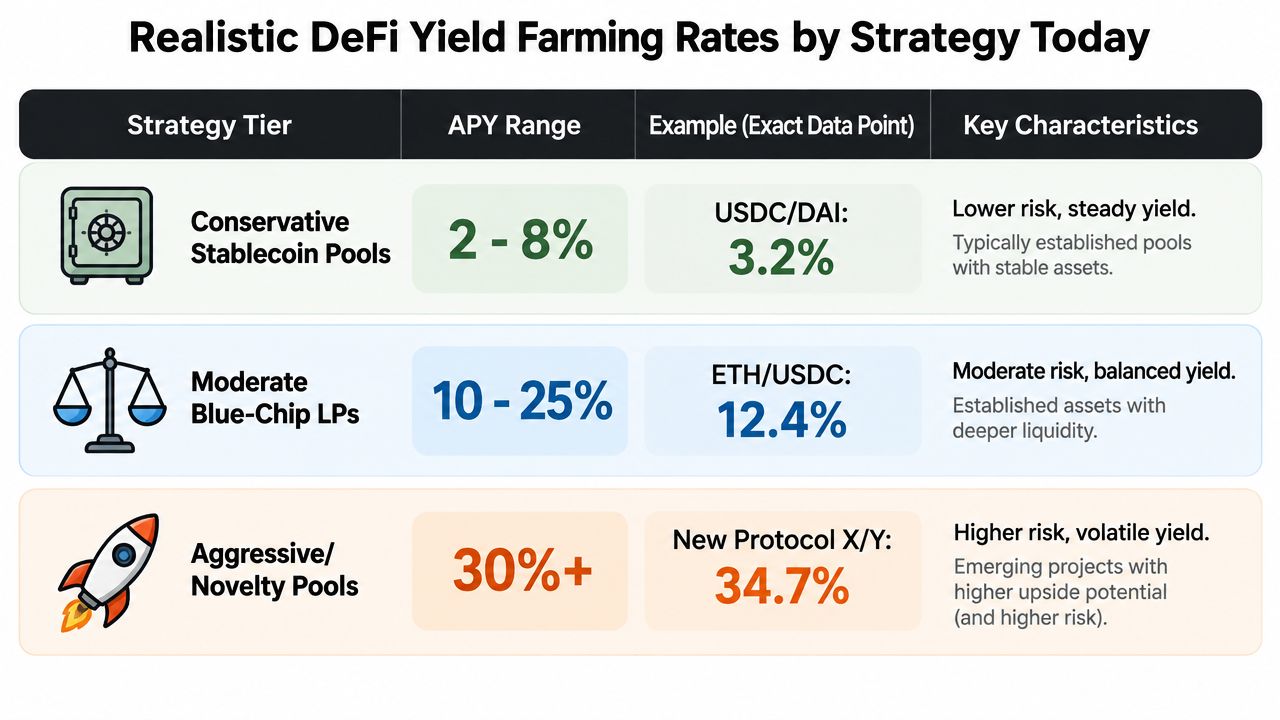
Independent 2026 coverage also says aggressive points farms and LP strategies can show 30%+ APY, while about 58% of Ethereum and L2 stablecoin liquidity pool TVL had yields below 3%, as reported in this DeFi yield-farming guide. The contrast is the central lesson: a small set of eye-catching farms can coexist with a much larger base of lower-yielding liquidity.
Ask, “What rate is realistic for my risk level?” That question is more useful than searching for the best APY in isolation.
Best Practices for Using Rates in Automated Yield Strategies
Automation helps only when the rules measure the right thing. If an agent blindly chases the highest displayed APY, it may rotate into a pool just as incentives begin to decay. A better system evaluates the source of yield, the costs of moving, the protocol exposure, and whether the rate has persisted long enough to deserve attention.
Build a persistence-first routine
Use a simple review sequence:
Separate organic yield from incentives. Record the portion attributed to lending interest or trading fees, then treat token rewards as a variable supplement.
Check the rate's direction. A declining APY can signal new deposits, weaker utilization, lower volume, or fading emissions.
Set a reallocation rule. Move only when the expected improvement is large enough to justify transaction costs, risk changes, and operational complexity.
Review exit conditions. Confirm that withdrawals remain available, liquidity is adequate, and the strategy doesn't introduce an unwanted lockup.
Diversify thoughtfully. Spreading capital across unrelated protocols can reduce concentration, but it also adds contracts and monitoring requirements.
A time-constrained stablecoin holder doesn't need to refresh every dashboard manually. Yield Seeker offers an AI-powered stablecoin yield agent that monitors DeFi protocols and allocates capital on Base, with deposits starting at $10 USDC, no lockups, and funds remaining accessible, as described in the publisher information.
Watch for decay signals
The clearest warning is a rate that depends almost entirely on newly issued rewards. Other signals include falling utilization, reduced trading activity, worsening liquidity, or a sudden change in withdrawal terms. Automation should surface those changes and apply preselected constraints, not remove the user's ability to understand where funds are deployed.
The right objective is steady decision quality. A strategy that accepts a lower rate with clearer income sources may outperform a high-rate farm once fees, slippage, impermanent loss, and incentive decay enter the calculation.
Making Smarter Decisions With DeFi Yield Farming Rates
DeFi yield farming rates become easier to evaluate when you use a fixed order of questions. Identify the income source first. Separate APR from APY, then estimate net yield after fees and transaction costs. Finally, match the strategy's smart contract, liquidity, stablecoin, and market risks to your own time horizon.
For many risk-aware stablecoin strategies, sustainable returns now cluster in lower, single-digit bands rather than the promotional levels associated with early DeFi. Higher rates can still appear, but they usually demand a clearer explanation of incentives, price exposure, or strategy complexity.
Your next allocation doesn't need to be the most exciting one. Choose the opportunity whose income source you understand, whose costs you can estimate, and whose rate you can monitor without losing control.
Yield Seeker helps stablecoin holders monitor and automate DeFi allocations on Base while keeping funds accessible and reducing the need to hunt across fragmented dashboards. Visit Yield Seeker to review how its AI agent can help you pursue risk-aware yield with a clearer view of rate changes and strategy choices.